

Ms4a4a deficiency ameliorates plaque pathology in a mouse model of amyloid accumulation
Open accessThe DOI matches its Crossref record; 81 of the 81 references it cites were found in a registry or an index; none of the 101 sources its claims cite is checked for support yet.
Abstract
INTRODUCTION: Genome‐wide association studies have identified MS4A4A , a microglia‐enriched gene, as a modulator of Alzheimer's disease (AD) risk. Common variants in MS4A4A affect AD susceptibility, gene expression, triggering receptor expressed on myeloid cells 2 (TREM2) signaling, and microglial transcriptional states, but the gene's functional role remains unclear. METHODS: Using a novel model, we investigated the impact of Ms4a4a loss in the 5xFAD mouse model of amyloid beta (Aβ) accumulation. RESULTS: Ms4a4a deficiency reduced steady‐state Aβ levels and shortened its half‐life in brain interstitial fluid. Aged 5xFAD mice lacking Ms4a4a exhibited more compact plaques and lower overall plaque burden. Microglia deficient in Ms4a4a showed a pro‐inflammatory profile and elevated matrix metalloproteinase 9 (MMP‐9) production, which may facilitate Aβ degradation. Notably, human carriers of the AD‐resilient variant rs1582763 near MS4A4A also displayed increased cerebrospinal fluid MMP‐9 levels. DISCUSSION: Together, we show that Ms4a4a loss enhances Aβ clearance and reduces pathology, suggesting a protective mechanism that may inform microglia‐targeted AD therapies. Highlights: We examined the impact of Ms4a4a loss on amyloid beta (Aβ) pathology using a mouse model of Aβ accumulation (5xFAD). Ms4a4a loss reduces overall plaque burden and increases plaque compaction. Microglia lacking Ms4a4a are more pro‐inflammatory and produce more matrix metalloproteinase 9 (MMP‐9). Alzheimer's disease (AD) resilience variant carriers, MS4A4A rs1582763, exhibit significantly elevated levels of cerebrospinal fluid MMP‐9. Our findings suggest that reduction of MS4A4A may be a therapeutic approach for AD.
Overview
CoChat Summary
TL;DR
In 5xFAD mice, global Ms4a4a knockout reduced interstitial fluid Aβ levels and half-life, lowered plaque burden, and increased plaque compaction. The protective phenotype was linked to pro-inflammatory microglia and elevated MMP-9, with human AD-resilience variant rs1582763 carriers showing higher CSF MMP-9.
Key findings
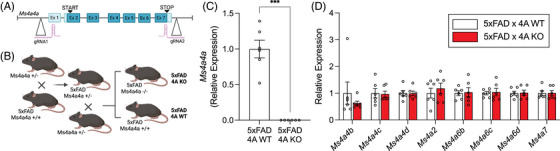
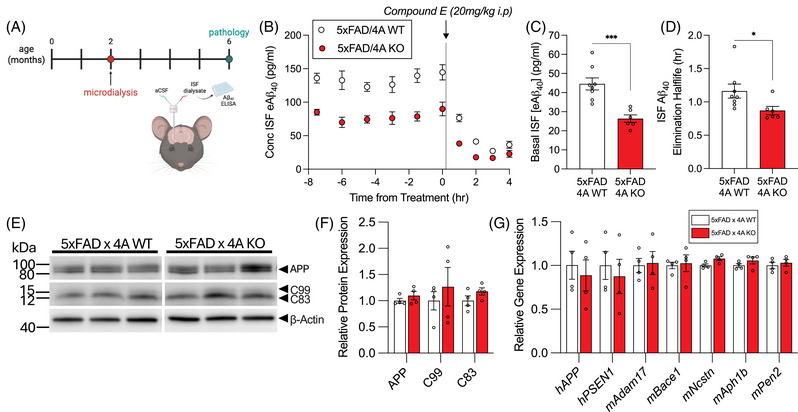
- Ms4a4a loss reduced steady-state ISF Aβ (P = 4 × 10⁻⁴) and shortened ISF Aβ half-life (0.87 hours vs 1.16 hours; P = 0.03) at 8 weeks, before plaque accumulation; APP processing was unchanged at 6 weeks.
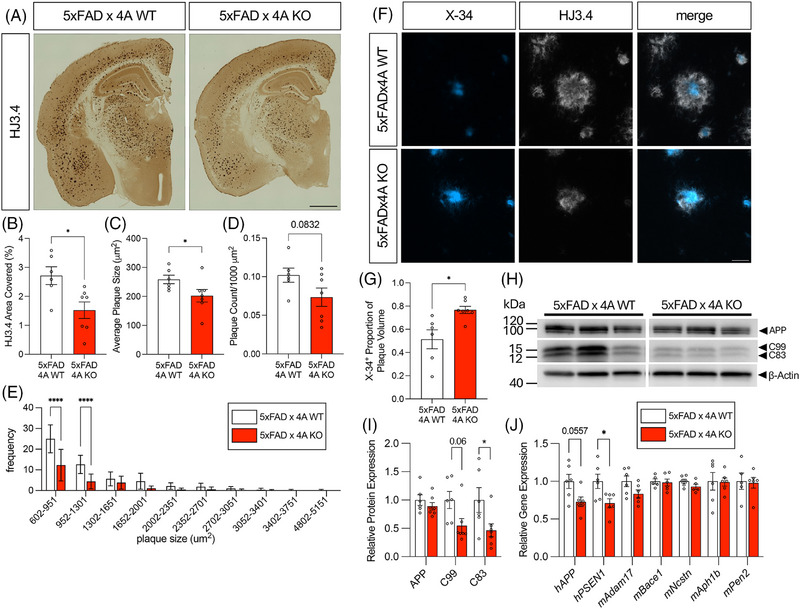
- At 6 months, 5xFAD 4A-KO mice had reduced plaque burden in hippocampus and cortex (P = 0.01), reduced average hippocampal plaque size (P = 0.05), similar plaque number (P = 0.08), fewer small plaques (hippocampus 602–1301 µm²; cortex 600–1649 µm²), and greater hippocampal plaque compaction (X-34 proportion P = 0.02; cortex P = 0.12).
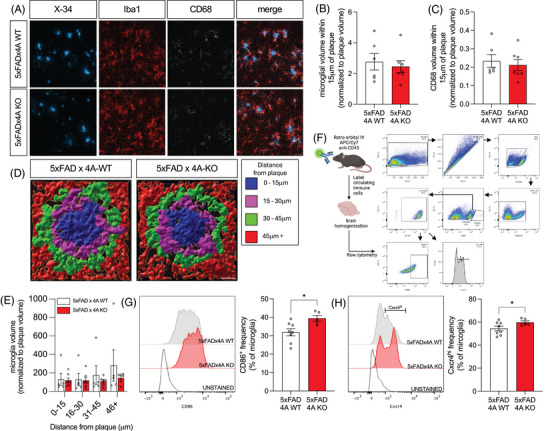
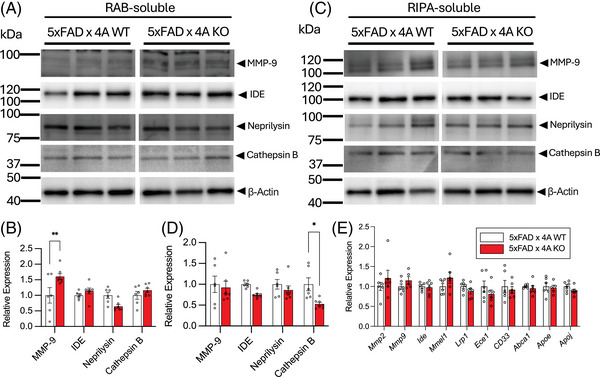
- Microglia lacking Ms4a4a showed increased CD86 (P = 0.0108) and Cxcr4hi (P = 0.049) without altered recruitment to plaques or overall gliosis; RAB-soluble MMP-9 was increased (P = 2.7 × 10⁻³; also at 6 weeks P = 0.015), and RIPA-soluble cathepsin B was decreased (P = 0.02).
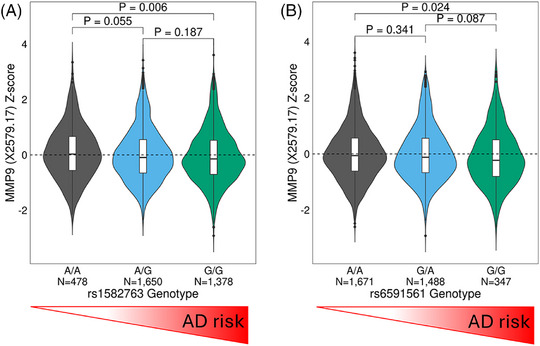
- In 3506 human CSF samples, rs1582763 A (protective) carriers had significantly higher CSF MMP-9, while rs6591561 G (risk) carriers had significantly lower CSF MMP-9.
Methods
- Constitutive CRISPR/Cas9 Ms4a4a−/− mice were crossed with 5xFAD mice to compare 5xFAD Ms4a4a+/+ and 5xFAD Ms4a4a−/− littermates. In vivo microdialysis was performed at 8 weeks; brain tissue was analyzed at 6 months by qPCR, immunoblot, DAB/immunofluorescence, confocal imaging, and flow cytometry.
- Human CSF analysis used 3506 samples from eight cohorts measured with SOMAscan7k or SOMAscan5k, restricted to individuals of European ancestry. MMP-9 z scores were residualized for age, sex, 10 genetic principal components, and cohort/array, then tested by genotype at rs1582763 and rs6591561 using two-sided Wilcoxon tests.
- Mouse comparisons used Welch’s t tests, two-way ANOVA, and one-way ANOVA as appropriate.
Limitations
- Stated: additional studies are required to understand the impact of Ms4a4a loss on MMP-9 activity; further research is necessary to understand mechanisms by which Ms4a4a impacts additional domains of AD pathophysiology; the impact of MS4A4A variants on MS4A4A expression remains unresolved.
- Evident from the text: aged plaque and flow cytometry analyses used 6-month-old female mice only; microdialysis cohorts were small and mixed-sex; the constitutive global knockout cannot distinguish microglial from peripheral Ms4a4a effects; the human CSF finding is an association in European-ancestry samples, not a causal demonstration.
Model-written summary. Check it against the paper before relying on it.
Integrity signals
Registry
Cites
Statistics
Figures
Verification
Claims the paper makes
0 Valid · 1 Not valid · 51 Not checked · 98 Own results and interpretations
In the paper
“We found that minor allele (A; protective) carriers had significantly higher levels of CSF MMP‐9 than major allele (G) carriers (Figure 6A).”
§ Ms4a4a deficiency ameliorates plaque pathology in a mouse model of amyloid accumulation > RESULTS > AD resilience allele in MS4A4A is associated with increased CSF MMP‐9 levels
What the sources say
- Not checked yetcites [31] Western D, Timsina J, Wang L, et al. Proteogenomic analysis of human cerebrospinal fluid identifies neurologically relevant regulation and implicates causal proteins for Alzheimer's disease. Nat Genet. 2024; 56(12): 2672‐ 2684. 39528825 PMC11831731 source
plainstates an associationn = 3,506- Asserted: passes — The authors put it forward as true.
- Checkable: passes — It can be checked against evidence.
- Load-bearing: passes — The paper’s conclusions depend on it.
- Based: passes — The paper gives a reason why it holds.
A result the paper reports from its own data — it cites no other source for it, so there is none to check. The quote shows it is in the paper.
In the paper
“Microgliosis, measured as the percent area of Iba1 staining in the hippocampus and cortex, was similar in 5xFAD 4A‐WT and 5xFAD 4A‐KO mice (Figure S6A–E in supporting information).”
§ Ms4a4a deficiency ameliorates plaque pathology in a mouse model of amyloid accumulation > RESULTS > Ms4a4a loss does not alter microglial recruitment in 5xFAD mice
plain- Asserted: passes — The authors put it forward as true.
- Checkable: passes — It can be checked against evidence.
- Load-bearing: passes — The paper’s conclusions depend on it.
- Based: passes — The paper gives a reason why it holds.
A result the paper states — it cites no source for it, so there is none to check. The quote shows it is in the paper.
In the paper
“Notably, human carriers of the AD‐resilient variant rs1582763 near MS4A4A also displayed increased cerebrospinal fluid MMP‐9 levels.”
§ Ms4a4a deficiency ameliorates plaque pathology in a mouse model of amyloid accumulation > Abstract > RESULTS
plainstates an association- Asserted: passes — The authors put it forward as true.
- Checkable: passes — It can be checked against evidence.
- Load-bearing: unclear — It is unclear whether the paper’s conclusions depend on it.
- Based: passes — The paper gives a reason why it holds.
A result the paper reports from its own data — it cites no other source for it, so there is none to check. The quote shows it is in the paper.
In the paper
“Minor allele carriers (G; risk) of the AD risk variant in MS4A4A exhibit significantly lower levels of CSF MMP‐9 (Figure 6B).”
§ Ms4a4a deficiency ameliorates plaque pathology in a mouse model of amyloid accumulation > RESULTS > AD resilience allele in MS4A4A is associated with increased CSF MMP‐9 levels
plainstates an associationn = 3,506- Asserted: passes — The authors put it forward as true.
- Checkable: passes — It can be checked against evidence.
- Load-bearing: passes — The paper’s conclusions depend on it.
- Based: passes — The paper gives a reason why it holds.
A result the paper reports from its own data — it cites no other source for it, so there is none to check. The quote shows it is in the paper.
In the paper
“However, other γ‐secretase components, mNcstn, mAph1b, and mPen2, were unchanged in the absence of Ms4a4a (Figure 3J).”
§ Ms4a4a deficiency ameliorates plaque pathology in a mouse model of amyloid accumulation > RESULTS > Ms4a4a loss reduces plaque burden in 5xFAD mice
plain- Asserted: passes — The authors put it forward as true.
- Checkable: passes — It can be checked against evidence.
- Load-bearing: unclear — It is unclear whether the paper’s conclusions depend on it.
- Based: passes — The paper gives a reason why it holds.
87 more claims
Create a free account to see all 150 claims and to verify the 101 references still open.
- It may state two separate claims as one. 32
- The quote only partly states this claim. 1
- Probably not a substantial claim. 35
Self-check
Percentages, sums and reported differences re-computed from the paper’s own numbers.
Each contradiction between two passages listed here was confirmed by an independent check.
Rated major: it would touch a result — a value a result rests on, reported and recomputed p-values on opposite sides of the significance level, two passages that conflict with no sign which is right, or a cited work retracted before this paper was published.
In the paper
§ Ms4a4a deficiency ameliorates plaque pathology in a mouse model of amyloid accumulation > RESULTS > Ms4a4a loss does not alter microglial recruitment in 5xFAD mice
“CD68‐positive microglia, representing activated microglia, within 15 µm of a X‐34‐positive plaque were also similar between 5xFAD 4A‐WT and 5xFAD 4A‐KO mice (P = 0.64; Figure 4C, hippocampus; Figure S5C, cortex).”
§ Ms4a4a deficiency ameliorates plaque pathology in a mouse model of amyloid accumulation > RESULTS > Ms4a4a loss does not alter microglial recruitment in 5xFAD mice
“C, Quantification of CD68 volume within 15 µm of plaques in 5xFAD 4A‐WT and 5xFAD 4A‐KO mice. Welch's t test; P = 0.12.”
Rated major: it would touch a result — a value a result rests on, reported and recomputed p-values on opposite sides of the significance level, two passages that conflict with no sign which is right, or a cited work retracted before this paper was published.
In the paper
§ Ms4a4a deficiency ameliorates plaque pathology in a mouse model of amyloid accumulation > RESULTS > Ms4a4a loss does not alter microglial recruitment in 5xFAD mice
“Iba1‐positive microglial recruitment within 15 µm of a X‐34‐positive plaque was similar between 5xFAD 4A‐WT and 5xFAD 4A‐KO mice (P = 0.65; Figure 4B, hippocampus; Figure S5B, cortex).”
§ Ms4a4a deficiency ameliorates plaque pathology in a mouse model of amyloid accumulation > RESULTS > Ms4a4a loss does not alter microglial recruitment in 5xFAD mice
“B, Quantification of Iba1‐positive microglial volume within 15 µm of plaques in 5xFAD 4A‐WT and 5xFAD 4A‐KO mice in the hippocampus. Welch's t test; P = 0.30.”
Rated minor: it would not touch a result — a value no result rests on, a p-value that stays on the same side of the significance level, or a conflict that is clerical, resolved elsewhere in the paper, or outside its own findings.
In the paper
§ Ms4a4a deficiency ameliorates plaque pathology in a mouse model of amyloid accumulation > METHODS > CSF marker association with rs1582763 and rs6591591
“### CSF marker association with rs1582763 and rs6591591”
§ Ms4a4a deficiency ameliorates plaque pathology in a mouse model of amyloid accumulation > METHODS > CSF marker association with rs1582763 and rs6591591
“Genotypes for each individual at rs1582763 and rs6591561 (GRCh38 coordinates chr11:60254475:G:A and chr11:60302703:A:G) were extracted from the full matrix along with z score–normalized measurements of MMP‐9 (SOMAscan aptamer ID X2579.17).”
Rated minor: it would not touch a result — a value no result rests on, a p-value that stays on the same side of the significance level, or a conflict that is clerical, resolved elsewhere in the paper, or outside its own findings.
In the paper
§ Ms4a4a deficiency ameliorates plaque pathology in a mouse model of amyloid accumulation > RESULTS > Ms4a4a loss reduces plaque burden in 5xFAD mice
“Plaque burden, as defined by the area of HJ3.4 coverage, was significantly reduced in the hippocampus and cortex of 5xFAD 4A‐KO mice compared to 5xFAD 4A‐WT controls (Figure 3B; P = 0.01; Figure S1 in supporting information).”
§ Ms4a4a deficiency ameliorates plaque pathology in a mouse model of amyloid accumulation > RESULTS > Ms4a4a loss reduces plaque burden in 5xFAD mice
“B, Quantification of HJ3.4 percent area within the hippocampus. Welch's t test, *, P = 0.02.”
Rated minor: it would not touch a result — a value no result rests on, a p-value that stays on the same side of the significance level, or a conflict that is clerical, resolved elsewhere in the paper, or outside its own findings.
In the paper
§ Ms4a4a deficiency ameliorates plaque pathology in a mouse model of amyloid accumulation > METHODS > 3,3′‐Diaminobenzidine staining for amyloid plaque quantification
“Plaque count was expressed as the number of plaques per mm2 averaged across two slices for each animal.”
§ Ms4a4a deficiency ameliorates plaque pathology in a mouse model of amyloid accumulation > RESULTS > Ms4a4a loss reduces plaque burden in 5xFAD mice
“D, Quantification of average number of plaques/1000µm2 within the hippocampus.”
Citations
Cites
Alzheimer's disease: the amyloid cascade hypothesis
Hardy, J. A., & Higgins, G. A. (1992) · Science · doi:10.1126/science.1566067 · Cited by 7,484
Zhang, Y., Chen, K., Sloan, S. A., Bennett, M. L., Scholze, A. R., O'Keeffe, S., Phatnani, H. P., Guarnieri, P., Caneda, C., Ruderisch, N., et al. (2014) · The Journal of Neuroscience · doi:10.1523/jneurosci.1860-14.2014 · Cited by 4,875
Meta-Analysis of 74,046 Individuals Identifies 11 New Susceptibility Loci for Alzheimer’s Disease
(EADI), E. A. D. I., Lambert, J.-C., (GERAD), G. A. E. R. I. A. D., Alzheimer's Disease Genetic Consortium (ADGC), (CHARGE), C. F. H. A. A. R. I. G. E., Ibrahim-Verbaas, C. A., Harold, D., Naj, A. C., Sims, R., Bellenguez, C., et al. (2013) · Nature Genetics · doi:10.1038/ng.2802 · Cited by 4,336
Self-citationWalsh, D. M., Klyubin, I., Fadeeva, J. V., Cullen, W. K., Anwyl, R., Wolfe, M. S., Rowan, M. J., & Selkoe, D. J. (2002) · Nature · doi:10.1038/416535a · Cited by 4,291
Oakley, H., Cole, S. L., Logan, S., Maus, E., Shao, P., Craft, J., Guillozet-Bongaarts, A., Ohno, M., Disterhoft, J., Van Eldik, L., et al. (2006) · The Journal of Neuroscience · doi:10.1523/jneurosci.1202-06.2006 · Cited by 3,530
TREM2 Variants in Alzheimer's Disease
Guerreiro, R., Wojtas, A., Bras, J., Carrasquillo, M., Rogaeva, E., Majounie, E., Cruchaga, C., Sassi, C., Kauwe, J. S. K., Younkin, S., et al. (2013) · New England Journal of Medicine · doi:10.1056/nejmoa1211851 · Cited by 3,020
Self-citationVariant of TREM2 Associated with the Risk of Alzheimer's Disease
Jonsson, T., Stefansson, H., Steinberg, S., Jonsdottir, I., Jonsson, P. V., Snaedal, J., Bjornsson, S., Huttenlocher, J., Levey, A. I., Lah, J. J., et al. (2013) · New England Journal of Medicine · doi:10.1056/nejmoa1211103 · Cited by 2,558
Decreased Clearance of CNS β-Amyloid in Alzheimer’s Disease
Mawuenyega, K. G., Sigurdson, W., Ovod, V., Munsell, L., Kasten, T., Morris, J. C., Yarasheski, K. E., & Bateman, R. J. (2010) · Science · doi:10.1126/science.1197623 · Cited by 2,078
Microglia in Alzheimer’s disease
Hansen, D. V., Hanson, J. E., & Sheng, M. (2018) · Journal of Cell Biology · doi:10.1083/jcb.201709069 · Cited by 1,935
Naj, A. C., Jun, G., Beecham, G. W., Wang, L.-S., Vardarajan, B. N., Buros, J., Gallins, P. J., Buxbaum, J. D., Jarvik, G. P., Crane, P. K., et al. (2011) · Nature Genetics · doi:10.1038/ng.801 · Cited by 1,901
Self-citation
Research works printed but not linked: 1
- Brase L, You SF, D'Oliveira Albanus R, et al. Single‐nucleus RNA‐sequencing of autosomal dominant Alzheimer disease and risk variant carriers. Nat Commun. 2023; 14: 2314. 37085492 PMC10121712 · DOI · Paper page
Cited by
Candia, Y. A., Aladyeva, E., Boyden, W., Bollman, B., Rogerson‐Wood, L., Davies, D., Affleck, A. J., Buckland, M. E., Harari, O., Piccio, L. M., et al. (2026) · Acta Neuropathologica Communications · doi:10.1186/s40478-026-02241-x · Cited by 5
“MS4A4A has been implicated in lipid metabolism and immune activation in microglia in Alzheimer’s disease brains and in preclinical models [23, 24], but its expression has not been characterised in MS lesions.”
Ma, H., Hugues, N., Voice, K., Peter, J., Таранов, А., Thapa, C., Roskin, K. M., & Luo, Y. (2026) · Genome Medicine · doi:10.1186/s13073-026-01687-x · Cited by 4
“In addition, we also found that a specific cluster (cluster Mg7) showed enriched genes of phagocytosis ( Cd93 , Ms4a4a , Anxa1 ) [55–58] and lipid transport ( Apoe , Apoc2 , Ldlrad3 , Psap , Pltp ) [59] (Fig.”
MS4A4A and MS4A6A: New targets to enhance microglia protective function in Alzheimer’s disease
Hansen, D. V., Karch, C. M. M., Mainali, D., & Piccio, L. M. (2026) · Neuron · doi:10.1016/j.neuron.2026.02.005 · Cited by 2
Self-citationJiang, S., Qi, P., Tian, J., liu, H., & Sun, C. (2026) · Frontiers in Neurology · doi:10.3389/fneur.2025.1732729 · Cited by 2
Shi, C. H., Zhu, B., Piña-Crespo, J., Chen, W. N., Vo, G. V., Huang, H., Yip, K. Y., & Huang, T. Y. (2026) · bioRxiv (Cold Spring Harbor Laboratory) · doi:10.64898/2026.10.15.759523 · Cited by 1
Metadata
- Authors
- Danhash, E. P., Verbeck, A. C., Western, D., Díaz‐Pacheco, A. S., Galasso, G., You, S., Huang, G., Starr, E., Miller, N., Nadarajah, C. J., Tiemann Powles, S., Musiek, E. S., Herz, J., Iyer, A. K., Cirrito, J., Cruchaga, C., & Karch, C. M.
- Affiliations
- Washington University in St. Louis (US)
- Department of Psychiatry Washington University in St. Louis School of Medicine St. Louis Missouri USA
- Corresponding author
- Karch, Celeste M.
- ORCID
- Venue
- Alzheimer's & Dementia
- Publisher
- Wiley
- Published
- 2025-08
- Volume
- 21
- Issue
- 8
- Pages
- e70580-e70580
- ISSN
- 1552-5260 (ISSN-L)
- 1552-5279
- PMC
- PMC12371455
- OpenAlex
- W4413431207
- Cited by
- 8
- References
- 78
- Citations by year
- 2026: 8
- FWCI
- 1.92
- Type
- journal article
- Language
- en
- Open access
- hybrid
- doi.org
- Licence
- Locations
- Alzheimer s & Dementia (publishedVersion, cc-by-nc)
- bioRxiv (Cold Spring Harbor Laboratory) (submittedVersion, cc-by-nc-nd)
- Europe PMC (PubMed Central) (publishedVersion, cc-by-nc)
- PubMed Central (publishedVersion, cc-by-nc)
- PubMed (publishedVersion)
- Funders
- National Institutes of Health (AG062734, AG058501)
- Chan Zuckerberg Initiative
- Edward N. and Della L. Thome Memorial Foundation
- National Institute on Aging (P30AG066444)
- Topics
- Life Sciences › Neuroscience › Cellular and Molecular Neuroscience › Alzheimer's disease research and treatments
- Life Sciences › Neuroscience › Neurology › Neuroinflammation and Neurodegeneration Mechanisms
- Health Sciences › Medicine › Psychiatry and Mental health › Dementia and Cognitive Impairment Research
- Keywords
- MS4A4A, Alzheimer's disease
- MeSH terms
- Alzheimer Disease, Animals, Brain, Disease Models, Animal, Humans, Mice, Transgenic, Amyloid beta-Peptides, Microglia, Matrix Metalloproteinase 9, Mice, Plaque, Amyloid
About these checks
Registry, retraction, Cites and statistics results are computed, not judged, with one exception: a printed reference that no index lists is read once by a model before it counts as a citation error. Claims are extracted by a model and kept only when their quote appears verbatim in the text; each cited source is then checked, with a model’s help, for whether it says what the claim relies on. Those verdicts can be wrong — read the claim’s quote and the cited source before relying on one.
A language model drew the claims from the paper on 2026-11-26, under version 3 of the claim definition (model deepseek-v4.1-flash, prompt extract-v3).
A second model labelled each claim on 2026-11-26 (model jev-1.13-20260917, definition revision gold-guideline-v0.2).
Statistics and arithmetic are recomputed, not judged.
Confidence bands are shown only for fields calibrated on our annotated test set. None is calibrated yet, so no band is shown.
What counts as a claim ›How we measure confidence ›How we check this ›
Are you an author, or do you see a problem with this page? Request a review
How to cite
Cite CoChat for the checks on this page, and the paper for its own findings.
- This page
- CoChat. (2026). Citation check: Ms4a4a deficiency ameliorates plaque pathology in a mouse model of amyloid accumulation. https://app.cochat.ai/papers/10.1002/alz.70580
- The paper
- Danhash, E. P., Verbeck, A. C., Western, D., Díaz‐Pacheco, A. S., Galasso, G., You, S., Huang, G., Starr, E., Miller, N., Nadarajah, C. J., Tiemann Powles, S., Musiek, E. S., Herz, J., Iyer, A. K., Cirrito, J., Cruchaga, C., & Karch, C. M. (2025). Ms4a4a deficiency ameliorates plaque pathology in a mouse model of amyloid accumulation. Alzheimer's & Dementia. https://doi.org/10.1002/alz.70580
Data sources
Bibliographic data: Semantic Scholar, OpenAlex, Crossref.
Contains information from the Semantic Scholar Academic Graph Datasets, made available under the ODC Attribution License (ODC-BY 1.0).
Semantic Scholar’s data is described in: Kinney, R., et al. (2023). The Semantic Scholar Open Data Platform. arXiv:2301.10140.
