

Shared genes and pathways in dementia: Insights from genome‐wide association studies
Open accessThe DOI matches its Crossref record; 139 of the 139 references it cites were found in a registry or an index; 1 of the 170 sources its claims cite were checked for support.
Abstract
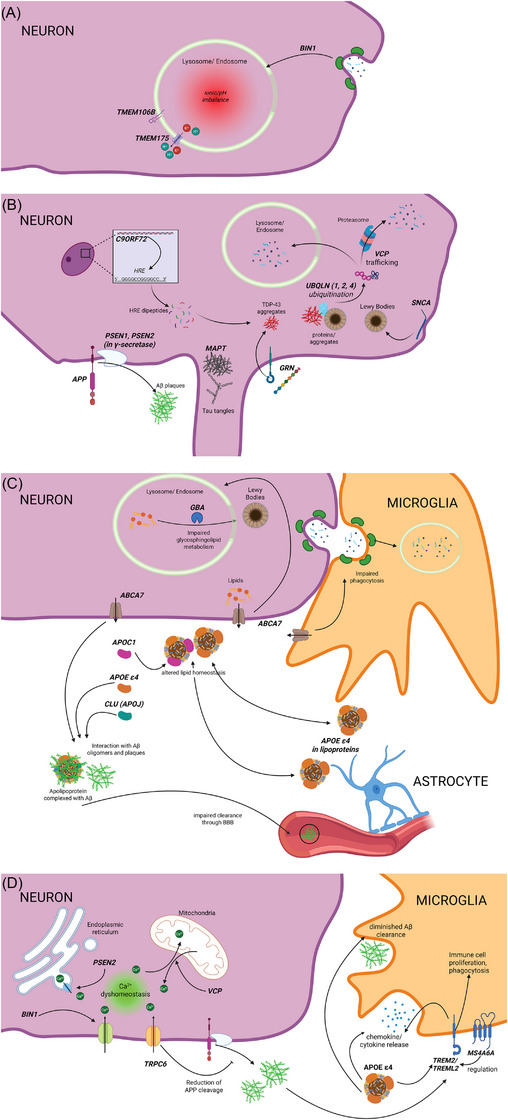
Dementia, a collective term for neurodegenerative disorders marked by cognitive decline, affects millions worldwide, and is expected to rise significantly in prevalence. Genome‐wide association studies (GWASs), as highlighted in this review, have revolutionized our understanding of dementia by identifying contributing genetic loci and pathways, including for Alzheimer's disease, vascular dementia, frontotemporal lobar dementia, and Lewy body dementia. This review critically analyzes published findings to shed insight on shared genes and pathways, encompassing lipid metabolism, immune responses, lysosomal mechanisms, and ionic homeostasis, which underlie neurodegeneration in dementia. We discuss methodological advances, challenges posed by genetic heterogeneity and population diversity, and the utility of polygenic risk scores in disease prediction. Furthermore, the importance of integrating tissue‐specific expression data and non‐European ancestral study cohorts is emphasized. Finally, this review outlines the next steps for advancing dementia research through GWASs and genetic insights. Highlights: Genome‐wide association studies (GWASs) provide insight into the complex genetic architecture underlying dementia. Synthesizing GWASs across dementia subtypes highlights shared mechanisms. Identifying shared pathways may guide therapeutic development. Limitations exist and future GWASs may benefit from use of diverse populations.
Overview
CoChat Summary
TL;DR
This review synthesizes genome-wide association study (GWAS) findings across Alzheimer’s disease, vascular dementia, frontotemporal lobar dementia, and Lewy body dementia, highlighting shared genes and pathways in lipid metabolism, immune response, lysosomal mechanisms, and ionic homeostasis. It also discusses methodological advances, population-diversity challenges, polygenic risk scores, and future directions for tissue- and cell-type-specific eQTL integration.
Key findings
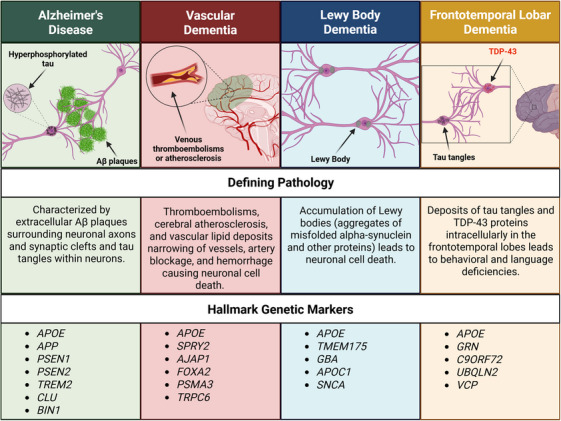
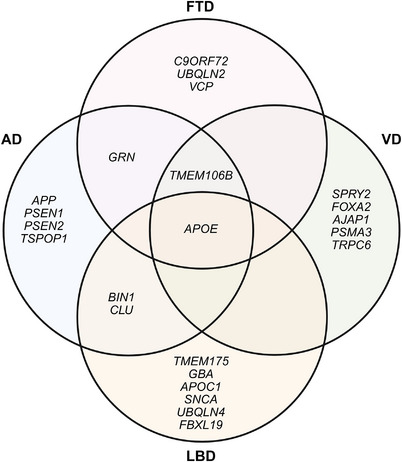
- Across reviewed GWASs, >80 significant genetic loci have been associated with AD and ADRD; APOE is a major contributor across AD, VaD, FTLD, and LBD, while other overlapping genes include TMEM106B (AD, VaD, FTLD), BIN1 and CLU (AD, LBD), and GRN (AD, FTLD).
- The largest AD GWAS to date, Wightman et al., analyzed 1,126,563 individuals and identified 42 loci associated with AD, 11 of them novel, including TMEM106B, GRN, and HAVCR2; Bellenguez et al. reported 75 significant loci in 487,511 total individuals.
- The largest VaD GWAS, MEGAVCID, included 753,695 participants and 8702 VaD cases but identified only APOE as significant, with suggestive associations at TRPC6, TMEM106B, SPRY2, FOXA2, AJAP1, and PSMA3.
- LBD and FTLD GWASs remain smaller: Guerreiro et al. studied 1216 LBD cases and 3791 controls and found five significant loci, while Guo et al. used 2591 LBD cases and 4027 controls and identified 13 significant loci; high AD polygenic risk scores combined with APOE ε4 were associated with up to a 5-fold higher risk of AD.
Methods
- Design: narrative/critical review of published GWAS findings across dementia subtypes, not an original primary GWAS or meta-analysis.
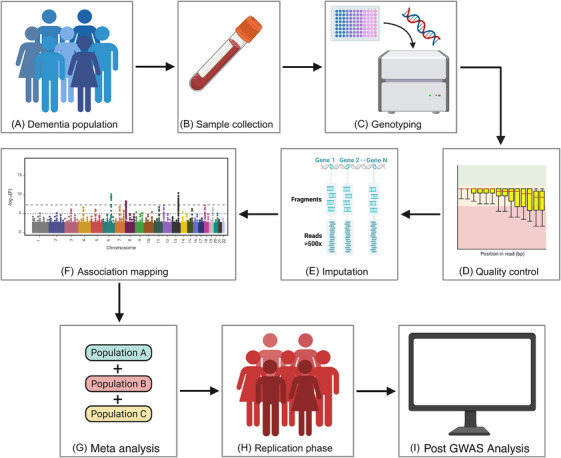
- Data/sample: reviewed the seven largest and most recent AD GWASs published since 2013 and all available GWASs on VaD, LBD, and FTLD; 18 GWASs were considered, and 17 were conducted on cohorts of largely European genetic ancestry.
- Analysis: synthesized shared and unique genes/pathways across subtypes, curated public eQTL databases for GWAS hits, and discussed GWAS principles, polygenic risk scores, and future methodological directions.
Limitations
- The paper states that polygenicity, genetic heterogeneity across dementia subtypes, high linkage disequilibrium, population diversity, diagnostic difficulty, comorbidities, and overlooked social/behavioral/environmental factors complicate GWAS interpretation and application.
- The paper notes that many cohorts are disproportionately European ancestry, that LBD/VaD/FTLD sample sizes remain modest, that some AD GWASs used proxy cases, and that specific studies faced limitations such as small sample size and the “winner’s curse.”
- Evident from the text: as a review, it does not report a systematic search strategy, selection criteria, or formal risk-of-bias assessment, so its conclusions depend on the selected published GWASs and narrative synthesis.
Model-written summary. Check it against the paper before relying on it.
Integrity signals
Registry
Cites
Statistics
Figures
Verification
Claims the paper makes
1 Valid · 0 Not valid · 108 Not checked · 27 Own results and interpretations
The cited sources support only part of this claim — read each source’s verdict below.
In the paper
“Additionally, they confirmed previous GWAS‐identified genes, including apolipoprotein E (APOE), BIN1, 29 , 30 , 31 CLU, 29 , 30 CR1, 30 and MS4A6A. 32 , 33”
§ Shared genes and pathways in dementia: Insights from genome‐wide association studies > GENETIC INSIGHTS FROM GWAS ON DEMENTIA > GWASs of AD
What the sources say
- Partly supportedcites [29] Harold D, Abraham R, Hollingworth P, et al. Genome‐wide association study identifies variants at CLU and PICALM associated with Alzheimer's disease. Nature Genetics. 2009; 41: 1088‐ 1093. 19734902 PMC2845877 sourceExperimental — accuracy not yet measured
Our copy supports only part of what the sentence attributes to this source. The Abstract states that stage 1 'replicated the established association with the APOE locus' (rs2075650, p=1.8×10^-157), so APOE confirmation is explicit. However, CLU is presented here as a NOVEL locus ('two novel loci: rs11136000 in the CLU or APOJ gene... rs3851179... 5′ to PICALM'), not as a previously GWAS-identified gene being confirmed. BIN1, CR1 and MS4A6A appear only in Table 2 as sub-genome-wide signals at P ≤ 1×10^-5, described as 'more variants associated... than expected by chance' and as loci among 'several genes associated with AD which remain to be identified' — suggestive evidence, not confirmation. The paper does mention testing 'over 100 variants highlighted by previous AD GWA studies', but those results are relegated to Supplementary Table 5, which is not in our copy, so no confirmed replication of BIN1, CLU, CR1 or MS4A6A as prior GWAS hits is documented here. (LLM, conf=0.78)
- Not checked yetcites [30] Lambert J‐C, Heath S, Even G, et al. Genome‐wide association study identifies variants at CLU and CR1 associated with Alzheimer's disease. Nature Genetics. 2009; 41: 1094‐ 1099. 19734903
- Not checked yetcites [32] Hollingworth P, Harold D, Sims R, et al. Common variants at ABCA7, MS4A6A/MS4A4E, EPHA1, CD33 and CD2AP are associated with Alzheimer's disease. Nature Genetics. 2011; 43: 429‐ 435. 21460840 PMC3084173
plainstates an associationn = 17,008- Asserted: passes — The authors put it forward as true.
- Checkable: passes — It can be checked against evidence.
- Load-bearing: unclear — It is unclear whether the paper’s conclusions depend on it.
- Based: passes — The paper gives a reason why it holds.
- Partly supported
A result the paper states — it cites no source for it, so there is none to check. The quote shows it is in the paper.
In the paper
“Notably, of the 18 GWASs considered in this review, 17 were conducted on cohorts of largely European genetic ancestry.”
§ Shared genes and pathways in dementia: Insights from genome‐wide association studies > CHALLENGES AND FUTURE DIRECTIONS > Population diversity challenges
plain- Asserted: passes — The authors put it forward as true.
- Checkable: passes — It can be checked against evidence.
- Load-bearing: passes — The paper’s conclusions depend on it.
- Based: passes — The paper gives a reason why it holds.
In the paper
“To date, the most robust estimate comes from the Mega Vascular Cognitive Impairment and Dementia Consortium, which reported a heritability of only 6.1%, underscoring the complex, multifactorial nature of VaD.”
§ Shared genes and pathways in dementia: Insights from genome‐wide association studies > INTRODUCTION
What the sources say
- Not checked yetcites [12] The Mega Vascular Cognitive I, Dementia consort i. A genome‐wide association meta‐analysis of all‐cause and vascular dementia. Alzheimer's & Dementia. 2024; 20: 5973‐ 5995. PMC11497727 39046104 source
boosted- Asserted: passes — The authors put it forward as true.
- Checkable: passes — It can be checked against evidence.
- Load-bearing: unclear — It is unclear whether the paper’s conclusions depend on it.
- Based: passes — The paper gives a reason why it holds.
None of the sources cited for this claim have been checked yet.
In the paper
“Twin and family studies consistently show that AD is highly heritable, with genetic factors accounting for ≈ 60% to 80% of late‐onset AD risk.”
§ Shared genes and pathways in dementia: Insights from genome‐wide association studies > INTRODUCTION
What the sources say
- Not checked yetcites [5] Gatz M, Reynolds CA, Fratiglioni L, et al. Role of genes and environments for explaining Alzheimer disease. Archives of General Psychiatry. 2006; 63: 168‐ 174. 16461860 source
- Not checked yetcites [6] Andrews SJ, Renton AE, Fulton‐Howard B, Podlesny‐Drabiniok A, Marcora E, Goate AM. The complex genetic architecture of Alzheimer's disease: novel insights and future directions. eBioMedicine. 2023; 90: 104511. 36907103 PMC10024184 source
- Not checked yetcites [7] Sims R, Hill M, Williams J. The multiplex model of the genetics of Alzheimer's disease. Nature Neuroscience. 2020; 23: 311‐ 322. 32112059 source
boostedstates a cause- Asserted: passes — The authors put it forward as true.
- Checkable: passes — It can be checked against evidence.
- Load-bearing: unclear — It is unclear whether the paper’s conclusions depend on it.
- Based: passes — The paper gives a reason why it holds.
In the paper
“Like Lambert et al., Kunkle et al. found APOE, BIN1, and CLU to be the three most significant genetic risk loci for AD.”
§ Shared genes and pathways in dementia: Insights from genome‐wide association studies > GENETIC INSIGHTS FROM GWAS ON DEMENTIA > GWASs of AD
What the sources say
- Not checked yetcites [34] Kunkle BW, Grenier‐Boley B, Sims R, et al. Genetic meta‐analysis of diagnosed Alzheimer's disease identifies new risk loci and implicates Aβ, tau, immunity and lipid processing. Nature Genetics. 2019; 51: 414‐ 430. Alzheimer Disease Genetics C, The European Alzheimer's Disease I, Cohorts for H, Aging Research in Genomic Epidemiology Consortium. 30820047 PMC6463297
plainstates an associationn = 21,982- Asserted: passes — The authors put it forward as true.
- Checkable: passes — It can be checked against evidence.
- Load-bearing: unclear — It is unclear whether the paper’s conclusions depend on it.
- Based: passes — The paper gives a reason why it holds.
52 more claims
Create a free account to see all 136 claims and to verify the 159 references still open.
- It may state two separate claims as one. 74
- Probably not a substantial claim. 10
- The quote only partly states this claim. 2
Self-check
Percentages, sums and reported differences re-computed from the paper’s own numbers.
Each contradiction between two passages listed here was confirmed by an independent check.
Rated major: it would touch a result — a value a result rests on, reported and recomputed p-values on opposite sides of the significance level, two passages that conflict with no sign which is right, or a cited work retracted before this paper was published.
In the paper
§ Shared genes and pathways in dementia: Insights from genome‐wide association studies > GENETIC INSIGHTS FROM GWAS ON DEMENTIA > GWASs of AD
“The study identified 42 loci associated with AD, of which 11 were novel, including TMEM106B, GRN, and HAVCR2.”
§ Shared genes and pathways in dementia: Insights from genome‐wide association studies > GENETIC INSIGHTS FROM GWAS ON DEMENTIA
“| 2021 | Wightman et al. | IGAP, UKB, DemGene, TwinGene, STSA, deCODE, Finngen, GR@CE, HUNT, BioVU, 23andMe, Gothenburg cohort, ANMerge | 1,126,563 | 90,338 | 1,036,225 | 38 | AGRN, TNIP1, HAVCR2, NTN5, LILRB2, (TMEM106B and GRN novel loci for AD) |”
Rated major: it would touch a result — a value a result rests on, reported and recomputed p-values on opposite sides of the significance level, two passages that conflict with no sign which is right, or a cited work retracted before this paper was published.
In the paper
§ Shared genes and pathways in dementia: Insights from genome‐wide association studies > GENETIC INSIGHTS FROM GWAS ON DEMENTIA > GWASs of VaD
“After replication, they identified one significant locus on chromosome 7q22, implicating PDE7A, a high‐affinity cAMP‐specific phosphodiesterase.”
§ Shared genes and pathways in dementia: Insights from genome‐wide association studies > GENETIC INSIGHTS FROM GWAS ON DEMENTIA
“| 2012 | Schrijvers et al. | Rotterdam Study | 5700 | 67 | 5633 | 1 | AR‐ rs12007229 |”
Rated major: it would touch a result — a value a result rests on, reported and recomputed p-values on opposite sides of the significance level, two passages that conflict with no sign which is right, or a cited work retracted before this paper was published.
In the paper
§ Shared genes and pathways in dementia: Insights from genome‐wide association studies > GENETIC INSIGHTS FROM GWAS ON DEMENTIA > GWASs of LBD
“eight novel loci (ELOVL7, HAVCR2, TREML2, FDFT1, CLU, FBXL19‐AS1, NCOR1, KANSL1; Table 1).”
§ Shared genes and pathways in dementia: Insights from genome‐wide association studies > GENETIC INSIGHTS FROM GWAS ON DEMENTIA
“| 2022 | Guo et al. | Chia et al. designated cohort | 6618 | 2591 | 4027 | 13 | GDF9, 5q33.3, NFKBIE, GATA4, 8p21.1, SH2B1, PMP22, MAPT |”
Rated major: it would touch a result — a value a result rests on, reported and recomputed p-values on opposite sides of the significance level, two passages that conflict with no sign which is right, or a cited work retracted before this paper was published.
In the paper
§ Shared genes and pathways in dementia: Insights from genome‐wide association studies > GENETIC INSIGHTS FROM GWAS ON DEMENTIA > GWASs of VaD
“Kim et al. conducted a GWAS of ischemic stroke, a leading cause of VaD, using data from 284 Korean individuals (84 cases, 200 controls) and identified a significant association with variants near HDAC9, which is implicated in large artery atherosclerosis, a key ischemic stroke and VaD risk factor.”
§ Shared genes and pathways in dementia: Insights from genome‐wide association studies > GENETIC INSIGHTS FROM GWAS ON DEMENTIA
“| 2013 | Kim et al. | Hallym University Hospital; DNA Link Inc. | 284 | 84 | 200 | 1 | SYK‐rs290227 |”
Rated minor: it would not touch a result — a value no result rests on, a p-value that stays on the same side of the significance level, or a conflict that is clerical, resolved elsewhere in the paper, or outside its own findings.
In the paper
“| 2018 | Marioni et al. | UKB | 368,440 | 42,034 | 506,921 | 26 | ADAM10, BCKDK/KAT8, ACE, TREML2, SPPL2A, IL‐34, PLCG2 |”
§ Shared genes and pathways in dementia: Insights from genome‐wide association studies > GENETIC INSIGHTS FROM GWAS ON DEMENTIA
Reported 368440 · recomputed 548955
3 more findings
Create a free account to see every finding of this check.
Citations
Cites
Nichols, E., Steinmetz, J. D., Vollset, S. E., Fukutaki, K., Chalek, J., Abd-Allah, F., Abdoli, A., Abualhasan, A., Abu-Gharbieh, E., Akram, T. T., et al. (2022) · The Lancet Public Health · doi:10.1016/s2468-2667(21)00249-8 · Cited by 5,575
Scheltens, P., De Strooper, B., Kivipelto, M., Holstege, H., Chételat, G., Teunissen, C. E., Cummings, J., & van der Flier, W. M. (2021) · The Lancet · doi:10.1016/s0140-6736(20)32205-4 · Cited by 5,465
DeJesus-Hernandez, M., Mackenzie, I. R., Boeve, B. F., Boxer, A. L., Baker, M., Rutherford, N. J., Nicholson, A. M., Finch, N. A., Flynn, H., Adamson, J., et al. (2011) · Neuron · doi:10.1016/j.neuron.2011.09.011 · Cited by 4,936
A Hexanucleotide Repeat Expansion in C9ORF72 Is the Cause of Chromosome 9p21-Linked ALS-FTD
Renton, A. E., Majounie, E., Waite, A., Simón-Sánchez, J., Rollinson, S., Gibbs, J. R., Schymick, J. C., Laaksovirta, H., van Swieten, J. C., Myllykangas, L., et al. (2011) · Neuron · doi:10.1016/j.neuron.2011.09.010 · Cited by 4,409
Meta-Analysis of 74,046 Individuals Identifies 11 New Susceptibility Loci for Alzheimer’s Disease
(EADI), E. A. D. I., Lambert, J.-C., (GERAD), G. A. E. R. I. A. D., Alzheimer's Disease Genetic Consortium (ADGC), (CHARGE), C. F. H. A. A. R. I. G. E., Ibrahim-Verbaas, C. A., Harold, D., Naj, A. C., Sims, R., Bellenguez, C., et al. (2013) · Nature Genetics · doi:10.1038/ng.2802 · Cited by 4,336
Fry, A., Littlejohns, T. J., Sudlow, C., Doherty, N., Adamska, L., Sprosen, T., Collins, R., & Allen, N. E. (2017) · American Journal of Epidemiology · doi:10.1093/aje/kwx246 · Cited by 3,979
Association of missense and 5′-splice-site mutations in tau with the inherited dementia FTDP-17
Hutton, M., Lendon, C. L., Rizzu, P., Baker, M., Froelich, S., Houlden, H., Pickering-Brown, S., Chakraverty, S., Isaacs, A., Grover, A., et al. (1998) · Nature · doi:10.1038/31508 · Cited by 3,498
Harold, D., Abraham, R., Hollingworth, P., Sims, R., Gerrish, A., Hamshere, M. L., Pahwa, J. S., Moskvina, V., Dowzell, K., Williams, A., et al. (2009) · Nature Genetics · doi:10.1038/ng.440 · Cited by 3,326
Alzheimer Disease Genetics Consortium (ADGC), Kunkle, B. W., The European Alzheimer’s Disease Initiative (EADI), Cohorts for Heart and Aging Research in Genomic Epidemiology Consortium (CHARGE), Genetic and Environmental Risk in AD/Defining Genetic, P. A. E. R. F. A. D. C. (., Grenier-Boley, B., Sims, R., Bis, J. C., Damotte, V., Naj, A. C., et al. (2019) · Nature Genetics · doi:10.1038/s41588-019-0358-2 · Cited by 2,946
Variant of TREM2 Associated with the Risk of Alzheimer's Disease
Jonsson, T., Stefansson, H., Steinberg, S., Jonsdottir, I., Jonsson, P. V., Snaedal, J., Bjornsson, S., Huttenlocher, J., Levey, A. I., Lah, J. J., et al. (2013) · New England Journal of Medicine · doi:10.1056/nejmoa1211103 · Cited by 2,558
Research works printed but not linked: 1
- Fongang B. A genome‐wide association meta‐analysis of all‐cause and vascular dementia. Alzheimer's & Dementia. 2024; 20(9): 5973‐ 5995. alz.14115. PMC11497727 39046104 · DOI · Paper page
Cited by
wang, K., Yang, X., Magwood, G., Xu, C. D., Navia, R. O., Neils‐Strunjas, J., & Li, X. (2026) · Current Issues in Molecular Biology · doi:10.3390/cimb48050442 · Cited by 2
Metabotropic glutamate receptor 5 is associated with plasma GFAP dependent on age
Hu, T., Wang, Y., Wang, J., Mao, X., Ren, S., He, K., Guan, Y., Huang, Q., Li, B., & Xie, F. (2026) · Alzheimer s & Dementia · doi:10.1002/alz.71473 · Cited by 1
He, Z., Zeng, J., Wang, G., Li, Y., & Zhang, F. (2026) · MedComm · doi:10.1002/mco2.71090 · Cited by 1
Venkei, Z. G., & Savelieff, M. G. (2026) · Exploration of neuroscience · doi:10.37349/en.2026.1006139
Hsu, C., Jallow, A. W., Saleem, F., Vu, T. M. C., & Lin, Y. (2026) · IBRO Neuroscience Reports · doi:10.1016/j.ibneur.2026.08.013
Matei, C., Palade, N. A., Dobri, A.-M., Dumitriu, D. O., Mutu, C., Popescu, A., Pintea, A. L., & Atasie, D. (2026) · Life · doi:10.3390/life16101749
Apolipoprotein E (APOE) in Alzheimer’s Disease: Mechanisms, Modifiers, and Therapeutic Implications
Rehman, S. U. (2026) · Bengal Journal of Psychiatry · doi:10.25259/bjpsy_2_2026
Öztan, G., İşsever, T., & İşsever, H. (2026) · International Journal of Molecular Sciences · doi:10.3390/ijms27209173
Metadata
- Authors
- Loi, K. J., Radtke, N., Kiriluk, C., Noureldein, M. H., Feldman, E. L., Bakulski, K. M., & Chen, K. S.
- Affiliations
- University of Michigan (US)
- Earlham College (US)
- Corresponding author
- Chen, Kevin S.
- Venue
- Alzheimer's & Dementia
- Publisher
- Wiley
- Published
- 2025-11
- Volume
- 21
- Issue
- 11
- Pages
- e70845-e70845
- ISSN
- 1552-5260 (ISSN-L)
- 1552-5279
- PMC
- PMC12591994
- OpenAlex
- W4415981144
- Cited by
- 9
- References
- 138
- Citations by year
- 2026: 9
- FWCI
- 0.95
- Type
- journal article
- Language
- en
- Open access
- hybrid
- doi.org
- Licence
- cc-by-nc-nd
- creativecommons.org/licenses/by-nc-nd/4.0/ (vor, 5 d)
- doi.wiley.com/10.1002/tdm_license_1.1 (tdm)
- Locations
- Alzheimer s & Dementia (publishedVersion, cc-by-nc-nd)
- PubMed Central (publishedVersion, cc-by-nc-nd)
- Europe PMC (PubMed Central) (publishedVersion, cc-by-nc-nd)
- PubMed (publishedVersion)
- Funders
- National Institute on Aging (K99AG081390, U01AG057562, P30 AG072931, 1K08AG084902)
- Alzheimer's Association (AACSF‐22‐970586)
- Sinai Medical Staff Foundation
- Topics
- Health Sciences › Medicine › Psychiatry and Mental health › Dementia and Cognitive Impairment Research
- Life Sciences › Neuroscience › Cellular and Molecular Neuroscience › Alzheimer's disease research and treatments
- Life Sciences › Biochemistry, Genetics and Molecular Biology › Genetics › Genetic Associations and Epidemiology
- Keywords
- dementia, genetic loci
- MeSH terms
- Alzheimer Disease, Dementia, Humans, Genetic Predisposition to Disease, Genome-Wide Association Study
About these checks
Registry, retraction, Cites and statistics results are computed, not judged, with one exception: a printed reference that no index lists is read once by a model before it counts as a citation error. Claims are extracted by a model and kept only when their quote appears verbatim in the text; each cited source is then checked, with a model’s help, for whether it says what the claim relies on. Those verdicts can be wrong — read the claim’s quote and the cited source before relying on one.
The claim verdicts this report counts are experimental: their accuracy is not yet measured.
A language model drew the claims from the paper on 2026-11-26, under version 3 of the claim definition (model deepseek-v4.1-flash, prompt extract-v3).
A second model labelled each claim on 2026-11-26 (model jev-1.13-20260917, definition revision gold-guideline-v0.2).
Cited sources are checked with a language model’s help (qwen3.8-omni-flash).
Statistics and arithmetic are recomputed, not judged.
Confidence bands are shown only for fields calibrated on our annotated test set. None is calibrated yet, so no band is shown.
What counts as a claim ›How we measure confidence ›How we check this ›
Are you an author, or do you see a problem with this page? Request a review
Data sources
Bibliographic data: Semantic Scholar, OpenAlex, Crossref.
Contains information from the Semantic Scholar Academic Graph Datasets, made available under the ODC Attribution License (ODC-BY 1.0).
Semantic Scholar’s data is described in: Kinney, R., et al. (2023). The Semantic Scholar Open Data Platform. arXiv:2301.10140.
