

MtDNA‐depleted neuronal cell transcriptomes reveal Alzheimer's disease‐related changes
Open accessThe DOI matches its Crossref record; 75 of the 75 references it cites were found in a registry or an index; none of the 27 sources its claims cite is checked for support yet.
Abstract
INTRODUCTION: We determined whether mitochondrial DNA (mtDNA) depletion induced Alzheimer's disease (AD)‐relevant transcription changes. METHODS: Following RNA sequencing (RNA‐seq), we identified differentially expressed genes (DEGs) between SH‐SY5Y or NT2 mtDNA‐depleted (ρ0) and intact (ρ+) cell lines and quantified concordant DEG changes. Gene set enrichment analysis and over‐representation analysis were used to determine the impact on the Kyoto Encyclopedia of Genes and Genomes (KEGG) AD and other neurodegenerative disease pathways, ascertain pathway and term enrichment in the Reactome and Gene Ontology databases, and generate Ingenuity Pathway Analysis z ‐scores. RESULTS: Relative to their ρ+ comparators, ρ0 lines differentially expressed >75% of their genes. The KEGG AD pathway was significantly enriched, and equivalently altered genes ranked the AD, Parkinson's disease, ALS, and Huntington's disease KEGG pathways among the most enriched gene sets. AD‐related enriched pathways and terms reflected lipid, insulin signaling, synapse, inflammation/immune response, endosome/endocytosis, RNA, and proteostasis biology. CONCLUSION: MtDNA depletion alters gene expression in ways that recapitulate or predictably promote AD molecular phenomena. Highlights: MtDNA‐depleted neuronal cell lines reshuffle nuclear gene expression. The KEGG AD pathway is enriched with DEGs. Transcription‐defined pathways and terms relating to AD biology broadly change.
Overview
CoChat Summary
TL;DR
Chronic mtDNA depletion in human neuronal cell lines reshuffles nuclear gene expression, with >75% of expressed genes differentially expressed and enrichment of Alzheimer's disease (AD)-related pathways. The authors conclude primary mitochondrial dysfunction alters gene expression in ways that recapitulate or predictably promote AD molecular phenomena.
Key findings
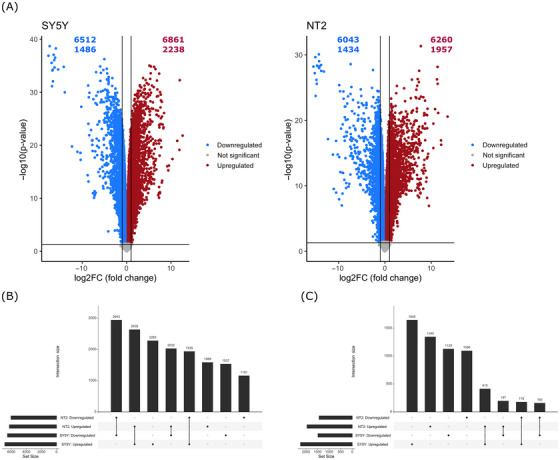
- mtDNA-depleted (ρ0) SH-SY5Y cells had 13,373 DEGs (84% of 15,914 genes; 6861 up, 6512 down), and ρ0 NT2 cells had 12,303 DEGs (77% of 16,029 genes; 6260 up, 6043 down); with absolute log2FC ≥ 1, SH-SY5Y had 3724 DEGs (23%) and NT2 had 3391 DEGs (21%).
- Across all DEGs, the two ρ0 lines shared 5582 concordant and 3971 divergent DEGs; with absolute log2FC ≥ 1, they shared 575 concordant and 375 divergent DEGs. There were 465 genes with highly equivalent change (ECI ≥ 0.9).
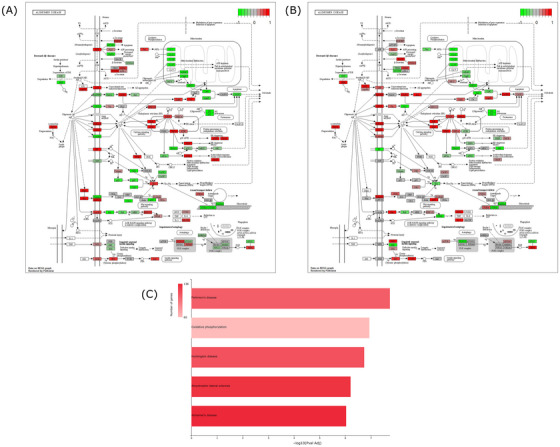
- The KEGG AD pathway was significantly enriched (FDR = 1.79E-02 for SH-SY5Y ρ0; FDR = 9.41E-03 for NT2 ρ0). Four of the five most enriched KEGG pathways from the high-ECI gene set were neurodegenerative disorders: AD, amyotrophic lateral sclerosis, Parkinson's disease, and Huntington's disease; the AD pathway included 136 of the 5000 DEGs with highest ECI scores.
- AD-relevant genes showed changes including APOE (SH-SY5Y ρ0 log2FC = 5.423), SNCA (SH-SY5Y ρ0 log2FC = 1.467; NT2 ρ0 log2FC = 2.729), CLU (SH-SY5Y ρ0 log2FC = 1.714; NT2 ρ0 log2FC = 1.300), and BIN1 (NT2 ρ0 log2FC = −1.73). Enriched pathways and terms reflected lipid, insulin signaling, synapse, inflammation/immune response, endosome/endocytosis, RNA, and proteostasis biology.
Methods
- SH-SY5Y and NT2 mtDNA-depleted (ρ0) and intact (ρ+) cell lines were generated by prolonged ethidium bromide exposure; RNA-seq was performed on 10 ρ0 and 10 ρ+ samples per cell line (total 40 samples) using an Illumina NovaSeq 6000. After filtering, 15,914 genes were retained for SH-SY5Y and 16,029 for NT2.
- Differential expression used edgeR with FDR ≤ 0.05; the Equivalent Change Index (ECI) quantified equivalent or inverse change across cell lines.
- Pathway analyses used KEGG GSEA/ORA, Reactome and Gene Ontology GSEA/ORA, and Ingenuity Pathway Analysis ORA and z-scores; data are in GEO accession GSE309664.
Limitations
- The paper states that the cell lines are tumor-derived and dividing, with bioenergetic characteristics differing from genuine neurons, such as high aerobic glycolysis; the magnitude of the ρ0 mitochondrial defect likely exceeds defects in surviving AD brain neurons; adaptive responses in ρ0 cells may differ from AD brains; and the study cannot establish causal sequence. The authors also state the ρ0 lines should be considered models of primary mitochondrial dysfunction, not models of AD.
- The paper notes that changes were frequently seen in one line but not the other, and some moved in opposite directions, likely reflecting inherent differences between SH-SY5Y and NT2 lines, including sex and neuron subtype differences.
- Evident from the text: the neuronal cell lines lack microglial characteristics, including TREM2 expression, and the study provides no direct human brain validation; findings are in vitro and may not extrapolate to AD brains.
Model-written summary. Check it against the paper before relying on it.
Integrity signals
Registry
Cites
Statistics
Figures
Verification
Claims the paper makes
0 Valid · 0 Not valid · 18 Not checked · 75 Own results and interpretations
A result the paper reports from its own data — it cites no other source for it, so there is none to check. The quote shows it is in the paper.
In the paper
“The KEGG AD pathway was significantly enriched”
- Also stated in: § mtDNA depletion alters the expression of AD‐associated genes · plain
“SH‐SY5Y ρ0 and NT2 ρ0 altered genes were significantly enriched in the KEGG database Alzheimer disease pathway (FDR = 1.79E‐02 for the SH‐SY5Y ρ0 cells; FDR = 9.41E‐03 for the NT2 ρ0 cells)”
§ MtDNA‐depleted neuronal cell transcriptomes reveal Alzheimer's disease‐related changes > Abstract > RESULTS
plainstates an association- Asserted: passes — The authors put it forward as true.
- Checkable: passes — It can be checked against evidence.
- Load-bearing: passes — The paper’s conclusions depend on it.
- Based: passes — The paper gives a reason why it holds.
- Also stated in: § mtDNA depletion alters the expression of AD‐associated genes · plain
A result the paper reports from its own data — it cites no other source for it, so there is none to check. The quote shows it is in the paper.
In the paper
“There were 465 genes exhibiting highly equivalent change (ECI ≥ 0.9) in ρ0 compared to ρ+ in both cell lines”
§ MtDNA‐depleted neuronal cell transcriptomes reveal Alzheimer's disease‐related changes > RESULTS > mtDNA depletion profoundly alters gene expression
plain- Asserted: passes — The authors put it forward as true.
- Checkable: passes — It can be checked against evidence.
- Load-bearing: unclear — It is unclear whether the paper’s conclusions depend on it.
- Based: passes — The paper gives a reason why it holds.
A result the paper reports from its own data — it cites no other source for it, so there is none to check. The quote shows it is in the paper.
In the paper
“The calculated ECI for the 5582 concordant genes ranged from 0.0155 to 0.9998”
§ MtDNA‐depleted neuronal cell transcriptomes reveal Alzheimer's disease‐related changes > RESULTS > mtDNA depletion profoundly alters gene expression
plain- Asserted: passes — The authors put it forward as true.
- Checkable: passes — It can be checked against evidence.
- Load-bearing: unclear — It is unclear whether the paper’s conclusions depend on it.
- Based: passes — The paper gives a reason why it holds.
A result the paper reports from its own data — it cites no other source for it, so there is none to check. The quote shows it is in the paper.
In the paper
“AD‐related enriched pathways and terms reflected lipid, insulin signaling, synapse, inflammation/immune response, endosome/endocytosis, RNA, and proteostasis biology.”
§ MtDNA‐depleted neuronal cell transcriptomes reveal Alzheimer's disease‐related changes > Abstract > RESULTS
plainstates an association- Asserted: passes — The authors put it forward as true.
- Checkable: passes — It can be checked against evidence.
- Load-bearing: passes — The paper’s conclusions depend on it.
- Based: passes — The paper gives a reason why it holds.
A result the paper reports from its own data — it cites no other source for it, so there is none to check. The quote shows it is in the paper.
In the paper
“For all DEGs, the SH‐SY5Y ρ0 and NT2 ρ0 cells shared 5582 concordant (upregulated or downregulated in both cell lines) and 3971 divergent (upregulated in one cell line but downregulated in the other) DEGs.”
§ MtDNA‐depleted neuronal cell transcriptomes reveal Alzheimer's disease‐related changes > RESULTS > mtDNA depletion profoundly alters gene expression
plain- Asserted: passes — The authors put it forward as true.
- Checkable: passes — It can be checked against evidence.
- Load-bearing: passes — The paper’s conclusions depend on it.
- Based: passes — The paper gives a reason why it holds.
54 more claims
Create a free account to see all 93 claims and to verify the 27 references still open.
- It may state two separate claims as one. 25
- Probably not a substantial claim. 13
- The quote only partly states this claim. 4
Self-check
Percentages, sums and reported differences re-computed from the paper’s own numbers.
Each contradiction between two passages listed here was confirmed by an independent check.
Rated minor: it would not touch a result — a value no result rests on, a p-value that stays on the same side of the significance level, or a conflict that is clerical, resolved elsewhere in the paper, or outside its own findings.
In the paper
§ MtDNA‐depleted neuronal cell transcriptomes reveal Alzheimer's disease‐related changes > RESULTS > Reactome database GSEA and ORA identify AD‐pertinent pathway changes
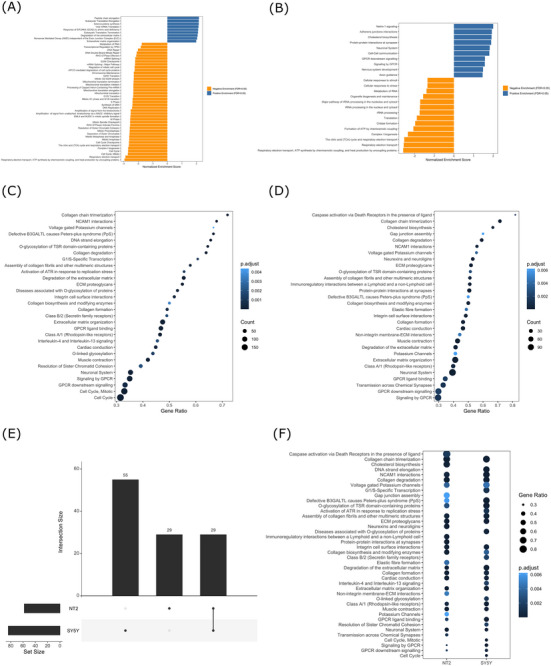
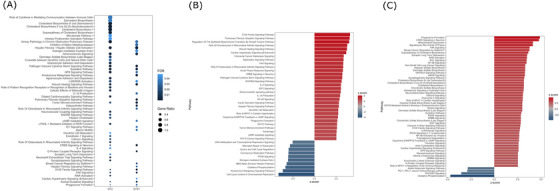
“(A) SH‐SY5Y GSEA analysis, 30 most significantly enriched pathways.”
§ MtDNA‐depleted neuronal cell transcriptomes reveal Alzheimer's disease‐related changes > RESULTS > Reactome database GSEA and ORA identify AD‐pertinent pathway changes
“Table S4 lists all significant SH‐SY5Y GSEA Reactome pathways, and Figure 3A shows the 50 most enriched pathways.”
Rated minor: it would not touch a result — a value no result rests on, a p-value that stays on the same side of the significance level, or a conflict that is clerical, resolved elsewhere in the paper, or outside its own findings.
In the paper
§ MtDNA‐depleted neuronal cell transcriptomes reveal Alzheimer's disease‐related changes > DISCUSSION
“Our ρ0 lines increased the expression of genes that encode proteins that aggregate in AD, including tau and α‐synuclein.”
§ MtDNA‐depleted neuronal cell transcriptomes reveal Alzheimer's disease‐related changes > RESULTS > mtDNA depletion alters the expression of AD‐associated genes
“| MAPT | 0.770 | 5.26E‐14 | −0.493 | 1.82E‐02 |”
Citations
Cites
Corder, E. H., Saunders, A. M., Strittmatter, W. J., Schmechel, D. E., Gaskell, P. C., Small, G. W., Roses, A. D., Haines, J. L., & Pericak-Vance, M. A. (1993) · Science · doi:10.1126/science.8346443 · Cited by 9,429
Alzheimer Disease Genetics Consortium (ADGC), Kunkle, B. W., The European Alzheimer’s Disease Initiative (EADI), Cohorts for Heart and Aging Research in Genomic Epidemiology Consortium (CHARGE), Genetic and Environmental Risk in AD/Defining Genetic, P. A. E. R. F. A. D. C. (., Grenier-Boley, B., Sims, R., Bis, J. C., Damotte, V., Naj, A. C., et al. (2019) · Nature Genetics · doi:10.1038/s41588-019-0358-2 · Cited by 2,946
Staging of alzheimer's disease-related neurofibrillary changes
Braak, H., & Braak, E. (1995) · Neurobiology of Aging · doi:10.1016/0197-4580(95)00021-6 · Cited by 2,357
Wolfe, M. S., Xia, W., Ostaszewski, B. L., Diehl, T. S., Kimberly, W. T., & Selkoe, D. J. (1999) · Nature · doi:10.1038/19077 · Cited by 1,916
Steen, E., Terry, B. M., J. Rivera, E., Cannon, J. L., Neely, T. R., Tavares, R., Xu, X. J., Wands, J. R., & de la Monte, S. M. (2005) · Journal of Alzheimer's Disease · doi:10.3233/jad-2005-7107 · Cited by 1,703
Prevalence of Cerebral Amyloid Pathology in Persons Without Dementia: A Meta-analysis
Jansen, W. J., Ossenkoppele, R., Knol, D. L., Tijms, B. M., Scheltens, P., Verhey, F. R. J., Visser, P. J., Aalten, P., Aarsland, D., Alcolea, D., et al. (2015) · JAMA · doi:10.1001/jama.2015.4668 · Cited by 1,610
Apolipoprotein E and Alzheimer disease: pathobiology and targeting strategies
Yamazaki, Y., Zhao, N., Caulfield, T. R., Liu, C.-C., & Bu, G. (2019) · Nature Reviews Neurology · doi:10.1038/s41582-019-0228-7 · Cited by 1,425 · cited 2×
“…changes (absolute log 2 FC ≥ 1; FDR ≤ 0.05) that affected one cell line or another, for example, expression of the lipid biology-related APOE gene 21 wassharplyincreasedintheSH-SY5Y ρ 0cells,whiletheexpres-sion of the endocytosis-related BIN1 gene 22 was strongly reduced in the NT2 ρ 0 cells.”
InfluentialAlzheimer’s Disease Risk Genes and Mechanisms of Disease Pathogenesis
Karch, C. M., & Goate, A. M. (2015) · Biological Psychiatry · doi:10.1016/j.biopsych.2014.05.006 · Cited by 1,357
CREB and the CRTC co-activators: sensors for hormonal and metabolic signals
Altarejos, J. Y., & Montminy, M. (2011) · Nature Reviews Molecular Cell Biology · doi:10.1038/nrm3072 · Cited by 1,040
Johnson, E. C. B., Dammer, E. B., Duong, D. M., Ping, L., Zhou, M., Yin, L., Higginbotham, L. A., Guajardo, A., White, B., Troncoso, J. C., et al. (2020) · Nature Medicine · doi:10.1038/s41591-020-0815-6 · Cited by 1,001
Cited by
Chatterjee, A., Alvarez, B. D., Sharma, R. U., Jonson, C., Wilkins, H., Pa, J., Swerdlow, R. H., Goate, A., Yaffe, K. S., & Andrews, S. J. (2026) · Alzheimer s & Dementia · doi:10.1002/alz.71469 · Cited by 1
Self-citationChronic mitochondrial DNA depletion alters MAPT splicing and increases tau levels
Weidling, I. W., Nissen, E., Wang, X., Novikova, L., Menta, B. W., Roberts, A., Ranjan, A., Kemna, R. E., Morris, J. K., Wilkins, H., et al. (2026) · Journal of Alzheimer s Disease · doi:10.1177/13872877261492673
Self-citationAn aging hallmark, Alzheimer's disease, and APOE nexus
Gabrielli, A. P., Weidling, I. W., Lysaker, C. R., Novikova, L., Ranjan, A., Wang, X., Wilkins, H., & Swerdlow, R. H. (2026) · Journal of Alzheimer s Disease · doi:10.1177/13872877261452598
Self-citationLiu, B., Wu, J., Liu, J., Mo, Y., Lin, G., Zhang, Y., Wei, C., & Tao, R. (2026) · Journal of Alzheimer s Disease · doi:10.1177/13872877261500762
Metadata
- Authors
- Menta, B. W., Schueddig, E., Ranjan, A., Li, Y., Andrews, S. J., Wilkins, H. M., Pei, D., & Swerdlow, R. H.
- Affiliations
- University of Kansas (US)
- University of Kansas Medical Center (US)
- University of California, San Francisco (US)
- Corresponding author
- Swerdlow, Russell H.
- ORCID
- Venue
- Alzheimer's & Dementia
- Publisher
- Wiley
- Published
- 2025-11
- Volume
- 21
- Issue
- 11
- Pages
- e70929-e70929
- ISSN
- 1552-5260 (ISSN-L)
- 1552-5279
- PMC
- PMC12647984
- OpenAlex
- W4416684734
- Semantic Scholar
- f079c4db5d7dad4446442cc3c042e8d964b8d7bd
- Cited by
- 4
- References
- 75
- Citations by year
- 2026: 4
- FWCI
- 0.96
- Type
- journal article
- Language
- en
- Open access
- hybrid
- doi.org
- Licence
- cc-by
- creativecommons.org/licenses/by/4.0/ (vor, 25 d)
- doi.wiley.com/10.1002/tdm_license_1.1 (tdm)
- Locations
- Alzheimer s & Dementia (publishedVersion, cc-by)
- PubMed Central (publishedVersion, cc-by)
- PubMed (publishedVersion)
- Funders
- Georgia Clinical and Translational Science Alliance
- Kansas IDeA Network of Biomedical Research Excellence (P20 GM130423, P30 CA168524, P20 GM103418, GM103418)
- National Institutes of Health (S10OD021743, UL1TR002366)
- Cancer Center, University of Kansas (P30-CA168524)
- National Institute on Aging (P30AG072973)
- National Cancer Institute (P30CA168524)
- National Institute of General Medical Sciences (P30GM122731, P20GM103418, P20GM130423)
- National Center for Advancing Translational Sciences
- Eunice Kennedy Shriver National Institute of Child Health and Human Development (T32HD057850, U54HD090216)
- Topics
- Life Sciences › Neuroscience › Cellular and Molecular Neuroscience › Alzheimer's disease research and treatments
- Life Sciences › Biochemistry, Genetics and Molecular Biology › Molecular Biology › Mitochondrial Function and Pathology
- Health Sciences › Medicine › Psychiatry and Mental health › Dementia and Cognitive Impairment Research
- Keywords
- mitochondrial DNA depletion, Alzheimer's disease
- MeSH terms
- Alzheimer Disease, DNA, Mitochondrial, Humans, Neurons, Sequence Analysis, RNA, Cell Line, Tumor, Transcriptome
About these checks
Registry, retraction, Cites and statistics results are computed, not judged, with one exception: a printed reference that no index lists is read once by a model before it counts as a citation error. Claims are extracted by a model and kept only when their quote appears verbatim in the text; each cited source is then checked, with a model’s help, for whether it says what the claim relies on. Those verdicts can be wrong — read the claim’s quote and the cited source before relying on one.
A language model drew the claims from the paper on 2026-11-26, under version 3 of the claim definition (model deepseek-v4.1-flash, prompt extract-v3).
A second model labelled each claim on 2026-11-26 (model jev-1.13-20260917, definition revision gold-guideline-v0.2).
Statistics and arithmetic are recomputed, not judged.
Confidence bands are shown only for fields calibrated on our annotated test set. None is calibrated yet, so no band is shown.
What counts as a claim ›How we measure confidence ›How we check this ›
Are you an author, or do you see a problem with this page? Request a review
Data sources
Bibliographic data: Semantic Scholar, OpenAlex, Crossref.
Contains information from the Semantic Scholar Academic Graph Datasets, made available under the ODC Attribution License (ODC-BY 1.0).
Semantic Scholar’s data is described in: Kinney, R., et al. (2023). The Semantic Scholar Open Data Platform. arXiv:2301.10140.
