

Dual Recycling of Depolymerization Catalyst and Biodegradable Polyester that Markedly Outperforms Polyolefins
Open accessThe DOI matches its Crossref record; 54 of the 55 references it cites were found in a registry or an index; none of the 13 sources its claims cite is checked for support yet.
Abstract
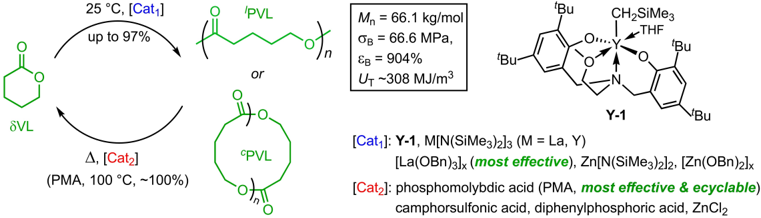
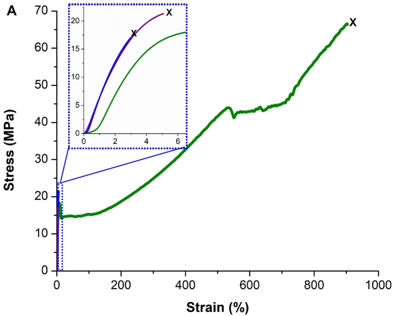
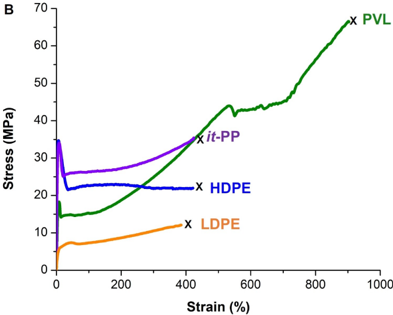
Chemically recyclable, circular polymers continue to attract increasing attention, but rendering both catalysts for depolymerization and high‐performance polymers recyclable is a more sustainable yet challenging goal. Here we introduce a dual catalyst/polymer recycling system in that recyclable inorganic phosphomolybdic acid catalyzes selective depolymerization of high‐ceiling‐temperature biodegradable poly(δ‐valerolactone) in bulk phase, which, upon reaching suitable molecular weight, exhibits outstanding mechanical performance with a high tensile strength of ≈66.6 MPa, fracture strain of ≈904 %, and toughness of ≈308 MJ m−3, and thus markedly outperforms commodity polyolefins, recovering its monomer in pure state and quantitative yield at only 100 °C. In sharp contrast, the uncatalyzed depolymerization not only requires a high temperature of >310 °C but is also low yielding and non‐selective. Importantly, the recovered monomer can be repolymerized as is to reproduce the same polymer, thereby closing the circular loop, and the recycled catalyst can be reused repeatedly for depolymerization runs without loss of its catalytic activity and efficiency.
Overview
Integrity signals
Registry
Cites
Statistics
Figures

Verification
Claims the paper makes
0 Valid · 3 Not valid · 11 Not checked · 57 Own results and interpretations
A result the paper states — it cites no source for it, so there is none to check. The quote shows it is in the paper.
In the paper
“To this end, we describe herein that identifying potent catalysts for the effective ROP of δVL leads to PVL materials with outstanding mechanical properties that largely outperform even robust polyolefins and for catalyzed, selective depolymerization of the resulting bulk PVL (solvent-free) with a recyclable catalyst to recover δVL in pure state and quantitative yield at desirably mild temperature”
§ Recyclable Polymers Hot Paper Dual Recycling of Depolymerization Catalyst and Biodegradable Polyester that Markedly Outperforms Polyolefins > Introduction
plainstates a cause- Asserted: passes — The authors put it forward as true.
- Checkable: passes — It can be checked against evidence.
- Load-bearing: passes — The paper’s conclusions depend on it.
- Based: passes — The paper gives a reason why it holds.
A result the paper reports from its own data — it cites no other source for it, so there is none to check. The quote shows it is in the paper.
In the paper
“Importantly, the recovered monomer can be repolymerized as is to reproduce the same polymer, thereby closing the circular loop”
§ Recyclable Polymers Hot Paper Dual Recycling of Depolymerization Catalyst and Biodegradable Polyester that Markedly Outperforms Polyolefins > Abstract
plainstates a cause- Asserted: passes — The authors put it forward as true.
- Checkable: passes — It can be checked against evidence.
- Load-bearing: passes — The paper’s conclusions depend on it.
- Based: passes — The paper gives a reason why it holds.
A result the paper reports from its own data — it cites no other source for it, so there is none to check. The quote shows it is in the paper.
In the paper
“To this end, we describe herein that identifying potent catalysts for the effective ROP of δVL leads to PVL materials with outstanding mechanical properties that largely outperform even robust polyolefins and for catalyzed, selective depolymerization of the resulting bulk PVL (solvent-free) with a recyclable catalyst to recover δVL in pure state and quantitative yield at desirably mild temperature”
- Also stated in: § Abstract · plain
“recovering its monomer in pure state and quantitative yield at only 100 °C”
§ Recyclable Polymers Hot Paper Dual Recycling of Depolymerization Catalyst and Biodegradable Polyester that Markedly Outperforms Polyolefins > Introduction
plainstates a cause- Asserted: passes — The authors put it forward as true.
- Checkable: passes — It can be checked against evidence.
- Load-bearing: passes — The paper’s conclusions depend on it.
- Based: passes — The paper gives a reason why it holds.
- Also stated in: § Abstract · plain
A result the paper reports from its own data — it cites no other source for it, so there is none to check. The quote shows it is in the paper.
In the paper
“Here we introduce a dual catalyst/polymer recycling system in that recyclable inorganic phosphomolybdic acid catalyzes selective depolymerization of high-ceiling-temperature biodegradable poly(δ-valerolactone) in bulk phase”
§ Recyclable Polymers Hot Paper Dual Recycling of Depolymerization Catalyst and Biodegradable Polyester that Markedly Outperforms Polyolefins > Abstract
plainstates a cause- Asserted: passes — The authors put it forward as true.
- Checkable: passes — It can be checked against evidence.
- Load-bearing: passes — The paper’s conclusions depend on it.
- Based: passes — The paper gives a reason why it holds.
A result the paper reports from its own data — it cites no other source for it, so there is none to check. The quote shows it is in the paper.
In the paper
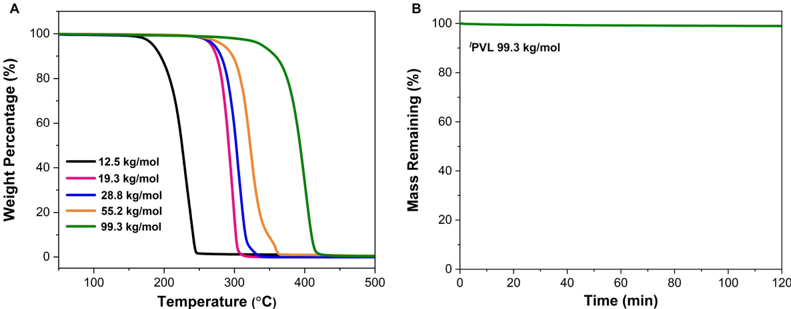
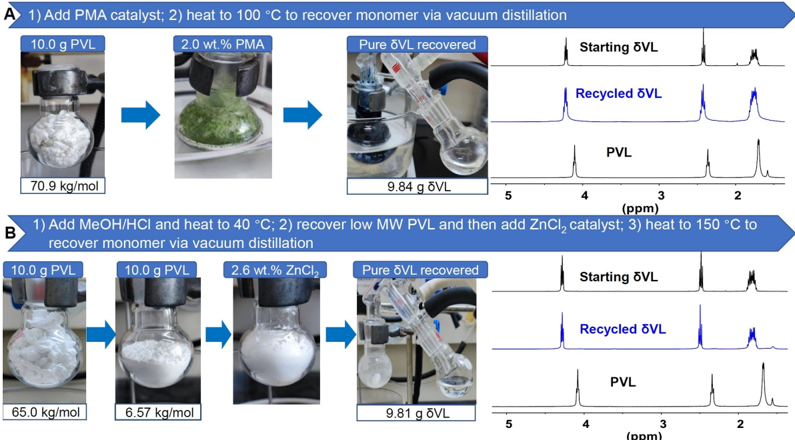
“When linear PVL with a low molecular weight (M n = 12.5 kg mol À 1 , Đ = 1.18) was mixed with 2.0 mol % ZnCl 2 at 150 °C under reduce pressure (0.07 Torr), δVL in near-quantitative purity and isolated yield (99 %) was recovered”
§ Recyclable Polymers Hot Paper Dual Recycling of Depolymerization Catalyst and Biodegradable Polyester that Markedly Outperforms Polyolefins > Chemical Recycling of PVL by Recyclable Catalyst
plainstates a causeSingle case- Asserted: passes — The authors put it forward as true.
- Checkable: passes — It can be checked against evidence.
- Load-bearing: passes — The paper’s conclusions depend on it.
- Based: passes — The paper gives a reason why it holds.
43 more claims
Create a free account to see all 71 claims and every source verdict.
- It may state two separate claims as one. 20
- The quote only partly states this claim. 1
- Probably not a substantial claim. 6
Citations
Cites
Williams, M. L., Landel, R. F., & Ferry, J. D. (1955) · Journal of the American Chemical Society · doi:10.1021/ja01619a008 · Cited by 8,083
Controlled Ring-Opening Polymerization of Lactide and Glycolide
Dechy-Cabaret, O., Martin-Vaca, B., & Bourissou, D. (2004) · Chemical Reviews · doi:10.1021/cr040002s · Cited by 2,257
Chemical recycling to monomer for an ideal, circular polymer economy
Coates, G. W., & Getzler, Y. D. Y. L. (2020) · Nature Reviews Materials · doi:10.1038/s41578-020-0190-4 · Cited by 1,644
Organocatalytic Ring-Opening Polymerization
Kamber, N. E., Jeong, W., Waymouth, R. M., Pratt, R. C., Lohmeijer, B. G. G., & Hedrick, J. L. (2007) · Chemical Reviews · doi:10.1021/cr068415b · Cited by 1,489
Critical advances and future opportunities in upcycling commodity polymers
Jehanno, C., Alty, J. W., Roosen, M., De Meester, S., Dove, A. P., Chen, E. Y.-X., Leibfarth, F. A., & Sardon, H. (2022) · Nature · doi:10.1038/s41586-021-04350-0 · Cited by 1,325
Self-citationChemically recyclable polymers: a circular economy approach to sustainability
Hong, M., & Chen, E. Y.-X. (2017) · Green Chemistry · doi:10.1039/c7gc01496a · Cited by 876
Self-citationThomas, C. M. (2010) · Chem. Soc. Rev. · doi:10.1039/b810065a · Cited by 853
Bio-based polymers with performance-advantaged properties
Cywar, R. M., Rorrer, N. A., Hoyt, C. B., Beckham, G. T., & Chen, E. Y.-X. (2021) · Nature Reviews Materials · doi:10.1038/s41578-021-00363-3 · Cited by 811
Self-citationA synthetic polymer system with repeatable chemical recyclability
Zhu, J.-B., Watson, E. M., Tang, J., & Chen, E. Y.-X. (2018) · Science · doi:10.1126/science.aar5498 · Cited by 709
Self-citationHong, M., & Chen, E. Y.-X. (2016) · Nature Chemistry · doi:10.1038/nchem.2391 · Cited by 677
Self-citation
Research works printed but not linked: 3
- 34. M. I. Khalil, D. O. H. Al-Shamary, S. S. Al-Deyab, Asian J. Biochem. Pharm. Res. 2015, 5, 137-147;
- 37. M. Save, M. Schappacher, A. Soum, Macromol. Chem. Phys. 2002, 203, 889-899.
- 48. J. Roovers in Cyclic Polymers, 2nd ed. (Ed.: J. A. Semlyen), Kluwer, Dordrecht, 2000, pp. 347-384.
Cited by
Depolymerization within a Circular Plastics System
Clark, R. A., & Shaver, M. P. (2024) · Chemical Reviews · doi:10.1021/acs.chemrev.3c00739 · Cited by 408
Recyclable and (Bio)degradable Polyesters in a Circular Plastics Economy
Shi, C., Quinn, E. C., Diment, W. T., & Chen, E. Y.-X. (2024) · Chemical Reviews · doi:10.1021/acs.chemrev.3c00848 · Cited by 402
Self-citationRing-Opening Polymerization of Lactones to Prepare Closed-Loop Recyclable Polyesters
Li, Z., Shen, Y., & Li, Z. (2024) · Macromolecules · doi:10.1021/acs.macromol.3c01912 · Cited by 130
Yang, S., Du, S., Zhu, J., & Ma, S. (2024) · Chemical Society Reviews · doi:10.1039/d4cs00663a · Cited by 123
The thermodynamics and kinetics of depolymerization: what makes vinyl monomer regeneration feasible?
Lohmann, V., Jones, G. R., Truong, N. P., & Anastasaki, A. (2024) · Chemical Science · doi:10.1039/d3sc05143a · Cited by 108
New sustainable polymers with on-demand depolymerization property
Sun, Y., An, Z., Gao, Y., Hu, R., Liu, Y., Lu, H., Lu, X., Pang, X., Qin, A., Shen, Y., et al. (2024) · Science China Chemistry · doi:10.1007/s11426-024-2167-9 · Cited by 107
Self-citationRecycled polymer: Green roads for polyester plastics
Yang, R., Xu, G., Tao, W., Wang, Q., & Tang, Y. J. (2024) · Green Carbon · doi:10.1016/j.greenca.2024.01.004 · Cited by 71
Recent advances in the chemical recycling of polyesters
Wang, S., Li, J., Li, X., & Tu, Y. (2024) · Fundamental Research · doi:10.1016/j.fmre.2024.05.014 · Cited by 52
Self-citationIonic-Liquid-Mediated Deconstruction of Polymers for Advanced Recycling and Upcycling
Christoff‐Tempesta, T., & Epps, T. H. I. (2023) · ACS Macro Letters · doi:10.1021/acsmacrolett.3c00276 · Cited by 50
Fully recyclable and tough thermoplastic elastomers from simple bio-sourced δ-valerolactones
Ma, K., An, H., Nam, J., Reilly, L. T., Zhang, Y., Chen, E. Y. ‐., & Xu, T. (2024) · Nature Communications · doi:10.1038/s41467-024-52229-1 · Cited by 55
“This result indicates that the polymerizability of α Me VL is indeed considerably higher than that of β Me VL ( T c =31°C at 1.0 M) and δ Me VL ( T c = 41 °C at 1.0 M) although, as expected, lower than the parent δ VL ( T c =243°C at [M] 0 =1.0 M) 33 .”
BackgroundMethodResultInfluentialSelf-citationUnderstanding the effect of plastic food packaging materials on food flavor: A critical review
Bai, F., Chen, G., Hu, Y., Liu, Y., Yang, R., Liu, J., Hou, R., Li, H., Wan, X., & Cai, H. (2024) · Trends in Food Science & Technology · doi:10.1016/j.tifs.2024.104502 · Cited by 54
Redesigned Nylon 6 Variants with Enhanced Recyclability, Ductility, and Transparency
Tian, J. M., Liu, X., Ye, L., Zhang, Z., Quinn, E. C., Shi, C., Broadbelt, L. J., Marks, T. J., & Chen, E. Y. ‐. (2024) · Angewandte Chemie International Edition · doi:10.1002/anie.202320214 · Cited by 42
Self-citationLi, X., Wu, R., Fu, T., Li, Z., Li, Y., Wang, X., & Wang, Y. (2024) · Advanced Functional Materials · doi:10.1002/adfm.202400911 · Cited by 47
Self-citationKimura, T., & Ouchi, M. (2023) · Angewandte Chemie International Edition · doi:10.1002/anie.202305252 · Cited by 35
Kang, S., Yuan, W., Guo, X., Zhang, Y., Shang, J., Yang, P., Ma, Y., Nicolosi, V., Cai, L., & Qiu, B. (2025) · Angewandte Chemie International Edition · doi:10.1002/anie.202504993 · Cited by 45
Chemical recycling of polyolefins via ring-closing metathesis depolymerization
Ibrahim, T., Ritacco, A., Nalley, D., Emon, O. F., Liang, Y., & Sun, H. R. (2024) · Chemical Communications · doi:10.1039/d3cc05612k · Cited by 42
Weng, C., Ding, Z., Qiu, W., Wang, B., & Tang, X. (2024) · Angewandte Chemie International Edition · doi:10.1002/anie.202401682 · Cited by 37
McGuire, T. M., Ning, D., Buchard, A., & Williams, C. K. (2025) · Journal of the American Chemical Society · doi:10.1021/jacs.5c04603 · Cited by 32
Understanding ceiling temperature as a predictive design parameter for circular polymers
Liu, X., Kozarekar, S. S., Shaw, A., Xu, T.-Q., Chen, E. Y. ‐., & Broadbelt, L. J. (2024) · Cell Reports Physical Science · doi:10.1016/j.xcrp.2024.101910 · Cited by 36
Self-citationCatalytic chemical recycling and upcycling of polyolefin plastics
Tan, Y., Cheng, Y., Xu, J., & Wang, H. (2024) · Giant · doi:10.1016/j.giant.2024.100307 · Cited by 34
Han, C.-T., Ma, K., Zhang, Z., Clarke, R. W., Gowda, R. R., Xu, T., & Chen, E. Y. ‐. (2025) · Journal of the American Chemical Society · doi:10.1021/jacs.4c16260 · Cited by 24
Self-citationQin, Y. F., Ma, J., Pei, W., Zhang, Y., Zhong, R., Liu, S., Shen, Y., & Li, Z. (2024) · Angewandte Chemie International Edition · doi:10.1002/anie.202418488 · Cited by 24
Lamparelli, D. H., Villar‐Yanez, A., Dittrich, L., Rintjema, J., Bravo, F., Bó, C., & Kleij, A. W. (2023) · Angewandte Chemie International Edition · doi:10.1002/anie.202314659 · Cited by 25
Zheng, M., Peng, W., Zhang, Y., Zhang, X., & Chen, W. (2024) · Macromolecules · doi:10.1021/acs.macromol.4c00933 · Cited by 20
Recent Advances in the Synthesis and Polymerization of New CO2‐Based Cyclic†
Lanzi, M., & Kleij, A. W. (2023) · Chinese Journal of Chemistry · doi:10.1002/cjoc.202300502 · Cited by 22
Divergent methods for polyester and polycarbonate depolymerization with a cobalt catalyst
Knight, K. D., & Fieser, M. E. (2024) · Inorganic Chemistry Frontiers · doi:10.1039/d3qi01833d · Cited by 19
“35,40,44,45,54 Herein, we demonstrate the use of a pyridine diimine cobalt catalyst that can catalyse the cyclodepolymerization of several di ff erent polyesters and polycarbonates.”
BackgroundDiment, W. T., Gowda, R. R., & Chen, E. Y. ‐. (2024) · Journal of the American Chemical Society · doi:10.1021/jacs.4c08127 · Cited by 19
Self-citationChemical closed-loop recyclable thermosetting polymers based on dynamic covalent bonds
Zhao, Z.-H., & Fu, J. (2025) · Science China Chemistry · doi:10.1007/s11426-024-2550-6 · Cited by 24
Direct Monomer Recovery from Ring-Closing Depolymerization of Thermosets
Zheng, C., Slor, G., Ma, Y., & Stellacci, F. (2024) · ACS Macro Letters · doi:10.1021/acsmacrolett.4c00665 · Cited by 17
Improving Circularity via Chemical Recycling to all Rings
Nieboer, V., Odelius, K., & Olsén, P. (2025) · Angewandte Chemie International Edition · doi:10.1002/anie.202502436 · Cited by 18
Recycling Polyester and Polycarbonate Plastics with Carbocation Lewis Acidic Organocatalysts
Wang, N., Zhang, Q., Sun, Z., Zhang, H., Hu, C., Sun, H. X., Pang, X., & Chen, X. (2025) · ACS Macro Letters · doi:10.1021/acsmacrolett.5c00054 · Cited by 17
Li, J., Chen, J., Zhang, Y., Wang, L., Gao, P., & Yang, J. (2026) · Advanced Science · doi:10.1002/advs.202521680 · Cited by 21
Dardé, T., Diomar, E., Schultze, X., & Taton, D. (2024) · Angewandte Chemie International Edition · doi:10.1002/anie.202411249 · Cited by 14
Mechanically Robust Polyvalerolactone Thermosets with Dual Recyclability
Gu, H., Ju, H., Chen, K., Sun, C. N., Li, N., Chen, J., Zhang, Z., & Cao, P. (2025) · Macromolecules · doi:10.1021/acs.macromol.5c00904 · Cited by 13
Xu, H.-D., Deng, H.-J., Zeng, H.-M., Yang, W., & Yao, C. (2024) · Macromolecules · doi:10.1021/acs.macromol.3c02504 · Cited by 11
Wang, Z., & Liu, X. (2024) · Chinese Journal of Polymer Science · doi:10.1007/s10118-024-3199-0 · Cited by 10
Lubricating Polymer Gels/Coatings: Syntheses and Measurement Strategies
Zhao, P., & Klein, J. E. (2024) · Gels · doi:10.3390/gels10060407 · Cited by 11
“For example, polymers with easily cleavable bonds or those that can be depolymerized into monomers under mild conditions are preferred [81,82].”
BackgroundMass-Produced Chemically Recyclable Aromatic Polymers with Exceptional Strength and Stability
Xie, P., Lu, X., Li, X., Wen, X., & Sun, J. (2025) · ACS Macro Letters · doi:10.1021/acsmacrolett.5c00239 · Cited by 10
Self-citationKang, S., Yuan, W., Guo, X., Zhang, Y., Shang, J., Yang, P., Ma, Y., Nicolosi, V., Cai, L., & Qiu, B. (2025) · Angewandte Chemie · doi:10.1002/ange.202504993 · Cited by 12
Dastidar, R. G., Chavarrio, J. E., Jiang, Z., McClelland, D. J., Mavrikakis, M., & Huber, G. W. (2025) · Applied Catalysis B: Environment and Energy · doi:10.1016/j.apcatb.2024.124519 · Cited by 9
Peng, Z., Chen, H., Chai, M., Yang, R., Xu, G., Sun, H., & Wang, Q. (2025) · Polymer Chemistry · doi:10.1039/d4py01175a · Cited by 9
More than ring-strain: revisiting the definition of enthalpy in ring-opening polymerization
Nieboer, V., Wohlert, J., Olsén, P., & Odelius, K. (2026) · Faraday Discussions · doi:10.1039/d5fd00060b · Cited by 10
Khechfe, A. A., Eckstrom, F. D., Chokkapu, E. R., Baston, L. A., Liu, B., Chen, E. Y. ‐., & Román‐Leshkov, Y. (2024) · Green Chemistry · doi:10.1039/d4gc03016h · Cited by 6
“All catalysts exhibited a small weight loss feature at ∼ 400 K, hypothesized to correspond to surface-bound species that do not desorb after purging in N 2 for ∼ 30 min prior to catalyst unloading.”
BackgroundSelf-citationYu, L., Wang, Y., Zhou, Q., Wu, X., Yu, Z., Xu, Y., Li, Z., & Wang, J. (2024) · Macromolecules · doi:10.1021/acs.macromol.4c00750 · Cited by 8
Li, J., Zhang, Y., Li, Y., Zhang, C., & Zhang, X. (2025) · Macromolecules · doi:10.1021/acs.macromol.4c03028 · Cited by 8
Luo, Z., Tian, G., Chen, S., Wu, G., & Wang, Y. (2025) · Polymer · doi:10.1016/j.polymer.2025.128577 · Cited by 6
Wang, M., Ding, Z., Xiao, J., Liao, Y., Ma, Z., Li, Y., & Wang, B. (2025) · Angewandte Chemie International Edition · doi:10.1002/anie.202509468 · Cited by 12
Nowicka, W., Różański, A., Pasha, F. A., Jasińska-Walc, L., & Duchateau, R. (2025) · Macromolecules · doi:10.1021/acs.macromol.5c01495 · Cited by 7
Kassim, A. O., Kariyawasam, L. S., & Yang, Y. (2025) · Macromolecules · doi:10.1021/acs.macromol.4c03237 · Cited by 7
Rithchumpon, P., Limwanich, W., Utama, K., Cheechana, N., Akkravijitrkul, N., Sangthong, P., Punyodom, W., & Meepowpan, P. (2025) · Journal of Catalysis · doi:10.1016/j.jcat.2025.116400 · Cited by 5
Advances in the Synthesis of Poly(Phenolic Ester)s via Ring‐Opening Polymerization
Lin, J., Li, L., Liu, S., Jia, Z., & Wu, J. (2024) · ChemCatChem · doi:10.1002/cctc.202400452 · Cited by 5
Current Advances and Challenges in Chemical Recycling of Polymeric MaterialsPreprint
Kim, H. J. (2023) · Preprints.org · doi:10.20944/preprints202310.0427.v1 · Cited by 5
Wang, M., Ding, Z., Xiao, J., Liao, Y., Ma, Z., Li, Y., & Wang, B. (2025) · Angewandte Chemie · doi:10.1002/ange.202509468 · Cited by 5
Kimura, T., & Ouchi, M. (2023) · Angewandte Chemie · doi:10.1002/ange.202305252 · Cited by 5
Circular Polyesters Based on Lactones
Dong, R., Guo, J., Sun, H., & Xu, T. (2024) · ChemCatChem · doi:10.1002/cctc.202401319 · Cited by 6
Self-citationProgramming Aliphatic Polyester Degradation by Engineered Bacterial Spores
Cui, Z., Kawada, M., Hui, Y., & Sim, S. (2025) · Biomacromolecules · doi:10.1021/acs.biomac.4c01652 · Cited by 5
Zhang, Z., Lv, W., Li, M., Wang, Y., Wang, X., & Tao, Y. (2025) · Nature Communications · doi:10.1038/s41467-025-59834-8 · Cited by 5
“As a result, to gain degradable and recyclable plastics for mitigating plastics littering has become an ambitious task over the recent years 4 – 11 .”
Pearcy, R. J., Berrow, S. R., & Platel, R. H. (2026) · Faraday Discussions · doi:10.1039/d5fd00055f · Cited by 4
Kiani, D., Rosetto, G., Ibrahim, F., Bozkurt, Ö. D., Pal, A., Roijen, E. C. V., DesVeaux, J. S., Bare, S. R., Hermans, I., & Beckham, G. T. (2026) · Nature Communications · doi:10.1038/s41467-026-69362-8 · Cited by 4
Li, H., Luo, S.-L., Zhang, D., Tian, G., Chen, S., Wu, G., & Wang, Y. (2026) · Macromolecules · doi:10.1021/acs.macromol.5c03098 · Cited by 4
Upcycling PET Plastics with Methanol into Lactic Acid and 1,4-Cyclohexanedicarboxylic Acid
Guo, Z., Chen, H., Tian, S., Zhang, M., Wang, M., & Ma, D. (2026) · Engineering · doi:10.1016/j.eng.2026.02.015 · Cited by 5
Jiang, H., Li, Z., Dai, Y.-N., Ling, Y., Mei, S., Wang, H., & Mou, Z. (2023) · Inorganic Chemistry · doi:10.1021/acs.inorgchem.3c03298 · Cited by 2
Lamparelli, D. H., Villar‐Yanez, A., Dittrich, L., Rintjema, J., Bravo, F., Bó, C., & Kleij, A. W. (2023) · Angewandte Chemie · doi:10.1002/ange.202314659 · Cited by 4
Redesigned Nylon 6 Variants with Enhanced Recyclability, Ductility, and Transparency
Tian, J., Liu, X., Ye, L., Zhang, Z., Quinn, E. C., Shi, C., Broadbelt, L. J., Marks, T. J., & Chen, E. Y. ‐. (2024) · Angewandte Chemie · doi:10.1002/ange.202320214 · Cited by 4
Self-citationWeng, C., Ding, Z., Qiu, W., Wang, B., & Tang, X. (2024) · Angewandte Chemie · doi:10.1002/ange.202401682 · Cited by 3
Baer, A. L., Clarke, R. W., Gowda, R. R., Hesse, S. A., Crowley, M., Xu, S., Hamernik, L. J., Curley, J. B., Urgun-Demirtas, M., Tassone, C. J., et al. (2026) · ACS Sustainable Chemistry & Engineering · doi:10.1021/acssuschemeng.6c00712 · Cited by 2
Self-citationImproving Circularity via Chemical Recycling to all Rings
Nieboer, V., Odelius, K., & Olsén, P. (2025) · Angewandte Chemie · doi:10.1002/ange.202502436 · Cited by 2
DMF/DMSO-catalyzed selective ring-opening polymerization of salicylate cyclic esters
Ge, Y., Liu, J., Fu, H., Wang, C., Li, G., Cao, L., Pan, X., & Wu, J. (2025) · Chemical Science · doi:10.1039/d5sc06353a · Cited by 2
Ou, S., Dai, Y., Ding, Z., Wu, J. H., He, W., Sun, J., Zhu, N., Liu, Y., & Guo, K. (2026) · Angewandte Chemie International Edition · doi:10.1002/anie.202522592 · Cited by 2
Guan, S., Wang, M., Xiao, J., Ding, Z., & Wang, B. (2026) · Angewandte Chemie · doi:10.1002/ange.202522383 · Cited by 2
Qin, Y. F., Ma, J., Pei, W., Zhang, Y., Zhong, R., Liu, S., Shen, Y., & Li, Z. (2024) · Angewandte Chemie · doi:10.1002/ange.202418488 · Cited by 3
Huang, Z., Yi, X., Pan, R., Huang, H., Liu, C., Chen, L., Wang, F., & Wang, S. (2025) · Inorganic Chemistry · doi:10.1021/acs.inorgchem.5c00790 · Cited by 1
Strong, Fully Recyclable, and Thermoplastic Ultrahigh-Molecular-Weight Poly(tetramethyl glycolide)
Sun, H. X., An, H., & Xu, T. (2025) · Macromolecules · doi:10.1021/acs.macromol.5c00841 · Cited by 2
Self-citationMichelas, M., Duffaut, G., Poli, R., & Fliedel, C. (2025) · Catalysis Science & Technology · doi:10.1039/d5cy01106j · Cited by 2
Degradable polyethylene-like materials
Yan, X., Zhou, H., An, Y., Wang, G., Hu, Y., Tan, R., & Zhang, Z. (2026) · Scientia Sinica Chimica · doi:10.1360/ssc-2025-0300 · Cited by 1
Zhang, L., Wang, X., & Zhang, Z. (2026) · Precision Chemistry · doi:10.1021/prechem.5c00446 · Cited by 1
Jampakaew, K., Joopor, W., & Hormnirun, P. (2026) · Macromolecules · doi:10.1021/acs.macromol.6c01180 · Cited by 1
Deacy, A. C., Webber, C., & Tonks, I. A. (2026) · Chemical Science · doi:10.1039/d6sc03244c · Cited by 2
Thorogood, R., McGuire, T. M., & Williams, C. K. (2026) · Journal of the American Chemical Society · doi:10.1021/jacs.6c06048 · Cited by 2
Sustainable Materials for Additive Manufacturing
Jarach, N., Dodiuk, H., Kenig, S., & Magdassi, S. (2026) · ACS Materials Letters · doi:10.1021/acsmaterialslett.6c00634 · Cited by 1
Yang, C., Wu, X., Yu, L., Bi, C.-A., Du, F., & Li, Z. (2024) · ACS Macro Letters · doi:10.1021/acsmacrolett.4c00398 · Cited by 1
Dardé, T., Diomar, E., Schultze, X., & Taton, D. (2024) · Angewandte Chemie · doi:10.1002/ange.202411249
Miao, X., Li, W., & Shi, C. (2026) · Scientia Sinica Chimica · doi:10.1360/ssc-2025-0255
平野, 直., Yoshida, H., Ando, T., & Ajiro, H. (2026) · Macromolecules · doi:10.1021/acs.macromol.5c03228
Function Meets Circularity: Metal–Ionomer Cross-Links Toughen and Recycle CO 2 -Derived Polymers
Poon, K. C., McGuire, T. M., Gao, C., Sulley, G. S., & Williams, C. K. (2026) · Macromolecules · doi:10.1021/acs.macromol.6c00188
Huang, B., Shen, T., He, Z., Yang, X., Wang, Z., Ji, L., Chen, Y., Luo, J., Ling, J., & Chen, Y. (2026) · European Polymer Journal · doi:10.1016/j.eurpolymj.2026.114911
Synthesis and thermodynamic properties of recyclable poly(α,α-substituted phenolic ester)s
Yao, G., Gao, S. Y., Qie, H., Li, G., Xian, J., Pan, X., & Wu, J. (2026) · Polymer · doi:10.1016/j.polymer.2026.130484
Gholami, F., Ramprasad, R., & Qi, H. J. (2026) · Advanced Materials · doi:10.1002/adma.73986
Cai, X.-L., Zhang, Y., Liu, L.-N., Zhu, J., Zhang, Y., & Yang, G. (2026) · Macromolecules · doi:10.1021/acs.macromol.6c01347
Vongfak, S., Joopor, W., Kamavichanurat, S., & Hormnirun, P. (2026) · New Journal of Chemistry · doi:10.1039/d6nj03471c
Metadata
- Authors
- Li, X., Clarke, R. W., An, H., Gowda, R. R., Jiang, J., Xu, T., & Chen, E. Y. ‐.
- Affiliations
- State Key Laboratory of Fine Chemicals Department of Chemistry School of Chemical Engineering Dalian University of Technology Dalian 116024 China
- Colorado State University (US)
- Corresponding author
- Chen, Eugene Y.‐X.
- Venue
- Angewandte Chemie International Edition
- Publisher
- Wiley
- Published
- 2023-05-16
- Volume
- 62
- Issue
- 26
- Pages
- e202303791-e202303791
- ISSN
- 1433-7851 (ISSN-L)
- 1521-3773
- OpenAlex
- W4367174559
- Cited by
- 93
- References
- 55
- Citations by year
- 2026: 21 · 2025: 26 · 2024: 35 · 2023: 11
- FWCI
- 5.93
- Type
- journal article
- Language
- en
- Open access
- hybrid
- doi.org
- Locations
- Angewandte Chemie International Edition (publishedVersion, cc-by)
- PubMed (publishedVersion)
- OSTI OAI (U.S. Department of Energy Office of Scientific and Technical Information) (submittedVersion)
- Funders
- National Natural Science Foundation of China (21774017)
- Fundamental Research Funds for the Central Universities (DUT20LK35)
- Office of Science (DE-SC0022290)
- Topics
- Physical Sciences › Materials Science › Biomaterials › biodegradable polymer synthesis and properties
- Physical Sciences › Materials Science › Polymers and Plastics › Polymer crystallization and properties
- Physical Sciences › Materials Science › Polymers and Plastics › Polymer composites and self-healing
- Keywords
- poly(δ-valerolactone), chemical recycling, phosphomolybdic acid, catalyst recycling, biodegradable polyesters, monomer recovery, mechanical properties, repolymerization
- MeSH terms
- Catalysis, Polyenes, Polyesters, Polymers
About these checks
Registry, retraction, Cites and statistics results are computed, not judged, with one exception: a printed reference that no index lists is read once by a model before it counts as a citation error. Claims are extracted by a model and kept only when their quote appears verbatim in the text; each cited source is then checked, with a model’s help, for whether it says what the claim relies on. Those verdicts can be wrong — read the claim’s quote and the cited source before relying on one.
A language model drew the claims from the paper on 2026-10-01, under version 3 of the claim definition (model deepseek-v4.1-flash, prompt extract-v3).
A second model labelled each claim on 2026-10-01 (model jev-1.13-20260917, definition revision gold-guideline-v0.2).
Statistics and arithmetic are recomputed, not judged.
Confidence bands are shown only for fields calibrated on our annotated test set. None is calibrated yet, so no band is shown.
What counts as a claim ›How we measure confidence ›How we check this ›
Are you an author, or do you see a problem with this page? Request a review
Data sources
Bibliographic data: Semantic Scholar, OpenAlex, Crossref.
Contains information from the Semantic Scholar Academic Graph Datasets, made available under the ODC Attribution License (ODC-BY 1.0).
Semantic Scholar’s data is described in: Kinney, R., et al. (2023). The Semantic Scholar Open Data Platform. arXiv:2301.10140.
