

Peptidylprolylisomerases, Protein Folders, or Scaffolders? The Example of FKBP51 and FKBP52
Open accessThe DOI matches its Crossref record; 136 of the 140 references it cites were found in a registry or an index.
Abstract
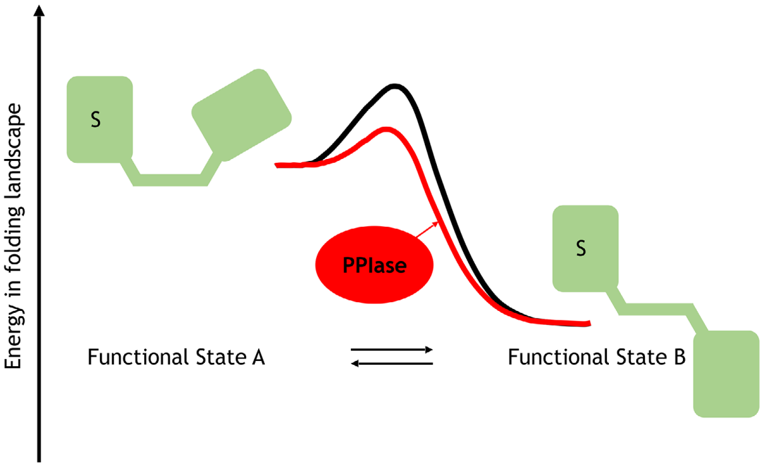
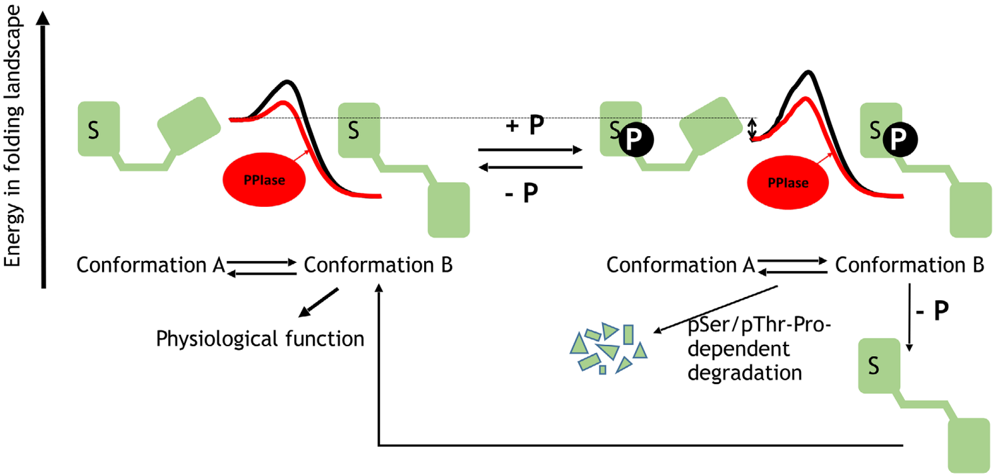
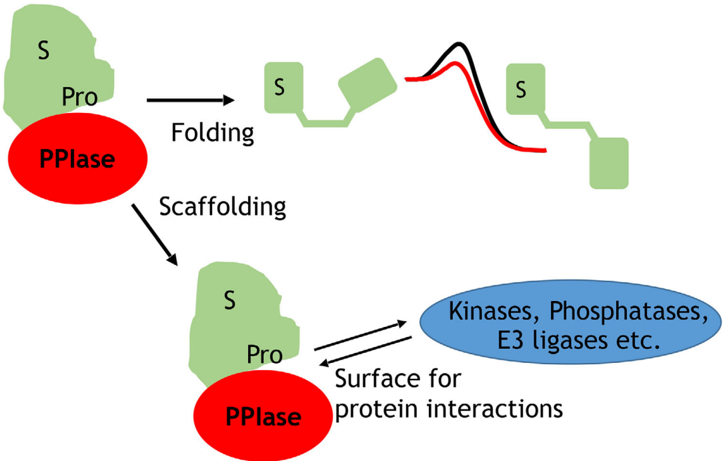
Peptidylprolyl‐isomerases (PPIases) comprise of the protein families of FK506 binding proteins (FKBPs), cyclophilins, and parvulins. Their common feature is their ability to expedite the transition of peptidylprolyl bonds between the cis and the trans conformation. Thus, it seemed highly plausible that PPIase enzymatic activity is crucial for protein folding. However, this has been difficult to prove over the decades since their discovery. In parallel, more and more studies have discovered scaffolding functions of PPIases. This essay discusses the hypothesis that PPIase enzymatic activity might be the consequence of binding to peptidylprolyl protein motifs. The main focus of this paper is the large immunophilins FKBP51 and FKBP52, but other PPIases such as cyclophilin A and Pin1 are also described. From the hypothesis, it follows that the PPIase activity of these proteins might be less relevant, if at all, than the organization of protein complexes through versatile protein binding. Also see the video abstract here https://youtu.be/A33la0dx5LE.
Overview
The claims and statistics of this paper haven’t been checked yet.
Free: it reads the open-access text and checks the first 5 claims that cite a source we can check. Create a free account to check every claim.
Integrity signals
Registry
Cites
Statistics
Figures



Verification
Claims the paper makes
The claims and statistics of this paper haven’t been checked yet.
Free: it reads the open-access text and checks the first 5 claims that cite a source we can check. Create a free account to check every claim.
Claims other papers make about this one
Each is checked against this paper’s own text: does it say what the citing paper says it does?
The source backs part of the claim, not all of it — or backs it for a different population, condition or comparison.
In the citing paper
“Although the FKBPs directly contact GR, they do not appear to isomerize GR prolines or engage GRNLS1 (nuclear localization signal 1) (GR467–505) (ref. 60) to regulate GR activity, as previously hypothesized8,61–63.”
From Cryo-EM reveals how Hsp90 and FKBP immunophilins co-regulate the glucocorticoid receptor (2023) · cites this paper as [63]
Experimental — accuracy not yet measured
Self-check
Percentages, sums and reported differences re-computed from the paper’s own numbers.
The self-check needs the paper’s full text.
Citations
Cites
Principles that Govern the Folding of Protein Chains
Anfinsen, C. B. (1973) · Science · doi:10.1126/science.181.4096.223 · Cited by 7,096
Molecular chaperones in cellular protein folding
Hartl, F. U. (1996) · Nature · doi:10.1038/381571a0 · Cited by 3,568
Molecular chaperones in protein folding and proteostasis
Hartl, F. U., Bracher, A., & Hayer-Hartl, M. (2011) · Nature · doi:10.1038/nature10317 · Cited by 3,381
Molecular Chaperones in the Cytosol: from Nascent Chain to Folded Protein
Hartl, F. U., & Hayer-Hartl, M. (2002) · Science · doi:10.1126/science.1068408 · Cited by 3,347
Adapting Proteostasis for Disease Intervention
Balch, W. E., Morimoto, R. I., Dillin, A., & Kelly, J. W. (2008) · Science · doi:10.1126/science.1141448 · Cited by 2,495
HSP90 at the hub of protein homeostasis: emerging mechanistic insights
Taipale, M., Jarosz, D. F., & Lindquist, S. (2010) · Nature Reviews Molecular Cell Biology · doi:10.1038/nrm2918 · Cited by 1,818
Steroid Receptor Interactions with Heat Shock Protein and Immunophilin Chaperones*
Pratt, W. B., & Toft, D. O. (1997) · Endocrine Reviews · doi:10.1210/edrv.18.3.0303 · Cited by 1,791
The proteostasis network and its decline in ageing
Hipp, M. S., Kasturi, P., & Hartl, F. U. (2019) · Nature Reviews Molecular Cell Biology · doi:10.1038/s41580-019-0101-y · Cited by 1,642
MOLECULAR CHAPERONE FUNCTIONS OF HEAT-SHOCK PROTEINS
Hendrick, J. P., & Hartl, F.-U. (1993) · Annual Review of Biochemistry · doi:10.1146/annurev.bi.62.070193.002025 · Cited by 1,638
Schopf, F. H., Biebl, M. M., & Buchner, J. (2017) · Nature Reviews Molecular Cell Biology · doi:10.1038/nrm.2017.20 · Cited by 1,540
Research works printed but not linked: 5
- S. Walter, J. Buchner, Angew. Chem., Int. Ed. 2002, 41, 1098. · DOI · Paper page
- F. Merz, A. Hoffmann, A. Rutkowska, B. Zachmann-Brand, B. Bukau, E. Deuerling, J. Biol. Chem. 2006, 281, 31963. · doi:10.1074/jbc.m605164200 · Paper page
- X. Z. Zhou, O. Kops, A. Werner, P. J. Lu, M. Shen, G. Stoller, G. Küllertz, M. Stark, G. Fischer, K. P. Lu, Mol. Cell 2000, 6, 873. · doi:10.1016/s1097-2765(05)00083-3 · Paper page
- W. B. Pratt, U. Gehring, D. O. Toft, EXS 1996, 77, 79.
- Y. Gao, E. Elamin, R. Zhou, H. Yan, S. Liu, S. Hu, J. Dong, M. Wei, L. Sun, Y. Zhao, Oncol. Lett. 2018, 16, 7020.
Cited by
Cryo-EM reveals how Hsp90 and FKBP immunophilins co-regulate the glucocorticoid receptor
Noddings, C. M., Johnson, J. L., & Agard, D. A. (2023) · Nature Structural & Molecular Biology · doi:10.1038/s41594-023-01128-y · Cited by 75
“60) to regulate GR activity, as previously hypothesized 8,61–63 .”
BackgroundHervás, R., & Oroz, J. (2020) · International Journal of Molecular Sciences · doi:10.3390/ijms21239186 · Cited by 46
Pasetto, L., Grassano, M., Pozzi, S., Luotti, S., Sammali, E., Migazzi, A., Basso, M., Spagnolli, G., Biasini, E., Micotti, E., et al. (2021) · Brain · doi:10.1093/brain/awab333 · Cited by 38
Daneri-Becerra, C., Valeiras, B., Gallo, L. I., Lagadari, M., & Galigniana, M. D. (2020) · Journal of Cell Science · doi:10.1242/jcs.253401 · Cited by 28
Cyclophilin D in Mitochondrial Dysfunction: A Key Player in Neurodegeneration?
Coluccino, G., Muraca, V. P., Corazza, A., & Lippe, G. (2023) · Biomolecules · doi:10.3390/biom13081265 · Cited by 29
“In this scenario, PPIases would serve just as scaffolds or interaction hubs, and exert their function regardless of their enzymatic activity [10], which in several cases have been shown to be dispensable.”
Background
Metadata
- Authors
- Rein, T.
- Affiliations
- Max Planck Institute of Psychiatry (DE)
- Corresponding author
- Rein, Theo
- ORCID
- Rein, Theo
- Venue
- BioEssays
- Publisher
- Wiley
- Published
- 2020-04-22
- Volume
- 42
- Issue
- 7
- Pages
- e1900250-e1900250
- ISSN
- 0265-9247 (ISSN-L)
- 1521-1878
- OpenAlex
- W3018502993
- Cited by
- 25
- References
- 140
- Citations by year
- 2026: 2 · 2025: 1 · 2024: 8 · 2023: 7 · 2022: 2 · 2020: 5
- FWCI
- 0.34
- Type
- journal article
- Language
- en
- Open access
- hybrid
- doi.org
- Licence
- Locations
- BioEssays (publishedVersion, cc-by)
- PubMed (publishedVersion)
- Topics
- Life Sciences › Biochemistry, Genetics and Molecular Biology › Molecular Biology › Signaling Pathways in Disease
- Life Sciences › Biochemistry, Genetics and Molecular Biology › Molecular Biology › Protein Structure and Dynamics
- Life Sciences › Biochemistry, Genetics and Molecular Biology › Molecular Biology › Heat shock proteins research
- Keywords
- peptidylprolyl isomerase, FKBP51, FKBP52, immunophilins, protein folding, protein scaffolding, cyclophilin A, Pin1, cis-trans isomerization, protein-protein interaction, protein complexes
- MeSH terms
- Protein Binding, Protein Folding, Cyclophilins, Tacrolimus Binding Proteins
About these checks
Registry, retraction, Cites and statistics results are computed, not judged, with one exception: a printed reference that no index lists is read once by a model before it counts as a citation error. Claims are extracted by a model and kept only when their quote appears verbatim in the text; each cited source is then checked, with a model’s help, for whether it says what the claim relies on. Those verdicts can be wrong — read the claim’s quote and the cited source before relying on one.
Statistics and arithmetic are recomputed, not judged.
Confidence bands are shown only for fields calibrated on our annotated test set. None is calibrated yet, so no band is shown.
What counts as a claim ›How we measure confidence ›How we check this ›
Are you an author, or do you see a problem with this page? Request a review
How to cite
Cite CoChat for the checks on this page, and the paper for its own findings.
- This page
- CoChat. (2026). Citation check: Peptidylprolylisomerases, Protein Folders, or Scaffolders? The Example of FKBP51 and FKBP52. https://app.cochat.ai/papers/10.1002/bies.201900250
- The paper
- Rein, T. (2020). Peptidylprolylisomerases, Protein Folders, or Scaffolders? The Example of FKBP51 and FKBP52. BioEssays. https://doi.org/10.1002/bies.201900250
Data sources
Bibliographic data: Semantic Scholar, OpenAlex, Crossref.
Contains information from the Semantic Scholar Academic Graph Datasets, made available under the ODC Attribution License (ODC-BY 1.0).
Semantic Scholar’s data is described in: Kinney, R., et al. (2023). The Semantic Scholar Open Data Platform. arXiv:2301.10140.
