

The DOI matches its Crossref record; 74 of the 74 references it cites were found in a registry or an index; none of the 20 sources its claims cite is checked for support yet.
Global prevalence and trend of anxiety among graduate students: A systematic review and meta‐analysis
Open accessAbstract
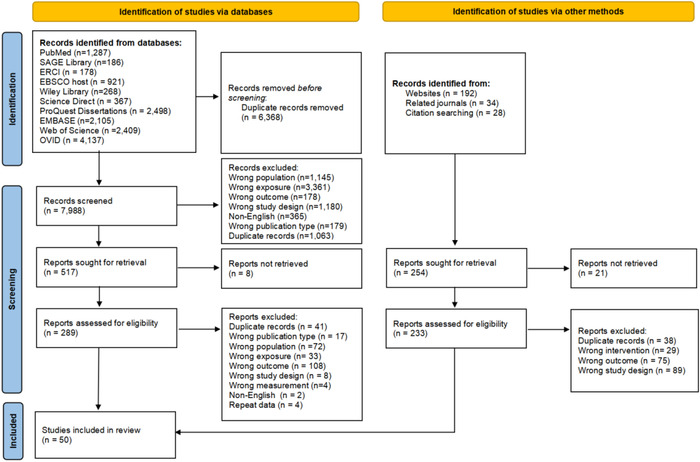
Objective: To evaluate the comprehensive prevalence of anxiety among postgraduates and estimate its changes with a meta‐analysis. Method: Systematic retrieval to SAGE, ERIC, EBSCO, Wiley, ScienceDirect, ProQuest, PubMed, EMBASE, and Web of Science database was performed for quantitative studies on the prevalence of anxiety among graduate students published before November 22, 2022. The prevalence of anxiety synthesized with random‐effects model, and subgroup analysis was conducted by study characteristics (publication year, sampling method, and measurements) and subjects’ characteristics (gender, region, and educational level). Result: Fifty studies were included in the meta‐analysis, totaling 39,668 graduate students. The result revealed that 34.8% of graduates suffered from the anxiety (95% CI: 29.5%–40.5%). Specifically, 19.1% (95% CI: 15.4%–23.5%) had mild anxiety, 15.1% (95% C: 11.6%–19.6%) had moderate anxiety, and 10.3% (95% CI: 7.2%–14.6%) had severe anxiety. And this prevalence showed a upward trend since 2005. Besides, master students suffered slightly less than doctoral students (29.2% vs. 34.3%), and female had similar anxiety to male (26.4% vs. 24.9%). Due to the COVID‐19, the prevalence of anxiety is higher after the pandemic than that before (any anxiety: 34.3% vs. 24.8%). Compared with other countries, students from Saudi Arabia, India, and Nepal were more vulnerable. The results of quality assessment showed that, 5 (10%) were in high quality, 21 (42%) were in moderate to high quality, 21 (42%) were in low to moderate quality, and 3 (6%) were in low quality. But, the studies with low quality tend to report a higher prevalence than that with high quality (40.3% vs. 13.0%), studies with nonrandom sampling tend to report a higher prevalence than that with random sampling (33.6% vs. 20.7%). Although we included the data collected based on the standard scales, there were higher heterogeneity among the measure ( Q = 253.1, df = 12, p < .00). Conclusion: More than one‐third postgraduates suffered from anxiety disorder, and this prevalence had a slight upward trend since 2005, school administrators, teachers and students should take joint actions to prevent mental disorder of graduates for deteriorating.
Overview
AI snapshot
Written from the paper’s full text.
TL;DR
This systematic review and meta-analysis of 50 studies (39,668 graduate students) estimated pooled anxiety prevalence at 34.8% and reported a slight upward trend in any and severe anxiety since 2005. It found high heterogeneity and no significant gender or COVID-19 before/after differences in the main results, though the abstract reports some conflicting subgroup figures.
Key findings
- Pooled any anxiety prevalence was 34.8% (95% CI: 29.5%–40.5%); mild anxiety was 19.1% (95% CI: 15.4%–23.5%), moderate anxiety 15.1% (95% CI: 11.6%–19.6%), and severe anxiety 10.3% (95% CI: 7.2%–14.6%), with significant heterogeneity for any anxiety (Q = 4683.1, p < .00; I² = 98.9%).
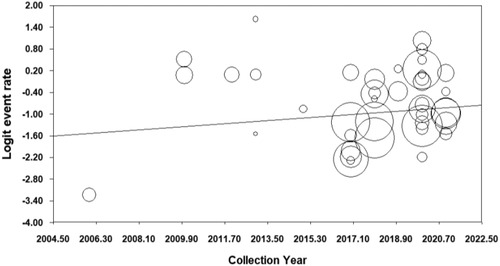
- Meta-regression showed any anxiety increased slightly over time (β = .05, p < .00) and severe anxiety increased (β = .07, p < .00), while mild and moderate anxiety decreased (β = –.07 and β = –.09, respectively, p < .00).
- Subgroup analyses found master’s students had any anxiety prevalence of 29.2% versus 34.3% for doctoral students in the abstract (results text reports 29.2% vs. 34.2%); no significant gender difference was found (any anxiety: 41.2% vs. 35.5%; Q = 0.37, p = .54), and nonrandom sampling reported higher moderate anxiety than random sampling (13.3% vs. 5.9%; Q = 6.88, p = .01).
- The results section found no significant COVID-19 before/after difference in any anxiety (32.4% vs. 36.2%; Q = 0.45, p = .50), while the abstract states higher after-pandemic prevalence (34.3% vs. 24.8%).
Methods
- Systematic review and meta-analysis; searched SAGE, ERIC, EBSCO, Wiley, ScienceDirect, ProQuest, PubMed, EMBASE, and Web of Science through November 22, 2022, including cross-sectional English studies of healthy master’s or doctoral students using standardized anxiety measures; 50 studies totaling 39,668 graduate students were included, with data collected between 2005 and 2021 and 14 measures used.
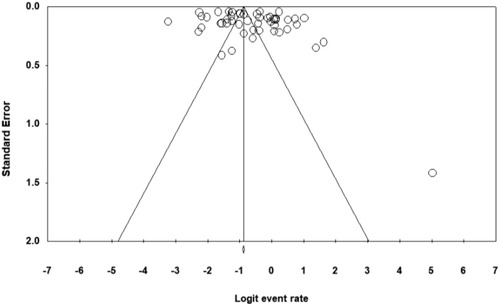
- Random-effects meta-analysis was used, with subgroup analyses by study characteristics (publication year, sampling method, measurement) and subject characteristics (gender, region, educational level), plus meta-regression for trend, leave-one-out sensitivity analysis, funnel plots, and fail-safe N for publication bias.
- Quality was assessed with a modified Newcastle-Ottawa scale; 5 studies (10%) were high quality, 21 (42%) moderate to high, 21 (42%) low to moderate, and 3 (6%) low quality.
Limitations
- Stated by the paper: most participants were assessed through self-report inventories rather than gold-standard diagnostic clinical interviews; different anxiety criteria across self-rating scales caused significant heterogeneity; most included studies used nonrandom sampling, which may overestimate moderate anxiety; and 36% of studies had sample sizes under 300.
- Evident from the text: heterogeneity was very high (I² = 98.9% for any anxiety), and reported figures are inconsistent across sections—e.g., any anxiety 34.8% in the abstract/results versus 34.1% in the discussion, severe anxiety 10.3% versus 1.3%, and conflicting COVID-19 and gender subgroup numbers.
Model-written summary. Check it against the paper before relying on it.
Integrity signals
Registry
Cites
Statistics
Figures
Verification
Claims the paper makes
60 Own result · 7 Own interpretation · 7 No basis given · 6 Sources not found · 4 No full text of the sources · 4 Own method · 3 Check pending · 3 Not checked yet
A result the paper reports from its own data — it cites no other source for it, so there is none to check. The quote shows it is in the paper.
In the paper
“the sample size from 36% studies was under 300”
§ Global prevalence and trend of anxiety among graduate students: A systematic review and meta‐analysis > LIMITATIONS
plain- Asserted: passes — The authors put it forward as true.
- Checkable: passes — It can be checked against evidence.
- Load-bearing: passes — The paper’s conclusions depend on it.
- Based: passes — The paper gives a reason why it holds.
In the paper
“only two response rates in these studies were over 75% (Al‐Shayea, 2014; Negi et al., 2019).”
§ Global prevalence and trend of anxiety among graduate students: A systematic review and meta‐analysis > DISCUSSION
What the sources say
- Not checked — no full text of the sourcecites Al‐Shayea, 2014
- Check pendingcites Negi et al., 2019 source
plain- Asserted: passes — The authors put it forward as true.
- Checkable: passes — It can be checked against evidence.
- Load-bearing: passes — The paper’s conclusions depend on it.
- Based: passes — The paper gives a reason why it holds.
A result the paper reports from its own data — it cites no other source for it, so there is none to check. The quote shows it is in the paper.
In the paper
“These results showed that there was no potential publication bias.”
§ Global prevalence and trend of anxiety among graduate students: A systematic review and meta‐analysis > RESULTS > Publication bias
plain- Asserted: passes — The authors put it forward as true.
- Checkable: passes — It can be checked against evidence.
- Load-bearing: unclear — It is unclear whether the paper’s conclusions depend on it.
- Based: passes — The paper gives a reason why it holds.
- Rests on an assumption: The systematic search captured all relevant studies on anxiety prevalence among graduate students.
A result the paper reports from its own data — it cites no other source for it, so there is none to check. The quote shows it is in the paper.
In the paper
“Meta‐analytic pooling of the prevalence estimates of anxiety was 34.8% (N = 39,668; 95% CI: 29.5%−40.5%), with significant heterogeneity across studies (Q = 4683.1, p < .00; I 2= 98.9%).”
§ Global prevalence and trend of anxiety among graduate students: A systematic review and meta‐analysis > RESULTS > Prevalence of anxiety among graduate students
plainn = 39,668- Asserted: passes — The authors put it forward as true.
- Checkable: passes — It can be checked against evidence.
- Load-bearing: passes — The paper’s conclusions depend on it.
- Based: passes — The paper gives a reason why it holds.
- Rests on an assumption: The different standardized anxiety scales used in the included studies measure a comparable construct and can be pooled.
- Rests on an assumption: The systematic search captured all relevant studies on anxiety prevalence among graduate students.
A result the paper reports from its own data — it cites no other source for it, so there is none to check. The quote shows it is in the paper.
In the paper
“we found a significant heterogeneity due to the different criteria for anxiety across these self‐rating scales.”
§ Global prevalence and trend of anxiety among graduate students: A systematic review and meta‐analysis > LIMITATIONS
plaindirect- Asserted: passes — The authors put it forward as true.
- Checkable: passes — It can be checked against evidence.
- Load-bearing: unclear — It is unclear whether the paper’s conclusions depend on it.
- Based: passes — The paper gives a reason why it holds.
A result the paper reports from its own data — it cites no other source for it, so there is none to check. The quote shows it is in the paper.
In the paper
“especially in severe anxiety (β = .07, p < .00)”
§ Global prevalence and trend of anxiety among graduate students: A systematic review and meta‐analysis > RESULTS > The trend of anxiety prevalence among graduate students
plaindirect- Asserted: passes — The authors put it forward as true.
- Checkable: passes — It can be checked against evidence.
- Load-bearing: passes — The paper’s conclusions depend on it.
- Based: passes — The paper gives a reason why it holds.
- Rests on an assumption: The systematic search captured all relevant studies on anxiety prevalence among graduate students.
A result the paper reports from its own data — it cites no other source for it, so there is none to check. The quote shows it is in the paper.
In the paper
“DASS‐42 had a higher sensitivity of anxiety, especially for mild and moderate anxiety (any anxiety: 8.0%, Q = 528.2, df = 13, p < .00; mild: 36.0%, Q = 253.0, df = 5, p < .00; moderate: 32.0%, Q = 203.0, df = 6, p < .00);”
§ Global prevalence and trend of anxiety among graduate students: A systematic review and meta‐analysis > RESULTS > Prevalence of anxiety mediated by moderators
plaincorrelational- Asserted: passes — The authors put it forward as true.
- Checkable: passes — It can be checked against evidence.
- Load-bearing: unclear — It is unclear whether the paper’s conclusions depend on it.
- Based: passes — The paper gives a reason why it holds.
A result the paper reports from its own data — it cites no other source for it, so there is none to check. The quote shows it is in the paper.
In the paper
“The results of subgroup analysis showed that the studies with nonrandom sampling reported a higher prevalence of moderate anxiety than that with random sampling (any anxiety: 33.6% vs. 2.7%; Q = 3.33, df = 1, p = .07; mild: 2.6% vs. 15.6%; Q = 3.09, df = 1, p = .08; moderate: 13.3% vs. 5.9%; Q = 6.88, df = 1, p = .01; severe: 8.3% vs. 7.5%; Q = 0.01, df = 1, p = .95).”
§ Global prevalence and trend of anxiety among graduate students: A systematic review and meta‐analysis > RESULTS > Prevalence of anxiety mediated by moderators
plain- Asserted: passes — The authors put it forward as true.
- Checkable: passes — It can be checked against evidence.
- Load-bearing: unclear — It is unclear whether the paper’s conclusions depend on it.
- Based: passes — The paper gives a reason why it holds.
The paper states this without a source or data behind it here, so there is nothing to check it against. The quote shows it is in the paper.
In the paper
“Compared with other countries, students from Saudi Arabia, India, and Nepal were more vulnerable.”
§ Global prevalence and trend of anxiety among graduate students: A systematic review and meta‐analysis > Abstract > Result
plaincorrelational- Asserted: passes — The authors put it forward as true.
- Checkable: passes — It can be checked against evidence.
- Load-bearing: unclear — It is unclear whether the paper’s conclusions depend on it.
- Based: passes — The paper gives a reason why it holds.
- Rests on an assumption: The systematic search captured all relevant studies on anxiety prevalence among graduate students.
A result the paper reports from its own data — it cites no other source for it, so there is none to check. The quote shows it is in the paper.
In the paper
“studies with nonrandom sampling tend to report a higher prevalence than that with random sampling (33.6% vs. 20.7%)”
§ Global prevalence and trend of anxiety among graduate students: A systematic review and meta‐analysis > Abstract > Result
hedgedcorrelational- Asserted: passes — The authors put it forward as true.
- Checkable: passes — It can be checked against evidence.
- Load-bearing: unclear — It is unclear whether the paper’s conclusions depend on it.
- Based: passes — The paper gives a reason why it holds.
- Rests on an assumption: The systematic search captured all relevant studies on anxiety prevalence among graduate students.
- It may state two separate claims as one. 12
- Probably not a substantial claim. 15
- The quote only partly states this claim. 3
The paper states this without a source or data behind it here, so there is nothing to check it against. The quote shows it is in the paper.
In the paper
“But the evidence suggested an increasing trend in any and severe anxiety; thus, we still need to keep going to prevent this from getting worse.”
§ Global prevalence and trend of anxiety among graduate students: A systematic review and meta‐analysis > DISCUSSION
hedgedcorrelational- Asserted: passes — The authors put it forward as true.
- Checkable: passes — It can be checked against evidence.
- Load-bearing: passes — The paper’s conclusions depend on it.
- Based: passes — The paper gives a reason why it holds.
It may state two separate claims as one.
A result the paper reports from its own data — it cites no other source for it, so there is none to check. The quote shows it is in the paper.
In the paper
“One reason is that 33 (66%) of the primary studies included were from China and the United States with 33,169 (83.6%) graduate students”
§ Global prevalence and trend of anxiety among graduate students: A systematic review and meta‐analysis > DISCUSSION
plain- Asserted: passes — The authors put it forward as true.
- Checkable: passes — It can be checked against evidence.
- Load-bearing: passes — The paper’s conclusions depend on it.
- Based: passes — The paper gives a reason why it holds.
It may state two separate claims as one.
A result the paper reports from its own data — it cites no other source for it, so there is none to check. The quote shows it is in the paper.
In the paper
“Five of 50 (10.0%) reports were in high quality, 21 (42%) were in moderate to high quality, 21 (42%) were in low to moderate quality, and 3 (6%) were in low quality (Table 1).”
§ Global prevalence and trend of anxiety among graduate students: A systematic review and meta‐analysis > RESULTS > Quality assessment
plain- Asserted: passes — The authors put it forward as true.
- Checkable: passes — It can be checked against evidence.
- Load-bearing: passes — The paper’s conclusions depend on it.
- Based: passes — The paper gives a reason why it holds.
It may state two separate claims as one.
- Rests on an assumption: The systematic search captured all relevant studies on anxiety prevalence among graduate students.
A result the paper reports from its own data — it cites no other source for it, so there is none to check. The quote shows it is in the paper.
In the paper
“14 measures were used in primary studies.”
§ Global prevalence and trend of anxiety among graduate students: A systematic review and meta‐analysis > RESULTS
plain- Asserted: passes — The authors put it forward as true.
- Checkable: passes — It can be checked against evidence.
- Load-bearing: fails — The paper’s conclusions may not depend on it.
- Based: passes — The paper gives a reason why it holds.
Probably not a substantial claim. The paper’s conclusions may not depend on it.
- Rests on an assumption: The systematic search captured all relevant studies on anxiety prevalence among graduate students.
A result the paper reports from its own data — it cites no other source for it, so there is none to check. The quote shows it is in the paper.
In the paper
“The data were collected from the United States (n = 19), the United Kingdom (n = 2), China (n = 15), India (n = 4), Australia (n = 1), Jordan (n = 1), Egypt (n = 1), Poland (n = 1), Croatia (n = 1), South Africa (n = 1), Nepal (n = 1), and Saudi Arabia (n = 1).”
§ Global prevalence and trend of anxiety among graduate students: A systematic review and meta‐analysis > RESULTS
plain- Asserted: passes — The authors put it forward as true.
- Checkable: passes — It can be checked against evidence.
- Load-bearing: unclear — It is unclear whether the paper’s conclusions depend on it.
- Based: passes — The paper gives a reason why it holds.
It may state two separate claims as one.
- Rests on an assumption: The systematic search captured all relevant studies on anxiety prevalence among graduate students.
The paper states this without a source or data behind it here, so there is nothing to check it against. The quote shows it is in the paper.
In the paper
“we found no obviously changing between before and after pandemic.”
§ Global prevalence and trend of anxiety among graduate students: A systematic review and meta‐analysis > DISCUSSION
plain- Asserted: passes — The authors put it forward as true.
- Checkable: passes — It can be checked against evidence.
- Load-bearing: passes — The paper’s conclusions depend on it.
- Based: passes — The paper gives a reason why it holds.
The quote only partly states this claim.
A result the paper reports from its own data — it cites no other source for it, so there is none to check. The quote shows it is in the paper.
In the paper
“The data were collected between 2005 and 2021”
§ Global prevalence and trend of anxiety among graduate students: A systematic review and meta‐analysis > RESULTS
plain- Asserted: passes — The authors put it forward as true.
- Checkable: passes — It can be checked against evidence.
- Load-bearing: fails — The paper’s conclusions may not depend on it.
- Based: passes — The paper gives a reason why it holds.
Probably not a substantial claim. The paper’s conclusions may not depend on it.
- Rests on an assumption: The systematic search captured all relevant studies on anxiety prevalence among graduate students.
A result the paper reports from its own data — it cites no other source for it, so there is none to check. The quote shows it is in the paper.
In the paper
“there were higher heterogeneity among the measure (Q = 253.1, df = 12, p < .00)”
§ Global prevalence and trend of anxiety among graduate students: A systematic review and meta‐analysis > Abstract > Result
plain- Asserted: passes — The authors put it forward as true.
- Checkable: passes — It can be checked against evidence.
- Load-bearing: unclear — It is unclear whether the paper’s conclusions depend on it.
- Based: passes — The paper gives a reason why it holds.
The quote only partly states this claim.
- Rests on an assumption: The different standardized anxiety scales used in the included studies measure a comparable construct and can be pooled.
- Rests on an assumption: The systematic search captured all relevant studies on anxiety prevalence among graduate students.
A result the paper reports from its own data — it cites no other source for it, so there is none to check. The quote shows it is in the paper.
In the paper
“The proportion of females in each study ranged from 34.7% to 100%.”
§ Global prevalence and trend of anxiety among graduate students: A systematic review and meta‐analysis > RESULTS
plain- Asserted: passes — The authors put it forward as true.
- Checkable: passes — It can be checked against evidence.
- Load-bearing: fails — The paper’s conclusions may not depend on it.
- Based: passes — The paper gives a reason why it holds.
Probably not a substantial claim. The paper’s conclusions may not depend on it.
- Rests on an assumption: The systematic search captured all relevant studies on anxiety prevalence among graduate students.
A result the paper reports from its own data — it cites no other source for it, so there is none to check. The quote shows it is in the paper.
In the paper
“students from Saudi Arabia and India experienced most anxiety and students from China and the United States reported lowest anxiety than that from other countries.”
§ Global prevalence and trend of anxiety among graduate students: A systematic review and meta‐analysis > RESULTS > Prevalence of anxiety mediated by moderators
plaincorrelational- Asserted: passes — The authors put it forward as true.
- Checkable: passes — It can be checked against evidence.
- Load-bearing: unclear — It is unclear whether the paper’s conclusions depend on it.
- Based: passes — The paper gives a reason why it holds.
It may state two separate claims as one.
A result the paper reports from its own data — it cites no other source for it, so there is none to check. The quote shows it is in the paper.
In the paper
“The sample size ranged from 40 to 4477, totaling 39,668 graduate students.”
§ Global prevalence and trend of anxiety among graduate students: A systematic review and meta‐analysis > RESULTS
plain- Asserted: passes — The authors put it forward as true.
- Checkable: passes — It can be checked against evidence.
- Load-bearing: fails — The paper’s conclusions may not depend on it.
- Based: passes — The paper gives a reason why it holds.
Probably not a substantial claim. The paper’s conclusions may not depend on it.
- Rests on an assumption: The systematic search captured all relevant studies on anxiety prevalence among graduate students.
A result the paper reports from its own data — it cites no other source for it, so there is none to check. The quote shows it is in the paper.
In the paper
“Five studies were collecting data with random sampling, 27 studies adopted convenience sampling method, and 18 studies did not report the sampling method.”
§ Global prevalence and trend of anxiety among graduate students: A systematic review and meta‐analysis > RESULTS > Prevalence of anxiety mediated by moderators
plain- Asserted: passes — The authors put it forward as true.
- Checkable: passes — It can be checked against evidence.
- Load-bearing: passes — The paper’s conclusions depend on it.
- Based: passes — The paper gives a reason why it holds.
It may state two separate claims as one.
The paper states this without a source or data behind it here, so there is nothing to check it against. The quote shows it is in the paper.
In the paper
“Although there was no obvious change after the COVID‐19 pandemic occurred”
§ Global prevalence and trend of anxiety among graduate students: A systematic review and meta‐analysis > CONCLUSIONS
plain- Asserted: passes — The authors put it forward as true.
- Checkable: passes — It can be checked against evidence.
- Load-bearing: passes — The paper’s conclusions depend on it.
- Based: passes — The paper gives a reason why it holds.
The quote only partly states this claim.
In the paper
“the number of degree holders worldwide will reach 300 million by 2030 (OCED., 2013).”
§ Global prevalence and trend of anxiety among graduate students: A systematic review and meta‐analysis > DISCUSSION
What the sources say
- Not matchedcites OCED., 2013
Couldn’t be matched to a paper in Crossref, so it can’t be checked.
plain- Asserted: passes — The authors put it forward as true.
- Checkable: passes — It can be checked against evidence.
- Load-bearing: fails — The paper’s conclusions may not depend on it.
- Based: passes — The paper gives a reason why it holds.
Probably not a substantial claim. The paper’s conclusions may not depend on it.
- Not matched
A conclusion the paper draws from its own results — it cites no other source for it, so there is none to check. The quote shows it is in the paper.
In the paper
“One reason for this is that the source of anxiety in the graduate student population was similar.”
§ Global prevalence and trend of anxiety among graduate students: A systematic review and meta‐analysis > DISCUSSION
plaindirect- Asserted: passes — The authors put it forward as true.
- Checkable: passes — It can be checked against evidence.
- Load-bearing: passes — The paper’s conclusions depend on it.
- Based: passes — The paper gives a reason why it holds.
Probably not a substantial claim.
In the paper
“based on the survey to 2279 graduate students across 26 countries, Evans et al. (2018) also presented that female suffered more major anxiety than male (43% vs. 34%) (Evans et al., 2018).”
§ Global prevalence and trend of anxiety among graduate students: A systematic review and meta‐analysis > DISCUSSION
What the sources say
- Not checked — no full text of the sourcecites Evans et al., 2018 source
plaincorrelational- Asserted: passes — The authors put it forward as true.
- Checkable: passes — It can be checked against evidence.
- Load-bearing: fails — The paper’s conclusions may not depend on it.
- Based: passes — The paper gives a reason why it holds.
Probably not a substantial claim. The paper’s conclusions may not depend on it.
In the paper
“As reported that, 85% of postgraduate students spent 41+ h a week on their postgraduate program, still, 74% of them were inability to finish studies in the set time, and 79% had uncertainty about their job and career prospects (Woolston, 2019)”
§ Global prevalence and trend of anxiety among graduate students: A systematic review and meta‐analysis > INTRODUCTION
What the sources say
- Not checked — no full text of the sourcecites Woolston, 2019 source
plain- Asserted: passes — The authors put it forward as true.
- Checkable: passes — It can be checked against evidence.
- Load-bearing: fails — The paper’s conclusions may not depend on it.
- Based: passes — The paper gives a reason why it holds.
Probably not a substantial claim. The paper’s conclusions may not depend on it. It may state two separate claims as one.
In the paper
“The factors of anxiety among graduate students are various and universal, such as employment prospects, inability to maintain work–life balance, inability to complete academic tasks on time, high academic competition, and long study period (Woolston, 2019).”
§ Global prevalence and trend of anxiety among graduate students: A systematic review and meta‐analysis > DISCUSSION
What the sources say
- Not checked — no full text of the sourcecites Woolston, 2019 source
plaincorrelational- Asserted: passes — The authors put it forward as true.
- Checkable: passes — It can be checked against evidence.
- Load-bearing: fails — The paper’s conclusions may not depend on it.
- Based: passes — The paper gives a reason why it holds.
Probably not a substantial claim. The paper’s conclusions may not depend on it. It may state two separate claims as one.
What the paper did — it cites no source for this, so there is none to check. The quote shows it is in the paper.
In the paper
“This study was not preregistered.”
§ Global prevalence and trend of anxiety among graduate students: A systematic review and meta‐analysis > METHODS
plain- Asserted: passes — The authors put it forward as true.
- Checkable: passes — It can be checked against evidence.
- Load-bearing: fails — The paper’s conclusions may not depend on it.
- Based: passes — The paper gives a reason why it holds.
Probably not a substantial claim. The paper’s conclusions may not depend on it.
None of the sources cited for this claim have been checked yet.
In the paper
“which is significantly higher than college students (Ramón‐Arbués et al., 2020) and even higher than the medical student population (Quek et al., 2019).”
§ Global prevalence and trend of anxiety among graduate students: A systematic review and meta‐analysis > DISCUSSION
What the sources say
- Not checked yetcites Ramón‐Arbués et al., 2020 source
- Not matchedcites Quek et al., 2019
Couldn’t be matched to a paper in Crossref, so it can’t be checked.
plaincorrelational- Asserted: passes — The authors put it forward as true.
- Checkable: passes — It can be checked against evidence.
- Load-bearing: unclear — It is unclear whether the paper’s conclusions depend on it.
- Based: passes — The paper gives a reason why it holds.
It may state two separate claims as one.
In the paper
“These results are consistent with the previous studies (Evans et al., 2017; Hoying et al., 2020), which revealed the high risk of anxiety disorder among postgraduate students.”
§ Global prevalence and trend of anxiety among graduate students: A systematic review and meta‐analysis > DISCUSSION
What the sources say
- Not matchedcites Evans et al., 2017
Couldn’t be matched to a paper in Crossref, so it can’t be checked.
- Check pendingcites Hoying et al., 2020 source
plain- Asserted: passes — The authors put it forward as true.
- Checkable: passes — It can be checked against evidence.
- Load-bearing: fails — The paper’s conclusions may not depend on it.
- Based: passes — The paper gives a reason why it holds.
Probably not a substantial claim. The paper’s conclusions may not depend on it.
- Not matched
In the paper
“the average share of younger adults with a tertiary degree has increased from 27% in 2000 to 48% in 2021 among 25‐ to 34‐years‐old (OCED., 2022)”
§ Global prevalence and trend of anxiety among graduate students: A systematic review and meta‐analysis > DISCUSSION
What the sources say
- Not matchedcites OCED., 2022
Couldn’t be matched to a paper in Crossref, so it can’t be checked.
plain- Asserted: passes — The authors put it forward as true.
- Checkable: passes — It can be checked against evidence.
- Load-bearing: fails — The paper’s conclusions may not depend on it.
- Based: passes — The paper gives a reason why it holds.
Probably not a substantial claim. The paper’s conclusions may not depend on it.
- Not matched
A conclusion the paper draws from its own results — it cites no other source for it, so there is none to check. The quote shows it is in the paper.
In the paper
“This change of talent pool brings lots of pressure to master students, and they may lose their advantage from academic qualification in the job marketing in the future, which pushes them to pursue higher degree.”
§ Global prevalence and trend of anxiety among graduate students: A systematic review and meta‐analysis > DISCUSSION
hedgedconditional- Asserted: passes — The authors put it forward as true.
- Checkable: fails — It may be too vague to check against evidence.
- Load-bearing: fails — The paper’s conclusions may not depend on it.
- Based: passes — The paper gives a reason why it holds.
Probably not a substantial claim. It may be too vague to check against evidence. The paper’s conclusions may not depend on it. It may state two separate claims as one.
In the paper
“As the report from WHO indicated that more women are affected by mental illness than men (WHO, 2017)”
§ Global prevalence and trend of anxiety among graduate students: A systematic review and meta‐analysis > DISCUSSION
What the sources say
- Not matchedcites WHO, 2017
Couldn’t be matched to a paper in Crossref, so it can’t be checked.
hedgedcorrelational- Asserted: passes — The authors put it forward as true.
- Checkable: passes — It can be checked against evidence.
- Load-bearing: fails — The paper’s conclusions may not depend on it.
- Based: passes — The paper gives a reason why it holds.
Probably not a substantial claim. The paper’s conclusions may not depend on it.
- Not matched
In the paper
“Convenience sample is drawn from a source that is conveniently accessible to researchers, but may not be representative of the population at large (Andrade, 2020).”
§ Global prevalence and trend of anxiety among graduate students: A systematic review and meta‐analysis > DISCUSSION
What the sources say
- Not matchedcites Andrade, 2020
Couldn’t be matched to a paper in Crossref, so it can’t be checked.
hedgedconditional- Asserted: passes — The authors put it forward as true.
- Checkable: passes — It can be checked against evidence.
- Load-bearing: passes — The paper’s conclusions depend on it.
- Based: passes — The paper gives a reason why it holds.
Probably not a substantial claim. It may state two separate claims as one.
- Not matched
What the paper did — it cites no source for this, so there is none to check. The quote shows it is in the paper.
In the paper
“majority of included studies adopted nonrandom sampling; as mentioned above, this may overestimate the prevalence of moderate anxiety.”
§ Global prevalence and trend of anxiety among graduate students: A systematic review and meta‐analysis > LIMITATIONS
hedgedconditional- Asserted: passes — The authors put it forward as true.
- Checkable: passes — It can be checked against evidence.
- Load-bearing: unclear — It is unclear whether the paper’s conclusions depend on it.
- Based: passes — The paper gives a reason why it holds.
It may state two separate claims as one.
The paper relies on this without support.
The trajectory of change in anxiety prevalence among graduate students remained unclear before this review.
“and the trajectory of the change remained unclear.”
The paper relies on this without support.
The year of data collection accurately reflects whether the study was conducted before or after the COVID-19 pandemic.
“To explore the effect of COVID‐19, we compared the prevalence of anxiety between before pandemic (before 202) and after (2020–2021) based on the data collection year.”
The paper relies on this without support.
The different standardized anxiety scales used in the included studies measure a comparable construct and can be pooled.
“Although we included the data collected based on the standard scales, there were higher heterogeneity among the measure (Q = 253.1, df = 12, p < .00).”
The paper relies on this without support.
The systematic search captured all relevant studies on anxiety prevalence among graduate students.
“Systematic retrieval of the electronic database was performed, including SAGE, ERIC, EBSCO, Wiley, ScienceDirect, ProQuest, PubMed, EMBASE, and Web of Science database.”
Claims other papers make about this one
Each is checked against this paper’s own text: does it say what the citing paper says it does?
The source backs part of the claim, not all of it — or backs it for a different population, condition or comparison.
In the citing paper
“In contrast, sample-level moderators such as national income level, gender and calendar year showed no consistent effects.”
From Prevalence and severity of mental health problems in early-career researchers: a systematic review and meta-analysis (2026) · cites this paper as [9]
Experimental — accuracy not yet measuredThe source backs part of the claim, not all of it — or backs it for a different population, condition or comparison.
In the citing paper
“recent studies suggest that this population experiences a disproportionate degree of psychological distress, including clinically defined syndromes such as depression, generalized anxiety disorder (GAD) and burnout, or individual symptoms such as stress, poor sleep and suicidal ideation1,9–11.”
From Prevalence and severity of mental health problems in early-career researchers: a systematic review and meta-analysis (2026) · cites this paper as [9]
Experimental — accuracy not yet measuredIn the citing paper
“These studies identified several study-level moderators. Prevalence estimates were generally lower in studies with random sampling and higher study quality, and both prevalence and severity estimates varied depending on which type of measurement scale was used.”
From Prevalence and severity of mental health problems in early-career researchers: a systematic review and meta-analysis (2026) · cites this paper as [9]
In the citing paper
“Despite the growing literature on this topic35–42, most reviews and meta-analyses have focused on depression, anxiety or suicidal ideation, with prevalence and severity estimates limited to depression10 and GAD9.”
From Prevalence and severity of mental health problems in early-career researchers: a systematic review and meta-analysis (2026) · cites this paper as [9]
In the citing paper
“To date, only two meta-analyses have empirically examined such moderators—and only in relation to depressive10 and anxiety symptoms9.”
From Prevalence and severity of mental health problems in early-career researchers: a systematic review and meta-analysis (2026) · cites this paper as [9]
In the citing paper
“Average symptom severity typically falls in the mild range9–11.”
From Prevalence and severity of mental health problems in early-career researchers: a systematic review and meta-analysis (2026) · cites this paper as [9]
In the citing paper
“Our findings are broadly consistent with those of other meta-analyses, but they fall on the higher end of previously reported ranges of 21–24% for depressive symptoms and 17–30% for anxiety symptoms9–11.”
From Prevalence and severity of mental health problems in early-career researchers: a systematic review and meta-analysis (2026) · cites this paper as [9]
Self-check
Percentages, sums and reported differences re-computed from the paper’s own numbers.
Each contradiction between two passages listed here was confirmed by an independent check.
Rated major: it would touch a result — a value a result rests on, reported and recomputed p-values on opposite sides of the significance level, two passages that conflict with no sign which is right, or a cited work retracted before this paper was published.
In the paper
§ Global prevalence and trend of anxiety among graduate students: A systematic review and meta‐analysis > RESULTS > The trend of anxiety prevalence among graduate students
“moderate anxiety: 21.5% vs. 12.5%; Q = 3.19, df = 1, p = .07;”
§ Global prevalence and trend of anxiety among graduate students: A systematic review and meta‐analysis > RESULTS > Prevalence of anxiety among graduate students
“| before | 20 | 0.362 | 0.287 | 0.443 | 99.02 | 12 | 0.224 | 0.180 | 0.275 | 85.46 | 9 | 0.177 | 0.127 | 0.241 | 87.59 |”
Rated major: it would touch a result — a value a result rests on, reported and recomputed p-values on opposite sides of the significance level, two passages that conflict with no sign which is right, or a cited work retracted before this paper was published.
In the paper
§ Global prevalence and trend of anxiety among graduate students: A systematic review and meta‐analysis > RESULTS > The trend of anxiety prevalence among graduate students
“moderate anxiety: 21.5% vs. 12.5%; Q = 3.19, df = 1, p = .07;”
§ Global prevalence and trend of anxiety among graduate students: A systematic review and meta‐analysis > RESULTS > Prevalence of anxiety among graduate students
“| COVID‐19 | | | Q = 0.452 | Q = 0.452 | 98.96 | | | Q = 1.210 | Q = 1.210 | 95.86 | | | Q = 1.683 | Q = 1.683 | 96.10 |”
Rated major: it would touch a result — a value a result rests on, reported and recomputed p-values on opposite sides of the significance level, two passages that conflict with no sign which is right, or a cited work retracted before this paper was published.
In the paper
§ Global prevalence and trend of anxiety among graduate students: A systematic review and meta‐analysis > Abstract > Result
“Due to the COVID‐19, the prevalence of anxiety is higher after the pandemic than that before (any anxiety: 34.3% vs. 24.8%).”
§ Global prevalence and trend of anxiety among graduate students: A systematic review and meta‐analysis > RESULTS > Prevalence of anxiety among graduate students
“| before | 20 | 0.362 | 0.287 | 0.443 | 99.02 |”
Rated major: it would touch a result — a value a result rests on, reported and recomputed p-values on opposite sides of the significance level, two passages that conflict with no sign which is right, or a cited work retracted before this paper was published.
In the paper
§ Global prevalence and trend of anxiety among graduate students: A systematic review and meta‐analysis > Abstract > Result
“female had similar anxiety to male (26.4% vs. 24.9%).”
§ Global prevalence and trend of anxiety among graduate students: A systematic review and meta‐analysis > RESULTS > Prevalence of anxiety among graduate students
“| female | 16 | 0.412 | 0.291 | 0.544 | 98.88 |”
Rated minor: it would not touch a result — a value no result rests on, a p-value that stays on the same side of the significance level, or a conflict that is clerical, resolved elsewhere in the paper, or outside its own findings.
In the paper
§ Global prevalence and trend of anxiety among graduate students: A systematic review and meta‐analysis > RESULTS > Quality assessment
“Five of 50 (10.0%) reports were in high quality, 21 (42%) were in moderate to high quality, 21 (42%) were in low to moderate quality, and 3 (6%) were in low quality (Table 1).”
§ Global prevalence and trend of anxiety among graduate students: A systematic review and meta‐analysis > RESULTS > Prevalence of anxiety among graduate students
“| H | 3 | 0.130 | 0.066 | 0.241 | 94.60 |”
Rated minor: it would not touch a result — a value no result rests on, a p-value that stays on the same side of the significance level, or a conflict that is clerical, resolved elsewhere in the paper, or outside its own findings.
In the paper
§ Global prevalence and trend of anxiety among graduate students: A systematic review and meta‐analysis > RESULTS > Prevalence of anxiety mediated by moderators
“severe: 14.7% vs. 13.5%, Q = 0.05, p = .82”
§ Global prevalence and trend of anxiety among graduate students: A systematic review and meta‐analysis > RESULTS > Prevalence of anxiety among graduate students
“| Master | 9 | 0.292 | 0.180 | 0.437 | 99.01 | 2 | 0.237 | 0.212 | 0.263 | .00 | 1 | 0.261 | 0.216 | 0.311 | / | 6 | 0.135 |”
Rated minor: it would not touch a result — a value no result rests on, a p-value that stays on the same side of the significance level, or a conflict that is clerical, resolved elsewhere in the paper, or outside its own findings.
In the paper
§ Global prevalence and trend of anxiety among graduate students: A systematic review and meta‐analysis > RESULTS > The trend of anxiety prevalence among graduate students
“between before pandemic (before 202) and after (2020–2021) based on the data collection year. The results showed that there was no significant difference of the anxiety prevalence (any anxiety: 32.4% vs. 36.2%;”
§ Global prevalence and trend of anxiety among graduate students: A systematic review and meta‐analysis > RESULTS > Prevalence of anxiety among graduate students
“| before | 20 | 0.362 | 0.287 | 0.443 | 99.02 |”
Rated minor: it would not touch a result — a value no result rests on, a p-value that stays on the same side of the significance level, or a conflict that is clerical, resolved elsewhere in the paper, or outside its own findings.
In the paper
§ Global prevalence and trend of anxiety among graduate students: A systematic review and meta‐analysis > DISCUSSION
“19.1% had mild anxiety, 15.1% moderate anxiety, and 1.3% had severe anxiety,”
§ Global prevalence and trend of anxiety among graduate students: A systematic review and meta‐analysis > RESULTS > Prevalence of anxiety among graduate students
“and 10.3% severe anxiety (K = 25, N = 1850; 95% CI: 7.2%–14.6%; Q = 889.7, p < .00; I 2= 97.3%).”
Rated minor: it would not touch a result — a value no result rests on, a p-value that stays on the same side of the significance level, or a conflict that is clerical, resolved elsewhere in the paper, or outside its own findings.
In the paper
§ Global prevalence and trend of anxiety among graduate students: A systematic review and meta‐analysis > RESULTS > Prevalence of anxiety mediated by moderators
“any anxiety: 8.0%, Q = 528.2, df = 13, p < .00;”
§ Global prevalence and trend of anxiety among graduate students: A systematic review and meta‐analysis > RESULTS > Prevalence of anxiety among graduate students
“| DASS‐42 | 1 | 0.800 | 0.667 | 0.889 |”
Rated minor: it would not touch a result — a value no result rests on, a p-value that stays on the same side of the significance level, or a conflict that is clerical, resolved elsewhere in the paper, or outside its own findings.
In the paper
§ Global prevalence and trend of anxiety among graduate students: A systematic review and meta‐analysis > RESULTS > Prevalence of anxiety mediated by moderators
“severe: 7.7% vs. 1.3%).”
§ Global prevalence and trend of anxiety among graduate students: A systematic review and meta‐analysis > RESULTS > Prevalence of anxiety among graduate students
“and 10.3% severe anxiety (K = 25, N = 1850; 95% CI: 7.2%–14.6%; Q = 889.7, p < .00; I 2= 97.3%).”
Rated minor: it would not touch a result — a value no result rests on, a p-value that stays on the same side of the significance level, or a conflict that is clerical, resolved elsewhere in the paper, or outside its own findings.
In the paper
§ Global prevalence and trend of anxiety among graduate students: A systematic review and meta‐analysis > RESULTS > Prevalence of anxiety mediated by moderators
“mild: 2.6% vs. 15.6%; Q = 3.09, df = 1, p = .08;”
§ Global prevalence and trend of anxiety among graduate students: A systematic review and meta‐analysis > RESULTS > Prevalence of anxiety among graduate students
“| Nonrandom | 27 | 0.336 | 0.264 | 0.416 | 99.17 | 12 | 0.206 |”
Rated minor: it would not touch a result — a value no result rests on, a p-value that stays on the same side of the significance level, or a conflict that is clerical, resolved elsewhere in the paper, or outside its own findings.
In the paper
§ Global prevalence and trend of anxiety among graduate students: A systematic review and meta‐analysis > DISCUSSION
“And the results indicated that 34.1% of them suffered from different degrees of anxiety.”
§ Global prevalence and trend of anxiety among graduate students: A systematic review and meta‐analysis > RESULTS > Prevalence of anxiety among graduate students
“Meta‐analytic pooling of the prevalence estimates of anxiety was 34.8% (N = 39,668; 95% CI: 29.5%−40.5%),”
Cited works that were retracted
Works this paper cites that were later retracted, from the retraction notices publishers deposit. Major when the notice came out before this paper was published.
Rated major: it would touch a result — a value a result rests on, reported and recomputed p-values on opposite sides of the significance level, two passages that conflict with no sign which is right, or a cited work retracted before this paper was published.
In the paper
“10.1093/tbm/ibab030”
Cited work 10.1093/tbm/ibab030 · retracted 2022-05-05 · notice 10.1093/tbm/ibac010 · this paper published 2023-02-27
Citations
Cites
1 retracted
Coley, R. L., & Baum, C. F. (2021) · Translational Behavioral Medicine · doi:10.1093/tbm/ibab030 · Cited by 39
RetractedQuantifying heterogeneity in a meta‐analysis
Higgins, J. P. T., & Thompson, S. G. (2002) · Statistics in Medicine · doi:10.1002/sim.1186 · Cited by 36,763
Borenstein, M., Hedges, L. V., Higgins, J. P. T., & Rothstein, H. R. (2009) · doi:10.1002/9780470743386 · Cited by 14,225
The file drawer problem and tolerance for null results.
Rosenthal, R. (1979) · Psychological Bulletin · doi:10.1037/0033-2909.86.3.638 · Cited by 9,068
Anxiety and cognitive performance: Attentional control theory
Eysenck, M. W., Derakshan, N., Santos, R., & Calvo, M. G. (2007) · Emotion · doi:10.1037/1528-3542.7.2.336 · Cited by 5,289 · cited 1×
“In addition to intense feelings of fear or panic, peoplewho sufferedanxiety distress may experience other physical symptoms, such as fatigue, dizziness, headache, nausea, abdominal pain, palpitations, shortness of breath, and urinary incontinence (Eysenck et al., 2007; Moran, 2016).”
BackgroundAnxiety disorders in primary care: prevalence, impairment, comorbidity, and detection
Kroenke, K., Spitzer, R. L., Williams, J. B. W., Monahan, P. O., & Löwe, B. (2007) · Annals of Internal Medicine · doi:10.7326/0003-4819-146-5-200703060-00004 · Cited by 4,741
The Handbook of Research Synthesis and Meta-Analysis
(2019) · doi:10.7758/9781610448864 · Cited by 4,553
Education at a glance: OECD indicators, 2002
(2003) · Choice Reviews Online · doi:10.5860/choice.40-4369 · Cited by 2,758
Prevalence and correlates of depression, anxiety, and suicidality among university students
Eisenberg, D., Gollust, S. E., Golberstein, E., & Hefner, J. L. (2007) · American Journal of Orthopsychiatry · doi:10.1037/0002-9432.77.4.534 · Cited by 1,592
Evidence for a mental health crisis in graduate education
Evans, T. M., Bira, L., Gastelum, J. B., Weiss, L. T., & Vanderford, N. L. (2018) · Nature Biotechnology · doi:10.1038/nbt.4089 · Cited by 1,441
Cited by
Sorted by citations
Efstathiou, M., Kakaidi, V., Tsitsas, G. D., Mantzoukas, S., Gouva, M., & Dragioti, E. (2025) · International Journal of Nursing Studies · doi:10.1016/j.ijnurstu.2025.104993 · Cited by 72
Alalalmeh, S. O., Hegazi, O. E., Shahwan, M. J., Hassan, N., Alnuaimi, G. R. H., Alaila, R. F. F., Jairoun, A. A., Hamdi, Y. T., Abdullah, M. T., Abdullah, R. M., et al. (2024) · Saudi Pharmaceutical Journal · doi:10.1016/j.jsps.2024.101987 · Cited by 63
Addressing the decline in graduate students’ mental well-being
SenthilKumar, G., Mathieu, N. M., Freed, J. K., Sigmund, C. D., & Gutterman, D. D. (2023) · American Journal of Physiology-Heart and Circulatory Physiology · doi:10.1152/ajpheart.00466.2023 · Cited by 60
Sivertsen, B., Knudsen, A. K., Kirkøen, B., Skogen, J. C., Lagerstrøm, B. O., Lønning, K.-J., Kessler, R. C., & Reneflot, A. (2023) · The Lancet Regional Health - Europe · doi:10.1016/j.lanepe.2023.100732 · Cited by 49
White, N., Milicev, J., Bradford, D. R. R., Rodger, A., & Gardani, M. (2023) · Higher Education · doi:10.1007/s10734-023-01061-5 · Cited by 46
PhD candidates’ and supervisors’ wellbeing and experiences of supervision
Tikkanen, L., Ketonen, E. E., Toom, A., & Pyhältö, K. (2024) · Higher Education · doi:10.1007/s10734-024-01385-w · Cited by 29
Sivertsen, B., Skogen, J. C., Reneflot, A., Knapstad, M., Smith, O. R. F., Aarø, L. E., Kirkøen, B., Lagerstrøm, B. O., & Knudsen, A. K. (2024) · Clinical Psychology in Europe · doi:10.32872/cpe.13275 · Cited by 25
Behind the graduate mental health crisis in science
Busch, C. A., Wiesenthal, N. J., Gin, L. E., & Cooper, K. M. (2024) · Nature Biotechnology · doi:10.1038/s41587-024-02457-z · Cited by 23
Lubega, N., Anderson, A., & Nelson, N. C. (2023) · PLoS ONE · doi:10.1371/journal.pone.0293584 · Cited by 16
Dechant, M., Lash, E., Shokr, S., & O’Driscoll, C. (2025) · JMIR Formative Research · doi:10.2196/74411 · Cited by 14
Sivertsen, B., Skogen, J. C., Petrie, K. J., O’Connor, R. C., Knudsen, A. K., Kirkøen, B., Reneflot, A., Lønning, K.-J., & Hysing, M. (2025) · The British Journal of Psychiatry · doi:10.1192/bjp.2025.10435 · Cited by 12
Ding, Y., Guo, X., Wang, R., Xu, L., Hou, S., & Chang, F. (2025) · BMC Nursing · doi:10.1186/s12912-025-03535-6 · Cited by 10
Jiang, B., Zhang, J., Yang, M., Zhang, X., & Yang, H. (2025) · World Journal of Psychiatry · doi:10.5498/wjp.v15.i6.106451 · Cited by 9
Xie, T., Huang, Z., Tan, Y., & Tan, T. (2024) · Frontiers in Public Health · doi:10.3389/fpubh.2024.1360119 · Cited by 8
Neyazi, A., Rahimi, B. A., Mohammadi, A. Q., Razaqi, N., Qanawezi, L., Sarem, S., Said, S., Tabib, R. M., Afzali, H., Neyazi, M., et al. (2024) · Sleep Epidemiology · doi:10.1016/j.sleepe.2024.100102 · Cited by 8
Sivertsen, B., Hysing, M., & Bøe, T. (2025) · BJPsych Open · doi:10.1192/bjo.2025.10878 · Cited by 6
This Is How I Felt: Crafting Conductive Wool Artefacts as an Embodied Practice to Regulate Anxiety
Economidou, E. (2025) · International Conference on Tangible, Embedded, and Embodied Interaction (TEI) · doi:10.1145/3689050.3706011 · Cited by 5
Wang, X., Yang, X., & Li, X. (2025) · Frontiers in Psychiatry · doi:10.3389/fpsyt.2025.1482079 · Cited by 5
Suicide among national university graduate students in Japan from 2002 to 2021
Marutani, T., Yasumi, K., Saito, K., Ibaraki, T., & Takayama, J. (2024) · Psychiatry and Clinical Neurosciences Reports · doi:10.1002/pcn5.180 · Cited by 5
Duffy, J., Cole, S. N., Charura, D., & Shevchenko, J. (2024) · Identity · doi:10.1080/15283488.2024.2390148 · Cited by 5
Bruce, E., Halladay, J. E., Pathiranawasam, S., & Munn, C. (2025) · Mental Health & Prevention · doi:10.1016/j.mhp.2025.200433 · Cited by 4
The association between autism, camouflaging and anxiety with suicidal ideation in women
Zubizarreta, S. C.-P., Cruz, S., Pozo-Rodríguez, M., Suárez‐Rama, J. J., Díaz-Hernández, A., Carracedo, Á., Tubío-Fungueiriño, M., & Fernández‐Prieto, M. (2026) · Frontiers in Psychology · doi:10.3389/fpsyg.2025.1685845 · Cited by 4
Jahanaray, M., Pasha, A., & Jahanaray, A. (2026) · Journal of American College Health · doi:10.1080/07448481.2025.2611276 · Cited by 4
Qian, M., Xu, Z., & Yan, C. (2026) · Behavioral Sciences · doi:10.3390/bs16020217 · Cited by 4
Zhu, L., Gong, L., Hu, K., Niu, J. X., Wang, S., Yang, P., Zhang, Q., & Zhang, Y. (2025) · Journal of Affective Disorders · doi:10.1016/j.jad.2025.119722 · Cited by 4
Social Support for Psychology Masters Students Who Live Away from Home: A Case Study
Monica, R., Abidin, Z., Lubis, F. Y., & Novita, S. (2025) · Psyche 165 Journal · doi:10.35134/jpsy165.v18i2.528 · Cited by 4
Nunnink, M., Ballester, L., Vilagut, G., Alayo, I., Mortier, P., Almenara, J., Cebrià, A. I., Gabilondo, A., Gili, M., Lagares, C., et al. (2025) · Journal of Affective Disorders · doi:10.1016/j.jad.2025.120058 · Cited by 4
Sharma, B., Shrestha, N., & Sah, S. K. (2023) · Journal of Nepal Medical Association · doi:10.31729/jnma.8133 · Cited by 4
Maia‐Lima, M. P., Ferreira, L. M., Nascimento, J. P. S., Trezena, S., de Oliveira, F. E. S., de Sousa, Á. A. D., Martelli, D. R. B., Alves, F. A., Almeida, J. D., dos Santos, J. N., et al. (2025) · Oral Surgery Oral Medicine Oral Pathology and Oral Radiology · doi:10.1016/j.oooo.2025.10.006 · Cited by 3
Exploring Success Factors for Underserved Graduate Students in STEM
Collier, K. M., & Hickman, W. A. (2025) · Trends in Higher Education · doi:10.3390/higheredu4040063 · Cited by 3
XIE, S., Yu, S., & Xu, L. (2026) · Frontiers in Psychology · doi:10.3389/fpsyg.2026.1794711 · Cited by 3
Ghiyamihoor, F., Rad, A. A., Hassanifar, P., Kaur, R., Patel, J. H., Kim, I., Marzban, A., Mehdizadeh, M., Levin, D. B., Ghavami, S., et al. (2026) · Molecular Neurobiology · doi:10.1007/s12035-026-05895-9 · Cited by 3
Dreisoerner, A., Goetz, V., Frohnmayer, D., Tran, U. S., Voracek, M., & Nater, U. M. (2026) · Nature Human Behaviour · doi:10.1038/s41562-026-02505-5 · Cited by 2
Muragod, A. R., Jadav, K., Dalal, J. R., & Joshi, V. (2024) · Indian Journal of Physical Therapy and Research · doi:10.4103/ijptr.ijptr_38_24 · Cited by 2
Parkhouse, A. R., House, P., Tsegah, D., & Ghosh, C. (2026) · Preventive Medicine Reports · doi:10.1016/j.pmedr.2026.103424 · Cited by 2
Fostering Graduate Student Engagement for the Future of Career Development
Ho, C. T. Y., & Manoliu, A. (2023) · Canadian Journal of Career Development · doi:10.53379/cjcd.2023.381 · Cited by 2
Elliot, T. R., & Aaen, S. B. (2025) · Journal of Problem Based Learning in Higher Education · doi:10.54337/ojs.jpblhe.v13i1.9827 · Cited by 2
Nurse Practitioner Well-Being and Self-Care When Pursuing Graduate Education
Cheatham, L. S., Oyeleye, O. A., & Ethington, M. D. (2025) · The Journal for Nurse Practitioners · doi:10.1016/j.nurpra.2024.105307 · Cited by 1
Li, Z., & Deng, W. (2025) · Frontiers in Psychology · doi:10.3389/fpsyg.2025.1473555 · Cited by 1
Saputro, G. G., Elisabeth, G., & Khansa, G. (2025) · Dinasti International Journal of Economics Finance & Accounting · doi:10.38035/dijefa.v6i3.4654 · Cited by 1
Underlying Causes of Research Anxiety among Grade 12 Academic Track Senior High Students
Barrios, B. G., Lobiano, N. G., Pespeñan, R. P., & Cababat, J. E. (2025) · Psychology and Education A Multidisciplinary Journal · doi:10.70838/pemj.441003 · Cited by 1
AlBalushi, A. R. S. I., Kadir, M. R. A., & Javed, S. (2025) · International Journal of Accounting and Economics Studies · doi:10.14419/fq1rxz47 · Cited by 1
Chen, L., Li, A., Chen, W., Wang, H., Zhou, J., & Sun, M. (2025) · Frontiers in Public Health · doi:10.3389/fpubh.2025.1672415 · Cited by 1
Pedrollo, L. F. S., Miasso, A. I., Molina, N. P. F. M., Donato, G. D., & Vedana, K. G. G. (2025) · Mental Illness · doi:10.1155/mij/1245527 · Cited by 1
A review on dental environment stress among dental students and factors affecting them
Singh, S., Singh, H., Singh, H., Bagadi, S., Mulliqi, A., & Nischal, V. (2025) · Journal of Dental Health Oral Disorders and Therapy · doi:10.15406/jdhodt.2025.16.00644 · Cited by 1
Huang, L., Kou, J., Zhang, Y., Chen, N., Jin, C., Zhou, X., & Wu, Y. (2026) · BMC Medical Education · doi:10.1186/s12909-026-09761-z · Cited by 1
Lei, J., Jiao, Y., Wang, J., Li, L., Chen, G., & Chen, H. (2026) · Nurse Education Today · doi:10.1016/j.nedt.2026.107249 · Cited by 1
DataVersify: A Framework for Data Literacy Instruction Featuring Scientist Stories
Schultheis, E. H., Bellard, R. S., Costello, R. A., Graham, C. D. K., Kjelvik, M. K., Thadi, A., & Ballen, C. J. (2026) · Integrative Organismal Biology · doi:10.1093/iob/obag045 · Cited by 1
EFFECT OF THIAMINE, BMI, SLEEP DURATION, AND ANXIETY IN NEUROTIC, STRESS, AND SOMATOFORM DISORDER
Pertiwi, L. M., Fanani, M., & Hikmayani, N. H. (2023) · Muhammadiyah International Public Health and Medicine Proceeding · doi:10.61811/miphmp.v3i1.395 · Cited by 1
Holding up a mirror: The mental health and well-being of academic psychologistsPreprint
Devendorf, A. R., Disabato, D. J., Nauphal, M., Rottenberg, J. A., & Victor, S. E. (2025) · PsyArXiv (OSF Preprints) · doi:10.31234/osf.io/p2nck_v1 · Cited by 1
Estudo da conectividade funcional entre cérebros de pessoas em cooperação
Bazán, P. R. (2023) · Digital Library of Theses and Dissertations (Universidade de São Paulo) · doi:10.11606/t.5.2023.tde-18122023-125751
Influencing Factors and Countermeasures of Academic Anxiety of Contemporary Graduate Students
樊, 兰. (2024) · Advances in Psychology · doi:10.12677/ap.2024.144241
FLOATing through stress: Virtual reality reduces anxiety in a randomized controlled trialPreprint
Enav, Y., Bahar, N., Fonar, Y., Lurie, I., & Mayer, Y. (2024) · Research Square · doi:10.21203/rs.3.rs-4738745/v1
Exploring life skills, research adaptation, and team building among basic medical postgraduates
Zhang, Q., Yuan, X. Q., Liu, Z., Liu, J., Ousmane, D., & Wang, J. (2025) · Frontiers in Medicine · doi:10.3389/fmed.2025.1638333
Finserås, T. R., Skogen, J. C., Hygen, B. W., Knudsen, A. K., & Sivertsen, B. (2025) · International Journal of Mental Health and Addiction · doi:10.1007/s11469-025-01576-1
da Silva, C. C., Jacinto, L. A., Silveira, M. T. P., Trindade, T. P. B., Amaral, J. D. O., Veras, H. D. A., & LEITE, A. P. (2025) · Aurum Editora eBooks · doi:10.63330/livroautoral172025-005
Brassolatti, A. C. M., Costa, L. T. T., & Purgatto, E. (2023) · doi:10.11606/003193570
A saúde mental dos pós-graduandos no contexto da pandemia da COVID-19: revisão de escopo.
Donato, G. D., Zanardo, A. B. R., Molina, N. P. F. M., Alves, V. D. M., Vedana, K. G. G., & Miasso, A. I. (2025) · PsicoFAE/Revista PsicoFAE · doi:10.55388/psicofae.v14n2.525
Understanding Graduate Student Experiences in Criminal Justice & Criminology Programs
Gunnison, E. (2026) · Journal of Criminal Justice Education · doi:10.1080/10511253.2026.2618729
Scalora, S. C., Lechich, S., DePasquale, A., Geramian, H., Blodget, K., Ilieva, I. P., Temkin, A. B., & Marino, P. (2026) · Journal of Psychiatric Research · doi:10.1016/j.jpsychires.2026.01.062
Sang, Y., Wang, X., Jiang, J., Zeng, Z., Huang, Y., & Lun, L. I. (2026) · Frontiers in Psychology · doi:10.3389/fpsyg.2026.1754190
Martin, L., Mason, H. D., & Nel, J. A. (2026) · Journal of Psychology in Africa · doi:10.32604/jpa.2026.073424
Garcia, N. B. V. (2025) · LA Referencia (Red Federada de Repositorios Institucionales de Publicaciones Científicas)
Neubert, M. (2026) · Higher Education Studies · doi:10.5539/hes.v16n3p22
Qi, X., Liang, L., Yuan, J., Luo, Y., Xu, J., & Meng, H. (2026) · Journal of Affective Disorders · doi:10.1016/j.jad.2026.122013
Duan, S., McNary, S. W., Hsieh, C.-J., Dong, L., Watson, S. L., Jiang, S., Xu, F., & Yu, J. H. (2026) · Journal of American College Health · doi:10.1080/07448481.2026.2678239
Culture and Emotion in Educational Dynamics, volume V
(2026) · Frontiers research topics · doi:10.3389/978-2-8325-7906-0
Effects of therapeutic horticulture on stress and anxiety in undergraduate vs. graduate students
Diehl, E. R. M., & Knudsen, E. (2026) · Landscape Architecture and Sustainability · doi:10.1016/j.las.2026.100046
Martini, L. (2026) · VTechWorks (Virginia Tech)
A grounded theory of burnout and success stories in psychology graduate school
Almaawali, M. S., Shindi, Y. A. A., Khalaf, M. A., & Zhai, Y. (2026) · Journal of Interdisciplinary Studies in Education · doi:10.32674/paw3ea90
Salinas, L. E. C., Ballesteros, M. A. A., Reyes, C. J. S., Ureña, G. A. B., & Mercy, F. S. C. (2026) · European Journal of Investigation in Health Psychology and Education · doi:10.3390/ejihpe16070092
Wu, B., Zhang, J., Xu, R., Zhang, Y., Wang, D., & Luo, X. (2026) · Critical Public Health · doi:10.1080/09581596.2026.2686459
Innovative Models for Community Health: Integrative Approaches to Public Health and Wellness
(2026) · Frontiers research topics · doi:10.3389/978-2-8325-8323-4
Liu, Z., Zhang, C., Wang, K., Wang, X., & Liu, D. (2026) · Journal of Food Composition and Analysis · doi:10.1016/j.jfca.2026.109418
Zhang, L., Xu, C.-Y., Zhang, Y.-S., Li, B., Zhang, L.-L., & Meng, Q. (2026) · Building and Environment · doi:10.1016/j.buildenv.2026.115075
Mustafa, Q. M., Othman, A., & Yaacob, N. M. (2026) · Malaysian Journal of Medicine and Health Sciences · doi:10.47836/mjmhs.22.s2.5
Knebel, J., Salinas, V., Thomas, C., & Iqbal, S. (2026) · Currents in Pharmacy Teaching and Learning · doi:10.1016/j.cptl.2026.102773
Pulido-Sánchez, A., Sotelo, C., Ruiz-Ramírez, J. A., Torres-Rodríguez, S. N., & Sotelo, D. (2026) · Frontiers in Education · doi:10.3389/feduc.2026.1892138
Balancing Acts: Exploring Chronic Illness’ Impact on Achievement in Graduate Health Education
Fulton, O. J., Iboy, L. S., & Decker, B. (2026) · Journal of Occupational Therapy Education · doi:10.26681/jote.2026.100104
Jiang, J., Duan, J., Xu, K., 常乐, Wang, H., Cheng, X., & Wang, J. (2026) · Research Square · doi:10.21203/rs.3.rs-10458261/v1
Jia, L., Zhang, X., Fen, Z., Wang, X., Wang, L., & Zang, X. (2026) · Current Psychology · doi:10.1007/s12144-026-10017-8
Pearmain, D. B., Kennedy, M., & Schlosser, K. K. (2026) · Frontiers in Psychology · doi:10.3389/fpsyg.2026.1810901
Muktar, L., Ummah, H., Sukmojati, E., Viana, S. A., & Rahmawati, R. (2025) · Attractive Innovative Education Journal · doi:10.51278/aj.v7i3.2352
Abbas, K., Usmani, N., Habib, S., Alam, M., & Kausar, S. (2026) · Healthcare · doi:10.3390/healthcare14193280
Ibiapina, J. P. B., Cardoso, I. R. A., Ribeiro, A. A. D. A., Lima, C. L. S., Avelino, F. V. S. D., Ibiapina, A. R. D. S., & Fernandes, M. A. (2026) · Revista Baiana de Enfermagem · doi:10.18471/rbe.v40.71032
Stevens, M. E. (2025) · Library, Museums and Press - UDSpace (University of Delaware)
Analisis Tingkat Kecemasan Pada Mahasiswa Akhir Jurusan Ilmu Pendidikan Universitas Sriwijaya
Rivansyah, A. A., & Alrefi, A. (2025) · Biblio Couns Jurnal Kajian Konseling dan Pendidikan · doi:10.30596/bibliocouns.v8i2.24278
Academic Anxiety among Non-Pesantren IQT Students: An Islamic Educational Psychology Perspective
Amanu, M., & Shobahiya, M. (2026) · Proceeding of International Conference of Islamic Education
Rutschke, M., Castillo, D., & Peyton, L. (2026) · The Open Journal of Occupational Therapy · doi:10.15453/2168-6408.2549
Nurhaliza, A. A. R. F., Widyaningsih, V., Rahardjo, S. S., Sumardiyono, S., & Ghozali, D. A. (2026) · Journal of Epidemiology and Public Health · doi:10.26911/jepublichealth.2026.11.04.06
Prevalence of Anxiety among Secondary School Students in Kibra Constituency, Nairobi County, Kenya
Asunda, V., Muasa, P., & Njiiru, L. (2026) · International Journal of Research and Innovation in Social Science · doi:10.47772/ijriss.2026.101000199
Evwerhamre, F. U. O., & Adeleye, R. M. (2026) · Scientific Societal & Behavioral Research Journal · doi:10.63329/av3nz12334
Metadata
- Authors
- Chi, T., Cheng, L., & Zhang, Z.
- Affiliations
- Gansu Provincial Cancer Hospital Gansu Provincial Academic Instiute for Medical Research (CN)
- Lanzhou University (CN)
- Gansu Provincial Hospital (CN)
- Corresponding author
- Zhang, Zhijie
- Venue
- Brain and Behavior
- Publisher
- Wiley
- Published
- 2023-02-27
- Volume
- 13
- Issue
- 4
- Pages
- e2909-e2909
- ISSN
- 2157-9032 (ISSN-L)
- 2162-3279
- PMC
- PMC10097092
- OpenAlex
- W4322617409
- Cited by
- 92
- References
- 74
- Citations by year
- 2026: 40 · 2025: 32 · 2024: 11 · 2023: 9
- FWCI
- 3.20
- Type
- journal article
- Language
- en
- Open access
- gold
- doi.org
- Licence
- Locations
- Brain and Behavior (publishedVersion, cc-by)
- PubMed Central (publishedVersion, cc-by)
- PubMed (publishedVersion)
- DOAJ (DOAJ: Directory of Open Access Journals) (submittedVersion, cc-by-sa)
- Topics
- Social Sciences › Psychology › Developmental and Educational Psychology › Student Stress and Coping
- Social Sciences › Education › Doctoral Education Challenges and Solutions
- Health Sciences › Health Professions › General Health Professions › Healthcare professionals’ stress and burnout
- Keywords
- anxiety, graduate students, prevalence, temporal trends, master's students, doctoral students, gender differences, COVID-19 pandemic, international students, study quality, measurement heterogeneity, student mental health, Saudi Arabia, India, Nepal, South America
- MeSH terms
- COVID-19, Anxiety, Anxiety Disorders, Depression, Female, Humans, Male, Students, Prevalence
About these checks
Registry, retraction, Cites and statistics results are computed, not judged, with one exception: a printed reference that no index lists is read once by a model before it counts as a citation error. Claims are extracted by a model and kept only when their quote appears verbatim in the text; each cited source is then checked, with a model’s help, for whether it says what the claim relies on. Those verdicts can be wrong — read the claim’s quote and the cited source before relying on one.
A language model drew the claims from the paper on 2026-11-11, under version 3 of the claim definition (model deepseek-v4.1-flash, prompt extract-v3).
A second model labelled each claim on 2026-11-11 (model jev-1.13-20260917, definition revision gold-guideline-v0.2).
Statistics and arithmetic are recomputed, not judged.
Confidence bands are shown only for fields calibrated on our annotated test set. None is calibrated yet, so no band is shown.
What counts as a claim ›How we measure confidence ›How we check this ›
Are you an author, or do you see a problem with this page? Request a review
