

In‐hospital outcomes in unhoused patients with cardiogenic shock in the United States: Insights from The National Inpatient Sample 2011−2019
The DOI matches its Crossref record; 1 of the 1 references it cites were found in a registry or an index.
Abstract
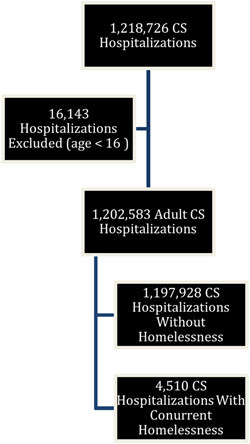
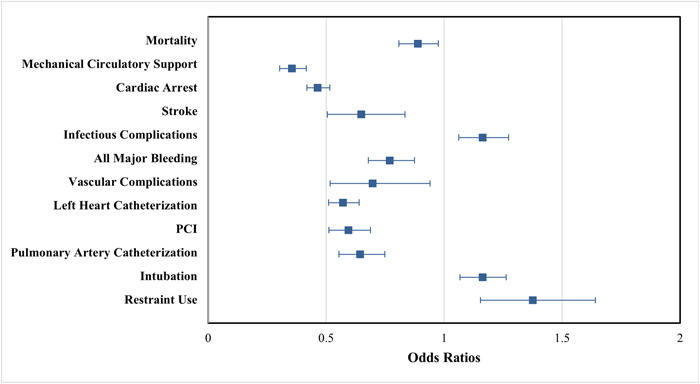
Background: Unhoused patients face significant barriers to receiving health care in both the inpatient and outpatient settings. For unhoused patients with heart failure who are in extremis, there is a lack of data regarding in‐hospital outcomes and resource utilization in the setting of cardiogenic shock (CS). Hypothesis: Unhoused patients hospitalized with CS have increased mortality and decreased use of invasive therapies as compared to housed patients. Methods: The National Inpatient Sample (NIS) database was queried from 2011 to 2019 for relevant ICD‐9 and ICD‐10 codes to identify unhoused patients with an admission diagnosis of CS. Baseline characteristics and in‐hospital outcomes between patients were compared. Binary logistic regression was used to adjust outcomes for prespecified and significantly different baseline characteristics (p < .05). Results: We identified a weighted sample of 1 202 583 adult CS hospitalizations, of whom 4510 were unhoused (0.38%). There was no significant difference in the comorbidity adjusted odds of mortality between groups. Unhoused patients had lower odds of receiving mechanical circulatory support, left heart catheterization, percutaneous coronary intervention, or pulmonary artery catheterization. Unhoused patients had higher adjusted odds of infectious complications, undergoing intubation, or requiring restraints. Conclusions: These data suggest that, despite having fewer traditional comorbidities, unhoused patients have similar mortality and less access to more aggressive care than housed patients. Unhoused patients may experience under‐diuresis, or more conservative care strategies, as evidenced by the higher intubation rate in this population. Further studies are needed to elucidate long‐term outcomes and investigate systemic methods to ameliorate barriers to care in unhoused populations.
Overview
The claims and statistics of this paper haven’t been checked yet.
Free: it reads the open-access text and checks the first 5 claims that cite a source we can check. Create a free account to check every claim.
Integrity signals
Registry
Cites
Statistics
Figures
Verification
Claims the paper makes
The claims and statistics of this paper haven’t been checked yet.
Free: it reads the open-access text and checks the first 5 claims that cite a source we can check. Create a free account to check every claim.
Claims other papers make about this one
Each is checked against this paper’s own text: does it say what the citing paper says it does?
The check wasn’t confident either way, so it gives no verdict — never disputed.
In the citing paper
“In 19 studies that were pooled, the prevalence of HF among older adults experiencing homelessness was 12.0% (95% confidence interval (CI) 7.3–19.1%, I2 = 99.9%) (Figure 2).(6,9,33–49)”
From Prevalence and Risk of Heart Failure Among Older Adults Experiencing Homelessness: A Systematic Review and Meta-Analysis (2026) · cites this paper as [33]
Experimental — accuracy not yet measured
Self-check
Percentages, sums and reported differences re-computed from the paper’s own numbers.
The self-check needs the paper’s full text.
Citations
Cites
Lower socioeconomic status predicts higher mortality and morbidity in patients with heart failure
Schrage, B., Lund, L. H., Benson, L., Stolfo, D., Ohlsson, A., Westerling, R., Westermann, D., Strömberg, A., Dahlström, U., Braunschweig, F., et al. (2021) · Heart · doi:10.1136/heartjnl-2020-317216 · Cited by 50
Research works printed but not linked: 33
- Lanham JS, White P, Gaffney B. Care of people experiencing homelessness. Am Fam Physician. 2022; 106(6): 684‐ 693. http://www.ncbi.nlm.nih.gov/pubmed/36521466 36521466
- Stafford A, Wood L. Tackling health disparities for people who are homeless? Start with social determinants. Int J Environ Res Public Health. 2017; 14(12): 1535. 10.3390/ijerph14121535 29292758 PMC5750953 · DOI · Paper page
- Wadhera RK, Khatana SAM, Choi E, et al. Disparities in care and mortality among homeless adults hospitalized for cardiovascular conditions. JAMA Int Med. 2020; 180(3): 357‐ 366. 10.1001/jamainternmed.2019.6010 PMC6865320 31738826 · DOI
- Gu KD, Faulkner KC, Thorndike AN. Housing instability and cardiometabolic health in the United States: a narrative review of the literature. BMC Public Health. 2023; 23(1): 931. 10.1186/s12889-023-15875-6 37221492 PMC10203673 · DOI
- Muchomba FM, Teitler J, Reichman NE. Association between housing affordability and severe maternal morbidity. JAMA Net Open. 2022; 5(11): e2243225. 10.1001/jamanetworkopen.2022.43225 PMC9682423 36413368 · DOI
- Jarpe M, Mosley JE, Smith BT. Understanding the collaborative planning process in homeless services: networking, advocacy, and local government support may reduce service gaps. J Public Health Manag Pract. 2019; 25(3): 262‐ 269. 10.1097/PHH.0000000000000812 29889180 PMC9016797 · DOI
- Chetty R, Stepner M, Abraham S, et al. The association between income and life expectancy in the United States, 2001‐2014. JAMA. 2016; 315(16): 1750‐ 1766. 10.1001/jama.2016.4226 27063997 PMC4866586 · DOI · Paper page
- Romaszko J, Cymes I, Dragańska E, Kuchta R, Glińska‐Lewczuk K. Mortality among the homeless: causes and meteorological relationships. PLoS One. 2017; 12(12): e0189938. 10.1371/journal.pone.0189938 29267330 PMC5739436 · DOI
- Al‐Shakarchi NJ, Evans H, Luchenski SA, Story A, Banerjee A. Cardiovascular disease in homeless versus housed individuals: a systematic review of observational and interventional studies. Heart. 2020; 106(19): 1483‐ 1488. 10.1136/heartjnl-2020-316706 32665359 PMC7509384 · DOI
- Liauw SSL, Luong L, Liu S, et al. Clinical presentation and outcome of patients experiencing homelessness presenting with ST‐Segment elevation myocardial infarction. Can J Cardiol. 2021; 37(10): 1555‐ 1561. 10.1016/j.cjca.2021.05.003 34004281 · DOI · Paper page
- Hung C‐L, Chao T‐F, Su C‐H, et al. Income level and outcomes in patients with heart failure with universal health coverage. Heart. 2021; 107(3): 208‐ 216. 10.1136/heartjnl-2020-316793 33082175 PMC7815895 · DOI
- Mathews L, Ding N, Mok Y, et al. Impact of socioeconomic status on mortality and readmission in patients with heart failure with reduced ejection fraction: the ARIC study. J Am Heart Assoc. 2022; 11(18): e024057. 10.1161/JAHA.121.024057 36102228 PMC9683665 · DOI
- Jentzer JC. Understanding cardiogenic shock severity and mortality risk assessment. Circ Heart Failure. 2020; 13(9): e007568. 10.1161/CIRCHEARTFAILURE.120.007568 32900232 · doi:10.1161/circheartfailure.120.007568
- Osman M, Syed M, Patibandla S, et al. Fifteen‐year trends in incidence of cardiogenic shock hospitalization and in‐hospital mortality in the United States. J Am Heart Assoc. 2021; 10(15): e021061. 10.1161/JAHA.121.021061 34315234 PMC8475696 · DOI · Paper page
- Basir MB, Kapur NK, Patel K, et al. Improved outcomes associated with the use of shock protocols: updates from the National cardiogenic shock initiative. Catheter Cardiovasc Interv. 2019; 93(7): 1173‐ 1183. 10.1002/ccd.28307 31025538 · DOI · Paper page
- Lang CN, Kaier K, Zotzmann V, et al. Cardiogenic shock: incidence, survival and mechanical circulatory support usage 2007‐2017‐insights from a national registry. Clin Res Cardiol. 2021; 110(9): 1421‐ 1430. 10.1007/s00392-020-01781-z 33258007 PMC8405485 · DOI
- Houchens R, Elixhauser A. Using the HCUP nationwide inpatient sample to estimate trends. HCUP Meth Seri Rep (in press).
- Thangam M, Luke AA, Johnson DY, et al. Sociodemographic differences in utilization and outcomes for temporary cardiovascular mechanical support in the setting of cardiogenic shock. Am Heart J. 2021; 236: 87‐ 96. 10.1016/j.ahj.2020.12.014 33359779 · DOI
- Patlolla SH, Kanwar A, Belford PM, et al. Influence of household income on management and outcomes of acute myocardial infarction complicated by cardiogenic shock. Am J Cardiol. 2022; 177: 7‐ 13. 10.1016/j.amjcard.2022.04.044 35701236 · DOI
- Baggett TP, Liauw SS, Hwang SW. Cardiovascular disease and homelessness. J Am Coll Cardiol. 2018; 71(22): 2585‐ 2597. 10.1016/j.jacc.2018.02.077 29852981 · DOI · Paper page
- Velez M. Advances in contemporary medical management to treat patients with heart failure. Curr Opin Cardiol. 2023; 38(2): 136‐ 142. 10.1097/HCO.0000000000001021 36718623 · DOI
- Rosengren A, Smyth A, Rangarajan S, et al. Socioeconomic status and risk of cardiovascular disease in 20 low‐income, middle‐income, and high‐income countries: the prospective urban rural epidemiologic (PURE) study. Lancet Global Health. 2019; 7(6): e748‐ e760. 10.1016/S2214-109X(19)30045-2 31028013 · DOI · Paper page
- Vojjini R, Patlolla SH, Cheungpasitporn W, et al. Racial disparities in the utilization and outcomes of temporary mechanical circulatory support for acute myocardial infarction‐cardiogenic shock. J Clin Med. 2021; 10(7): 1459. 10.3390/jcm10071459 33918132 PMC8037539 · doi:10.3390/jcm10071459
- Ya'qoub L, Lemor A, Dabbagh M, et al. Racial, ethnic, and sex disparities in patients with STEMI and cardiogenic shock. JACC: Cardiovas Intervent. 2021; 14(6): 653‐ 660. 10.1016/j.jcin.2021.01.003 33736772 · DOI
- Alviar CL, Rico‐Mesa JS, Morrow DA, et al. Positive pressure ventilation in cardiogenic shock: review of the evidence and practical advice for patients with mechanical circulatory support. Can J Cardiol. 2020; 36(2): 300‐ 312. 10.1016/j.cjca.2019.11.038 32036870 · DOI
- Jentzer JC, Pöss J, Schaubroeck H, Morrow DA, Hollenberg SM, Mebazaa A. Advances in the management of cardiogenic shock. Crit Care Med. 2023; 51(9): 1222‐ 1233. 10.1097/CCM.0000000000005919 37184336 · DOI
- Pendyal A, Rosenthal MS, Spatz ES, Cunningham A, Bliesener D, Keene DE. “When you're homeless, they look down on you”: a qualitative, community‐based study of homeless individuals with heart failure. Heart & Lung. 2021; 50(1): 80‐ 85. 10.1016/j.hrtlng.2020.08.001 32792114 PMC7738391 · DOI
- Chen C, Li X, Su Y, You Z, Wan R, Hong K. Adherence with cardiovascular medications and the outcomes in patients with coronary arterial disease: “Real‐world” evidence. Clin Cardiol. 2022; 45(12): 1220‐ 1228. 10.1002/clc.23898 36116032 PMC9748759 · DOI
- LaRosa AR, Swabe GM, Magnani JW. Income and antiplatelet adherence following percutaneous coronary intervention. Int J Cardiol Cardiovas Risk Prevent. 2022; 14: 200140. 10.1016/j.ijcrp.2022.200140 PMC9434414 36060289 · DOI
- Batchelor P, Kingsland J. Improving the health of the homeless and how to achieve it within the new NHS architecture. Int J Environ Res Public Health. 2020; 17(11): 4100. 10.3390/ijerph17114100 32521822 PMC7312815 · DOI · Paper page
- Rezansoff SN, Moniruzzaman A, Fazel S, McCandless L, Procyshyn R, Somers JM. Housing first improves adherence to antipsychotic medication among formerly homeless adults with schizophrenia: results of a randomized controlled trial. Schizophr Bull. 2017; 43(4): 852‐ 861. 10.1093/schbul/sbw136 27665002 PMC5274537 · DOI · Paper page
- Liu M, Hwang SW. Health care for homeless people. Nat Rev Dis Primers. 2021; 7(1): 5. 10.1038/s41572-020-00241-2 33446661 · DOI · Paper page
- Sinha SS, Rosner CM, Tehrani BN, et al. Cardiogenic shock from heart failure versus acute myocardial infarction: clinical characteristics, hospital course, and 1‐year outcomes. Circu Heart Fail. 2022; 15(6): e009279. 10.1161/CIRCHEARTFAILURE.121.009279 PMC9286066 35510546 · DOI
Cited by
Hoang, P. M., Ding, J., Almsari, L., Seedu, J., Asgarali, R., Huang, Y. Q., De Castro, C., Rochon, P., Harris, M., & Kokorelias, K. M. (2026) · Canadian Geriatrics Journal · doi:10.5770/cgj.29.938
Metadata
- Authors
- Ergui, I., Salama, J., Hooda, U., Ebner, B., Dangl, M., Vincent, L., Sancassani, R., & Colombo, R.
- Affiliations
- Division of Internal Medicine, Department of Medicine University of Miami Miller School of Medicine Miami Florida USA
- Division of Cardiology, Department of Medicine University of Miami Miller School of Medicine Miami Florida USA
- Department of Cardiology Jackson Memorial Hospital Miami Florida USA
- ORCID
- Ergui, Ian
- Venue
- Clinical Cardiology
- Publisher
- Wiley
- Published
- 2024-02
- Volume
- 47
- Issue
- 2
- ISSN
- 0160-9289
- 1932-8737
- PMC
- PMC10873680
- Cited by
- 0
- References
- 1
- Language
- en
About these checks
Registry, retraction, Cites and statistics results are computed, not judged, with one exception: a printed reference that no index lists is read once by a model before it counts as a citation error. Claims are extracted by a model and kept only when their quote appears verbatim in the text; each cited source is then checked, with a model’s help, for whether it says what the claim relies on. Those verdicts can be wrong — read the claim’s quote and the cited source before relying on one.
Statistics and arithmetic are recomputed, not judged.
Confidence bands are shown only for fields calibrated on our annotated test set. None is calibrated yet, so no band is shown.
What counts as a claim ›How we measure confidence ›How we check this ›
Are you an author, or do you see a problem with this page? Request a review
How to cite
Cite CoChat for the checks on this page, and the paper for its own findings.
- This page
- CoChat. (2026). Citation check: In‐hospital outcomes in unhoused patients with cardiogenic shock in the United States: Insights from The National Inpatient Sample 2011−2019. https://app.cochat.ai/papers/10.1002/clc.24235
- The paper
- Ergui, I., Salama, J., Hooda, U., Ebner, B., Dangl, M., Vincent, L., Sancassani, R., & Colombo, R. (2024). In‐hospital outcomes in unhoused patients with cardiogenic shock in the United States: Insights from The National Inpatient Sample 2011−2019. Clinical Cardiology. https://doi.org/10.1002/clc.24235
Data sources
Bibliographic data: Semantic Scholar, OpenAlex, Crossref.
Contains information from the Semantic Scholar Academic Graph Datasets, made available under the ODC Attribution License (ODC-BY 1.0).
Semantic Scholar’s data is described in: Kinney, R., et al. (2023). The Semantic Scholar Open Data Platform. arXiv:2301.10140.
