

The DOI matches its Crossref record.
Effect of Beta-Blocker Therapy on the Response to Mavacamten in Patients with Symptomatic Obstructive Hypertrophic Cardiomyopathy
Abstract
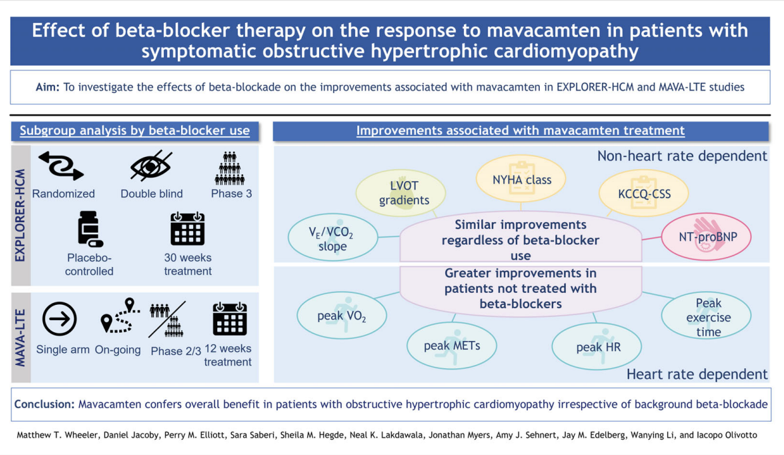
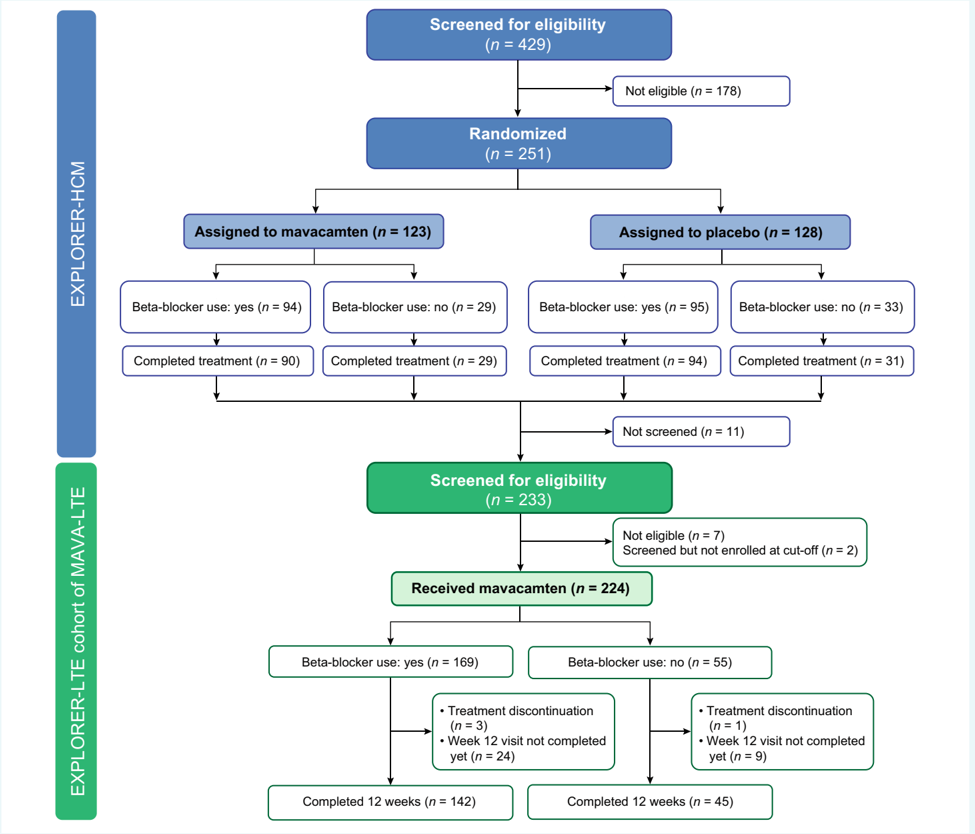
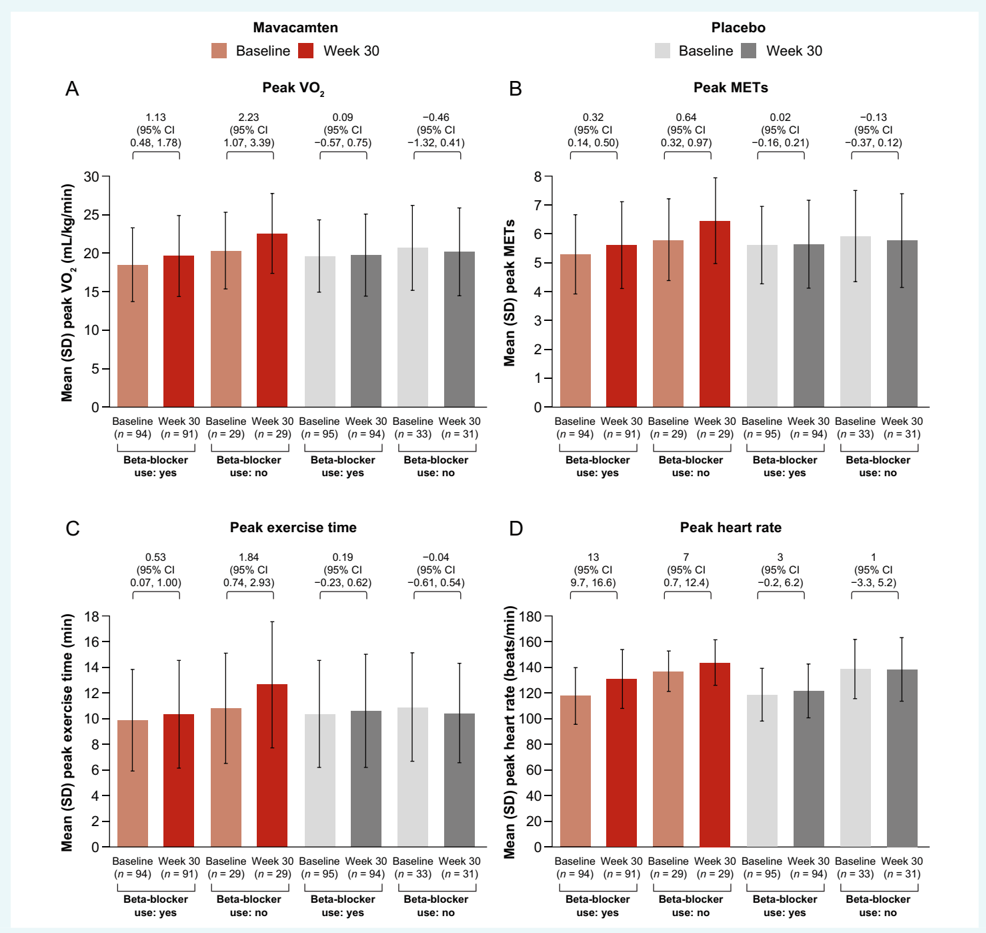
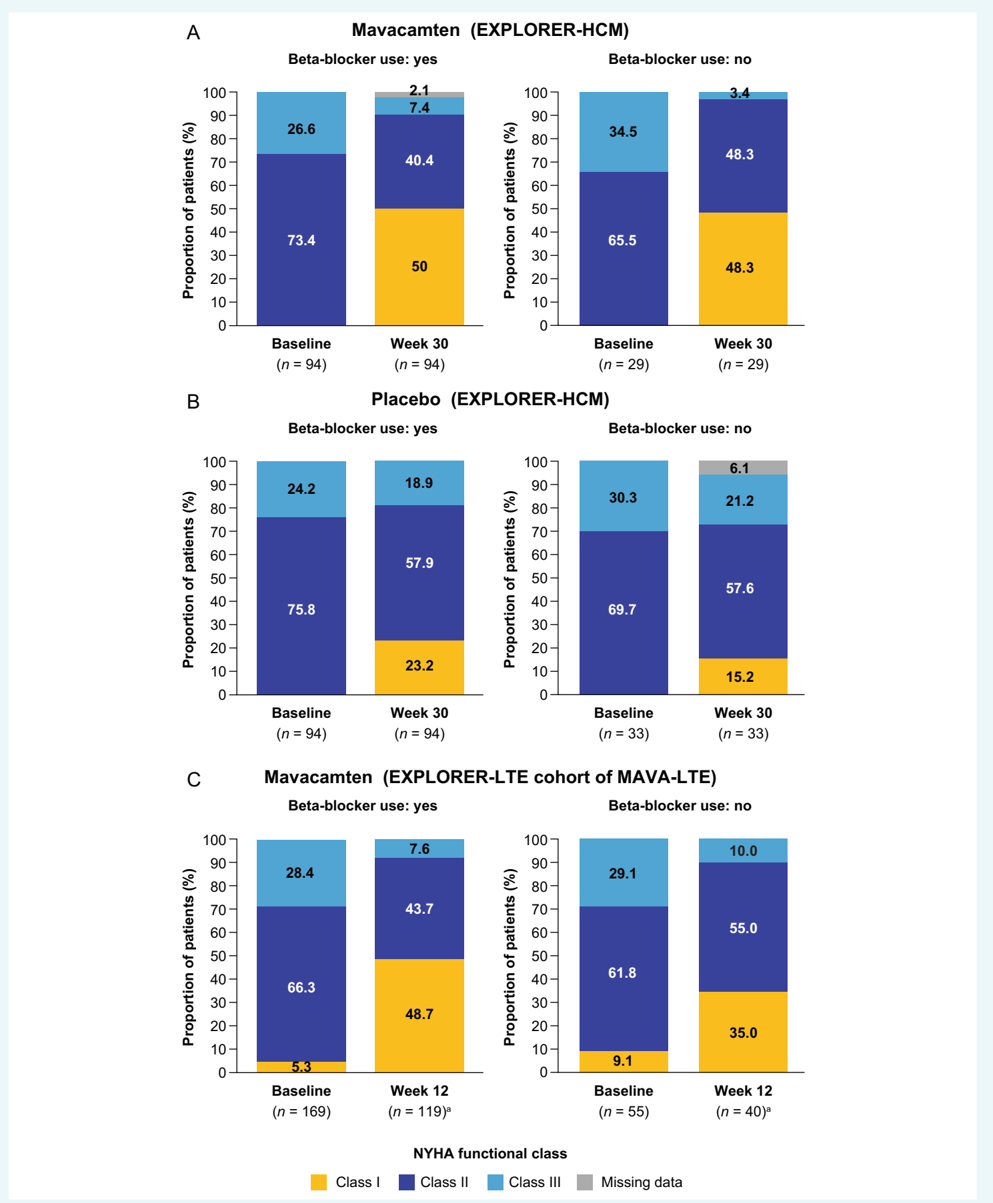
Aims: In the EXPLORER-HCM trial, mavacamten improved exercise capacity and symptoms in patients with obstructive hypertrophic cardiomyopathy (oHCM). Mavacamten effects on the primary endpoint, a composite of peak oxygen consumption (VO2) and New York Heart Association (NYHA) class, were greater in patients not receiving background beta-blockers than in those receiving beta-blockers. We sought to determine if the effect of background treatment was consistent across other clinically meaningful parameters. Methods and results: Subgroup analyses by beta-blocker use were performed in patients with oHCM from the EXPLORER-HCM and mavacamten long-term extension (MAVA-LTE) studies. In EXPLORER-HCM, 189 patients (75.3%) were receiving beta-blockers, and 62 (24.7%) were receiving non-dihydropyridine calcium channel blockers or no background HCM medication; 170 patients (90.4%) receiving beta-blockers had chronotropic incompetence. Improvements in peak VO2 at week 30 with mavacamten versus placebo were lower with beta-blockers (mean difference [95% confidence interval (CI)]: 1.04 [0.12, 1.95] ml/kg/min) than without beta-blockers (mean difference [95% CI]: 2.69 [1.29, 4.09] ml/kg/min); improvements in non-heart rate-dependent parameters (VE/VCO2 slope) appeared unaffected by beta-blockers. Improvements in functional capacity parameters at week 30 with mavacamten versus placebo were independent of beta-blockade for post-exercise left ventricular outflow tract gradient (mean difference [95% CI]: −37.9 [−48.0, −27.9] mmHg with beta-blockers; −33.5 [−53.6, −13.3] mmHg without beta-blockers), proportion of patients with reduction of ≥1 NYHA class, Kansas City Cardiomyopathy Questionnaire clinical summary scores and N-terminal pro-B-type natriuretic peptide. Mavacamten benefits were reproduced and maintained in MAVA-LTE regardless of beta-blockade. Conclusion: Mavacamten improved measures of functional capacity, left ventricular outflow tract obstruction, symptom burden and biomarkers in patients with HCM regardless of beta-blocker use. Beta-blocker use was often associated with chronotropic incompetence, affecting peak VO2 and other heart rate-dependent measures, but had minimal impact on heart rate-independent measures.
Overview
The claims and statistics of this paper haven’t been checked yet.
Run the check — free, no account needed. It reads the open-access text and checks the sources it cites.
Integrity signals
Registry
Cites
Statistics
Figures
Verification
Claims the paper makes
The claims and statistics of this paper haven’t been checked yet.
Run the check — free, no account needed. It reads the open-access text and checks the sources it cites.
Claims other papers make about this one
Each is checked against this paper’s own text: does it say what the citing paper says it does?
The source backs part of the claim, not all of it — or backs it for a different population, condition or comparison.
In the citing paper
“Concurrent β blocker use did not affect functional capacity, reduction in LVOT gradients, symptoms, or biomarkers, but patients on β blockers had lower peak VO 2 and chronotropic incompetence.52”
From Current management of hypertrophic cardiomyopathy (2025) · cites this paper as [52]
Experimental — accuracy not yet measured
Self-check
Percentages, sums and reported differences re-computed from the paper’s own numbers.
The self-check needs the paper’s full text.
Citations
Cites
No references could be resolved yet.
Research works printed but not linked: 30
- Ommen, 2020, 2020 AHA/ACC Guideline for the diagnosis and treatment of patients with hypertrophic cardiomyopathy: executive summary: a report of the American College of Cardiology/American Heart Association Joint Committee on Clinical Practice Guidelines, J Am Coll Cardiol, 76, 3022, 10.1016/j.jacc.2020.08.044 · DOI
- Elliott, 2014, 2014 ESC Guidelines on diagnosis and management of hypertrophic cardiomyopathy: the task force for the diagnosis and management of hypertrophic cardiomyopathy of the European Society of Cardiology (ESC), Eur Heart J, 35, 2733, 10.1093/eurheartj/ehu284 · DOI · Paper page
- Maron, 2018, Clinical course and management of hypertrophic cardiomyopathy, N Engl J Med, 379, 655, 10.1056/NEJMra1710575 · DOI · Paper page
- Gilligan, 1993, A double-blind, placebo-controlled crossover trial of nadolol and verapamil in mild and moderately symptomatic hypertrophic cardiomyopathy, J Am Coll Cardiol, 21, 1672, 10.1016/0735-1097(93)90386-F · DOI
- Dybro, 2021, Randomized trial of metoprolol in patients with obstructive hypertrophic cardiomyopathy, J Am Coll Cardiol, 78, 2505, 10.1016/j.jacc.2021.07.065 · DOI
- Kawas, 2017, A small-molecule modulator of cardiac myosin acts on multiple stages of the myosin chemomechanical cycle, J Biol Chem, 292, 16571, 10.1074/jbc.M117.776815 · DOI
- Green, 2016, A small-molecule inhibitor of sarcomere contractility suppresses hypertrophic cardiomyopathy in mice, Science, 351, 617, 10.1126/science.aad3456 · DOI
- Olivotto, 2020, Mavacamten for treatment of symptomatic obstructive hypertrophic cardiomyopathy (EXPLORER-HCM): a randomised, double-blind, placebo-controlled, phase 3 trial, Lancet, 396, 759, 10.1016/S0140-6736(20)31792-X · DOI · Paper page
- Van Baak, 1988, Beta-adrenoceptor blockade and exercise. An update, Sports Med, 5, 209, 10.2165/00007256-198805040-00002 · DOI
- Palau, 2021, Effect of β-blocker withdrawal on functional capacity in heart failure and preserved ejection fraction, J Am Coll Cardiol, 78, 2042, 10.1016/j.jacc.2021.08.073 · DOI
- Smarz, 2021, Chronotropic incompetence limits aerobic exercise capacity in patients taking beta-blockers: real-life observation of consecutive patients, Healthcare (Basel), 9, 212, 10.3390/healthcare9020212 · DOI
- Ho, 2020, Study design and rationale of EXPLORER-HCM: evaluation of mavacamten in adults with symptomatic obstructive hypertrophic cardiomyopathy, Circ Heart Fail, 13, 10.1161/CIRCHEARTFAILURE.120.006853 · DOI
- Gersh, 2011, ACCF/AHA Guideline for the diagnosis and treatment of hypertrophic cardiomyopathy: executive summary: a report of the American College of Cardiology Foundation/American Heart Association Task Force on Practice Guidelines, Circulation, 124, 2761, 10.1161/CIR.0b013e318223e230 · DOI
- Ho, 2020, Evaluation of mavacamten in symptomatic patients with nonobstructive hypertrophic cardiomyopathy, J Am Coll Cardiol, 75, 2649, 10.1016/j.jacc.2020.03.064 · DOI
- Green, 2000, Development and evaluation of the Kansas City Cardiomyopathy Questionnaire: a new health status measure for heart failure, J Am Coll Cardiol, 35, 1245, 10.1016/S0735-1097(00)00531-3 · DOI · Paper page
- Spertus, 2020, Interpreting the Kansas City Cardiomyopathy Questionnaire in clinical trials and clinical care: JACC state-of-the-art review, J Am Coll Cardiol, 76, 2379, 10.1016/j.jacc.2020.09.542 · DOI · Paper page
- Efthimiadis, 2011, Chronotropic incompetence and its relation to exercise intolerance in hypertrophic cardiomyopathy, Int J Cardiol, 153, 179, 10.1016/j.ijcard.2010.08.026 · DOI
- Nambiar, 2018, β-Blockers in myocardial infarction and coronary artery disease with a preserved ejection fraction: recommendations, mechanisms, and concerns, Coron Artery Dis, 29, 262, 10.1097/MCA.0000000000000610 · DOI
- Peyracchia, 2018, Beta-blocker therapy reduces mortality in patients with coronary artery disease treated with percutaneous revascularization: a meta-analysis of adjusted results, J Cardiovasc Med, 19, 337, 10.2459/JCM.0000000000000662 · DOI
- Kloner, 2017, Angina and its management, J Cardiovasc Pharmacol Ther, 22, 199, 10.1177/1074248416679733 · DOI
- January, 2014, 2014 AHA/ACC/HRS Guideline for the management of patients with atrial fibrillation: a report of the American College of Cardiology/American Heart Association Task Force on Practice Guidelines and the Heart Rhythm Society, Circulation, 130, e199
- Al-Khatib, 2018, 2017 AHA/ACC/HRS Guideline for management of patients with ventricular arrhythmias and the prevention of sudden cardiac death: executive summary: a report of the American College of Cardiology/American Heart Association Task Force on Clinical Practice Guidelines and the Heart Rhythm Society, Circulation, 138, e210
- Seller, Effect on maximal functional capacity of beta-blockers withdrawal in heart failure with preserved ejection fraction and chronotropic incompetence: PRESERVE-HR trial
- Magrì, 2017, Cardiopulmonary exercise test in hypertrophic cardiomyopathy, Ann Am Thorac Soc, 14, S102, 10.1513/AnnalsATS.201611-884FR · DOI
- Arena, 2008, The ventilatory classification system effectively predicts hospitalization in patients with heart failure, J Cardiopulm Rehabil Prev, 28, 195, 10.1097/01.HCR.0000320071.89093.d6 · DOI
- Arena, 2007, Development of a ventilatory classification system in patients with heart failure, Circulation, 115, 2410, 10.1161/CIRCULATIONAHA.107.686576 · DOI
- Francis, 2000, Cardiopulmonary exercise testing for prognosis in chronic heart failure: continuous and independent prognostic value from VE/VCO2 slope and peak VO2, Eur Heart J, 21, 154, 10.1053/euhj.1999.1863 · DOI
- Dimopoulos, 2006, Abnormal ventilatory response to exercise in adults with congenital heart disease relates to cyanosis and predicts survival, Circulation, 113, 2796, 10.1161/CIRCULATIONAHA.105.594218 · DOI
- Bard, 2006, Determining the best ventilatory efficiency measure to predict mortality in patients with heart failure, J Heart Lung Transplant, 25, 589, 10.1016/j.healun.2005.11.448 · DOI
- Klaassen, 2017, Clinical and hemodynamic correlates and prognostic value of VE/VCO2 slope in patients with heart failure with preserved ejection fraction and pulmonary hypertension, J Card Fail, 23, 777, 10.1016/j.cardfail.2017.07.397 · DOI
Cited by
Sorted by citations
Current management of hypertrophic cardiomyopathy
Sikand, N., Stendahl, J., Sen, S., Lampert, R., & Day, S. (2025) · BMJ · doi:10.1136/bmj-2023-077274 · Cited by 26
Metadata
- Authors
- Wheeler, M. T., Jacoby, D., Elliott, P. M., Saberi, S., Hegde, S. M., Lakdawala, N. K., Myers, J., Sehnert, A. J., Edelberg, J. M., Li, W., & Olivotto, I.
- Venue
- European Journal of Heart Failure
- Publisher
- Oxford University Press (OUP)
- Published
- 2023-02-01
- Volume
- 25
- Issue
- 2
- Pages
- 260-270
- ISSN
- 1388-9842
- 1879-0844
- Cited by
- 52
- References
- 0
- Language
- en
- Licence
- Funders
- MyoKardia, Inc.
- MyoKardia
About these checks
Registry, retraction, Cites and statistics results are computed, not judged, with one exception: a printed reference that no index lists is read once by a model before it counts as a citation error. Claims are extracted by a model and kept only when their quote appears verbatim in the text; each cited source is then checked, with a model’s help, for whether it says what the claim relies on. Those verdicts can be wrong — read the claim’s quote and the cited source before relying on one.
Statistics and arithmetic are recomputed, not judged.
Confidence bands are shown only for fields calibrated on our annotated test set. None is calibrated yet, so no band is shown.
What counts as a claim ›How we measure confidence ›How we check this ›
Are you an author, or do you see a problem with this page? Request a review
