

The DOI matches its Crossref record; 3 of the 3 references it cites were found in a registry or an index.
The Effect of Different Extraction Techniques on the Bioactive Characteristics of Dill ( Anethum graveolens ) Essential Oil
Abstract
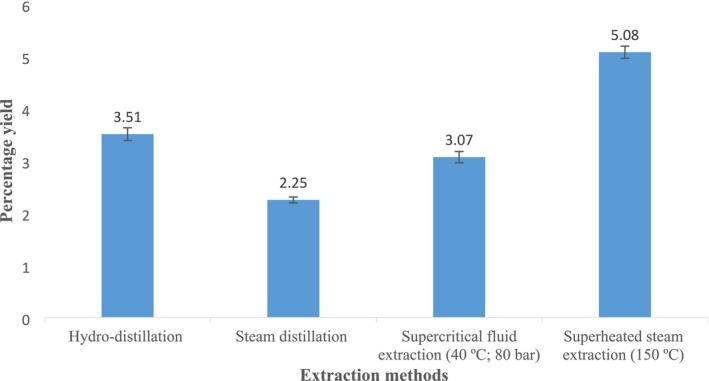
This study explores the extraction of Anethum graveolens essential oil (EO) using advanced techniques, including Superheated Steam Extraction (SHSE), and compares them with traditional methods such as Hydro Distillation (HD), Steam Distillation (SD), and Supercritical Carbon Dioxide Extraction (SCF‐CO 2 ). The novelty of this research lies in the comprehensive evaluation of SHSE, a relatively underexplored method, for its effectiveness in enhancing both yield and biological activities of the EO. This study provides a detailed comparative analysis of antioxidant and antimicrobial properties across different extraction methods. The SHSE method yielded essential oil with the highest antioxidant activity, including DPPH scavenging (87.48%) and total antioxidant capacity (measured by FRAP, 163.06 mg/L), outperforming traditional methods. The EO's high content of key components such as carvone, limonene, and dillapiole significantly contributes to its enhanced biological activities. These findings underscore the superior efficacy of SHSE in extracting essential oils, offering new insights into their potential applications in health and wellness, which set this study apart from previous work.
Overview
The claims and statistics of this paper haven’t been checked yet.
Run the check — free, no account needed. It reads the open-access text and checks the sources it cites.
Integrity signals
Registry
Cites
Statistics
Figures
Verification
Claims the paper makes
The claims and statistics of this paper haven’t been checked yet.
Run the check — free, no account needed. It reads the open-access text and checks the sources it cites.
Claims other papers make about this one
Each is checked against this paper’s own text: does it say what the citing paper says it does?
In the citing paper
“although the chemical composition varies based on the geographical origin, harvesting time, parts of the plant and extraction method used [6].”
From Maceration, Soxhlet Extraction, and Steam Hydrodistillation of Anethum graveolens Seeds: Phytochemical Profiles and Cytotoxic Effects (2026) · cites this paper as [6]
In the citing paper
“Moreover, different extraction techniques used to obtain A. graveolens EOs influenced the chemical composition, yield, antimicrobial and antioxidant activities of studied EOs [6].”
From Maceration, Soxhlet Extraction, and Steam Hydrodistillation of Anethum graveolens Seeds: Phytochemical Profiles and Cytotoxic Effects (2026) · cites this paper as [6]
Self-check
Percentages, sums and reported differences re-computed from the paper’s own numbers.
The self-check needs the paper’s full text.
Citations
Cites
Sarker, S. D., Nahar, L., & Kumarasamy, Y. (2007) · Methods · doi:10.1016/j.ymeth.2007.01.006 · Cited by 1,849
Antioxidant Activity of Essential Oils
Amorati, R., Foti, M. C., & Valgimigli, L. (2013) · Journal of Agricultural and Food Chemistry · doi:10.1021/jf403496k · Cited by 803
Anethum graveolens: An Indian traditional medicinal herb and spice
Shekhawat, G., & Jana, S. (2010) · Pharmacognosy Reviews · doi:10.4103/0973-7847.70915 · Cited by 269
Research works printed but not linked: 56
- 10.1016/B978-0-12-819516-1.00003-X · DOI
- Akthar M. S., 2014, Antimicrobial Activity of Essential Oils Extracted From Medicinal Plants Against the Pathogenic Microorganisms: A Review, Jouranl of Issues Issn, 2350, 1588
- 10.1111/1750-3841.16597 · DOI
- 10.3390/separations10010027 · DOI
- 10.1080/14786419.2022.2044327 · DOI
- 10.1080/10942912.2018.1439957 · DOI
- 10.1016/j.arabjc.2021.103482 · DOI
- Badar N., 2008, Characteristics of Anethum graveolens (Umbelliferae) Seed Oil: Extraction, Composition and Antimicrobial Activity, International Journal of Agriculture and Biology, 10, 329
- 10.1016/S0926-6690(01)00088-7 · DOI
- 10.1016/j.fct.2007.09.106 · DOI · Paper page
- 10.1002/ffj.1226 · DOI
- 10.4141/P03-202 · DOI
- Chahal K., 2017, Chemistry and Biological Activities of Anethum graveolens L.(Dill) Essential Oil: A Review, Journal of Pharmacognosy and Phytochemistry, 6, 295
- Dabur R., 2004, A Novel Antifungal Pyrrole Derivative From Datura metel Leaves, Die Pharmazie‐An International Journal of Pharmaceutical Sciences, 59, 568
- 10.1080/0972060X.2019.1683080 · DOI
- 10.3390/biom13071144 · DOI
- 10.1016/j.jarmap.2020.100263 · DOI
- 10.1016/j.foodchem.2006.11.062 · DOI
- 10.1016/j.supflu.2021.105384 · DOI
- Hamza L. F., 2017, Anethum graveolens: Physicochemical Properties, Medicinal Uses, Antimicrobial Effects, Antioxidant Effect, Anti‐Inflammatory and Analgesic Effects: A Review, World, 5, 88
- Jafari S. M., 2023, Extraction Processes in the Food Industry: Unit Operations and Processing Equipment in the Food Industry
- 10.1002/pca.1221 · DOI
- 10.1021/jf030004y · DOI · Paper page
- 10.1080/10408398.2018.1488159 · DOI
- 10.1016/j.scp.2022.100829 · DOI
- 10.1111/jfbc.12782 · DOI · Paper page
- 10.3923/jps.2012.55.66 · DOI
- Khaldi A., 2015, Chemical Composition and Antifungal Activity of Essential Oil of Anethum graveolens L. From South‐Western Algeria (Bechar), Journal of Chemical and Pharmaceutical Research, 7, 615
- 10.1016/j.lwt.2016.07.042 · DOI · Paper page
- 10.1007/978-3-642-18659-2 · DOI · Paper page
- 10.31883/pjfns/137612 · DOI
- 10.1016/j.focha.2023.100312 · DOI
- 10.4314/tjpr.v18i6.21 · DOI
- 10.1371/journal.pone.0131733 · DOI · Paper page
- 10.1002/ptr.687 · DOI
- 10.1016/j.ijpharm.2023.123186 · DOI
- Mohammed M. S. A., 2019, Influence of Two Extraction Methods on Essential Oils of Some Apiaceae Family Plants, Egyptian Pharmaceutical Journal, 18, 160
- 10.1016/j.arabjc.2024.105726 · DOI
- 10.1016/S0308-8146(02)00558-7 · DOI
- 10.1186/s40538-021-00224-9 · DOI · Paper page
- 10.3390/molecules21030388 · DOI
- 10.3389/fmed.2024.1337785 · DOI
- 10.1016/S2221-1691(12)60465-1 · DOI
- 10.1007/s13399-022-02807-4 · DOI
- 10.1016/j.jfoodeng.2005.11.010 · DOI
- Ruangamnart A., 2015, Chemical Compositions and Antibacterial Activity of Essential Oil From Dill Fruits (Anethum graveolens L.) Cultivated in Thailand, Mahidol University Journal of Pharmaceutical Sciences, 42, 135
- 10.1080/10412905.2022.2029776 · DOI
- 10.1016/j.sajb.2019.01.030 · DOI
- 10.1111/j.1365-2621.2005.tb07190.x · DOI
- 10.1002/ffj.1729 · DOI
- 10.1007/s11172-019-2703-0 · DOI
- 10.3390/su13094827 · DOI
- 10.1007/s10600-009-9275-4 · DOI
- 10.1007/s10600-006-0190-7 · DOI
- 10.1016/j.tifs.2019.11.018 · DOI
- 10.12911/22998993/177404 · DOI
Cited by
Kesti Usta, S., Yalçın, E., & Çavuşoğlu, K. (2025) · Scientific Reports · doi:10.1038/s41598-025-07297-8 · Cited by 10
Goldiș, C., Racoviceanu, R., Negrea-Ghiulai, R., Mioc, A., Prodea, A., Atyim, E., Maksimovic, T., Lukinich-Gruia, A. T., Pricop, M.-A., & Șoica, C. (2026) · Molecules · doi:10.3390/molecules31183337
Metadata
- Authors
- Fatima, A., Ayub, M. A., Choobkar, N., Zubair, M., Thomspon, K. D., & Hussain, A.
- Affiliations
- Department of Chemistry University of Sahiwal Sahiwal Pakistan
- Plant Biotechnology Research Center, Kermanshah Branch Islamic Azad University Kermanshah Iran
- Department of Chemistry, Faculty of Science University of Gujrat Gujrat Pakistan
- Aquaculture Research Group Moredun Research Institute Penicuik UK
- Institute of Chemistry University of Okara Okara Punjab Pakistan
- Venue
- Food Science & Nutrition
- Publisher
- Wiley
- Published
- 2025-03-24
- Volume
- 13
- Issue
- 4
- ISSN
- 2048-7177
- PMC
- PMC11932054
- Cited by
- 14
- References
- 3
- Language
- en
- Funders
- Higher Education Commission, Pakistan (20‐15988/NRPU/R&D/HEC/2021)
About these checks
Registry, retraction, Cites and statistics results are computed, not judged, with one exception: a printed reference that no index lists is read once by a model before it counts as a citation error. Claims are extracted by a model and kept only when their quote appears verbatim in the text; each cited source is then checked, with a model’s help, for whether it says what the claim relies on. Those verdicts can be wrong — read the claim’s quote and the cited source before relying on one.
Statistics and arithmetic are recomputed, not judged.
Confidence bands are shown only for fields calibrated on our annotated test set. None is calibrated yet, so no band is shown.
What counts as a claim ›How we measure confidence ›How we check this ›
Are you an author, or do you see a problem with this page? Request a review
Data sources
Bibliographic data: Semantic Scholar, OpenAlex, Crossref.
Contains information from the Semantic Scholar Academic Graph Datasets, made available under the ODC Attribution License (ODC-BY 1.0).
Semantic Scholar’s data is described in: Kinney, R., et al. (2023). The Semantic Scholar Open Data Platform. arXiv:2301.10140.
