

The DOI matches its Crossref record; 2 of the 2 references it cites were found in a registry or an index.
Aberrant Molecular Myelin Architecture in Charcot–Marie–Tooth Disease Type 1A and Hereditary Neuropathy With Liability to Pressure Palsies
Open accessPublished version of a preprint
Abstract
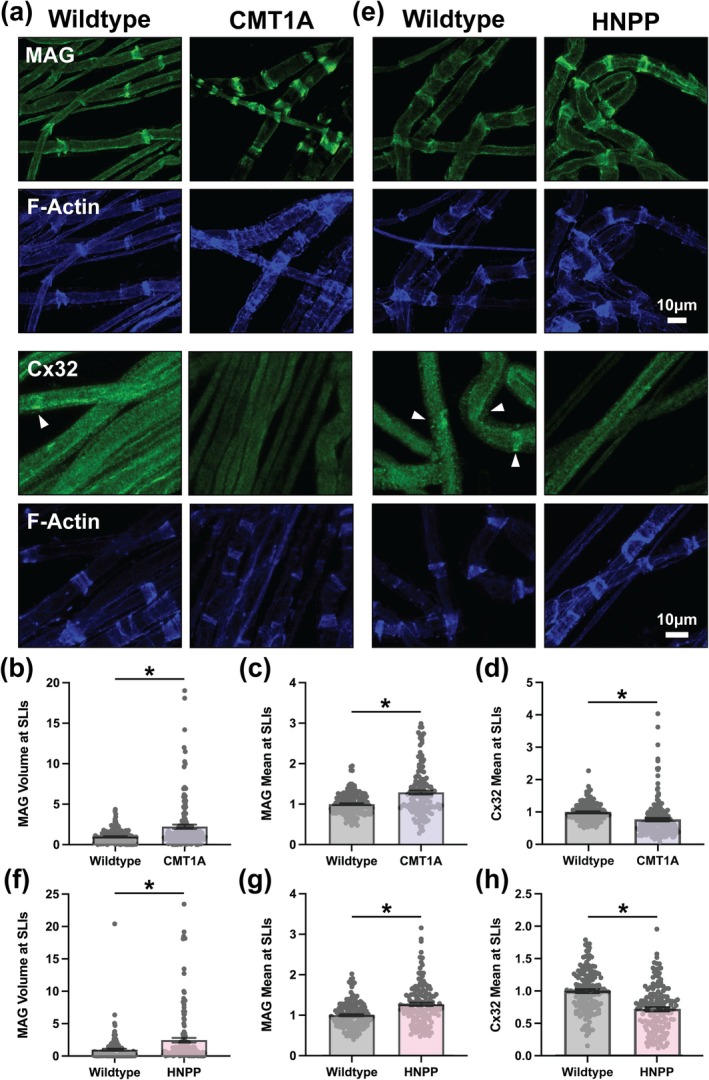
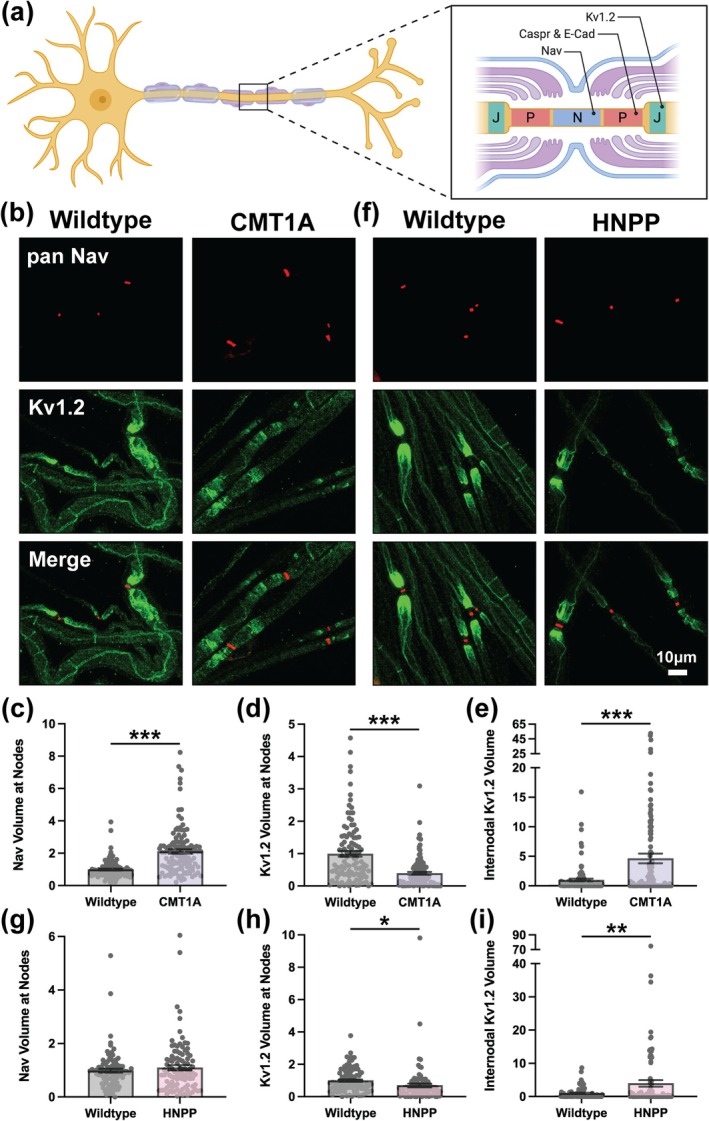
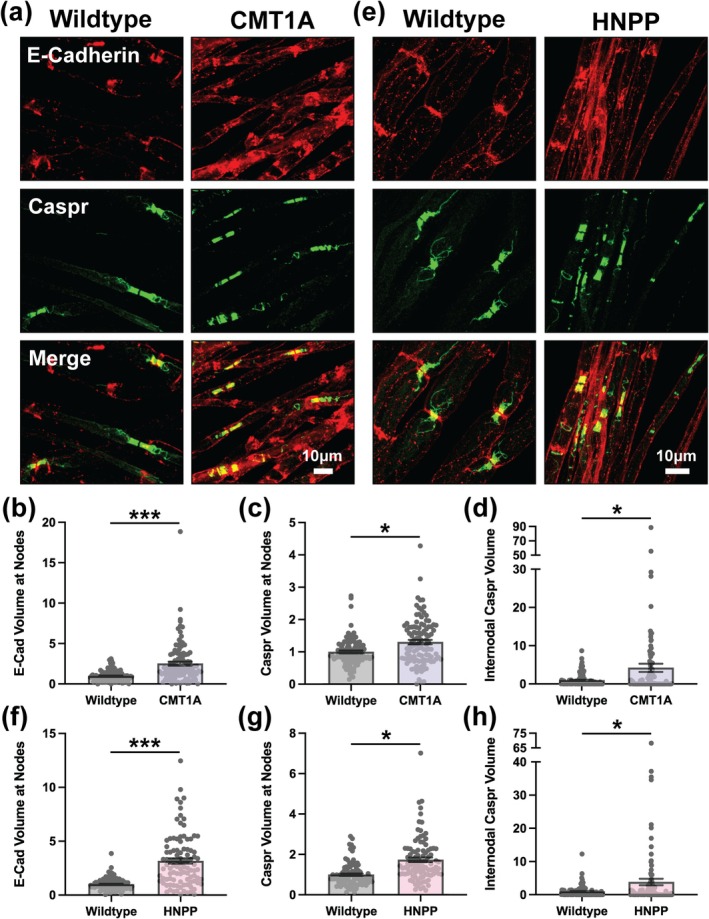
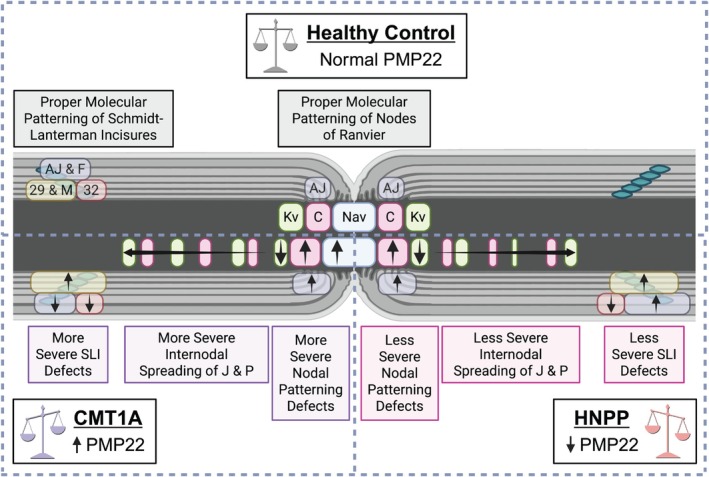
Charcot–Marie–Tooth Disease Type 1A (CMT1A) and Hereditary Neuropathy with Liability to Pressure Palsies (HNPP) are the most common inherited peripheral neuropathies and arise from copy number variation of the Peripheral Myelin Protein 22 ( PMP22 ) gene. While secondary axon degeneration has been proposed as the primary driver of disability, our prior work demonstrated pronounced neuromuscular impairment in CMT1A model mice in the absence of overt axonal loss, prompting investigation into primary myelin dysfunction. Here, we reveal that altered PMP22 dosage profoundly disrupts molecular architecture at critical myelin domains, Schmidt‐Lanterman incisures (SLIs) and Nodes of Ranvier. Using high‐resolution confocal imaging of teased peripheral nerve fibers from CMT1A and HNPP model mice, we identified widespread disorganization of adherens junctions, mislocalization of Connexin29 and aberrant distribution of nodal ion channels, with several defects more severe in CMT1A, consistent with disease burden. Notably, nodal widening and abnormal spreading of Kv1.2 and Caspr along internodes indicate compromised axo‐glial compartmentalization essential for saltatory conduction. Together, these findings support a model in which PMP22 functions as a structural organizer of myelin, coordinating adherens junction patterning and nodal subdomain integrity. Dysregulation of this function is predicted to compromise Schwann‐cell architecture, metabolic support and axonal excitability. Our findings support a paradigm shift in which molecular destabilization of myelin, rather than secondary axonal degeneration alone, contributes to disease progression in CMT1A and HNPP. This work also identifies junctional complexes as potential actionable molecular targets and establishes a mechanistic framework applicable to a broad spectrum of inherited dysmyelinating and acquired demyelinating neuropathies.
Overview
The claims and statistics of this paper haven’t been checked yet.
Run the check — free, no account needed. It reads the open-access text and checks the sources it cites.
Integrity signals
Registry
Cites
Statistics
Figures
Verification
Claims the paper makes
The claims and statistics of this paper haven’t been checked yet.
Run the check — free, no account needed. It reads the open-access text and checks the sources it cites.
Self-check
Percentages, sums and reported differences re-computed from the paper’s own numbers.
The self-check needs the paper’s full text.
Citations
Cites
Highly accurate protein structure prediction with AlphaFold
Jumper, J., Evans, R., Pritzel, A., Green, T., Figurnov, M., Ronneberger, O., Tunyasuvunakool, K., Bates, R., Žídek, A., Potapenko, A., et al. (2021) · Nature · doi:10.1038/s41586-021-03819-2 · Cited by 43,764
Adherens junctions as molecular regulators of emergent tissue mechanics
Campàs, O., Noordstra, I., & Yap, A. S. (2024) · Nature Reviews Molecular Cell Biology · doi:10.1038/s41580-023-00688-7 · Cited by 149
Research works printed but not linked: 68
- 10.1523/JNEUROSCI.17-12-04662.1997 · DOI
- 10.1038/ng1195-274 · DOI
- 10.1523/JNEUROSCI.22-15-06458.2002 · DOI
- 10.1523/JNEUROSCI.17-12-04545.1997 · DOI
- 10.1023/A:1007009613484 · DOI
- 10.1007/s00415-019-09319-8 · DOI
- 10.1007/s12035-022-02838-y · DOI
- 10.1083/jcb.142.4.1095 · DOI
- 10.1186/s12990-015-0065-7 · DOI
- 10.1007/s00726-025-03479-w · DOI
- 10.1126/science.8266101 · DOI
- 10.1002/ana.10089 · DOI
- 10.1177/0192623319850773 · DOI
- 10.1073/pnas.090034797 · DOI · Paper page
- 10.1111/ejn.16457 · DOI
- 10.1002/glia.20315 · DOI
- 10.1212/WNL.53.4.846 · DOI
- 10.1016/j.bbamem.2020.183211 · DOI
- 10.1083/jcb.129.1.189 · DOI · Paper page
- 10.1016/S0301-0082(99)00049-0 · DOI
- 10.1002/ana.24086 · DOI
- 10.1111/bph.15231 · DOI
- 10.1093/brain/awu257 · DOI · Paper page
- 10.1007/BF01190831 · DOI
- 10.1371/journal.pgen.1006290 · DOI
- 10.3389/fmolb.2024.1486576 · DOI
- 10.1016/B978-0-12-394311-8.00018-2 · DOI
- 10.1093/brain/123.7.1516 · DOI
- 10.1038/s44321-023-00019-5 · DOI
- 10.1177/019262330002800114 · DOI
- 10.1007/s12035-012-8370-x · DOI
- 10.1111/ene.13079 · DOI
- 10.1073/pnas.2000508117 · DOI
- 10.1136/jnnp.62.4.310 · DOI
- 10.1002/glia.23578 · DOI
- 10.1021/bi500809t · DOI
- 10.1016/0896-6273(94)90472-3 · DOI
- 10.1111/jns.12483 · DOI
- 10.1073/pnas.93.18.9565 · DOI
- 10.1002/(SICI)1097-4547(19991201)58:5<612::AID-JNR2>3.0.CO;2-X · DOI
- 10.1073/pnas.251548398 · DOI
- 10.1159/000505815 · DOI
- 10.1016/j.isci.2024.110989 · DOI
- 10.1101/cshperspect.a041361 · DOI
- 10.1152/jn.01077.2015 · DOI
- 10.1046/j.1469-7580.2002.00039.x · DOI
- 10.1091/mbc.e04-07-0551 · DOI
- 10.1002/cne.20154 · DOI · Paper page
- 10.1046/j.1529-8027.2002.02001.x · DOI
- 10.1002/(SICI)1098-1136(199809)24:1<8::AID-GLIA2>3.0.CO;2-3 · DOI
- 10.1002/jnr.21992 · DOI
- 10.4161/tisb.25502 · DOI
- 10.4103/1673-5374.361538 · DOI
- 10.1111/j.1529-8027.2012.00441.x · DOI
- 10.1523/JNEUROSCI.5168-04.2005 · DOI
- 10.1016/j.tcb.2022.08.007 · DOI
- 10.1136/bmjopen-2017-018048 · DOI
- 10.1002/ana.410390621 · DOI
- 10.1146/annurev.physiol.68.040104.131404 · DOI
- 10.3390/ijms20225655 · DOI
- 10.1097/NEN.0b013e318217eba0 · DOI
- 10.1093/brain/awaf219 · DOI
- 10.1016/j.jns.2015.05.037 · DOI
- 10.1002/mus.1159 · DOI
- 10.1242/bio.059634 · DOI
- 10.1523/JNEUROSCI.18-06-01953.1998 · DOI
- 10.1006/mcne.2002.1177 · DOI
- 10.1172/JCI96499 · DOI
Metadata
- Authors
- Moss, K. R., Arowolo, M. A., Gutierrez, D. R., & Höke, A.
- Affiliations
- University of Missouri Health System (US)
- Johns Hopkins University (US)
- Corresponding author
- Moss, Kathryn R.
- Venue
- Glia
- Publisher
- Wiley
- Published
- 2025-12-16
- Volume
- 74
- Issue
- 2
- Pages
- e70124-e70124
- ISSN
- 0894-1491 (ISSN-L)
- 1098-1136
- PMC
- PMC12706824
- OpenAlex
- W4417427233
- Cited by
- 2
- References
- 2
- Citations by year
- 2026: 2
- FWCI
- 0.78
- Type
- journal article
- Language
- en
- Open access
- hybrid
- doi.org
- Locations
- Glia (publishedVersion, cc-by)
- bioRxiv (Cold Spring Harbor Laboratory) (acceptedVersion)
- Europe PMC (PubMed Central) (publishedVersion, cc-by)
- PubMed (publishedVersion)
- PubMed Central (publishedVersion, cc-by)
- Funders
- National Institute of Neurological Disorders and Stroke (K22NS125057)
- Topics
- Life Sciences › Neuroscience › Cellular and Molecular Neuroscience › Hereditary Neurological Disorders
- Health Sciences › Medicine › Clinical Neurology › Peripheral Neuropathies and Disorders
- Health Sciences › Medicine › Oncology › Cancer Treatment and Pharmacology
- Keywords
- Charcot-Marie-Tooth disease type 1A, hereditary neuropathy with liability to pressure palsies, Schmidt-Lanterman incisures, nodes of Ranvier, adherens junctions, Kv1.2, Caspr, saltatory conduction, Schwann cells, demyelinating neuropathy, peripheral nerve myelin
- MeSH terms
- Animals, Arthrogryposis, Axons, Charcot-Marie-Tooth Disease, Disease Models, Animal, Male, Mice, Inbred C57BL, Mice, Transgenic, Myelin Proteins, Myelin Sheath, Ranvier's Nodes, Hereditary Sensory and Motor Neuropathy, Connexins, Mice
About these checks
Registry, retraction, Cites and statistics results are computed, not judged, with one exception: a printed reference that no index lists is read once by a model before it counts as a citation error. Claims are extracted by a model and kept only when their quote appears verbatim in the text; each cited source is then checked, with a model’s help, for whether it says what the claim relies on. Those verdicts can be wrong — read the claim’s quote and the cited source before relying on one.
Statistics and arithmetic are recomputed, not judged.
Confidence bands are shown only for fields calibrated on our annotated test set. None is calibrated yet, so no band is shown.
What counts as a claim ›How we measure confidence ›How we check this ›
Are you an author, or do you see a problem with this page? Request a review
How to cite
Cite CoChat for the checks on this page, and the paper for its own findings.
- This page
- CoChat. (2026). Citation check: Aberrant Molecular Myelin Architecture in Charcot–Marie–Tooth Disease Type 1A and Hereditary Neuropathy With Liability to Pressure Palsies. https://app.cochat.ai/papers/10.1002/glia.70124
- The paper
- Moss, K. R., Arowolo, M. A., Gutierrez, D. R., & Höke, A. (2026). Aberrant Molecular Myelin Architecture in Charcot–Marie–Tooth Disease Type 1A and Hereditary Neuropathy With Liability to Pressure Palsies. Glia. https://doi.org/10.1002/glia.70124
