

The complexity of post‐mergers and acquisitions reorganization: Integration and differentiation
Open accessThe DOI matches its Crossref record; 74 of the 75 references it cites were found in a registry or an index; none of the 22 sources its claims cite is checked for support yet.
Abstract
Research Summary: This article applies a mixed‐method approach to explore the complexities of post‐mergers and acquisitions (M&A) integration processes. Extant literature provides significant insights regarding the impact of task and human integration and their influence on post‐integration processes. However, the literature often fails to differentiate between subelements of these two dimensions. This article investigates task and human integration in a cross‐border M&A aimed at efficiency and innovativeness. We highlight the importance of a clear distinction between two subelements of task integration (product harmonization and structural integration) and show that different interorganizational contexts matter. Consequently, we propose a conceptual framework based on two contextual characteristics—source of synergy and choice of location—suggesting that different integration approaches should be applied simultaneously in different contexts of the same post‐M&A organization. Managerial Summary: Due to the complexity of the post‐M&A integration process, organizing and managing such a process is a challenge to most practitioners. Understanding how to manage different integration dimensions increases the need for prioritization in order to bypass a one‐size‐fits‐all initiative. We suggest that managers should apply a differentiated postintegration approach, depending on specific organizational contexts. A product‐focused approach seems to fit best in a context where target and acquirer remain working in separate locations, but on similar products. A structure‐focused approach is recommended when target and acquirer remain separated, but work on complementary products. Finally, a people‐focused approach is proposed when target and acquirer are colocated.
Overview
CoChat Summary
TL;DR
This mixed-method study of a cross-border acquisition finds that post-M&A integration is not homogeneous: task and human integration levels vary across locations, and task integration itself splits into product harmonization and structural integration. The authors propose that firms should differentiate integration approaches by source of synergy (similarity vs. complementarity) and location (separated vs. colocated), rather than applying one organization-wide approach.
Key findings
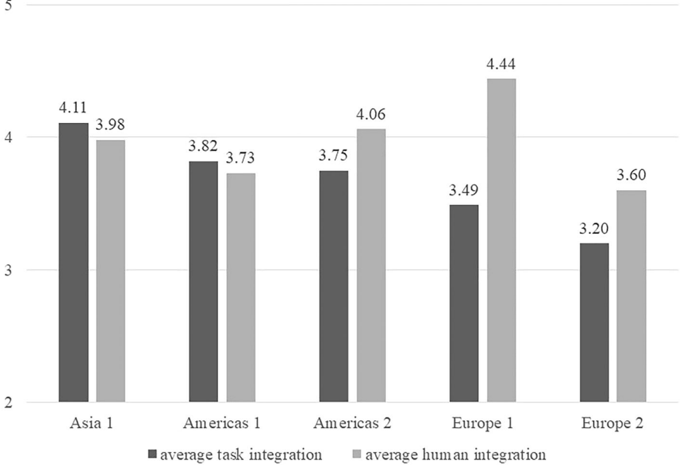
- Integration levels differed significantly across Sigma’s locations: task integration mean scores ranged from 3.20 (Europe 2) to 4.11 (Asia 1), and human integration ranged from 3.60 (Europe 2) to 4.44 (Europe 1); ANOVA differences were significant (task integration p = .000; human integration p = .0452).
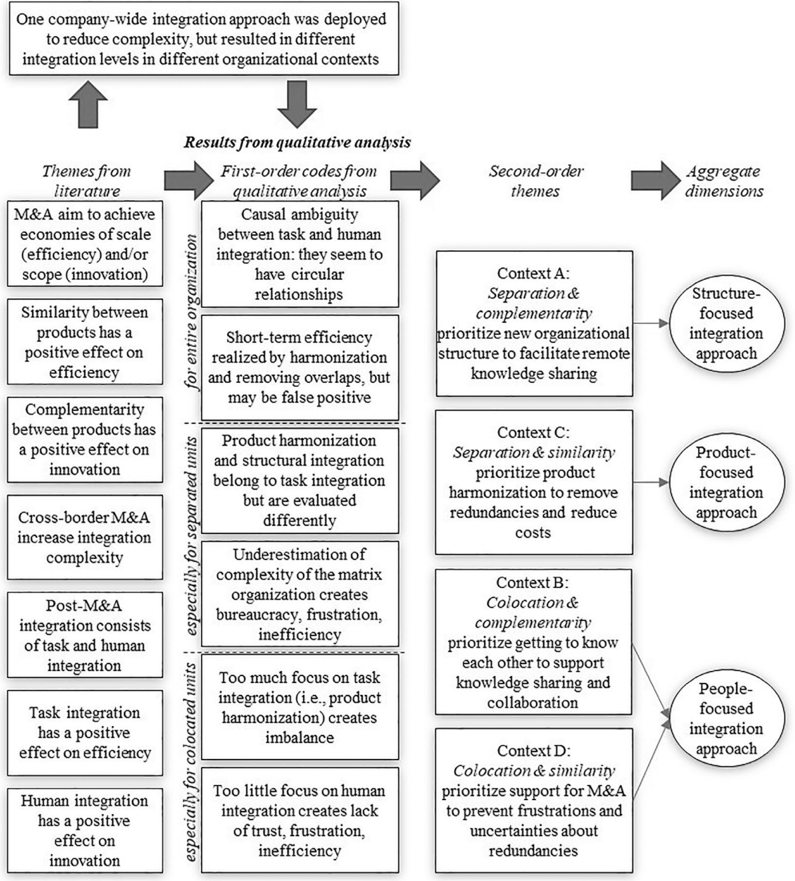
- Qualitative findings show product harmonization was viewed positively and linked to short-term efficiency, while structural integration was less successful; the strong focus on task integration came at the expense of human integration, producing frustration, inefficiencies, resistance, and turnover.
- The paper argues task integration should be split into product harmonization and structural integration, and proposes three differentiated approaches: structure-focused when target and acquirer are separated and synergy is complementary; product-focused when separated and synergy is similar; people-focused when colocated, regardless of synergy source.
- Task and human integration have reciprocal relationships and causal ambiguity, making it difficult to identify where to start; the authors suggest prioritizing the right element depending on context rather than seeking a one-size-fits-all solution.
Methods
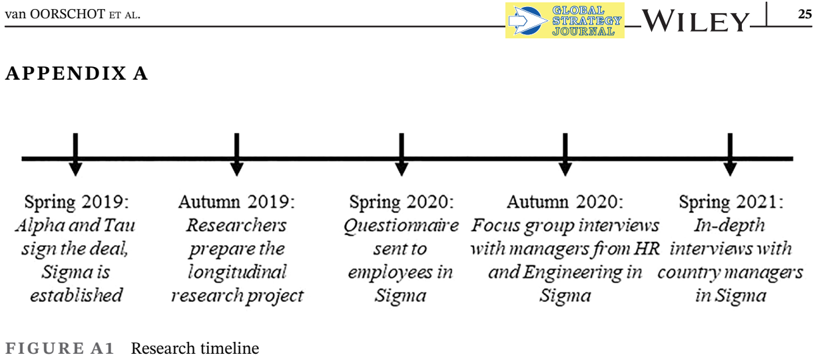
- Sequential mixed-method case study of Sigma, formed after Alpha acquired Tau in spring 2019; the acquisition involved almost 4,000 people, more than 100 IT systems, and was worth approximately €500 million.
- Quantitative survey in March 2020: emails sent to 768 targeted respondents, 326 complete questionnaires (42.4% response rate), final dataset of 307 responses; measures used 7-point Likert scales, reliability/validity checks, mean comparisons across countries, Bartlett tests, and ANOVA.
- Qualitative stage: two focus group interviews (11 HR employees; 9 engineering managers) in autumn 2020 and eight in-depth interviews with senior managers in spring 2021 (60–80 min each), analyzed through content and template analysis with first-order codes, second-order themes, and aggregate dimensions.
Limitations
- The paper states limitations including the small number of participants in both quantitative and qualitative studies, imperfect measures of key items, a single case involving Western European firms, a limited time frame of about 2 years, and overlap with the COVID-19 pandemic.
- The paper also notes that cross-sectional data prevent causal inferences about whether task integration causes human integration or vice versa, and that the single-case design limits generalizability; replication and longitudinal studies are recommended.
Model-written summary. Check it against the paper before relying on it.
Integrity signals
Registry
Cites
Statistics
Figures
Verification
Claims the paper makes
0 Valid · 0 Not valid · 21 Not checked · 100 Own results and interpretations
A result the paper reports from its own data — it cites no other source for it, so there is none to check. The quote shows it is in the paper.
In the paper
“In sum, the empirical results show that even though Sigma had an organization-wide plan for the integration process, employees in different locations regarded the current state of the integration process differently.”
§ The complexity of post-mergers and acquisitions reorganization: Integration and differentiation > 4.1 | Quantitative analysis
plainstates an association- Asserted: passes — The authors put it forward as true.
- Checkable: passes — It can be checked against evidence.
- Load-bearing: passes — The paper’s conclusions depend on it.
- Based: passes — The paper gives a reason why it holds.
A result the paper reports from its own data — it cites no other source for it, so there is none to check. The quote shows it is in the paper.
In the paper
“The results exhibit clear differences in levels of integration across the five countries.”
- Also stated in: § 4.1 | Quantitative analysis · plain
“The quantitative study revealed that the levels of human and task integration varied across countries and regions.”
§ The complexity of post-mergers and acquisitions reorganization: Integration and differentiation > 4.1 | Quantitative analysis
boostedstates an association- Asserted: passes — The authors put it forward as true.
- Checkable: passes — It can be checked against evidence.
- Load-bearing: passes — The paper’s conclusions depend on it.
- Based: passes — The paper gives a reason why it holds.
- Also stated in: § 4.1 | Quantitative analysis · plain
A result the paper reports from its own data — it cites no other source for it, so there is none to check. The quote shows it is in the paper.
In the paper
“and the heterotrait-monotrait ratio is 0.489.”
§ The complexity of post-mergers and acquisitions reorganization: Integration and differentiation > 4.1 | Quantitative analysis
plain- Asserted: passes — The authors put it forward as true.
- Checkable: passes — It can be checked against evidence.
- Load-bearing: passes — The paper’s conclusions depend on it.
- Based: passes — The paper gives a reason why it holds.
A result the paper reports from its own data — it cites no other source for it, so there is none to check. The quote shows it is in the paper.
In the paper
“The correlation is .418(p = .000)”
§ The complexity of post-mergers and acquisitions reorganization: Integration and differentiation > 4.1 | Quantitative analysis
plainstates an association- Asserted: passes — The authors put it forward as true.
- Checkable: passes — It can be checked against evidence.
- Load-bearing: unclear — It is unclear whether the paper’s conclusions depend on it.
- Based: passes — The paper gives a reason why it holds.
A result the paper reports from its own data — it cites no other source for it, so there is none to check. The quote shows it is in the paper.
In the paper
“The two constructs also are positively correlated (p = .000).”
§ The complexity of post-mergers and acquisitions reorganization: Integration and differentiation > 4.1 | Quantitative analysis
plainstates an association- Asserted: passes — The authors put it forward as true.
- Checkable: passes — It can be checked against evidence.
- Load-bearing: unclear — It is unclear whether the paper’s conclusions depend on it.
- Based: passes — The paper gives a reason why it holds.
47 more claims
Create a free account to see all 121 claims and to verify the 16 references still open.
- It may state two separate claims as one. 30
- Probably not a substantial claim. 52
Claims other papers make about this one
Each is checked against this paper’s own text: does it say what the citing paper says it does?
In the citing paper
“the findings suggest that employee engagement may function more strongly as an outcome of other integration variables, particularly cultural integration and leadership effectiveness”
From Critical Drivers of Post-Integration Performance in Mergers and Acquisitions (2025) · cites this paper as van Oorschot et al., 2023
In the citing paper
“M&A deals usually fail between 50 and 70% of times (van Oorschot et al., 2023).”
From Critical Drivers of Post-Integration Performance in Mergers and Acquisitions (2025) · cites this paper as van Oorschot et al., 2023
In the citing paper
“Mixed-method evidence indicates that prioritizing task and structural integration while neglecting human integration reduces trust, increases turnover, and lowers organizational effectiveness (van Oorschot et al., 2023).”
From Critical Drivers of Post-Integration Performance in Mergers and Acquisitions (2025) · cites this paper as van Oorschot et al., 2023
In the citing paper
“Modern due diligence extends beyond financial and legal assessment to include organizational culture, human capital evaluation, and broader organizational considerations (van Oorschot et al., 2023).”
From Critical Drivers of Post-Integration Performance in Mergers and Acquisitions (2025) · cites this paper as van Oorschot et al., 2023
In the citing paper
“Inadequate communication strategies characterized by insufficient information, contradictory messaging, or delayed announcements increase employee anxiety, reduce productivity, and accelerate staff turnover following merger announcements (van Oorschot et al., 2023).”
From Critical Drivers of Post-Integration Performance in Mergers and Acquisitions (2025) · cites this paper as van Oorschot et al., 2023
4 more claims about this paper
Create a free account to see every claim other papers make about this one.
Self-check
Percentages, sums and reported differences re-computed from the paper’s own numbers.
Each contradiction between two passages listed here was confirmed by an independent check.
Rated minor: it would not touch a result — a value no result rests on, a p-value that stays on the same side of the significance level, or a conflict that is clerical, resolved elsewhere in the paper, or outside its own findings.
In the paper
§ The complexity of post-mergers and acquisitions reorganization: Integration and differentiation > 2.3 | Reciprocal relationships between integration dimensions
“(Cording et al., 2008, p. 743)”
§ The complexity of post-mergers and acquisitions reorganization: Integration and differentiation > References
“Cording, M., Christmann, P., & King, D. R. (2008). Reducing causal ambiguity in acquisition integration: Inter- mediate goals as mediators of integration decisions and acquisition performance. Academy of Management Journal, 51(4), 744-767.”
Rated minor: it would not touch a result — a value no result rests on, a p-value that stays on the same side of the significance level, or a conflict that is clerical, resolved elsewhere in the paper, or outside its own findings.
In the paper
§ The complexity of post-mergers and acquisitions reorganization: Integration and differentiation > 3.2.1 | Organization and respondent profiles
“Approximately half (46.3%) of the respondents worked in a specific European country (coded Europe 1)”
§ The complexity of post-mergers and acquisitions reorganization: Integration and differentiation > Additional information
“Europe 1 27 8.8% Europe 2 142 46.3%”
Citations
Cites
When to Use and How to Report the Results of PLS-SEM
Hair, J. F., Risher, J. J., Sarstedt, M., & Ringle, C. M. (2019) · European Business Review · doi:10.1108/ebr-11-2018-0203 · Cited by 27,541
Designing and Conducting Mixed Methods Research
Robinson, P. (2007) · Australian and New Zealand Journal of Public Health · doi:10.1111/j.1753-6405.2007.00096.x · Cited by 23,258
Seeking Qualitative Rigor in Inductive Research: Notes on the Gioia Methodology
Gioia, D. A., Corley, K. G., & Hamilton, A. L. (2013) · Organizational Research Methods · doi:10.1177/1094428112452151 · Cited by 13,227
Asset Stock Accumulation and Sustainability of Competitive Advantage
Dierickx, I., & Cool, K. (1989) · Management Science · doi:10.1287/mnsc.35.12.1504 · Cited by 8,353
Uncertain Imitability: An Analysis of Interfirm Differences in Efficiency under Competition
Lippman, S. A., & Rumelt, R. P. (1982) · The Bell Journal of Economics · doi:10.2307/3003464 · Cited by 2,824
Venkatesh, V., Brown, S. A., & Bala, H. (2013) · MIS Quarterly · doi:10.25300/misq/2013/37.1.02 · Cited by 2,363
Lorentzon, M. (1993) · Journal of Advanced Nursing · doi:10.1046/j.1365-2648.1993.180610057.x · Cited by 1,389
Larsson, R., & Finkelstein, S. (1999) · Organization Science · doi:10.1287/orsc.10.1.1 · Cited by 1,302
Meyer, K. E., Mudambi, R., & Narula, R. (2011) · Journal of Management Studies · doi:10.1111/j.1467-6486.2010.00968.x · Cited by 1,180
Zollo, M., & Singh, H. (2004) · Strategic Management Journal · doi:10.1002/smj.426 · Cited by 1,106
Research works printed but not linked: 1
- van OORSCHOT ET AL. 20425805, 0, Downloaded from https://onlinelibrary.wiley.com/doi/10.1002/gsj.1454, Wiley Online Library on [20/08/2023]. See the Terms and Conditions (https://onlinelibrary.wiley.com/terms-and-conditions) on Wiley Online Library for rules of use; OA articles are governed by the applicable Creative Commons License
Cited by
Larsen, M. M., Birkinshaw, J., Zhou, Y. M., & Benito, G. R. G. (2023) · Global Strategy Journal · doi:10.1002/gsj.1493 · Cited by 32
Chaturvedi, T., & Weigelt, C. (2024) · Long Range Planning · doi:10.1016/j.lrp.2024.102428 · Cited by 32
Theorizing about emerging multinationals' cross‐border acquisitions
Peng, M. W., Wang, J. C., Xie, E., & Lebedev, S. (2024) · Global Strategy Journal · doi:10.1002/gsj.1512 · Cited by 28
Wiedemann, M., zu Knyphausen‐Aufseß, D., & Ippendorf, N. (2024) · Review of Managerial Science · doi:10.1007/s11846-024-00813-6 · Cited by 17
Hendriks, G., Slangen, A., & Heugens, P. P. M. A. R. (2023) · Long Range Planning · doi:10.1016/j.lrp.2023.102342 · Cited by 16
Metadata
- Authors
- van Oorschot, K. E., Nujen, B. B., Solli‐Sæther, H., & Mwesiumo, D. E.
- Affiliations
- BI Norwegian Business School (NO)
- Norwegian University of Science and Technology (NO)
- Molde University College (NO)
- Corresponding author
- van Oorschot, Kim E.
- Venue
- Global Strategy Journal
- Publisher
- Wiley
- Published
- 2022-07
- Volume
- 13
- Issue
- 3
- Pages
- 673-699
- ISSN
- 2042-5791 (ISSN-L)
- 2042-5805
- OpenAlex
- W4283740644
- Cited by
- 53
- References
- 75
- Citations by year
- 2026: 21 · 2025: 15 · 2024: 12 · 2023: 5
- FWCI
- 4.34
- Type
- journal article
- Language
- en
- Open access
- hybrid
- doi.org
- Licence
- Locations
- Global Strategy Journal (publishedVersion, cc-by-nc-nd)
- NORA - Norwegian Open Research Archives (submittedVersion, cc-by-nc-nd)
- Topics
- Social Sciences › Economics, Econometrics and Finance › Finance › Corporate Finance and Governance
- Social Sciences › Business, Management and Accounting › Strategy and Management › International Business and FDI
- Social Sciences › Business, Management and Accounting › Strategy and Management › Innovation and Knowledge Management
- Keywords
- mergers and acquisitions, post-merger integration, task integration, human integration, structural integration, cross-border mergers and acquisitions, location choice
About these checks
Registry, retraction, Cites and statistics results are computed, not judged, with one exception: a printed reference that no index lists is read once by a model before it counts as a citation error. Claims are extracted by a model and kept only when their quote appears verbatim in the text; each cited source is then checked, with a model’s help, for whether it says what the claim relies on. Those verdicts can be wrong — read the claim’s quote and the cited source before relying on one.
A language model drew the claims from the paper on 2026-11-23, under version 3 of the claim definition (model deepseek-v4.1-flash, prompt extract-v3).
A second model labelled each claim on 2026-11-23 (model jev-1.13-20260917, definition revision gold-guideline-v0.2).
Statistics and arithmetic are recomputed, not judged.
Confidence bands are shown only for fields calibrated on our annotated test set. None is calibrated yet, so no band is shown.
What counts as a claim ›How we measure confidence ›How we check this ›
Are you an author, or do you see a problem with this page? Request a review
Data sources
Bibliographic data: Semantic Scholar, OpenAlex, Crossref.
Contains information from the Semantic Scholar Academic Graph Datasets, made available under the ODC Attribution License (ODC-BY 1.0).
Semantic Scholar’s data is described in: Kinney, R., et al. (2023). The Semantic Scholar Open Data Platform. arXiv:2301.10140.
