

The DOI matches its Crossref record; 214 of the 214 references it cites were found in a registry or an index; none of the 289 sources its claims cite is checked for support yet.
AASLD practice guidance on drug, herbal, and dietary supplement–induced liver injury
Open accessAbstract
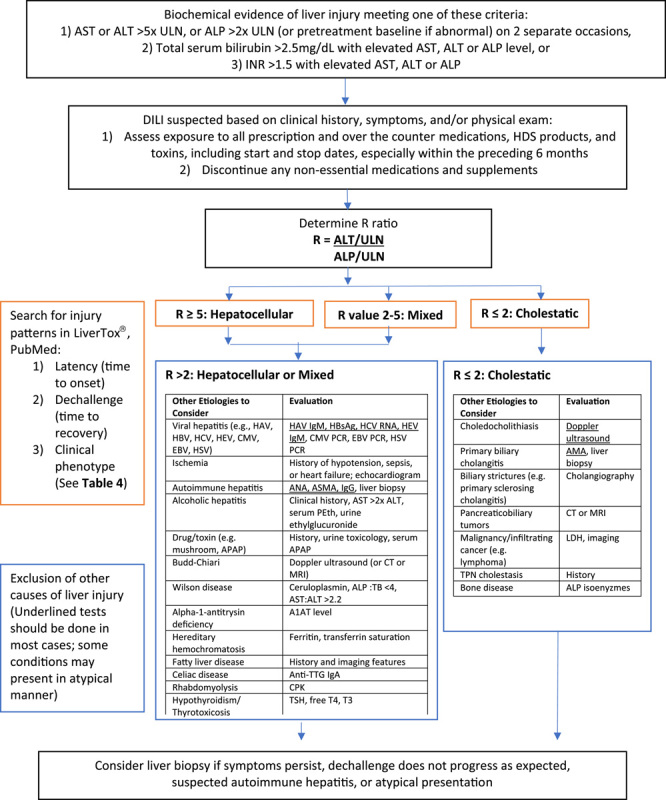
INTRODUCTION There are currently more than 1000 prescription medications available for use in the United States and more than 100,000 over‐the‐counter herbal and dietary supplements (HDS) available for purchase in retail stores and online. In addition, the average adult American receives more than six prescription medications per year.1,2 Many of these drugs and HDS products have been implicated as causes of DILI. Furthermore, DILI is a leading reason for regulatory actions regarding drugs in development as well as those in the marketplace.1 Confidently establishing a diagnosis of DILI is difficult because of the need to exclude more common competing causes of liver injury, the protean clinical manifestations from an individual agent, and the lack of a validated diagnostic biomarker.3–5 This guidance was developed with the support and oversight of the American Association for the Study of Liver Diseases Practice Guidelines Committee, who chose to commission a guidance, rather than a guideline, because of the paucity of randomized controlled trials on this topic. This document was developed by consensus of an expert panel and provides guidance statements based on formal review and analysis of the literature on the topics and questions related to the needs of patients with drug and supplement–induced liver injury. The aim of this practice guidance is to provide recommendations regarding the common clinical, laboratory, and histological features seen in patients with DILI based on observational and epidemiological data reported in case series or DILI registries. In addition, expert opinion–based recommendations for patient management, including risk stratification, are provided to assist patients and practitioners. DILI classification DILI can be mechanistically classified as being either direct (i.e., dose‐dependent, intrinsic, and predictable) or idiosyncratic (largely dose‐independent, idiosyncratic, and unpredictable) (Table 1). Direct hepatotoxins such as acetaminophen (APAP) (N‐acetyl‐para‐aminophenol) can cause liver injury in nearly all exposed individuals if a threshold dose or duration is exceeded. In contrast, idiosyncratic hepatotoxins are usually neither dose‐related nor duration‐related but rather occur at varying times during or after drug administration.6 Idiosyncratic DILI is uncommon, with most approved drugs occurring in only 1 in 1000 to 1 in a million exposed individuals. Although most patients do not have rash, eosinophilia, or other hypersensitivity features at presentation, aberrant host immunity is implicated in most instances of idiosyncratic DILI.3 TABLE 1 - Proposed classification of DILI Mechanistic classification Direct hepatotoxicity Idiosyncratic hepatotoxicity Indirect hepatotoxicity Incidence Common Rare Intermediate Dose relatedness Yes No No Predictable Yes No Partially Reproduced in animal models Yes No Not usually Latency Rapid (days) Variable (days to years) Delayed (months) Phenotypes of injury Serum AST, ALT, or ALP elevations, hepatic necrosis, acute fatty liver, nodular regeneration Mixed or cholestatic hepatitis, bland cholestasis, chronic hepatitis Immune‐mediated hepatitis, fatty liver, chronic hepatitis Examples Acetaminophen, niacin, intravenous methotrexate Amoxicillin‐clavulanate, cephalosporins, isoniazid, nitrofurantoin Immune checkpoint inhibitors, anti‐CD20 monoclonal Ab, protein kinase inhibitors Touted mechanism of injury Intrinsic hepatotoxicity that is dose‐dependent Idiosyncratic host metabolic or immune reaction Indirect effect on liver or host immunity Source: Adapted from Björnsson et al.5 A third mechanism of hepatotoxicity is called indirect DILI, which arises when the biological action of the drug affects the host immune system, leading to a secondary form of liver injury. Like idiosyncratic DILI, indirect hepatotoxins are generally independent of the dose of medication administered and have a latency of weeks to months with varying clinical manifestations. Examples of indirect hepatotoxicity include the immune‐mediated hepatitis (IMH) observed with immune checkpoint inhibitors (ICIs) and reactivation of HBV infection following rituximab infusions.7,8 Guidance statements Clinicians should be familiar with the three main types of hepatotoxicity when evaluating patients with suspected DILI. Direct hepatotoxins such as APAP can cause liver injury in nearly all exposed individuals once a threshold dose or duration of use is exceeded. Idiosyncratic DILI is largely independent of the dose and duration of medication use and characterized by a low incidence and variable drug latency and clinical and histological features. Idiosyncratic DILI is believed to arise from an aberrant adaptive host immune response to the drug and/or its metabolite(s). Indirect hepatotoxins are generally independent of the dose administered and have a variable latency and manifestations that arise from the biological action of the drug on the liver and/ or host immune system. Ep
Overview
AI snapshot
Written from the paper’s full text.
TL;DR
This AASLD practice guidance summarizes drug-, herbal-, and dietary supplement–induced liver injury (DILI), covering classification, epidemiology, diagnosis, causality assessment, histology, management, and monitoring. It provides consensus guidance statements because randomized controlled trial evidence is sparse.
Key findings
- Idiosyncratic DILI is uncommon, with an estimated annual incidence of 14–19 per 100,000 in the general population (~60,000 US cases/year), higher in exposure-based electronic medical record studies (32.8–40 per 100,000) and up to 1.4% among medical inpatients.
- Herbal and dietary supplements (HDS) account for ~20% of adult DILI cases in the DILIN registry; in China, Korea, and Singapore, HDS account for 27%–62% of DILI cases. Amoxicillin-clavulanate is the most frequently implicated individual agent in many Western countries, whereas anti-tuberculosis agents dominate in Asian countries.
- Acetaminophen (APAP) is a dose-dependent hepatotoxin; in North America, APAP overdose is believed to cause 100,000 poison-control calls, 50,000 emergency room visits, and at least 500 deaths annually, and is the leading cause of acute liver failure among US adults.
- With drug discontinuation, ~80% of DILI patients fully recover; ~10% with severe hepatocellular DILI and jaundice are at risk of death or transplant, and spontaneous survival in DILI-related acute liver failure is only ~25%. Chronic DILI occurred in 21% of DILIN subjects at 6 months, with 10%–20% persistence beyond 6–12 months in guidance statements.
Methods
- The American Association for the Study of Liver Diseases Practice Guidelines Committee commissioned a guidance, rather than a guideline, because of the paucity of randomized controlled trials; it was developed by expert panel consensus with formal literature review and analysis.
- Evidence came largely from observational and epidemiological data in case series and DILI registries (e.g., DILIN, Spanish, Iceland, Latin America, China, India), supplemented by expert opinion for management and risk stratification.
- The document synthesizes guidance statements, diagnostic algorithms, and tables on DILI classification, etiologies, genetic associations, histologic phenotypes, causality assessment instruments, prognostic indices, and monitoring/management.
Limitations
- Stated in the paper: there is a paucity of randomized controlled trials on DILI, no validated diagnostic biomarker, and diagnosis remains difficult because it requires excluding more common competing causes of liver injury.
- Stated in the paper: causality assessment tools have important limitations—RUCAM weighting and risk factors are not evidence-based, RECAM has not been tested in regions with different DILI spectra, in HDS-induced injury, or in cases with more than one suspect drug, and DILIN expert opinion requires specialized expertise that limits generalizability.
- Stated in the paper and evident from the text: insufficient data exist to confirm age, sex, and race/ethnicity as reliable DILI susceptibility risk factors; HDS compositional complexity, adulteration, mislabeling, and batch variability confound assessment; and many recommendations rely on observational data and expert consensus rather than controlled trials.
Model-written summary. Check it against the paper before relying on it.
Integrity signals
Registry
Cites
Statistics
Figures
Verification
Claims the paper makes
186 Not checked yet · 71 No basis given · 23 Own interpretation · 1 Sources not found · 1 Own result
The paper states this without a source or data behind it here, so there is nothing to check it against. The quote shows it is in the paper.
In the paper
“The characteristic laboratory profile of APAP hepatotoxicity includes very high aminotransferase levels with low bilirubin.”
§ AASLD practice guidance on drug, herbal, and dietary supplement–induced liver injury > INTRODUCTION > Management of APAP overdose
plaincorrelational- Asserted: passes — The authors put it forward as true.
- Checkable: passes — It can be checked against evidence.
- Load-bearing: unclear — It is unclear whether the paper’s conclusions depend on it.
- Based: passes — The paper gives a reason why it holds.
None of the sources cited for this claim have been checked yet.
In the paper
“Recent studies have shown that patients with HDS hepatoxicity leading to liver failure are more likely to die or undergo transplantation compared to patients with drug hepatoxicity.133,134”
§ AASLD practice guidance on drug, herbal, and dietary supplement–induced liver injury > INTRODUCTION > HDS hepatotoxicity, susceptibility factors, and outcomes
What the sources say
- Not checked yetcites [133] Kesar V Channen L Masood U Grewal P Ahmad J Roth NC. Liver transplantation for acute liver injury in asians is more likely due to herbal and dietary supplements. Liver Transpl. 2022; 28: 188– 99. 34370392 PMC8792150
- Not checked yetcites [134] Ghabril M Ma J Patidar KR Nephew L Desai AP Orman E. Eight fold increase in the dietary supplement related liver failure leading to transplant waitlisting over the last quarter century in the US. Liver Transpl. 2022; 28: 169– 79. 34331346
plaincorrelational- Asserted: passes — The authors put it forward as true.
- Checkable: passes — It can be checked against evidence.
- Load-bearing: unclear — It is unclear whether the paper’s conclusions depend on it.
- Based: passes — The paper gives a reason why it holds.
In the paper
“If NAC is administered within 12 h of ingestion, it virtually assures that the liver damage will be minimal.”
§ AASLD practice guidance on drug, herbal, and dietary supplement–induced liver injury > INTRODUCTION > Management of APAP overdose
What the sources say
- Not checked yetcites [167] Prescott LF Critchley JA. The treatment of acetaminophen poisoning. Annu Rev Pharmacol Toxicol. 1983; 23: 87– 101. 6347057
boosteddirect- Asserted: passes — The authors put it forward as true.
- Checkable: passes — It can be checked against evidence.
- Load-bearing: unclear — It is unclear whether the paper’s conclusions depend on it.
- Based: passes — The paper gives a reason why it holds.
The paper states this without a source or data behind it here, so there is nothing to check it against. The quote shows it is in the paper.
In the paper
“Development of signs and symptoms of liver failure (encephalopathy, primarily) are concerning, and once they are present, nearly one‐third of patients either die or require a liver transplant.”
§ AASLD practice guidance on drug, herbal, and dietary supplement–induced liver injury > INTRODUCTION > Management of APAP overdose
plaincorrelational- Asserted: passes — The authors put it forward as true.
- Checkable: passes — It can be checked against evidence.
- Load-bearing: unclear — It is unclear whether the paper’s conclusions depend on it.
- Based: passes — The paper gives a reason why it holds.
None of the sources cited for this claim have been checked yet.
In the paper
“Outcomes have also generally improved over the past two decades, likely because of improvements in intensive care, with only 8% of patients undergoing transplantation.168,169”
§ AASLD practice guidance on drug, herbal, and dietary supplement–induced liver injury > INTRODUCTION > Prognosis
What the sources say
- Not checked yetcites [168] Koch DG Tillman H Durkalski V Lee WM Reuben A. Development of a model to predict transplant‐free survival of patients with acute liver failure. Clin Gastroenterol Hepatol. 2016; 14: 1199– 206. 27085756 PMC6055510
- Not checked yetcites [169] Larson AM Polson J Fontana RJ Davern TJ Lalani E Hynan LS. Acetaminophen‐induced acute liver failure: results of a United States multicenter, prospective study. Hepatology. 2005; 42: 1364– 72. 16317692
hedgedconditional- Asserted: passes — The authors put it forward as true.
- Checkable: passes — It can be checked against evidence.
- Load-bearing: unclear — It is unclear whether the paper’s conclusions depend on it.
- Based: passes — The paper gives a reason why it holds.
The paper states this without a source or data behind it here, so there is nothing to check it against. The quote shows it is in the paper.
In the paper
“The remaining patients make a full and complete recovery within 7 days.”
§ AASLD practice guidance on drug, herbal, and dietary supplement–induced liver injury > INTRODUCTION > Management of APAP overdose
plain- Asserted: passes — The authors put it forward as true.
- Checkable: passes — It can be checked against evidence.
- Load-bearing: unclear — It is unclear whether the paper’s conclusions depend on it.
- Based: unclear — It is unclear why the paper says it holds.
In the paper
“the DILIN has shown that supplements implicated in liver injury are frequently mislabeled.130”
§ AASLD practice guidance on drug, herbal, and dietary supplement–induced liver injury > INTRODUCTION > HDS hepatotoxicity, susceptibility factors, and outcomes
What the sources say
- Not checked yetcites [130] Navarro V Avula B Khan I Verma M Seeff L Serrano J. The contents of herbal and dietary supplements implicated in liver injury in the United States are frequently mislabeled. Hepatol Commun. 2019; 3: 792– 4. 31168513 PMC6545864
boosted- Asserted: passes — The authors put it forward as true.
- Checkable: passes — It can be checked against evidence.
- Load-bearing: unclear — It is unclear whether the paper’s conclusions depend on it.
- Based: passes — The paper gives a reason why it holds.
In the paper
“Intravenous or orally administered NAC can prevent liver injury nearly completely if given within 12 h of ingestion”
§ AASLD practice guidance on drug, herbal, and dietary supplement–induced liver injury > INTRODUCTION > Prognosis
What the sources say
- Not checked yetcites [167] Prescott LF Critchley JA. The treatment of acetaminophen poisoning. Annu Rev Pharmacol Toxicol. 1983; 23: 87– 101. 6347057
plaindirect- Asserted: passes — The authors put it forward as true.
- Checkable: passes — It can be checked against evidence.
- Load-bearing: unclear — It is unclear whether the paper’s conclusions depend on it.
- Based: passes — The paper gives a reason why it holds.
None of the sources cited for this claim have been checked yet.
In the paper
“Several randomized controlled trials have demonstrated no significant increase in the incidence of persistently elevated serum aminotransferase levels between statin and placebo therapy, including in patients with known chronic liver disease.198–200”
§ AASLD practice guidance on drug, herbal, and dietary supplement–induced liver injury > INTRODUCTION > Monitoring strategies for four commonly used medications
What the sources say
- Not checked yetcites [198] Pfeffer MA Keech A Sacks FM Cobbe SM Tonkin A Byington RP. Safety and tolerability of pravastatin in long term clinical trials. Circulation. 2002; 105: 2341– 6. 12021218
- Not checked yetcites [199] Lewis JH Mortensen ME Zweig S Fusco MJ Medoff JR Belder R. Efficacy and safety of high dose pravastatin in hypercholesterolemic patients with well‐compensated chronic liver disease: results of a prospective, randomized, double‐blind, placebo‐controlled multicenter trial. Hepatology. 2007; 46: 1453– 63. 17668878
- Not checked yetcites [200] Bays H Cohen DE Chalasani N Harrison SA. The National Lipid Association's statin safety task force. An assessment by the statin liver safety task force: 2014 update. J Clin Lipidol. 2014; 8(Suppl 3): S47– 57. 24793441
boosted- Asserted: passes — The authors put it forward as true.
- Checkable: passes — It can be checked against evidence.
- Load-bearing: passes — The paper’s conclusions depend on it.
- Based: passes — The paper gives a reason why it holds.
In the paper
“Finally, reintroduction of isoniazid after a DILI episode leads to recurrent liver injury in only 10% of patients but should only be done for patients with active, drug‐resistant TB.190”
§ AASLD practice guidance on drug, herbal, and dietary supplement–induced liver injury > INTRODUCTION > Monitoring strategies for four commonly used medications
What the sources say
- Not checked yetcites [190] Zuberi BF Zuberi FF Bader N Alvi H Salahuddin J. Comparison of British Thoracic Society and American Thoracic Society reintroduction guidelines for anti‐tuberculous therapy induced liver injury. J Pak Med Assoc. 2014; 64: 896– 9. 25252514
plaindirect- Asserted: passes — The authors put it forward as true.
- Checkable: passes — It can be checked against evidence.
- Load-bearing: unclear — It is unclear whether the paper’s conclusions depend on it.
- Based: passes — The paper gives a reason why it holds.
None of the sources cited for this claim have been checked yet.
In the paper
“Outcomes have also generally improved over the past two decades, likely because of improvements in intensive care, with only 8% of patients undergoing transplantation.168,169”
§ AASLD practice guidance on drug, herbal, and dietary supplement–induced liver injury > INTRODUCTION > Prognosis
What the sources say
- Not checked yetcites [168] Koch DG Tillman H Durkalski V Lee WM Reuben A. Development of a model to predict transplant‐free survival of patients with acute liver failure. Clin Gastroenterol Hepatol. 2016; 14: 1199– 206. 27085756 PMC6055510
- Not checked yetcites [169] Larson AM Polson J Fontana RJ Davern TJ Lalani E Hynan LS. Acetaminophen‐induced acute liver failure: results of a United States multicenter, prospective study. Hepatology. 2005; 42: 1364– 72. 16317692
plain- Asserted: passes — The authors put it forward as true.
- Checkable: passes — It can be checked against evidence.
- Load-bearing: unclear — It is unclear whether the paper’s conclusions depend on it.
- Based: passes — The paper gives a reason why it holds.
The paper states this without a source or data behind it here, so there is nothing to check it against. The quote shows it is in the paper.
In the paper
“The early intracellular events and mechanisms that lead to DILI are not well understood.”
§ AASLD practice guidance on drug, herbal, and dietary supplement–induced liver injury > SUMMARY/FUTURE DIRECTIONS > DILI biomarkers
plain- Asserted: passes — The authors put it forward as true.
- Checkable: passes — It can be checked against evidence.
- Load-bearing: passes — The paper’s conclusions depend on it.
- Based: passes — The paper gives a reason why it holds.
None of the sources cited for this claim have been checked yet.
In the paper
“When the liver biopsy guidelines in rheumatoid arthritis were relaxed, more frequent blood testing reduced the need for liver biopsies without sacrificing patient safety.192,193”
§ AASLD practice guidance on drug, herbal, and dietary supplement–induced liver injury > INTRODUCTION > Monitoring strategies for four commonly used medications
What the sources say
- Not checked yetcites [192] Erikson AR Reddy V Vogelgesang SA West SG. Usefulness of the American College of Rheumatology recommendations for liver biopsy in methotrexate‐treated rheumatoid arthritis patients. Arthritis Rheum. 1995; 38: 1115– 9. 7639808
- Not matchedcites [193] Aithal GP. Hepatotoxicity related to methotrexate. In: Kaplowitz N Deleve LD, editors. Drug‐Induced Liver Disease. 3rd ed. London: Academic Press; 2013.
Couldn’t be matched to a paper in Crossref, so it can’t be checked.
plaindirect- Asserted: passes — The authors put it forward as true.
- Checkable: passes — It can be checked against evidence.
- Load-bearing: unclear — It is unclear whether the paper’s conclusions depend on it.
- Based: passes — The paper gives a reason why it holds.
None of the sources cited for this claim have been checked yet.
In the paper
“The package inserts of currently approved drugs may recommend (i) monitoring, with or without providing a schedule for testing or any instructions; (ii) therapy discontinuation if symptoms and/or signs of liver injury supervene; or (iii) medication discontinuation or interruption for specified laboratory abnormalities.174,175”
§ AASLD practice guidance on drug, herbal, and dietary supplement–induced liver injury > INTRODUCTION > Early detection of DILI in clinical practice
What the sources say
- Not checked yetcites [174] Avigan MI. DILI and drug development: a regulatory perspective. Semin Liver Dis. 2014; 34: 215– 26. 24879985
- Not checked yetcites [175] Council for International Organizations of Medical Sciences; Drug‐Induced Liver Injury (DILI). Current status and future directions for drug development and the post marketing setting. A consensus by a CIOMS working group [cited 2021 Sep 30]. Geneva: CIOMS; 2020. Available from: https://cioms.ch/wp‐content/uploads/2020/06/CIOMS_DILI_Web_16Jun2020.pdf
hedged- Asserted: passes — The authors put it forward as true.
- Checkable: passes — It can be checked against evidence.
- Load-bearing: unclear — It is unclear whether the paper’s conclusions depend on it.
- Based: passes — The paper gives a reason why it holds.
In the paper
“Studies of infiltrating lymphocytes in the livers of patients with DILI have demonstrated unique cellular profiles, but further studies are needed to improve our understanding of the immunopathogenesis of DILI with the hope of preventing disease progression and identifying targets for therapeutic intervention.220”
§ AASLD practice guidance on drug, herbal, and dietary supplement–induced liver injury > SUMMARY/FUTURE DIRECTIONS > DILI biomarkers
What the sources say
- Not checked yetcites [220] Foureau DM Walling TL Maddukuri V Anderson W Culbreath K Kleiner DE. Comparative analysis of portal hepatic infiltrating leukocytes in acute drug‐induced liver injury, idiopathic autoimmune hepatitis, and viral hepatitis. Clin Exp Immunol. 2015; 180: 40– 51. 25418487 PMC4367092
boostedcorrelational- Asserted: passes — The authors put it forward as true.
- Checkable: passes — It can be checked against evidence.
- Load-bearing: unclear — It is unclear whether the paper’s conclusions depend on it.
- Based: passes — The paper gives a reason why it holds.
In the paper
“However, when patients are educated to self‐monitor and stop drugs when symptoms occur, ALF and death can be averted.189”
§ AASLD practice guidance on drug, herbal, and dietary supplement–induced liver injury > INTRODUCTION > Monitoring strategies for four commonly used medications
What the sources say
- Not checked yetcites [189] Senior JR Sr. Unintended adverse events associated with cancer chemotherapy. Toxicol Pathol. 2010; 38: 142– 7. 19858501
plaindirect- Asserted: passes — The authors put it forward as true.
- Checkable: passes — It can be checked against evidence.
- Load-bearing: passes — The paper’s conclusions depend on it.
- Based: passes — The paper gives a reason why it holds.
The paper states this without a source or data behind it here, so there is nothing to check it against. The quote shows it is in the paper.
In the paper
“Long‐term methotrexate treatment can be associated with the insidious development of hepatic steatosis and fibrosis.”
§ AASLD practice guidance on drug, herbal, and dietary supplement–induced liver injury > INTRODUCTION > Monitoring strategies for four commonly used medications
plaincorrelational- Asserted: passes — The authors put it forward as true.
- Checkable: passes — It can be checked against evidence.
- Load-bearing: passes — The paper’s conclusions depend on it.
- Based: passes — The paper gives a reason why it holds.
None of the sources cited for this claim have been checked yet.
In the paper
“transient and self‐limited aminotransferase elevations encountered with drugs like isoniazid and statins (Figure 2) that can resolve with continued dosing, presumably because of metabolic and or immunological adaptation.177,178”
§ AASLD practice guidance on drug, herbal, and dietary supplement–induced liver injury > INTRODUCTION > Hepatotoxicity monitoring in routine clinical practice
What the sources say
- Not checked yetcites [177] Mitchell JR Long MW Thorgeirsson UP Jollow DJ. Acetylation rates and monthly liver function tests during one year of isoniazid preventative therapy. Chest. 1975; 68: 181– 90. 1080096
- Not checked yetcites [178] Dara L Liu ZX Kaplowitz N. Mechanisms of adaptation and progression in idiosyncratic drug induced liver injury, clinical implications. Liver Int. 2016; 36: 158– 65. 26484420 PMC4718752
hedgedconditional- Asserted: passes — The authors put it forward as true.
- Checkable: passes — It can be checked against evidence.
- Load-bearing: unclear — It is unclear whether the paper’s conclusions depend on it.
- Based: passes — The paper gives a reason why it holds.
None of the sources cited for this claim have been checked yet.
In the paper
“Substantial differences have been identified between US (FDA) and European Medicines Agency drug labeling recommendations regarding hepatoxicity.172,173”
§ AASLD practice guidance on drug, herbal, and dietary supplement–induced liver injury > INTRODUCTION > Early detection of DILI in clinical practice
What the sources say
- Not checked yetcites [172] Bjornsson ES Jacobsen EI Einarsdottir R Chalasani N. Discrepancies in liver disease labeling in the package inserts of commonly prescribed medications. Gastroenterology. 2015; 148: 269– 73. 25527971
- Not checked yetcites [173] Wu Y Xiao W TongW BJ Chen M. A systematic comparison of hepatobiliary adverse drug reactions in FDA and EMA drug labelling reveals discrepancies. Drug Discov Today. 2021; 27: 337– 46. 34607018
plaincorrelational- Asserted: passes — The authors put it forward as true.
- Checkable: passes — It can be checked against evidence.
- Load-bearing: unclear — It is unclear whether the paper’s conclusions depend on it.
- Based: passes — The paper gives a reason why it holds.
The paper states this without a source or data behind it here, so there is nothing to check it against. The quote shows it is in the paper.
In the paper
“Therefore, individuals taking a drug with a moderate to high likelihood of causing DILI should undergo laboratory and clinical monitoring using a validated surveillance program, but only a few bona fide protocols exist.”
§ AASLD practice guidance on drug, herbal, and dietary supplement–induced liver injury > INTRODUCTION > Early detection of DILI in clinical practice
plain- Asserted: passes — The authors put it forward as true.
- Checkable: passes — It can be checked against evidence.
- Load-bearing: passes — The paper’s conclusions depend on it.
- Based: passes — The paper gives a reason why it holds.
The paper states this without a source or data behind it here, so there is nothing to check it against. The quote shows it is in the paper.
In the paper
“DILI research continues to be hampered by the lack of an objective, reliable laboratory test to confirm a particular drug as the correct suspect agent.”
§ AASLD practice guidance on drug, herbal, and dietary supplement–induced liver injury > SUMMARY/FUTURE DIRECTIONS > DILI biomarkers
plaindirect- Asserted: passes — The authors put it forward as true.
- Checkable: passes — It can be checked against evidence.
- Load-bearing: passes — The paper’s conclusions depend on it.
- Based: passes — The paper gives a reason why it holds.
In the paper
“Liver biopsy typically demonstrates lobular or periportal hepatitis and is generally not recommended unless patients have persistent grade 3 hepatotoxicity or jaundice despite corticosteroids.206”
§ AASLD practice guidance on drug, herbal, and dietary supplement–induced liver injury > INTRODUCTION > Monitoring strategies for four commonly used medications
What the sources say
- Not checked yetcites [206] Li M Sack JS Bell P Rahma OE Srivastava A Grover S. Utility of liver biopsy in diagnosis and management of high‐grade immune checkpoint inhibitor hepatitis in patients with cancer. JAMA Oncol. 2021; 7: 1711– 4. 34554206 PMC8461544
plaincorrelational- Asserted: passes — The authors put it forward as true.
- Checkable: passes — It can be checked against evidence.
- Load-bearing: unclear — It is unclear whether the paper’s conclusions depend on it.
- Based: passes — The paper gives a reason why it holds.
In the paper
“To ensure prompt treatment modification or discontinuation in patients with early liver injury, a comprehensive risk evaluation and mitigation strategy has been instituted by the FDA for pexidartinib that requires the registration and clinical monitoring of all treated patients.176”
§ AASLD practice guidance on drug, herbal, and dietary supplement–induced liver injury > INTRODUCTION > Early detection of DILI in clinical practice
What the sources say
- Not checked yetcites [176] Lewis JH Gelderblom H van de Sande M Stacchiotti S Healey JH Tap WD. Pexidartinib long‐term hepatic safety profile in patients with tenosynovial giant cell tumors. Oncologist. 2021; 26: e863– 73. 33289960 PMC8100574
plain- Asserted: passes — The authors put it forward as true.
- Checkable: passes — It can be checked against evidence.
- Load-bearing: unclear — It is unclear whether the paper’s conclusions depend on it.
- Based: passes — The paper gives a reason why it holds.
None of the sources cited for this claim have been checked yet.
In the paper
“However, this approach has not been shown to be better than assessing for clinical symptoms of hepatitis at detecting toxicity.181–184”
§ AASLD practice guidance on drug, herbal, and dietary supplement–induced liver injury > INTRODUCTION > Monitoring strategies for four commonly used medications
What the sources say
- Not checked yetcites [181] Nolan CM Goldberg SV Buskin SE. Hepatotoxicity associated with isoniazid preventative therapy. A 7‐year survey from a public health tuberculosis clinic. JAMA. 1999; 281: 1014– 8. 10086436
- Not checked yetcites [182] Sotgiu G Matteelli A Getahun H Girardi E Sañé Schepisi M Centis R. Monitoring toxicity in individuals receiving treatment for latent tuberculosis infection: a systematic review versus expert opinion. Eur Respir J. 2015; 45: 1170– 3. 25700378 PMC4391659
- Not checked yetcites [183] Saukkonen JJ Cohn DL Jasmer RM Schenker S Jereb JA Nolan CM. An official ATS statement: hepatotoxicity of antituberculosis therapy. Am J Respir Crit Care Med. 2006; 174: 935– 52. 17021358
- Not checked yetcites [184] Joint Tuberculosis Committee of the British Thoracic Society. Chemotherapy and management of tuberculosis in the United Kingdom: recommendations 1998. Thorax. 1998; 53: 536– 48. 9797751 PMC1745276
plain- Asserted: passes — The authors put it forward as true.
- Checkable: passes — It can be checked against evidence.
- Load-bearing: passes — The paper’s conclusions depend on it.
- Based: passes — The paper gives a reason why it holds.
In the paper
“For example, 8.7% of the warnings for drug hepatoxicity and 21.3% of the contraindications for patients with liver disease were disparate in a recent study.173”
§ AASLD practice guidance on drug, herbal, and dietary supplement–induced liver injury > INTRODUCTION > Early detection of DILI in clinical practice
What the sources say
- Not checked yetcites [173] Wu Y Xiao W TongW BJ Chen M. A systematic comparison of hepatobiliary adverse drug reactions in FDA and EMA drug labelling reveals discrepancies. Drug Discov Today. 2021; 27: 337– 46. 34607018
plain- Asserted: passes — The authors put it forward as true.
- Checkable: passes — It can be checked against evidence.
- Load-bearing: unclear — It is unclear whether the paper’s conclusions depend on it.
- Based: passes — The paper gives a reason why it holds.
In the paper
“The incidence of IMH ranges varies from 1%–15% in clinical trials and observational studies, respectively.204”
§ AASLD practice guidance on drug, herbal, and dietary supplement–induced liver injury > INTRODUCTION > Monitoring strategies for four commonly used medications
What the sources say
- Not checked yetcites [204] Peeraphatdit T Wang J Odenwald MA Hu S Hart J Charlton MR. Hepatotoxicity from immune checkpoint inhibitors: a systematic review and management recommendation. Hepatology. 2020; 72: 315– 29. 32167613
plain- Asserted: passes — The authors put it forward as true.
- Checkable: passes — It can be checked against evidence.
- Load-bearing: unclear — It is unclear whether the paper’s conclusions depend on it.
- Based: passes — The paper gives a reason why it holds.
In the paper
“In contrast, VBDS was observed during clinical studies of pexidartinib, a monoclonal antibody used to treat tenosynovial giant cell tumor.176”
§ AASLD practice guidance on drug, herbal, and dietary supplement–induced liver injury > INTRODUCTION > Early detection of DILI in clinical practice
What the sources say
- Not checked yetcites [176] Lewis JH Gelderblom H van de Sande M Stacchiotti S Healey JH Tap WD. Pexidartinib long‐term hepatic safety profile in patients with tenosynovial giant cell tumors. Oncologist. 2021; 26: e863– 73. 33289960 PMC8100574
plain- Asserted: passes — The authors put it forward as true.
- Checkable: passes — It can be checked against evidence.
- Load-bearing: unclear — It is unclear whether the paper’s conclusions depend on it.
- Based: passes — The paper gives a reason why it holds.
None of the sources cited for this claim have been checked yet.
In the paper
“In this regard, high‐mobility group box 1, a DAMP that can be detected in the serum in various isoforms, as well as MCSFR and osteopontin, demonstrate promise as prognostic biomarkers.210,214–216”
§ AASLD practice guidance on drug, herbal, and dietary supplement–induced liver injury > SUMMARY/FUTURE DIRECTIONS > DILI biomarkers
What the sources say
- Not checked yetcites [210] Harrill AH Roach J Fier I Eaddy JS Kurtz CL Antoine DJ. The effects of heparins on the liver: application of mechanistic serum biomarkers in a randomized study in healthy volunteers. Clin Pharmacol Ther. 2012; 92: 214– 220. 22739141 PMC4320779
- Not checked yetcites [214] Church RJ Kullak‐Ublick GA Aubrechts J Bonkovsky HL Chalasani N Fontana RJ. Candidate biomarkers for the diagnosis and prognosis of drug‐induced liver injury: an international collaborative effort. Hepatology. 2019; 69: 767– 73. PMC6054900 29357190
- Not checked yetcites [215] Roth SE Avigan MI Bourdet D Brott D Church R Dash A. Next‐generation of DILI biomarkers: prioritization for biomarkers for qualification and best practices for biospecimen collection in drug development. Clin Pharm Ther. 2020; 107(2): 333– 45. PMC7006882 31314926
- Not checked yetcites [216] Wen Y Jeong S Xia Q Kong Z. Role of osteopontin in liver diseases. Int J Biol Sci. 2015; 12: 1121– 18. PMC4997056 27570486
boostedcorrelational- Asserted: passes — The authors put it forward as true.
- Checkable: passes — It can be checked against evidence.
- Load-bearing: passes — The paper’s conclusions depend on it.
- Based: passes — The paper gives a reason why it holds.
In the paper
“In the DILIN study, only 22 of 1188 (1.8%) consecutively enrolled patients with DILI were attributed to a statin over an 8‐year period.93”
§ AASLD practice guidance on drug, herbal, and dietary supplement–induced liver injury > INTRODUCTION > Monitoring strategies for four commonly used medications
What the sources say
- Not checked yetcites [93] Björnsson ES. Hepatotoxicity of statins and other lipid‐lowering agents. Liver Int. 2017; 37: 173– 8. 27860156
plain- Asserted: passes — The authors put it forward as true.
- Checkable: passes — It can be checked against evidence.
- Load-bearing: unclear — It is unclear whether the paper’s conclusions depend on it.
- Based: passes — The paper gives a reason why it holds.
None of the sources cited for this claim have been checked yet.
In the paper
“Currently, glutamate dehydrogenase and micro‐RNA‐122 show promise as being more sensitive and specific biomarkers for liver injury compared with ALT from clinical studies in patients with APAP overdose (Table 12).210,211”
§ AASLD practice guidance on drug, herbal, and dietary supplement–induced liver injury > SUMMARY/FUTURE DIRECTIONS > DILI biomarkers
What the sources say
- Not checked yetcites [210] Harrill AH Roach J Fier I Eaddy JS Kurtz CL Antoine DJ. The effects of heparins on the liver: application of mechanistic serum biomarkers in a randomized study in healthy volunteers. Clin Pharmacol Ther. 2012; 92: 214– 220. 22739141 PMC4320779
- Not checked yetcites [211] Antoine DJ Dear JW Lewis PS Platt V Coyle J Masson M. Mechanistic biomarkers provide early and sensitive detection of acetaminophen‐induced acute liver injury at first presentation to hospital. Hepatology. 2013; 58: 777– 87. 23390034 PMC3842113
hedgedcorrelational- Asserted: passes — The authors put it forward as true.
- Checkable: passes — It can be checked against evidence.
- Load-bearing: passes — The paper’s conclusions depend on it.
- Based: passes — The paper gives a reason why it holds.
The paper states this without a source or data behind it here, so there is nothing to check it against. The quote shows it is in the paper.
In the paper
“Some recently approved drugs and biological agents have concrete recommendations for monthly laboratory monitoring during the first 12 months of therapy to detect acute hepatocellular injury.”
§ AASLD practice guidance on drug, herbal, and dietary supplement–induced liver injury > INTRODUCTION > Early detection of DILI in clinical practice
plain- Asserted: passes — The authors put it forward as true.
- Checkable: passes — It can be checked against evidence.
- Load-bearing: unclear — It is unclear whether the paper’s conclusions depend on it.
- Based: passes — The paper gives a reason why it holds.
In the paper
“Although most patients do not have rash, eosinophilia, or other hypersensitivity features at presentation, aberrant host immunity is implicated in most instances of idiosyncratic DILI.3”
§ AASLD practice guidance on drug, herbal, and dietary supplement–induced liver injury > INTRODUCTION > DILI classification
What the sources say
- Not checked yetcites [3] Fontana RJ Seeff LB Andrade RJ Bjornsson E Day CP Serrano J. Standardization of nomenclature and causality assessment in drug‐induced liver injury: summary of a clinical research workshop. Hepatology. 2010; 52: 730– 42. 20564754 PMC3616501
plain- Asserted: passes — The authors put it forward as true.
- Checkable: passes — It can be checked against evidence.
- Load-bearing: unclear — It is unclear whether the paper’s conclusions depend on it.
- Based: passes — The paper gives a reason why it holds.
A conclusion the paper draws from its own results — it cites no other source for it, so there is none to check. The quote shows it is in the paper.
In the paper
“These observations likely reflect differences in case definitions as well as differences in medication use, health care systems, and sociocultural and medical attributes in the various populations”
§ AASLD practice guidance on drug, herbal, and dietary supplement–induced liver injury > INTRODUCTION > Epidemiology of idiosyncratic DILI
hedgedconditional- Asserted: passes — The authors put it forward as true.
- Checkable: passes — It can be checked against evidence.
- Load-bearing: unclear — It is unclear whether the paper’s conclusions depend on it.
- Based: passes — The paper gives a reason why it holds.
None of the sources cited for this claim have been checked yet.
In the paper
“For example, antimicrobials, central nervous system agents, immunomodulatory agents, and antineoplastic agents are more frequently implicated than antihypertensives.17–24”
§ AASLD practice guidance on drug, herbal, and dietary supplement–induced liver injury > INTRODUCTION > Leading causes of idiosyncratic DILI worldwide
What the sources say
- Not checked yetcites [17] Andrade RJ Lucena MI Fernández MC Pelaez G Pachkoria K García‐Ruiz E. Drug‐induced liver injury: an analysis of 461 incidences submitted to the Spanish registry over a 10‐year period. Gastroenterology. 2005; 129: 512– 21. 16083708
- Not checked yetcites [18] Bessone F Hernandez N Mendizabal M Sanchez A Paraná R Arrese M. When the creation of a consortium provides useful answers: experience of the Latin American DILI network (LATINDILIN). Clin Liver Dis (Hoboken). 2019; 13: 51– 7. 31139356 PMC6465791
- Not checked yetcites [19] Chalasani N Fontana RJ Bonkovsky HL Watkins PB Davern T Serrano J. Causes, clinical features, and outcomes from a prospective study of drug‐induced liver injury in the United States. Gastroenterology. 2008; 135: 1924– 34.e1–4. 18955056 PMC3654244
- Not checked yetcites [20] Alhaddad O Elsabaawy M Abdelsameea E Abdallah A Shabaan A Ehsan N. Presentations, causes and outcomes of drug‐induced liver injury in Egypt. Sci Rep. 2020; 10: 5124. 32198411 PMC7083870
- Not checked yetcites [21] Devarbhavi H Dierkhising R Kremers WK Sandeep MS Karanth D Adarsh CK. Single‐center experience with drug‐induced liver injury from India: causes, outcome, prognosis, and predictors of mortality. Am J Gastroenterol. 2010; 105: 2396– 404. 20648003
- Not checked yetcites [22] Shen T Liu Y Shang J Xie Q Li J Yan M. Incidence and etiology of drug‐induced liver injury in mainland China. Gastroenterology. 2019; 156: 2230– 41.e11. 30742832
- Not checked yetcites [23] Takikawa H Murata Y Horiike N Fukui H Onji M. Drug‐induced liver injury in Japan: an analysis of 1676 cases between 1997 and 2006. Hepatol Res. 2009; 39: 427– 31. 19207579
- Not checked yetcites [24] Björnsson E Olsson R. Outcome and prognostic markers in severe drug‐induced liver disease. Hepatology. 2005; 42: 481– 9. 16025496
plaincorrelational- Asserted: passes — The authors put it forward as true.
- Checkable: passes — It can be checked against evidence.
- Load-bearing: unclear — It is unclear whether the paper’s conclusions depend on it.
- Based: passes — The paper gives a reason why it holds.
None of the sources cited for this claim have been checked yet.
In the paper
“Results of ongoing DILI registry studies demonstrate that the spectrum of suspect drugs and demographics of afflicted patients substantially differ among countries and regions.17–24”
§ AASLD practice guidance on drug, herbal, and dietary supplement–induced liver injury > INTRODUCTION > Epidemiology of idiosyncratic DILI
What the sources say
- Not checked yetcites [17] Andrade RJ Lucena MI Fernández MC Pelaez G Pachkoria K García‐Ruiz E. Drug‐induced liver injury: an analysis of 461 incidences submitted to the Spanish registry over a 10‐year period. Gastroenterology. 2005; 129: 512– 21. 16083708
- Not checked yetcites [18] Bessone F Hernandez N Mendizabal M Sanchez A Paraná R Arrese M. When the creation of a consortium provides useful answers: experience of the Latin American DILI network (LATINDILIN). Clin Liver Dis (Hoboken). 2019; 13: 51– 7. 31139356 PMC6465791
- Not checked yetcites [19] Chalasani N Fontana RJ Bonkovsky HL Watkins PB Davern T Serrano J. Causes, clinical features, and outcomes from a prospective study of drug‐induced liver injury in the United States. Gastroenterology. 2008; 135: 1924– 34.e1–4. 18955056 PMC3654244
- Not checked yetcites [20] Alhaddad O Elsabaawy M Abdelsameea E Abdallah A Shabaan A Ehsan N. Presentations, causes and outcomes of drug‐induced liver injury in Egypt. Sci Rep. 2020; 10: 5124. 32198411 PMC7083870
- Not checked yetcites [21] Devarbhavi H Dierkhising R Kremers WK Sandeep MS Karanth D Adarsh CK. Single‐center experience with drug‐induced liver injury from India: causes, outcome, prognosis, and predictors of mortality. Am J Gastroenterol. 2010; 105: 2396– 404. 20648003
- Not checked yetcites [22] Shen T Liu Y Shang J Xie Q Li J Yan M. Incidence and etiology of drug‐induced liver injury in mainland China. Gastroenterology. 2019; 156: 2230– 41.e11. 30742832
- Not checked yetcites [23] Takikawa H Murata Y Horiike N Fukui H Onji M. Drug‐induced liver injury in Japan: an analysis of 1676 cases between 1997 and 2006. Hepatol Res. 2009; 39: 427– 31. 19207579
- Not checked yetcites [24] Björnsson E Olsson R. Outcome and prognostic markers in severe drug‐induced liver disease. Hepatology. 2005; 42: 481– 9. 16025496
boostedcorrelational- Asserted: passes — The authors put it forward as true.
- Checkable: passes — It can be checked against evidence.
- Load-bearing: unclear — It is unclear whether the paper’s conclusions depend on it.
- Based: passes — The paper gives a reason why it holds.
The paper states this without a source or data behind it here, so there is nothing to check it against. The quote shows it is in the paper.
In the paper
“Direct hepatotoxins such as acetaminophen (APAP) (N‐acetyl‐para‐aminophenol) can cause liver injury in nearly all exposed individuals if a threshold dose or duration is exceeded.”
- Also stated in: § DILI classification · plain
“Direct hepatotoxins such as APAP can cause liver injury in nearly all exposed individuals once a threshold dose or duration of use is exceeded.”
§ AASLD practice guidance on drug, herbal, and dietary supplement–induced liver injury > INTRODUCTION > DILI classification
plaindirect- Asserted: passes — The authors put it forward as true.
- Checkable: passes — It can be checked against evidence.
- Load-bearing: unclear — It is unclear whether the paper’s conclusions depend on it.
- Based: passes — The paper gives a reason why it holds.
- Also stated in: § DILI classification · plain
None of the sources cited for this claim have been checked yet.
In the paper
“Confidently establishing a diagnosis of DILI is difficult because of the need to exclude more common competing causes of liver injury, the protean clinical manifestations from an individual agent, and the lack of a validated diagnostic biomarker.3–5”
§ AASLD practice guidance on drug, herbal, and dietary supplement–induced liver injury > INTRODUCTION
What the sources say
- Not checked yetcites [3] Fontana RJ Seeff LB Andrade RJ Bjornsson E Day CP Serrano J. Standardization of nomenclature and causality assessment in drug‐induced liver injury: summary of a clinical research workshop. Hepatology. 2010; 52: 730– 42. 20564754 PMC3616501
- Not checked yetcites [4] Rockey DC Seeff LB Rochon J Freston J Chalasani N Bonacini M. Causality assessment in drug‐induced liver injury using a structured expert opinion process: comparison to the Roussel‐Uclaf causality assessment method. Hepatology. 2010; 51(6): 2117– 26. 20512999 PMC3249230
- Not checked yetcites [5] Björnsson ES Hoofnagle JH. Categorization of drugs implicated in causing liver injury: critical assessment based on published case reports. Hepatology. 2016; 63: 590– 603. 26517184
plaindirect- Asserted: passes — The authors put it forward as true.
- Checkable: passes — It can be checked against evidence.
- Load-bearing: passes — The paper’s conclusions depend on it.
- Based: passes — The paper gives a reason why it holds.
In the paper
“Idiosyncratic DILI is uncommon, with most approved drugs occurring in only 1 in 1000 to 1 in a million exposed individuals.”
§ AASLD practice guidance on drug, herbal, and dietary supplement–induced liver injury > INTRODUCTION > DILI classification
What the sources say
- Not checked yetcites [3] Fontana RJ Seeff LB Andrade RJ Bjornsson E Day CP Serrano J. Standardization of nomenclature and causality assessment in drug‐induced liver injury: summary of a clinical research workshop. Hepatology. 2010; 52: 730– 42. 20564754 PMC3616501
plain- Asserted: passes — The authors put it forward as true.
- Checkable: passes — It can be checked against evidence.
- Load-bearing: unclear — It is unclear whether the paper’s conclusions depend on it.
- Based: passes — The paper gives a reason why it holds.
A conclusion the paper draws from its own results — it cites no other source for it, so there is none to check. The quote shows it is in the paper.
In the paper
“Idiosyncratic DILI is believed to arise from an aberrant adaptive host immune response to the drug and/or its metabolite(s).”
§ AASLD practice guidance on drug, herbal, and dietary supplement–induced liver injury > INTRODUCTION > DILI classification
hedgedconditional- Asserted: passes — The authors put it forward as true.
- Checkable: passes — It can be checked against evidence.
- Load-bearing: unclear — It is unclear whether the paper’s conclusions depend on it.
- Based: passes — The paper gives a reason why it holds.
In the paper
“In contrast, idiosyncratic hepatotoxins are usually neither dose‐related nor duration‐related but rather occur at varying times during or after drug administration.6”
§ AASLD practice guidance on drug, herbal, and dietary supplement–induced liver injury > INTRODUCTION > DILI classification
What the sources say
- Not checked yetcites [6] Hoofnagle JH Björnsson ES. Drug‐induced liver injury—types and phenotypes. N Engl J Med. 2019; 381: 264– 73. 31314970
plain- Asserted: passes — The authors put it forward as true.
- Checkable: passes — It can be checked against evidence.
- Load-bearing: unclear — It is unclear whether the paper’s conclusions depend on it.
- Based: passes — The paper gives a reason why it holds.
In the paper
“Although most patients do not have rash, eosinophilia, or other hypersensitivity features at presentation, aberrant host immunity is implicated in most instances of idiosyncratic DILI.3”
§ AASLD practice guidance on drug, herbal, and dietary supplement–induced liver injury > INTRODUCTION > DILI classification
What the sources say
- Not checked yetcites [3] Fontana RJ Seeff LB Andrade RJ Bjornsson E Day CP Serrano J. Standardization of nomenclature and causality assessment in drug‐induced liver injury: summary of a clinical research workshop. Hepatology. 2010; 52: 730– 42. 20564754 PMC3616501
plaindirect- Asserted: passes — The authors put it forward as true.
- Checkable: passes — It can be checked against evidence.
- Load-bearing: unclear — It is unclear whether the paper’s conclusions depend on it.
- Based: passes — The paper gives a reason why it holds.
In the paper
“Although idiosyncratic DILI typically is independent of the total dose or duration of medication administered, most implicated drugs are given at a daily dose of > 50–100 mg per day.33”
§ AASLD practice guidance on drug, herbal, and dietary supplement–induced liver injury > INTRODUCTION > Leading causes of idiosyncratic DILI worldwide
What the sources say
- Not checked yetcites [33] Lammert C Einarsson S Saha C Niklasson A Bjornsson E Chalasani N. Relationship between daily dose of oral medications and idiosyncratic drug‐induced liver injury: search for signals. Hepatology. 2008; 47: 2003– 9. 18454504
plaincorrelational- Asserted: passes — The authors put it forward as true.
- Checkable: passes — It can be checked against evidence.
- Load-bearing: unclear — It is unclear whether the paper’s conclusions depend on it.
- Based: passes — The paper gives a reason why it holds.
None of the sources cited for this claim have been checked yet.
In the paper
“Several genetic studies have also identified distinct human leukocyte antigen (HLA) alleles as risk factors for specific drugs or HDS products.”
- Also stated in: § Leading causes of idiosyncratic DILI worldwide · plain
“Various HLA alleles have also been associated with increased susceptibility to individual drugs, but the clinical utility of HLA testing in DILI diagnosis has yet to be determined.”
§ AASLD practice guidance on drug, herbal, and dietary supplement–induced liver injury > INTRODUCTION > Leading causes of idiosyncratic DILI worldwide
plaincorrelational- Asserted: passes — The authors put it forward as true.
- Checkable: passes — It can be checked against evidence.
- Load-bearing: unclear — It is unclear whether the paper’s conclusions depend on it.
- Based: passes — The paper gives a reason why it holds.
- Also stated in: § Leading causes of idiosyncratic DILI worldwide · plain
In the paper
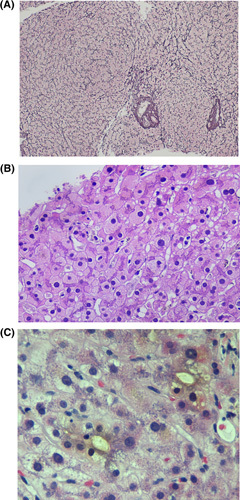
“This histological pattern includes various degrees of lobular inflammation, portal inflammation, interface hepatitis, apoptosis, granulomas, coagulative necrosis, and confluent or bridging necrosis (Table 4).87”
§ AASLD practice guidance on drug, herbal, and dietary supplement–induced liver injury > INTRODUCTION > Approach to liver biopsy interpretation
What the sources say
- Not checked yetcites [87] Kleiner DE. The pathology of drug‐induced liver injury. Semin Liver Dis. 2009; 29: 364– 72. 19826970
plain- Asserted: passes — The authors put it forward as true.
- Checkable: passes — It can be checked against evidence.
- Load-bearing: unclear — It is unclear whether the paper’s conclusions depend on it.
- Based: passes — The paper gives a reason why it holds.
A conclusion the paper draws from its own results — it cites no other source for it, so there is none to check. The quote shows it is in the paper.
In the paper
“The daily dose of a medication, its lipophilicity, and extent of hepatic metabolism influence the risk of causing DILI when comparing medications.”
§ AASLD practice guidance on drug, herbal, and dietary supplement–induced liver injury > INTRODUCTION > Leading causes of idiosyncratic DILI worldwide
plaindirect- Asserted: passes — The authors put it forward as true.
- Checkable: passes — It can be checked against evidence.
- Load-bearing: unclear — It is unclear whether the paper’s conclusions depend on it.
- Based: passes — The paper gives a reason why it holds.
- Rests on an assumption: The available observational and epidemiological data from case series and DILI registries are adequate to support recommendations on the clinical, laboratory, and histological features of DILI.
None of the sources cited for this claim have been checked yet.
In the paper
“Concomitant administration of multiple hepatotoxic drugs has also been associated with an increased risk of DILI in several studies.40–43”
§ AASLD practice guidance on drug, herbal, and dietary supplement–induced liver injury > INTRODUCTION > Leading causes of idiosyncratic DILI worldwide
What the sources say
- Not checked yetcites [40] Suzuki A Yuen NA Ilic K Miller RT Reese MJ Brown HR. Comedications alter drug‐induced liver injury reporting frequency: data mining in the WHO VigiBase™. Regul Toxicol Pharmacol. 2015; 72: 481– 90. 25988394 PMC4548888
- Not checked yetcites [41] Suzuki A Yuen N Walsh J Papay J Hunt CM Diehl AM. Co‐medications that modulate liver injury and repair influence clinical outcome of acetaminophen‐associated liver injury. Clin Gastroenterol Hepatol. 2009; 7: 882– 888. 19362607
- Not checked yetcites [42] De Abajo FJ Montero D Madurga M García Rodríguez LA. Acute and clinically relevant drug‐induced liver injury: a population based case‐control study. Br J Clin Pharmacol. 2004; 58: 71– 80. 15206996 PMC1884531
- Not checked yetcites [43] Pérez Gutthann S García Rodríguez LA. The increased risk of hospitalizations for acute liver injury in a population with exposure to multiple drugs. Epidemiology. 1993; 4: 496– 501. 8268277
plaincorrelational- Asserted: passes — The authors put it forward as true.
- Checkable: passes — It can be checked against evidence.
- Load-bearing: unclear — It is unclear whether the paper’s conclusions depend on it.
- Based: passes — The paper gives a reason why it holds.
None of the sources cited for this claim have been checked yet.
In the paper
“Similarly, men appear to be overrepresented with azathioprine, anabolic steroid, and amoxicillin‐clavulanate hepatotoxicity.45–47”
§ AASLD practice guidance on drug, herbal, and dietary supplement–induced liver injury > INTRODUCTION > Leading causes of idiosyncratic DILI worldwide
What the sources say
- Not checked yetcites [45] George N Chen M Yuen N Hunt CM Suzuki A. Interplay of gender, age and drug properties on reporting frequency of drug‐induced liver injury. Regul Toxicol Pharmacol. 2018; 94: 101– 7. 29407200
- Not checked yetcites [46] Fountain FF Tolley E Chrisman CR Self TH. Isoniazid hepatotoxicity associated with treatment of latent tuberculosis infection: a 7‐year evaluation from a public health tuberculosis clinic. Chest. 2005; 128: 116– 23. 16002924
- Not checked yetcites [47] DiPaola F Molleston JP Gu J Cirulli ET Chalasani N Barnhart H. Antimicrobials and antiepileptics are the leading causes of idiosyncratic drug‐induced liver injury in American children. J Pediatr Gastroenterol Nutr. 2019; 69: 152– 9. 31169665 PMC6658343
hedgedcorrelational- Asserted: passes — The authors put it forward as true.
- Checkable: passes — It can be checked against evidence.
- Load-bearing: unclear — It is unclear whether the paper’s conclusions depend on it.
- Based: passes — The paper gives a reason why it holds.
In the paper
“In addition, drugs that form reactive metabolites, exert mitochondrial toxicity, and inhibit bile acid transporters in in vitro test systems are associated with increased DILI risk in humans.32”
§ AASLD practice guidance on drug, herbal, and dietary supplement–induced liver injury > INTRODUCTION > Leading causes of idiosyncratic DILI worldwide
What the sources say
- Not checked yetcites [32] Chen M Suzuki A Borlak J Andrade RJ Lucena MI. Drug‐induced liver injury: interactions between drug properties and host factors. J Hepatol. 2015; 63: 503– 14. 25912521
plaincorrelational- Asserted: passes — The authors put it forward as true.
- Checkable: passes — It can be checked against evidence.
- Load-bearing: unclear — It is unclear whether the paper’s conclusions depend on it.
- Based: passes — The paper gives a reason why it holds.
In the paper
“Certain drugs have been associated with specific clinical and histologic phenotypes, also called “signatures,” such as autoimmune‐like hepatitis, granulomatous hepatitis, vanishing bile duct syndrome (VBDS), or sinusoidal obstruction syndrome (SOS).80”
- Also stated in: § Competing causes of liver injury · hedged
“Certain drugs have been associated with specific laboratory and histologic phenotypes, termed signatures which may be useful in causality assessment.”
§ AASLD practice guidance on drug, herbal, and dietary supplement–induced liver injury > INTRODUCTION > Competing causes of liver injury
What the sources say
- Not checked yetcites [80] Björnsson E Talwalkar J Treeprasertsuk S Kamath PS Takahashi N Sanderson S. Drug‐induced autoimmune hepatitis: clinical characteristics and prognosis. Hepatology. 2010; 51: 2040– 8. 20512992
plaincorrelational- Asserted: passes — The authors put it forward as true.
- Checkable: passes — It can be checked against evidence.
- Load-bearing: unclear — It is unclear whether the paper’s conclusions depend on it.
- Based: passes — The paper gives a reason why it holds.
- Also stated in: § Competing causes of liver injury · hedged
None of the sources cited for this claim have been checked yet.
In the paper
“Finally, case series demonstrate an overrepresentation of women with diclofenac, macrolide, flucloxacillin, halothane, ibuprofen, interferon beta‐1a, and nitrofurantoin hepatotoxicity.”
§ AASLD practice guidance on drug, herbal, and dietary supplement–induced liver injury > INTRODUCTION > Leading causes of idiosyncratic DILI worldwide
What the sources say
- Not checked yetcites [45] George N Chen M Yuen N Hunt CM Suzuki A. Interplay of gender, age and drug properties on reporting frequency of drug‐induced liver injury. Regul Toxicol Pharmacol. 2018; 94: 101– 7. 29407200
- Not checked yetcites [46] Fountain FF Tolley E Chrisman CR Self TH. Isoniazid hepatotoxicity associated with treatment of latent tuberculosis infection: a 7‐year evaluation from a public health tuberculosis clinic. Chest. 2005; 128: 116– 23. 16002924
- Not checked yetcites [47] DiPaola F Molleston JP Gu J Cirulli ET Chalasani N Barnhart H. Antimicrobials and antiepileptics are the leading causes of idiosyncratic drug‐induced liver injury in American children. J Pediatr Gastroenterol Nutr. 2019; 69: 152– 9. 31169665 PMC6658343
boostedcorrelational- Asserted: passes — The authors put it forward as true.
- Checkable: passes — It can be checked against evidence.
- Load-bearing: unclear — It is unclear whether the paper’s conclusions depend on it.
- Based: passes — The paper gives a reason why it holds.
In the paper
“In fact, 1.3% of adjudicated cases in the initial analysis of the DILIN cohort tested positive for HCV RNA.30”
§ AASLD practice guidance on drug, herbal, and dietary supplement–induced liver injury > INTRODUCTION > Competing causes of liver injury
What the sources say
- Not checked yetcites [30] Chalasani N Bonkovsky HL Fontana RJ Lee W Stolz A Talwalkar J. Features and outcomes of 899 patients with drug‐induced liver injury: the DILIN prospective study. Gastroenterology. 2015; 148: 1340– 52.e7. 25754159 PMC4446235
plain- Asserted: passes — The authors put it forward as true.
- Checkable: passes — It can be checked against evidence.
- Load-bearing: unclear — It is unclear whether the paper’s conclusions depend on it.
- Based: passes — The paper gives a reason why it holds.
A result the paper reports from its own data — it cites no other source for it, so there is none to check. The quote shows it is in the paper.
In the paper
“Of note, anti‐HEV IgM seroprevalence was 3% in adjudicated cases in the DILIN database.”
§ AASLD practice guidance on drug, herbal, and dietary supplement–induced liver injury > INTRODUCTION > Competing causes of liver injury
plain- Asserted: passes — The authors put it forward as true.
- Checkable: passes — It can be checked against evidence.
- Load-bearing: unclear — It is unclear whether the paper’s conclusions depend on it.
- Based: passes — The paper gives a reason why it holds.
None of the sources cited for this claim have been checked yet.
In the paper
“A missense variant (rs2476601) in PTPN22, which has been associated with other autoimmune disorders, appears to be a risk factor for all‐cause DILI across multiple racial and ethnic groups with an OR of 1.4.57,58”
- Also stated in: § Leading causes of idiosyncratic DILI worldwide · plain
“A polymorphism in PTPN22 is a genetic risk factor across multiple drugs and major ethnic groups.”
§ AASLD practice guidance on drug, herbal, and dietary supplement–induced liver injury > INTRODUCTION > Leading causes of idiosyncratic DILI worldwide
What the sources say
- Not checked yetcites [57] Chung SA Criswell LA. PTPN22: its role in SLE and autoimmunity. Autoimmunity. 2007; 40: 582– 90. 18075792 PMC2875134
- Not checked yetcites [58] Cirulli ET Nicoletti P Abramson K Andrade RJ Bjornsson ES Chalasani N. A missense variant in PTPN22 is a risk factor for drug‐induced liver injury. Gastroenterology. 2019; 156: 1707– 16.e2. 30664875 PMC6511989
plaincorrelational- Asserted: passes — The authors put it forward as true.
- Checkable: passes — It can be checked against evidence.
- Load-bearing: unclear — It is unclear whether the paper’s conclusions depend on it.
- Based: passes — The paper gives a reason why it holds.
- Also stated in: § Leading causes of idiosyncratic DILI worldwide · plain
In the paper
“Although there are concerns regarding reliability of the commercially available serologic tests, testing for acute HEV infection should be considered in selected instances, including cases without a clear suspect agent or in cases with very high aminotransferase values arising in older adults.78”
§ AASLD practice guidance on drug, herbal, and dietary supplement–induced liver injury > INTRODUCTION > Competing causes of liver injury
What the sources say
- Not checked yetcites [78] Davern TJ Chalasani N Fontana RJ Hayashi PH Protiva P Kleiner DE. Acute hepatitis E infection accounts for some cases of suspected drug‐induced liver injury. Gastroenterology. 2011; 141: 1665– 72. 21855518 PMC3654540
plain- Asserted: passes — The authors put it forward as true.
- Checkable: passes — It can be checked against evidence.
- Load-bearing: unclear — It is unclear whether the paper’s conclusions depend on it.
- Based: passes — The paper gives a reason why it holds.
A conclusion the paper draws from its own results — it cites no other source for it, so there is none to check. The quote shows it is in the paper.
In the paper
“DILI is largely a clinical diagnosis of exclusion, relying on a detailed medical history including medication exposure, the pattern and course of liver biochemistry tests before and after drug discontinuation, and exclusion of other causes of liver disease.”
§ AASLD practice guidance on drug, herbal, and dietary supplement–induced liver injury > INTRODUCTION > Diagnostic approach to DILI
plain- Asserted: passes — The authors put it forward as true.
- Checkable: passes — It can be checked against evidence.
- Load-bearing: passes — The paper’s conclusions depend on it.
- Based: passes — The paper gives a reason why it holds.
None of the sources cited for this claim have been checked yet.
In the paper
“The presence of fibrosis may aid in distinguishing AIH from DI‐AIH.90–94”
§ AASLD practice guidance on drug, herbal, and dietary supplement–induced liver injury > INTRODUCTION > Approach to liver biopsy interpretation
What the sources say
- Not checked yetcites [90] Licata A Maida M Cabibi D Butera G Macaluso FS Alessi N. Clinical features and outcomes of patients with drug‐induced autoimmune hepatitis: a retrospective cohort study. Dig Liver Dis. 2014; 46: 1116– 20. 25224696
- Not checked yetcites [91] Febres‐Aldana CA Alghamdi S Krishnamurthy K Poppiti RJ. Liver fibrosis helps to distinguish autoimmune hepatitis from DILI with autoimmune features: a review of twenty cases. J Clin Transl Hepatol. 2019; 7: 21– 6. 30944815 PMC6441645
- Not checked yetcites [92] Russo MW Hoofnagle JH Gu J Fontana RJ Barnhart H Kleiner DE. Spectrum of statin hepatotoxicity: experience of the drug‐induced liver injury network. Hepatology. 2014; 60: 679– 86. 24700436 PMC4110177
- Not checked yetcites [93] Björnsson ES. Hepatotoxicity of statins and other lipid‐lowering agents. Liver Int. 2017; 37: 173– 8. 27860156
- Not checked yetcites [94] Meurer L Cohen SM. Drug‐induced liver injury from statins. Clin Liver Dis. 2020; 24: 107– 19. 31753243
hedgedconditional- Asserted: passes — The authors put it forward as true.
- Checkable: passes — It can be checked against evidence.
- Load-bearing: unclear — It is unclear whether the paper’s conclusions depend on it.
- Based: passes — The paper gives a reason why it holds.
None of the sources cited for this claim have been checked yet.
In the paper
“The first step in the evaluation of a liver biopsy for a patient with suspected DILI is to determine the pattern of injury, as there are various histological presentations of DILI.87,88”
§ AASLD practice guidance on drug, herbal, and dietary supplement–induced liver injury > INTRODUCTION > Approach to liver biopsy interpretation
What the sources say
- Not checked yetcites [87] Kleiner DE. The pathology of drug‐induced liver injury. Semin Liver Dis. 2009; 29: 364– 72. 19826970
- Not checked yetcites [88] Kleiner DE Chalasani NP Lee WM Fontana RJ Bonkovsky HL Watkins PB. Hepatic histological findings in suspected drug‐induced liver injury: systematic evaluation and clinical associations. Hepatology. 2014; 59: 661– 70. 24037963 PMC3946736
plain- Asserted: passes — The authors put it forward as true.
- Checkable: passes — It can be checked against evidence.
- Load-bearing: passes — The paper’s conclusions depend on it.
- Based: passes — The paper gives a reason why it holds.
The paper states this without a source or data behind it here, so there is nothing to check it against. The quote shows it is in the paper.
In the paper
“Another mimicker of DILI is acute HEV infection, which is increasingly reported in developed nations because of exposure to HEV genotype 3 infections.”
§ AASLD practice guidance on drug, herbal, and dietary supplement–induced liver injury > INTRODUCTION > Competing causes of liver injury
plaindirect- Asserted: passes — The authors put it forward as true.
- Checkable: passes — It can be checked against evidence.
- Load-bearing: unclear — It is unclear whether the paper’s conclusions depend on it.
- Based: passes — The paper gives a reason why it holds.
In the paper
“Certain medications are associated with specific histological patterns of liver injury that can be confirmed on biopsy.84”
§ AASLD practice guidance on drug, herbal, and dietary supplement–induced liver injury > INTRODUCTION > Liver biopsy in suspected DILI
What the sources say
- Not checked yetcites [84] Kleiner DE. Histopathological challenges in suspected drug‐induced liver injury. Liver Int. 2018; 38: 198– 209. 28865179
plaincorrelational- Asserted: passes — The authors put it forward as true.
- Checkable: passes — It can be checked against evidence.
- Load-bearing: passes — The paper’s conclusions depend on it.
- Based: passes — The paper gives a reason why it holds.
A conclusion the paper draws from its own results — it cites no other source for it, so there is none to check. The quote shows it is in the paper.
In the paper
“The impact of host age, sex, and race and ethnicity on DILI susceptibility is not well established because of the lack of large exposure‐based epidemiological studies to compare DILI incidence with drug‐treated controls.”
§ AASLD practice guidance on drug, herbal, and dietary supplement–induced liver injury > INTRODUCTION > Leading causes of idiosyncratic DILI worldwide
plain- Asserted: passes — The authors put it forward as true.
- Checkable: passes — It can be checked against evidence.
- Load-bearing: unclear — It is unclear whether the paper’s conclusions depend on it.
- Based: passes — The paper gives a reason why it holds.
None of the sources cited for this claim have been checked yet.
In the paper
“In contrast, Asian Americans were more likely to experience a liver‐related death or undergo liver transplant than the other racial groups.48,49”
§ AASLD practice guidance on drug, herbal, and dietary supplement–induced liver injury > INTRODUCTION > Leading causes of idiosyncratic DILI worldwide
What the sources say
- Not checked yetcites [48] Fontana RJ Hayashi PH Gu J Reddy KR Barnhart H Watkins PB. Idiosyncratic drug‐induced liver injury is associated with substantial morbidity and mortality within 6 months from onset. Gastroenterology. 2014; 147: 96– 108.e4. 24681128 PMC4285559
- Not checked yetcites [49] Chalasani N Reddy KRK Fontana RJ Barnhart H Gu J Hayashi PH. Idiosyncratic drug induced liver injury in African‐Americans is associated with greater morbidity and mortality compared to Caucasians. Am J Gastroenterol. 2017; 112: 1382– 8. 28762375 PMC5667647
plaincorrelational- Asserted: passes — The authors put it forward as true.
- Checkable: passes — It can be checked against evidence.
- Load-bearing: unclear — It is unclear whether the paper’s conclusions depend on it.
- Based: passes — The paper gives a reason why it holds.
In the paper
“More than 80% of DILI cases that resulted in liver transplantation in the United States were caused by medications with daily doses exceeding 50 mg.34”
§ AASLD practice guidance on drug, herbal, and dietary supplement–induced liver injury > INTRODUCTION > Leading causes of idiosyncratic DILI worldwide
What the sources say
- Not checked yetcites [34] Reuben A Koch DG Lee WM, Acute Liver Failure Study Group. Drug‐induced acute liver failure: results of a U.S. multicenter, prospective study. Hepatology. 2010; 52: 2065– 76. 20949552 PMC3992250
plaindirect- Asserted: passes — The authors put it forward as true.
- Checkable: passes — It can be checked against evidence.
- Load-bearing: unclear — It is unclear whether the paper’s conclusions depend on it.
- Based: passes — The paper gives a reason why it holds.
In the paper
“An individual's risk of developing idiosyncratic DILI is determined by complex interactions among host, drug, and environmental factors.32”
§ AASLD practice guidance on drug, herbal, and dietary supplement–induced liver injury > INTRODUCTION > Leading causes of idiosyncratic DILI worldwide
What the sources say
- Not checked yetcites [32] Chen M Suzuki A Borlak J Andrade RJ Lucena MI. Drug‐induced liver injury: interactions between drug properties and host factors. J Hepatol. 2015; 63: 503– 14. 25912521
plaindirect- Asserted: passes — The authors put it forward as true.
- Checkable: passes — It can be checked against evidence.
- Load-bearing: unclear — It is unclear whether the paper’s conclusions depend on it.
- Based: passes — The paper gives a reason why it holds.
In the paper
“The mechanism by which chronic liver disease (e.g., NAFLD, viral hepatitis) impacts DILI susceptibility remains unclear.54”
§ AASLD practice guidance on drug, herbal, and dietary supplement–induced liver injury > INTRODUCTION > Leading causes of idiosyncratic DILI worldwide
What the sources say
- Not checked yetcites [54] Bliven EE Podewils LJ. The role of chronic hepatitis in isoniazid hepatotoxicity during treatment for latent tuberculosis infection. Int J Tuberc Lung Dis. 2009; 13: 1054– 60. 19723392
plain- Asserted: passes — The authors put it forward as true.
- Checkable: passes — It can be checked against evidence.
- Load-bearing: unclear — It is unclear whether the paper’s conclusions depend on it.
- Based: passes — The paper gives a reason why it holds.
In the paper
“Obesity has been associated with an increased risk of tamoxifen‐induced steatosis/steatohepatitis.50”
§ AASLD practice guidance on drug, herbal, and dietary supplement–induced liver injury > INTRODUCTION > Leading causes of idiosyncratic DILI worldwide
What the sources say
- Not checked yetcites [50] Bruno S Maisonneuve P Castellana P Rotmensz N Rossi S Maggioni M. Incidence and risk factors for non‐alcoholic steatohepatitis: prospective study of 5408 women enrolled in Italian tamoxifen chemoprevention trial. BMJ. 2005; 330: 932. 15746106 PMC556336
plaincorrelational- Asserted: passes — The authors put it forward as true.
- Checkable: passes — It can be checked against evidence.
- Load-bearing: unclear — It is unclear whether the paper’s conclusions depend on it.
- Based: passes — The paper gives a reason why it holds.
None of the sources cited for this claim have been checked yet.
In the paper
“Drugs with high lipophilicity and extensive metabolism in the liver (> 50%) are associated with an increased hepatotoxic potential, especially in combination with a high daily dose (> 100 mg daily).38,39”
§ AASLD practice guidance on drug, herbal, and dietary supplement–induced liver injury > INTRODUCTION > Leading causes of idiosyncratic DILI worldwide
What the sources say
- Not checked yetcites [38] Chen M Borlak J Tong W. High lipophilicity and high daily dose of oral medications are associated with significant risk for drug‐induced liver injury. Hepatology. 2013; 58: 388– 96. 23258593
- Not checked yetcites [39] McEuen K Borlak J Tong W Chen M. Associations of drug lipophilicity and extent of metabolism with drug‐induced liver injury. Int J Mol Sci. 2017; 18: 1335. 28640208 PMC5535828
plaincorrelational- Asserted: passes — The authors put it forward as true.
- Checkable: passes — It can be checked against evidence.
- Load-bearing: unclear — It is unclear whether the paper’s conclusions depend on it.
- Based: passes — The paper gives a reason why it holds.
A conclusion the paper draws from its own results — it cites no other source for it, so there is none to check. The quote shows it is in the paper.
In the paper
“Finally, improvement of liver injury after drug discontinuation (dechallenge) is important in DILI diagnosis; resolution of injury after discontinuation helps confirm the causal relationship to the drug.”
§ AASLD practice guidance on drug, herbal, and dietary supplement–induced liver injury > INTRODUCTION > Competing causes of liver injury
plaindirect- Asserted: passes — The authors put it forward as true.
- Checkable: passes — It can be checked against evidence.
- Load-bearing: passes — The paper’s conclusions depend on it.
- Based: passes — The paper gives a reason why it holds.
In the paper
“Various host genetic factors related to drug‐metabolizing enzymes and transporters have been reported as increasing DILI susceptibility56 (Table 3).”
§ AASLD practice guidance on drug, herbal, and dietary supplement–induced liver injury > INTRODUCTION > Leading causes of idiosyncratic DILI worldwide
What the sources say
- Not checked yetcites [56] Khoury T Rmeileh AA Yosha L Benson AA Daher S Mizrahi M. Drug induced liver injury: review with a focus on genetic factors, tissue diagnosis, and treatment options. J Clin Transl Hepatol. 2015; 3: 99– 108. 26356634 PMC4548351
plaindirect- Asserted: passes — The authors put it forward as true.
- Checkable: passes — It can be checked against evidence.
- Load-bearing: unclear — It is unclear whether the paper’s conclusions depend on it.
- Based: passes — The paper gives a reason why it holds.
In the paper
“However, the amount of alcohol consumed was not associated with clinical outcomes in consecutive patients enrolled in the DILIN Prospective registry.53”
§ AASLD practice guidance on drug, herbal, and dietary supplement–induced liver injury > INTRODUCTION > Leading causes of idiosyncratic DILI worldwide
What the sources say
- Not checked yetcites [53] Dakhoul L Ghabril M Gu J Navarro V Chalasani N Serrano J. Heavy consumption of alcohol is not associated with worse outcomes in patients with idiosyncratic drug‐induced liver injury compared to non‐drinkers. Clin Gastroenterol Hepatol. 2018; 16: 722– 9.e2. 29306044 PMC5911195
plain- Asserted: passes — The authors put it forward as true.
- Checkable: passes — It can be checked against evidence.
- Load-bearing: unclear — It is unclear whether the paper’s conclusions depend on it.
- Based: passes — The paper gives a reason why it holds.
A conclusion the paper draws from its own results — it cites no other source for it, so there is none to check. The quote shows it is in the paper.
In the paper
“However, DILI can present with a multitude of clinical and histological phenotypes from the same drug, depending on host factors and timing of evaluation.”
§ AASLD practice guidance on drug, herbal, and dietary supplement–induced liver injury > INTRODUCTION > Competing causes of liver injury
plaincorrelational- Asserted: passes — The authors put it forward as true.
- Checkable: passes — It can be checked against evidence.
- Load-bearing: unclear — It is unclear whether the paper’s conclusions depend on it.
- Based: passes — The paper gives a reason why it holds.
A conclusion the paper draws from its own results — it cites no other source for it, so there is none to check. The quote shows it is in the paper.
In the paper
“A diagnostic challenge occurs when trying to distinguish idiopathic AIH from drug‐induced AIH (DI‐AIH).”
§ AASLD practice guidance on drug, herbal, and dietary supplement–induced liver injury > INTRODUCTION > Approach to liver biopsy interpretation
plain- Asserted: passes — The authors put it forward as true.
- Checkable: passes — It can be checked against evidence.
- Load-bearing: passes — The paper’s conclusions depend on it.
- Based: passes — The paper gives a reason why it holds.
In the paper
“Approximately one‐third to one‐half of DILI cases will present with acute hepatocellular liver injury and accompanying necro‐inflammatory type of histology, which includes acute or chronic hepatitis with or without accompanying mild cholestasis.87”
§ AASLD practice guidance on drug, herbal, and dietary supplement–induced liver injury > INTRODUCTION > Approach to liver biopsy interpretation
What the sources say
- Not checked yetcites [87] Kleiner DE. The pathology of drug‐induced liver injury. Semin Liver Dis. 2009; 29: 364– 72. 19826970
plain- Asserted: passes — The authors put it forward as true.
- Checkable: passes — It can be checked against evidence.
- Load-bearing: unclear — It is unclear whether the paper’s conclusions depend on it.
- Based: passes — The paper gives a reason why it holds.
The paper states this without a source or data behind it here, so there is nothing to check it against. The quote shows it is in the paper.
In the paper
“Less common histological manifestations of DILI include fatty liver disease, drug‐induced steatosis, and drug‐induced steatohepatitis.”
§ AASLD practice guidance on drug, herbal, and dietary supplement–induced liver injury > INTRODUCTION > Approach to liver biopsy interpretation
plain- Asserted: passes — The authors put it forward as true.
- Checkable: passes — It can be checked against evidence.
- Load-bearing: unclear — It is unclear whether the paper’s conclusions depend on it.
- Based: passes — The paper gives a reason why it holds.
None of the sources cited for this claim have been checked yet.
In the paper
“Some limitations of the original have been addressed in the updated RUCAM”
§ AASLD practice guidance on drug, herbal, and dietary supplement–induced liver injury > INTRODUCTION > Limitations of causality assessment in DILI
What the sources say
- Not checked yetcites [108] Danan G Teschke R. RUCAM in drug and herb induced liver injury: the update. Int J Mol Sci. 2016; 27: 14– 30. PMC4730261 26712744
- Not checked yetcites [119] Teschke R Frenzel C Schulze J Eickhoff A. Herbal hepatotoxicity: challenges and pitfalls of causality assessment methods. World J Gastroenterol. 2013; 19: 2864– 82. 23704820 PMC3660812
plaindirect- Asserted: passes — The authors put it forward as true.
- Checkable: passes — It can be checked against evidence.
- Load-bearing: unclear — It is unclear whether the paper’s conclusions depend on it.
- Based: passes — The paper gives a reason why it holds.
None of the sources cited for this claim have been checked yet.
In the paper
“compositional complexity and lack of label trustworthiness of HDS confounds assessment.118,119”
§ AASLD practice guidance on drug, herbal, and dietary supplement–induced liver injury > INTRODUCTION > Limitations of causality assessment in DILI
What the sources say
- Not checked yetcites [118] Teschke R Danan G. Worldwide use of RUCAM for causality assessment in 81,856 idiosyncratic DILI and 14,029 HILI cases published 1993–mid 2020: a comprehensive analysis. Medicines (Basel). 2020; 7: 62. 33003400 PMC7600114
- Not checked yetcites [119] Teschke R Frenzel C Schulze J Eickhoff A. Herbal hepatotoxicity: challenges and pitfalls of causality assessment methods. World J Gastroenterol. 2013; 19: 2864– 82. 23704820 PMC3660812
plaindirect- Asserted: passes — The authors put it forward as true.
- Checkable: passes — It can be checked against evidence.
- Load-bearing: passes — The paper’s conclusions depend on it.
- Based: passes — The paper gives a reason why it holds.
None of the sources cited for this claim have been checked yet.
In the paper
“there is no requirement for testing for acute HCV or HEV infection”
§ AASLD practice guidance on drug, herbal, and dietary supplement–induced liver injury > INTRODUCTION > Limitations of causality assessment in DILI
What the sources say
- Not checked yetcites [9] Björnsson ES Bergmann OM Björnsson HK Kvaran RB Olafsson S. Incidence, presentation, and outcomes in patients with drug‐induced liver injury in the general population of Iceland. Gastroenterology. 2013; 144: 1419– 25. 23419359
- Not checked yetcites [29] Stephens C Robles‐Diaz M Medina‐Caliz I Garcia‐Cortes M Ortega‐Alonso A Sanabria‐Cabrera J. Comprehensive analysis and insights gained from long‐term experience of the Spanish DILI registry. J Hepatol. 2021; 75: 86– 97. 33539847
- Not checked yetcites [30] Chalasani N Bonkovsky HL Fontana RJ Lee W Stolz A Talwalkar J. Features and outcomes of 899 patients with drug‐induced liver injury: the DILIN prospective study. Gastroenterology. 2015; 148: 1340– 52.e7. 25754159 PMC4446235
plain- Asserted: passes — The authors put it forward as true.
- Checkable: passes — It can be checked against evidence.
- Load-bearing: unclear — It is unclear whether the paper’s conclusions depend on it.
- Based: passes — The paper gives a reason why it holds.
The paper states this without a source or data behind it here, so there is nothing to check it against. The quote shows it is in the paper.
In the paper
“but retains risk factors of age, alcohol, and pregnancy that are of unclear value.”
§ AASLD practice guidance on drug, herbal, and dietary supplement–induced liver injury > INTRODUCTION > Limitations of causality assessment in DILI
plain- Asserted: passes — The authors put it forward as true.
- Checkable: passes — It can be checked against evidence.
- Load-bearing: unclear — It is unclear whether the paper’s conclusions depend on it.
- Based: passes — The paper gives a reason why it holds.
The paper states this without a source or data behind it here, so there is nothing to check it against. The quote shows it is in the paper.
In the paper
“Furthermore, the RECAM has not yet been tested in HDS‐induced liver injury cases”
§ AASLD practice guidance on drug, herbal, and dietary supplement–induced liver injury > INTRODUCTION > Limitations of causality assessment in DILI
plain- Asserted: passes — The authors put it forward as true.
- Checkable: passes — It can be checked against evidence.
- Load-bearing: unclear — It is unclear whether the paper’s conclusions depend on it.
- Based: passes — The paper gives a reason why it holds.
None of the sources cited for this claim have been checked yet.
In the paper
“but still retains the risk factors of age and alcohol for all cases.108,119”
§ AASLD practice guidance on drug, herbal, and dietary supplement–induced liver injury > INTRODUCTION > Limitations of causality assessment in DILI
What the sources say
- Not checked yetcites [108] Danan G Teschke R. RUCAM in drug and herb induced liver injury: the update. Int J Mol Sci. 2016; 27: 14– 30. PMC4730261 26712744
- Not checked yetcites [119] Teschke R Frenzel C Schulze J Eickhoff A. Herbal hepatotoxicity: challenges and pitfalls of causality assessment methods. World J Gastroenterol. 2013; 19: 2864– 82. 23704820 PMC3660812
plain- Asserted: passes — The authors put it forward as true.
- Checkable: passes — It can be checked against evidence.
- Load-bearing: unclear — It is unclear whether the paper’s conclusions depend on it.
- Based: passes — The paper gives a reason why it holds.
In the paper
“Induction hepatocytes are frequently noted in the setting of polypharmacy, or chronic intake of phenytoin and barbiturates.103”
§ AASLD practice guidance on drug, herbal, and dietary supplement–induced liver injury > INTRODUCTION > Approach to liver biopsy interpretation
What the sources say
- Not checked yetcites [103] Lu HC González IA Byrnes K. Ground‐glass hepatocellular inclusions are associated with polypharmacy. Ann Diagn Pathol. 2021; 52: 151740. 33836412
plaincorrelational- Asserted: passes — The authors put it forward as true.
- Checkable: passes — It can be checked against evidence.
- Load-bearing: unclear — It is unclear whether the paper’s conclusions depend on it.
- Based: passes — The paper gives a reason why it holds.
The paper states this without a source or data behind it here, so there is nothing to check it against. The quote shows it is in the paper.
In the paper
“many instances of harm resulting from individual and multi‐ingredient products have been reported, including acute liver failure (ALF).”
§ AASLD practice guidance on drug, herbal, and dietary supplement–induced liver injury > INTRODUCTION > HDS hepatotoxicity
plaindirect- Asserted: passes — The authors put it forward as true.
- Checkable: passes — It can be checked against evidence.
- Load-bearing: unclear — It is unclear whether the paper’s conclusions depend on it.
- Based: passes — The paper gives a reason why it holds.
None of the sources cited for this claim have been checked yet.
In the paper
“consideration of other causes of liver injury may have been overlooked or unappreciated when the tools were first developed.75,118”
§ AASLD practice guidance on drug, herbal, and dietary supplement–induced liver injury > INTRODUCTION > Limitations of causality assessment in DILI
What the sources say
- Not checked yetcites [75] Danan G Benichou C. Causality assessment of adverse reactions to drugs. Part I: a novel method based on the conclusions of international consensus meetings: application to drug‐induced liver injuries. J Clin Epidemiol. 1993; 46: 1323– 30. 8229110
- Not checked yetcites [118] Teschke R Danan G. Worldwide use of RUCAM for causality assessment in 81,856 idiosyncratic DILI and 14,029 HILI cases published 1993–mid 2020: a comprehensive analysis. Medicines (Basel). 2020; 7: 62. 33003400 PMC7600114
hedgedconditional- Asserted: passes — The authors put it forward as true.
- Checkable: passes — It can be checked against evidence.
- Load-bearing: unclear — It is unclear whether the paper’s conclusions depend on it.
- Based: passes — The paper gives a reason why it holds.
In the paper
“Several clinical tools have been developed for DILI causality assessment (Tables 5 and 6).”
§ AASLD practice guidance on drug, herbal, and dietary supplement–induced liver injury > INTRODUCTION > Models of causality assessment
What the sources say
- Not matchedcites Tables 5 and 6
Couldn’t be matched to a paper in Crossref, so it can’t be checked.
plain- Asserted: passes — The authors put it forward as true.
- Checkable: passes — It can be checked against evidence.
- Load-bearing: unclear — It is unclear whether the paper’s conclusions depend on it.
- Based: passes — The paper gives a reason why it holds.
- Not matched
None of the sources cited for this claim have been checked yet.
In the paper
“expands the search for alternative diagnoses”
§ AASLD practice guidance on drug, herbal, and dietary supplement–induced liver injury > INTRODUCTION > Limitations of causality assessment in DILI
What the sources say
- Not checked yetcites [108] Danan G Teschke R. RUCAM in drug and herb induced liver injury: the update. Int J Mol Sci. 2016; 27: 14– 30. PMC4730261 26712744
- Not checked yetcites [119] Teschke R Frenzel C Schulze J Eickhoff A. Herbal hepatotoxicity: challenges and pitfalls of causality assessment methods. World J Gastroenterol. 2013; 19: 2864– 82. 23704820 PMC3660812
plaindirect- Asserted: passes — The authors put it forward as true.
- Checkable: passes — It can be checked against evidence.
- Load-bearing: unclear — It is unclear whether the paper’s conclusions depend on it.
- Based: passes — The paper gives a reason why it holds.
None of the sources cited for this claim have been checked yet.
In the paper
“Sclerosing cholangitis is an uncommon manifestation of ICI DILI.96,97”
§ AASLD practice guidance on drug, herbal, and dietary supplement–induced liver injury > INTRODUCTION > Approach to liver biopsy interpretation
What the sources say
- Not checked yetcites [96] Zen Y Yeh MM. Checkpoint inhibitor‐induced liver injury: a novel form of liver disease emerging in the era of cancer immunotherapy. Semin Diagn Pathol. 2019; 36: 434– 440. 31358424
- Not checked yetcites [97] Zen Y Chen YY Jeng YM Tsai HW Yeh MM. Immune‐related adverse reactions in the hepatobiliary system: second‐generation check‐point inhibitors highlight diverse histological changes. Histopathology. 2020; 76: 470– 80. 31550390
plain- Asserted: passes — The authors put it forward as true.
- Checkable: passes — It can be checked against evidence.
- Load-bearing: unclear — It is unclear whether the paper’s conclusions depend on it.
- Based: passes — The paper gives a reason why it holds.
In the paper
“Nonspecific histological features and minimal changes may be seen on a liver biopsy in a patient with suspected DILI. These changes may include activation of sinusoidal lining cells, ceroid‐laden macrophages, and ground‐glass‐like cytoplasm of hepatocytes (also known as induction hepatocytes).103”
§ AASLD practice guidance on drug, herbal, and dietary supplement–induced liver injury > INTRODUCTION > Approach to liver biopsy interpretation
What the sources say
- Not checked yetcites [103] Lu HC González IA Byrnes K. Ground‐glass hepatocellular inclusions are associated with polypharmacy. Ann Diagn Pathol. 2021; 52: 151740. 33836412
hedged- Asserted: passes — The authors put it forward as true.
- Checkable: passes — It can be checked against evidence.
- Load-bearing: unclear — It is unclear whether the paper’s conclusions depend on it.
- Based: passes — The paper gives a reason why it holds.
None of the sources cited for this claim have been checked yet.
In the paper
“there are few good data to justify inclusion of risk factors as listed in the RUCAM.9,29,30”
§ AASLD practice guidance on drug, herbal, and dietary supplement–induced liver injury > INTRODUCTION > Limitations of causality assessment in DILI
What the sources say
- Not checked yetcites [9] Björnsson ES Bergmann OM Björnsson HK Kvaran RB Olafsson S. Incidence, presentation, and outcomes in patients with drug‐induced liver injury in the general population of Iceland. Gastroenterology. 2013; 144: 1419– 25. 23419359
- Not checked yetcites [29] Stephens C Robles‐Diaz M Medina‐Caliz I Garcia‐Cortes M Ortega‐Alonso A Sanabria‐Cabrera J. Comprehensive analysis and insights gained from long‐term experience of the Spanish DILI registry. J Hepatol. 2021; 75: 86– 97. 33539847
- Not checked yetcites [30] Chalasani N Bonkovsky HL Fontana RJ Lee W Stolz A Talwalkar J. Features and outcomes of 899 patients with drug‐induced liver injury: the DILIN prospective study. Gastroenterology. 2015; 148: 1340– 52.e7. 25754159 PMC4446235
plain- Asserted: passes — The authors put it forward as true.
- Checkable: passes — It can be checked against evidence.
- Load-bearing: unclear — It is unclear whether the paper’s conclusions depend on it.
- Based: passes — The paper gives a reason why it holds.
None of the sources cited for this claim have been checked yet.
In the paper
“DILI resulting in vascular injury may lead to the development of nodular regenerative hyperplasia (NRH), obliterative portal venopathy (OPV), and SOS (formerly known as veno‐occlusive disease).86,88”
§ AASLD practice guidance on drug, herbal, and dietary supplement–induced liver injury > INTRODUCTION > Approach to liver biopsy interpretation
What the sources say
- Not checked yetcites [86] Goodman ZD. Drug hepatotoxicity. Clin Liver Dis. 2002; 6: 381– 97. 12122862
- Not checked yetcites [88] Kleiner DE Chalasani NP Lee WM Fontana RJ Bonkovsky HL Watkins PB. Hepatic histological findings in suspected drug‐induced liver injury: systematic evaluation and clinical associations. Hepatology. 2014; 59: 661– 70. 24037963 PMC3946736
hedgedconditional- Asserted: passes — The authors put it forward as true.
- Checkable: passes — It can be checked against evidence.
- Load-bearing: unclear — It is unclear whether the paper’s conclusions depend on it.
- Based: passes — The paper gives a reason why it holds.
The paper states this without a source or data behind it here, so there is nothing to check it against. The quote shows it is in the paper.
In the paper
“structured assessments do not take into account evolving knowledge of and experience with hepatotoxicity due to drugs and HDS over time, which will add confidence to decision making.”
§ AASLD practice guidance on drug, herbal, and dietary supplement–induced liver injury > INTRODUCTION > Limitations of causality assessment in DILI
plain- Asserted: passes — The authors put it forward as true.
- Checkable: passes — It can be checked against evidence.
- Load-bearing: unclear — It is unclear whether the paper’s conclusions depend on it.
- Based: passes — The paper gives a reason why it holds.
In the paper
“These observations were also noted in a meta‐analysis of DILI case reports.105”
§ AASLD practice guidance on drug, herbal, and dietary supplement–induced liver injury > INTRODUCTION > DILI severity and prognosis
What the sources say
- Not checked yetcites [105] Björnsson E Kalaitzakis E Olsson R. The impact of eosinophilia and hepatic necrosis on prognosis in patients with drug‐induced liver injury. Aliment Pharmacol Ther. 2007; 25: 1411– 21. 17539980
plaincorrelational- Asserted: passes — The authors put it forward as true.
- Checkable: passes — It can be checked against evidence.
- Load-bearing: unclear — It is unclear whether the paper’s conclusions depend on it.
- Based: passes — The paper gives a reason why it holds.
None of the sources cited for this claim have been checked yet.
In the paper
“An underlying chronic liver disease flare also is not accounted for by the current scales.120,121”
§ AASLD practice guidance on drug, herbal, and dietary supplement–induced liver injury > INTRODUCTION > Limitations of causality assessment in DILI
What the sources say
- Not checked yetcites [120] Fontana RJ Avigan MI Janssen HLA Regev A Mishra P Gaggar A. Liver safety assessment in clinical trials of new agents for chronic hepatitis B. J Viral Hep. 2020; 27: 96– 109. 31828894
- Not checked yetcites [121] Regev A Seeff LB Merz M Ormarsdottir S Aithal GP Gallivan J. Causality assessment for suspected DILI during clinical phases of drug development. Drug Saf. 2014; 37(Suppl 1): S47– 56. 25352327 PMC4212150
plain- Asserted: passes — The authors put it forward as true.
- Checkable: passes — It can be checked against evidence.
- Load-bearing: passes — The paper’s conclusions depend on it.
- Based: passes — The paper gives a reason why it holds.
A conclusion the paper draws from its own results — it cites no other source for it, so there is none to check. The quote shows it is in the paper.
In the paper
“A liver biopsy from a patient with DILI may help determine the mechanism of injury, as was seen with the mitochondrial toxin fialuridine that led to microvesicular steatosis and necrosis.”
§ AASLD practice guidance on drug, herbal, and dietary supplement–induced liver injury > INTRODUCTION > DILI severity and prognosis
hedgedconditional- Asserted: passes — The authors put it forward as true.
- Checkable: passes — It can be checked against evidence.
- Load-bearing: unclear — It is unclear whether the paper’s conclusions depend on it.
- Based: passes — The paper gives a reason why it holds.
The paper states this without a source or data behind it here, so there is nothing to check it against. The quote shows it is in the paper.
In the paper
“but the need for specialized expertise limits its generalizability.”
§ AASLD practice guidance on drug, herbal, and dietary supplement–induced liver injury > INTRODUCTION > Limitations of causality assessment in DILI
plaindirect- Asserted: passes — The authors put it forward as true.
- Checkable: passes — It can be checked against evidence.
- Load-bearing: unclear — It is unclear whether the paper’s conclusions depend on it.
- Based: passes — The paper gives a reason why it holds.
The paper states this without a source or data behind it here, so there is nothing to check it against. The quote shows it is in the paper.
In the paper
“There are several important challenges in DILI causality assessment, especially with the structured nonexpert opinion approaches.”
§ AASLD practice guidance on drug, herbal, and dietary supplement–induced liver injury > INTRODUCTION > Limitations of causality assessment in DILI
plain- Asserted: passes — The authors put it forward as true.
- Checkable: passes — It can be checked against evidence.
- Load-bearing: passes — The paper’s conclusions depend on it.
- Based: passes — The paper gives a reason why it holds.
The paper states this without a source or data behind it here, so there is nothing to check it against. The quote shows it is in the paper.
In the paper
“Limitations regarding the RUCAM include the relative weighting of its domain scores, which were developed using a set of cases with drug rechallenge and not by evidence‐based or statistical weighting.”
§ AASLD practice guidance on drug, herbal, and dietary supplement–induced liver injury > INTRODUCTION > Limitations of causality assessment in DILI
plain- Asserted: passes — The authors put it forward as true.
- Checkable: passes — It can be checked against evidence.
- Load-bearing: unclear — It is unclear whether the paper’s conclusions depend on it.
- Based: passes — The paper gives a reason why it holds.
In the paper
“The CDS is not used widely in clinical practice because it was shown to be inferior to the RUCAM.110”
§ AASLD practice guidance on drug, herbal, and dietary supplement–induced liver injury > INTRODUCTION > Models of causality assessment
What the sources say
- Not checked yetcites [110] Lucena M Camargo R Andrade RJ Perez‐Sanchez CJ De LaCuesta F. Comparison of two clinical scales for causality assessment in hepatotoxicity. Hepatology. 2001; 33: 123– 30. 11124828
plaindirect- Asserted: passes — The authors put it forward as true.
- Checkable: passes — It can be checked against evidence.
- Load-bearing: unclear — It is unclear whether the paper’s conclusions depend on it.
- Based: passes — The paper gives a reason why it holds.
In the paper
“A 3‐day course of N‐acetylcysteine (NAC) should be considered in adult patients with DILI‐related ALF in light of improved 3‐week outcomes in a large randomized controlled trial, particularly in patients with early‐stage encephalopathy.148”
§ AASLD practice guidance on drug, herbal, and dietary supplement–induced liver injury > INTRODUCTION > Medical management of idiosyncratic patients with DILI
What the sources say
- Not checked yetcites [148] Lee WM Hynan LS Rossaro L Fontana RJ Stravitz RT Larson AM. Intravenous N‐acetylcysteine improves transplant‐free survival in early stage non‐acetaminophen acute liver failure. Gastroenterology. 2009; 137: 856– 64.e1. 19524577 PMC3189485
hedgeddirect- Asserted: passes — The authors put it forward as true.
- Checkable: passes — It can be checked against evidence.
- Load-bearing: passes — The paper’s conclusions depend on it.
- Based: passes — The paper gives a reason why it holds.
None of the sources cited for this claim have been checked yet.
In the paper
“APAP overdose is the leading cause of ALF among adults in the United States.”
§ AASLD practice guidance on drug, herbal, and dietary supplement–induced liver injury > INTRODUCTION > Prognosis
plaindirect- Asserted: passes — The authors put it forward as true.
- Checkable: passes — It can be checked against evidence.
- Load-bearing: unclear — It is unclear whether the paper’s conclusions depend on it.
- Based: passes — The paper gives a reason why it holds.
In the paper
“Several prognostic scores have been developed and evaluated including the King's College Hospital score, Model for End‐Stage Liver Disease score, and the Acute Liver Failure Study Group prognostic index.167”
§ AASLD practice guidance on drug, herbal, and dietary supplement–induced liver injury > INTRODUCTION > Prognosis
What the sources say
- Not checked yetcites [167] Prescott LF Critchley JA. The treatment of acetaminophen poisoning. Annu Rev Pharmacol Toxicol. 1983; 23: 87– 101. 6347057
plain- Asserted: passes — The authors put it forward as true.
- Checkable: passes — It can be checked against evidence.
- Load-bearing: unclear — It is unclear whether the paper’s conclusions depend on it.
- Based: passes — The paper gives a reason why it holds.
In the paper
“Administration of oral or intravenous NAC is an effective antidote, given as a loading dose followed by maintenance doses over several days.167”
§ AASLD practice guidance on drug, herbal, and dietary supplement–induced liver injury > INTRODUCTION > Management of APAP overdose
What the sources say
- Not checked yetcites [167] Prescott LF Critchley JA. The treatment of acetaminophen poisoning. Annu Rev Pharmacol Toxicol. 1983; 23: 87– 101. 6347057
plaindirect- Asserted: passes — The authors put it forward as true.
- Checkable: passes — It can be checked against evidence.
- Load-bearing: passes — The paper’s conclusions depend on it.
- Based: passes — The paper gives a reason why it holds.
The paper states this without a source or data behind it here, so there is nothing to check it against. The quote shows it is in the paper.
In the paper
“In multiple prospective registry studies, nearly 50% of patients have acute hepatocellular injury, whereas the remainder present with either an acute mixed or cholestatic injury pattern (Table 2).”
§ AASLD practice guidance on drug, herbal, and dietary supplement–induced liver injury > INTRODUCTION > Natural history and management of idiosyncratic DILI
plain- Asserted: passes — The authors put it forward as true.
- Checkable: passes — It can be checked against evidence.
- Load-bearing: unclear — It is unclear whether the paper’s conclusions depend on it.
- Based: passes — The paper gives a reason why it holds.
The paper states this without a source or data behind it here, so there is nothing to check it against. The quote shows it is in the paper.
In the paper
“Manufacturers are not compelled to prove that their product is safe”
§ AASLD practice guidance on drug, herbal, and dietary supplement–induced liver injury > INTRODUCTION > Epidemiology of HDS use and liver injury
plain- Asserted: passes — The authors put it forward as true.
- Checkable: passes — It can be checked against evidence.
- Load-bearing: unclear — It is unclear whether the paper’s conclusions depend on it.
- Based: passes — The paper gives a reason why it holds.
In the paper
“This same HLA risk allele has also been associated with hepatotoxicity in Han Chinese individuals attributed to Polygonum multiflorum, a popular herbal taken to enhance hair color and improve fertility.73”
§ AASLD practice guidance on drug, herbal, and dietary supplement–induced liver injury > INTRODUCTION > HDS hepatotoxicity, susceptibility factors, and outcomes
What the sources say
- Not checked yetcites [73] Li C Rao T Chen X Zou Z Wei A Tang J. HLA‐B*35:01 allele is a potential biomarker for predicting Polygonum multiflorum‐induced liver injury in humans. Hepatology. 2019; 70: 346– 57. 30985007
plaincorrelational- Asserted: passes — The authors put it forward as true.
- Checkable: passes — It can be checked against evidence.
- Load-bearing: unclear — It is unclear whether the paper’s conclusions depend on it.
- Based: passes — The paper gives a reason why it holds.
A conclusion the paper draws from its own results — it cites no other source for it, so there is none to check. The quote shows it is in the paper.
In the paper
“Through detailed analyses of hepatotoxicity due to specific ingredients, recognition of characteristic toxicity patterns arises.”
§ AASLD practice guidance on drug, herbal, and dietary supplement–induced liver injury > INTRODUCTION > HDS hepatotoxicity, susceptibility factors, and outcomes
plaindirect- Asserted: passes — The authors put it forward as true.
- Checkable: passes — It can be checked against evidence.
- Load-bearing: passes — The paper’s conclusions depend on it.
- Based: passes — The paper gives a reason why it holds.
None of the sources cited for this claim have been checked yet.
In the paper
“Multiple studies have also demonstrated that patients with higher total bilirubin and INR levels as well as lower serum albumin levels at presentation are at greatest risk for adverse outcomes.143–146”
§ AASLD practice guidance on drug, herbal, and dietary supplement–induced liver injury > INTRODUCTION > Natural history and management of idiosyncratic DILI
What the sources say
- Not checked yetcites [143] Hayashi PH Rockey DC Fontana RJ Tillmann HL Kaplowitz N Barnhart HX. Death and liver transplantation within 2 years of onset of drug‐induced liver injury. Hepatology. 2017; 66: 1275– 85. 28543844 PMC5605419
- Not checked yetcites [144] Robles‐Diaz M Lucena MI Kaplowitz N Stephens C Medina‐Cáliz I González‐Jimenez A. Use of Hy's law and a new composite algorithm to predict acute liver failure in patients with DILI. Gastroenterology. 2014; 147: 109– 18. 24704526
- Not checked yetcites [145] Temple R. Hy's law: predicting serious hepatotoxicity. Pharmacoepidemiol Drug Saf. 2006; 15: 241– 3. 16552790
- Not checked yetcites [146] Ghabril M Gu J Yoder L Corbito L Ringel A Beyer CD. Development and validation of a model consisting of comorbidity burden to calculate risk of death within 6 months for patients with suspected DILI. Gastroenterology. 2019; 157: 1245– 52. 31302142 PMC6815697
boostedcorrelational- Asserted: passes — The authors put it forward as true.
- Checkable: passes — It can be checked against evidence.
- Load-bearing: passes — The paper’s conclusions depend on it.
- Based: passes — The paper gives a reason why it holds.
The paper states this without a source or data behind it here, so there is nothing to check it against. The quote shows it is in the paper.
In the paper
“Structured causality assessment tools are confounded by several factors unique to HDS.”
§ AASLD practice guidance on drug, herbal, and dietary supplement–induced liver injury > INTRODUCTION > Special considerations in the diagnosis of HDS‐associated liver injury
plaindirect- Asserted: passes — The authors put it forward as true.
- Checkable: passes — It can be checked against evidence.
- Load-bearing: passes — The paper’s conclusions depend on it.
- Based: passes — The paper gives a reason why it holds.
None of the sources cited for this claim have been checked yet.
In the paper
“those with ALF (coagulopathy and encephalopathy) should be urgently referred to a liver transplant center because of their low likelihood (~25% chance) of spontaneous recovery.34,143”
§ AASLD practice guidance on drug, herbal, and dietary supplement–induced liver injury > INTRODUCTION > Natural history and management of idiosyncratic DILI
What the sources say
- Not checked yetcites [34] Reuben A Koch DG Lee WM, Acute Liver Failure Study Group. Drug‐induced acute liver failure: results of a U.S. multicenter, prospective study. Hepatology. 2010; 52: 2065– 76. 20949552 PMC3992250
- Not checked yetcites [143] Hayashi PH Rockey DC Fontana RJ Tillmann HL Kaplowitz N Barnhart HX. Death and liver transplantation within 2 years of onset of drug‐induced liver injury. Hepatology. 2017; 66: 1275– 85. 28543844 PMC5605419
plain- Asserted: passes — The authors put it forward as true.
- Checkable: passes — It can be checked against evidence.
- Load-bearing: passes — The paper’s conclusions depend on it.
- Based: passes — The paper gives a reason why it holds.
In the paper
“Measurement of a serum APAP level after a single‐time‐point ingestion can help identify the patients at greatest risk of developing liver injury.161”
§ AASLD practice guidance on drug, herbal, and dietary supplement–induced liver injury > INTRODUCTION > APAP hepatotoxicity
What the sources say
- Not checked yetcites [161] Rumack BH. Acetaminophen hepatotoxicity: the first 35 years. J Toxicol Clin Toxicol. 2002; 40: 3– 20. 11990202
plaincorrelational- Asserted: passes — The authors put it forward as true.
- Checkable: passes — It can be checked against evidence.
- Load-bearing: passes — The paper’s conclusions depend on it.
- Based: passes — The paper gives a reason why it holds.
None of the sources cited for this claim have been checked yet.
In the paper
“Similarly, some clinical features are associated with a greater likelihood of spontaneous recovery, such as the presence of granulomas and eosinophils on liver biopsy.88,107”
§ AASLD practice guidance on drug, herbal, and dietary supplement–induced liver injury > INTRODUCTION > Natural history and management of idiosyncratic DILI
What the sources say
- Not checked yetcites [88] Kleiner DE Chalasani NP Lee WM Fontana RJ Bonkovsky HL Watkins PB. Hepatic histological findings in suspected drug‐induced liver injury: systematic evaluation and clinical associations. Hepatology. 2014; 59: 661– 70. 24037963 PMC3946736
- Not checked yetcites [107] Hayashi PH Fontana RJ. Clinical features, diagnosis and natural history of drug‐induced liver injury. Semin Liver Dis. 2014; 34: 134– 44. 24879979
hedgedcorrelational- Asserted: passes — The authors put it forward as true.
- Checkable: passes — It can be checked against evidence.
- Load-bearing: unclear — It is unclear whether the paper’s conclusions depend on it.
- Based: passes — The paper gives a reason why it holds.
In the paper
“A minority of patients (i.e., < 1%) may also experience progressive loss of intrahepatic bile ducts leading to VBDS, which can be progressive and fatal.100”
§ AASLD practice guidance on drug, herbal, and dietary supplement–induced liver injury > INTRODUCTION > Natural history and management of idiosyncratic DILI
What the sources say
- Not checked yetcites [100] Rabinowich L Shibolet O. Drug induced steatohepatitis: an uncommon culprit of a common disease. Biomed Res Int. 2015; 2015: 168905. 26273591 PMC4529891
hedgeddirect- Asserted: passes — The authors put it forward as true.
- Checkable: passes — It can be checked against evidence.
- Load-bearing: unclear — It is unclear whether the paper’s conclusions depend on it.
- Based: passes — The paper gives a reason why it holds.
The paper states this without a source or data behind it here, so there is nothing to check it against. The quote shows it is in the paper.
In the paper
“APAP is a dose‐dependent hepatotoxin that leads to acute pericentral liver injury when doses exceeding 4 g are ingested within a 24‐h period or excessive doses over several days.”
§ AASLD practice guidance on drug, herbal, and dietary supplement–induced liver injury > INTRODUCTION > Prognosis
plaindirect- Asserted: passes — The authors put it forward as true.
- Checkable: passes — It can be checked against evidence.
- Load-bearing: unclear — It is unclear whether the paper’s conclusions depend on it.
- Based: passes — The paper gives a reason why it holds.
In the paper
“With drug discontinuation, most patients with DILI (80%) fully recover without long‐term sequelae.30”
- Also stated in: § Medical management of idiosyncratic patients with DILI · hedged
“Most adults and children with idiosyncratic DILI present with an acute liver injury phenotype that may or may not be symptomatic but typically resolves within 6 months of onset without long-term sequelae in 80%.”
§ AASLD practice guidance on drug, herbal, and dietary supplement–induced liver injury > INTRODUCTION > Natural history and management of idiosyncratic DILI
What the sources say
- Not checked yetcites [30] Chalasani N Bonkovsky HL Fontana RJ Lee W Stolz A Talwalkar J. Features and outcomes of 899 patients with drug‐induced liver injury: the DILIN prospective study. Gastroenterology. 2015; 148: 1340– 52.e7. 25754159 PMC4446235
plaindirect- Asserted: passes — The authors put it forward as true.
- Checkable: passes — It can be checked against evidence.
- Load-bearing: unclear — It is unclear whether the paper’s conclusions depend on it.
- Based: passes — The paper gives a reason why it holds.
- Also stated in: § Medical management of idiosyncratic patients with DILI · hedged
In the paper
“In addition, cholestyramine may be of value for patients with leflunomide hepatotoxicity because of its prolonged half‐life and enterohepatic circulation.157”
§ AASLD practice guidance on drug, herbal, and dietary supplement–induced liver injury > INTRODUCTION > Medical management of idiosyncratic patients with DILI
What the sources say
- Not checked yetcites [157] Stine JG Lewis JH. Current and future directions in the treatment and prevention of drug induced liver injury: a systematic review. Expert Rev Gastroenterol Hepatol. 2016; 10: 517– 36. 26633044 PMC5074808
hedgedconditional- Asserted: passes — The authors put it forward as true.
- Checkable: passes — It can be checked against evidence.
- Load-bearing: unclear — It is unclear whether the paper’s conclusions depend on it.
- Based: passes — The paper gives a reason why it holds.
In the paper
“Unintentional overdosing may occur in the setting of chronic pain or flu‐like symptoms because of the lack of awareness of dosing limitations and/or the simultaneous use of multiple APAP‐containing products.163”
§ AASLD practice guidance on drug, herbal, and dietary supplement–induced liver injury > INTRODUCTION > APAP hepatotoxicity
What the sources say
- Not checked yetcites [163] Craig DGN Bates CM Davidson JS Martin KG Hayes PC Simpson KJ. Overdose pattern and outcome in paracetamol‐induced acute severe hepatotoxicity. Br J Clin Pharm. 2010; 71: 273– 82. PMC3040549 21219409
hedgedconditional- Asserted: passes — The authors put it forward as true.
- Checkable: passes — It can be checked against evidence.
- Load-bearing: unclear — It is unclear whether the paper’s conclusions depend on it.
- Based: passes — The paper gives a reason why it holds.
None of the sources cited for this claim have been checked yet.
In the paper
“In addition, recent prospective registries have demonstrated that patients with pre‐existing liver disease are at greater risk of adverse hepatic outcomes.29,30”
§ AASLD practice guidance on drug, herbal, and dietary supplement–induced liver injury > INTRODUCTION > Natural history and management of idiosyncratic DILI
What the sources say
- Not checked yetcites [29] Stephens C Robles‐Diaz M Medina‐Caliz I Garcia‐Cortes M Ortega‐Alonso A Sanabria‐Cabrera J. Comprehensive analysis and insights gained from long‐term experience of the Spanish DILI registry. J Hepatol. 2021; 75: 86– 97. 33539847
- Not checked yetcites [30] Chalasani N Bonkovsky HL Fontana RJ Lee W Stolz A Talwalkar J. Features and outcomes of 899 patients with drug‐induced liver injury: the DILIN prospective study. Gastroenterology. 2015; 148: 1340– 52.e7. 25754159 PMC4446235
boostedcorrelational- Asserted: passes — The authors put it forward as true.
- Checkable: passes — It can be checked against evidence.
- Load-bearing: unclear — It is unclear whether the paper’s conclusions depend on it.
- Based: passes — The paper gives a reason why it holds.
In the paper
“Its use has been associated with improved survival in patients with severe SOS following hematopoietic cell transplantation compared with historical controls.158”
§ AASLD practice guidance on drug, herbal, and dietary supplement–induced liver injury > INTRODUCTION > Medical management of idiosyncratic patients with DILI
What the sources say
- Not checked yetcites [158] Richardson PG Riches ML Kernan NA Brochstein JA Minieshi S Termuhlen AM. Phase 3 trial of defibrotide for the treatment of severe veno‐occlusive disease and muti‐organ failure. Blood. 2016; 127: 1656– 65. 26825712 PMC4817309
plaincorrelational- Asserted: passes — The authors put it forward as true.
- Checkable: passes — It can be checked against evidence.
- Load-bearing: unclear — It is unclear whether the paper’s conclusions depend on it.
- Based: passes — The paper gives a reason why it holds.
In the paper
“Many of the most prominent instances of hepatotoxicity from HDS have resulted from multi‐ingredient products such as Hydroxycut, Herbalife, and Oxy‐Elite Pro.129”
§ AASLD practice guidance on drug, herbal, and dietary supplement–induced liver injury > INTRODUCTION > HDS hepatotoxicity, susceptibility factors, and outcomes
What the sources say
- Not checked yetcites [129] Navarro VJ Lucena MI. Hepatotoxicity induced by herbal and dietary supplements. Semin Liv Dis. 2014; 34: 172– 93. 24879982
plaindirect- Asserted: passes — The authors put it forward as true.
- Checkable: passes — It can be checked against evidence.
- Load-bearing: unclear — It is unclear whether the paper’s conclusions depend on it.
- Based: passes — The paper gives a reason why it holds.
None of the sources cited for this claim have been checked yet.
In the paper
“and only need to attest to the product's safety based on historical use.”
§ AASLD practice guidance on drug, herbal, and dietary supplement–induced liver injury > INTRODUCTION > Epidemiology of HDS use and liver injury
plain- Asserted: passes — The authors put it forward as true.
- Checkable: passes — It can be checked against evidence.
- Load-bearing: unclear — It is unclear whether the paper’s conclusions depend on it.
- Based: passes — The paper gives a reason why it holds.
In the paper
“For example, there are uncontrolled data demonstrating clinical benefit with l‐carnitine therapy for children with hyperammonemia due to valproate hepatotoxicity.156”
§ AASLD practice guidance on drug, herbal, and dietary supplement–induced liver injury > INTRODUCTION > Medical management of idiosyncratic patients with DILI
What the sources say
- Not checked yetcites [156] Perrott J Murphy NG Zed PJ. l‐carnitine for acute valproic acid overdose: a systematic review of published cases. Ann Pharmacother. 2010; 44: 1287– 93. 20587742
boosteddirect- Asserted: passes — The authors put it forward as true.
- Checkable: passes — It can be checked against evidence.
- Load-bearing: unclear — It is unclear whether the paper’s conclusions depend on it.
- Based: passes — The paper gives a reason why it holds.
The paper states this without a source or data behind it here, so there is nothing to check it against. The quote shows it is in the paper.
In the paper
“The polyphenolic catechins comprise the chemically active component of green tea extract (GTE).”
§ AASLD practice guidance on drug, herbal, and dietary supplement–induced liver injury > INTRODUCTION > HDS hepatotoxicity, susceptibility factors, and outcomes
plain- Asserted: passes — The authors put it forward as true.
- Checkable: passes — It can be checked against evidence.
- Load-bearing: unclear — It is unclear whether the paper’s conclusions depend on it.
- Based: passes — The paper gives a reason why it holds.
The paper states this without a source or data behind it here, so there is nothing to check it against. The quote shows it is in the paper.
In the paper
“dietary supplements are ever‐changing, in that there is variability of ingredients that may come and go within the same supplement, such that the product sold with the same label at two time points could be substantially different.”
§ AASLD practice guidance on drug, herbal, and dietary supplement–induced liver injury > INTRODUCTION > HDS hepatotoxicity, susceptibility factors, and outcomes
hedged- Asserted: passes — The authors put it forward as true.
- Checkable: passes — It can be checked against evidence.
- Load-bearing: unclear — It is unclear whether the paper’s conclusions depend on it.
- Based: passes — The paper gives a reason why it holds.
The paper states this without a source or data behind it here, so there is nothing to check it against. The quote shows it is in the paper.
In the paper
“with permissive standards of safety in the United States and other countries leading to the possibility of inaccurate labeling, adulteration, and contamination.”
§ AASLD practice guidance on drug, herbal, and dietary supplement–induced liver injury > INTRODUCTION > HDS hepatotoxicity, susceptibility factors, and outcomes
hedgeddirect- Asserted: passes — The authors put it forward as true.
- Checkable: passes — It can be checked against evidence.
- Load-bearing: unclear — It is unclear whether the paper’s conclusions depend on it.
- Based: passes — The paper gives a reason why it holds.
A conclusion the paper draws from its own results — it cites no other source for it, so there is none to check. The quote shows it is in the paper.
In the paper
“The prognosis in APAP‐related ALF is related to the degree of encephalopathy, coagulopathy, and acidosis.”
§ AASLD practice guidance on drug, herbal, and dietary supplement–induced liver injury > INTRODUCTION > Prognosis
plaincorrelational- Asserted: passes — The authors put it forward as true.
- Checkable: passes — It can be checked against evidence.
- Load-bearing: unclear — It is unclear whether the paper’s conclusions depend on it.
- Based: passes — The paper gives a reason why it holds.
The paper states this without a source or data behind it here, so there is nothing to check it against. The quote shows it is in the paper.
In the paper
“Regulation of products in the United States is minimal”
§ AASLD practice guidance on drug, herbal, and dietary supplement–induced liver injury > INTRODUCTION > Epidemiology of HDS use and liver injury
plain- Asserted: passes — The authors put it forward as true.
- Checkable: passes — It can be checked against evidence.
- Load-bearing: unclear — It is unclear whether the paper’s conclusions depend on it.
- Based: passes — The paper gives a reason why it holds.
In the paper
“Although APAP initially was noted to be a frequent cause of toxicity in attempts at self‐harm, increasing recognition of inapparent or unintentional overdosing has become apparent.162”
§ AASLD practice guidance on drug, herbal, and dietary supplement–induced liver injury > INTRODUCTION > APAP hepatotoxicity
What the sources say
- Not checked yetcites [162] Schiødt FV Rochling FA Casey DL Lee WM. Acetaminophen toxicity in an urban county hospital. N Engl J Med. 1997; 337: 1112– 7. 9329933
plain- Asserted: passes — The authors put it forward as true.
- Checkable: passes — It can be checked against evidence.
- Load-bearing: unclear — It is unclear whether the paper’s conclusions depend on it.
- Based: passes — The paper gives a reason why it holds.
In the paper
“However, outcomes with a short course of parenteral NAC were poorer in children with non‐APAP ALF, limiting enthusiasm for its use in children.150”
§ AASLD practice guidance on drug, herbal, and dietary supplement–induced liver injury > INTRODUCTION > Medical management of idiosyncratic patients with DILI
What the sources say
- Not checked yetcites [150] Squires RH Dhawan A Alonso E Narkewicz MR Shneider BL Rodriguez‐Baez N. Intravenous N‐acetylcysteine in pediatric patients with nonacetaminophen acute liver failure: a placebo‐controlled clinical trial. Hepatology. 2015; 57: 1542– 9. PMC3509266 22886633
plaindirect- Asserted: passes — The authors put it forward as true.
- Checkable: passes — It can be checked against evidence.
- Load-bearing: passes — The paper’s conclusions depend on it.
- Based: passes — The paper gives a reason why it holds.
In the paper
“Established risk factors for accelerated liver injury with methotrexate therapy include active alcohol consumption, pre‐existing liver disease, diabetes, hyperlipidemia, and obesity.191”
§ AASLD practice guidance on drug, herbal, and dietary supplement–induced liver injury > INTRODUCTION > Monitoring strategies for four commonly used medications
What the sources say
- Not checked yetcites [191] Schmajuk G Miao Y Yazdany J Boscardin WJ Daikh DI Steinman MA. Identification of risk factors for elevated transaminases in methotrexate users through an electronic health record. Arthritis Care Res. 2014; 66: 1159– 66. PMC4112168 24470205
boosteddirect- Asserted: passes — The authors put it forward as true.
- Checkable: passes — It can be checked against evidence.
- Load-bearing: unclear — It is unclear whether the paper’s conclusions depend on it.
- Based: passes — The paper gives a reason why it holds.
None of the sources cited for this claim have been checked yet.
In the paper
“Outcomes have also generally improved over the past two decades, likely because of improvements in intensive care, with only 8% of patients undergoing transplantation.168,169”
§ AASLD practice guidance on drug, herbal, and dietary supplement–induced liver injury > INTRODUCTION > Prognosis
What the sources say
- Not checked yetcites [168] Koch DG Tillman H Durkalski V Lee WM Reuben A. Development of a model to predict transplant‐free survival of patients with acute liver failure. Clin Gastroenterol Hepatol. 2016; 14: 1199– 206. 27085756 PMC6055510
- Not checked yetcites [169] Larson AM Polson J Fontana RJ Davern TJ Lalani E Hynan LS. Acetaminophen‐induced acute liver failure: results of a United States multicenter, prospective study. Hepatology. 2005; 42: 1364– 72. 16317692
hedgedconditional- Asserted: passes — The authors put it forward as true.
- Checkable: passes — It can be checked against evidence.
- Load-bearing: unclear — It is unclear whether the paper’s conclusions depend on it.
- Based: passes — The paper gives a reason why it holds.
In the paper
“The recommended treatment for latent TB has recently changed from 6 to 9 months of isoniazid monotherapy to regimens with a lower risk of hepatoxicity, including 3–4‐month regimens of isoniazid with other agents.185”
§ AASLD practice guidance on drug, herbal, and dietary supplement–induced liver injury > INTRODUCTION > Monitoring strategies for four commonly used medications
What the sources say
- Not checked yetcites [185] Sterling TR Njie G Zenner D Cohn DL Reves R Ahmed A. Guidelines for the treatment of latent tuberculosis infection: recommendations from the National Tuberculosis Controllers Association and CDC, 2020. MMWR Recomm Rep. 2020; 69: 1– 11. PMC7041302 32053584
plaindirect- Asserted: passes — The authors put it forward as true.
- Checkable: passes — It can be checked against evidence.
- Load-bearing: unclear — It is unclear whether the paper’s conclusions depend on it.
- Based: passes — The paper gives a reason why it holds.
In the paper
“The updated 2021 guidelines further restrict the use of methotrexate in patients with suspected NAFLD to those with normal liver tests without advanced hepatic fibrosis (stage 3 or 4), detected by noninvasive testing.195”
§ AASLD practice guidance on drug, herbal, and dietary supplement–induced liver injury > INTRODUCTION > Monitoring strategies for four commonly used medications
What the sources say
- Not checked yetcites [195] Fraenkel L Bathon JM England BR St. Clair EW Arayssi T Carandang K. 2021 American College of Rheumatology Guideline for the treatment of rheumatoid arthritis. Arthritis Care Res (Hoboken). 2021; 73: 924– 39. 34101387 PMC9273041
plain- Asserted: passes — The authors put it forward as true.
- Checkable: passes — It can be checked against evidence.
- Load-bearing: passes — The paper’s conclusions depend on it.
- Based: passes — The paper gives a reason why it holds.
In the paper
“In 2012, the FDA altered the product labels of available statins so that baseline liver biochemistries be obtained but that on‐treatment liver biochemistry monitoring is not required unless clinically indicated.202”
§ AASLD practice guidance on drug, herbal, and dietary supplement–induced liver injury > INTRODUCTION > Monitoring strategies for four commonly used medications
What the sources say
- Not checked yetcites [202] FDA Drug Safety Communication. Important safety label changes to cholesterol‐lowering statin drugs. US Food and Drug Administration; 2012. Available from: http://www.fda.gov/drugs/drugsafety/ucm293101.htm
plaindirect- Asserted: passes — The authors put it forward as true.
- Checkable: passes — It can be checked against evidence.
- Load-bearing: passes — The paper’s conclusions depend on it.
- Based: passes — The paper gives a reason why it holds.
- Probably not a substantial claim. 84
- It may state two separate claims as one. 83
The paper states this without a source or data behind it here, so there is nothing to check it against. The quote shows it is in the paper.
In the paper
“In countries in which the over‐the‐counter sale of APAP has been restricted, the incidence of serious APAP toxicity has fallen.”
§ AASLD practice guidance on drug, herbal, and dietary supplement–induced liver injury > INTRODUCTION > Prognosis
plaindirect- Asserted: passes — The authors put it forward as true.
- Checkable: passes — It can be checked against evidence.
- Load-bearing: fails — The paper’s conclusions may not depend on it.
- Based: fails — The paper may give no reason why it holds.
Probably not a substantial claim. The paper’s conclusions may not depend on it. The paper may give no reason why it holds.
In the paper
“A focused analysis of GTE cases enrolled in the DILIN has led to recognition of the typical presentation of GTE as being hepatocellular and sometimes fatal, with a strong genetic association with HLA‐B*35:01.72”
§ AASLD practice guidance on drug, herbal, and dietary supplement–induced liver injury > INTRODUCTION > HDS hepatotoxicity, susceptibility factors, and outcomes
What the sources say
- Not checked yetcites [72] Hoofnagle JH Bonkovsky HL Phillips EJ Li YJ Ahmad J Barnhart H. HLA‐B*35:01 and green tea‐induced liver injury. Hepatology. 2021; 73: 2484– 93. 32892374 PMC8052949
boostedcorrelational- Asserted: passes — The authors put it forward as true.
- Checkable: passes — It can be checked against evidence.
- Load-bearing: unclear — It is unclear whether the paper’s conclusions depend on it.
- Based: passes — The paper gives a reason why it holds.
It may state two separate claims as one.
In the paper
“Based on DILIN Registry data, HDS comprise approximately 20% of all cases of liver injury encountered in adults.28”
§ AASLD practice guidance on drug, herbal, and dietary supplement–induced liver injury > INTRODUCTION > Epidemiology of HDS use and liver injury
What the sources say
- Not checked yetcites [28] Navarro VJ Barnhart H Bonkovsky HL Davern T Fontana RJ Grant L. Liver injury from herbals and dietary supplements in the U.S. drug‐induced liver injury network. Hepatology. 2014; 60: 1399– 408. 25043597 PMC4293199
plain- Asserted: passes — The authors put it forward as true.
- Checkable: passes — It can be checked against evidence.
- Load-bearing: fails — The paper’s conclusions may not depend on it.
- Based: passes — The paper gives a reason why it holds.
Probably not a substantial claim. The paper’s conclusions may not depend on it.
In the paper
“The coagulopathy can be severe, and a prolonged INR is a bad prognostic sign.168”
§ AASLD practice guidance on drug, herbal, and dietary supplement–induced liver injury > INTRODUCTION > Management of APAP overdose
What the sources say
- Not checked yetcites [168] Koch DG Tillman H Durkalski V Lee WM Reuben A. Development of a model to predict transplant‐free survival of patients with acute liver failure. Clin Gastroenterol Hepatol. 2016; 14: 1199– 206. 27085756 PMC6055510
plaincorrelational- Asserted: passes — The authors put it forward as true.
- Checkable: passes — It can be checked against evidence.
- Load-bearing: unclear — It is unclear whether the paper’s conclusions depend on it.
- Based: passes — The paper gives a reason why it holds.
It may state two separate claims as one.
None of the sources cited for this claim have been checked yet.
In the paper
“The apoptotic index, which incorporates full‐length serum cytokeratin 18 (CK18) and caspase‐cleaved CK18 levels, may also be more sensitive than serum ALT in detecting liver injury and also be of prognostic value.212,213”
§ AASLD practice guidance on drug, herbal, and dietary supplement–induced liver injury > SUMMARY/FUTURE DIRECTIONS > DILI biomarkers
What the sources say
- Not checked yetcites [212] Thulin P Nordahl G Gry M Yimer G Aklillu E Makonnen E. Keratin‐18 and microRNA‐122 complement alanine aminotransferase as novel safety biomarkers for drug‐induced liver injury in two human cohorts. Liver Int. 2014; 34: 367– 78. 24118944
- Not checked yetcites [213] Rutherford A King LY Hynan LS Vedvyas C Lin W Lee WM. Development of an accurate index for predicting outcomes of patients with acute liver failure. Gastroenterology. 2012; 143: 1237– 43. 22885329 PMC3480539
hedgedcorrelational- Asserted: passes — The authors put it forward as true.
- Checkable: passes — It can be checked against evidence.
- Load-bearing: unclear — It is unclear whether the paper’s conclusions depend on it.
- Based: passes — The paper gives a reason why it holds.
It may state two separate claims as one.
In the paper
“The DILIN tested a multiplex lymphocyte proliferation assay but did not obtain informative results.217”
§ AASLD practice guidance on drug, herbal, and dietary supplement–induced liver injury > SUMMARY/FUTURE DIRECTIONS > DILI biomarkers
What the sources say
- Not checked yetcites [217] Whritenour J Ko M Zong Q Wang J Tartaro K Schneider P. Development of a modified lymphocyte transformation test for diagnosing drug induced liver injury associated with an adaptive immune response. J Immunotoxicol. 2017; 14: 28– 31. PMC5505862 28121193
plain- Asserted: passes — The authors put it forward as true.
- Checkable: passes — It can be checked against evidence.
- Load-bearing: unclear — It is unclear whether the paper’s conclusions depend on it.
- Based: passes — The paper gives a reason why it holds.
It may state two separate claims as one.
The paper states this without a source or data behind it here, so there is nothing to check it against. The quote shows it is in the paper.
In the paper
“Rarely, ICI‐related sclerosing cholangitis can present with a cholestatic pattern of liver test elevations.”
§ AASLD practice guidance on drug, herbal, and dietary supplement–induced liver injury > INTRODUCTION > Monitoring strategies for four commonly used medications
plaincorrelational- Asserted: passes — The authors put it forward as true.
- Checkable: passes — It can be checked against evidence.
- Load-bearing: fails — The paper’s conclusions may not depend on it.
- Based: fails — The paper may give no reason why it holds.
Probably not a substantial claim. The paper’s conclusions may not depend on it. The paper may give no reason why it holds.
In the paper
“Fatalities arise in < 1% of patients with IMH and almost exclusively occur in those with jaundice.207”
§ AASLD practice guidance on drug, herbal, and dietary supplement–induced liver injury > INTRODUCTION > Monitoring strategies for four commonly used medications
What the sources say
- Not checked yetcites [207] Schneider BJ Naidoo J Santomasso BD Lacchetti C Adkins S Anadkat M. Management of immune‐related adverse events in patients treated with immune checkpoint inhibitor therapy: ASCO guideline update. J Clin Oncol. 2021; 39: 4073– 126. 34724392
plaincorrelational- Asserted: passes — The authors put it forward as true.
- Checkable: passes — It can be checked against evidence.
- Load-bearing: fails — The paper’s conclusions may not depend on it.
- Based: passes — The paper gives a reason why it holds.
Probably not a substantial claim. The paper’s conclusions may not depend on it. It may state two separate claims as one.
In the paper
“In general, statins are safe to administer, but myalgias and myopathy may lead to early dose reduction or termination in up to 10% of treated patients.197”
§ AASLD practice guidance on drug, herbal, and dietary supplement–induced liver injury > INTRODUCTION > Monitoring strategies for four commonly used medications
What the sources say
- Not checked yetcites [197] Zhang H Plutzky J Skentzos S Morrison F Mar P Shubina M. Discontinuation of statins in routine care settings: a cohort study. Ann Intern Med. 2013; 158: 526– 34. 23546564 PMC3692286
hedgedconditional- Asserted: passes — The authors put it forward as true.
- Checkable: passes — It can be checked against evidence.
- Load-bearing: unclear — It is unclear whether the paper’s conclusions depend on it.
- Based: passes — The paper gives a reason why it holds.
It may state two separate claims as one.
The paper states this without a source or data behind it here, so there is nothing to check it against. The quote shows it is in the paper.
In the paper
“Although many medications have been associated with liver‐related fatalities, only a minority carry a black box warning for hepatotoxicity.”
§ AASLD practice guidance on drug, herbal, and dietary supplement–induced liver injury > INTRODUCTION > Early detection of DILI in clinical practice
plain- Asserted: passes — The authors put it forward as true.
- Checkable: passes — It can be checked against evidence.
- Load-bearing: fails — The paper’s conclusions may not depend on it.
- Based: passes — The paper gives a reason why it holds.
Probably not a substantial claim. The paper’s conclusions may not depend on it.
None of the sources cited for this claim have been checked yet.
In the paper
“Underreporting and poor adherence to American Thoracic Society guidelines are common in cases of isoniazid hepatotoxicity and are associated with hospitalization, death, and liver transplantation.187,188”
§ AASLD practice guidance on drug, herbal, and dietary supplement–induced liver injury > INTRODUCTION > Monitoring strategies for four commonly used medications
What the sources say
- Not checked yetcites [187] Singanayagam A Sridhar S Dhariwal J Abdel‐Aziz D Munro K Connell DW. A comparison between two strategies for monitoring hepatic function during antituberculous therapy. Am J Respir Crit Care Med. 2012; 185: 653– 9. 22198973
- Not checked yetcites [188] Hayashi PH Fontana RJ Chalasani NP Stolz AA Talwalkar JA Navarro VJ. Under‐reporting and poor adherence to monitoring guidelines for severe cases of isoniazid hepatotoxicity. Clin Gastroenterol Hepatol. 2015; 13: 1676– 82.e1. 25724701 PMC4653068
plaincorrelational- Asserted: passes — The authors put it forward as true.
- Checkable: passes — It can be checked against evidence.
- Load-bearing: unclear — It is unclear whether the paper’s conclusions depend on it.
- Based: passes — The paper gives a reason why it holds.
It may state two separate claims as one.
None of the sources cited for this claim have been checked yet.
In the paper
“Other groups are exploring the development of in vitro test systems derived from circulating macrophages and human liver organoids, but further validation is needed.218,219”
§ AASLD practice guidance on drug, herbal, and dietary supplement–induced liver injury > SUMMARY/FUTURE DIRECTIONS > DILI biomarkers
What the sources say
- Not checked yetcites [218] Benesic A Rotter I Dragoi D Weber S Buchholtz ML Gerbes AL. Development and validation of a test to identify drugs that cause idiosyncratic drug‐induced liver injury. Clin Gastroenterol Hepatol. 2018; 16: 1488– 94. 29723689
- Not checked yetcites [219] Shinozawa T Kimura M Cai Y Saiki N Yoneyama Y Ouchi R. High‐fidelity drug‐induced liver injury screen using human pluripotent stem cell‐derived organoids. Gastroenterology. 2021; 160: 831– 46.e10. 33039464 PMC7878295
plain- Asserted: passes — The authors put it forward as true.
- Checkable: passes — It can be checked against evidence.
- Load-bearing: fails — The paper’s conclusions may not depend on it.
- Based: passes — The paper gives a reason why it holds.
Probably not a substantial claim. The paper’s conclusions may not depend on it. It may state two separate claims as one.
None of the sources cited for this claim have been checked yet.
In the paper
“Although the incidence of severe DILI appears to be lower than previously appreciated,180 isoniazid continues to be a leading cause of DILI‐related ALF in the United States and worldwide (Table 2).181–184”
§ AASLD practice guidance on drug, herbal, and dietary supplement–induced liver injury > INTRODUCTION > Monitoring strategies for four commonly used medications
What the sources say
- Not checked yetcites [180] Jiang F Yan H Liang L Du J Jin S Yang S. Incidence and risk factors of anti‐tuberculosis drug induced liver injury (DILI): large cohort study involving 4652 Chinese adult tuberculosis patients. Liver Int. 2021; 41: 1565– 75. 33866661
- Not checked yetcites [181] Nolan CM Goldberg SV Buskin SE. Hepatotoxicity associated with isoniazid preventative therapy. A 7‐year survey from a public health tuberculosis clinic. JAMA. 1999; 281: 1014– 8. 10086436
- Not checked yetcites [182] Sotgiu G Matteelli A Getahun H Girardi E Sañé Schepisi M Centis R. Monitoring toxicity in individuals receiving treatment for latent tuberculosis infection: a systematic review versus expert opinion. Eur Respir J. 2015; 45: 1170– 3. 25700378 PMC4391659
- Not checked yetcites [183] Saukkonen JJ Cohn DL Jasmer RM Schenker S Jereb JA Nolan CM. An official ATS statement: hepatotoxicity of antituberculosis therapy. Am J Respir Crit Care Med. 2006; 174: 935– 52. 17021358
- Not checked yetcites [184] Joint Tuberculosis Committee of the British Thoracic Society. Chemotherapy and management of tuberculosis in the United Kingdom: recommendations 1998. Thorax. 1998; 53: 536– 48. 9797751 PMC1745276
hedgeddirect- Asserted: passes — The authors put it forward as true.
- Checkable: passes — It can be checked against evidence.
- Load-bearing: unclear — It is unclear whether the paper’s conclusions depend on it.
- Based: passes — The paper gives a reason why it holds.
It may state two separate claims as one.
In the paper
“Recent studies suggest that bona fide DILI is only responsible for 30% of cases of demonstrable liver injury in patients with advanced cancer, whereas hepatic metastases, sepsis, and other causes of liver disease account for the remainder, emphasizing the importance of contrast‐enhanced CT and MR scanning in evaluation of these patients.205”
§ AASLD practice guidance on drug, herbal, and dietary supplement–induced liver injury > INTRODUCTION > Monitoring strategies for four commonly used medications
What the sources say
- Not checked yetcites [205] Tsung I Dolan R Lao CD Fecher L Riggenbach K Yeboah‐Korang A. Liver injury is most commonly due to hepatic metastases rather than drug hepatotoxicity during pembrolizumab immunotherapy. Aliment Pharmacol Ther. 2020; 50: 800– 8. 31309615
hedged- Asserted: passes — The authors put it forward as true.
- Checkable: passes — It can be checked against evidence.
- Load-bearing: unclear — It is unclear whether the paper’s conclusions depend on it.
- Based: passes — The paper gives a reason why it holds.
It may state two separate claims as one.
None of the sources cited for this claim have been checked yet.
In the paper
“They are prescribed to more than 50% of oncology patients with advanced solid organ tumors.8,203”
§ AASLD practice guidance on drug, herbal, and dietary supplement–induced liver injury > INTRODUCTION > Monitoring strategies for four commonly used medications
What the sources say
- Not checked yetcites [8] Lombardi A Mondelli MU. Review article: immune checkpoint inhibitors and the liver, from therapeutic efficacy to side effects. Aliment Pharm Ther. 2019; 50: 872– 84. 31378985
- Not checked yetcites [203] Haslam A Prasad V. Estimation of the percentage of us patients with cancer who are eligible for and respond to checkpoint inhibitor immunotherapy drugs. JAMA Net Open. 2019; 2: e192535. PMC6503493 31050774
plain- Asserted: passes — The authors put it forward as true.
- Checkable: passes — It can be checked against evidence.
- Load-bearing: fails — The paper’s conclusions may not depend on it.
- Based: passes — The paper gives a reason why it holds.
Probably not a substantial claim. The paper’s conclusions may not depend on it.
The paper states this without a source or data behind it here, so there is nothing to check it against. The quote shows it is in the paper.
In the paper
“DILI biomarkers in development are currently being directed toward improved DILI diagnosis and prognosis as well as to provide mechanistic insight into DILI pathogenesis.”
§ AASLD practice guidance on drug, herbal, and dietary supplement–induced liver injury > SUMMARY/FUTURE DIRECTIONS > DILI biomarkers
plain- Asserted: passes — The authors put it forward as true.
- Checkable: passes — It can be checked against evidence.
- Load-bearing: fails — The paper’s conclusions may not depend on it.
- Based: passes — The paper gives a reason why it holds.
Probably not a substantial claim. The paper’s conclusions may not depend on it. It may state two separate claims as one.
The paper states this without a source or data behind it here, so there is nothing to check it against. The quote shows it is in the paper.
In the paper
“Currently available serum markers of liver injury (i.e., AST, ALT, ALP) are neither sensitive nor specific enough to detect early DILI, nor are they able to reliably predict clinical outcomes.”
- Also stated in: § DILI biomarkers · plain
“Currently available serum markers of liver injury such as serum AST, ALT, and ALP levels are not sensitive or specific enough to detect early DILI.”
§ AASLD practice guidance on drug, herbal, and dietary supplement–induced liver injury > SUMMARY/FUTURE DIRECTIONS > DILI biomarkers
plain- Asserted: passes — The authors put it forward as true.
- Checkable: passes — It can be checked against evidence.
- Load-bearing: passes — The paper’s conclusions depend on it.
- Based: unclear — It is unclear why the paper says it holds.
It may state two separate claims as one.
- Also stated in: § DILI biomarkers · plain
In the paper
“In addition, other studies have suggested that statins in patients with compensated chronic liver disease and cirrhosis may even reduce the risk of hepatocellular cancer and decompensation.201”
§ AASLD practice guidance on drug, herbal, and dietary supplement–induced liver injury > INTRODUCTION > Monitoring strategies for four commonly used medications
What the sources say
- Not checked yetcites [201] Athyros VG Boutari C Stavropoulos K Anagnostis P Imprialos KP Doumas M. Statins: an under‐appreciated asset for the prevention and treatment of NAFLD and NASH and the related cardiovascular risk. Cur Vasc Pharmacol. 2018; 16: 246– 53. 28676019
hedgedconditional- Asserted: passes — The authors put it forward as true.
- Checkable: passes — It can be checked against evidence.
- Load-bearing: fails — The paper’s conclusions may not depend on it.
- Based: passes — The paper gives a reason why it holds.
Probably not a substantial claim. The paper’s conclusions may not depend on it.
None of the sources cited for this claim have been checked yet.
In the paper
“For example, the incidence appears to be higher in exposure‐based studies using electronic medical records (32.8 per 100,000 adult patients who received one of the top implicated drugs in the United States and 40 per 100,000 patients at a pediatric hospital).11,12”
§ AASLD practice guidance on drug, herbal, and dietary supplement–induced liver injury > INTRODUCTION > Epidemiology of idiosyncratic DILI
What the sources say
- Not checked yetcites [11] Shin J Hunt CM Suzuki A Papay JI Beach KJ Cheetham TC. Characterizing phenotypes and outcomes of drug‐associated liver injury using electronic medical record data. Pharmacoepidemiol Drug Saf. 2013; 22: 190– 8. 23258383
- Not checked yetcites [12] Sandritter TL Goldman JL Habiger CJ Daniel JF Lowry J Fischer RT. An electronic medical records‐based approach to identify idiosyncratic drug‐induced liver injury in children. Sci Rep. 2019; 9: 18090. 31792283 PMC6888850
hedgedcorrelational- Asserted: passes — The authors put it forward as true.
- Checkable: passes — It can be checked against evidence.
- Load-bearing: fails — The paper’s conclusions may not depend on it.
- Based: passes — The paper gives a reason why it holds.
Probably not a substantial claim. The paper’s conclusions may not depend on it.
The paper states this without a source or data behind it here, so there is nothing to check it against. The quote shows it is in the paper.
In the paper
“DILI can be mechanistically classified as being either direct (i.e., dose‐dependent, intrinsic, and predictable) or idiosyncratic (largely dose‐independent, idiosyncratic, and unpredictable) (Table 1).”
§ AASLD practice guidance on drug, herbal, and dietary supplement–induced liver injury > INTRODUCTION > DILI classification
plain- Asserted: passes — The authors put it forward as true.
- Checkable: passes — It can be checked against evidence.
- Load-bearing: fails — The paper’s conclusions may not depend on it.
- Based: passes — The paper gives a reason why it holds.
Probably not a substantial claim. The paper’s conclusions may not depend on it.
None of the sources cited for this claim have been checked yet.
In the paper
“A third mechanism of hepatotoxicity is called indirect DILI, which arises when the biological action of the drug affects the host immune system, leading to a secondary form of liver injury.”
§ AASLD practice guidance on drug, herbal, and dietary supplement–induced liver injury > INTRODUCTION > DILI classification
What the sources say
- Not checked yetcites [7] Loomba R Liang TJ. Hepatitis B reactivation associated with immune suppressive and biological modifier therapies: current concepts, management strategies, and future directions. Gastroenterology. 2017; 152: 1297– 309. 28219691 PMC5501983
- Not checked yetcites [8] Lombardi A Mondelli MU. Review article: immune checkpoint inhibitors and the liver, from therapeutic efficacy to side effects. Aliment Pharm Ther. 2019; 50: 872– 84. 31378985
plaindirect- Asserted: passes — The authors put it forward as true.
- Checkable: passes — It can be checked against evidence.
- Load-bearing: fails — The paper’s conclusions may not depend on it.
- Based: passes — The paper gives a reason why it holds.
Probably not a substantial claim. The paper’s conclusions may not depend on it.
None of the sources cited for this claim have been checked yet.
In the paper
“Examples of indirect hepatotoxicity include the immune‐mediated hepatitis (IMH) observed with immune checkpoint inhibitors (ICIs) and reactivation of HBV infection following rituximab infusions.7,8”
§ AASLD practice guidance on drug, herbal, and dietary supplement–induced liver injury > INTRODUCTION > DILI classification
What the sources say
- Not checked yetcites [7] Loomba R Liang TJ. Hepatitis B reactivation associated with immune suppressive and biological modifier therapies: current concepts, management strategies, and future directions. Gastroenterology. 2017; 152: 1297– 309. 28219691 PMC5501983
- Not checked yetcites [8] Lombardi A Mondelli MU. Review article: immune checkpoint inhibitors and the liver, from therapeutic efficacy to side effects. Aliment Pharm Ther. 2019; 50: 872– 84. 31378985
plaindirect- Asserted: passes — The authors put it forward as true.
- Checkable: passes — It can be checked against evidence.
- Load-bearing: unclear — It is unclear whether the paper’s conclusions depend on it.
- Based: passes — The paper gives a reason why it holds.
It may state two separate claims as one.
None of the sources cited for this claim have been checked yet.
In the paper
“The incidence of idiosyncratic DILI is even higher in hospitalized patients, being reported as high as 1.4% among medical inpatients.13–16”
§ AASLD practice guidance on drug, herbal, and dietary supplement–induced liver injury > INTRODUCTION > Epidemiology of idiosyncratic DILI
What the sources say
- Not checked yetcites [13] Meier Y Cavallaro M Roos M Pauli‐Magnus C Folkers G Meier PJ. Incidence of drug‐induced liver injury in medical inpatients. Eur J Clin Pharmacol. 2005; 61: 135– 43. 15726344
- Not checked yetcites [14] Xu H Chen Y Xu J Zhou Q. Drug‐induced liver injury in hospitalized patients with notably elevated alanine aminotransferase. World J Gastroenterol. 2012; 18: 5972– 8. 23139615 PMC3491606
- Not checked yetcites [15] Björnsson HK Olafsson S Bergmann OM Björnsson ES. A prospective study on the causes of notably raised alanine aminotransferase (ALT). Scand J Gastroenterol. 2016; 51: 594– 600. 26653080
- Not checked yetcites [16] Sistanizad M Peterson GM. Drug‐induced liver injury in the Australian setting. J Clin Pharm Ther. 2013; 38: 115– 20. 23350857
plaincorrelational- Asserted: passes — The authors put it forward as true.
- Checkable: passes — It can be checked against evidence.
- Load-bearing: fails — The paper’s conclusions may not depend on it.
- Based: passes — The paper gives a reason why it holds.
Probably not a substantial claim. The paper’s conclusions may not depend on it.
None of the sources cited for this claim have been checked yet.
In the paper
“Like idiosyncratic DILI, indirect hepatotoxins are generally independent of the dose of medication administered and have a latency of weeks to months with varying clinical manifestations.”
§ AASLD practice guidance on drug, herbal, and dietary supplement–induced liver injury > INTRODUCTION > DILI classification
plain- Asserted: passes — The authors put it forward as true.
- Checkable: passes — It can be checked against evidence.
- Load-bearing: unclear — It is unclear whether the paper’s conclusions depend on it.
- Based: passes — The paper gives a reason why it holds.
It may state two separate claims as one.
None of the sources cited for this claim have been checked yet.
In the paper
“Idiosyncratic DILI is uncommon, with an estimated annual incidence in the general population of 14 to 19 events per 100,000 inhabitants or 60,000 cases per year in the general US population.9,10”
- Also stated in: § Leading causes of idiosyncratic DILI worldwide · hedged
“The estimated annual incidence of idiosyncratic DILI in the general population is low (14–19/100,000) but higher in exposure‐based studies using electronic medical record data (33–40/100,000).”
§ AASLD practice guidance on drug, herbal, and dietary supplement–induced liver injury > INTRODUCTION > Epidemiology of idiosyncratic DILI
What the sources say
- Not checked yetcites [9] Björnsson ES Bergmann OM Björnsson HK Kvaran RB Olafsson S. Incidence, presentation, and outcomes in patients with drug‐induced liver injury in the general population of Iceland. Gastroenterology. 2013; 144: 1419– 25. 23419359
- Not checked yetcites [10] Sgro C Clinard F Ouazir K Chanay H Allard C Guilleminet C. Incidence of drug‐induced hepatic injuries: a French population‐based study. Hepatology. 2002; 36: 451– 5. 12143055
hedgedn = 60,000- Asserted: passes — The authors put it forward as true.
- Checkable: passes — It can be checked against evidence.
- Load-bearing: fails — The paper’s conclusions may not depend on it.
- Based: passes — The paper gives a reason why it holds.
Probably not a substantial claim. The paper’s conclusions may not depend on it. It may state two separate claims as one.
- Also stated in: § Leading causes of idiosyncratic DILI worldwide · hedged
None of the sources cited for this claim have been checked yet.
In the paper
“For instance, HDS products surpass pharmaceuticals in China, Korea, and Singapore, accounting for 27%–62% of their DILI cases.22,25,26”
§ AASLD practice guidance on drug, herbal, and dietary supplement–induced liver injury > INTRODUCTION > Leading causes of idiosyncratic DILI worldwide
What the sources say
- Not checked yetcites [22] Shen T Liu Y Shang J Xie Q Li J Yan M. Incidence and etiology of drug‐induced liver injury in mainland China. Gastroenterology. 2019; 156: 2230– 41.e11. 30742832
- Not checked yetcites [25] Suk KT Kim DJ Kim CH Park SH Yoon JH Kim YS. A prospective nationwide study of drug‐induced liver injury in Korea. Am J Gastroenterol. 2012; 107: 1380– 7. 22733303
- Not checked yetcites [26] Wai CT. Presentation of drug‐induced liver injury in Singapore. Singapore Med J. 2006; 47: 116– 20. 16435052
plaincorrelational- Asserted: passes — The authors put it forward as true.
- Checkable: passes — It can be checked against evidence.
- Load-bearing: unclear — It is unclear whether the paper’s conclusions depend on it.
- Based: passes — The paper gives a reason why it holds.
It may state two separate claims as one.
In the paper
“Histologic features typically observed in AIH, such as interface hepatitis, emperipolesis (the presence of an intact cell within the cytoplasm of another), and rosette formation, are also observed among DILI cases (89%, 34%, and 40%, respectively, in DILI cases) and are not pathognomonic for AIH.89”
§ AASLD practice guidance on drug, herbal, and dietary supplement–induced liver injury > INTRODUCTION > Approach to liver biopsy interpretation
What the sources say
- Not checked yetcites [89] Suzuki A Brunt EM Kleiner DE Miquel R Smyrk TC Andrade RJ. The use of liver biopsy evaluation in discrimination of idiopathic autoimmune hepatitis versus drug‐induced liver injury. Hepatology. 2011; 54: 931– 939. 21674554 PMC3192933
plain- Asserted: passes — The authors put it forward as true.
- Checkable: passes — It can be checked against evidence.
- Load-bearing: passes — The paper’s conclusions depend on it.
- Based: passes — The paper gives a reason why it holds.
It may state two separate claims as one.
The paper states this without a source or data behind it here, so there is nothing to check it against. The quote shows it is in the paper.
In the paper
“Although DILI is often attributed to repeated exposure to an oral agent, it is important to recognize that exposure to an intravenous agent, such as monoclonal antibodies, may also cause DILI.”
§ AASLD practice guidance on drug, herbal, and dietary supplement–induced liver injury > INTRODUCTION > Medication history
hedgedconditional- Asserted: passes — The authors put it forward as true.
- Checkable: passes — It can be checked against evidence.
- Load-bearing: fails — The paper’s conclusions may not depend on it.
- Based: fails — The paper may give no reason why it holds.
Probably not a substantial claim. The paper’s conclusions may not depend on it. The paper may give no reason why it holds.
A conclusion the paper draws from its own results — it cites no other source for it, so there is none to check. The quote shows it is in the paper.
In the paper
“Insufficient data exist to confirm subject age, sex, and race and ethnicity as reliable risk factors for DILI susceptibility. However, some drugs are more likely to cause DILI in older individuals (e.g., amoxicillin‐clavulanate, isoniazid), whereas others are more commonly implicated in children (valproate, minocycline).”
§ AASLD practice guidance on drug, herbal, and dietary supplement–induced liver injury > INTRODUCTION > Leading causes of idiosyncratic DILI worldwide
hedgedcorrelational- Asserted: passes — The authors put it forward as true.
- Checkable: passes — It can be checked against evidence.
- Load-bearing: unclear — It is unclear whether the paper’s conclusions depend on it.
- Based: passes — The paper gives a reason why it holds.
It may state two separate claims as one.
- Rests on an assumption: The available observational and epidemiological data from case series and DILI registries are adequate to support recommendations on the clinical, laboratory, and histological features of DILI.
In the paper
“DI‐AIH may show more portal neutrophilic infiltrates and be accompanied by cholestasis, whereas sporadic AIH may show a chronic “hepatitis” pattern, and the interface hepatitis will be dominated by plasma cells.89”
§ AASLD practice guidance on drug, herbal, and dietary supplement–induced liver injury > INTRODUCTION > Approach to liver biopsy interpretation
What the sources say
- Not checked yetcites [89] Suzuki A Brunt EM Kleiner DE Miquel R Smyrk TC Andrade RJ. The use of liver biopsy evaluation in discrimination of idiopathic autoimmune hepatitis versus drug‐induced liver injury. Hepatology. 2011; 54: 931– 939. 21674554 PMC3192933
hedgedcorrelational- Asserted: passes — The authors put it forward as true.
- Checkable: passes — It can be checked against evidence.
- Load-bearing: passes — The paper’s conclusions depend on it.
- Based: passes — The paper gives a reason why it holds.
It may state two separate claims as one.
The paper states this without a source or data behind it here, so there is nothing to check it against. The quote shows it is in the paper.
In the paper
“However, topical formulations of medications to the skin, eyes, or ears rarely, if ever, cause DILI because of the low dose of medication absorbed.”
§ AASLD practice guidance on drug, herbal, and dietary supplement–induced liver injury > INTRODUCTION > Medication history
plaindirect- Asserted: passes — The authors put it forward as true.
- Checkable: passes — It can be checked against evidence.
- Load-bearing: fails — The paper’s conclusions may not depend on it.
- Based: passes — The paper gives a reason why it holds.
Probably not a substantial claim. The paper’s conclusions may not depend on it.
The paper states this without a source or data behind it here, so there is nothing to check it against. The quote shows it is in the paper.
In the paper
“Patients with recent hypotension, sepsis, or heart failure are at risk for ischemic liver injury, usually characterized by rapid and a marked increase in serum aminotransferase values followed by rapid decline with normal or near‐normal bilirubin levels.”
§ AASLD practice guidance on drug, herbal, and dietary supplement–induced liver injury > INTRODUCTION > Competing causes of liver injury
plainconditional- Asserted: passes — The authors put it forward as true.
- Checkable: passes — It can be checked against evidence.
- Load-bearing: fails — The paper’s conclusions may not depend on it.
- Based: passes — The paper gives a reason why it holds.
Probably not a substantial claim. The paper’s conclusions may not depend on it. It may state two separate claims as one.
None of the sources cited for this claim have been checked yet.
In the paper
“Noticeable differences also exist between sexes, with women experiencing more frequent and severe hepatotoxicity.44,45”
§ AASLD practice guidance on drug, herbal, and dietary supplement–induced liver injury > INTRODUCTION > Leading causes of idiosyncratic DILI worldwide
What the sources say
- Not checked yetcites [44] Zopf Y Rabe C Neubert A Gassmann KG Rascher W Hahn EG. Women encounter ADRs more often than do men. Eur J Clin Pharmacol. 2008; 64: 999– 1004. 18604529
- Not checked yetcites [45] George N Chen M Yuen N Hunt CM Suzuki A. Interplay of gender, age and drug properties on reporting frequency of drug‐induced liver injury. Regul Toxicol Pharmacol. 2018; 94: 101– 7. 29407200
plaincorrelational- Asserted: passes — The authors put it forward as true.
- Checkable: passes — It can be checked against evidence.
- Load-bearing: unclear — It is unclear whether the paper’s conclusions depend on it.
- Based: passes — The paper gives a reason why it holds.
It may state two separate claims as one.
In the paper
“Although standardized DILI incidence increases with patient age, this may be explained, in part, by greater medication use with increasing age.9”
§ AASLD practice guidance on drug, herbal, and dietary supplement–induced liver injury > INTRODUCTION > Leading causes of idiosyncratic DILI worldwide
What the sources say
- Not checked yetcites [9] Björnsson ES Bergmann OM Björnsson HK Kvaran RB Olafsson S. Incidence, presentation, and outcomes in patients with drug‐induced liver injury in the general population of Iceland. Gastroenterology. 2013; 144: 1419– 25. 23419359
hedgeddirect- Asserted: passes — The authors put it forward as true.
- Checkable: passes — It can be checked against evidence.
- Load-bearing: unclear — It is unclear whether the paper’s conclusions depend on it.
- Based: passes — The paper gives a reason why it holds.
It may state two separate claims as one.
None of the sources cited for this claim have been checked yet.
In the paper
“The Drug‐Induced Liver Injury Network (DILIN) has demonstrated that trimethoprim‐sulfamethoxazole is the most common suspect drug among African Americans, whereas amoxicillin‐clavulanate is the leading cause in White populations.”
§ AASLD practice guidance on drug, herbal, and dietary supplement–induced liver injury > INTRODUCTION > Leading causes of idiosyncratic DILI worldwide
What the sources say
- Not checked yetcites [48] Fontana RJ Hayashi PH Gu J Reddy KR Barnhart H Watkins PB. Idiosyncratic drug‐induced liver injury is associated with substantial morbidity and mortality within 6 months from onset. Gastroenterology. 2014; 147: 96– 108.e4. 24681128 PMC4285559
- Not checked yetcites [49] Chalasani N Reddy KRK Fontana RJ Barnhart H Gu J Hayashi PH. Idiosyncratic drug induced liver injury in African‐Americans is associated with greater morbidity and mortality compared to Caucasians. Am J Gastroenterol. 2017; 112: 1382– 8. 28762375 PMC5667647
boosteddirect- Asserted: passes — The authors put it forward as true.
- Checkable: passes — It can be checked against evidence.
- Load-bearing: unclear — It is unclear whether the paper’s conclusions depend on it.
- Based: passes — The paper gives a reason why it holds.
It may state two separate claims as one.
None of the sources cited for this claim have been checked yet.
In the paper
“In some instances, dose escalation may also increase the risk of developing idiosyncratic DILI as seen with azathioprine, whereas dose reduction or increasing the dosing interval may improve tolerability.35–37”
§ AASLD practice guidance on drug, herbal, and dietary supplement–induced liver injury > INTRODUCTION > Leading causes of idiosyncratic DILI worldwide
What the sources say
- Not checked yetcites [35] Carrascosa MF Salcines‐Caviedes JR Lucena MI Andrade RJ. Acute liver failure following atorvastatin dose escalation: is there a threshold dose for idiosyncratic hepatotoxicity? J Hepatol. 2015; 62: 751– 2. 25463547
- Not checked yetcites [36] Seki N Uematsu K Shibakuki R Eguchi K. Promising new treatment schedule for gefitinib responders after severe hepatotoxicity with daily administration. J Clin Oncol. 2006; 24: 3213– 5. 16809744
- Not checked yetcites [37] Otani K Kaneko S Tasaki H Fukushima Y. Hepatic injury caused by mianserin. BMJ. 1989; 299: 519. PMC1837346 2507056
hedgedconditional- Asserted: passes — The authors put it forward as true.
- Checkable: passes — It can be checked against evidence.
- Load-bearing: unclear — It is unclear whether the paper’s conclusions depend on it.
- Based: passes — The paper gives a reason why it holds.
It may state two separate claims as one.
The paper states this without a source or data behind it here, so there is nothing to check it against. The quote shows it is in the paper.
In the paper
“In contrast, hypersensitivity reactions can have very short latency periods of only 24–72 h.”
§ AASLD practice guidance on drug, herbal, and dietary supplement–induced liver injury > INTRODUCTION > Medication history
plain- Asserted: passes — The authors put it forward as true.
- Checkable: passes — It can be checked against evidence.
- Load-bearing: fails — The paper’s conclusions may not depend on it.
- Based: fails — The paper may give no reason why it holds.
Probably not a substantial claim. The paper’s conclusions may not depend on it. The paper may give no reason why it holds.
None of the sources cited for this claim have been checked yet.
In the paper
“In addition, African Americans were more likely to have adverse outcomes and develop chronic DILI.48,49”
§ AASLD practice guidance on drug, herbal, and dietary supplement–induced liver injury > INTRODUCTION > Leading causes of idiosyncratic DILI worldwide
What the sources say
- Not checked yetcites [48] Fontana RJ Hayashi PH Gu J Reddy KR Barnhart H Watkins PB. Idiosyncratic drug‐induced liver injury is associated with substantial morbidity and mortality within 6 months from onset. Gastroenterology. 2014; 147: 96– 108.e4. 24681128 PMC4285559
- Not checked yetcites [49] Chalasani N Reddy KRK Fontana RJ Barnhart H Gu J Hayashi PH. Idiosyncratic drug induced liver injury in African‐Americans is associated with greater morbidity and mortality compared to Caucasians. Am J Gastroenterol. 2017; 112: 1382– 8. 28762375 PMC5667647
plaincorrelational- Asserted: passes — The authors put it forward as true.
- Checkable: passes — It can be checked against evidence.
- Load-bearing: unclear — It is unclear whether the paper’s conclusions depend on it.
- Based: passes — The paper gives a reason why it holds.
It may state two separate claims as one.
The paper states this without a source or data behind it here, so there is nothing to check it against. The quote shows it is in the paper.
In the paper
“Patients with pre‐existing liver disease are at increased risk of developing liver injury with selected drugs (e.g., methotrexate, anti‐TB therapy). In addition, subjects with pre‐existing liver disease are at increased risk of poor outcomes with a DILI episode.”
§ AASLD practice guidance on drug, herbal, and dietary supplement–induced liver injury > INTRODUCTION > Leading causes of idiosyncratic DILI worldwide
plaindirect- Asserted: passes — The authors put it forward as true.
- Checkable: passes — It can be checked against evidence.
- Load-bearing: passes — The paper’s conclusions depend on it.
- Based: unclear — It is unclear why the paper says it holds.
It may state two separate claims as one.
- Rests on an assumption: The available observational and epidemiological data from case series and DILI registries are adequate to support recommendations on the clinical, laboratory, and histological features of DILI.
None of the sources cited for this claim have been checked yet.
In the paper
“The predominant histological pattern in ICI DILI is hepatocellular injury, with approximately 70% showing panlobular hepatitis and approximately 20% with centrilobular coagulative necrosis on liver biopsy.95–97”
§ AASLD practice guidance on drug, herbal, and dietary supplement–induced liver injury > INTRODUCTION > Approach to liver biopsy interpretation
What the sources say
- Not checked yetcites [95] Sawada K Hayashi H Nakajima S Hasebe T Fujiya M Okumura T. Non‐alcoholic fatty liver disease is a potential risk factor for liver injury caused by immune checkpoint inhibitor. J Gastroenterol Hepatol. 2020; 35: 1042– 8. 31752049
- Not checked yetcites [96] Zen Y Yeh MM. Checkpoint inhibitor‐induced liver injury: a novel form of liver disease emerging in the era of cancer immunotherapy. Semin Diagn Pathol. 2019; 36: 434– 440. 31358424
- Not checked yetcites [97] Zen Y Chen YY Jeng YM Tsai HW Yeh MM. Immune‐related adverse reactions in the hepatobiliary system: second‐generation check‐point inhibitors highlight diverse histological changes. Histopathology. 2020; 76: 470– 80. 31550390
plain- Asserted: passes — The authors put it forward as true.
- Checkable: passes — It can be checked against evidence.
- Load-bearing: unclear — It is unclear whether the paper’s conclusions depend on it.
- Based: passes — The paper gives a reason why it holds.
It may state two separate claims as one.
A conclusion the paper draws from its own results — it cites no other source for it, so there is none to check. The quote shows it is in the paper.
In the paper
“In general, the identified HLA alleles have low positive predictive value, because of the low incidence of DILI in the general population, but a high negative predictive value.”
§ AASLD practice guidance on drug, herbal, and dietary supplement–induced liver injury > INTRODUCTION > Leading causes of idiosyncratic DILI worldwide
plaindirect- Asserted: passes — The authors put it forward as true.
- Checkable: passes — It can be checked against evidence.
- Load-bearing: passes — The paper’s conclusions depend on it.
- Based: passes — The paper gives a reason why it holds.
It may state two separate claims as one.
None of the sources cited for this claim have been checked yet.
In the paper
“Antimicrobials, central nervous system agents, and anti‐inflammatory agents are the most commonly implicated agents in the DILI series worldwide. However, HDS are most commonly implicated in some Asian countries and are increasingly implicated in Western countries as well.”
§ AASLD practice guidance on drug, herbal, and dietary supplement–induced liver injury > INTRODUCTION > Leading causes of idiosyncratic DILI worldwide
plaincorrelational- Asserted: passes — The authors put it forward as true.
- Checkable: passes — It can be checked against evidence.
- Load-bearing: unclear — It is unclear whether the paper’s conclusions depend on it.
- Based: passes — The paper gives a reason why it holds.
It may state two separate claims as one.
- Rests on an assumption: The available observational and epidemiological data from case series and DILI registries are adequate to support recommendations on the clinical, laboratory, and histological features of DILI.
A conclusion the paper draws from its own results — it cites no other source for it, so there is none to check. The quote shows it is in the paper.
In the paper
“Furthermore, there are limited data exploring the impact of diet, tobacco use, and coffee consumption on DILI susceptibility.”
§ AASLD practice guidance on drug, herbal, and dietary supplement–induced liver injury > INTRODUCTION > Leading causes of idiosyncratic DILI worldwide
plain- Asserted: passes — The authors put it forward as true.
- Checkable: passes — It can be checked against evidence.
- Load-bearing: fails — The paper’s conclusions may not depend on it.
- Based: passes — The paper gives a reason why it holds.
Probably not a substantial claim. The paper’s conclusions may not depend on it.
None of the sources cited for this claim have been checked yet.
In the paper
“In contrast, HDS products represent only a minority of cases in Japan, the United States, and Spain but with an increasing incidence over time.23,27–31”
§ AASLD practice guidance on drug, herbal, and dietary supplement–induced liver injury > INTRODUCTION > Leading causes of idiosyncratic DILI worldwide
What the sources say
- Not checked yetcites [23] Takikawa H Murata Y Horiike N Fukui H Onji M. Drug‐induced liver injury in Japan: an analysis of 1676 cases between 1997 and 2006. Hepatol Res. 2009; 39: 427– 31. 19207579
- Not checked yetcites [27] Andrade RJ Medina‐Caliz I Gonzalez‐Jimenez A Garcia‐Cortes M Lucena ML. Hepatic damage by natural remedies. Semin Liver Dis. 2018; 38: 21– 40. 29471563
- Not checked yetcites [28] Navarro VJ Barnhart H Bonkovsky HL Davern T Fontana RJ Grant L. Liver injury from herbals and dietary supplements in the U.S. drug‐induced liver injury network. Hepatology. 2014; 60: 1399– 408. 25043597 PMC4293199
- Not checked yetcites [29] Stephens C Robles‐Diaz M Medina‐Caliz I Garcia‐Cortes M Ortega‐Alonso A Sanabria‐Cabrera J. Comprehensive analysis and insights gained from long‐term experience of the Spanish DILI registry. J Hepatol. 2021; 75: 86– 97. 33539847
- Not checked yetcites [30] Chalasani N Bonkovsky HL Fontana RJ Lee W Stolz A Talwalkar J. Features and outcomes of 899 patients with drug‐induced liver injury: the DILIN prospective study. Gastroenterology. 2015; 148: 1340– 52.e7. 25754159 PMC4446235
- Not checked yetcites [31] Devarbhavi H Joseph T Kumar NS Rathi C Thomas V Singh SP. The Indian network of drug‐induced liver injury: etiology, clinical features, outcome and prognostic markers in 1288 patients. J Clin Exp Hepatol. 2021; 11: 288– 98. 33994711 PMC8103312
plaincorrelational- Asserted: passes — The authors put it forward as true.
- Checkable: passes — It can be checked against evidence.
- Load-bearing: unclear — It is unclear whether the paper’s conclusions depend on it.
- Based: passes — The paper gives a reason why it holds.
It may state two separate claims as one.
None of the sources cited for this claim have been checked yet.
In the paper
“Medical comorbidities such as obesity and diabetes are associated with increased incidence and severity of DILI with specific drugs. However, the role of alcohol, tobacco, and diet in DILI susceptibility is not established.”
§ AASLD practice guidance on drug, herbal, and dietary supplement–induced liver injury > INTRODUCTION > Leading causes of idiosyncratic DILI worldwide
plaincorrelational- Asserted: passes — The authors put it forward as true.
- Checkable: passes — It can be checked against evidence.
- Load-bearing: unclear — It is unclear whether the paper’s conclusions depend on it.
- Based: passes — The paper gives a reason why it holds.
It may state two separate claims as one.
- Rests on an assumption: The available observational and epidemiological data from case series and DILI registries are adequate to support recommendations on the clinical, laboratory, and histological features of DILI.
In the paper
“However, DILI caused by anti‐TB therapy has been associated with abnormal baseline serum aminotransferases, showing a stronger dose‐dependent association with the severity of liver enzyme elevation than older age.55”
§ AASLD practice guidance on drug, herbal, and dietary supplement–induced liver injury > INTRODUCTION > Leading causes of idiosyncratic DILI worldwide
What the sources say
- Not checked yetcites [55] Gray EL Goldberg HF. Baseline abnormal liver function tests are more important than age in the development of isoniazid‐induced hepatoxicity for patients receiving preventive therapy for latent tuberculosis infection. Intern Med J. 2016; 46: 281– 7. 26648478
plaincorrelational- Asserted: passes — The authors put it forward as true.
- Checkable: passes — It can be checked against evidence.
- Load-bearing: unclear — It is unclear whether the paper’s conclusions depend on it.
- Based: passes — The paper gives a reason why it holds.
It may state two separate claims as one.
None of the sources cited for this claim have been checked yet.
In the paper
“Therefore, pretreatment HLA testing will likely not prove useful in most circumstances to prevent DILI, but HLA testing may be helpful in DILI diagnosis and causality assessment.59,60”
§ AASLD practice guidance on drug, herbal, and dietary supplement–induced liver injury > INTRODUCTION > Leading causes of idiosyncratic DILI worldwide
What the sources say
- Not checked yetcites [59] Kullak‐Ublick GA Andrade RJ Merz M End P Benesic A Gerbes AL. Drug‐induced liver injury: recent advances in diagnosis and risk assessment. Gut. 2017; 66: 1154– 64. 28341748 PMC5532458
- Not checked yetcites [60] Koido M Kawakami E Fukumura J Noguchi Y Ohori M Nio Y. Polygenic architecture informs potential vulnerability to drug‐induced liver injury. Nat Med. 2020; 26: 1541– 8. 32895570 PMC8482794
hedged- Asserted: passes — The authors put it forward as true.
- Checkable: passes — It can be checked against evidence.
- Load-bearing: passes — The paper’s conclusions depend on it.
- Based: passes — The paper gives a reason why it holds.
It may state two separate claims as one.
The paper states this without a source or data behind it here, so there is nothing to check it against. The quote shows it is in the paper.
In the paper
“Moreover, a given drug may be associated with more than one clinical profile.”
§ AASLD practice guidance on drug, herbal, and dietary supplement–induced liver injury > INTRODUCTION > Initial laboratory assessment
hedgedcorrelational- Asserted: passes — The authors put it forward as true.
- Checkable: passes — It can be checked against evidence.
- Load-bearing: fails — The paper’s conclusions may not depend on it.
- Based: fails — The paper may give no reason why it holds.
Probably not a substantial claim. The paper’s conclusions may not depend on it. The paper may give no reason why it holds.
In the paper
“Although DILI may present with lower levels of laboratory abnormalities, up to 20% of individuals in the general population have mildly increased liver biochemistries because of NAFLD, alcohol, and other common conditions.74”
§ AASLD practice guidance on drug, herbal, and dietary supplement–induced liver injury > INTRODUCTION > Diagnostic approach to DILI
What the sources say
- Not checked yetcites [74] Fontana RJ Watkins PB Bonkovsky HL Chalasani N Davern T Serrano J. Drug‐induced liver injury network (DILIN) prospective study: rationale, design and conduct. Drug Saf. 2009; 32: 55– 68. 19132805 PMC3637941
plaindirect- Asserted: passes — The authors put it forward as true.
- Checkable: passes — It can be checked against evidence.
- Load-bearing: fails — The paper’s conclusions may not depend on it.
- Based: passes — The paper gives a reason why it holds.
Probably not a substantial claim. The paper’s conclusions may not depend on it.
In the paper
“The LiverTox website provides a brief synopsis of the clinical features of idiosyncratic DILI due to more than 1000 prescription drugs and 60 HDS that are culled from the world's literature.”
§ AASLD practice guidance on drug, herbal, and dietary supplement–induced liver injury > INTRODUCTION > Competing causes of liver injury
What the sources say
- Not checked yetcites [5] Björnsson ES Hoofnagle JH. Categorization of drugs implicated in causing liver injury: critical assessment based on published case reports. Hepatology. 2016; 63: 590– 603. 26517184
plain- Asserted: passes — The authors put it forward as true.
- Checkable: passes — It can be checked against evidence.
- Load-bearing: fails — The paper’s conclusions may not depend on it.
- Based: passes — The paper gives a reason why it holds.
Probably not a substantial claim. The paper’s conclusions may not depend on it.
The paper states this without a source or data behind it here, so there is nothing to check it against. The quote shows it is in the paper.
In the paper
“In addition, LiverTox provides a likelihood scale summarizing how many reports of bona fide hepatotoxicity have been attributed to a product as follows: category A, 50 or more reports; category B, 12–49 cases; category C, 4–11 cases; category D, 1–3 plausible cases; category E, no reports of liver injury; and category X, newly approved agents.”
§ AASLD practice guidance on drug, herbal, and dietary supplement–induced liver injury > INTRODUCTION > Competing causes of liver injury
plain- Asserted: passes — The authors put it forward as true.
- Checkable: passes — It can be checked against evidence.
- Load-bearing: fails — The paper’s conclusions may not depend on it.
- Based: passes — The paper gives a reason why it holds.
Probably not a substantial claim. The paper’s conclusions may not depend on it.
The paper states this without a source or data behind it here, so there is nothing to check it against. The quote shows it is in the paper.
In the paper
“Amoxicillin‐clavulanate is the most frequently implicated individual agent in many western countries, whereas anti‐tuberculosis (TB) agents dominate in Asian countries (Table 2).”
§ AASLD practice guidance on drug, herbal, and dietary supplement–induced liver injury > INTRODUCTION > Leading causes of idiosyncratic DILI worldwide
plaincorrelational- Asserted: passes — The authors put it forward as true.
- Checkable: passes — It can be checked against evidence.
- Load-bearing: unclear — It is unclear whether the paper’s conclusions depend on it.
- Based: passes — The paper gives a reason why it holds.
It may state two separate claims as one.
None of the sources cited for this claim have been checked yet.
In the paper
“In addition, older subjects appear to be at increased risk of isoniazid and amoxicillin‐clavulanate hepatotoxicity, whereas younger individuals are more prone to develop DILI from anticonvulsants and minocycline.45,46”
§ AASLD practice guidance on drug, herbal, and dietary supplement–induced liver injury > INTRODUCTION > Leading causes of idiosyncratic DILI worldwide
What the sources say
- Not checked yetcites [45] George N Chen M Yuen N Hunt CM Suzuki A. Interplay of gender, age and drug properties on reporting frequency of drug‐induced liver injury. Regul Toxicol Pharmacol. 2018; 94: 101– 7. 29407200
- Not checked yetcites [46] Fountain FF Tolley E Chrisman CR Self TH. Isoniazid hepatotoxicity associated with treatment of latent tuberculosis infection: a 7‐year evaluation from a public health tuberculosis clinic. Chest. 2005; 128: 116– 23. 16002924
hedgedcorrelational- Asserted: passes — The authors put it forward as true.
- Checkable: passes — It can be checked against evidence.
- Load-bearing: unclear — It is unclear whether the paper’s conclusions depend on it.
- Based: passes — The paper gives a reason why it holds.
It may state two separate claims as one.
In the paper
“The R‐value is best calculated at the time of presentation, but the pattern of injury can change as the condition progresses.77”
§ AASLD practice guidance on drug, herbal, and dietary supplement–induced liver injury > INTRODUCTION > Initial laboratory assessment
What the sources say
- Not checked yetcites [77] Benichou C Danan G Flahault A. Causality assessment of adverse reactions to drugs. Part II: an original model for validation of drug causality assessment methods: case reports with positive rechallenge. J Clin Epidemiol. 1993; 46: 1331– 6. 8229111
plain- Asserted: passes — The authors put it forward as true.
- Checkable: passes — It can be checked against evidence.
- Load-bearing: unclear — It is unclear whether the paper’s conclusions depend on it.
- Based: passes — The paper gives a reason why it holds.
It may state two separate claims as one.
The paper states this without a source or data behind it here, so there is nothing to check it against. The quote shows it is in the paper.
In the paper
“Typically, DILI appears within 6 months of starting a new medication, although certain drugs have longer latency periods (e.g., nitrofurantoin, methotrexate).”
- Also stated in: § Competing causes of liver injury · plain
“Most hepatotoxic drugs cause liver injury within the first 6 months of use but occasionally have longer latency intervals or may even present after drug discontinuation (e.g., amoxicillin‐clavulanate).”
§ AASLD practice guidance on drug, herbal, and dietary supplement–induced liver injury > INTRODUCTION > Medication history
plaindirect- Asserted: passes — The authors put it forward as true.
- Checkable: passes — It can be checked against evidence.
- Load-bearing: unclear — It is unclear whether the paper’s conclusions depend on it.
- Based: passes — The paper gives a reason why it holds.
It may state two separate claims as one.
- Also stated in: § Competing causes of liver injury · plain
None of the sources cited for this claim have been checked yet.
In the paper
“A French population‐based study showed that the standardized DILI incidence was more than 2 times higher in women than men older than 50 years, although no sex differences were noted under age 50.9,10”
§ AASLD practice guidance on drug, herbal, and dietary supplement–induced liver injury > INTRODUCTION > Leading causes of idiosyncratic DILI worldwide
What the sources say
- Not checked yetcites [9] Björnsson ES Bergmann OM Björnsson HK Kvaran RB Olafsson S. Incidence, presentation, and outcomes in patients with drug‐induced liver injury in the general population of Iceland. Gastroenterology. 2013; 144: 1419– 25. 23419359
- Not checked yetcites [10] Sgro C Clinard F Ouazir K Chanay H Allard C Guilleminet C. Incidence of drug‐induced hepatic injuries: a French population‐based study. Hepatology. 2002; 36: 451– 5. 12143055
plaincorrelational- Asserted: passes — The authors put it forward as true.
- Checkable: passes — It can be checked against evidence.
- Load-bearing: unclear — It is unclear whether the paper’s conclusions depend on it.
- Based: passes — The paper gives a reason why it holds.
It may state two separate claims as one.
None of the sources cited for this claim have been checked yet.
In the paper
“Being overweight, having diabetes, alcohol use, and chronic viral hepatitis have also been associated with progressive fibrosis in methotrexate‐treated patients.51,52”
§ AASLD practice guidance on drug, herbal, and dietary supplement–induced liver injury > INTRODUCTION > Leading causes of idiosyncratic DILI worldwide
What the sources say
- Not checked yetcites [51] Laharie D Seneschal J Schaeverbeke T Doutre MS Longy‐Boursier M Pellegrin JL. Assessment of liver fibrosis with transient elastography and FibroTest in patients treated with methotrexate for chronic inflammatory diseases: a case‐control study. J Hepatol. 2010; 53: 1035– 40. 20801541
- Not checked yetcites [52] Rosenberg P Urwitz H Johannesson A Ros AM Lindholm J Kinnman N. Psoriasis patients with diabetes type 2 are at high risk of developing liver fibrosis during methotrexate treatment. J Hepatol. 2007; 46: 1111– 8. 17399848
plaincorrelational- Asserted: passes — The authors put it forward as true.
- Checkable: passes — It can be checked against evidence.
- Load-bearing: unclear — It is unclear whether the paper’s conclusions depend on it.
- Based: passes — The paper gives a reason why it holds.
It may state two separate claims as one.
In the paper
“The Maria‐Victorino Clinical Diagnostic Scale (CDS)109 uses similar variables to the RUCAM but excludes concomitant medications and includes points for extrahepatic manifestations.”
§ AASLD practice guidance on drug, herbal, and dietary supplement–induced liver injury > INTRODUCTION > Models of causality assessment
What the sources say
- Not checked yetcites [109] Maria VA Victorino RM. Development and validation of a clinical scale for the diagnosis of drug‐induced hepatitis. Hepatology. 1997; 26: 664– 9. 9303497
plain- Asserted: passes — The authors put it forward as true.
- Checkable: passes — It can be checked against evidence.
- Load-bearing: fails — The paper’s conclusions may not depend on it.
- Based: passes — The paper gives a reason why it holds.
Probably not a substantial claim. The paper’s conclusions may not depend on it. It may state two separate claims as one.
The paper states this without a source or data behind it here, so there is nothing to check it against. The quote shows it is in the paper.
In the paper
“Notwithstanding, RECAM has yet to be tested in regions of the world where the spectrum of DILI agents differs from that seen in the United States and Spain (Table 2) or in cases with more than a single suspect drug.”
§ AASLD practice guidance on drug, herbal, and dietary supplement–induced liver injury > INTRODUCTION > Limitations of causality assessment in DILI
plain- Asserted: passes — The authors put it forward as true.
- Checkable: passes — It can be checked against evidence.
- Load-bearing: unclear — It is unclear whether the paper’s conclusions depend on it.
- Based: passes — The paper gives a reason why it holds.
It may state two separate claims as one.
In the paper
“This semiautomated, computerized platform has a dynamic range of −6 to +20 points and performs at least as well as the RUCAM in independent data sets.113”
§ AASLD practice guidance on drug, herbal, and dietary supplement–induced liver injury > INTRODUCTION > Models of causality assessment
What the sources say
- Not checked yetcites [113] Hayashi PH Lucena MI Fontana RJ Bjornsson E Aithal GP Barnhart H. A revised electronic version of RUCAM for the diagnosis of drug induced liver injury. Hepatology. 2022; 76: 18– 31. 35014066 PMC9233102
plain- Asserted: passes — The authors put it forward as true.
- Checkable: passes — It can be checked against evidence.
- Load-bearing: unclear — It is unclear whether the paper’s conclusions depend on it.
- Based: passes — The paper gives a reason why it holds.
It may state two separate claims as one.
In the paper
“Although the DDW‐J was shown to be superior to the original RUCAM in Japanese patients, it is not currently used outside of Japan because of the lack of widely available and reproducible DLST assays.112”
§ AASLD practice guidance on drug, herbal, and dietary supplement–induced liver injury > INTRODUCTION > Models of causality assessment
What the sources say
- Not checked yetcites [112] Hanatani T Sai K Tohkin M Segawa K Kimura M Hori K. A detection algorithm for drug‐induced liver injury in medical information databases using the Japanese diagnostic scale and its comparison with the Council for International Organizations of medical sciences/the Roussel Uclaf causality assessment method scale. Pharmacoepidemiol Drug Saf. 2014; 23: 984– 8. 24596340
plaindirect- Asserted: passes — The authors put it forward as true.
- Checkable: passes — It can be checked against evidence.
- Load-bearing: unclear — It is unclear whether the paper’s conclusions depend on it.
- Based: passes — The paper gives a reason why it holds.
It may state two separate claims as one.
The paper states this without a source or data behind it here, so there is nothing to check it against. The quote shows it is in the paper.
In the paper
“The updated RUCAM also provides more specific guidance in ascertaining the hepatotoxicity profile of the suspect drug”
§ AASLD practice guidance on drug, herbal, and dietary supplement–induced liver injury > INTRODUCTION > Limitations of causality assessment in DILI
plaindirect- Asserted: passes — The authors put it forward as true.
- Checkable: passes — It can be checked against evidence.
- Load-bearing: fails — The paper’s conclusions may not depend on it.
- Based: passes — The paper gives a reason why it holds.
Probably not a substantial claim. The paper’s conclusions may not depend on it.
None of the sources cited for this claim have been checked yet.
In the paper
“specifies criteria for rechallenge”
§ AASLD practice guidance on drug, herbal, and dietary supplement–induced liver injury > INTRODUCTION > Limitations of causality assessment in DILI
What the sources say
- Not checked yetcites [108] Danan G Teschke R. RUCAM in drug and herb induced liver injury: the update. Int J Mol Sci. 2016; 27: 14– 30. PMC4730261 26712744
- Not checked yetcites [119] Teschke R Frenzel C Schulze J Eickhoff A. Herbal hepatotoxicity: challenges and pitfalls of causality assessment methods. World J Gastroenterol. 2013; 19: 2864– 82. 23704820 PMC3660812
plain- Asserted: passes — The authors put it forward as true.
- Checkable: passes — It can be checked against evidence.
- Load-bearing: fails — The paper’s conclusions may not depend on it.
- Based: passes — The paper gives a reason why it holds.
Probably not a substantial claim. The paper’s conclusions may not depend on it.
In the paper
“In the acute cholestatic type, cholestasis without accompanying inflammation (so‐called bland cholestasis) may be the sole histological presentation and manifests as bile present in dilated canaliculi and within the hepatocyte cytoplasm.98”
§ AASLD practice guidance on drug, herbal, and dietary supplement–induced liver injury > INTRODUCTION > Approach to liver biopsy interpretation
What the sources say
- Not checked yetcites [98] Zhang X Ouyang J Thung SN. Histopathologic manifestations of drug‐induced hepatotoxicity. Clin Liver Dis. 2013; 17: 547– 64. 24099017
hedged- Asserted: passes — The authors put it forward as true.
- Checkable: passes — It can be checked against evidence.
- Load-bearing: unclear — It is unclear whether the paper’s conclusions depend on it.
- Based: passes — The paper gives a reason why it holds.
It may state two separate claims as one.
The paper states this without a source or data behind it here, so there is nothing to check it against. The quote shows it is in the paper.
In the paper
“The RECAM is a newly developed, computerized causality assessment instrument”
§ AASLD practice guidance on drug, herbal, and dietary supplement–induced liver injury > INTRODUCTION > Limitations of causality assessment in DILI
plain- Asserted: passes — The authors put it forward as true.
- Checkable: passes — It can be checked against evidence.
- Load-bearing: fails — The paper’s conclusions may not depend on it.
- Based: passes — The paper gives a reason why it holds.
Probably not a substantial claim. The paper’s conclusions may not depend on it.
In the paper
“contemporary HDS are commonly multi‐ingredient products that are marketed under the guise of delivering some improvement in appearance, performance, or sense of well‐being.124”
§ AASLD practice guidance on drug, herbal, and dietary supplement–induced liver injury > INTRODUCTION > HDS hepatotoxicity
What the sources say
- Not checked yetcites [124] Huang YS Chang TT Peng CY Lo GH Hsu CW Hu CT. Herbal and dietary supplement‐induced liver injury in Taiwan: comparison with conventional drug‐induced liver injury. Hepatol Int. 2021; 15: 1456– 65. 34382132
plain- Asserted: passes — The authors put it forward as true.
- Checkable: passes — It can be checked against evidence.
- Load-bearing: fails — The paper’s conclusions may not depend on it.
- Based: passes — The paper gives a reason why it holds.
Probably not a substantial claim. The paper’s conclusions may not depend on it.
A conclusion the paper draws from its own results — it cites no other source for it, so there is none to check. The quote shows it is in the paper.
In the paper
“Advantages of expert opinion include the ability to account for atypical cases, interrupted drug exposure, and synthesis of subtle clues including liver histology in relationship to published literature.”
§ AASLD practice guidance on drug, herbal, and dietary supplement–induced liver injury > INTRODUCTION > Models of causality assessment
plaindirect- Asserted: passes — The authors put it forward as true.
- Checkable: passes — It can be checked against evidence.
- Load-bearing: fails — The paper’s conclusions may not depend on it.
- Based: passes — The paper gives a reason why it holds.
Probably not a substantial claim. The paper’s conclusions may not depend on it.
In the paper
“Overall, jaundice and liver failure are rare in DILI because of ICI, and approximately a third of those with severe grades of DILI may even regress spontaneously.97”
§ AASLD practice guidance on drug, herbal, and dietary supplement–induced liver injury > INTRODUCTION > Approach to liver biopsy interpretation
What the sources say
- Not checked yetcites [97] Zen Y Chen YY Jeng YM Tsai HW Yeh MM. Immune‐related adverse reactions in the hepatobiliary system: second‐generation check‐point inhibitors highlight diverse histological changes. Histopathology. 2020; 76: 470– 80. 31550390
hedged- Asserted: passes — The authors put it forward as true.
- Checkable: passes — It can be checked against evidence.
- Load-bearing: unclear — It is unclear whether the paper’s conclusions depend on it.
- Based: passes — The paper gives a reason why it holds.
It may state two separate claims as one.
The paper states this without a source or data behind it here, so there is nothing to check it against. The quote shows it is in the paper.
In the paper
“The RECAM is currently available online.”
§ AASLD practice guidance on drug, herbal, and dietary supplement–induced liver injury > INTRODUCTION > Models of causality assessment
plain- Asserted: passes — The authors put it forward as true.
- Checkable: passes — It can be checked against evidence.
- Load-bearing: fails — The paper’s conclusions may not depend on it.
- Based: passes — The paper gives a reason why it holds.
Probably not a substantial claim. The paper’s conclusions may not depend on it.
None of the sources cited for this claim have been checked yet.
In the paper
“Structured expert opinion: The semiquantitative scale developed by DILIN categorizes the likelihood of DILI into five probability groups that vary from < 25% to > 95% probability (Table 6).74,116,117”
§ AASLD practice guidance on drug, herbal, and dietary supplement–induced liver injury > INTRODUCTION > Models of causality assessment
What the sources say
- Not checked yetcites [74] Fontana RJ Watkins PB Bonkovsky HL Chalasani N Davern T Serrano J. Drug‐induced liver injury network (DILIN) prospective study: rationale, design and conduct. Drug Saf. 2009; 32: 55– 68. 19132805 PMC3637941
- Not checked yetcites [116] Tillmann HL Suzuki A Barnhart HX Serrano J Rockey DC. Tools for causality assessment in drug‐induced liver disease. Curr Opin Gastroenterol. 2019; 35: 183– 90. 30865042 PMC6452904
- Not checked yetcites [117] Hayashi PH Barnhart HX Fontana RJ Chalasani N Davern TJ Talwalkar JA. Reliability of causality assessment for drug, herbal and dietary supplement hepatotoxicity in the drug‐induced liver injury network (DILIN). Liver Int. 2015; 35: 1623– 32. 24661785 PMC4305346
plain- Asserted: passes — The authors put it forward as true.
- Checkable: passes — It can be checked against evidence.
- Load-bearing: fails — The paper’s conclusions may not depend on it.
- Based: passes — The paper gives a reason why it holds.
Probably not a substantial claim. The paper’s conclusions may not depend on it.
The paper states this without a source or data behind it here, so there is nothing to check it against. The quote shows it is in the paper.
In the paper
“and its interrater and intrarater reliability needs to be determined.”
§ AASLD practice guidance on drug, herbal, and dietary supplement–induced liver injury > INTRODUCTION > Limitations of causality assessment in DILI
plain- Asserted: passes — The authors put it forward as true.
- Checkable: passes — It can be checked against evidence.
- Load-bearing: fails — The paper’s conclusions may not depend on it.
- Based: passes — The paper gives a reason why it holds.
Probably not a substantial claim. The paper’s conclusions may not depend on it.
In the paper
“Peliosis hepatis appears as blood‐filled lacunar spaces, and its development is associated with androgens and oral contraceptive agents.102”
§ AASLD practice guidance on drug, herbal, and dietary supplement–induced liver injury > INTRODUCTION > Approach to liver biopsy interpretation
What the sources say
- Not checked yetcites [102] Tsirigotis P Sella T Shapira MY Bitan M Bloom A Kiselgoff D. Peliosis hepatis following treatment with androgen‐steroids in patients with bone marrow failure syndromes. Haematologica. 2007; 92: e106– 10. 18024386
plaincorrelational- Asserted: passes — The authors put it forward as true.
- Checkable: passes — It can be checked against evidence.
- Load-bearing: fails — The paper’s conclusions may not depend on it.
- Based: passes — The paper gives a reason why it holds.
Probably not a substantial claim. The paper’s conclusions may not depend on it. It may state two separate claims as one.
In the paper
“Causality assessment by expert opinion addresses the unique clinical features of a particular patient along with knowledge of the hepatotoxic potential of the suspect agent versus other causes of liver injury.122”
§ AASLD practice guidance on drug, herbal, and dietary supplement–induced liver injury > INTRODUCTION > Limitations of causality assessment in DILI
What the sources say
- Not checked yetcites [122] Rochon J Protiva P Seeff LB Fontana RJ Liangpunsakul S Watkins PB. Reliability of the Roussel Uclaf causality assessment method for assessing causality in drug‐induced liver injury. Hepatology. 2008; 48: 1175– 83. 18798340 PMC3618289
plaindirect- Asserted: passes — The authors put it forward as true.
- Checkable: passes — It can be checked against evidence.
- Load-bearing: passes — The paper’s conclusions depend on it.
- Based: passes — The paper gives a reason why it holds.
Probably not a substantial claim.
In the paper
“more than 50% of adults over the age of 20 used dietary supplements in the preceding 30 days in a 2017–2018 study.123”
§ AASLD practice guidance on drug, herbal, and dietary supplement–induced liver injury > INTRODUCTION > HDS hepatotoxicity
What the sources say
- Not checked yetcites [123] Mishra S Stierman B Gahche JJ Potischman N. Dietary supplement use among adults: United States, 2017–2018. NCHS Data Brief. 2021; 399: 1– 8. 33663653
plain- Asserted: passes — The authors put it forward as true.
- Checkable: passes — It can be checked against evidence.
- Load-bearing: fails — The paper’s conclusions may not depend on it.
- Based: passes — The paper gives a reason why it holds.
Probably not a substantial claim. The paper’s conclusions may not depend on it.
None of the sources cited for this claim have been checked yet.
In the paper
“The Digestive Disease Week–Japan 2004 (DDW‐J) score is a modification of the RUCAM with the inclusion of drug‐lymphocyte stimulation test (DLST) results and peripheral eosinophilia.111,112”
§ AASLD practice guidance on drug, herbal, and dietary supplement–induced liver injury > INTRODUCTION > Models of causality assessment
What the sources say
- Not checked yetcites [111] Takikawa H Takamori Y Kumagi T Onji M Watanabe M Shibuya A. Assessment of 287 Japanese cases of drug induced liver injury by the diagnostic scale of the international consensus meeting. Hepatol Res. 2003; 27: 192– 5. 14585395
- Not checked yetcites [112] Hanatani T Sai K Tohkin M Segawa K Kimura M Hori K. A detection algorithm for drug‐induced liver injury in medical information databases using the Japanese diagnostic scale and its comparison with the Council for International Organizations of medical sciences/the Roussel Uclaf causality assessment method scale. Pharmacoepidemiol Drug Saf. 2014; 23: 984– 8. 24596340
plain- Asserted: passes — The authors put it forward as true.
- Checkable: passes — It can be checked against evidence.
- Load-bearing: fails — The paper’s conclusions may not depend on it.
- Based: passes — The paper gives a reason why it holds.
Probably not a substantial claim. The paper’s conclusions may not depend on it.
The paper states this without a source or data behind it here, so there is nothing to check it against. The quote shows it is in the paper.
In the paper
“The semiquantitative expert opinion causality assessment scale developed by the DILIN is frequently used in clinical practice and in prospective research studies”
§ AASLD practice guidance on drug, herbal, and dietary supplement–induced liver injury > INTRODUCTION > Limitations of causality assessment in DILI
plain- Asserted: passes — The authors put it forward as true.
- Checkable: passes — It can be checked against evidence.
- Load-bearing: fails — The paper’s conclusions may not depend on it.
- Based: passes — The paper gives a reason why it holds.
Probably not a substantial claim. The paper’s conclusions may not depend on it.
None of the sources cited for this claim have been checked yet.
In the paper
“The updated RUCAM has improved user instructions and more complete diagnostic evaluation compared with the original RUCAM”
§ AASLD practice guidance on drug, herbal, and dietary supplement–induced liver injury > INTRODUCTION > Limitations of causality assessment in DILI
plaindirect- Asserted: passes — The authors put it forward as true.
- Checkable: passes — It can be checked against evidence.
- Load-bearing: fails — The paper’s conclusions may not depend on it.
- Based: passes — The paper gives a reason why it holds.
Probably not a substantial claim. The paper’s conclusions may not depend on it.
The paper states this without a source or data behind it here, so there is nothing to check it against. The quote shows it is in the paper.
In the paper
“Intentional suspect drug rechallenge is rarely undertaken in clinical practice”
§ AASLD practice guidance on drug, herbal, and dietary supplement–induced liver injury > INTRODUCTION > Limitations of causality assessment in DILI
plain- Asserted: passes — The authors put it forward as true.
- Checkable: passes — It can be checked against evidence.
- Load-bearing: fails — The paper’s conclusions may not depend on it.
- Based: fails — The paper may give no reason why it holds.
Probably not a substantial claim. The paper’s conclusions may not depend on it. The paper may give no reason why it holds.
The paper states this without a source or data behind it here, so there is nothing to check it against. The quote shows it is in the paper.
In the paper
“There are five likelihood categories, but the dynamic range of possible scores is more compressed compared with the RUCAM and the Revised Electronic Causality Assessment Method (RECAM).”
§ AASLD practice guidance on drug, herbal, and dietary supplement–induced liver injury > INTRODUCTION > Models of causality assessment
plain- Asserted: passes — The authors put it forward as true.
- Checkable: passes — It can be checked against evidence.
- Load-bearing: fails — The paper’s conclusions may not depend on it.
- Based: passes — The paper gives a reason why it holds.
Probably not a substantial claim. The paper’s conclusions may not depend on it. It may state two separate claims as one.
In the paper
“The updated RUCAM score was published in 2016 and has several modifications that generates a score ranging from −9 to +14 points with the same five likelihood categories.108”
§ AASLD practice guidance on drug, herbal, and dietary supplement–induced liver injury > INTRODUCTION > Models of causality assessment
What the sources say
- Not checked yetcites [108] Danan G Teschke R. RUCAM in drug and herb induced liver injury: the update. Int J Mol Sci. 2016; 27: 14– 30. PMC4730261 26712744
plain- Asserted: passes — The authors put it forward as true.
- Checkable: passes — It can be checked against evidence.
- Load-bearing: fails — The paper’s conclusions may not depend on it.
- Based: passes — The paper gives a reason why it holds.
Probably not a substantial claim. The paper’s conclusions may not depend on it. It may state two separate claims as one.
In the paper
“In contrast, a liver biopsy defines chronic liver disease when there is significant fibrosis or even cirrhosis noted on histology.104”
§ AASLD practice guidance on drug, herbal, and dietary supplement–induced liver injury > INTRODUCTION > DILI severity and prognosis
What the sources say
- Not checked yetcites [104] Kleiner DE. Liver histology in the diagnosis and prognosis of drug‐induced liver injury. Clin Liver Dis (Hoboken). 2014; 4: 12– 6. 30992912 PMC6448725
plain- Asserted: passes — The authors put it forward as true.
- Checkable: passes — It can be checked against evidence.
- Load-bearing: fails — The paper’s conclusions may not depend on it.
- Based: passes — The paper gives a reason why it holds.
Probably not a substantial claim. The paper’s conclusions may not depend on it.
None of the sources cited for this claim have been checked yet.
In the paper
“The updated RUCAM has improved user instructions and more complete diagnostic evaluation compared with the original RUCAM”
§ AASLD practice guidance on drug, herbal, and dietary supplement–induced liver injury > INTRODUCTION > Limitations of causality assessment in DILI
plaindirect- Asserted: passes — The authors put it forward as true.
- Checkable: passes — It can be checked against evidence.
- Load-bearing: fails — The paper’s conclusions may not depend on it.
- Based: passes — The paper gives a reason why it holds.
Probably not a substantial claim. The paper’s conclusions may not depend on it.
None of the sources cited for this claim have been checked yet.
In the paper
“According to DILIN, chronic DILI is the perpetuation of liver damage after 6 months from DILI onset, independent of the pattern of liver injury, whereas the Spanish DILI Group considers 1 year as the best cutoff point.48,106”
§ AASLD practice guidance on drug, herbal, and dietary supplement–induced liver injury > INTRODUCTION > DILI severity and prognosis
What the sources say
- Not checked yetcites [48] Fontana RJ Hayashi PH Gu J Reddy KR Barnhart H Watkins PB. Idiosyncratic drug‐induced liver injury is associated with substantial morbidity and mortality within 6 months from onset. Gastroenterology. 2014; 147: 96– 108.e4. 24681128 PMC4285559
- Not checked yetcites [106] Medina‐Caliz I Robles‐Diaz M Garcia‐Munoz B Stephens C Ortega‐Alonso A Garcia‐Cortes M. Definition and risk factors for chronicity following acute idiosyncratic drug‐induced liver injury. J Hepatol. 2016; 65: 532– 42. 27184533 PMC7458366
plain- Asserted: passes — The authors put it forward as true.
- Checkable: passes — It can be checked against evidence.
- Load-bearing: fails — The paper’s conclusions may not depend on it.
- Based: passes — The paper gives a reason why it holds.
Probably not a substantial claim. The paper’s conclusions may not depend on it. It may state two separate claims as one.
None of the sources cited for this claim have been checked yet.
In the paper
“It provides a score varying from −10 to +14 points and groups the scores into five likelihood categories with stratification by hepatocellular versus cholestatic/mixed injury.”
§ AASLD practice guidance on drug, herbal, and dietary supplement–induced liver injury > INTRODUCTION > Models of causality assessment
What the sources say
- Not checked yetcites [75] Danan G Benichou C. Causality assessment of adverse reactions to drugs. Part I: a novel method based on the conclusions of international consensus meetings: application to drug‐induced liver injuries. J Clin Epidemiol. 1993; 46: 1323– 30. 8229110
- Not checked yetcites [77] Benichou C Danan G Flahault A. Causality assessment of adverse reactions to drugs. Part II: an original model for validation of drug causality assessment methods: case reports with positive rechallenge. J Clin Epidemiol. 1993; 46: 1331– 6. 8229111
plain- Asserted: passes — The authors put it forward as true.
- Checkable: passes — It can be checked against evidence.
- Load-bearing: fails — The paper’s conclusions may not depend on it.
- Based: passes — The paper gives a reason why it holds.
Probably not a substantial claim. The paper’s conclusions may not depend on it. It may state two separate claims as one.
None of the sources cited for this claim have been checked yet.
In the paper
“HDS are used widely around the world on a daily basis.”
§ AASLD practice guidance on drug, herbal, and dietary supplement–induced liver injury > INTRODUCTION > HDS hepatotoxicity
plain- Asserted: passes — The authors put it forward as true.
- Checkable: passes — It can be checked against evidence.
- Load-bearing: fails — The paper’s conclusions may not depend on it.
- Based: passes — The paper gives a reason why it holds.
Probably not a substantial claim. The paper’s conclusions may not depend on it.
The paper states this without a source or data behind it here, so there is nothing to check it against. The quote shows it is in the paper.
In the paper
“NRH and OPV may clinically present insidiously, whereas SOS may manifest as either acute or chronic disease.”
§ AASLD practice guidance on drug, herbal, and dietary supplement–induced liver injury > INTRODUCTION > Approach to liver biopsy interpretation
hedged- Asserted: passes — The authors put it forward as true.
- Checkable: passes — It can be checked against evidence.
- Load-bearing: unclear — It is unclear whether the paper’s conclusions depend on it.
- Based: passes — The paper gives a reason why it holds.
It may state two separate claims as one.
The paper states this without a source or data behind it here, so there is nothing to check it against. The quote shows it is in the paper.
In the paper
“Structured causality assessment instruments incorporate the dose, duration, and timing of suspect drug and other concomitant drug or HDS product use; an assessment of the laboratory, radiological, and histological features at presentation; and exclusion of competing causes of liver injury.”
§ AASLD practice guidance on drug, herbal, and dietary supplement–induced liver injury > INTRODUCTION > Limitations of causality assessment in DILI
plain- Asserted: passes — The authors put it forward as true.
- Checkable: passes — It can be checked against evidence.
- Load-bearing: fails — The paper’s conclusions may not depend on it.
- Based: passes — The paper gives a reason why it holds.
Probably not a substantial claim. The paper’s conclusions may not depend on it.
The paper states this without a source or data behind it here, so there is nothing to check it against. The quote shows it is in the paper.
In the paper
“Although most marketed supplements are safe”
§ AASLD practice guidance on drug, herbal, and dietary supplement–induced liver injury > INTRODUCTION > HDS hepatotoxicity
plain- Asserted: passes — The authors put it forward as true.
- Checkable: passes — It can be checked against evidence.
- Load-bearing: fails — The paper’s conclusions may not depend on it.
- Based: fails — The paper may give no reason why it holds.
Probably not a substantial claim. The paper’s conclusions may not depend on it. The paper may give no reason why it holds.
In the paper
“Steatosis may be purely microvesicular, which is primarily related to mitochondrial injury, mixed microvesicular and macrovesicular, or purely macrovesicular.100”
§ AASLD practice guidance on drug, herbal, and dietary supplement–induced liver injury > INTRODUCTION > Approach to liver biopsy interpretation
What the sources say
- Not checked yetcites [100] Rabinowich L Shibolet O. Drug induced steatohepatitis: an uncommon culprit of a common disease. Biomed Res Int. 2015; 2015: 168905. 26273591 PMC4529891
hedgedconditional- Asserted: passes — The authors put it forward as true.
- Checkable: passes — It can be checked against evidence.
- Load-bearing: unclear — It is unclear whether the paper’s conclusions depend on it.
- Based: passes — The paper gives a reason why it holds.
It may state two separate claims as one.
None of the sources cited for this claim have been checked yet.
In the paper
“but retains risk factors of age, alcohol, and pregnancy that are of unclear value.”
§ AASLD practice guidance on drug, herbal, and dietary supplement–induced liver injury > INTRODUCTION > Limitations of causality assessment in DILI
plain- Asserted: passes — The authors put it forward as true.
- Checkable: passes — It can be checked against evidence.
- Load-bearing: fails — The paper’s conclusions may not depend on it.
- Based: passes — The paper gives a reason why it holds.
Probably not a substantial claim. The paper’s conclusions may not depend on it.
The paper states this without a source or data behind it here, so there is nothing to check it against. The quote shows it is in the paper.
In the paper
“The RECAM removed several risk factors and has an expanded list of competing causes to exclude, and diagnostic testing is categorical and menu‐driven to reduce interobserver variability.”
§ AASLD practice guidance on drug, herbal, and dietary supplement–induced liver injury > INTRODUCTION > Models of causality assessment
plaindirect- Asserted: passes — The authors put it forward as true.
- Checkable: passes — It can be checked against evidence.
- Load-bearing: unclear — It is unclear whether the paper’s conclusions depend on it.
- Based: passes — The paper gives a reason why it holds.
It may state two separate claims as one.
In the paper
“This approach has been shown to be as useful as the RUCAM, although expert opinion is rarely available in routine clinical practice.117”
§ AASLD practice guidance on drug, herbal, and dietary supplement–induced liver injury > INTRODUCTION > Models of causality assessment
What the sources say
- Not checked yetcites [117] Hayashi PH Barnhart HX Fontana RJ Chalasani N Davern TJ Talwalkar JA. Reliability of causality assessment for drug, herbal and dietary supplement hepatotoxicity in the drug‐induced liver injury network (DILIN). Liver Int. 2015; 35: 1623– 32. 24661785 PMC4305346
plain- Asserted: passes — The authors put it forward as true.
- Checkable: passes — It can be checked against evidence.
- Load-bearing: unclear — It is unclear whether the paper’s conclusions depend on it.
- Based: passes — The paper gives a reason why it holds.
It may state two separate claims as one.
None of the sources cited for this claim have been checked yet.
In the paper
“Phospholipidosis is another form of DILI seen as hepatocytes with foamy granular cytoplasm. Similar to induction hepatocytes, phospholipidosis represents an adaptive response to cationic amphophilic drugs like amiodarone and antimalarial agents, via the inhibition of lysosome‐specific phospholipase A2.100,101”
§ AASLD practice guidance on drug, herbal, and dietary supplement–induced liver injury > INTRODUCTION > Approach to liver biopsy interpretation
What the sources say
- Not checked yetcites [100] Rabinowich L Shibolet O. Drug induced steatohepatitis: an uncommon culprit of a common disease. Biomed Res Int. 2015; 2015: 168905. 26273591 PMC4529891
- Not checked yetcites [101] Bessone F Dirchwolf M Rodil MA Razori MV Roma MG. Review article: drug‐induced liver injury in the context of nonalcoholic fatty liver disease—a physiopathological and clinical integrated view. Aliment Pharmacol Ther. 2018; 48: 892– 913. 30194708
plaindirect- Asserted: passes — The authors put it forward as true.
- Checkable: passes — It can be checked against evidence.
- Load-bearing: unclear — It is unclear whether the paper’s conclusions depend on it.
- Based: passes — The paper gives a reason why it holds.
It may state two separate claims as one.
The paper states this without a source or data behind it here, so there is nothing to check it against. The quote shows it is in the paper.
In the paper
“but is not intended for use in patients with chronic liver disease.”
§ AASLD practice guidance on drug, herbal, and dietary supplement–induced liver injury > INTRODUCTION > Limitations of causality assessment in DILI
plain- Asserted: passes — The authors put it forward as true.
- Checkable: passes — It can be checked against evidence.
- Load-bearing: fails — The paper’s conclusions may not depend on it.
- Based: passes — The paper gives a reason why it holds.
Probably not a substantial claim. The paper’s conclusions may not depend on it.
A conclusion the paper draws from its own results — it cites no other source for it, so there is none to check. The quote shows it is in the paper.
In the paper
“The presence of eosinophils and granulomas on a liver biopsy in a patient with suspected DILI is associated with a more favorable outcome, whereas those who have necrosis or fibrosis have poorer outcomes.”
§ AASLD practice guidance on drug, herbal, and dietary supplement–induced liver injury > INTRODUCTION > DILI severity and prognosis
plaincorrelational- Asserted: passes — The authors put it forward as true.
- Checkable: passes — It can be checked against evidence.
- Load-bearing: unclear — It is unclear whether the paper’s conclusions depend on it.
- Based: passes — The paper gives a reason why it holds.
It may state two separate claims as one.
None of the sources cited for this claim have been checked yet.
In the paper
“Generic causality assessment models include the World Health Organization Collaborating Center for International Drug Monitoring system by the Uppsala Monitoring Center, which have not gained traction in DILI research or clinical practice because of their lack of liver specificity.114,115”
§ AASLD practice guidance on drug, herbal, and dietary supplement–induced liver injury > INTRODUCTION > Models of causality assessment
What the sources say
- Not checked yetcites [114] The use of the WHO–UMC system for standardised case causality assessment. 2021. [cited 2021 Sep 29]. Available from: http://www.who‐umc.org/graphics/4409.pdf
- Not checked yetcites [115] Naranjo CA Busto U Sellers EM Sandor P Ruiz I Roberts EA. A method for estimating the probability of adverse drug reactions. Clin Pharmacol Ther. 1981; 30: 239– 45. 7249508
plaindirect- Asserted: passes — The authors put it forward as true.
- Checkable: passes — It can be checked against evidence.
- Load-bearing: unclear — It is unclear whether the paper’s conclusions depend on it.
- Based: passes — The paper gives a reason why it holds.
It may state two separate claims as one.
None of the sources cited for this claim have been checked yet.
In the paper
“Scores range from −5 to +17 points.”
§ AASLD practice guidance on drug, herbal, and dietary supplement–induced liver injury > INTRODUCTION > Models of causality assessment
What the sources say
- Not checked yetcites [111] Takikawa H Takamori Y Kumagi T Onji M Watanabe M Shibuya A. Assessment of 287 Japanese cases of drug induced liver injury by the diagnostic scale of the international consensus meeting. Hepatol Res. 2003; 27: 192– 5. 14585395
- Not checked yetcites [112] Hanatani T Sai K Tohkin M Segawa K Kimura M Hori K. A detection algorithm for drug‐induced liver injury in medical information databases using the Japanese diagnostic scale and its comparison with the Council for International Organizations of medical sciences/the Roussel Uclaf causality assessment method scale. Pharmacoepidemiol Drug Saf. 2014; 23: 984– 8. 24596340
plain- Asserted: passes — The authors put it forward as true.
- Checkable: passes — It can be checked against evidence.
- Load-bearing: fails — The paper’s conclusions may not depend on it.
- Based: passes — The paper gives a reason why it holds.
Probably not a substantial claim. The paper’s conclusions may not depend on it.
The paper states this without a source or data behind it here, so there is nothing to check it against. The quote shows it is in the paper.
In the paper
“Currently there are three commonly used causality assessment methods”
§ AASLD practice guidance on drug, herbal, and dietary supplement–induced liver injury > INTRODUCTION > Limitations of causality assessment in DILI
plain- Asserted: passes — The authors put it forward as true.
- Checkable: passes — It can be checked against evidence.
- Load-bearing: fails — The paper’s conclusions may not depend on it.
- Based: passes — The paper gives a reason why it holds.
Probably not a substantial claim. The paper’s conclusions may not depend on it.
The paper states this without a source or data behind it here, so there is nothing to check it against. The quote shows it is in the paper.
In the paper
“and each has its own strengths and limitations.”
§ AASLD practice guidance on drug, herbal, and dietary supplement–induced liver injury > INTRODUCTION > Limitations of causality assessment in DILI
plain- Asserted: passes — The authors put it forward as true.
- Checkable: passes — It can be checked against evidence.
- Load-bearing: fails — The paper’s conclusions may not depend on it.
- Based: passes — The paper gives a reason why it holds.
Probably not a substantial claim. The paper’s conclusions may not depend on it.
None of the sources cited for this claim have been checked yet.
In the paper
“Unlike AIH, plasma cell infiltration is not predominant, and the inflammatory infiltrate consists mostly of T lymphocytes, with CD8+ cells being greater in number than CD4+ cells.”
§ AASLD practice guidance on drug, herbal, and dietary supplement–induced liver injury > INTRODUCTION > Approach to liver biopsy interpretation
What the sources say
- Not checked yetcites [95] Sawada K Hayashi H Nakajima S Hasebe T Fujiya M Okumura T. Non‐alcoholic fatty liver disease is a potential risk factor for liver injury caused by immune checkpoint inhibitor. J Gastroenterol Hepatol. 2020; 35: 1042– 8. 31752049
- Not checked yetcites [96] Zen Y Yeh MM. Checkpoint inhibitor‐induced liver injury: a novel form of liver disease emerging in the era of cancer immunotherapy. Semin Diagn Pathol. 2019; 36: 434– 440. 31358424
- Not checked yetcites [97] Zen Y Chen YY Jeng YM Tsai HW Yeh MM. Immune‐related adverse reactions in the hepatobiliary system: second‐generation check‐point inhibitors highlight diverse histological changes. Histopathology. 2020; 76: 470– 80. 31550390
plain- Asserted: passes — The authors put it forward as true.
- Checkable: passes — It can be checked against evidence.
- Load-bearing: unclear — It is unclear whether the paper’s conclusions depend on it.
- Based: passes — The paper gives a reason why it holds.
It may state two separate claims as one.
In the paper
“In chronic cholestasis, the cholestasis persists and may have severe bile duct injury or progress to bile duct loss.88”
§ AASLD practice guidance on drug, herbal, and dietary supplement–induced liver injury > INTRODUCTION > Approach to liver biopsy interpretation
What the sources say
- Not checked yetcites [88] Kleiner DE Chalasani NP Lee WM Fontana RJ Bonkovsky HL Watkins PB. Hepatic histological findings in suspected drug‐induced liver injury: systematic evaluation and clinical associations. Hepatology. 2014; 59: 661– 70. 24037963 PMC3946736
hedgedconditional- Asserted: passes — The authors put it forward as true.
- Checkable: passes — It can be checked against evidence.
- Load-bearing: unclear — It is unclear whether the paper’s conclusions depend on it.
- Based: passes — The paper gives a reason why it holds.
It may state two separate claims as one.
A conclusion the paper draws from its own results — it cites no other source for it, so there is none to check. The quote shows it is in the paper.
In the paper
“A broad spectrum of histological patterns has been reported in patients with DILI, and a given drug may be associated with more than a single histopathological signature.”
§ AASLD practice guidance on drug, herbal, and dietary supplement–induced liver injury > INTRODUCTION > DILI severity and prognosis
hedgedcorrelational- Asserted: passes — The authors put it forward as true.
- Checkable: passes — It can be checked against evidence.
- Load-bearing: unclear — It is unclear whether the paper’s conclusions depend on it.
- Based: passes — The paper gives a reason why it holds.
It may state two separate claims as one.
In the paper
“Of note, microvesicular steatosis usually does not lead to increased echogenicity on ultrasound, nor does it manifest with hepatomegaly, and only liver biopsy can confirm its presence.101”
§ AASLD practice guidance on drug, herbal, and dietary supplement–induced liver injury > INTRODUCTION > Approach to liver biopsy interpretation
What the sources say
- Not checked yetcites [101] Bessone F Dirchwolf M Rodil MA Razori MV Roma MG. Review article: drug‐induced liver injury in the context of nonalcoholic fatty liver disease—a physiopathological and clinical integrated view. Aliment Pharmacol Ther. 2018; 48: 892– 913. 30194708
plain- Asserted: passes — The authors put it forward as true.
- Checkable: passes — It can be checked against evidence.
- Load-bearing: unclear — It is unclear whether the paper’s conclusions depend on it.
- Based: passes — The paper gives a reason why it holds.
It may state two separate claims as one.
The paper states this without a source or data behind it here, so there is nothing to check it against. The quote shows it is in the paper.
In the paper
“Cholestatic DILI histology includes acute cholestasis, chronic cholestasis, and acute cholestatic hepatitis.”
§ AASLD practice guidance on drug, herbal, and dietary supplement–induced liver injury > INTRODUCTION > Approach to liver biopsy interpretation
plain- Asserted: passes — The authors put it forward as true.
- Checkable: passes — It can be checked against evidence.
- Load-bearing: fails — The paper’s conclusions may not depend on it.
- Based: passes — The paper gives a reason why it holds.
Probably not a substantial claim. The paper’s conclusions may not depend on it.
The paper states this without a source or data behind it here, so there is nothing to check it against. The quote shows it is in the paper.
In the paper
“Marketed supplements comprise single‐ingredient products as well as mixtures of many different ingredients that may be both natural and synthetic.”
§ AASLD practice guidance on drug, herbal, and dietary supplement–induced liver injury > INTRODUCTION > HDS hepatotoxicity
plain- Asserted: passes — The authors put it forward as true.
- Checkable: passes — It can be checked against evidence.
- Load-bearing: fails — The paper’s conclusions may not depend on it.
- Based: passes — The paper gives a reason why it holds.
Probably not a substantial claim. The paper’s conclusions may not depend on it. It may state two separate claims as one.
None of the sources cited for this claim have been checked yet.
In the paper
“which stratifies causality assessment by the R‐value”
§ AASLD practice guidance on drug, herbal, and dietary supplement–induced liver injury > INTRODUCTION > Limitations of causality assessment in DILI
What the sources say
- Not checked yetcites [108] Danan G Teschke R. RUCAM in drug and herb induced liver injury: the update. Int J Mol Sci. 2016; 27: 14– 30. PMC4730261 26712744
- Not checked yetcites [119] Teschke R Frenzel C Schulze J Eickhoff A. Herbal hepatotoxicity: challenges and pitfalls of causality assessment methods. World J Gastroenterol. 2013; 19: 2864– 82. 23704820 PMC3660812
plaindirect- Asserted: passes — The authors put it forward as true.
- Checkable: passes — It can be checked against evidence.
- Load-bearing: fails — The paper’s conclusions may not depend on it.
- Based: passes — The paper gives a reason why it holds.
Probably not a substantial claim. The paper’s conclusions may not depend on it.
In the paper
“The degree of necrosis and presence of prominent ductular reaction are associated with poor outcome, whereas the presence of eosinophils and granulomas is associated with better outcome.104”
§ AASLD practice guidance on drug, herbal, and dietary supplement–induced liver injury > INTRODUCTION > DILI severity and prognosis
What the sources say
- Not checked yetcites [104] Kleiner DE. Liver histology in the diagnosis and prognosis of drug‐induced liver injury. Clin Liver Dis (Hoboken). 2014; 4: 12– 6. 30992912 PMC6448725
plaincorrelational- Asserted: passes — The authors put it forward as true.
- Checkable: passes — It can be checked against evidence.
- Load-bearing: unclear — It is unclear whether the paper’s conclusions depend on it.
- Based: passes — The paper gives a reason why it holds.
It may state two separate claims as one.
A conclusion the paper draws from its own results — it cites no other source for it, so there is none to check. The quote shows it is in the paper.
In the paper
“Genetic polymorphisms in the HLA region and the conditions under which a product is consumed may influence the likelihood of an individual patient developing HDS hepatotoxicity.”
§ AASLD practice guidance on drug, herbal, and dietary supplement–induced liver injury > INTRODUCTION > HDS hepatotoxicity, susceptibility factors, and outcomes
hedgedconditional- Asserted: passes — The authors put it forward as true.
- Checkable: passes — It can be checked against evidence.
- Load-bearing: unclear — It is unclear whether the paper’s conclusions depend on it.
- Based: passes — The paper gives a reason why it holds.
It may state two separate claims as one.
None of the sources cited for this claim have been checked yet.
In the paper
“In some instances, a short course of corticosteroids (i.e., 1–3 months) with rapid tapering may be of benefit in patients with autoimmune features on biopsy as well as for patients with DILI from ICIs and tyrosine kinase inhibitors (Table 9).153,154”
- Also stated in: § Medical management of idiosyncratic patients with DILI · hedged
“Corticosteroids given for 1–3 months may be of benefit in selected patients with idiosyncratic DILI, including those with severe hypersensitivity features, DRESS, and autoimmune features on liver biopsy.”
§ AASLD practice guidance on drug, herbal, and dietary supplement–induced liver injury > INTRODUCTION > Medical management of idiosyncratic patients with DILI
What the sources say
- Not checked yetcites [153] Hu PF Wang PQ Chen H Hu XF Xie QP Shi J. Beneficial effect of corticosteroids for patients with severe drug‐induced liver injury. J Dig Dis. 2016; 17: 618– 27. 27426618
- Not checked yetcites [154] Wree A Dechêne A Herzer K Hilgard P Syn WK Gerken G. Steroid and ursodesoxycholic acid combination therapy in severe drug‐induced liver injury. Digestion. 2011; 84: 54– 9. 21304237
hedgedconditional- Asserted: passes — The authors put it forward as true.
- Checkable: passes — It can be checked against evidence.
- Load-bearing: passes — The paper’s conclusions depend on it.
- Based: passes — The paper gives a reason why it holds.
It may state two separate claims as one.
- Also stated in: § Medical management of idiosyncratic patients with DILI · hedged
The paper states this without a source or data behind it here, so there is nothing to check it against. The quote shows it is in the paper.
In the paper
“An example is the inclusion of sildenafil in products marketed for sexual performance.”
§ AASLD practice guidance on drug, herbal, and dietary supplement–induced liver injury > INTRODUCTION > Special considerations in the diagnosis of HDS‐associated liver injury
plain- Asserted: passes — The authors put it forward as true.
- Checkable: passes — It can be checked against evidence.
- Load-bearing: fails — The paper’s conclusions may not depend on it.
- Based: passes — The paper gives a reason why it holds.
Probably not a substantial claim. The paper’s conclusions may not depend on it.
The paper states this without a source or data behind it here, so there is nothing to check it against. The quote shows it is in the paper.
In the paper
“the composition of HDS may change over time as a result of varying growing conditions, leading to batch‐to‐batch variability.”
§ AASLD practice guidance on drug, herbal, and dietary supplement–induced liver injury > INTRODUCTION > Special considerations in the diagnosis of HDS‐associated liver injury
hedgedconditional- Asserted: passes — The authors put it forward as true.
- Checkable: passes — It can be checked against evidence.
- Load-bearing: fails — The paper’s conclusions may not depend on it.
- Based: fails — The paper may give no reason why it holds.
Probably not a substantial claim. The paper’s conclusions may not depend on it. The paper may give no reason why it holds.
In the paper
“Recent data suggest that APAP hepatotoxicity may occur even when therapeutic doses are used, but particularly in association with these other cofactors.165”
§ AASLD practice guidance on drug, herbal, and dietary supplement–induced liver injury > INTRODUCTION > APAP hepatotoxicity
What the sources say
- Not checked yetcites [165] Louvet A Wandji LCN Lemaître E Khaldi M Lafforgue C Artru F. Acute liver injury with therapeutic doses of acetaminophen: a prospective study. Hepatology. 2021; 73: 1634– 6. 33306215
hedgedcorrelational- Asserted: passes — The authors put it forward as true.
- Checkable: passes — It can be checked against evidence.
- Load-bearing: unclear — It is unclear whether the paper’s conclusions depend on it.
- Based: passes — The paper gives a reason why it holds.
It may state two separate claims as one.
The paper states this without a source or data behind it here, so there is nothing to check it against. The quote shows it is in the paper.
In the paper
“latency of exposure to a product before the onset of injury can be quite variable because of the accumulation of product within the body.”
§ AASLD practice guidance on drug, herbal, and dietary supplement–induced liver injury > INTRODUCTION > Special considerations in the diagnosis of HDS‐associated liver injury
plaindirect- Asserted: passes — The authors put it forward as true.
- Checkable: passes — It can be checked against evidence.
- Load-bearing: fails — The paper’s conclusions may not depend on it.
- Based: fails — The paper may give no reason why it holds.
Probably not a substantial claim. The paper’s conclusions may not depend on it. The paper may give no reason why it holds.
The paper states this without a source or data behind it here, so there is nothing to check it against. The quote shows it is in the paper.
In the paper
“it is well known that supplements are vulnerable to intentional or inadvertent inclusion of ingredients.”
§ AASLD practice guidance on drug, herbal, and dietary supplement–induced liver injury > INTRODUCTION > Special considerations in the diagnosis of HDS‐associated liver injury
boosted- Asserted: passes — The authors put it forward as true.
- Checkable: passes — It can be checked against evidence.
- Load-bearing: passes — The paper’s conclusions depend on it.
- Based: fails — The paper may give no reason why it holds.
Probably not a substantial claim. The paper may give no reason why it holds.
In the paper
“Ursodeoxycholic acid may improve symptoms of pruritus and hasten DILI recovery, but large, randomized controlled trials are needed to determine the optimal dose and duration.155”
§ AASLD practice guidance on drug, herbal, and dietary supplement–induced liver injury > INTRODUCTION > Medical management of idiosyncratic patients with DILI
What the sources say
- Not checked yetcites [155] Lang SM Ortmann J Rostig S Schiffl H. Ursodeoxycholic acid attenuates hepatotoxicity of multidrug treatment of mycobacterial infections: a prospective pilot study. Int J Mycobacterol. 2019; 8: 89– 92. 30860185
hedgedconditional- Asserted: passes — The authors put it forward as true.
- Checkable: passes — It can be checked against evidence.
- Load-bearing: passes — The paper’s conclusions depend on it.
- Based: passes — The paper gives a reason why it holds.
It may state two separate claims as one.
In the paper
“Another randomized trial of 102 patients with antitubercular DILI also demonstrated a shorter length of stay but no survival benefit with NAC.149”
§ AASLD practice guidance on drug, herbal, and dietary supplement–induced liver injury > INTRODUCTION > Medical management of idiosyncratic patients with DILI
What the sources say
- Not checked yetcites [149] Moosa MS Maartens G Gunter H Allie S Chughlay MF Setshedi M. A randomized controlled trial of intravenous N‐acetylcysteine in the management of anti‐tuberculosis drug‐induced liver injury. Clin Infect Dis. 2021; 73: e3377– 83. 32845997
boosteddirectn = 102- Asserted: passes — The authors put it forward as true.
- Checkable: passes — It can be checked against evidence.
- Load-bearing: unclear — It is unclear whether the paper’s conclusions depend on it.
- Based: passes — The paper gives a reason why it holds.
It may state two separate claims as one.
In the paper
“More recently, detection of serum APAP‐protein adducts has been proposed as a more specific way to diagnose APAP hepatotoxicity particularly in patients presenting late or with an unintentional overdose, but this assay is not commercially available.166”
§ AASLD practice guidance on drug, herbal, and dietary supplement–induced liver injury > INTRODUCTION > APAP hepatotoxicity
What the sources say
- Not checked yetcites [166] James LP Letzig L Simpson PM Capparelli E Roberts DW Hinson JA. Pharmacokinetics of acetaminophen‐protein adducts in adults with acetaminophen overdose and acute liver failure. Drug Metab Dispos. 2009; 37: 1779– 84. 19439490 PMC2712440
plain- Asserted: passes — The authors put it forward as true.
- Checkable: passes — It can be checked against evidence.
- Load-bearing: unclear — It is unclear whether the paper’s conclusions depend on it.
- Based: passes — The paper gives a reason why it holds.
It may state two separate claims as one.
In the paper
“Most adults and children with idiosyncratic DILI present with a drug latency of 2–24 weeks, although some drugs have an ultrashort (< 7 days) latency.30”
§ AASLD practice guidance on drug, herbal, and dietary supplement–induced liver injury > INTRODUCTION > Natural history and management of idiosyncratic DILI
What the sources say
- Not checked yetcites [30] Chalasani N Bonkovsky HL Fontana RJ Lee W Stolz A Talwalkar J. Features and outcomes of 899 patients with drug‐induced liver injury: the DILIN prospective study. Gastroenterology. 2015; 148: 1340– 52.e7. 25754159 PMC4446235
plain- Asserted: passes — The authors put it forward as true.
- Checkable: passes — It can be checked against evidence.
- Load-bearing: unclear — It is unclear whether the paper’s conclusions depend on it.
- Based: passes — The paper gives a reason why it holds.
It may state two separate claims as one.
In the paper
“when the veracity of a report is verified, regulatory actions can be taken against the manufacturer”
§ AASLD practice guidance on drug, herbal, and dietary supplement–induced liver injury > INTRODUCTION > Epidemiology of HDS use and liver injury
What the sources say
- Not checked yetcites [128] MedWatch: the FDA safety information and adverse event reporting program. US Food and Drug Administration. [cited 2021 Sep 19]. Available from: https://www.fda.gov/safety/medwatch‐fda‐safety‐information‐and‐adverse‐event‐reporting‐program
plaindirect- Asserted: passes — The authors put it forward as true.
- Checkable: passes — It can be checked against evidence.
- Load-bearing: fails — The paper’s conclusions may not depend on it.
- Based: passes — The paper gives a reason why it holds.
Probably not a substantial claim. The paper’s conclusions may not depend on it.
In the paper
“in the European Union, the allowance of a product on the market requires a demonstrated history of safe use, along with periodic chemical verification of the labeled ingredients.”
§ AASLD practice guidance on drug, herbal, and dietary supplement–induced liver injury > INTRODUCTION > Epidemiology of HDS use and liver injury
What the sources say
- Not checked yetcites [127] Food supplements. European Commission website. 2021. [cited 2021 Sep 19]. Available from: https://ec.europa.eu/food/safety/labelling‐and‐nutrition/food‐supplements_en
plain- Asserted: passes — The authors put it forward as true.
- Checkable: passes — It can be checked against evidence.
- Load-bearing: fails — The paper’s conclusions may not depend on it.
- Based: passes — The paper gives a reason why it holds.
Probably not a substantial claim. The paper’s conclusions may not depend on it. It may state two separate claims as one.
In the paper
“The reason for this widespread toxicity is that, unlike drugs associated with idiosyncrasy, APAP is a dose‐related hepatotoxin, with all mammalian species susceptible to liver injury in doses only 2 to 3 times therapeutic dosing.161”
§ AASLD practice guidance on drug, herbal, and dietary supplement–induced liver injury > INTRODUCTION > APAP hepatotoxicity
What the sources say
- Not checked yetcites [161] Rumack BH. Acetaminophen hepatotoxicity: the first 35 years. J Toxicol Clin Toxicol. 2002; 40: 3– 20. 11990202
plaindirect- Asserted: passes — The authors put it forward as true.
- Checkable: passes — It can be checked against evidence.
- Load-bearing: passes — The paper’s conclusions depend on it.
- Based: passes — The paper gives a reason why it holds.
It may state two separate claims as one.
The paper states this without a source or data behind it here, so there is nothing to check it against. The quote shows it is in the paper.
In the paper
“Botanical ingredients include plant parts and other herbs that are not listed on the product label.”
§ AASLD practice guidance on drug, herbal, and dietary supplement–induced liver injury > INTRODUCTION > Special considerations in the diagnosis of HDS‐associated liver injury
plain- Asserted: passes — The authors put it forward as true.
- Checkable: passes — It can be checked against evidence.
- Load-bearing: fails — The paper’s conclusions may not depend on it.
- Based: fails — The paper may give no reason why it holds.
Probably not a substantial claim. The paper’s conclusions may not depend on it. The paper may give no reason why it holds.
In the paper
“American consumers spent more than $9.6 billion on herbal products in 2019.125”
§ AASLD practice guidance on drug, herbal, and dietary supplement–induced liver injury > INTRODUCTION > Epidemiology of HDS use and liver injury
What the sources say
- Not checked yetcites [125] US herbal supplement sales increase by 8.6% in 2019, record‐breaking sales predicted for 2020. 2020. [cited 2021 Sep 19]. Available from: http://herbalgram.org/news/press‐releases/2020/us‐herbal‐supplement‐sales‐2019/
plain- Asserted: passes — The authors put it forward as true.
- Checkable: passes — It can be checked against evidence.
- Load-bearing: fails — The paper’s conclusions may not depend on it.
- Based: passes — The paper gives a reason why it holds.
Probably not a substantial claim. The paper’s conclusions may not depend on it.
The paper states this without a source or data behind it here, so there is nothing to check it against. The quote shows it is in the paper.
In the paper
“Nonbotanical ingredients include chemicals, pesticides, and heavy metals.”
§ AASLD practice guidance on drug, herbal, and dietary supplement–induced liver injury > INTRODUCTION > Special considerations in the diagnosis of HDS‐associated liver injury
plain- Asserted: passes — The authors put it forward as true.
- Checkable: passes — It can be checked against evidence.
- Load-bearing: fails — The paper’s conclusions may not depend on it.
- Based: passes — The paper gives a reason why it holds.
Probably not a substantial claim. The paper’s conclusions may not depend on it.
A conclusion the paper draws from its own results — it cites no other source for it, so there is none to check. The quote shows it is in the paper.
In the paper
“This may be due to delayed recognition of the product as the cause of liver injury or reluctance of HDS consumers to seek medical care.”
§ AASLD practice guidance on drug, herbal, and dietary supplement–induced liver injury > INTRODUCTION > HDS hepatotoxicity, susceptibility factors, and outcomes
hedgedconditional- Asserted: passes — The authors put it forward as true.
- Checkable: passes — It can be checked against evidence.
- Load-bearing: fails — The paper’s conclusions may not depend on it.
- Based: passes — The paper gives a reason why it holds.
Probably not a substantial claim. The paper’s conclusions may not depend on it.
In the paper
“The regulatory environment in non‐US markets varies, as summarized in a recent review.127”
§ AASLD practice guidance on drug, herbal, and dietary supplement–induced liver injury > INTRODUCTION > Epidemiology of HDS use and liver injury
What the sources say
- Not checked yetcites [127] Food supplements. European Commission website. 2021. [cited 2021 Sep 19]. Available from: https://ec.europa.eu/food/safety/labelling‐and‐nutrition/food‐supplements_en
plain- Asserted: passes — The authors put it forward as true.
- Checkable: passes — It can be checked against evidence.
- Load-bearing: fails — The paper’s conclusions may not depend on it.
- Based: passes — The paper gives a reason why it holds.
Probably not a substantial claim. The paper’s conclusions may not depend on it.
None of the sources cited for this claim have been checked yet.
In the paper
“A diagnosis of APAP hepatotoxicity relies on a history of excessive APAP ingestion, detection of an elevated serum APAP level following single‐time‐point ingestion, and exclusion of competing causes of acute hepatocellular liver injury.”
§ AASLD practice guidance on drug, herbal, and dietary supplement–induced liver injury > INTRODUCTION > Prognosis
plain- Asserted: passes — The authors put it forward as true.
- Checkable: passes — It can be checked against evidence.
- Load-bearing: unclear — It is unclear whether the paper’s conclusions depend on it.
- Based: passes — The paper gives a reason why it holds.
It may state two separate claims as one.
The paper states this without a source or data behind it here, so there is nothing to check it against. The quote shows it is in the paper.
In the paper
“HDS are commonly used worldwide”
§ AASLD practice guidance on drug, herbal, and dietary supplement–induced liver injury > INTRODUCTION > HDS hepatotoxicity, susceptibility factors, and outcomes
plain- Asserted: passes — The authors put it forward as true.
- Checkable: passes — It can be checked against evidence.
- Load-bearing: fails — The paper’s conclusions may not depend on it.
- Based: passes — The paper gives a reason why it holds.
Probably not a substantial claim. The paper’s conclusions may not depend on it.
In the paper
“including withdrawal of a product from the market in the most extreme circumstance.”
§ AASLD practice guidance on drug, herbal, and dietary supplement–induced liver injury > INTRODUCTION > Epidemiology of HDS use and liver injury
What the sources say
- Not checked yetcites [128] MedWatch: the FDA safety information and adverse event reporting program. US Food and Drug Administration. [cited 2021 Sep 19]. Available from: https://www.fda.gov/safety/medwatch‐fda‐safety‐information‐and‐adverse‐event‐reporting‐program
plain- Asserted: passes — The authors put it forward as true.
- Checkable: passes — It can be checked against evidence.
- Load-bearing: fails — The paper’s conclusions may not depend on it.
- Based: passes — The paper gives a reason why it holds.
Probably not a substantial claim. The paper’s conclusions may not depend on it.
The paper states this without a source or data behind it here, so there is nothing to check it against. The quote shows it is in the paper.
In the paper
“the lack of knowledge and awareness of potential liver injury from these widely used, over‐the‐counter supplements may cause the injury to go unrecognized by patients and providers.”
§ AASLD practice guidance on drug, herbal, and dietary supplement–induced liver injury > INTRODUCTION > Special considerations in the diagnosis of HDS‐associated liver injury
hedgedconditional- Asserted: passes — The authors put it forward as true.
- Checkable: passes — It can be checked against evidence.
- Load-bearing: fails — The paper’s conclusions may not depend on it.
- Based: fails — The paper may give no reason why it holds.
Probably not a substantial claim. The paper’s conclusions may not depend on it. The paper may give no reason why it holds.
In the paper
“The incidence of chronic DILI in 598 subjects enrolled into the DILIN was 21% at 6 months, with African Americans and patients with a cholestatic liver injury at presentation being at increased risk.147”
§ AASLD practice guidance on drug, herbal, and dietary supplement–induced liver injury > INTRODUCTION > Natural history and management of idiosyncratic DILI
What the sources say
- Not checked yetcites [147] Fontana RJ Hayashi PH Barnhart H Kleiner DE Reddy KR Chalasani N. Persistent liver biochemistry abnormalities are more common in older patients and those with cholestatic drug‐induced liver injury. Am J Gastroenterol. 2015; 110: 1450– 9. 26346867 PMC4784423
plaincorrelationaln = 598- Asserted: passes — The authors put it forward as true.
- Checkable: passes — It can be checked against evidence.
- Load-bearing: unclear — It is unclear whether the paper’s conclusions depend on it.
- Based: passes — The paper gives a reason why it holds.
It may state two separate claims as one.
None of the sources cited for this claim have been checked yet.
In the paper
“Supplements can cause severe hepatotoxicity that can have variable clinical, laboratory, and histological phenotypes.”
§ AASLD practice guidance on drug, herbal, and dietary supplement–induced liver injury > INTRODUCTION > HDS hepatotoxicity, susceptibility factors, and outcomes
plaindirect- Asserted: passes — The authors put it forward as true.
- Checkable: passes — It can be checked against evidence.
- Load-bearing: passes — The paper’s conclusions depend on it.
- Based: passes — The paper gives a reason why it holds.
It may state two separate claims as one.
The paper states this without a source or data behind it here, so there is nothing to check it against. The quote shows it is in the paper.
In the paper
“Intentional adulteration usually results from the inclusion of substances, usually pharmaceuticals, to achieve some pharmacodynamic effect in keeping with the supplement's marketed purpose for use.”
§ AASLD practice guidance on drug, herbal, and dietary supplement–induced liver injury > INTRODUCTION > Special considerations in the diagnosis of HDS‐associated liver injury
plaindirect- Asserted: passes — The authors put it forward as true.
- Checkable: passes — It can be checked against evidence.
- Load-bearing: fails — The paper’s conclusions may not depend on it.
- Based: fails — The paper may give no reason why it holds.
Probably not a substantial claim. The paper’s conclusions may not depend on it. The paper may give no reason why it holds.
A conclusion the paper draws from its own results — it cites no other source for it, so there is none to check. The quote shows it is in the paper.
In the paper
“The polyphenolic backbone of the catechins is exploited for its antioxidant potential but is likely also responsible for liver injury.”
§ AASLD practice guidance on drug, herbal, and dietary supplement–induced liver injury > INTRODUCTION > HDS hepatotoxicity, susceptibility factors, and outcomes
hedgedconditional- Asserted: passes — The authors put it forward as true.
- Checkable: passes — It can be checked against evidence.
- Load-bearing: unclear — It is unclear whether the paper’s conclusions depend on it.
- Based: passes — The paper gives a reason why it holds.
It may state two separate claims as one.
None of the sources cited for this claim have been checked yet.
In the paper
“Several cases of liver injury due to GTE have been published, with the most convincing cases being those in which injury recurred following rechallenge.131,132”
§ AASLD practice guidance on drug, herbal, and dietary supplement–induced liver injury > INTRODUCTION > HDS hepatotoxicity, susceptibility factors, and outcomes
What the sources say
- Not checked yetcites [131] Bonkovsky HL. Hepatotoxicity associated with supplements containing Chinese green tea (Camellia sinensis). Ann Intern Med. 2006; 144: 68– 71. 16389263
- Not checked yetcites [132] Oketch‐Rabah HA Roe AL Rider CV Bonkovsky HL Giancaspro GI Navarro V. United States Pharmacopeia (USP) comprehensive review of the hepatotoxicity of green tea extracts. Toxicol Rep. 2020; 7: 386– 402. 32140423 PMC7044683
plaindirect- Asserted: passes — The authors put it forward as true.
- Checkable: passes — It can be checked against evidence.
- Load-bearing: unclear — It is unclear whether the paper’s conclusions depend on it.
- Based: passes — The paper gives a reason why it holds.
It may state two separate claims as one.
In the paper
“Allegations of injury attributable to a dietary supplement can be reported by consumers and providers to the US Food and Drug Administration (FDA), through the MedWatch passive reporting system.128”
§ AASLD practice guidance on drug, herbal, and dietary supplement–induced liver injury > INTRODUCTION > Epidemiology of HDS use and liver injury
What the sources say
- Not checked yetcites [128] MedWatch: the FDA safety information and adverse event reporting program. US Food and Drug Administration. [cited 2021 Sep 19]. Available from: https://www.fda.gov/safety/medwatch‐fda‐safety‐information‐and‐adverse‐event‐reporting‐program
plain- Asserted: passes — The authors put it forward as true.
- Checkable: passes — It can be checked against evidence.
- Load-bearing: fails — The paper’s conclusions may not depend on it.
- Based: passes — The paper gives a reason why it holds.
Probably not a substantial claim. The paper’s conclusions may not depend on it.
The paper states this without a source or data behind it here, so there is nothing to check it against. The quote shows it is in the paper.
In the paper
“The DILIN's current efforts are being directed to understand the toxicity that may result from specific ingredients that are sold individually or as ingredients in product mixtures (Table 7).”
§ AASLD practice guidance on drug, herbal, and dietary supplement–induced liver injury > INTRODUCTION > HDS hepatotoxicity, susceptibility factors, and outcomes
hedgedconditional- Asserted: passes — The authors put it forward as true.
- Checkable: passes — It can be checked against evidence.
- Load-bearing: fails — The paper’s conclusions may not depend on it.
- Based: passes — The paper gives a reason why it holds.
Probably not a substantial claim. The paper’s conclusions may not depend on it.
In the paper
“These reports are investigated by the FDA's Center for Food Safety and Applied Nutrition”
§ AASLD practice guidance on drug, herbal, and dietary supplement–induced liver injury > INTRODUCTION > Epidemiology of HDS use and liver injury
What the sources say
- Not checked yetcites [128] MedWatch: the FDA safety information and adverse event reporting program. US Food and Drug Administration. [cited 2021 Sep 19]. Available from: https://www.fda.gov/safety/medwatch‐fda‐safety‐information‐and‐adverse‐event‐reporting‐program
plaindirect- Asserted: passes — The authors put it forward as true.
- Checkable: passes — It can be checked against evidence.
- Load-bearing: fails — The paper’s conclusions may not depend on it.
- Based: passes — The paper gives a reason why it holds.
Probably not a substantial claim. The paper’s conclusions may not depend on it.
In the paper
“Other risk factors for APAP toxicity include fasting and malnutrition, which can lead to depletion of intrahepatic glutathione stores, as well as use of alcohol and other medications that can induce the cytochrome P‐450 system and lead to enhanced production of the toxic metabolite, N‐acetyl‐p‐benzoquinone imine.164”
§ AASLD practice guidance on drug, herbal, and dietary supplement–induced liver injury > INTRODUCTION > APAP hepatotoxicity
What the sources say
- Not checked yetcites [164] Whitcomb DC Block GD. Association of acetaminophen hepatotoxicity with fasting and ethanol use. JAMA. 1994; 272: 1845– 50. 7990219
plaindirect- Asserted: passes — The authors put it forward as true.
- Checkable: passes — It can be checked against evidence.
- Load-bearing: unclear — It is unclear whether the paper’s conclusions depend on it.
- Based: passes — The paper gives a reason why it holds.
It may state two separate claims as one.
The paper states this without a source or data behind it here, so there is nothing to check it against. The quote shows it is in the paper.
In the paper
“HLA‐B 35:01 has been associated with hepatotoxicity attributed to GTE in White populations and P. multiflorum hepatotoxicity in Asian populations.”
§ AASLD practice guidance on drug, herbal, and dietary supplement–induced liver injury > INTRODUCTION > HDS hepatotoxicity, susceptibility factors, and outcomes
plaincorrelational- Asserted: passes — The authors put it forward as true.
- Checkable: passes — It can be checked against evidence.
- Load-bearing: unclear — It is unclear whether the paper’s conclusions depend on it.
- Based: unclear — It is unclear why the paper says it holds.
It may state two separate claims as one.
In the paper
“The 1994 Dietary Supplement Health and Education Act provides the current regulatory framework for supplement manufacturing and distribution in the United States.126”
§ AASLD practice guidance on drug, herbal, and dietary supplement–induced liver injury > INTRODUCTION > Epidemiology of HDS use and liver injury
What the sources say
- Not checked yetcites [126] Roytman MM Poerzgen P Navarro V. Botanicals and hepatotoxicity. Clin Pharm Ther. 2018; 104: 458– 69. 29920648
plain- Asserted: passes — The authors put it forward as true.
- Checkable: passes — It can be checked against evidence.
- Load-bearing: fails — The paper’s conclusions may not depend on it.
- Based: passes — The paper gives a reason why it holds.
Probably not a substantial claim. The paper’s conclusions may not depend on it.
A conclusion the paper draws from its own results — it cites no other source for it, so there is none to check. The quote shows it is in the paper.
In the paper
“The key to preventing clinically significant liver injury from DILI is early detection of the signal event before it becomes symptomatic or severe.”
§ AASLD practice guidance on drug, herbal, and dietary supplement–induced liver injury > INTRODUCTION > Early detection of DILI in clinical practice
plaindirect- Asserted: passes — The authors put it forward as true.
- Checkable: passes — It can be checked against evidence.
- Load-bearing: passes — The paper’s conclusions depend on it.
- Based: fails — The paper may give no reason why it holds.
Probably not a substantial claim. The paper may give no reason why it holds.
The paper states this without a source or data behind it here, so there is nothing to check it against. The quote shows it is in the paper.
In the paper
“DILI biomarkers in development broadly fall into four categories: (A) dynamic liver injury markers that quantify the extent or severity of hepatocyte damage; (B) mechanistic biomarkers that aim to elucidate the intracellular pathways of liver injury; (C) prognostic biomarkers; and (D) diagnostic biomarkers including single‐nucleotide polymorphisms.”
§ AASLD practice guidance on drug, herbal, and dietary supplement–induced liver injury > SUMMARY/FUTURE DIRECTIONS > DILI biomarkers
plain- Asserted: passes — The authors put it forward as true.
- Checkable: passes — It can be checked against evidence.
- Load-bearing: fails — The paper’s conclusions may not depend on it.
- Based: passes — The paper gives a reason why it holds.
Probably not a substantial claim. The paper’s conclusions may not depend on it.
None of the sources cited for this claim have been checked yet.
In the paper
“International Classification of Diseases, Tenth Revision codes and natural language processing algorithms may help identify DILI cases from administrative databases, but further refinement is needed.208,209”
§ AASLD practice guidance on drug, herbal, and dietary supplement–induced liver injury > SUMMARY/FUTURE DIRECTIONS
What the sources say
- Not checked yetcites [208] Yeboah‐Korang A Louissant J Tsung I Prabhu S Fontana RJ. Utility of computerized ICD‐10 algorithm to identify idiosyncratic drug‐induced liver injury cases in the electronic medical record. Drug Saf. 2020; 43: 371– 7. 31916081 PMC8487619
- Not checked yetcites [209] Heidemann L Law J Fontana RJ. A text searching tool to identify patients with idiosyncratic drug‐induced liver injury. Dig Dis Sci. 2017; 62: 615– 25. 26597192 PMC4877288
hedgedconditional- Asserted: passes — The authors put it forward as true.
- Checkable: passes — It can be checked against evidence.
- Load-bearing: unclear — It is unclear whether the paper’s conclusions depend on it.
- Based: passes — The paper gives a reason why it holds.
It may state two separate claims as one.
In the paper
“In the United States, an estimated 13 million individuals have latent TB, but > 10,000 individuals are treated for active TB each year.179”
§ AASLD practice guidance on drug, herbal, and dietary supplement–induced liver injury > INTRODUCTION > Monitoring strategies for four commonly used medications
What the sources say
- Not checked yetcites [179] Talwar A Tsang CA Price SF Pratt RH Walker WL Schmit KM. Tuberculosis– United States 2018. MMWR Morb Mortal Wkly Rep. 2019; 68: 257– 62.30897076
hedged- Asserted: passes — The authors put it forward as true.
- Checkable: passes — It can be checked against evidence.
- Load-bearing: fails — The paper’s conclusions may not depend on it.
- Based: passes — The paper gives a reason why it holds.
Probably not a substantial claim. The paper’s conclusions may not depend on it. It may state two separate claims as one.
In the paper
“Whereas the treatment for active TB still consists of isoniazid, rifamycin, pyrazinamide, and ethambutol, alternative strategies are now available that depend on various individual patient characteristics.186”
§ AASLD practice guidance on drug, herbal, and dietary supplement–induced liver injury > INTRODUCTION > Monitoring strategies for four commonly used medications
What the sources say
- Not checked yetcites [186] Nahid P Dorman SE Alipanah N Barry PM Brozek JL Cattamanchi A. Official American Thoracic Society/Centers for Disease Control and Prevention/Infectious Diseases Society of America clinical practice guidelines: treatment of drug‐susceptible tuberculosis. Clin Infect Dis. 2016; 63: e147– 95. 27516382 PMC6590850
plain- Asserted: passes — The authors put it forward as true.
- Checkable: passes — It can be checked against evidence.
- Load-bearing: fails — The paper’s conclusions may not depend on it.
- Based: passes — The paper gives a reason why it holds.
Probably not a substantial claim. The paper’s conclusions may not depend on it. It may state two separate claims as one.
The paper states this without a source or data behind it here, so there is nothing to check it against. The quote shows it is in the paper.
In the paper
“Over the past 40 years, various recommendations for laboratory monitoring while receiving isoniazid have been proposed that begin with baseline liver assessments for all patients.”
§ AASLD practice guidance on drug, herbal, and dietary supplement–induced liver injury > INTRODUCTION > Monitoring strategies for four commonly used medications
plain- Asserted: passes — The authors put it forward as true.
- Checkable: passes — It can be checked against evidence.
- Load-bearing: fails — The paper’s conclusions may not depend on it.
- Based: passes — The paper gives a reason why it holds.
Probably not a substantial claim. The paper’s conclusions may not depend on it.
In the paper
“In contrast, the 2020 Academy of Dermatology guidelines for managing psoriasis recommends fibrosis‐4 serologic testing and transient elastography at baseline and annually while on methotrexate therapy in patients with risk factors for hepatotoxicity.196”
§ AASLD practice guidance on drug, herbal, and dietary supplement–induced liver injury > INTRODUCTION > Monitoring strategies for four commonly used medications
What the sources say
- Not checked yetcites [196] Menter A Gelfand JM Connor C Armstrong AW Cordoro KM Davis DMR. Joint American Academy of Dermatology–National Psoriasis Foundation guidelines of care for the management of psoriasis with systemic nonbiologic therapies. J Am Acad Dermatol. 2020; 82: 1445– 86. 32119894
plain- Asserted: passes — The authors put it forward as true.
- Checkable: passes — It can be checked against evidence.
- Load-bearing: fails — The paper’s conclusions may not depend on it.
- Based: passes — The paper gives a reason why it holds.
Probably not a substantial claim. The paper’s conclusions may not depend on it.
In the paper
“The 2008 American College of Rheumatology guidelines for the treatment of rheumatoid arthritis advises laboratory monitoring at baseline and then every 2–4 weeks with the first 3 months, every 8–12 weeks for 3–6 months, and then every 12 weeks beyond 6 months of treatment.194”
§ AASLD practice guidance on drug, herbal, and dietary supplement–induced liver injury > INTRODUCTION > Monitoring strategies for four commonly used medications
What the sources say
- Not checked yetcites [194] Saag KG Teng GG Patkar NM Anuntiyo J Finney C Curtis JR. American College of Rheumatology 2008 recommendations for the use of nonbiologic and biologic disease‐modifying antirheumatic drugs in rheumatoid arthritis. Arthritis Rheum. 2008; 59: 762– 84. 18512708
plain- Asserted: passes — The authors put it forward as true.
- Checkable: passes — It can be checked against evidence.
- Load-bearing: fails — The paper’s conclusions may not depend on it.
- Based: passes — The paper gives a reason why it holds.
Probably not a substantial claim. The paper’s conclusions may not depend on it.
A conclusion the paper draws from its own results — it cites no other source for it, so there is none to check. The quote shows it is in the paper.
In the paper
“Areas of unmet need in DILI clinical care include the need for improved diagnostic and prognostic biomarkers, accurate and reliable causality assessment instruments, and studies of the epidemiology of DILI.”
§ AASLD practice guidance on drug, herbal, and dietary supplement–induced liver injury > SUMMARY/FUTURE DIRECTIONS
plain- Asserted: passes — The authors put it forward as true.
- Checkable: passes — It can be checked against evidence.
- Load-bearing: passes — The paper’s conclusions depend on it.
- Based: passes — The paper gives a reason why it holds.
Probably not a substantial claim. It may state two separate claims as one.
A conclusion the paper draws from its own results — it cites no other source for it, so there is none to check. The quote shows it is in the paper.
In the paper
“In addition, improved understanding of the molecular pathogenesis of DILI is needed to minimize future morbidity and mortality and identify therapeutic targets for intervention.”
§ AASLD practice guidance on drug, herbal, and dietary supplement–induced liver injury > SUMMARY/FUTURE DIRECTIONS
plaindirect- Asserted: passes — The authors put it forward as true.
- Checkable: fails — It may be too vague to check against evidence.
- Load-bearing: passes — The paper’s conclusions depend on it.
- Based: fails — The paper may give no reason why it holds.
Probably not a substantial claim. It may be too vague to check against evidence. The paper may give no reason why it holds.
The paper relies on this without support.
The available observational and epidemiological data from case series and DILI registries are adequate to support recommendations on the clinical, laboratory, and histological features of DILI.
“The aim of this practice guidance is to provide recommendations regarding the common clinical, laboratory, and histological features seen in patients with DILI based on observational and epidemiological data reported in case series or DILI registries.”
The paper relies on this without support.
Expert opinion is an adequate basis for patient management recommendations when randomized controlled trials are lacking.
“In addition, expert opinion–based recommendations for patient management, including risk stratification, are provided to assist patients and practitioners.”
“This guidance was developed with the support and oversight of the American Association for the Study of Liver Diseases Practice Guidelines Committee, who chose to commission a guidance, rather than a guideline, because of the paucity of randomized controlled trials on this topic.”
The paper relies on this without support.
Up to 10% of patients with severe hepatocellular DILI with jaundice may be at risk of death because of their liver condition or underlying medical comorbidities.
“However, up to 10% of patients with severe hepatocellular DILI with jaundice may be at risk of death because of their liver condition or underlying medical comorbidities.”
The paper relies on this without support.
In registry studies, 10% of patients with idiosyncratic DILI are at risk for adverse hepatic outcomes including ALF, liver transplantation, and death within 6 months of onset.
“In registry studies, 10% of patients with idiosyncratic DILI are at risk for adverse hepatic outcomes including ALF, liver transplantation, and death within 6 months of onset.”
The paper relies on this without support.
Spontaneous survival in idiosyncratic DILI-related ALF is only 25%.
“Because of the low likelihood of spontaneous survival in idiosyncratic DILI-related ALF of only 25%, early transfer of these individuals to a liver transplant center is recommended.”
The paper relies on this without support.
Chronic liver injury that persists beyond 6–12 months is observed in 10%–20% of patients with DILI and may be more commonly encountered in those with cholestatic DILI.
“Chronic liver injury that persists beyond 6–12 months is observed in 10%–20% of patients with DILI and may be more commonly encountered in those with cholestatic DILI.”
The paper relies on this without support.
Individuals at increased risk for adverse outcomes include patients with DILI with severe necrosis and fibrosis on liver biopsy.
“Individuals at increased risk for adverse outcomes include patients with DILI with higher bilirubin and INR values and lower serum albumin at presentation as well as those with severe necrosis and fibrosis on liver biopsy and those with medical comorbidities and pre-existing liver disease.”
The paper relies on this without support.
Defibrotide is approved for use in adults and children undergoing hematopoietic cell transplantation with moderate to severe SOS.
“Defibrotide is a profibrolytic that is approved for use in adults and children undergoing hematopoietic cell transplantation with moderate to severe SOS.”
The paper relies on this without support.
Ursodeoxycholic acid is not an established therapy for patients with DILI but is presumably safe to administer.
“Ursodeoxycholic acid is not an established therapy for patients with DILI but is presumably safe to administer.”
The paper relies on this without support.
A diagnosis of APAP overdose is based on a history of ingestion of excessive doses (usually > 4 g as a single time point) that can lead to variable severity of acute hepatocellular liver injury with towering transaminase levels (often > 1000 U/L) within the first 24 h of observation.
“A diagnosis of APAP overdose is based on a history of ingestion of excessive doses (usually > 4 g as a single time point) that can then lead to variable severity of acute hepatocellular liver injury with towering transaminase levels (often > 1000 U/L) within the first 24 h of observation (Table 10).”
The paper relies on this without support.
Histologically, APAP toxicity is characterized by a variable degree of pericentral necrosis.
“Histologically, APAP toxicity is characterized by a variable degree of pericentral necrosis.”
Claims other papers make about this one
Each is checked against this paper’s own text: does it say what the citing paper says it does?
The source backs part of the claim, not all of it — or backs it for a different population, condition or comparison.
In the citing paper
“While this test has shown promise as a confirmatory assay in several studies, further refinement of the methodology and validation is required for its implementation in clinical practice.”
From Methods for causality assessment of idiosyncratic drug‐induced liver injury (2025) · cites this paper as [59]
Experimental — accuracy not yet measuredThe source backs part of the claim, not all of it — or backs it for a different population, condition or comparison.
In the citing paper
“Most DILIs are idiosyncratic.”
From Drug-induced liver injury. Part I: Classification, diagnosis and treatment (2025) · cites this paper as [8]
Experimental — accuracy not yet measuredThe source backs part of the claim, not all of it — or backs it for a different population, condition or comparison.
In the citing paper
“The lack of reliable diagnostic biomarkers and an evidence-based treatment paradigm has resulted in limited guidance on how to manage this aspect of DILI.2,25–27”
From Nomenclature, diagnosis and management of drug-induced autoimmune-like hepatitis (DI-ALH): An expert opinion meeting report (2023) · cites this paper as [27]
Experimental — accuracy not yet measuredThe source backs part of the claim, not all of it — or backs it for a different population, condition or comparison.
In the citing paper
“HDS constitute the majority of the idiosyncratic DILI in many Asian countries including China and Korea, while they are responsible for the minority of DILI cases in the United States (US).[2,10,14]”
From Drug-induced liver injury: Diagnosis, management and the role of liver transplantation (2025) · cites this paper as [2]
Experimental — accuracy not yet measuredThe source backs part of the claim, not all of it — or backs it for a different population, condition or comparison.
In the citing paper
“Most commonly implicated medications for idiosyncratic DILI are antimicrobials, immunomodulatory agents, and central nervous system agents.[2,10,12,13]”
From Drug-induced liver injury: Diagnosis, management and the role of liver transplantation (2025) · cites this paper as [2]
Experimental — accuracy not yet measured
The source backs part of the claim, not all of it — or backs it for a different population, condition or comparison.
In the citing paper
“while 40-60 mg/d prednisone taper over 1-3 months may improve normalization of liver enzyme for iDILI [82,191].”
From Chinese guideline for the diagnosis and treatment of drug-induced liver injury: an update (2024) · cites this paper as [82]
Experimental — accuracy not yet measuredThe cited source says what the claim attributes to it.
In the citing paper
“They are unpredictable, largely dose-independent, and symptoms may appear after a long latency period [7, 8].”
From Drug-induced liver injury. Part I: Classification, diagnosis and treatment (2025) · cites this paper as [8]
The cited source says what the claim attributes to it.
In the citing paper
“N-acetylcysteine (NAC) is the most commonly used antidote in patients with acute paracetamol poisoning.”
From Drug-induced liver injury. Part I: Classification, diagnosis and treatment (2025) · cites this paper as [8]
The cited source says what the claim attributes to it.
In the citing paper
“The lack of a reliable diagnostic biomarker and evidence-based treatment paradigm has resulted in limited guidance on how to manage this aspect of DILI.”
From Nomenclature, diagnosis and management of drug-induced autoimmune-like hepatitis (DI-ALH): An expert opinion meeting report (2023) · cites this paper as [27]
The cited source says what the claim attributes to it.
In the citing paper
“Idiosyncratic hepatotoxicity is rare, largely dose-independent, unpredictable, and has variable latency.[2]”
From Drug-induced liver injury: Diagnosis, management and the role of liver transplantation (2025) · cites this paper as [2]
The cited source says what the claim attributes to it.
In the citing paper
“Direct hepatotoxicity is common, largely dose-dependent, predictable, and rapid in latency.”
From Drug-induced liver injury: Diagnosis, management and the role of liver transplantation (2025) · cites this paper as [2]
The cited source says what the claim attributes to it.
In the citing paper
“Serum APAP level after a single-time-point acute ingestion can aid in identifying patients with the highest risk of developing liver injury, and the use of the modified Rumack-Matthew nomogram is recommended in patients with single-point APAP ingestion to guide N-acetylcysteine (NAC) therapy.[2]”
From Drug-induced liver injury: Diagnosis, management and the role of liver transplantation (2025) · cites this paper as [2]
In the citing paper
“Research into DILI continues to be hampered by the lack of an objective, reliable laboratory tests that can reliably identify a specific drug or HDS as the cause of liver injury.”
From Methods for causality assessment of idiosyncratic drug‐induced liver injury (2025) · cites this paper as [59]
In the citing paper
“They occur in only a small number of exposed individuals (1 in 1000 to 1 in a million), so detection during a clinical trial is extremely difficult, and it usually occurs after the drug is marketed.”
From Drug-induced liver injury. Part I: Classification, diagnosis and treatment (2025) · cites this paper as [8]
In the citing paper
“Proper dose selection can prevent their development [7, 8].”
From Drug-induced liver injury. Part I: Classification, diagnosis and treatment (2025) · cites this paper as [8]
In the citing paper
“Symptoms appear quickly, within hours or days after exposure, and their severity depends on the drug dose taken.”
From Drug-induced liver injury. Part I: Classification, diagnosis and treatment (2025) · cites this paper as [8]
In the citing paper
“Like idiosyncratic DILI, indirect reactions are generally independent of the dose of drug administered and have a latency of weeks to months with varying clinical manifestations [7-9].”
From Drug-induced liver injury. Part I: Classification, diagnosis and treatment (2025) · cites this paper as [8]
In the citing paper
“The third, recently described, mechanism of DILI has been defined as indirect. It arises when the biological action of a drug affects the host immune system, leading to a secondary form of liver injury.”
From Drug-induced liver injury. Part I: Classification, diagnosis and treatment (2025) · cites this paper as [8]
In the citing paper
“Some cases of DILI are due to direct reaction, which is predictable, dose-dependent and occurs in nearly all exposed individuals if a threshold dose or duration is exceeded.”
From Drug-induced liver injury. Part I: Classification, diagnosis and treatment (2025) · cites this paper as [8]
In the citing paper
“The total dose of NAC is 300 mg/kg over 24 hours.”
From Drug-induced liver injury. Part I: Classification, diagnosis and treatment (2025) · cites this paper as [8]
In the citing paper
“Ursodeoxycholic acid (UDCA) may improve symptoms of pruritus and hasten DILI recovery, but large, randomized controlled trials are needed to determine the optimal dose and duration.”
From Drug-induced liver injury. Part I: Classification, diagnosis and treatment (2025) · cites this paper as [8]
In the citing paper
“those with ALF (coagulopathy and encephalopathy) should be urgently referred to a liver transplant center because of their low likelihood (~25% chance) of spontaneous recovery [8].”
From Drug-induced liver injury. Part I: Classification, diagnosis and treatment (2025) · cites this paper as [8]
In the citing paper
“Direct hepatotoxins such as acetaminophen (APAP) can lead to liver injury after a certain threshold dose in nearly all individuals.[2]”
From Drug-induced liver injury: Diagnosis, management and the role of liver transplantation (2025) · cites this paper as [2]
In the citing paper
“APAP causes liver injury predictably and in a dose-related manner, typically with doses exceeding 4 g/day at a single time point or with excessive doses over several days/weeks.”
From Drug-induced liver injury: Diagnosis, management and the role of liver transplantation (2025) · cites this paper as [2]
In the citing paper
“However, if patients progress to ALF, approximately one-third of the patients require LT or die.[2]”
From Drug-induced liver injury: Diagnosis, management and the role of liver transplantation (2025) · cites this paper as [2]
In the citing paper
“Approximately 80% of patients with idiosyncratic DILI have resolution without long-term sequelae, and 10% of patients with idiosyncratic DILI are at risk of severe adverse hepatic outcomes including ALF and need for LT.[2]”
From Drug-induced liver injury: Diagnosis, management and the role of liver transplantation (2025) · cites this paper as [2]
In the citing paper
“Idiosyncratic DILI is rare and reported to occur in 1 to 1,000–1,000,000 people.[2]”
From Drug-induced liver injury: Diagnosis, management and the role of liver transplantation (2025) · cites this paper as [2]
In the citing paper
“It is characterized by variable drug latency, clinical presentation, and liver histopathology findings, and is thought to be due to an aberrant host immune response to the drugs.[2]”
From Drug-induced liver injury: Diagnosis, management and the role of liver transplantation (2025) · cites this paper as [2]
Self-check
Percentages, sums and reported differences re-computed from the paper’s own numbers.
Each contradiction between two passages listed here was confirmed by an independent check.
Rated major: it would touch a result — a value a result rests on, reported and recomputed p-values on opposite sides of the significance level, two passages that conflict with no sign which is right, or a cited work retracted before this paper was published.
In the paper
§ AASLD practice guidance on drug, herbal, and dietary supplement–induced liver injury > INTRODUCTION > Models of causality assessment
“| Range of scores | −9 to +14 | −6 to 17 | −6 to +20 |”
§ AASLD practice guidance on drug, herbal, and dietary supplement–induced liver injury > INTRODUCTION > Models of causality assessment
“| Definite | ≥ 9 | > 17 | Highly likely/high probable ≥ 8 |”
Rated minor: it would not touch a result — a value no result rests on, a p-value that stays on the same side of the significance level, or a conflict that is clerical, resolved elsewhere in the paper, or outside its own findings.
In the paper
§ AASLD practice guidance on drug, herbal, and dietary supplement–induced liver injury > INTRODUCTION > APAP hepatotoxicity
“150 mg/kg load over 15–60 min, followed by 50 mg/kg (12.5 mg/kg/h) over the next 4 h then 100 mg/kg (6.25 mg/kg/h) over 16 h thereafter”
§ AASLD practice guidance on drug, herbal, and dietary supplement–induced liver injury > INTRODUCTION > APAP hepatotoxicity
“(total 300 mg/kg over 24 h)”
Rated minor: it would not touch a result — a value no result rests on, a p-value that stays on the same side of the significance level, or a conflict that is clerical, resolved elsewhere in the paper, or outside its own findings.
In the paper
§ AASLD practice guidance on drug, herbal, and dietary supplement–induced liver injury > INTRODUCTION > Models of causality assessment
“| Unlikely | 1–2 | 6–9 | Unlikely/excluded, < −4 |”
§ AASLD practice guidance on drug, herbal, and dietary supplement–induced liver injury > INTRODUCTION > Models of causality assessment
“| Excluded | ≤ 0 | ≤ 6 | Unlikely/excluded, < −4 |”
Rated minor: it would not touch a result — a value no result rests on, a p-value that stays on the same side of the significance level, or a conflict that is clerical, resolved elsewhere in the paper, or outside its own findings.
In the paper
§ AASLD practice guidance on drug, herbal, and dietary supplement–induced liver injury > INTRODUCTION > Initial laboratory assessment
“An R value > 5 identifies cases of hepatocellular liver injury, whereas an R value < 2 categorizes cases of cholestatic liver injury, and an R value between 2 and 5 reflects a mixed liver injury pattern.”
§ AASLD practice guidance on drug, herbal, and dietary supplement–induced liver injury > INTRODUCTION > Competing causes of liver injury
“15Idiosyncratic DILI cases should be categorized by the R value at presentation (R = (ALT/ULN)/(ALP/ULN)) into hepatocellular (R ≥ 5), mixed (2 < R < 5), and cholestatic (R ≤ 2) profiles”
Citations
Cites
A method for estimating the probability of adverse drug reactions
Naranjo, C. A., Busto, U., Sellers, E. M., Sandor, P., Ruiz, I., Roberts, E. A., Janecek, E., Domecq, C., & Greenblatt, D. J. (1981) · Clinical Pharmacology and Therapeutics · doi:10.1038/clpt.1981.154 · Cited by 11,914 · cited 1×
“Generic causality assessment models include the World Health Organization Collaborating Center for International Drug Monitoring system by the Uppsala Monitoring Center, which have not gained traction in DILI research or clinical practice because of their lack of liver specificity.[114,115]”
MethodSchneider, B. J., Naidoo, J., Santomasso, B., Lacchetti, C., Adkins, S., Anadkat, M. J., Atkins, M. B., Brassil, K. J., Caterino, J. M., Chau, I., et al. (2021) · Journal of Clinical Oncology · doi:10.1200/jco.21.01440 · Cited by 2,536
Acetaminophen‐induced acute liver failure
Larson, A. M., Polson, J., Fontana, R. J., Davern, T. J., Lalani, E., Hynan, L. S., REISCH, J. S., Schiødt, F. V., Ostapowicz, G., Shakil, A. O., et al. (2005) · Hepatology · doi:10.1002/hep.20948 · Cited by 1,934
Self-citationNahid, P., Dorman, S. E., Alipanah, N., Barry, P. M., Brożek, J., Cattamanchi, A., Chaisson, L. H., Chaisson, R. E., Daley, C. L., Grzemska, M., et al. (2016) · Clinical Infectious Diseases · doi:10.1093/cid/ciw376 · Cited by 1,542
Danan, G., & Benichou, C. (1993) · Journal of Clinical Epidemiology · doi:10.1016/0895-4356(93)90101-6 · Cited by 1,481
Saag, K. G., Teng, G. G., Patkar, N. M., Anuntiyo, J., Finney, C., Curtis, J. R., Paulus, H. E., Mudano, A. S., Pisu, M., Melton, M. E., et al. (2008) · Arthritis Care & Research · doi:10.1002/art.23721 · Cited by 1,465
2021 American College of Rheumatology Guideline for the Treatment of Rheumatoid Arthritis
Fraenkel, L., Bathon, J. M., England, B. R., Clair, E. W. S., Arayssi, T., Carandang, K. M., Deane, K. D., Genovese, M. C., Huston, K. K., Kerr, G. S., et al. (2021) · Arthritis Care & Research · doi:10.1002/acr.24596 · Cited by 1,432
Haslam, A., & Prasad, V. (2019) · JAMA Network Open · doi:10.1001/jamanetworkopen.2019.2535 · Cited by 1,413 · cited 1×
“They are prescribed to more than 50% of oncology patients with advanced solid organ tumors.[8,203] The severity of IMH and other irAEs has been stratified into five grades according to common terminology criteria for adverse events.”
An Official ATS Statement: Hepatotoxicity of Antituberculosis Therapy
Saukkonen, J. J., Cohn, D. L., Jasmer, R. M., Schenker, S., Jereb, J., Nolan, C. M., Peloquin, C. A., Gordin, F. M., Nunes, D., Strader, D. B., et al. (2006) · American Journal of Respiratory and Critical Care Medicine · doi:10.1164/rccm.200510-1666st · Cited by 1,216
Criteria of drug-induced liver disorders
(1990) · Journal of Hepatology · doi:10.1016/0168-8278(90)90124-a · Cited by 1,106
Cited by
Sorted by citations
Liver diseases: epidemiology, causes, trends and predictions
Gan, C., Yuan, Y., Shen, H., Gao, J., Kong, X., Che, Z., Guo, Y., Wang, H., Dong, E., & Xiao, J. (2025) · Signal Transduction and Targeted Therapy · doi:10.1038/s41392-024-02072-z · Cited by 416
Chen, V. L., Morgan, T. R. M., Rotman, Y., Patton, H. M., Cusi, K. J., Kanwal, F., & Kim, W. R. (2024) · Hepatology · doi:10.1097/hep.0000000000001112 · Cited by 235
Mak, L., Liu, K., Chirapongsathorn, S., Yew, K. C., Tamaki, N., Rajaram, R. B., Panlilio, M. T., Lui, R. N.-S., Lee, H. W., Lai, J. C., et al. (2024) · Nature Reviews Gastroenterology & Hepatology · doi:10.1038/s41575-024-00967-4 · Cited by 206
Ge, J., Sun, S., Owens, J., Galvez, V., Gologorskaya, O., Lai, J. C., Pletcher, M. J., & Lai, K. (2024) · Hepatology · doi:10.1097/hep.0000000000000834 · Cited by 199
EASL Clinical Practice Guidelines on the management of autoimmune hepatitis
Dalekos, G., Gatselis, N., Drenth, J. P. H., Heneghan, M., Jørgensen, M., Lohse, A. W., Londoño, M., Muratori, L., Papp, M., Samyn, M., et al. (2025) · Journal of Hepatology · doi:10.1016/j.jhep.2025.03.017 · Cited by 175
Metadata
- Authors
- Fontana, R. J., Liou, I., Reuben, A., Suzuki, A., Fiel, M. I., Lee, W., & Navarro, V.
- Affiliations
- University of Michigan (US)
- University of Washington (US)
- Medical University of South Carolina (US)
- Duke University (US)
- Icahn School of Medicine at Mount Sinai (US)
- The University of Texas Southwestern Medical Center (US)
- Einstein Healthcare Network (US)
- Corresponding author
- Fontana, Robert J.
- Venue
- Hepatology
- Published
- 2023-02-17
- Volume
- 77
- Issue
- 3
- Pages
- 1036-1065
- ISSN
- 0270-9139 (ISSN-L)
- PMC
- PMC9936988
- OpenAlex
- W4288077670
- Cited by
- 340
- References
- 212
- Citations by year
- 2026: 152 · 2025: 85 · 2024: 61 · 2023: 38
- FWCI
- 27.36
- Type
- journal article
- Language
- en
- Open access
- hybrid
- doi.org
- Licence
- Locations
- Hepatology (publishedVersion, cc-by-nc)
- PubMed Central (publishedVersion, cc-by-nc)
- PubMed (publishedVersion)
- Funders
- American Association for the Study of Liver Diseases
- Gilead Sciences
- Alexion Pharmaceuticals
- Topics
- Life Sciences › Pharmacology, Toxicology and Pharmaceutics › Pharmacology › Drug-Induced Hepatotoxicity and Protection
- Health Sciences › Medicine › Complementary and alternative medicine › Complementary and Alternative Medicine Studies
- Life Sciences › Pharmacology, Toxicology and Pharmaceutics › Toxicology › Pharmacovigilance and Adverse Drug Reactions
- Keywords
- drug-induced liver injury, idiosyncratic drug-induced liver injury, acetaminophen hepatotoxicity, liver injury biomarkers, risk stratification, hepatotoxicity
- MeSH terms
- Humans, Dietary Supplements, Chemical and Drug Induced Liver Injury, Chemical and Drug Induced Liver Injury, Chronic
About these checks
Registry, retraction, Cites and statistics results are computed, not judged, with one exception: a printed reference that no index lists is read once by a model before it counts as a citation error. Claims are extracted by a model and kept only when their quote appears verbatim in the text; each cited source is then checked, with a model’s help, for whether it says what the claim relies on. Those verdicts can be wrong — read the claim’s quote and the cited source before relying on one.
A language model drew the claims from the paper on 2026-11-10, under version 3 of the claim definition (model deepseek-v4.1-flash, prompt extract-v3).
A second model labelled each claim on 2026-11-10 (model jev-1.13-20260917, definition revision gold-guideline-v0.2).
Statistics and arithmetic are recomputed, not judged.
Confidence bands are shown only for fields calibrated on our annotated test set. None is calibrated yet, so no band is shown.
What counts as a claim ›How we measure confidence ›How we check this ›
Are you an author, or do you see a problem with this page? Request a review
