

The DOI matches its Crossref record; 68 of the 68 references it cites were found in a registry or an index.
Insights Into the Conformational Dynamics of the Cytoplasmic Domain of Metal‐Sensing Sensor Histidine Kinase ZraS
Open accessPublished version of a preprint
Abstract
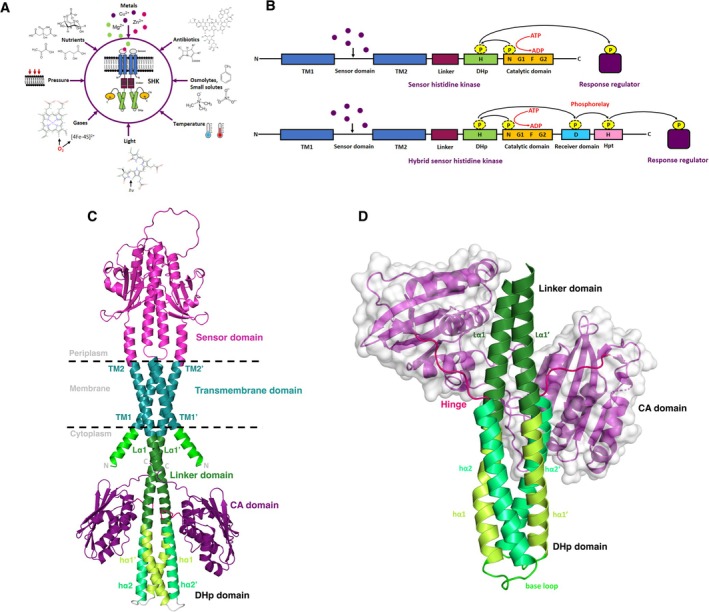
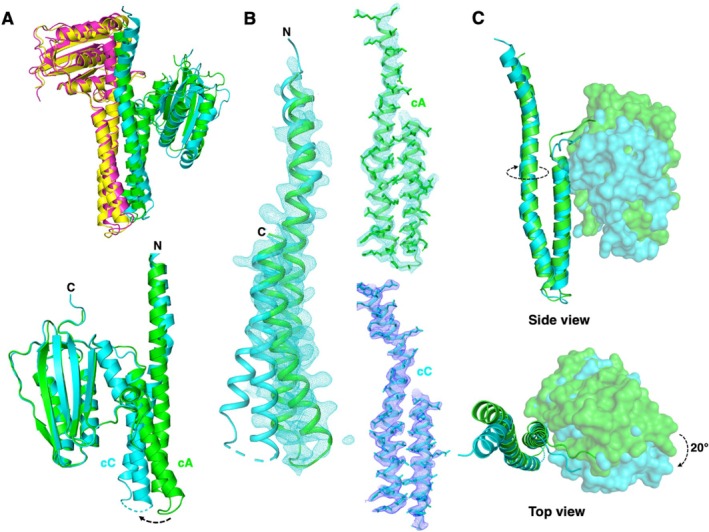
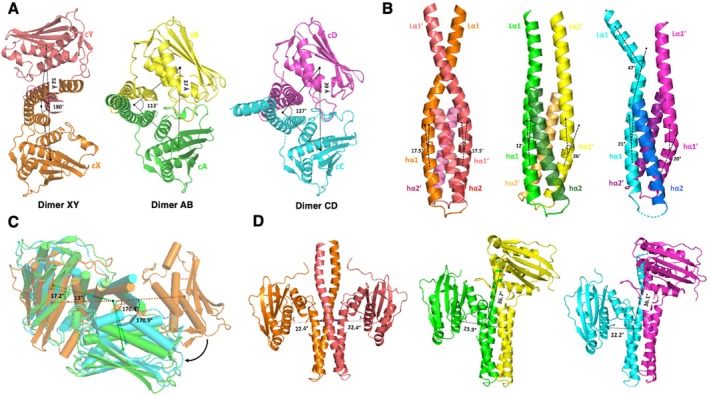
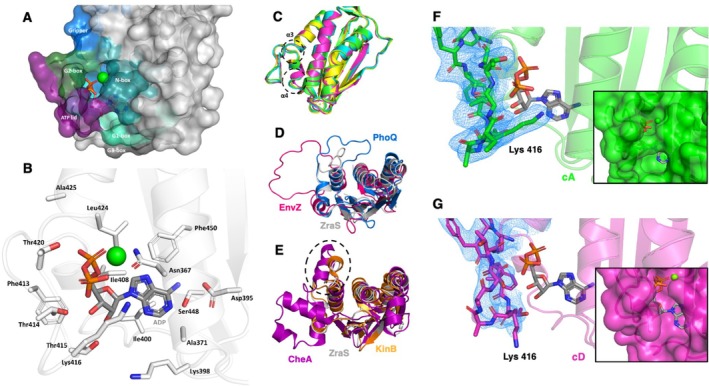
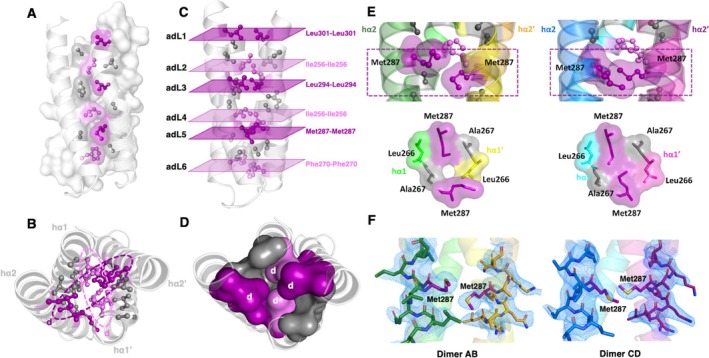
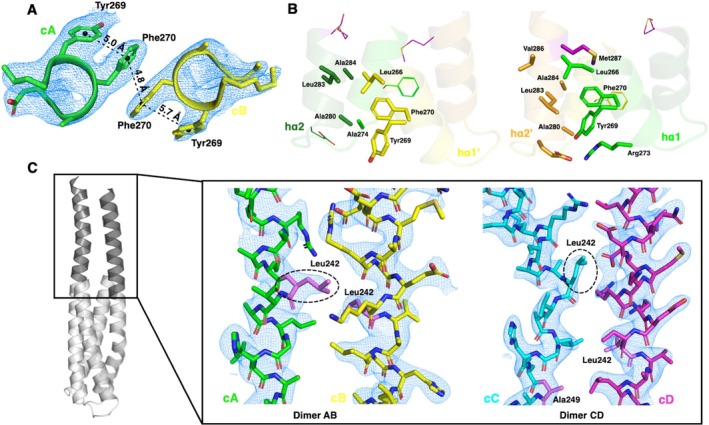
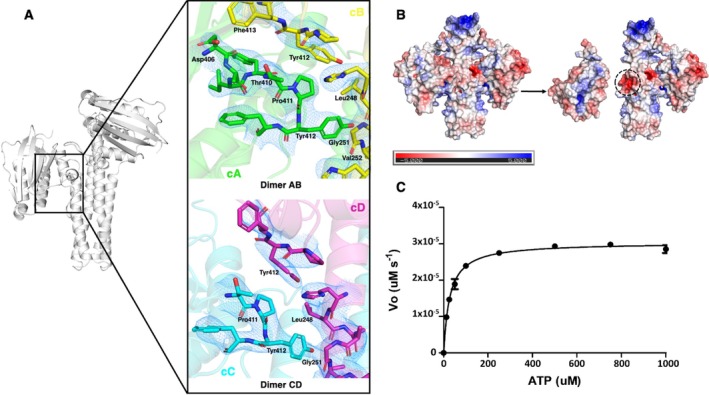
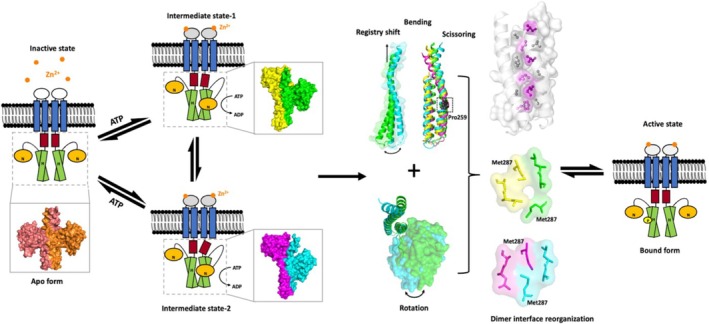
ZraS is a metal sensor integral to ZraPSR, a two‐component signaling system found in enterobacters. It belongs to a family of bifunctional sensor histidine kinases (SHKs) and is speculated to sense zinc‐induced stress on the bacterial envelope. Information on the structure–function relationship of sensor kinases is elusive due to the lack of full‐length structures, intrinsically dynamic behavior, and difficulty trapping them in active state conformations. While the kinase domains (KDs) of a few SHKs are well characterized, they exhibit significant functional diversity attributed to their modular multi‐domain arrangement in the cytoplasmic region, combined with other signal transducing elements such as simple helices, HAMP, and PAS domains. We report the crystal structure of the entire cytoplasmic region of Escherichia coli ZraS (EcZraS‐CD) resolved at a resolution of 2.49 Å, comprising a unique helical linker and the KD. In the asymmetric unit, four molecules of ZraS assemble as homodimers trapped as two ligand‐bound occluded conformers. Our analysis using these conformers shows that modulation of the dimer bundle through segmental helical bending, sliding, and rotation leads to the reorganization of the dimerization interface during kinase activation. Further, our analysis reveals the significance of aromatic amino acid interactions and loop residues at the dimer base in regulating the directionality of rotation during autophosphorylation. We also performed an in vitro coupled assay to determine ATPase activity. Overall, our findings provide structure‐based mechanistic insights into the process of autophosphorylation in trans‐acting SHKs.
Overview
The claims and statistics of this paper haven’t been checked yet.
Run the check — free, no account needed. It reads the open-access text and checks the sources it cites.
Integrity signals
Registry
Cites
Statistics
Figures
Verification
Claims the paper makes
The claims and statistics of this paper haven’t been checked yet.
Run the check — free, no account needed. It reads the open-access text and checks the sources it cites.
Self-check
Percentages, sums and reported differences re-computed from the paper’s own numbers.
The self-check needs the paper’s full text.
Citations
Cites
1 retracted
RETRACTED: A mathematical model explains saturating axon guidance responses to molecular gradients
Nguyen, H., Dayan, P., Pujic, Z., Cooper-White, J., & Goodhill, G. J. (2016) · eLife · doi:10.7554/elife.12248 · Cited by 1,221
RetractedThompson, J. D., Higgins, D. G., & Gibson, T. J. (1994) · Nucleic Acids Research · doi:10.1093/nar/22.22.4673 · Cited by 64,617
Highly accurate protein structure prediction with AlphaFold
Jumper, J., Evans, R., Pritzel, A., Green, T., Figurnov, M., Ronneberger, O., Tunyasuvunakool, K., Bates, R., Žídek, A., Potapenko, A., et al. (2021) · Nature · doi:10.1038/s41586-021-03819-2 · Cited by 43,764
Coot : model-building tools for molecular graphics
Emsley, P., & Cowtan, K. (2004) · Acta Crystallographica Section D Biological Crystallography · doi:10.1107/s0907444904019158 · Cited by 30,571
PHENIX : a comprehensive Python-based system for macromolecular structure solution
Adams, P. D., Afonine, P. V., Bunkóczi, G., Chen, V. B., Davis, I. W., Echols, N., Headd, J. J., Hung, L.-W., Kapral, G. J., Grosse-Kunstleve, R. W., et al. (2010) · Acta Crystallographica Section D Biological Crystallography · doi:10.1107/s0907444909052925 · Cited by 23,716
Phaser crystallographic software
McCoy, A. J., Grosse-Kunstleve, R. W., Adams, P. D., Winn, M. D., Storoni, L. C., & Read, R. J. (2007) · Journal of Applied Crystallography · doi:10.1107/s0021889807021206 · Cited by 20,612
Kabsch, W. (2010) · Acta Crystallographica Section D Biological Crystallography · doi:10.1107/s0907444909047337 · Cited by 16,463
WebLogo: A Sequence Logo Generator: Figure 1
Crooks, G. E., Hon, G., Chandonia, J.-M., & Brenner, S. E. (2004) · Genome Research · doi:10.1101/gr.849004 · Cited by 12,386
In situ click chemistry generation of cyclooxygenase-2 inhibitors
Bhardwaj, A., Kaur, J., Wuest, M., & Wuest, F. (2017) · Nature Communications · doi:10.1038/s41467-016-0009-6 · Cited by 7,448
Electrostatics of nanosystems: Application to microtubules and the ribosome
Baker, N., Sept, D., Joseph, S., Holst, M., & McCammon, J. A. (2001) · Proceedings of the National Academy of Sciences · doi:10.1073/pnas.181342398 · Cited by 7,125
Metadata
- Authors
- Mahapatra, N., Mahanta, P., Pandey, S., & Acharya, R.
- Affiliations
- National Institute of Science Education and Research (IN)
- Corresponding author
- Acharya, Rudresh
- Venue
- Proteins: Structure, Function, and Bioinformatics
- Publisher
- Wiley
- Published
- 2025-03-10
- Volume
- 93
- Issue
- 9
- Pages
- 1465-1480
- ISSN
- 0887-3585 (ISSN-L)
- 1097-0134
- PMC
- PMC12314577
- OpenAlex
- W4408301829
- Cited by
- 2
- References
- 68
- Citations by year
- 2025: 2
- FWCI
- 1.17
- Type
- journal article
- Language
- en
- Open access
- hybrid
- doi.org
- Licence
- Locations
- Proteins Structure Function and Bioinformatics (publishedVersion, cc-by-nc-nd)
- bioRxiv (Cold Spring Harbor Laboratory) (acceptedVersion)
- Europe PMC (PubMed Central) (publishedVersion, cc-by-nc-nd)
- PubMed Central (publishedVersion, cc-by-nc-nd)
- PubMed (publishedVersion)
- Funders
- National Institute of Science Education and Research (RIN4002)
- Council of Scientific and Industrial Research, India (09/1002(0045)/2019‐EMR‐I)
- Topics
- Life Sciences › Biochemistry, Genetics and Molecular Biology › Genetics › Bacterial Genetics and Biotechnology
- Life Sciences › Biochemistry, Genetics and Molecular Biology › Molecular Biology › Protein Structure and Dynamics
- Life Sciences › Biochemistry, Genetics and Molecular Biology › Structural Biology › Enzyme Structure and Function
- Keywords
- sensor histidine kinase, two-component systems, zinc ion detection, Escherichia coli, kinase domain, homodimer, ATPase activity, conformational dynamics
- MeSH terms
- Histidine Kinase, Protein Domains, Binding Sites, Cytoplasm, Escherichia coli, Models, Molecular, Protein Binding, Protein Conformation, Zinc, Signal Transduction, Crystallography, X-Ray, Escherichia coli Proteins, Protein Multimerization
About these checks
Registry, retraction, Cites and statistics results are computed, not judged, with one exception: a printed reference that no index lists is read once by a model before it counts as a citation error. Claims are extracted by a model and kept only when their quote appears verbatim in the text; each cited source is then checked, with a model’s help, for whether it says what the claim relies on. Those verdicts can be wrong — read the claim’s quote and the cited source before relying on one.
Statistics and arithmetic are recomputed, not judged.
Confidence bands are shown only for fields calibrated on our annotated test set. None is calibrated yet, so no band is shown.
What counts as a claim ›How we measure confidence ›How we check this ›
Are you an author, or do you see a problem with this page? Request a review
How to cite
Cite CoChat for the checks on this page, and the paper for its own findings.
- This page
- CoChat. (2026). Citation check: Insights Into the Conformational Dynamics of the Cytoplasmic Domain of Metal‐Sensing Sensor Histidine Kinase ZraS. https://app.cochat.ai/papers/10.1002/prot.26819
- The paper
- Mahapatra, N., Mahanta, P., Pandey, S., & Acharya, R. (2025). Insights Into the Conformational Dynamics of the Cytoplasmic Domain of Metal‐Sensing Sensor Histidine Kinase ZraS. Proteins: Structure, Function, and Bioinformatics. https://doi.org/10.1002/prot.26819
Data sources
Bibliographic data: Semantic Scholar, OpenAlex, Crossref.
Contains information from the Semantic Scholar Academic Graph Datasets, made available under the ODC Attribution License (ODC-BY 1.0).
Semantic Scholar’s data is described in: Kinney, R., et al. (2023). The Semantic Scholar Open Data Platform. arXiv:2301.10140.
