

The DOI matches its Crossref record.
FluorMango, an RNA-based fluorogenic biosensor for the direct and specific detection of fluoride
Abstract
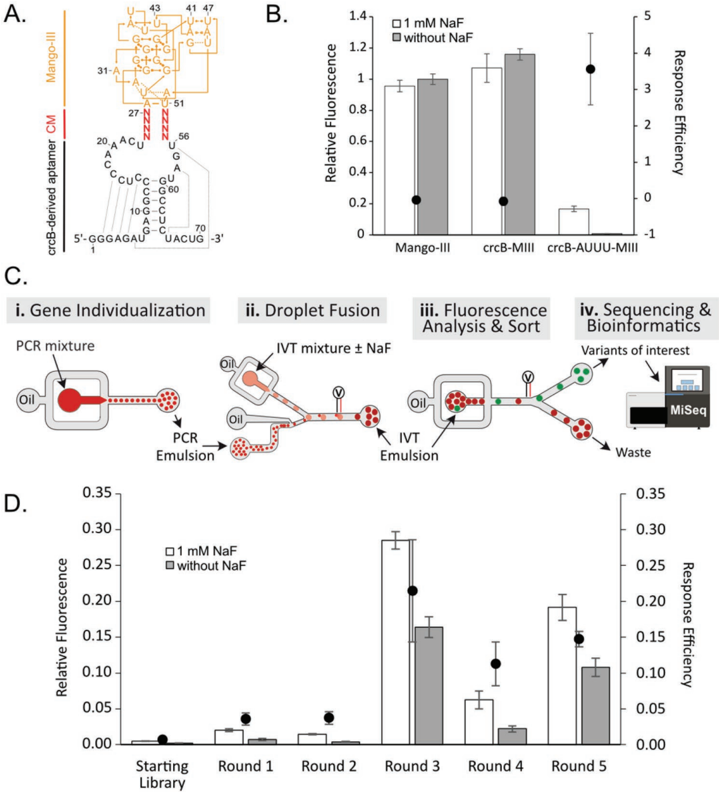
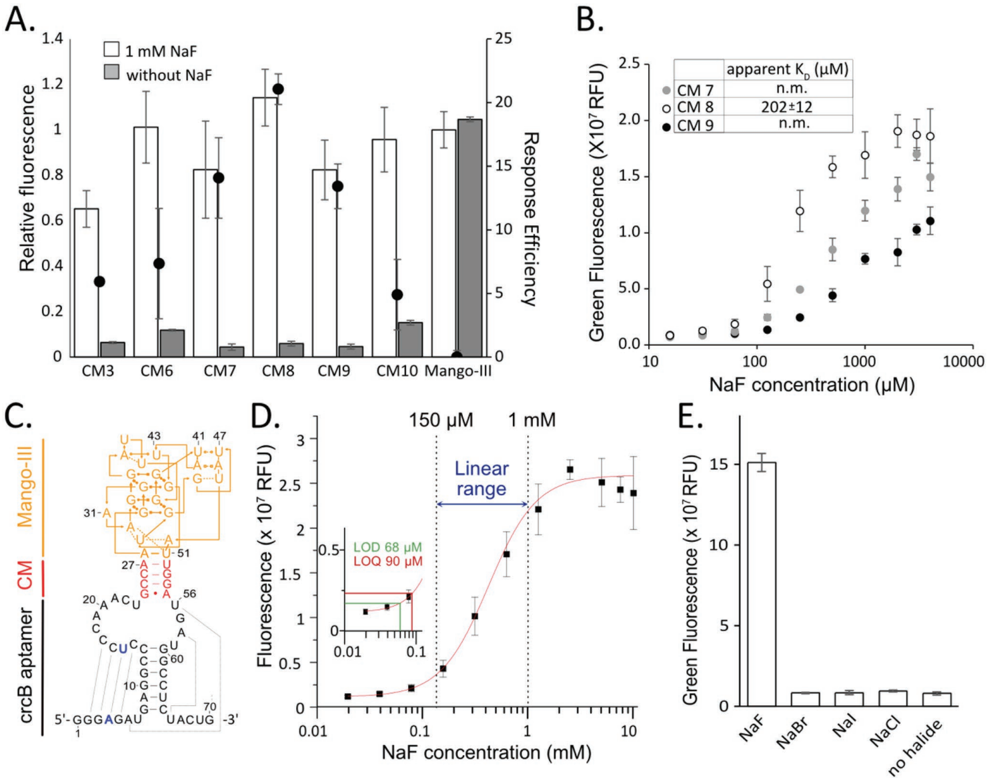
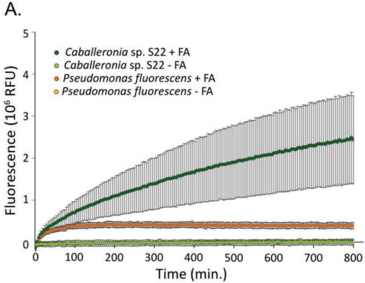
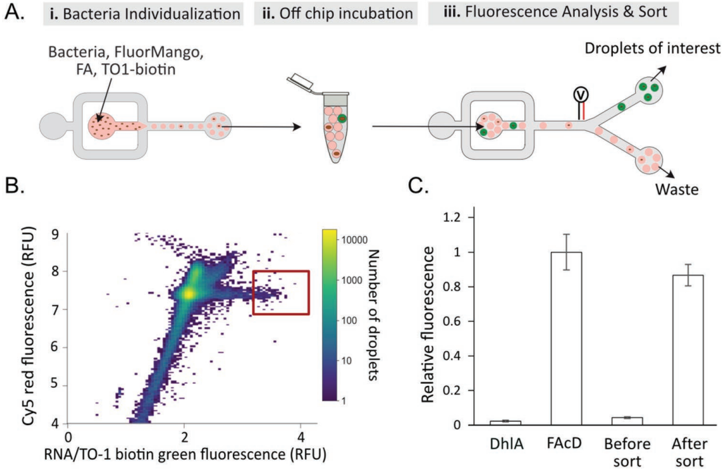
Nucleic acids are not only essential actors of cell life but also extremely appealing molecular objects in the development of synthetic molecules for biotechnological application, such as biosensors to report on the presence and concentration of a target ligand by emission of a measurable signal. In this work, FluorMango, a fluorogenic ribonucleic acid (RNA)‐based biosensor specific for fluoride is introduced. The molecule consists of two RNA aptamer modules, a fluoride‐specific sensor derived from the crcB riboswitch which changes its structure upon interaction with the target ion, and the light‐up RNA Mango‐III that emits fluorescence when complexed with a fluorogen. The two modules are connected by an optimized communication module identified by ultrahigh‐throughput screening, which results in extremely high fluorescence of FluorMango in the presence of fluoride, and background fluorescence in its absence. The value and efficiency of this biosensor by direct monitoring of defluorinase activity in living bacterial cells is illustrated, and the use of this new tool in future screening campaigns aiming at discovering new defluorinase activities is discussed.
Overview
The claims and statistics of this paper haven’t been checked yet.
Run the check — free, no account needed. It reads the open-access text and checks the sources it cites.
Integrity signals
Registry
Cites
Statistics
Figures



Verification
Claims the paper makes
The claims and statistics of this paper haven’t been checked yet.
Run the check — free, no account needed. It reads the open-access text and checks the sources it cites.
Claims other papers make about this one
Each is checked against this paper’s own text: does it say what the citing paper says it does?
The cited source says what the claim attributes to it.
In the citing paper
“When coupled to a reporter system, the fluoride riboswitch has also been shown to have utility as a sensitive and biocompatible fluoride sensor that can be used in living bacteria or in wholly in vitro systems (170, 173).”
From Toward the development of a molecular toolkit for the microbial remediation of per-and polyfluoroalkyl substances (2024) · cites this paper as [173]
Self-check
Percentages, sums and reported differences re-computed from the paper’s own numbers.
The self-check needs the paper’s full text.
Citations
Cites
No references could be resolved yet.
Research works printed but not linked: 47
- 10.1002/sstr.202000132 · DOI
- 10.1016/j.bbagrm.2020.194501 · DOI
- 10.1039/D0CS00617C · DOI
- Ariza‐Mateos A., 2021, Biochemistry, 86, 962
- 10.1039/D1CB00138H · DOI
- 10.1016/j.jmb.2022.167631 · DOI
- 10.1016/j.copbio.2019.11.008 · DOI
- 10.1038/s41545-020-0064-8 · DOI
- 10.2174/092986710791698503 · DOI
- 10.1002/etc.4890 · DOI · Paper page
- 10.1186/s13765-019-0469-6 · DOI · Paper page
- 10.1016/j.tibtech.2022.06.006 · DOI
- 10.1126/science.154.3756.1553 · DOI
- 10.1128/mBio.03001-21 · DOI · Paper page
- 10.1128/aem.00288-22 · DOI
- 10.3389/fchem.2021.666450 · DOI
- 10.7150/thno.9860 · DOI
- 10.1016/j.dyepig.2022.110200 · DOI
- 10.1039/D1RA08037G · DOI
- 10.1126/science.1215063 · DOI · Paper page
- 10.1038/nature11152 · DOI · Paper page
- 10.1021/acssynbio.9b00347 · DOI
- 10.1093/nar/gkaa673 · DOI
- 10.1039/D1SC03508H · DOI
- 10.1007/978-1-0716-0712-1_5 · DOI
- 10.3390/ijms19010044 · DOI
- 10.1039/C9AN01825E · DOI
- 10.1039/C9TB02668A · DOI
- 10.1073/pnas.1504354112 · DOI
- 10.1126/science.1218298 · DOI
- 10.1038/s41467-018-02993-8 · DOI
- 10.1038/s41589-019-0267-9 · DOI
- 10.1038/nsmb.3316 · DOI
- 10.1016/j.ymeth.2019.03.015 · DOI
- 10.1007/978-1-0716-1386-3_17 · DOI
- 10.3390/chemosensors9110299 · DOI
- 10.1186/s40104-017-0180-6 · DOI
- 10.1007/s10529-008-9849-4 · DOI · Paper page
- 10.1016/S1381-1177(03)00098-5 · DOI · Paper page
- 10.1128/jb.171.12.6791-6799.1989 · DOI
- 10.1021/acsomega.2c00248 · DOI
- M. A.Boyd W.Thavarajah J. B.Lucks N. P.Kamat. bioRxiv https://doi.org/10.1101/2022.03.02.482665. · DOI
- 10.1002/cbic.202200006 · DOI
- 10.1039/C8CC08796B · DOI
- 10.1038/s41467-017-00425-7 · DOI
- 10.1261/rna.048033.114 · DOI
- 10.1017/S1355838201002515 · DOI
Cited by
Sorted by citations
Hu, M., & Scott, C. (2024) · Applied and Environmental Microbiology · doi:10.1128/aem.00157-24 · Cited by 63
Metadata
- Authors
- Husser, C., Vuilleumier, S., & Ryckelynck, M.
- Affiliations
- CNRS, Architecture et Réactivité de l'ARN Université de Strasbourg UPR 9002, 2 allée Konrad Roentgen Strasbourg 67000 France
- CNRS, Génétique Moléculaire, Génomique, Microbiologie Université de Strasbourg UMR 7156, 4 allée Konrad Roentgen Strasbourg 67000 France
- Venue
- Small
- Publisher
- Wiley
- Published
- 2022-11-27
- Volume
- 19
- Issue
- 13
- ISSN
- 1613-6810
- 1613-6829
- Cited by
- 30
- References
- 0
- Language
- en
- Funders
- Agence Nationale de la Recherche (ANR‐17‐CE07‐0009)
- Centre National de la Recherche Scientifique
- Université de Strasbourg
About these checks
Registry, retraction, Cites and statistics results are computed, not judged, with one exception: a printed reference that no index lists is read once by a model before it counts as a citation error. Claims are extracted by a model and kept only when their quote appears verbatim in the text; each cited source is then checked, with a model’s help, for whether it says what the claim relies on. Those verdicts can be wrong — read the claim’s quote and the cited source before relying on one.
Statistics and arithmetic are recomputed, not judged.
Confidence bands are shown only for fields calibrated on our annotated test set. None is calibrated yet, so no band is shown.
What counts as a claim ›How we measure confidence ›How we check this ›
Are you an author, or do you see a problem with this page? Request a review
How to cite
Cite CoChat for the checks on this page, and the paper for its own findings.
- This page
- CoChat. (2026). Citation check: FluorMango, an RNA-based fluorogenic biosensor for the direct and specific detection of fluoride. https://app.cochat.ai/papers/10.1002/smll.202205232
- The paper
- Husser, C., Vuilleumier, S., & Ryckelynck, M. (2023). FluorMango, an RNA-based fluorogenic biosensor for the direct and specific detection of fluoride. Small. https://doi.org/10.1002/smll.202205232
