

Far Beyond the Gay Village: LGBTQ Urbanism and Generation in Montréal’s Mile End
The DOI matches its Crossref record; 34 of the 34 references it cites were found in a registry or an index.
Abstract
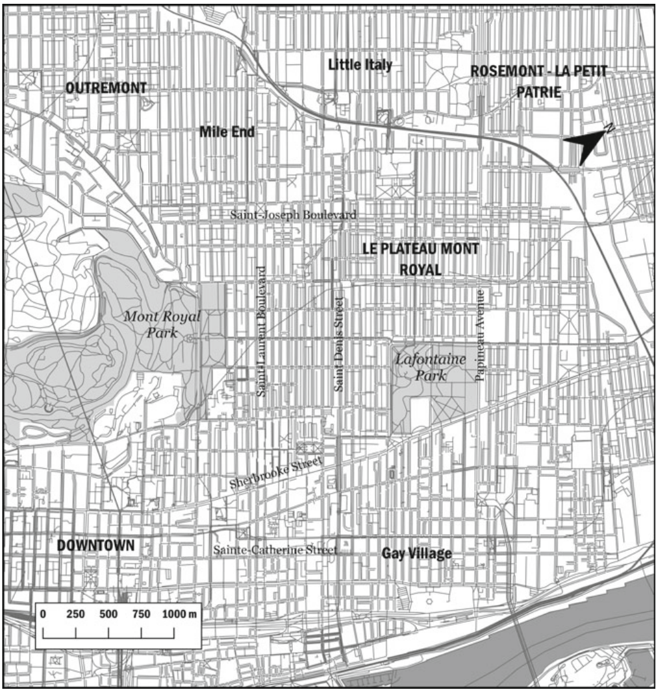
Research on LGBTQ neighbourhood formation in the urban West suggests that new patterns of community and identity are reshaping the queer inner-city and its geographies. As gay village districts “decline” or are “de-gayed” and new generations “dis-identify” with the urban ideals that once informed their production, LGBTQ subcultures are producing varied alternatives in other inner-city neighbourhoods. Beyond the contours of ethno-racialization and social class, generational interpretations of LGBTQ urbanism—subcultural ideals regarding the relationship between sexual and gender identity and its expression in urban space—are central to the production of such new inner-city LGBTQ subcultural sites. This chapter provides a qualitative case study Montréal’s of Mile End, an inner-city neighbourhood that, by the early 2010s, was touted as the centre of the city’s emerging queer subculture. Drawing on a sample of young-adult (22 to 30 years) LGBTQ-identified Mile Enders (n = 40), it examines generational shifts in perceptions of sexual and gender identity, queer community and neighbourhoods. The chapter concludes with a discussion of the implications of queer Mile End for theorizing the contemporary queer inner-city.
Overview
The claims and statistics of this paper haven’t been checked yet.
Free: it reads the open-access text and checks the first 5 claims that cite a source we can check. Create a free account to check every claim.
Integrity signals
Registry
Cites
Statistics
Figures
Verification
Claims the paper makes
The claims and statistics of this paper haven’t been checked yet.
Free: it reads the open-access text and checks the first 5 claims that cite a source we can check. Create a free account to check every claim.
Claims other papers make about this one
Each is checked against this paper’s own text: does it say what the citing paper says it does?
In the citing paper
“The study compares two cities with rich queer histories, Montréal and Berlin, which are both important hubs for queer sociality ("Club Culture Berlin" 2019; Podmore 2021).”
From Staring Back at the Surveillance Gaze: The Resistance of LGBTQ+ Users on Social Media (2026) · cites this paper as Podmore 2021
Self-check
Percentages, sums and reported differences re-computed from the paper’s own numbers.
The self-check needs the paper’s full text.
Citations
Cites
Snowball sampling: using social networks to research non‐heterosexual women
Browne, K. (2005) · International Journal of Social Research Methodology · doi:10.1080/1364557032000081663 · Cited by 1,124
CONSUMING AUTHENTICITY: From outposts of difference to means of exclusion
Zukin, S. (2008) · Cultural Studies · doi:10.1080/09502380802245985 · Cited by 459 · cited 1×
“As the urban studies literature on gentrification suggests, Queer Mile Enders share this urban ideal with other members of the new urban middle-class in inner-city areas of the urban West (e.g. Brown-Saracino 2009; De Oliver 2016; Tissot 2014; Zukin 2008).”
BackgroundWhat's that Smell? Queer Temporalities and Subcultural Lives
Halberstam, J. (2003) · International Journal of Cultural Studies · doi:10.1177/13678779030063005 · Cited by 286
Queers in the American City: Transgendered perceptions of urban space
Doan, P. L. (2007) · Gender, Place & Culture · doi:10.1080/09663690601122309 · Cited by 253
The Demise of Queer Space? Resurgent Gentrification and the Assimilation of LGBT Neighborhoods
Doan, P. L., & Higgins, H. (2011) · Journal of Planning Education and Research · doi:10.1177/0739456x10391266 · Cited by 202
Sexual Dissidence, Enterprise and Assimilation: Bedfellows in Urban Regeneration
Collins, A. (2004) · Urban Studies · doi:10.1080/0042098042000243156 · Cited by 176
The age of the “post-mo”? Toronto’s gay Village and a new generation
Nash, C. J. (2012) · Geoforum · doi:10.1016/j.geoforum.2012.11.023 · Cited by 163
Nash, C. J., & Gorman‐Murray, A. (2014) · International Journal of Urban and Regional Research · doi:10.1111/1468-2427.12104 · Cited by 151
Plummer, K. (2010) · Symbolic Interaction · doi:10.1525/si.2010.33.2.163 · Cited by 116
Gorman‐Murray, A., & Waitt, G. (2009) · Environment and Planning A Economy and Space · doi:10.1068/a41356 · Cited by 110
Research works printed but not linked: 13
- Adriansen HK, Madsen LM (2009) Studying the making of geographical knowledge: the implications of insider interviews. Nor Geogr Tidsskr-Nor J Geogr 63(3):145-153
- Atkinson R, Flint J (2001) Accessing hidden and hard-to-reach populations: snowball research strategies. Soc Res Update 33(1):93-108
- Bourdieu P (1991) Social space and symbolic space. In: Calhoun C et al (eds) Contemporary sociological theory. Wiley, Chichester, pp 325-334
- Brown G (2006) Cosmopolitan camouflage: (post-)gay space in Spitalfields, East London. In: Binnie J et al (eds) Cosmopolitan urbanism. Routledge, London, pp 130-145
- Brown-Saracino J (2009) A neighborhood that never changes: gentrification, social preservation, and the search for authenticity. University of Chicago Press, Chicago, IL · DOI · Paper page
- Driver S (2008) Queer youth cultures. Suny Press, Albany, NY
- Duggan L (2002) The new homonormativity: the sexual politics of neoliberalism. In: Castronovo R, Nelson DD (eds) Materializing democracy: toward a revitalized cultural politics. Duke University Press, Durham, NC, pp 175-194 · DOI · Paper page
- Germain A, Radice M (2006) Cosmopolitanism by default: public sociability in Montréal. In: Binnie J et al (eds) Cosmopolitan urbanism. Routledge, London, pp 112-130
- Gieseking JJ (2016) Dyked New York: the space between geographical imagination and material- ization of lesbian-queer bars and neighbourhoods. In: Brown G, Browne K (eds) The Routledge research companion to geographies of sex and sexualities. Routledge, London, pp 53-60
- Hogan M (2005) Radical queers: A pop culture assessment of Montréal's anti-capitalist ass pirates, the panthères roses, and lesbians on ecstasy. Can Woman Stud 24(2):154-159
- Martinez A (2015) Queer cosmopolis: the evolution of Jackson Heights. In: Doan P (ed) Planning and LGBTQ communities. Routledge, New York, NY, pp 167-180 · doi:10.4324/9781315756721-13
- Nash CJ (2013a) Queering neighbourhoods: politics and practice in Toronto. ACME 12(2):193-219
- Podmore J (2015) From contestation to incorporation: LGBT activism and urban politics in Montréal. In: Tremblay M (ed) Queer mobilizations: social movement activism and Canadian Public Policy. UBC Press, Vancouver, pp 187-207 · doi:10.59962/9780774829090-011
Cited by
Staring Back at the Surveillance Gaze: The Resistance of LGBTQ+ Users on Social Media
Chartrand, A. (2026) · Surveillance & Society · doi:10.24908/ss.v24i3.19225 · Cited by 1
Metadata
- Authors
- Podmore, J. A.
- Venue
- The Urban Book Series
- Publisher
- Springer International Publishing
- Published
- 2021
- Pages
- 289-306
- ISSN
- 2365-757X
- 2365-7588
- Cited by
- 5
- References
- 34
- Language
- en
- Licence
- creativecommons.org/licenses/by/4.0 (tdm)
- creativecommons.org/licenses/by/4.0 (vor, 78 d)
About these checks
Registry, retraction, Cites and statistics results are computed, not judged, with one exception: a printed reference that no index lists is read once by a model before it counts as a citation error. Claims are extracted by a model and kept only when their quote appears verbatim in the text; each cited source is then checked, with a model’s help, for whether it says what the claim relies on. Those verdicts can be wrong — read the claim’s quote and the cited source before relying on one.
Statistics and arithmetic are recomputed, not judged.
Confidence bands are shown only for fields calibrated on our annotated test set. None is calibrated yet, so no band is shown.
What counts as a claim ›How we measure confidence ›How we check this ›
Are you an author, or do you see a problem with this page? Request a review
Data sources
Bibliographic data: Semantic Scholar, OpenAlex, Crossref.
Contains information from the Semantic Scholar Academic Graph Datasets, made available under the ODC Attribution License (ODC-BY 1.0).
Semantic Scholar’s data is described in: Kinney, R., et al. (2023). The Semantic Scholar Open Data Platform. arXiv:2301.10140.
