

VCDB: A Large-Scale Database for Partial Copy Detection in Videos
The DOI matches its Crossref record; 24 of the 24 references it cites were found in a registry or an index; 3 of the 14 sources its claims cite were checked for support.
Overview
CoChat Summary
TL;DR
VCDB is introduced as a large-scale video copy database with over 100,000 Web videos and 9,236 manually annotated real partial copy pairs, addressing the lack of realistic partial-copy benchmarks. Benchmarking a state-of-the-art baseline shows that methods with near-perfect results on simulated datasets perform poorly on complex real copies.
Key findings
- VCDB contains 528 core videos (approximately 27 hours) from 28 queries, plus 100,000 YouTube background distraction videos; annotation found 9,236 pairs of partial copies.
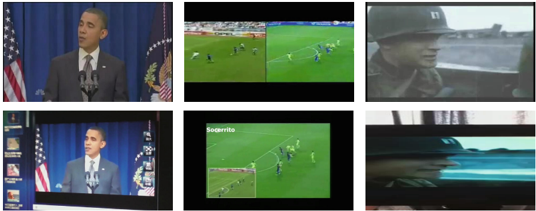
- Among annotated copies, 36% contain insertion of patterns, 18% are from camcording, 27% have scale changes, and 2% contain picture-in-picture; nearly 80% of video pairs with at least one copy contain just one copied segment, while 20% contain two or more.
- 32% of copied segments are less than 10 seconds and another 28% are between 10 and 30 seconds; 44% of copies are shorter than 1/5 of their parent videos, and only 31% occupy over 80% of the parent videos.
- On Muscle-VCD ST2, the baseline achieves QS=0.81 and QF=0.70, versus best reported 0.86 and 0.76. On VCDB core, temporal network alignment reaches segment-level recall around 0.48 at precision 0.80; frame-level recall saturates at 0.5 for temporal network and 0.45 for Hough voting, and best recall is close to 0.60 when precision drops to 0.20.
Methods
- Dataset construction: videos downloaded from YouTube and MetaCafe, starting from 28 queries with about 20 manually picked videos per query, yielding 528 core videos; 100,000 YouTube distraction videos were added. Seven trained annotators used a custom tool with transitivity propagation over about one month (around 700 man-hours).
- Baseline pipeline: uniform sampling of two frames per second; local SIFT descriptors; bag-of-visual-words quantization via hierarchical k-means; inverted file indexing with Hamming embedding; weak geometric consistency; temporal alignment compared via temporal network optimization and temporal Hough voting.
- Evaluation: Muscle-VCD ST2 with 21 query segments using QF and QS; VCDB with each of the 9,236 pairs as a query using segment-level and frame-level precision/recall; large-scale tests incrementally adding 10,000, 30,000, 50,000, and 100,000 distraction videos.
Limitations
- The paper states that manual annotation of real partial copies is extremely difficult and time-consuming, and that the transitivity property used to speed annotation does not always hold, e.g., when a bridging segment contains picture-in-picture scenes.
- The paper notes the baseline uses standard weak geometric consistency, whereas the best Muscle-VCD result used an improved version; it also samples only two frames per second and says evaluating more frames is beyond the paper’s focus.
- Evident from the text: the core dataset is built from 28 queries and YouTube/MetaCafe videos, and distraction videos were only skimmed to reduce the chance of copies, so coverage of all real partial copies is not guaranteed; the benchmark uses one representative baseline rather than an exhaustive comparison.
Model-written summary. Check it against the paper before relying on it.
Integrity signals
Registry
Cites
Statistics
Figures


Verification
Claims the paper makes
1 Valid · 3 Not valid · 7 Not checked · 38 Own results and interpretations
At least one cited source doesn’t support this claim or points to a different paper, and none confirmed it — see the verdicts below.
In the paper
“To our knowledge the best results achieved on this dataset are 0.86 and 0.76 respectively for the two criteria, reported in [14]”
What the sources say
- Disputedcites [14] 14. Tan, H.K., Ngo, C.W., Hong, R., Chua, T.S.: Scalable detection of partial nearduplicate videos by visual-temporal consistency. In: ACM MM (2009) sourceExperimental — accuracy not yet measured
Section 7.1 (page unavailable) reports the highest Muscle-VCD-2007 localization scores as QS = 0.90 and QF = 0.82, not 0.86 and 0.76. The 0.86 values visible in Table 7 are detection precision for other teams, not QS scores. (LLM, conf=0.88)
Checked by a reasoning model — may be wrong.
hedged- Asserted: passes — The authors put it forward as true.
- Checkable: passes — It can be checked against evidence.
- Load-bearing: unclear — It is unclear whether the paper’s conclusions depend on it.
- Based: passes — The paper gives a reason why it holds.
- Disputed
The cited sources that could be checked couldn’t confirm or dispute this claim.
In the paper
“The small performance gap is mainly due to the use of different geometric verification methods. An improved version of the WGC was used in [14], while our baseline uses the standard WGC.”
What the sources say
- Could not verifycites [14] 14. Tan, H.K., Ngo, C.W., Hong, R., Chua, T.S.: Scalable detection of partial nearduplicate videos by visual-temporal consistency. In: ACM MM (2009) sourceExperimental — accuracy not yet measured
Section 7.1 reports Muscle-VCD results and describes reranking with SR-PE verification, but it does not compare the cited method with the citing paper’s baseline or explain a small performance gap. The method description in Section 5 also identifies SR-PE, not WGC, as its verification method. Searches for the performance-gap explanation and WGC found no passage establishing the claimed cause. (LLM, conf=0.76)
plainstates a cause- Asserted: passes — The authors put it forward as true.
- Checkable: passes — It can be checked against evidence.
- Load-bearing: unclear — It is unclear whether the paper’s conclusions depend on it.
- Based: passes — The paper gives a reason why it holds.
- Could not verify
The sources with a verdict support this claim; the rest weren’t checked yet, have no full text we could read, or their verdicts aren’t rated yet.
In the paper
“We further benchmark a baseline system on VCDB, which has demonstrated state-of-the-art results in recent copy detection research.”
- Also stated in: § 4 The Baseline System · p. 8 · boosted
“we benchmark a system that has produced strong performances on various datasets”
What the sources say
- Not checked — no full text of the sourcecites [5] 5. Jegou, H., Douze, M., Schmid, C.: Hamming embedding and weak geometric consistency for large scale image search. In: Forsyth, D., Torr, P., Zisserman, A. (eds.) ECCV 2008, Part I. LNCS, vol. 5302, pp. 304-317. Springer, Heidelberg (2008) source
- Not checked — no full text of the sourcecites [2] 2. Douze, M., J´ egou, H., Schmid, C., P´ erez, P.: Compact video description for copy detection with precise temporal alignment. In: Daniilidis, K., Maragos, P., Paragios, N. (eds.) ECCV 2010, Part I. LNCS, vol. 6311, pp. 522-535. Springer, Heidelberg (2010) source
- Supportedcites [14] 14. Tan, H.K., Ngo, C.W., Hong, R., Chua, T.S.: Scalable detection of partial nearduplicate videos by visual-temporal consistency. In: ACM MM (2009) source
Section 7.1 (Copy Detection and Localization) reports that the proposed system achieved perfect copy-detection precision on Muscle-VCD-2007, outperforming the other evaluated teams. It also reports superior partial-copy localization results, supporting the description of state-of-the-art results in copy detection. (LLM, conf=0.91)
boosted- Asserted: passes — The authors put it forward as true.
- Checkable: passes — It can be checked against evidence.
- Load-bearing: unclear — It is unclear whether the paper’s conclusions depend on it.
- Based: passes — The paper gives a reason why it holds.
- Also stated in: § 4 The Baseline System · p. 8 · boosted
A result the paper reports from its own data — it cites no other source for it, so there is none to check. The quote shows it is in the paper.
In the paper
“we introduce a large-scale video copy database (VCDB) with over 100,000 Web videos”
- Also stated in: § 3.1 Database Collection · p. 5 · plain
“we further downloaded 100,000 videos from YouTube as background distraction videos”
- Also stated in: § 3.1 Database Collection · p. 5 · plain
“The final VCDB consists of both the core dataset and the distraction videos.”
plain- Asserted: passes — The authors put it forward as true.
- Checkable: passes — It can be checked against evidence.
- Load-bearing: passes — The paper’s conclusions depend on it.
- Based: passes — The paper gives a reason why it holds.
- Also stated in: § 3.1 Database Collection · p. 5 · plain
A result the paper reports from its own data — it cites no other source for it, so there is none to check. The quote shows it is in the paper.
In the paper
“one can observe from Figure 7 that the existing techniques face difficulties in locating nearly 50% of the partial copies”
- Also stated in: § 5.2 VCDB · p. 11 · hedged
“around half of the copied frames are difficult to be identified by the baseline system”
plainstates a cause- Asserted: passes — The authors put it forward as true.
- Checkable: passes — It can be checked against evidence.
- Load-bearing: passes — The paper’s conclusions depend on it.
- Based: passes — The paper gives a reason why it holds.
- Also stated in: § 5.2 VCDB · p. 11 · hedged
30 more claims
Create a free account to see all 49 claims and every source verdict.
- It may state two separate claims as one. 10
- Probably not a substantial claim. 6
Self-check
Percentages, sums and reported differences re-computed from the paper’s own numbers.
Each contradiction between two passages listed here was confirmed by an independent check.
Rated minor: it would not touch a result — a value no result rests on, a p-value that stays on the same side of the significance level, or a conflict that is clerical, resolved elsewhere in the paper, or outside its own findings.
In the paper
§ 2 Related Work · p. 4
“| Indyk et al. | [7] | 1999 | N | Real |”
§ 2 Related Work · p. 3
“Copies were generated by the authors using predefined transformations including inserting TV logos and using various camcordings, frame rates, etc.”
Citations
Cites
Distinctive Image Features from Scale-Invariant Keypoints
Lowe, D. G. (2004) · International Journal of Computer Vision · doi:10.1023/b:visi.0000029664.99615.94 · Cited by 55,589
Product Quantization for Nearest Neighbor Search
Jégou, H., Douze, M., & Schmid, C. (2011) · IEEE Transactions on Pattern Analysis and Machine Intelligence · doi:10.1109/tpami.2010.57 · Cited by 2,956 · cited 2×
“, using the product quantization [15] or its extended version [16]), the geometric verification scheme (e.”
MethodObject retrieval with large vocabularies and fast spatial matching
Philbin, J., Chum, O., Isard, M., Sivic, J., & Zisserman, A. (2007) · 2007 IEEE Conference on Computer Vision and Pattern Recognition · doi:10.1109/cvpr.2007.383172 · Cited by 2,929
Aggregating local descriptors into a compact image representation
Jegou, H., Douze, M., Schmid, C., & Perez, P. (2010) · 2010 IEEE Computer Society Conference on Computer Vision and Pattern Recognition · doi:10.1109/cvpr.2010.5540039 · Cited by 2,692
Hamming Embedding and Weak Geometric Consistency for Large Scale Image Search
Jegou, H., Douze, M., & Schmid, C. (2008) · Lecture Notes in Computer Science · doi:10.1007/978-3-540-88682-2_24 · Cited by 1,901 · cited 13×
“, using the Weak Geometric Consistency [5] or its variant [17]), or the final copy segment identification algorithm.”
BackgroundMethodInfluentialFisher Kernels on Visual Vocabularies for Image Categorization
Perronnin, F., & Dance, C. (2007) · 2007 IEEE Conference on Computer Vision and Pattern Recognition · doi:10.1109/cvpr.2007.383266 · Cited by 1,641
Lost in quantization: Improving particular object retrieval in large scale image databases
Philbin, J., Chum, O., Isard, M., Sivic, J., & Zisserman, A. (2008) · 2008 IEEE Conference on Computer Vision and Pattern Recognition · doi:10.1109/cvpr.2008.4587635 · Cited by 1,478
Three things everyone should know to improve object retrieval
Arandjelovic, R., & Zisserman, A. (2012) · 2012 IEEE Conference on Computer Vision and Pattern Recognition · doi:10.1109/cvpr.2012.6248018 · Cited by 1,383
ClassCut for Unsupervised Class Segmentation
Alexe, B., Deselaers, T., & Ferrari, V. (2010) · Lecture Notes in Computer Science · doi:10.1007/978-3-642-15555-0_28 · Cited by 993
Large-scale image retrieval with compressed Fisher vectors
Perronnin, F., Liu, Y., Sanchez, J., & Poirier, H. (2010) · 2010 IEEE Computer Society Conference on Computer Vision and Pattern Recognition · doi:10.1109/cvpr.2010.5540009 · Cited by 761
Research works printed but not linked: 1
- 11. Law-To, J., Chen, L., Joly, A., Laptev, I., Buisson, O., Gouet-Brunet, V., Boujemaa, N., Stentiford, F.: Video copy detection: a comparative study. In: CIVR (2007) · DOI · Paper page
Cited by
Near-Duplicate Video Retrieval with Deep Metric Learning
Kordopatis-Zilos, G., Papadopoulos, S., Patras, I., & Kompatsiaris, Y. (2017) · IEEE International Conference on Computer Vision Workshops · doi:10.1109/iccvw.2017.49 · Cited by 99
“In our last experiment, we implemented the second best performing approach CNN-L [14] based on information derived from the VCDB dataset, i.e. we built the layer codebooks from a set of video frames sampled from the aforementioned dataset.”
MethodInfluentialViSiL: Fine-Grained Spatio-Temporal Video Similarity Learning
Kordopatis-Zilos, G., Papadopoulos, S., Patras, I., & Kompatsiaris, I. Y. (2019) · IEEE/CVF International Conference on Computer Vision (ICCV) · doi:10.1109/iccv.2019.00645 · Cited by 109
“Additionally, other approaches employ Temporal Hough Voting [8, 16] to align matched frames by means of a temporal Hough transform.”
BackgroundMethodInfluentialFIVR: Fine-Grained Incident Video Retrieval
Kordopatis-Zilos, G., Papadopoulos, S., Patras, I., & Kompatsiaris, I. (2019) · IEEE Transactions on Multimedia · doi:10.1109/tmm.2019.2905741 · Cited by 79
“clude CC_WEB_VIDEO [49], UQ_VIDEO [42], MUSCLEVCD [30], TRECVID-CBCD 2011 [29], VCDB [21] and EVVE [35].”
MethodInfluentialPartial Copy Detection in Videos: A Benchmark and an Evaluation of Popular Methods
Jiang, Y.-G., & Wang, J. (2016) · IEEE Transactions on Big Data · doi:10.1109/tbdata.2016.2530714 · Cited by 72
“Index Terms—Video copy detection, benchmark dataset, frame matching, temporal alignment, deep learning Ç”
BackgroundSelf-citationTemporal Context Aggregation for Video Retrieval with Contrastive Learning
Shao, J., Wen, X., Zhao, B., & Xue, X. (2021) · IEEE Winter Conference on Applications of Computer Vision · doi:10.1109/wacv48630.2021.00331 · Cited by 91
“We leverage the VCDB [25] dataset as the training dataset.”
MethodInfluential
Metadata
- Authors
- Jiang, Y.-G., Jiang, Y., & Wang, J.
- Affiliations
- Fudan University (CN)
- Corresponding author
- Jiang, Yu-Gang
- Jiang, Yudong
- Venue
- Lecture Notes in Computer Science
- Publisher
- Springer International Publishing
- Published
- 2014
- Pages
- 357-371
- ISSN
- 0302-9743 (ISSN-L)
- 1611-3349
- OpenAlex
- W2129795158
- Cited by
- 82
- References
- 23
- Citations by year
- 2026: 6 · 2025: 5 · 2024: 13 · 2023: 11 · 2022: 10 · 2021: 10 · 2019: 9 · 2018: 6 · 2017: 4 · 2016: 5 · 2015: 2 · 2014: 1
- FWCI
- 2.15
- Type
- conference paper
- Language
- en
- Open access
- closed
- Licence
- www.springer.com/tdm (tdm)
- Locations
- Lecture notes in computer science (publishedVersion)
- Topics
- Physical Sciences › Computer Science › Computer Vision and Pattern Recognition › Video Analysis and Summarization
- Physical Sciences › Computer Science › Computer Vision and Pattern Recognition › Digital Media Forensic Detection
- Physical Sciences › Computer Science › Computer Vision and Pattern Recognition › Advanced Image and Video Retrieval Techniques
- Keywords
- video copy detection, video databases, benchmark dataset, online video, manual annotation, copyright infringement detection
About these checks
Registry, retraction, Cites and statistics results are computed, not judged, with one exception: a printed reference that no index lists is read once by a model before it counts as a citation error. Claims are extracted by a model and kept only when their quote appears verbatim in the text; each cited source is then checked, with a model’s help, for whether it says what the claim relies on. Those verdicts can be wrong — read the claim’s quote and the cited source before relying on one.
The claim verdicts this report counts are experimental: their accuracy is not yet measured.
A language model drew the claims from the paper on 2026-10-10, under version 3 of the claim definition (model deepseek-v4.1-flash, prompt extract-v3).
A second model labelled each claim on 2026-10-10 (model jev-1.13-20260917, definition revision gold-guideline-v0.2).
Cited sources are checked with a language model’s help (gpt-6-sol).
Statistics and arithmetic are recomputed, not judged.
Confidence bands are shown only for fields calibrated on our annotated test set. None is calibrated yet, so no band is shown.
What counts as a claim ›How we measure confidence ›How we check this ›
Are you an author, or do you see a problem with this page? Request a review
How to cite
Cite CoChat for the checks on this page, and the paper for its own findings.
- This page
- CoChat. (2026). Citation check: VCDB: A Large-Scale Database for Partial Copy Detection in Videos. https://app.cochat.ai/papers/10.1007/978-3-319-10593-2_24
- The paper
- Jiang, Y.-G., Jiang, Y., & Wang, J. (2014). VCDB: A Large-Scale Database for Partial Copy Detection in Videos. Lecture Notes in Computer Science. https://doi.org/10.1007/978-3-319-10593-2_24
Data sources
Bibliographic data: Semantic Scholar, OpenAlex, Crossref.
Contains information from the Semantic Scholar Academic Graph Datasets, made available under the ODC Attribution License (ODC-BY 1.0).
Semantic Scholar’s data is described in: Kinney, R., et al. (2023). The Semantic Scholar Open Data Platform. arXiv:2301.10140.
