

Childlessness in the UK
Open accessThe DOI matches its Crossref record; 45 of the 47 references it cites were found in a registry or an index.
Abstract
Levels of childlessness in Britain are higher than in many other European countries, with just under one in five British women currently reaching age 45 with no biological children of her own. This chapter provides new insights in two ways. First, by combining childbearing data from repeated rounds of the General Household Survey and the United Kingdom Household Panel Survey, the chapter examines how the educational gradient of childlessness has changed over birth cohorts. Second, the chapter investigates childlessness from a life course perspective among men and women born in 1970 who were followed up within the British Cohort Study. Focusing on cohort members who were childless at age 30, the relationship between fertility intentions expressed at age 30 and achieved childbearing by age 42 is examined. At age 42, the male and female respondents who remained childless were invited to give their reasons for remaining childless. Some reported that they did not have children “due to health reasons”, many more responded that they “did not ever want children”, while others said that they had “not met the right partner to have children with”. Only a few suggested that they “had been focused on their career”. We examine these responses in the context of the individuals’ partnership histories, and contribute to the debate on the question of whether the “perpetual postponement” of childbearing to later ages is acting to increase the proportion of the population who ultimately remain childless.
Overview
The claims and statistics of this paper haven’t been checked yet.
Free: it reads the open-access text and checks the first 5 claims that cite a source we can check. Create a free account to check every claim.
Integrity signals
Registry
Cites
Statistics
Figures

Verification
Claims the paper makes
The claims and statistics of this paper haven’t been checked yet.
Free: it reads the open-access text and checks the first 5 claims that cite a source we can check. Create a free account to check every claim.
Self-check
Percentages, sums and reported differences re-computed from the paper’s own numbers.
The self-check needs the paper’s full text.
Citations
Cites
European Marriage Patterns in Perspective
Hajnal, J. (2017) · Population in History · doi:10.4324/9781315127019-7 · Cited by 1,115 · cited 2×
“These trends were characteristic of the West European Marriage Pattern, as described by Hajnal (1965).”
Demographic and medical consequences of the postponement of parenthood
Schmidt, L., Sobotka, T., Bentzen, J. G., Nyboe Andersen, A., & on behalf of the ESHRE Reproduction and Society Task Force (2012) · Human Reproduction Update · doi:10.1093/humupd/dmr040 · Cited by 656
Cohort Profile: 1970 British Birth Cohort (BCS70)
Elliott, J., & Shepherd, P. (2006) · International Journal of Epidemiology · doi:10.1093/ije/dyl174 · Cited by 488 · cited 1×
“In this chapter we use data for men and women born in Britain in one week of April 1970 (BCS70) who have been followed up in multiple waves of data collection through childhood and early adulthood to age 42 (Elliott & Shepherd, 2006) 3 .”
Fertility postponement is largely due to rising educational enrolment
Ní Bhrolcháin, M., & Beaujouan, É. (2012) · Population Studies · doi:10.1080/00324728.2012.697569 · Cited by 313
Childfree And Feminine: Understanding the Gender Identity of Voluntarily Childless Women
Gillespie, R. (2003) · Gender & Society · doi:10.1177/0891243202238982 · Cited by 308 · cited 1×
“Ideally, the reasons offered should also include positive pull factors of being childfree, such as having more freedom and disposable income (Gillespie, 2003).”
Stability and Change: Innovation in an Educational Context
Rosenblum, S., & Louis, K. S. (1981) · Springer eBooks · doi:10.1007/978-1-4613-3234-3 · Cited by 291
The Correspondence Between Fertility Intentions and Behavior in the United States
Morgan, S. P., & Rackin, H. (2010) · Population and Development Review · doi:10.1111/j.1728-4457.2010.00319.x · Cited by 289 · cited 1×
“Consistent with findings from earlier UK and US cohorts, respondents both underand overachieve their intended fertility (Morgan & Rackin, 2010; Berrington & Pattaro, 2014), but childless " postponers " are more likely to underachieve: overall, 30% of those who were childless at age 30 and who said…”
Cohort fertility patterns in the Nordic countries
Andersson, G., Rønsen, M., Knudsen, L. B., Lappegård, T., Neyer, G., Skrede, K., Teschner, K., & Vikat, A. (2009) · Demographic Research · doi:10.4054/demres.2009.20.14 · Cited by 281
Letherby, G. (2002) · Sociological Inquiry · doi:10.1111/1475-682x.00003 · Cited by 278 · cited 1×
“Several authors have suggested that there is a continuum of childlessness (Letherby, 2002; McAllister & Clarke, 2000).”
Yearning, Learning, and Conceding: Reasons Men and Women Change Their Childbearing Intentions
Iacovou, M., & Tavares, L. P. (2011) · Population and Development Review · doi:10.1111/j.1728-4457.2011.00391.x · Cited by 235 · cited 1×
“On one end of the continuum is a small group who say from a young adult age that they do not want to have children; the so-called " early articulators " (Houseknecht 1987).”
Research works printed but not linked: 4
- Berrington, A., Stone, J. and Beaujouan, E. (2015). "Educational differentials in timing and quantum of fertility: Evidence from 1940-1969 cohorts." Demographic Research (forthcoming).
- Black, R. and Scull, L. (2005) Beyond Childlessness: For Every Woman Who Ever Wanted to Have a Child -and Didn't. Rodale International Ltd.
- Day, J. (2013) "Rocking the Life Unexpected: 12 Weeks to Your Plan B for a Meaningful and Fulfilling Life Without Children." CreateSpace Independent Publishing Platform.
- Van Agtmaal-Wobma, E. and van Huis, M. (2008). "De relatie tussen vruchtbaarheid en opleidingsniveau van de vrouw [The relationship between fertility and educational level of women]." Bevolkingtrends, 56 (2), 32-41.
Cited by
His and Her Earnings Following Parenthood in the United States, Germany, and the United Kingdom
Musick, K., Bea, M. D., & Gonalons-Pons, P. (2020) · American Sociological Review · doi:10.1177/0003122420934430 · Cited by 183
Trends in Childlessness Among Highly Educated Men in Sweden
Chudnovskaya, M. (2019) · European Journal of Population / Revue européenne de Démographie · doi:10.1007/s10680-018-9511-3 · Cited by 130
“2008) and the UK (Berrington 2017).”
From never partnered to serial cohabitors: Union trajectories to childlessness
Jalovaara, M., & Fasang, A. (2017) · Demographic Research · doi:10.4054/demres.2017.36.55 · Cited by 109
“Several scholars stress that childlessness is ideally studied from a life-course perspective (see Berrington 2017; Mynarska et al. 2015).”
BackgroundResultReduced reproductive success is associated with selective constraint on human genes
Gardner, E. J., Neville, M. D. C., Samocha, K. E., Barclay, K., Kolk, M., Niemi, M. E. K., Kirov, G., Martin, H. C., & Hurles, M. E. (2022) · Nature · doi:10.1038/s41586-022-04549-9 · Cited by 72
Fertility Desires of Childless Poles: Which Childbearing Motives Matter for Men and Women?
Mynarska, M. A., & Rytel, J. (2019) · Journal of Family Issues · doi:10.1177/0192513x19868257 · Cited by 78
“Across modern societies, voluntary childlessness1 is believed to significantly contribute to overall trends of childlessness (Berrington, 2017; Kreyenfeld & Konietzka, 2017; Rowland, 2007; Tanturri & Mencarini, 2008).”
BackgroundGray divorce and mental health in the United Kingdom
Tosi, M., & van den Broek, T. (2020) · Social Science & Medicine · doi:10.1016/j.socscimed.2020.113030 · Cited by 67
Channon, M. D., & Harper, S. E. (2019) · PLoS ONE · doi:10.1371/journal.pone.0219736 · Cited by 47
The Heterogeneity of Partnership Trajectories to Childlessness in Germany
Raab, M., & Struffolino, E. (2019) · European Journal of Population / Revue européenne de Démographie · doi:10.1007/s10680-019-09519-y · Cited by 55
“Persons in this group simply might be (involuntarily) childless because they did not find a suitable partner (Berrington 2017; Jalovaara and Fasang 2017; Miettinen 2010).”
BackgroundRoustaei, Z., Räisänen, S., Gissler, M., & Heinonen, S. T. (2019) · BMJ Open · doi:10.1136/bmjopen-2018-026336 · Cited by 63
Childlessness and social and emotional loneliness in middle and later life
Penning, M. J., Wu, Z., & Hou, F. (2022) · Ageing and Society · doi:10.1017/s0144686x22000824 · Cited by 48
“Evidence suggests that the experiences of parents as well as of both ‘ voluntarily ’ and ‘ involuntarily ’ childless adults are both complex and diverse (Berrington, 2017; O ’ Driscoll and Mercer, 2018).”
Racial/ethnic disparities in infertility treatment utilization in the US, 2011–2019
Dongarwar, D., Mercado-Evans, V., Adu-Gyamfi, S., Laracuente, M., & Salihu, H. M. (2022) · Systems Biology in Reproductive Medicine · doi:10.1080/19396368.2022.2038718 · Cited by 46
“child-bearing, thereby reducing the biologic likelihood of reproducing (Schmidt et al. 2012; Berrington 2017).”
BackgroundExploring the childless universe: Profiles of women and men without children in Italy
Tocchioni, V. (2018) · Demographic Research · doi:10.4054/demres.2018.38.19 · Cited by 48
“Not having a partner plays a key role in being childless in all birth cohorts (Berrington 2017; Jalovaara and Fasang 2017; Rotkirch and Miettinen 2017).”
BackgroundResultInfluentialBrini, E. (2020) · Genus · doi:10.1186/s41118-020-00074-7 · Cited by 34
“A greater prevalence of childlessness is documented for higher educated and working women (Burkimsher and Zeman, 2017 for Austria and Switzerland; Berrington, 2017 for the UK; Köppen et al., 2017 for France; Reher and Requena, 2019 for Spain; Mynarska et al., 2015 for Italy and Poland; Hoem et al., 2006 for Sweden; Ab…”
Ekelund, M., & Ask, K. (2021) · Social Psychology · doi:10.1027/1864-9335/a000455 · Cited by 50
Wilkinson, K., & Rouse, J. (2022) · Gender Work and Organization · doi:10.1111/gwao.12900 · Cited by 35
Deprivation and exposure to public activities during the COVID-19 pandemic in England and Wales
Beale, S., Braithwaite, I., Navaratnam, A. M. D., Hardelid, P., Rodger, A., Aryee, A., Byrne, T., Fong, W. L. E., Fragaszy, E., Geismar, C., et al. (2021) · Journal of Epidemiology & Community Health · doi:10.1136/jech-2021-217076 · Cited by 26
Generosity pays: Selfish people have fewer children and earn less money.
Eriksson, K., Vartanova, I., Strimling, P., & Simpson, B. (2020) · Journal of Personality and Social Psychology · doi:10.1037/pspp0000213 · Cited by 28
Tomkinson, J. (2019) · Demographic Research · doi:10.4054/demres.2019.40.27 · Cited by 40
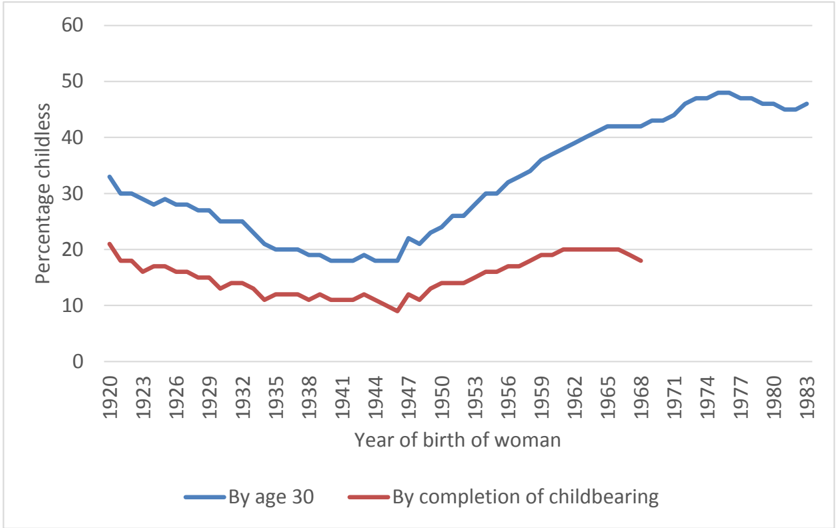
“For the cohorts born in the first half of the 1960s and having completed their childbearing, around 20% of English and Welsh women have not given birth (Berrington 2017).”
BackgroundJiang, Q., Zhang, C., Zhuang, Y., Jiang, Y., & Zhang, X. (2023) · BMJ Open · doi:10.1136/bmjopen-2022-070553 · Cited by 31
Factors shaping the timing of later entry into parenthood: Narratives of choice and constraint
Datta, J., Maxwell, K., Mitchell, K. R., Lewis, R., & Wellings, K. (2023) · Social Sciences & Humanities Open · doi:10.1016/j.ssaho.2023.100700 · Cited by 28
Mynarska, M. A., & Rytel, J. (2017) · Journal of Biosocial Science · doi:10.1017/s0021932017000190 · Cited by 27
“The increasing share of childless women has generated new research and a heated debate on the causes and consequences of having no offspring (Kreyenfeld & Konietzka, 2017).”
BackgroundDelayed Fertility as a Driver of Fertility Decline?
Beaujouan, E. (2023) · The Springer Series on Demographic Methods and Population Analysis · doi:10.1007/978-3-031-29666-6_4 · Cited by 21
Partnership dynamics and entry into parenthood: Comparison of Finnish birth cohorts 1969–2000
Rahnu, L., & Jalovaara, M. (2023) · Advances in Life Course Research · doi:10.1016/j.alcr.2023.100548 · Cited by 27
Infertility as Trauma: Understanding the Lived Experience of Involuntary Childlessness
Archetti, C. (2024) · Culture Medicine and Psychiatry · doi:10.1007/s11013-024-09871-7 · Cited by 29
“Trauma, more specifically psychotrauma, is understood here as anything that overwhelms us emotionally and/or physically and that we are unable to process (Broughton, 2021; Maté & Maté, 2022; Menakem, 2017; Ruppert, 2012, 2016).”
InfluentialLife-Course Trajectories of Childless Women: Country-Specific or Universal?
Tocchioni, V., Rybińska, A., Mynarska, M. A., Matysiak, A., & Vignoli, D. (2022) · European Journal of Population / Revue européenne de Démographie · doi:10.1007/s10680-022-09624-5 · Cited by 19
“At the macrolevel, whilst in some countries childlessness is positively associated with educational level (Berrington, 2017; Berrington et al., 2015), in other settings childlessness is prevalent amongst less-educated women (Miettinen et al., 2015).”
BackgroundWhen public relations can heal: An embodied theory of silence for public communication
Archetti, C. (2021) · Public Relations Inquiry · doi:10.1177/2046147x211014095 · Cited by 19
“…issues, there are countless more individuals who are childless “by circumstance,” as a result of what is often referred to as “social infertility” (Berrington, 2016: 58):4 having been ill during fertile years, the death of a partner, miscarriage, still birth or early infancy death, among many…”
BackgroundEarly-Life Circumstances, Health Behavior Profiles, and Later-Life Health in Great Britain
van den Broek, T. (2020) · Journal of Aging and Health · doi:10.1177/0898264320981233 · Cited by 20
Men’s Explanations for Being Childless; a dynamic perspective
Maříková, H. (2021) · Sociological Research Online · doi:10.1177/13607804211040094 · Cited by 16
“Childlessness thus emerges – as other studies have confirmed (cf. Berrington, 2017) – as the consequence of having chosen to follow a particular life pattern, rather than as the result of some decision made at an easily identified point in time.”
BackgroundResultInfluentialProjecting future utilization of medically assisted fertility treatments
Raymer, J., Guan, Q., Norman, R. J., Ledger, W. J., & Chambers, G. M. (2019) · Population Studies · doi:10.1080/00324728.2019.1676461 · Cited by 14
“The trend towards delayed childbearing in developed countries is associated with increasing rates of age-related infertility, with postponementrelated infertility being a major reason for increasing childlessness (Schmidt et al. 2012; Te Velde et al. 2012; Berrington 2017).”
BackgroundHadley, R. (2019) · Springer eBooks · doi:10.1007/978-3-030-04384-1_3 · Cited by 16
Home-based work and childbearing
Osiewalska, B., Matysiak, A., & Kurowská, A. (2024) · Population Studies · doi:10.1080/00324728.2023.2287510 · Cited by 19
“This downturn in total fertility has been attributed predominantly to a decrease in first-birth rates, further underscoring the UK ’ s position among those countries experiencing high levels of childless-ness (Berrington 2017; Ermisch 2021).”
Reduced reproductive success is associated with selective constraint on human genesPreprint
Gardner, E. J., Neville, M. D. C., Samocha, K. E., Barclay, K. J., Kolk, M., Niemi, M., Kirov, G., Martin, H. C., & Hurles, M. E. (2020) · bioRxiv (Cold Spring Harbor Laboratory) · doi:10.1101/2020.05.26.116111 · Cited by 12
Dimitrova, E., & Kotzeva, T. (2022) · Social Inclusion · doi:10.17645/si.v10i3.5065 · Cited by 21
“Discussing the differences in the definitions of this phe‐ nomenon, Berrington (2017) emphasizes the distinction between individuals who are involuntary childless due to different biomedical reasons and voluntary childless‐ ness as a social inability to become a parent.”
BackgroundTippett, A. (2023) · Human Fertility · doi:10.1080/14647273.2022.2164746 · Cited by 10
“The mean age of entry into parenthood has increased in the UK, with more couples delaying childbearing contributing to the issue of declining reproductive capacity (Berrington, 2017).”
Kuang, B., Berrington, A. M., Vasireddy, S., & Kulu, H. (2025) · Demographic Research · doi:10.4054/demres.2025.52.7 · Cited by 26
Self-citationKuang, B., Berrington, A. M., Christison, S., & Kulu, H. (2024) · Demographic Research · doi:10.4054/demres.2024.51.36 · Cited by 11
“In most reviews of European trends in childbearing, the United Kingdom is described as a country with average-to-high levels of fertility (Wood, Neels, and Kil 2014; Vignoli et al. 2020) and yet it also exhibits relatively high levels of childlessness (Berrington 2017).”
Self-citationЛомакин, И. В. (2019) · Monitoring obŝestvennogo mneniâ: èkonomičeskie i socialʹnye peremeny · doi:10.14515/monitoring.2019.6.20 · Cited by 20
Coping strategies for happy childless ageing: an explorative study in Poland
Abramowska-Kmon, A., Mynarska, M. A., & Timoszuk, S. (2023) · Genus · doi:10.1186/s41118-022-00180-8 · Cited by 13
“Specifically, there is evidence that men with lower socio-economic status as well as women with higher socio-economic status are more likely to remain childless (Berrington, 2017; Dykstra & Hagestad, 2007a, 2007b).”
BackgroundMynarska, M. A., & Brzozowska, Z. (2022) · Social Inclusion · doi:10.17645/si.v10i3.5377 · Cited by 10
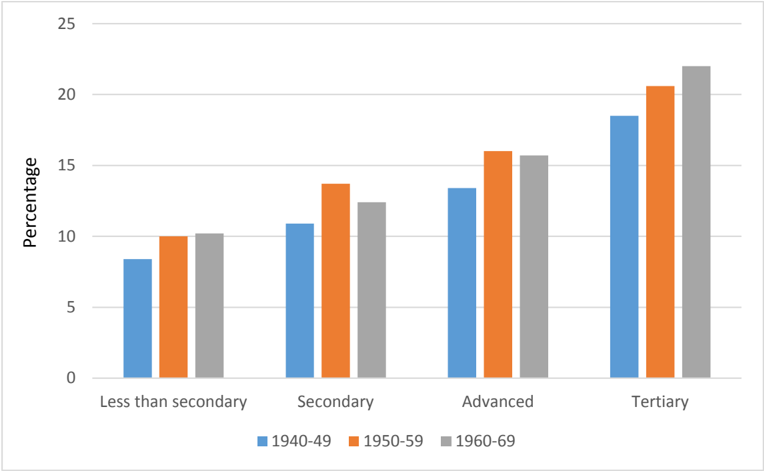
“…gradient in childlessness: Highly educated women are at higher risk of remaining childless than their lower educated peers, be it due to fertility postponement or because they are less family‐oriented (Berrington, 2017; Keizer et al., 2008; Tanturri & Mencarini, 2008; Wood et al., 2014).”
BackgroundMeasuring attitudes towards voluntary childlessness: Indicators in European comparative surveys
Szalma, I., Heers, M., & Tanturri, M. L. (2025) · PLoS ONE · doi:10.1371/journal.pone.0319081 · Cited by 22
“However, it is frequently caused by a continuous sequence of postponements in childbearing [18].”
Understanding the sex inequality in childlessness: an approach using Swedish register data
Chudnovskaya, M., & Ueda, P. (2021) · Journal of Biosocial Science · doi:10.1017/s0021932021000638 · Cited by 11
When Family Policy Doesn’t Work: Motives and Welfare Attitudes Among Childfree Persons in Poland
Szelewa, D. (2022) · Social Inclusion · doi:10.17645/si.v10i3.5504 · Cited by 11
“Among the reasons for childlessness, the literature points to such circumstances as the inability to find a suitable partner (Berrington, 2017; Szalma, 2021; Waren & Pals, 2013) or orientation toward professional work (Hakim, 2003).”
BackgroundInfluentialLeocádio, V. A., Verona, A. P., & de Miranda-Ribeiro, A. (2022) · Population Research and Policy Review · doi:10.1007/s11113-022-09725-3 · Cited by 11
“The percentage is 18% in the United Kingdom (Berrington, 2017), and almost 20% in both Italy and Spain (Miettinen et al., 2015; Reher & Requena, 2018).”
BackgroundChwastek, A., & Mynarska, M. A. (2024) · Journal of Reproductive and Infant Psychology · doi:10.1080/02646838.2024.2316317 · Cited by 13
“The postponement of childbearing might then lead to permanent childlessness, as women reach an age when conceiving a child becomes problematic (Berrington, 2017; Schmidt et al., 2012).”
Partnership trajectories preceding medically assisted reproduction
Pelikh, A., Remes, H. M., Metsä‐Simola, N., & Goisis, A. (2023) · Population Studies · doi:10.1080/00324728.2023.2215213 · Cited by 8
“At the same time, the proportions of never-partnered individuals and single parents have both remained stable (Jalovaara and Fasang 2015, 2017; Official Statistics of Finland 2021).”
Scenarios of Delayed First Births and Associated Cohort Fertility Levels
Winkler‐Dworak, M., Pohl, M., & Beaujouan, É. (2024) · Demography · doi:10.1215/00703370-11315685 · Cited by 8
Childlessness and Elderly Care in Asia: Shortcomings and Gaps in Law and Policy
Menon, R. J., & Gangopadhyay, J. (2024) · Springer eBooks · doi:10.1007/978-981-16-1914-4_266-1 · Cited by 4
Perez, C. (2021) · Advances in Life Course Research · doi:10.1016/j.alcr.2021.100414 · Cited by 6
Why do Polish Women Want to Stay Childless? Analysis of Voluntary Childlessness Motives
Wilak, J. (2023) · Prace Naukowe Uniwersytetu Ekonomicznego we Wrocławiu · doi:10.15611/pn.2023.3.12 · Cited by 4
Las trayectorias de las mujeres sin hijos en Uruguay
Pardo, I., Cabella, W., & Nathan, M. (2020) · Revista Brasileira de Estudos de População · doi:10.20947/s0102-3098a0115 · Cited by 11
Verkroost, F. C. J. (2022) · Journal of the Royal Statistical Society Series A (Statistics in Society) · doi:10.1111/rssa.12917 · Cited by 3
“Although some individuals make an active decision not to have children or are biologically unable to have children (Berrington, 2017), permanent childlessness most often entails a process of ‘a sequence of socially defined events and roles that the individual enacts over time’ (Abbott, 2005, p. 22;…”
BackgroundInfluentialMogi, R., Mugiyama, R., & Alderotti, G. (2024) · Journal of Family Research · doi:10.20377/jfr-953 · Cited by 4
“…one of the main obstacles to the realisation of fertility desires (Esteve et al., 2021; Testa, 2007) and one of the key reasons for remaining childless in these “very-low” fertility countries (Berrington, 2017; National Institute of Population and Social Security Research; NIPPSR hereafter, 2017).”
BackgroundChildlessness and women’s work trends in East and West Germany
Kreyenfeld, M. R., & Konietzka, D. (2017) · Travail genre et sociétés · doi:10.3917/tgs.037.0053 · Cited by 3
Childlessness and Economic Development: A Survey
Baudin, T., de la Croix, D., & Gobbi, P. E. (2019) · Springer eBooks · doi:10.1007/978-3-030-21599-6_3 · Cited by 3
“Berrington (2017) documents a positive educational gradient of childlessness among English women aged 40–49 born between 1940 and 1969.”
BackgroundChandler, L., & Tasker, F. (2024) · LGBTQ+ Family An Interdisciplinary Journal · doi:10.1080/27703371.2024.2394153 · Cited by 2
“…sometimes parallel those given in mainstream research studies on the general population: not wanting to have children, or postponing decision making on parenthood due to not having met a suitable partner to co-parent with, or to a lesser extent for financial or career reasons (Berrington, 2017).”
Parenthood and self-fulfilment: does having children matter to Italian young-adults?
Luppi, F., Rosina, A., & Testa, M. R. (2025) · Genus · doi:10.1186/s41118-025-00272-1 · Cited by 3
Jalovaara, M., & Miettinen, A. (2025) · Population Studies · doi:10.1080/00324728.2025.2592578 · Cited by 5
“Rather, many individuals wish to have children but repeatedly make choices or face constraints that lead to a continuous postponement of parent-hood (Berrington 2017).”
Crawford, O., McKenna-Plumley, P. E., Millar, R., & Gerlach, T. M. (2026) · Journal of Social and Personal Relationships · doi:10.1177/02654075261420845 · Cited by 4
“Demographic trends also demonstrate an increase in the number of individuals not expecting or intending to have children (e.g., Berrington, 2017), and a trend of delaying parenthood, with women increasingly having children in their thirties rather than their twenties (ONS, 2024).”
Prince, C., Howe, L. D., Sanderson, E. C. M., Sharp, G. C., Fraser, A., Lloyd‐Lewis, B., & Richmond, R. C. (2025) · BMC Medicine · doi:10.1186/s12916-025-04375-6 · Cited by 4
“As more women are choosing not to have children [34], or having children later in life [35], it is important to understand how these traits might convey different risk depending on subtype.”
A Legal Maternal Wall? No Revolution in Motherhood for Women Lawyers in England
Guyard-Nedelec, A. (2018) · Revue française de civilisation britannique · doi:10.4000/rfcb.1859 · Cited by 2
Infertility clinics and acupuncture: a qualitative web-based study
Magee, B., & Smith, K. R. (2023) · Journal of Assisted Reproduction and Genetics · doi:10.1007/s10815-023-02898-6 · Cited by 2
The Role of Culture in Negotiating Reproductive Rights of Diaspora Heterosexual Nigerian Women
Anizoba, E. L., & Davis, S. J. (2019) · Feminist Encounters A Journal of Critical Studies in Culture and Politics · doi:10.20897/femenc/5922 · Cited by 2
“However, Berrington (2017) observes that there are an increasing number of UK women who are making the choice to be childless, a trend which is very rare in Nigeria regardless of marital status.”
BackgroundQuinn, M., Shepperd, S., & Floud, S. (2025) · Age and Ageing · doi:10.1093/ageing/afaf279 · Cited by 1
“Demographic changes such as a falling birth rate and longer working lives with rising pensionable age may also impact informal care availability and result in a care deficit [54, 55].”
Dating apps as tools for social engineering
Beckstein, M., & de Vries, B. (2024) · Ethics and Information Technology · doi:10.1007/s10676-024-09817-y · Cited by 3
“…(Pearce et al., 2018), not being able to find the right partner or finding them at an age where it has become difficult, if not impossible, to conceive has been shown to be one major cause of involuntary childlessness in contemporary Western societies (e.g. Berrington, 2017; Stone, 2020).”
Williamson, L. E. (2019) · HARVEST (University of Saskatchewan) · Cited by 4
Prince, C., Howe, L. D., Sanderson, E. C. M., Sharp, G. C., Fraser, A., Lloyd‐Lewis, B., & Richmond, R. C. (2024) · medRxiv · doi:10.1101/2024.02.02.24301815 · Cited by 1
An Overview on Low Fertility Motivations among Italian Young-AdultsPreprint
Luppi, F., Rosina, A., & Testa, M. R. (2024) · SocArXiv (OSF Preprints) · doi:10.31235/osf.io/hf78t · Cited by 3
A gyermektelenség mintázatai magyar férfiak körében: egy interjús vizsgálat folytatása
Szalma, I., & Judit, T. (2018) · Szociológiai szemle · doi:10.51624/szocszemle.2018.3.4 · Cited by 6
Szabó, L. (2021) · Demográfia · doi:10.21543/dee.2020.1 · Cited by 1
Pelikh, A., Remes, H. M., Metsä‐Simola, N., & Goisis, A. (2023) · SocArXiv (OSF Preprints) · doi:10.31235/osf.io/besvu
Exploring Non-Motherhood: Analysis of Perceived Factors in Feminist Women, Mothers, and Non-Mothers
Migal, R. M. M., Hernández, M. M., & Garrido, Á. A. (2025) · Sexes · doi:10.3390/sexes6020029
Childlessness and Elderly Care in Asia: Shortcomings and Gaps in Law and Policy
Menon, R. J., & Gangopadhyay, J. (2025) · Springer eBooks · doi:10.1007/978-981-99-7842-7_266
Dating Apps and the Right to an Explanation
de Vries, B., & Barman, K. G. (2025) · Journal of Applied Philosophy · doi:10.1111/japp.70061 · Cited by 1
The Role of Socio-Economic Development and Higher Education in Fertility Decline in Turkiye
Doğan, E. (2026) · Habitus toplumbilim dergisi · doi:10.62156/habitus.1881349
Tomkinson, J. (2018) · theses.fr (ABES) · doi:10.70675/d3c119b8zdd36z448ezadffz93ecff69e5a4 · Cited by 2
The Rise of Zero Fertility Desire in China
Xu, X. (2026) · Population Research and Policy Review · doi:10.21203/rs.3.rs-8921502/v1
Social parenting and childlessness in Norway: Associations by sex and economic uncertainty
Kristensen, A. P., & Lappegård, T. (2026) · Population Studies · doi:10.1080/00324728.2026.2649772
The rise of male childlessness in Spain: a cohort analysisPreprint
Juni, M., & Requena, M. (2026) · Research Square · doi:10.21203/rs.3.rs-10163768/v1
Fitzmaurice, M. W. (2026) · Dialogues in Human Geography · doi:10.1177/20438206261479813
Ermisch, J. (2026) · Demographic Research · doi:10.4054/demres.2026.55.15
Metadata
- Authors
- Berrington, A.
- Affiliations
- University of Southampton (GB)
- Corresponding author
- Berrington, Ann
- ORCID
- Berrington, Ann
- Venue
- Demographic Research Monographs
- Publisher
- Springer International Publishing
- Published
- 2017
- Pages
- 57-76
- ISSN
- 1613-5520 (ISSN-L)
- 2197-9286
- OpenAlex
- W1961952606
- Cited by
- 80
- References
- 47
- Citations by year
- 2026: 7 · 2025: 9 · 2024: 11 · 2023: 10 · 2022: 10 · 2021: 7 · 2020: 6 · 2019: 12 · 2018: 5 · 2017: 3
- FWCI
- 55.37
- Type
- book chapter
- Language
- en
- Open access
- hybrid
- doi.org
- Locations
- Demographic research monographs (publishedVersion, cc-by)
- ePrints Soton (University of Southampton) (acceptedVersion)
- ePrints Soton (University of Southampton) (submittedVersion)
- Funders
- University of Essex
- Economic and Social Research Council (ES/K007394/1)
- Topics
- Social Sciences › Demography › Family Dynamics and Relationships
- Health Sciences › Medicine › Reproductive Medicine › Reproductive Health and Technologies
- Health Sciences › Medicine › Public Health, Environmental and Occupational Health › Reproductive Health and Contraception
- Keywords
- childlessness, fertility intentions, educational gradient, birth cohort, life course, British Cohort Study, partnership history, postponement of childbearing, female fertility, United Kingdom
About these checks
Registry, retraction, Cites and statistics results are computed, not judged, with one exception: a printed reference that no index lists is read once by a model before it counts as a citation error. Claims are extracted by a model and kept only when their quote appears verbatim in the text; each cited source is then checked, with a model’s help, for whether it says what the claim relies on. Those verdicts can be wrong — read the claim’s quote and the cited source before relying on one.
Statistics and arithmetic are recomputed, not judged.
Confidence bands are shown only for fields calibrated on our annotated test set. None is calibrated yet, so no band is shown.
What counts as a claim ›How we measure confidence ›How we check this ›
Are you an author, or do you see a problem with this page? Request a review
Data sources
Bibliographic data: Semantic Scholar, OpenAlex, Crossref.
Contains information from the Semantic Scholar Academic Graph Datasets, made available under the ODC Attribution License (ODC-BY 1.0).
Semantic Scholar’s data is described in: Kinney, R., et al. (2023). The Semantic Scholar Open Data Platform. arXiv:2301.10140.
