

Charting GLOBs in asymptotically safe gravity
Open accessThe DOI matches its Crossref record; 251 of the 251 references it cites were found in a registry or an index; 35 of the 69 sources its claims cite were checked for support.
Abstract
Computing the gravitational effective action provides a direct route to charting the landscape of admissible black hole spacetimes. We identify the unique ultraviolet-complete trajectory emanating from the asymptotically safe fixed point. Quantum gravity can constrain effective field theory and the associated set of allowed spacetimes, yielding a rich landscape of beyond-general-relativity solutions.
Overview
CoChat Summary
TL;DR
The paper gives a proof of principle that asymptotically safe quantum gravity can constrain the Einstein-Weyl effective action and the resulting phase diagram of gravitationally localized objects (GLOBs). Using the unique UV-complete trajectory from the non-Gaussian fixed point, it predicts the Weyl-squared Wilson coefficient and finds wormholes favored while Bachian attractive naked singularities are disfavored.
Key findings
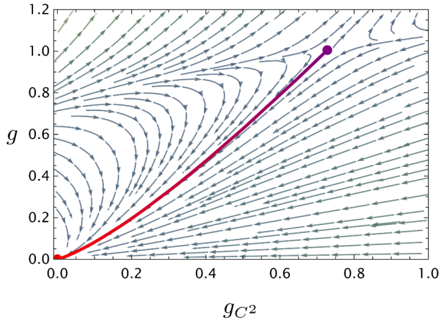
- The projected Einstein-Weyl RG flow has a non-Gaussian fixed point \((g^*, g_{C^2}^*)_{\rm NGFP}=(1.0053,0.7277)\), with critical exponents \(\theta_1=2.6165\) and \(\theta_2=-0.9365\), making it a saddle point with one relevant direction.
- The unique UV-complete trajectory predicts the Weyl-squared Wilson coefficient \(G_{C^2}=0.5092\,m_{\rm Pl}^{-2}\), corresponding to \(m^2=1.4013\,m_{\rm Pl}\); the paper states this leaves zero free parameters in the asymptotic safety landscape.
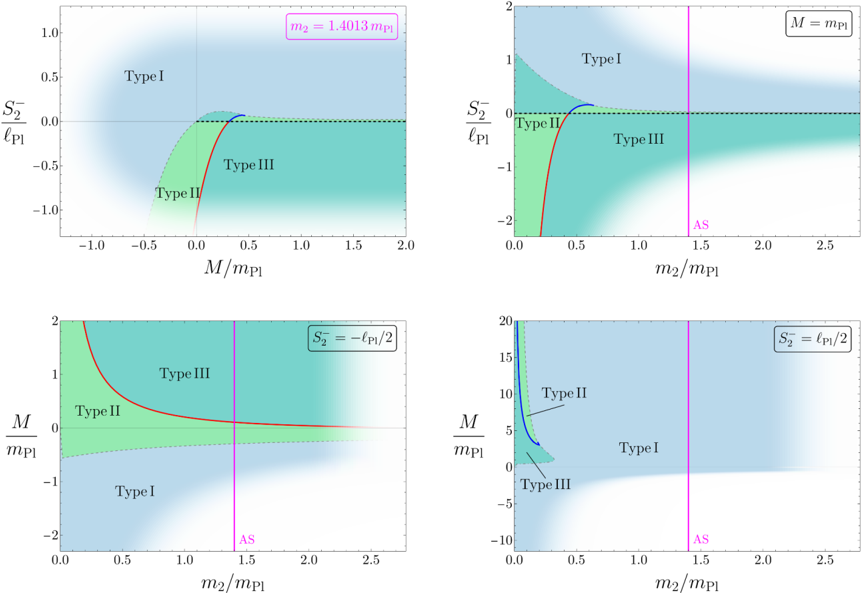
- In the resulting GLOB phase diagram, wormholes dominate a large portion, Type-III non-symmetric wormholes are favored by \(S^{-2}<0\), repulsive naked singularities by \(S^{-2}>0\), and Type-II attractive (Bachian) naked singularities are generically disfavored, especially at large masses.
- Black holes appear in zero-measure regions: the Schwarzschild and non-Schwarzschild lines cross at \(m^2 G_N M=m^2 r_H/2\simeq 0.438\) with \(m^2 S^{-2}=0\), and end at a massive triple point \(m^2 G_N M_{\rm mtp}\simeq 0.626\), \(m^2 S^{-2}_{\rm mtp}\simeq 0.097\).
Methods
- The authors use FRG beta functions from prior work, projected onto the Einstein-Weyl subspace \(\{G_N,G_{C^2}\}\) by setting the cosmological constant and Ricci-squared couplings to zero; they find fixed points, compute the stability matrix, critical exponents, and eigenvectors, and identify the unique UV-complete trajectory connecting the NGFP to the Gaussian fixed point.
- They integrate the flow, subtract the logarithmic IR running with \(k_0=m_{\rm Pl}\), \(g_{\rm IR}=1\), and slope \(b=0.5358\), extracting \(G_{C^2}\) and then overlaying the ASQG prediction for \(m^2\) onto the classical Einstein-Weyl phase diagram.
- The classical phase diagram is based on static, spherically symmetric vacuum Einstein-Weyl solutions, using the weak-field expansion and the classification of GLOBs from prior work, with new consistency conditions derived for the validity of the asymptotic analysis.
Limitations
- The paper states that all solutions considered present a singularity; this is not necessarily a problem of ASQG but an expected outcome of the chosen truncation, since Einstein-Weyl and quadratic gravity are not expected to resolve singularities. It calls for extending the analysis to higher operators, including \(\mathcal{R}^3\) and the Goroff-Sagnotti counterterm, and notes that a complete classification of all classical solutions in such theories is still missing.
- The definition of Wilson coefficients in the presence of logarithmic running is stated to remain ambiguous; the prescription depends on \(k_0\) and \(g_{\rm IR}\), and a rigorous definition is left for future work. The qualitative picture remains robust for \(k_0\gtrsim 10^{-1}m_{\rm Pl}\), and \(G_{C^2}\) remains positive for \(\xi\ge 0.15\) when \(k_0=\xi m_{\rm Pl}\), but below \(\xi\simeq 0.15\) it becomes negative and invalidates the analysis.
- The weak-field consistency conditions limit the reliable phase-diagram region to Planckian-sized deviations from the Schwarzschild line, \(S^{-2}/\ell_{\rm Pl}\sim\mathcal{O}(1)\); the paper describes this as a computational limitation rather than a physical constraint, and marks white regions where the prior analysis is not applicable. It also notes that the phase-diagram analogy is pictorial and that transitions between phases remain unclear.
Model-written summary. Check it against the paper before relying on it.
Integrity signals
Registry
Cites
Statistics
Figures




Verification
Claims the paper makes
27 Valid · 8 Not valid · 15 Not checked · 69 Own results and interpretations
The cited sources support only part of this claim — read each source’s verdict below.
In the paper
“This truncation is particularly instructive, as all asymptotically flat black hole solutions of the general quadratic action are also solutions of the classical Einstein-Weyl theory [101,112].”
§ Charting GLOBs in asymptotically safe gravity > 1 Introduction
What the sources say
- Partly supportedcites [101] H. Lü, A. Perkins, C.N. Pope and K.S. Stelle, Black Holes in Higher-Derivative Gravity, Phys. Rev. Lett. 114 (2015) 171601 [arXiv:1502.01028] [INSPIRE]. sourceExperimental — accuracy not yet measured
On p. 2, the paper says that any static black-hole solution of the general quadratic action has vanishing Ricci scalar, so the R-squared term does not contribute and one can study pure Einstein-Weyl gravity. The citing sentence omits the static restriction and extends the conclusion to all asymptotically flat black-hole solutions, which this passage does not establish. (LLM, conf=0.87)
- Could not verifycites [112] W. Nelson, Static Solutions for 4th order gravity, Phys. Rev. D 82 (2010) 104026 [arXiv:1010.3986] [INSPIRE]. sourceExperimental — accuracy not yet measured
Our copy of Nelson (2010) never mentions the Einstein-Weyl (conformal/Weyl-squared) theory as a theory whose solution set contains the quadratic-action black holes; the conformal special case alpha = 3 beta giving the Bach-Einstein equations appears only as background literature in the Introduction (p. 2, citing [14]-[20]). What the paper does establish is different in kind and narrower in scope: Theorem IV.1 (Sec. IV, p. 11) and the Conclusions (p. 14) show that the static, asymptotically flat, spherically symmetric black-hole solution of 4th order gravity is uniquely Schwarzschild (R_ab = 0), and only for alpha = 0 with alpha - 3 beta >= 0 and under the spatial-curvature bounds - not for the 'general quadratic action' and not relative to Einstein-Weyl theory. Sec. V (p. 12) states the analogous inclusion only between GR vacuum solutions and 4th order gravity. Searches: 'Einstein-Weyl', 'conformal gravity Weyl tensor squared Bach equations', 'solutions also solutions of another theory Ricci-flat'. (LLM, conf=0.62)
plainstates an association- Asserted: passes — The authors put it forward as true.
- Checkable: passes — It can be checked against evidence.
- Load-bearing: passes — The paper’s conclusions depend on it.
- Based: passes — The paper gives a reason why it holds.
- Partly supported
The cited sources support only part of this claim — read each source’s verdict below.
In the paper
“In this case, black holes can only have non-Schwarzschild metrics and negative masses.”
§ Charting GLOBs in asymptotically safe gravity > Type III exotic solutions: non-symmetric wormholes [102, 107-109].
What the sources say
- Partly supportedcites [107] S. Silveravalle and A. Zuccotti, Phase diagram of Einstein-Weyl gravity, Phys. Rev. D 107 (2023) 064029 [arXiv:2210.13877] [INSPIRE]. sourceExperimental — accuracy not yet measured
The Conclusions (p. 9) place Schwarzschild black holes at zero Yukawa charge, supporting the non-Schwarzschild part of the claim for negative charge. They place the non-Schwarzschild black-hole curve in both the small-mass and negative-mass regions, but do not establish that black holes at large negative Yukawa charge must have negative mass. (LLM, conf=0.83)
plainstates a cause- Asserted: passes — The authors put it forward as true.
- Checkable: passes — It can be checked against evidence.
- Load-bearing: passes — The paper’s conclusions depend on it.
- Based: passes — The paper gives a reason why it holds.
- Partly supported
The cited sources support only part of this claim — read each source’s verdict below.
In the paper
“All solutions with positive mass correspond to non-symmetric wormholes”
§ Charting GLOBs in asymptotically safe gravity > Type III exotic solutions: non-symmetric wormholes [102, 107-109].
What the sources say
- Partly supportedcites [107] S. Silveravalle and A. Zuccotti, Phase diagram of Einstein-Weyl gravity, Phys. Rev. D 107 (2023) 064029 [arXiv:2210.13877] [INSPIRE]. sourceExperimental — accuracy not yet measured
The Conclusions (p. 9) place non-symmetric wormholes in the negative-Yukawa-charge region for arbitrarily large positive mass. But the Phase Diagram section (p. 7) limits that pattern to large masses and says that, at small positive mass, type II solutions occur with negative Yukawa charge. The paper therefore does not support 'all solutions with positive mass,' even with the stated large-negative-charge qualifier. (LLM, conf=0.86)
plainstates an association- Asserted: passes — The authors put it forward as true.
- Checkable: passes — It can be checked against evidence.
- Load-bearing: passes — The paper’s conclusions depend on it.
- Based: passes — The paper gives a reason why it holds.
- Partly supported
The cited sources support only part of this claim — read each source’s verdict below.
In the paper
“small positive Yukawa charges (0 < S - 2 ≪ 1/m 2 ) yield attractive naked singularities.”
§ Charting GLOBs in asymptotically safe gravity > Type III exotic solutions: non-symmetric wormholes [102, 107-109].
What the sources say
- Partly supportedcites [107] S. Silveravalle and A. Zuccotti, Phase diagram of Einstein-Weyl gravity, Phys. Rev. D 107 (2023) 064029 [arXiv:2210.13877] [INSPIRE]. sourceExperimental — accuracy not yet measured
The Conclusions (p. 9) identify small positive Yukawa charge with a type II attractive naked singularity, but explicitly place this finding in the large positive-mass regime. The Phase Diagram section (p. 7) describes different solutions in the small-mass region, and the available text does not state the specific bound S₋₂ ≪ 1/m². The claim omits the mass condition and gives a quantitative bound the source does not establish. (LLM, conf=0.86)
plainstates a cause- Asserted: passes — The authors put it forward as true.
- Checkable: passes — It can be checked against evidence.
- Load-bearing: passes — The paper’s conclusions depend on it.
- Based: passes — The paper gives a reason why it holds.
- Partly supported
Every source the paper cites for this claim was checked and supports it.
In the paper
“for negative masses, the solutions correspond to wormholes, attractive naked singularities, and repulsive naked singularities, respectively, as the absolute value of the mass increases.”
§ Charting GLOBs in asymptotically safe gravity > Type III exotic solutions: non-symmetric wormholes [102, 107-109].
What the sources say
- Supportedcites [107] S. Silveravalle and A. Zuccotti, Phase diagram of Einstein-Weyl gravity, Phys. Rev. D 107 (2023) 064029 [arXiv:2210.13877] [INSPIRE]. source
The phase-diagram discussion (Section IV, p. 7) says that for negative masses and negative Yukawa charge, wormholes occur at the smallest absolute masses, type II solutions at larger values, and type I solutions beyond those. The descriptions of type II (pp. 4–5) and type I (p. 4), together with the Conclusions (p. 9), identify them as attractive and repulsive naked singularities, respectively. (LLM, conf=0.90)
plainstates a cause- Asserted: passes — The authors put it forward as true.
- Checkable: passes — It can be checked against evidence.
- Load-bearing: passes — The paper’s conclusions depend on it.
- Based: passes — The paper gives a reason why it holds.
- Supported
58 more claims · 13 with their cited sources checked
Create a free account to see all 119 claims and to verify the 21 references still open.
- Probably not a substantial claim. 22
- It may state two separate claims as one. 43
- The quote only partly states this claim. 1
Citations
Cites
Items 201–251 of 251
Towards a Non-singular Paradigm of Black Hole Physics
Carballo-Rubio, R., Filippo, F. D., Liberati, S., et al. (2025) · arXiv · doi:10.48550/arxiv.2501.05505
Formation and evaporation of non-singular black holes
Hayward, S. A. (2005) · arXiv · doi:10.48550/arxiv.gr-qc/0506126
Rovelli, C. (1997) · arXiv · doi:10.48550/arxiv.gr-qc/9710008
A Short Review of Loop Quantum Gravity
Ashtekar, A., & Bianchi, E. (2021) · arXiv · doi:10.48550/arxiv.2104.04394
Quantum Gravity from Causal Dynamical Triangulations: A Review
Loll, R. (2019) · arXiv · doi:10.48550/arxiv.1905.08669
The nonperturbative functional renormalization group and its applications
Dupuis, N., Canet, L., Eichhorn, A., et al. (2020) · arXiv · doi:10.48550/arxiv.2006.04853
Renormalization group fixed points of foliated gravity-matter systems
Biemans, J., Platania, A., & Saueressig, F. (2017) · arXiv · doi:10.48550/arxiv.1702.06539
Self-citationThe Asymptotically Safe Standard Model: From quantum gravity to dynamical chiral symmetry breaking
Pastor-Gutiérrez, Á., Pawlowski, J. M., & Reichert, M. (2022) · arXiv · doi:10.48550/arxiv.2207.09817
Curvature dependence of quantum gravity
Christiansen, N., Falls, K., Pawlowski, J. M., et al. (2017) · arXiv · doi:10.48550/arxiv.1711.09259
Asymptotic safety of quantum gravity beyond Ricci scalars
Falls, K. G., King, C. R., Litim, D. F., et al. (2018) · arXiv · doi:10.48550/arxiv.1801.00162
Functional Renormalisation for $f(R_{μνρσ})$ Quantum Gravity
Kluth, Y., & Litim, D. F. (2022) · arXiv · doi:10.48550/arxiv.2202.10436
Further evidence for asymptotic safety of quantum gravity
Falls, K., Litim, D. F., Nikolakopoulos, K., et al. (2014) · arXiv · doi:10.48550/arxiv.1410.4815
Fixed Points of Quantum Gravity and the Dimensionality of the UV Critical Surface
Kluth, Y., & Litim, D. (2020) · arXiv · doi:10.48550/arxiv.2008.09181
Field Parametrization Dependence in Asymptotically Safe Quantum Gravity
Nink, A. (2014) · arXiv · doi:10.48550/arxiv.1410.7816
Generalized Parametrization Dependence in Quantum Gravity
Gies, H., Knorr, B., & Lippoldt, S. (2015) · arXiv · doi:10.48550/arxiv.1507.08859
Correlation functions on a curved background
Knorr, B., & Lippoldt, S. (2017) · arXiv · doi:10.48550/arxiv.1707.01397
Asymptotic safety and field parametrization dependence in the f(R) truncation
de Brito, G. P., Ohta, N., Pereira, A. D., et al. (2018) · arXiv · doi:10.48550/arxiv.1805.09656
Asymptotically Safe Lorentzian Gravity
Manrique, E., Rechenberger, S., & Saueressig, F. (2011) · arXiv · doi:10.48550/arxiv.1102.5012
Quantum gravity on foliated spacetime - asymptotically safe and sound
Biemans, J., Platania, A., & Saueressig, F. (2016) · arXiv · doi:10.48550/arxiv.1609.04813
Self-citationKnorr, B. (2018) · arXiv · doi:10.48550/arxiv.1810.07971
Lorentz invariance violations in the interplay of quantum gravity with matter
Eichhorn, A., Platania, A., & Schiffer, M. (2019) · arXiv · doi:10.48550/arxiv.1911.10066
Self-citationBonanno, A., Denz, T., Pawlowski, J. M., et al. (2021) · arXiv · doi:10.48550/arxiv.2102.02217
The spatial Functional Renormalization Group and Hadamard states on cosmological spacetimes
Banerjee, R., & Niedermaier, M. (2022) · arXiv · doi:10.48550/arxiv.2201.02575
Self-consistent graviton spectral function in Lorentzian quantum gravity
Pawlowski, J. M., Reichert, M., & Wessely, J. (2025) · arXiv · doi:10.48550/arxiv.2507.22169
Non-perturbative propagators in quantum gravity
Knorr, B., & Schiffer, M. (2021) · arXiv · doi:10.48550/arxiv.2105.04566
Asymptotic safety, quantum gravity, and the swampland: a conceptual assessment
Basile, I., Knorr, B., Platania, A., et al. (2025) · arXiv · doi:10.48550/arxiv.2502.12290
Self-citationUpper bound on the Abelian gauge coupling from asymptotic safety
Eichhorn, A., & Versteegen, F. (2017) · arXiv · doi:10.48550/arxiv.1709.07252
Asymptotic safety, string theory and the weak gravity conjecture
de Alwis, S., Eichhorn, A., Held, A., et al. (2019) · arXiv · doi:10.48550/arxiv.1907.07894
Cosmological $α'$-corrections from the functional renormalization group
Basile, I., & Platania, A. (2021) · arXiv · doi:10.48550/arxiv.2101.02226
Self-citationString Tension between de Sitter vacua and Curvature Corrections
Basile, I., & Platania, A. (2021) · arXiv · doi:10.48550/arxiv.2103.06276
Self-citationRenormalization group flows in area-metric gravity
Borissova, J., Dittrich, B., Eichhorn, A., et al. (2025) · arXiv · doi:10.48550/arxiv.2507.02034
Renormalization group improved black hole spacetimes
Bonanno, A., & Reuter, M. (2000) · arXiv · doi:10.48550/arxiv.hep-th/0002196
Asymptotic Safety, Singularities, and Gravitational Collapse
Casadio, R., Hsu, S. D. H., & Mirza, B. (2010) · arXiv · doi:10.48550/arxiv.1008.2768
Black holes and asymptotically safe gravity
Falls, K., Litim, D. F., & Raghuraman, A. (2010) · arXiv · doi:10.48550/arxiv.1002.0260
Structural aspects of asymptotically safe black holes
Koch, B., & Saueressig, F. (2013) · arXiv · doi:10.48550/arxiv.1306.1546
Gravitational collapse in Quantum Einstein Gravity
Bonanno, A., Koch, B., & Platania, A. (2017) · arXiv · doi:10.48550/arxiv.1710.10845
Self-citationNon-Singular Black Holes, the Cosmological Constant and Asymptotic Safety
Torres, R. (2017) · arXiv · doi:10.48550/arxiv.1703.09997
Towards conditions for black-hole singularity-resolution in asymptotically safe quantum gravity
Adeifeoba, A., Eichhorn, A., & Platania, A. (2018) · arXiv · doi:10.48550/arxiv.1808.03472
Self-citationAsymptotic safety casts its shadow
Held, A., Gold, R., & Eichhorn, A. (2019) · arXiv · doi:10.48550/arxiv.1904.07133
Dynamical renormalization of black-hole spacetimes
Platania, A. (2019) · arXiv · doi:10.48550/arxiv.1903.10411
Self-citationGravitational antiscreening in stellar interiors
Bonanno, A., Casadio, R., & Platania, A. (2019) · arXiv · doi:10.48550/arxiv.1910.11393
Self-citationFormation and evaporation of quantum black holes from the decoupling mechanism in quantum gravity
Borissova, J. N., & Platania, A. (2022) · arXiv · doi:10.48550/arxiv.2210.01138
Self-citationSifting quantum black holes through the principle of least action
Knorr, B., & Platania, A. (2022) · arXiv · doi:10.48550/arxiv.2202.01216
Self-citationDust collapse and horizon formation in Quadratic Gravity
Buoninfante, L., Filippo, F. D., Kolář, I., et al. (2024) · arXiv · doi:10.48550/arxiv.2410.05941
Matter matters in asymptotically safe quantum gravity
Donà, P., Eichhorn, A., & Percacci, R. (2013) · arXiv · doi:10.48550/arxiv.1311.2898
Black holes in an asymptotically safe gravity theory with higher derivatives
Cai, Y.-F., & Easson, D. A. (2010) · arXiv · doi:10.48550/arxiv.1007.1317
Black hole thermodynamics under the microscope
Falls, K., & Litim, D. F. (2012) · arXiv · doi:10.48550/arxiv.1212.1821
Quantum Improved Schwarzschild-(A)dS and Kerr-(A)dS Space-times
Pawlowski, J. M., & Stock, D. (2018) · arXiv · doi:10.48550/arxiv.1807.10512
Quantum improved charged black holes
Ishibashi, A., Ohta, N., & Yamaguchi, D. (2021) · arXiv · doi:10.48550/arxiv.2106.05015
Dust collapse in asymptotic safety: a path to regular black holes
Bonanno, A., Malafarina, D., & Panassiti, A. (2023) · arXiv · doi:10.48550/arxiv.2308.10890
Research works printed but not linked: 2
- S. Weinberg, Ultraviolet Divergences in Quantum Theories of Gravitation, in General Relativity: An Einstein Centenary Survey, W. Israel and S. W. Hawking eds., Cambridge University Press (1980), p. 790–831 [INSPIRE].
- S.M. Silveravalle, Isolated Objects in Quadratic Gravity: From Action Principles to Observations, Ph.D. thesis, Trento University, I-38123 Povo (TN), Italy (2024) [INSPIRE].
Cited by
Black Holes in Asymptotic Safety: A Review of Solutions and Phenomenology
Spina, A. (2025) · International Journal of Gravitation and Theoretical Physics · doi:10.53941/ijgtp.2025.100008 · Cited by 21
“Furthermore, the chosen truncation of the effective action can limit the type of solutions and their properties (see [85] for a recent exploration with Einstein-Weyl truncation).”
Asymptotically (un)safe scattering amplitudes from scratch: a deep dive into the IR junglePreprint
Knorr, B. (2026) · arXiv (Cornell University) · doi:10.48550/arxiv.2602.21285 · Cited by 11
“The computation of the full landscape has received a lot of interest lately [21, 22, 24, 26, 56, 102, 103].”
Spherically-symmetric solutions in quasi-local Einstein-Weyl gravity
Borissova, J. N., Giacchini, B. L., & Held, A. (2026) · Journal of Cosmology and Astroparticle Physics · doi:10.1088/1475-7516/2026/07/080 · Cited by 4
“In asymptotically safe quantum gravity, first results for these form factors F i ( □ ) have been obtained in [59–66], see also [67, 68] for first steps on charting the landscape of gravitationally localised objects.”
Asymptotic safety in generalized Proca theories
Heisenberg, L., Platania, A. B., & Aliberti, S. (2026) · Physics Letters B · doi:10.1016/j.physletb.2026.140546 · Cited by 5
Self-citationSpectral Functions of Lorentzian Quantum GravityPreprint
Assant, G., Litim, D. F., & Reichert, M. (2026) · arXiv (Cornell University) · doi:10.48550/arxiv.2606.19321 · Cited by 8
Metadata
- Authors
- Del Porro, F., Pfeiffer, J., Platania, A., & Silveravalle, S.
- Affiliations
- Center of Gravity, Niels Bohr Institute
- Scuola Internazionale Superiore di Studi Avanzati (IT)
- Venue
- Journal of High Energy Physics
- Published
- 2026-02-03
- Volume
- 2026
- Issue
- 2
- ISSN
- 1029-8479 (ISSN-L)
- OpenAlex
- W4417080719
- Cited by
- 1
- References
- 133
- Citations by year
- 2026: 1
- FWCI
- 3.16
- Type
- journal article
- Language
- en
- Open access
- diamond
- doi.org
- Licence
- cc-by
- creativecommons.org/licenses/by/4.0 (tdm)
- creativecommons.org/licenses/by/4.0 (vor)
- Locations
- Journal of High Energy Physics (publishedVersion, cc-by)
- Research at the University of Copenhagen (University of Copenhagen) (publishedVersion, cc-by)
- arXiv (Cornell University) (submittedVersion)
- DOAJ (DOAJ: Directory of Open Access Journals) (submittedVersion, cc-by-sa)
- Research at the University of Copenhagen (University of Copenhagen) (submittedVersion, other-oa)
- arXiv (Cornell University)
- Funders
- VILLUM FONDEN (VIL60819)
- Danish National Research Foundation (184)
- MUR - Italian Ministry for University and Research (20224JR28W)
- Topics
- Physical Sciences › Physics and Astronomy › Nuclear and High Energy Physics › Noncommutative and Quantum Gravity Theories
- Physical Sciences › Physics and Astronomy › Nuclear and High Energy Physics › Black Holes and Theoretical Physics
- Physical Sciences › Physics and Astronomy › Astronomy and Astrophysics › Relativity and Gravitational Theory
- Keywords
- asymptotically safe gravity, Wilson coefficients, ultraviolet fixed point, wormholes, quantum gravity, effective field theory
About these checks
Registry, retraction, Cites and statistics results are computed, not judged, with one exception: a printed reference that no index lists is read once by a model before it counts as a citation error. Claims are extracted by a model and kept only when their quote appears verbatim in the text; each cited source is then checked, with a model’s help, for whether it says what the claim relies on. Those verdicts can be wrong — read the claim’s quote and the cited source before relying on one.
The claim verdicts this report counts are experimental: their accuracy is not yet measured.
A language model drew the claims from the paper on 2026-10-10, under version 3 of the claim definition (model deepseek-v4.1-flash, prompt extract-v3).
A second model labelled each claim on 2026-10-10 (model jev-1.13-20260917, definition revision gold-guideline-v0.2).
Cited sources are checked with a language model’s help (gpt-6-sol and qwen3.8-omni-flash).
Statistics and arithmetic are recomputed, not judged.
Confidence bands are shown only for fields calibrated on our annotated test set. None is calibrated yet, so no band is shown.
What counts as a claim ›How we measure confidence ›How we check this ›
Are you an author, or do you see a problem with this page? Request a review
Data sources
Bibliographic data: Semantic Scholar, OpenAlex, Crossref.
Contains information from the Semantic Scholar Academic Graph Datasets, made available under the ODC Attribution License (ODC-BY 1.0).
Semantic Scholar’s data is described in: Kinney, R., et al. (2023). The Semantic Scholar Open Data Platform. arXiv:2301.10140.
