

Charting GLOBs in asymptotically safe gravity
Open accessThe DOI matches its Crossref record; 251 of the 251 references it cites were found in a registry or an index; 35 of the 69 sources its claims cite were checked for support.
Abstract
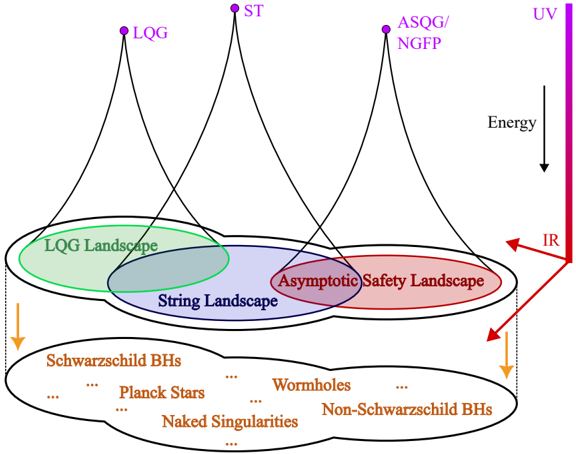
Computing the gravitational effective action provides a direct route to charting the landscape of admissible black hole spacetimes. We identify the unique ultraviolet-complete trajectory emanating from the asymptotically safe fixed point. Quantum gravity can constrain effective field theory and the associated set of allowed spacetimes, yielding a rich landscape of beyond-general-relativity solutions.
Overview
CoChat Summary
TL;DR
The paper gives a proof of principle that asymptotically safe quantum gravity can constrain the Einstein-Weyl effective action and the resulting phase diagram of gravitationally localized objects (GLOBs). Using the unique UV-complete trajectory from the non-Gaussian fixed point, it predicts the Weyl-squared Wilson coefficient and finds wormholes favored while Bachian attractive naked singularities are disfavored.
Key findings
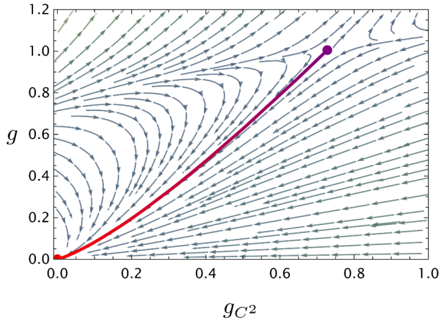
- The projected Einstein-Weyl RG flow has a non-Gaussian fixed point \((g^*, g_{C^2}^*)_{\rm NGFP}=(1.0053,0.7277)\), with critical exponents \(\theta_1=2.6165\) and \(\theta_2=-0.9365\), making it a saddle point with one relevant direction.
- The unique UV-complete trajectory predicts the Weyl-squared Wilson coefficient \(G_{C^2}=0.5092\,m_{\rm Pl}^{-2}\), corresponding to \(m^2=1.4013\,m_{\rm Pl}\); the paper states this leaves zero free parameters in the asymptotic safety landscape.
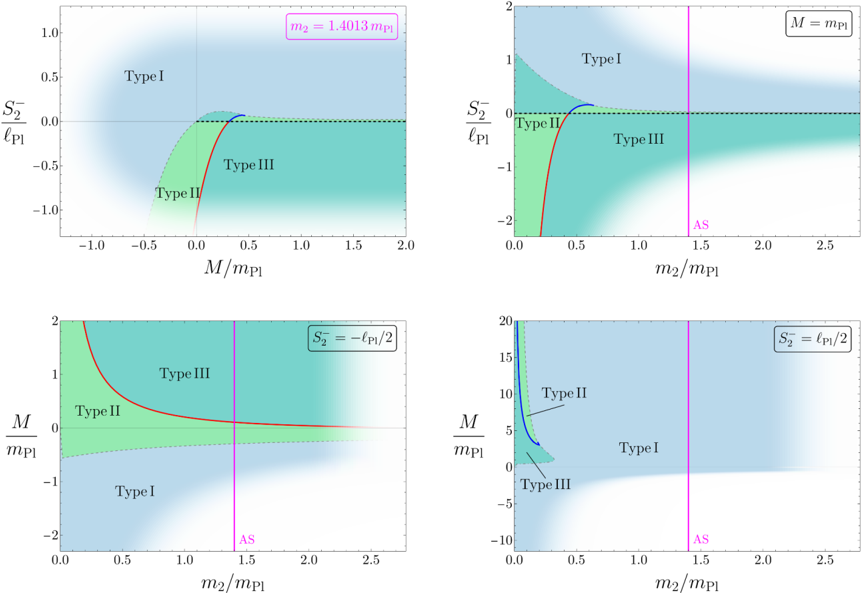
- In the resulting GLOB phase diagram, wormholes dominate a large portion, Type-III non-symmetric wormholes are favored by \(S^{-2}<0\), repulsive naked singularities by \(S^{-2}>0\), and Type-II attractive (Bachian) naked singularities are generically disfavored, especially at large masses.
- Black holes appear in zero-measure regions: the Schwarzschild and non-Schwarzschild lines cross at \(m^2 G_N M=m^2 r_H/2\simeq 0.438\) with \(m^2 S^{-2}=0\), and end at a massive triple point \(m^2 G_N M_{\rm mtp}\simeq 0.626\), \(m^2 S^{-2}_{\rm mtp}\simeq 0.097\).
Methods
- The authors use FRG beta functions from prior work, projected onto the Einstein-Weyl subspace \(\{G_N,G_{C^2}\}\) by setting the cosmological constant and Ricci-squared couplings to zero; they find fixed points, compute the stability matrix, critical exponents, and eigenvectors, and identify the unique UV-complete trajectory connecting the NGFP to the Gaussian fixed point.
- They integrate the flow, subtract the logarithmic IR running with \(k_0=m_{\rm Pl}\), \(g_{\rm IR}=1\), and slope \(b=0.5358\), extracting \(G_{C^2}\) and then overlaying the ASQG prediction for \(m^2\) onto the classical Einstein-Weyl phase diagram.
- The classical phase diagram is based on static, spherically symmetric vacuum Einstein-Weyl solutions, using the weak-field expansion and the classification of GLOBs from prior work, with new consistency conditions derived for the validity of the asymptotic analysis.
Limitations
- The paper states that all solutions considered present a singularity; this is not necessarily a problem of ASQG but an expected outcome of the chosen truncation, since Einstein-Weyl and quadratic gravity are not expected to resolve singularities. It calls for extending the analysis to higher operators, including \(\mathcal{R}^3\) and the Goroff-Sagnotti counterterm, and notes that a complete classification of all classical solutions in such theories is still missing.
- The definition of Wilson coefficients in the presence of logarithmic running is stated to remain ambiguous; the prescription depends on \(k_0\) and \(g_{\rm IR}\), and a rigorous definition is left for future work. The qualitative picture remains robust for \(k_0\gtrsim 10^{-1}m_{\rm Pl}\), and \(G_{C^2}\) remains positive for \(\xi\ge 0.15\) when \(k_0=\xi m_{\rm Pl}\), but below \(\xi\simeq 0.15\) it becomes negative and invalidates the analysis.
- The weak-field consistency conditions limit the reliable phase-diagram region to Planckian-sized deviations from the Schwarzschild line, \(S^{-2}/\ell_{\rm Pl}\sim\mathcal{O}(1)\); the paper describes this as a computational limitation rather than a physical constraint, and marks white regions where the prior analysis is not applicable. It also notes that the phase-diagram analogy is pictorial and that transitions between phases remain unclear.
Model-written summary. Check it against the paper before relying on it.
Integrity signals
Registry
Cites
Statistics
Figures




Verification
Claims the paper makes
27 Valid · 8 Not valid · 15 Not checked · 69 Own results and interpretations
The cited sources support only part of this claim — read each source’s verdict below.
In the paper
“This truncation is particularly instructive, as all asymptotically flat black hole solutions of the general quadratic action are also solutions of the classical Einstein-Weyl theory [101,112].”
§ Charting GLOBs in asymptotically safe gravity > 1 Introduction
What the sources say
- Partly supportedcites [101] H. Lü, A. Perkins, C.N. Pope and K.S. Stelle, Black Holes in Higher-Derivative Gravity, Phys. Rev. Lett. 114 (2015) 171601 [arXiv:1502.01028] [INSPIRE]. sourceExperimental — accuracy not yet measured
On p. 2, the paper says that any static black-hole solution of the general quadratic action has vanishing Ricci scalar, so the R-squared term does not contribute and one can study pure Einstein-Weyl gravity. The citing sentence omits the static restriction and extends the conclusion to all asymptotically flat black-hole solutions, which this passage does not establish. (LLM, conf=0.87)
- Could not verifycites [112] W. Nelson, Static Solutions for 4th order gravity, Phys. Rev. D 82 (2010) 104026 [arXiv:1010.3986] [INSPIRE]. sourceExperimental — accuracy not yet measured
Our copy of Nelson (2010) never mentions the Einstein-Weyl (conformal/Weyl-squared) theory as a theory whose solution set contains the quadratic-action black holes; the conformal special case alpha = 3 beta giving the Bach-Einstein equations appears only as background literature in the Introduction (p. 2, citing [14]-[20]). What the paper does establish is different in kind and narrower in scope: Theorem IV.1 (Sec. IV, p. 11) and the Conclusions (p. 14) show that the static, asymptotically flat, spherically symmetric black-hole solution of 4th order gravity is uniquely Schwarzschild (R_ab = 0), and only for alpha = 0 with alpha - 3 beta >= 0 and under the spatial-curvature bounds - not for the 'general quadratic action' and not relative to Einstein-Weyl theory. Sec. V (p. 12) states the analogous inclusion only between GR vacuum solutions and 4th order gravity. Searches: 'Einstein-Weyl', 'conformal gravity Weyl tensor squared Bach equations', 'solutions also solutions of another theory Ricci-flat'. (LLM, conf=0.62)
plainstates an association- Asserted: passes — The authors put it forward as true.
- Checkable: passes — It can be checked against evidence.
- Load-bearing: passes — The paper’s conclusions depend on it.
- Based: passes — The paper gives a reason why it holds.
- Partly supported
The cited sources support only part of this claim — read each source’s verdict below.
In the paper
“In this case, black holes can only have non-Schwarzschild metrics and negative masses.”
§ Charting GLOBs in asymptotically safe gravity > Type III exotic solutions: non-symmetric wormholes [102, 107-109].
What the sources say
- Partly supportedcites [107] S. Silveravalle and A. Zuccotti, Phase diagram of Einstein-Weyl gravity, Phys. Rev. D 107 (2023) 064029 [arXiv:2210.13877] [INSPIRE]. sourceExperimental — accuracy not yet measured
The Conclusions (p. 9) place Schwarzschild black holes at zero Yukawa charge, supporting the non-Schwarzschild part of the claim for negative charge. They place the non-Schwarzschild black-hole curve in both the small-mass and negative-mass regions, but do not establish that black holes at large negative Yukawa charge must have negative mass. (LLM, conf=0.83)
plainstates a cause- Asserted: passes — The authors put it forward as true.
- Checkable: passes — It can be checked against evidence.
- Load-bearing: passes — The paper’s conclusions depend on it.
- Based: passes — The paper gives a reason why it holds.
- Partly supported
The cited sources support only part of this claim — read each source’s verdict below.
In the paper
“All solutions with positive mass correspond to non-symmetric wormholes”
§ Charting GLOBs in asymptotically safe gravity > Type III exotic solutions: non-symmetric wormholes [102, 107-109].
What the sources say
- Partly supportedcites [107] S. Silveravalle and A. Zuccotti, Phase diagram of Einstein-Weyl gravity, Phys. Rev. D 107 (2023) 064029 [arXiv:2210.13877] [INSPIRE]. sourceExperimental — accuracy not yet measured
The Conclusions (p. 9) place non-symmetric wormholes in the negative-Yukawa-charge region for arbitrarily large positive mass. But the Phase Diagram section (p. 7) limits that pattern to large masses and says that, at small positive mass, type II solutions occur with negative Yukawa charge. The paper therefore does not support 'all solutions with positive mass,' even with the stated large-negative-charge qualifier. (LLM, conf=0.86)
plainstates an association- Asserted: passes — The authors put it forward as true.
- Checkable: passes — It can be checked against evidence.
- Load-bearing: passes — The paper’s conclusions depend on it.
- Based: passes — The paper gives a reason why it holds.
- Partly supported
The cited sources support only part of this claim — read each source’s verdict below.
In the paper
“small positive Yukawa charges (0 < S - 2 ≪ 1/m 2 ) yield attractive naked singularities.”
§ Charting GLOBs in asymptotically safe gravity > Type III exotic solutions: non-symmetric wormholes [102, 107-109].
What the sources say
- Partly supportedcites [107] S. Silveravalle and A. Zuccotti, Phase diagram of Einstein-Weyl gravity, Phys. Rev. D 107 (2023) 064029 [arXiv:2210.13877] [INSPIRE]. sourceExperimental — accuracy not yet measured
The Conclusions (p. 9) identify small positive Yukawa charge with a type II attractive naked singularity, but explicitly place this finding in the large positive-mass regime. The Phase Diagram section (p. 7) describes different solutions in the small-mass region, and the available text does not state the specific bound S₋₂ ≪ 1/m². The claim omits the mass condition and gives a quantitative bound the source does not establish. (LLM, conf=0.86)
plainstates a cause- Asserted: passes — The authors put it forward as true.
- Checkable: passes — It can be checked against evidence.
- Load-bearing: passes — The paper’s conclusions depend on it.
- Based: passes — The paper gives a reason why it holds.
- Partly supported
Every source the paper cites for this claim was checked and supports it.
In the paper
“for negative masses, the solutions correspond to wormholes, attractive naked singularities, and repulsive naked singularities, respectively, as the absolute value of the mass increases.”
§ Charting GLOBs in asymptotically safe gravity > Type III exotic solutions: non-symmetric wormholes [102, 107-109].
What the sources say
- Supportedcites [107] S. Silveravalle and A. Zuccotti, Phase diagram of Einstein-Weyl gravity, Phys. Rev. D 107 (2023) 064029 [arXiv:2210.13877] [INSPIRE]. source
The phase-diagram discussion (Section IV, p. 7) says that for negative masses and negative Yukawa charge, wormholes occur at the smallest absolute masses, type II solutions at larger values, and type I solutions beyond those. The descriptions of type II (pp. 4–5) and type I (p. 4), together with the Conclusions (p. 9), identify them as attractive and repulsive naked singularities, respectively. (LLM, conf=0.90)
plainstates a cause- Asserted: passes — The authors put it forward as true.
- Checkable: passes — It can be checked against evidence.
- Load-bearing: passes — The paper’s conclusions depend on it.
- Based: passes — The paper gives a reason why it holds.
- Supported
58 more claims · 13 with their cited sources checked
Create a free account to see all 119 claims and to verify the 21 references still open.
- Probably not a substantial claim. 22
- It may state two separate claims as one. 43
- The quote only partly states this claim. 1
Citations
Cites
Exact evolution equation for the effective potential
Wetterich, C. (1993) · Physics Letters B · doi:10.1016/0370-2693(93)90726-x · Cited by 2,272 · cited 1×
“In this section, we introduce the general idea behind our work, as well as its concrete setup.”
Polchinski, J. (1998) · Cambridge University Press eBooks · doi:10.1017/cbo9780511618123 · Cited by 1,602
Formation and Evaporation of Nonsingular Black Holes
Hayward, S. A. (2006) · Physical Review Letters · doi:10.1103/physrevlett.96.031103 · Cited by 1,420
Classical gravity with higher derivatives
Stelle, K. S. (1978) · General Relativity and Gravitation · doi:10.1007/bf00760427 · Cited by 1,379 · cited 2×
“The weak-field expression for the metric in Eq.”
Nonperturbative evolution equation for quantum gravity
Reuter, M. (1998) · Physical Review D · doi:10.1103/physrevd.57.971 · Cited by 1,160 · cited 1×
“In this section, we introduce the general idea behind our work, as well as its concrete setup.”
Polchinski, J. (1998) · Cambridge University Press eBooks · doi:10.1017/cbo9780511816079 · Cited by 1,075
(1998) · doi:10.12942/lrr-1998-1 · Cited by 917 · cited 1×
“Approaches inspired by candidate theories of QG, such as string theory (ST) [8, 9], loop quantum gravity (LQG) [10, 11], and asymptotically safe quantum gravity (ASQG) [12, 13], have also been employed.”
The Swampland: Introduction and Review
Palti, E. (2019) · Fortschritte der Physik · doi:10.1002/prop.201900037 · Cited by 908 · cited 1×
“The crucial observation is that not all the classically-allowed solutions can come from QG: each of them — at least in the large-mass limit — ought to stem from a principle of least action from a specific EFT [95], and not all EFTs can come from an ultraviolet (UV) completion of gravity [126].”
The ultraviolet behavior of Einstein gravity
Goroff, M. H., & Sagnotti, A. (1986) · Nuclear Physics B · doi:10.1016/0550-3213(86)90193-8 · Cited by 862 · cited 1×
“This set of operators crucially includes the Goroff-Sagnotti counterterm [131–133], which has been shown to be asymptotically safe [36, 134].”
Dymnikova, I. (1992) · General Relativity and Gravitation · doi:10.1007/bf00760226 · Cited by 784 · cited 1×
“Seminal examples include the Dymnikova [6] and Hayward [7] metrics, which modify the Schwarzschild geometry by introducing scale parameters associated with the length scale of new physics.”
The nonperturbative functional renormalization group and its applications
Dupuis, N., Canet, L., Eichhorn, A., Metzner, W., Pawlowski, J. M., Tissier, M., & Wschebor, N. (2021) · Physics Reports · doi:10.1016/j.physrep.2021.01.001 · Cited by 660 · cited 1×
“Over the past decades, mounting evidence for asymptotic safety has been obtained both via the lattice Monte Carlo simulations of dynamical triangulations [24, 25] and via the semi-analytical methods of the functional renormalization group (FRG) [26].”
Renormalization group improved black hole spacetimes
Bonanno, A., & Reuter, M. (2000) · Physical Review D · doi:10.1103/physrevd.62.043008 · Cited by 574
Goroff, M. H., Sagnotti, A., & Sagnotti, A. (1985) · Physics Letters B · doi:10.1016/0370-2693(85)91470-4 · Cited by 404
Asymptotic safety of gravity and the Higgs boson mass
Shaposhnikov, M., & Wetterich, C. (2010) · Physics Letters B · doi:10.1016/j.physletb.2009.12.022 · Cited by 385 · cited 1×
“…still be challenged by its compatibility with standard black hole thermodynamics [56], but its impressive consistency with particle physics data [57–63] (see also [15] for a review) could point to an effective realization of the asymptotic safety scenario as a predictive bridge between EFT and…”
van de Ven, A. E. M. (1992) · Nuclear Physics B · doi:10.1016/0550-3213(92)90011-y · Cited by 368 · cited 1×
“This set of operators crucially includes the Goroff-Sagnotti counterterm [131–133], which has been shown to be asymptotically safe [36, 134].”
Quantum gravity from causal dynamical triangulations: a review
Loll, R. (2020) · Classical and Quantum Gravity · doi:10.1088/1361-6382/ab57c7 · Cited by 359 · cited 1×
“Over the past decades, mounting evidence for asymptotic safety has been obtained both via the lattice Monte Carlo simulations of dynamical triangulations [24, 25] and via the semi-analytical methods of the functional renormalization group (FRG) [26].”
An Introduction to Covariant Quantum Gravity and Asymptotic Safety
Percacci, R. (2017) · 100 Years of General Relativity · doi:10.1142/10369 · Cited by 327 · cited 3×
“Therefore, the limit k → 0 (or, equivalently, τ → −∞ ) corresponds to performing a functional integral over all the quantum fluctuations and is tantamount to computing the quantum effective action of a theory [12].”
Non-Trivial Ultraviolet Fixed Point in Quantum Gravity
Souma, W. (1999) · Progress of Theoretical Physics · doi:10.1143/ptp.102.181 · Cited by 322 · cited 1×
“Initial studies focused on the Einstein-Hilbert truncation of the gravitational effective action [28, 29], as well as its coupling to matter fields.”
A short review of loop quantum gravity
Ashtekar, A., & Bianchi, E. (2021) · Reports on Progress in Physics · doi:10.1088/1361-6633/abed91 · Cited by 294 · cited 1×
“Approaches inspired by candidate theories of QG, such as string theory (ST) [8, 9], loop quantum gravity (LQG) [10, 11], and asymptotically safe quantum gravity (ASQG) [12, 13], have also been employed.”
Black Holes in Higher Derivative Gravity
Lü, H., Perkins, A., Pope, C. N., & Stelle, K. S. (2015) · Physical Review Letters · doi:10.1103/physrevlett.114.171601 · Cited by 265 · cited 3×
“In this section, we introduce the general idea behind our work, as well as its concrete setup.”
Matter matters in asymptotically safe quantum gravity
Donà, P., Eichhorn, A., & Percacci, R. (2014) · Physical Review D · doi:10.1103/physrevd.89.084035 · Cited by 259
Spacetime structure of an evaporating black hole in quantum gravity
Bonanno, A., & Reuter, M. (2006) · Physical Review D · doi:10.1103/physrevd.73.083005 · Cited by 249
Asymptotically Safe Lorentzian Gravity
Manrique, E., Rechenberger, S., & Saueressig, F. (2011) · Physical Review Letters · doi:10.1103/physrevlett.106.251302 · Cited by 222 · cited 1×
“In this section, we introduce the general idea behind our work, as well as its concrete setup.”
Further evidence for asymptotic safety of quantum gravity
Falls, K., Litim, D., Nikolakopoulos, K., & Rahmede, C. (2016) · Physical Review D · doi:10.1103/physrevd.93.104022 · Cited by 220 · cited 1×
“In this section, we introduce the general idea behind our work, as well as its concrete setup.”
Spherically symmetric solutions in higher-derivative gravity
Lü, H., Perkins, A., Pope, C. N., & Stelle, K. S. (2015) · Physical Review D · doi:10.1103/physrevd.92.124019 · Cited by 187 · cited 4×
“Type I exotic solutions: repulsive naked singularities [100, 105, 107].”
InfluentialThe realistic models of relativistic stars in f ( R ) = R + αR 2 gravity
Astashenok, A. V., Odintsov, S. D., & de la Cruz-Dombriz, Á. (2017) · Classical and Quantum Gravity · doi:10.1088/1361-6382/aa8971 · Cited by 187
Quantum Gravity and the Functional Renormalization Group: The Road towards Asymptotic Safety
Reuter, M., & Saueressig, F. (2018) · doi:10.1017/9781316227596 · Cited by 179
Holdom, B., & Ren, J. (2017) · Physical Review D · doi:10.1103/physrevd.95.084034 · Cited by 159 · cited 1×
“Type II exotic solutions: attractive (Bachian) naked singularities [100, 105, 107, 122, 123].”
Gravitational Two-Loop Counterterm Is Asymptotically Safe
Gies, H., Knorr, B., Lippoldt, S., & Saueressig, F. (2016) · Physical Review Letters · doi:10.1103/physrevlett.116.211302 · Cited by 157 · cited 1×
“This set of operators crucially includes the Goroff-Sagnotti counterterm [131–133], which has been shown to be asymptotically safe [36, 134].”
On neutron stars in f ( R ) theories: Small radii, large masses and large energy emitted in a merger
Resco, M. A., de la Cruz-Dombriz, Á., Llanes–Estrada, F. J., & Castrillo, V. Z. (2016) · Physics of the Dark Universe · doi:10.1016/j.dark.2016.07.001 · Cited by 147
Asymptotic safety of gravity with matter
Christiansen, N., Litim, D. F., Pawlowski, J. M., & Reichert, M. (2018) · Physical Review D · doi:10.1103/physrevd.97.106012 · Cited by 141 · cited 1×
“In this section, we introduce the general idea behind our work, as well as its concrete setup.”
Quantum gravity on foliated spacetimes: Asymptotically safe and sound
Biemans, J., Platania, A., & Saueressig, F. (2017) · Physical Review D · doi:10.1103/physrevd.95.086013 · Cited by 137
Self-citationTop mass from asymptotic safety
Eichhorn, A., & Held, A. (2018) · Physics Letters B · doi:10.1016/j.physletb.2017.12.040 · Cited by 137
Asymptotic safety of quantum gravity beyond Ricci scalars
Falls, K., King, C. R., Litim, D. F., Nikolakopoulos, K., & Rahmede, C. (2018) · Physical Review D · doi:10.1103/physrevd.97.086006 · Cited by 136 · cited 1×
“In this section, we introduce the general idea behind our work, as well as its concrete setup.”
Renormalization group fixed points of foliated gravity-matter systems
Biemans, J., Platania, A., & Saueressig, F. (2017) · Journal of High Energy Physics · doi:10.1007/jhep05(2017)093 · Cited by 131 · cited 1×
“In this section, we introduce the general idea behind our work, as well as its concrete setup.”
Self-citationGeneralized parametrization dependence in quantum gravity
Gies, H., Knorr, B., & Lippoldt, S. (2015) · Physical Review D · doi:10.1103/physrevd.92.084020 · Cited by 129
BLACK HOLES AND ASYMPTOTICALLY SAFE GRAVITY
FALLS, K., LITIM, D. F., & RAGHURAMAN, A. (2012) · International Journal of Modern Physics A · doi:10.1142/s0217751x12500194 · Cited by 129
Quantum gravity effects near the null black hole singularity
Bonanno, A., & Reuter, M. (1999) · Physical Review D · doi:10.1103/physrevd.60.084011 · Cited by 127 · cited 1×
“In this section, we introduce the general idea behind our work, as well as its concrete setup.”
Asymptotic safety casts its shadow
Held, A., Gold, R., & Eichhorn, A. (2019) · Journal of Cosmology and Astroparticle Physics · doi:10.1088/1475-7516/2019/06/029 · Cited by 127
Structural aspects of asymptotically safe black holes
Koch, B., & Saueressig, F. (2014) · Classical and Quantum Gravity · doi:10.1088/0264-9381/31/1/015006 · Cited by 121
Form factors in asymptotic safety: conceptual ideas and computational toolbox
Knorr, B., Ripken, C., & Saueressig, F. (2019) · Classical and Quantum Gravity · doi:10.1088/1361-6382/ab4a53 · Cited by 117 · cited 1×
“It is well-known indeed that the quantum effective action encodes the physical running of the couplings as form factors [14, 127], and logarithmic form factors are expected on general grounds.”
Dynamical renormalization of black-hole spacetimes
Platania, A. (2019) · The European Physical Journal C · doi:10.1140/epjc/s10052-019-6990-2 · Cited by 115
Self-citationUpper bound on the Abelian gauge coupling from asymptotic safety
Eichhorn, A., & Versteegen, F. (2018) · Journal of High Energy Physics · doi:10.1007/jhep01(2018)030 · Cited by 113
Curvature dependence of quantum gravity
Christiansen, N., Falls, K., Pawlowski, J. M., & Reichert, M. (2018) · Physical Review D · doi:10.1103/physrevd.97.046007 · Cited by 112 · cited 1×
“In this section, we introduce the general idea behind our work, as well as its concrete setup.”
Bonanno, A., Denz, T., Pawlowski, J. M., & Reichert, M. (2022) · SciPost Physics · doi:10.21468/scipostphys.12.1.001 · Cited by 111
Black Holes in Asymptotically Safe Gravity
Platania, A. B. (2023) · Springer eBooks · doi:10.1007/978-981-19-3079-9_24-1 · Cited by 105
Self-citationMass Difference for Charged Quarks from Asymptotically Safe Quantum Gravity
Eichhorn, A., & Held, A. (2018) · Physical Review Letters · doi:10.1103/physrevlett.121.151302 · Cited by 100
Black hole thermodynamics under the microscope
Falls, K., & Litim, D. F. (2014) · Physical Review D · doi:10.1103/physrevd.89.084002 · Cited by 95
Positivity bounds and the massless spin-2 pole
Alberte, L., de Rham, C., Jaitly, S., & Tolley, A. J. (2020) · Physical Review D · doi:10.1103/physrevd.102.125023 · Cited by 92
Static solutions for fourth order gravity
Nelson, W. (2010) · Physical Review D · doi:10.1103/physrevd.82.104026 · Cited by 88
(2024) · doi:10.1007/978-981-99-7681-2 · Cited by 86
Black holes in an asymptotically safe gravity theory with higher derivatives
Cai, Y.-F., & Easson, D. A. (2010) · Journal of Cosmology and Astroparticle Physics · doi:10.1088/1475-7516/2010/09/002 · Cited by 86
The Functional Renormalization Group in Quantum Gravity
Frank Saueressig, B. (2023) · Springer eBooks · doi:10.1007/978-981-19-3079-9_16-1 · Cited by 85
Lorentzian Quantum Gravity and the Graviton Spectral Function
Fehre, J., Litim, D. F., Pawlowski, J. M., & Reichert, M. (2023) · Physical Review Letters · doi:10.1103/physrevlett.130.081501 · Cited by 82 · cited 3×
“In a truncation of the effective action, this pole can generally be fictitious [112], and indeed the non-perturbative dressed propagator in ASQG seems to be ghost-free [48, 53].”
Non-perturbative unitarity and fictitious ghosts in quantum gravity
Platania, A., & Wetterich, C. (2020) · Physics Letters B · doi:10.1016/j.physletb.2020.135911 · Cited by 79 · cited 3×
“In a truncation of the effective action, this pole can generally be fictitious [112], and indeed the non-perturbative dressed propagator in ASQG seems to be ghost-free [48, 53].”
Self-citationCorrelation functions on a curved background
Knorr, B., & Lippoldt, S. (2017) · Physical Review D · doi:10.1103/physrevd.96.065020 · Cited by 74
Field parametrization dependence in asymptotically safe quantum gravity
Nink, A. (2015) · Physical Review D · doi:10.1103/physrevd.91.044030 · Cited by 74 · cited 1×
“In this section, we introduce the general idea behind our work, as well as its concrete setup.”
Towards a non-singular paradigm of black hole physics
Carballo-Rubio, R., Filippo, F. D., Liberati, S., Visser, M., Arrechea, J., Barceló, C., Bonanno, A., Borissova, J., Boyanov, V., Cardoso, V., et al. (2025) · Journal of Cosmology and Astroparticle Physics · doi:10.1088/1475-7516/2025/05/003 · Cited by 73 · cited 1×
“In the absence of a complete and universally accepted theory of quantum gravity (QG) [1–3], various models have been proposed to describe “quantum-corrected” black holes (see [4, 5] for recent overviews).”
Self-citationQuantum-improved Schwarzschild-(A)dS and Kerr-(A)dS spacetimes
Pawlowski, J. M., & Stock, D. (2018) · Physical Review D · doi:10.1103/physrevd.98.106008 · Cited by 71
Asymptotic safety and field parametrization dependence in the f(R) truncation
de Brito, G. P., Ohta, N., Pereira, A. D., Tomaz, A. A., & Yamada, M. (2018) · Physical Review D · doi:10.1103/physrevd.98.026027 · Cited by 68 · cited 1×
“In this section, we introduce the general idea behind our work, as well as its concrete setup.”
Extremal Kerr Black Holes as Amplifiers of New Physics
Horowitz, G. T., Kolanowski, M., Remmen, G. N., & Santos, J. E. (2023) · Physical Review Letters · doi:10.1103/physrevlett.131.091402 · Cited by 68 · cited 1×
“This kind of extension has also been a recent object of study, since it has been suggested that some black hole solutions may be sensitive to higher-derivative corrections already at the level of their horizon [135], see also [125].”
Lichnerowicz modes and black hole families in Ricci quadratic gravity
Lü, H., Perkins, A., Pope, C. N., & Stelle, K. S. (2017) · Physical review. D/Physical review. D. · doi:10.1103/physrevd.96.046006 · Cited by 66 · cited 2×
“To see this more clearly, it is useful to use Planck units, so that the full phase diagram is a 3D plot given in terms of the dimensionless parameters { S − 2 /l Pl , M/m Pl , m 2 /m Pl } .”
Fate of singularities and horizons in higher derivative gravity
Holdom, B. (2002) · Physical Review D · doi:10.1103/physrevd.66.084010 · Cited by 64 · cited 2×
“Notably, R 3 is also the first set of operators possibly leading to non-singular GLOBs [128, 130, 136].”
Dust Collapse in Asymptotic Safety: A Path to Regular Black Holes
Bonanno, A., Malafarina, D., & Panassiti, A. (2024) · Physical Review Letters · doi:10.1103/physrevlett.132.031401 · Cited by 64
Black Holes in Asymptotically Safe Gravity and Beyond
Eichhorn, A., & Held, A. (2023) · Springer Series in Astrophysics and Cosmology · doi:10.1007/978-981-99-1596-5_5 · Cited by 64
Dynamical Formation of Regular Black Holes
Bueno, P., Cano, P. A., Hennigar, R. A., & Murcia, Á. J. (2025) · Physical Review Letters · doi:10.1103/physrevlett.134.181401 · Cited by 60
Quantum improved charged black holes
Ishibashi, A., Ohta, N., & Yamaguchi, D. (2021) · Physical review. D/Physical review. D. · doi:10.1103/physrevd.104.066016 · Cited by 58
Towards conditions for black-hole singularity-resolution in asymptotically safe quantum gravity
Adéìféoba, A., Eichhorn, A., & Platania, A. B. (2018) · Classical and Quantum Gravity · doi:10.1088/1361-6382/aae6ef · Cited by 58
Self-citationTowards Black-Hole Singularity-Resolution in the Lorentzian Gravitational Path Integral
Borissova, J. N., & Eichhorn, A. (2021) · Universe · doi:10.3390/universe7030048 · Cited by 58
Knorr, B. (2019) · Physics Letters B · doi:10.1016/j.physletb.2019.01.070 · Cited by 56
Gravitational Collapse in Quantum Einstein Gravity
Bonanno, A., Koch, B., & Platania, A. (2018) · Foundations of Physics · doi:10.1007/s10701-018-0195-7 · Cited by 56
Self-citationLorentz invariance violations in the interplay of quantum gravity with matter
Eichhorn, A., Platania, A., & Schiffer, M. (2020) · Physical Review D · doi:10.1103/physrevd.102.026007 · Cited by 56
Self-citationBounding violations of the weak gravity conjecture
Henriksson, J., McPeak, B., Russo, F., & Vichi, A. (2022) · Journal of High Energy Physics · doi:10.1007/jhep08(2022)184 · Cited by 55
Massless positivity in graviton exchange
Herrero-Valea, M., Santos-Garcia, R., & Tokareva, A. (2021) · Physical Review D · doi:10.1103/physrevd.104.085022 · Cited by 55
Buoninfante, L., Knorr, B., Kumar, K. S., Platania, A. B., Anselmi, D., Basile, I., Bjerrum-Bohr, N. E. J., Brandenberger, R., González, M. C., Davis, A.-C., et al. (2025) · SciPost Physics Community Reports · doi:10.21468/scipostphyscommrep.11 · Cited by 54 · cited 2×
“This is clearly a very simplified approximation of the full effective action, retaining only two key terms: the Einstein-– Hilbert term, which is the leading-order term in the gravitational EFT, and the Weyl-squared term C 2 .”
Self-citationExplicit black hole solutions in higher-derivative gravity
Podolský, J., Švarc, R., Pravda, V., & Pravdová, A. (2018) · Physical Review D · doi:10.1103/physrevd.98.021502 · Cited by 54 · cited 1×
“Moreover, as depicted in the other three panels of Fig.”
Essential Quantum Einstein Gravity
Baldazzi, A., & Falls, K. (2021) · Universe · doi:10.3390/universe7080294 · Cited by 54 · cited 1×
“Extending our analysis beyond quadratic order, possibly including essential operators only [36, 137, 138], is also desirable to avoid unphysical features related to the spin-2 ghost pole.”
The spatial Functional Renormalization Group and Hadamard states on cosmological spacetimes
Banerjee, R., & Niedermaier, M. R. (2022) · Nuclear Physics B · doi:10.1016/j.nuclphysb.2022.115814 · Cited by 51
Black holes and other exact spherical solutions in quadratic gravity
Podolský, J., Švarc, R., Pravda, V., & Pravdová, A. (2020) · Physical Review D · doi:10.1103/physrevd.101.024027 · Cited by 50
Asymptotic safety, string theory and the weak gravity conjecture
de Alwis, S., Eichhorn, A., Held, A., Pawlowski, J. M., Schiffer, M., & Versteegen, F. (2019) · Physics Letters B · doi:10.1016/j.physletb.2019.134991 · Cited by 50
The derivative expansion in asymptotically safe quantum gravity: general setup and quartic order
Knorr, B. (2021) · SciPost Physics Core · doi:10.21468/scipostphyscore.4.3.020 · Cited by 49
Black Holes Inside and Out 2024: visions for the future of black hole physicsPreprint
Afshordi, N., Ashtekar, A., Barausse, E., Berti, E., Brito, R., Buoninfante, L., Carballo-Rubio, R., Cardoso, V., Carullo, G., Dafermos, M., et al. (2024) · arXiv (Cornell University) · doi:10.48550/arxiv.2410.14414 · Cited by 49
Self-citationCharacterizing black hole metrics in quadratic gravity
Bonanno, A., & Silveravalle, S. (2019) · Physical Review D · doi:10.1103/physrevd.99.101501 · Cited by 48 · cited 3×
“The weak-field expression for the metric in Eq.”
Self-citationCosmic censorship in quantum Einstein gravity
Bonanno, A., Koch, B., & Platania, A. (2017) · Classical and Quantum Gravity · doi:10.1088/1361-6382/aa6788 · Cited by 48
Self-citationInstability of spherically symmetric black holes in quadratic gravity
Held, A., & Zhang, J. (2023) · Physical review. D/Physical review. D. · doi:10.1103/physrevd.107.064060 · Cited by 47
QUANTUM GRAVITY EFFECTS IN ROTATING BLACK HOLES
REUTER, M., & Tuirán, E. (2008) · The Ninth Marcel Grossmann Meeting · doi:10.1142/9789812834300_0473 · Cited by 47
Asymptotic safety, singularities, and gravitational collapse
Casadio, R., Hsu, S. D. H., & Mirza, B. (2011) · Physics Letters B · doi:10.1016/j.physletb.2010.10.060 · Cited by 46
Fixed points of quantum gravity and the dimensionality of the UV critical surface
Kluth, Y., & Litim, D. F. (2023) · Physical Review D · doi:10.1103/physrevd.108.026005 · Cited by 43 · cited 1×
“In this section, we introduce the general idea behind our work, as well as its concrete setup.”
An Algebraic QFT Approach to the Wetterich Equation on Lorentzian Manifolds
D’Angelo, E., Drago, N., Pinamonti, N., & Rejzner, K. (2023) · Annales Henri Poincaré · doi:10.1007/s00023-023-01348-4 · Cited by 42
Essential renormalisation group
Baldazzi, A., Ben Ali Zinati, R., & Falls, K. (2022) · SciPost Physics · doi:10.21468/scipostphys.13.4.085 · Cited by 42 · cited 1×
“Extending our analysis beyond quadratic order, possibly including essential operators only [36, 137, 138], is also desirable to avoid unphysical features related to the spin-2 ghost pole.”
The Asymptotically Safe Standard Model: From quantum gravity to dynamical chiral symmetry breaking
Pastor-Gutiérrez, Á., Pawlowski, J. M., & Reichert, M. (2023) · SciPost Physics · doi:10.21468/scipostphys.15.3.105 · Cited by 42 · cited 1×
“In this section, we introduce the general idea behind our work, as well as its concrete setup.”
Towards effective actions for the continuum limit of spin foams
Borissova, J. N., & Dittrich, B. (2023) · Classical and Quantum Gravity · doi:10.1088/1361-6382/accbfb · Cited by 41
Causality, unitarity and stability in quantum gravity: a non-perturbative perspective
Platania, A. (2022) · Journal of High Energy Physics · doi:10.1007/jhep09(2022)167 · Cited by 41
Self-citationSifting quantum black holes through the principle of least action
Knorr, B., & Platania, A. (2022) · Physical Review D · doi:10.1103/physrevd.106.l021901 · Cited by 41
Self-citationProbing quadratic gravity with the Event Horizon Telescope
Daas, J., Kuijpers, K., Frank Saueressig, B., Wondrak, M. F., & Falcke, H. D. (2023) · Astronomy and Astrophysics · doi:10.1051/0004-6361/202244080 · Cited by 40 · cited 2×
“Extensive analytical and numerical analysis clarified that there are four different types of static, spherically symmetric vacuum solutions (in addition to the trivial Minkowski vacuum) [99–108], of which we briefly sketch their main properties.”
Asymptotic Safety: Swampland or Wonderland?
Basile, I., & Platania, A. (2021) · Universe · doi:10.3390/universe7100389 · Cited by 39 · cited 8×
“The extraction of the asymptotic safety landscape and the computation of the Wilson coefficients can be done following the steps in [54, 124].”
InfluentialSelf-citationInstability and backreaction of massive spin-2 fields around black holes
East, W. E., & Siemonsen, N. P. (2023) · Physical review. D/Physical review. D. · doi:10.1103/physrevd.108.124048 · Cited by 37
Gravitational antiscreening in stellar interiors
Bonanno, A., Casadio, R., & Platania, A. (2020) · Journal of Cosmology and Astroparticle Physics · doi:10.1088/1475-7516/2020/01/022 · Cited by 36
Self-citationThe Functional f(R) Approximation
Morris, T. R., & Stulga, D. (2023) · Springer eBooks · doi:10.1007/978-981-19-3079-9_19-1 · Cited by 35
Quantum Gravity from Dynamical Metric Fluctuations
Pawlowski, J. M., & Reichert, M. (2023) · Springer eBooks · doi:10.1007/978-981-19-3079-9_17-1 · Cited by 33
Nonsingular black holes, the cosmological constant, and asymptotic safety
Torres, R. (2017) · Physical Review D · doi:10.1103/physrevd.95.124004 · Cited by 33
A Lorentzian Renormalization Group Equation for Gauge Theories
D’Angelo, E., & Rejzner, K. (2025) · Annales Henri Poincaré · doi:10.1007/s00023-024-01535-x · Cited by 32
String tension between de Sitter vacua and curvature corrections
Basile, I., & Platania, A. (2021) · Physical Review D · doi:10.1103/physrevd.104.l121901 · Cited by 31
Self-citationInvariant Renormalization-Group improvementPreprint
Held, A. (2021) · arXiv (Cornell University) · doi:10.48550/arxiv.2105.11458 · Cited by 31
Ineffective higher derivative black hole hair
Goldstein, K., & Mashiyane, J. J. (2018) · Physical Review D · doi:10.1103/physrevd.97.024015 · Cited by 29 · cited 1×
“The idea of this work is to embed the phase diagram in a fundamental QFT framework and constrain some parts of it.”
Form Factors in Asymptotically Safe Quantum Gravity
Knorr, B., Ripken, C., & Frank Saueressig, B. (2024) · Springer eBooks · doi:10.1007/978-981-19-3079-9_21-1 · Cited by 29
Perturbative Approaches to Nonperturbative Quantum Gravity
Martini, R., Vacca, G. P., & Zanusso, O. (2023) · Springer eBooks · doi:10.1007/978-981-19-3079-9_25-1 · Cited by 29
Cosmological α′-corrections from the functional renormalization group
Basile, I., & Platania, A. (2021) · Journal of High Energy Physics · doi:10.1007/jhep06(2021)045 · Cited by 28
Self-citationUV graviton scattering and positivity bounds from IR dispersion relations
Herrero-Valea, M., Koshelev, A. S., & Tokareva, A. (2022) · Physical review. D/Physical review. D. · doi:10.1103/physrevd.106.105002 · Cited by 28
Formation and evaporation of quantum black holes from the decoupling mechanism in quantum gravity
Borissova, J. N., & Platania, A. (2023) · Journal of High Energy Physics · doi:10.1007/jhep03(2023)046 · Cited by 28
Self-citationGravitational quasinormal modes of black holes in quadratic gravity
Antoniou, G., Gualtieri, L., & Pani, P. (2025) · Physical review. D/Physical review. D. · doi:10.1103/physrevd.111.064059 · Cited by 26 · cited 1×
“One can then use this UV completion to compute the asymptotic safety landscape [54, 124], predict the Weyl coupling G C 2 , and constrain the GLOB phase diagram of [105].”
The gravitational field of a star in quadratic gravity
Bonanno, A., & Silveravalle, S. (2021) · Journal of Cosmology and Astroparticle Physics · doi:10.1088/1475-7516/2021/08/050 · Cited by 26
Self-citationFunctional renormalization for f(Rμνρσ) quantum gravity
Kluth, Y., & Litim, D. F. (2022) · Physical Review D · doi:10.1103/physrevd.106.106022 · Cited by 26
Neutron star masses in R 2 -gravity
Sbisà, F., Baqui, P. O., Miranda, T., Jorás, S. E., & Piattella, O. F. (2019) · Physics of the Dark Universe · doi:10.1016/j.dark.2019.100411 · Cited by 24
Quantum improved regular Kerr black holes
Chen, C.-M., Chen, Y., Ishibashi, A., & Ohta, N. (2024) · Chinese Journal of Physics · doi:10.1016/j.cjph.2024.10.001 · Cited by 23
Effective Asymptotic Safety and Its Predictive Power: Gauge-Yukawa Theories
Held, A. (2020) · Frontiers in Physics · doi:10.3389/fphy.2020.00341 · Cited by 23
A quantum improvement to the gravitational collapse of radiating stars
Fayos, F., & Torres, R. (2011) · Classical and Quantum Gravity · doi:10.1088/0264-9381/28/10/105004 · Cited by 21
Quantum Gravity and Scale Symmetry in Cosmology
WETTERICH, C. (2023) · Springer eBooks · doi:10.1007/978-981-19-3079-9_26-1 · Cited by 20
Knorr, B., & Platania, A. (2025) · Journal of High Energy Physics · doi:10.1007/jhep03(2025)003 · Cited by 19 · cited 8×
“The extraction of the asymptotic safety landscape and the computation of the Wilson coefficients can be done following the steps in [54, 124].”
InfluentialSelf-citationApplication of positivity bounds in asymptotically safe gravity
Eichhorn, A., Schiffer, M., & Pedersen, A. O. (2025) · The European Physical Journal C · doi:10.1140/epjc/s10052-025-14449-7 · Cited by 19 · cited 1×
“…have strengthened the case for asymptotic safety in QG. Additionally, preliminary investigations seem to indicate that the existence and properties of the fixed point remain unaltered by Wick rotation or within Lorentzian FRG studies [30, 43–52] and that the theory may be unitary [47, 48, 53–55].”
Asymptotic Safety and Cosmology
Bonanno, A. M. (2023) · Springer eBooks · doi:10.1007/978-981-19-3079-9_23-1 · Cited by 19
Quark and lepton mixing in the asymptotically safe Standard ModelPreprint
Eichhorn, A., Gyftopoulos, Z., & Held, A. (2025) · arXiv (Cornell University) · doi:10.48550/arxiv.2507.18304 · Cited by 18
Effective action and black hole solutions in asymptotically safe quantum gravity
(2024) · doi:10.1103/physrevd.110.086011 · Cited by 17
Phase diagram of Einstein-Weyl gravity
Silveravalle, S., & Zuccotti, A. (2023) · Physical Review D · doi:10.1103/physrevd.107.064029 · Cited by 17 · cited 10×
“Indeed, as in the general case [105], the phase diagram reveals a rich structure of gravitational solutions, encompassing wormholes, Schwarzschild, and non-Schwarzschild black holes.”
InfluentialSelf-citationSuppression of spacetime singularities in quantum gravity
Borissova, J. N. (2024) · Classical and Quantum Gravity · doi:10.1088/1361-6382/ad46c0 · Cited by 14 · cited 1×
“Notably, R 3 is also the first set of operators possibly leading to non-singular GLOBs [128, 130, 136].”
Nonsymmetric wormholes and localized big rip singularities in Einstein-Weyl gravity
Bonanno, A., Silveravalle, S., & Zuccotti, A. (2022) · Physical Review D · doi:10.1103/physrevd.105.124059 · Cited by 14
Self-citationHoldom, B. (2022) · Physics Letters B · doi:10.1016/j.physletb.2022.137142 · Cited by 13 · cited 1×
“Type II exotic solutions: attractive (Bachian) naked singularities [100, 105, 107, 122, 123].”
Lorentzian quantum gravity and the graviton spectral functionPreprint
Fehre, J., Litim, D. F., Pawlowski, J. M., et al. (2021) · arXiv (Cornell University) · doi:10.48550/arxiv.2111.13232 · Cited by 13
Asymptotically Safe gravitational collapse: Kuroda-Papapetrou RG-improved model
Platania, A. B., Bonanno, A. M., & Koch, B. (2017) · Corfu Summer Institute School and Workshops on Elementary Particle Physics and Gravity (CORFU) · doi:10.22323/1.292.0058 · Cited by 10
Self-citationDust collapse and horizon formation in quadratic gravity
Buoninfante, L., Filippo, F. D., Kolář, I., & Saueressig, F. (2025) · Journal of Cosmology and Astroparticle Physics · doi:10.1088/1475-7516/2025/01/114 · Cited by 10 · cited 1×
“…stemming from ASQG is, as expected on general EFT grounds, vastly richer than the Einstein-Hilbert approximation: higher derivative terms are expected to become relevant at high energies and their impact on black hole solutions [95–98] has not been fully charted within a fundamental framework.”
Diverging black hole entropy from quantum infrared non-localities
Platania, A. B., & Redondo–Yuste, J. (2024) · Physics Letters B · doi:10.1016/j.physletb.2024.138993 · Cited by 9
Self-citationRobustness of the derivative expansion in asymptotic safety
(2025) · doi:10.1103/hlrm-d4g2 · Cited by 9
Phase structure of quantum improved Schwarzschild-(Anti)de Sitter black holes
Chen, C.-M., Chen, Y., Ishibashi, A., & Ohta, N. (2023) · Classical and Quantum Gravity · doi:10.1088/1361-6382/acfc91 · Cited by 7
Non-Perturbative Propagators in Quantum Gravity
Knorr, B., & Schiffer, M. (2021) · Universe · doi:10.3390/universe7070216 · Cited by 7
Some thoughts about black holes in asymptotic safety
Platania, A. B. (2025) · General Relativity and Gravitation · doi:10.1007/s10714-025-03390-5 · Cited by 4 · cited 1×
“In the context of black holes, an influential line of work has pursued the idea of “RG improving” classical solutions [19, 69– 94 The underlying space of quantum effective actions stemming from ASQG is, as expected on general EFT grounds, vastly richer than the Einstein-Hilbert approximation:…”
Self-citationEmoto, H. (2005) · arXiv (Cornell University) · doi:10.48550/arxiv.hep-th/0511075 · Cited by 4
Improved algorithm for dynamical triangulations and simulations of finer lattices
Dai, M., Freeman, W., Laiho, J., Schiffer, M., & Unmuth-Yockey, J. (2024) · Physical Review D · doi:10.1103/physrevd.109.034518 · Cited by 3
Asymptotic safety of gravity with matter
Eichhorn, A., & Schiffer, M. (2022) · arXiv · doi:10.48550/arxiv.2212.07456 · Cited by 3
Application of positivity bounds in asymptotically safe gravityPreprint
Eichhorn, A., Pedersen, A. O., & Schiffer, M. (2024) · arXiv (Cornell University) · doi:10.48550/arxiv.2405.08862 · Cited by 3
Probing Quadratic Gravity with the Event Horizon TelescopePreprint
Daas, J., Kuijpers, K., Frank Saueressig, B., et al. (2022) · arXiv (Cornell University) · doi:10.48550/arxiv.2204.08480 · Cited by 2
Robustness of the derivative expansion in Asymptotic SafetyPreprint
Baldazzi, A., Falls, K., Kluth, Y., et al. (2023) · arXiv (Cornell University) · doi:10.48550/arxiv.2312.03831 · Cited by 2
Knorr, B., & Platania, A. B. (2024) · arXiv (Cornell University) · doi:10.48550/arxiv.2405.08860 · Cited by 2
Self-citationImpact of quantum gravity on the UV sensitivity of extremal black holes
Del Porro, F., Ferrarin, F., & Platania, A. (2025) · arXiv · doi:10.48550/arxiv.2509.07058 · Cited by 2
Self-citationScalar weak gravity bound from full unitarity
(2025) · doi:10.1103/86hv-m36b · Cited by 1
Diverging black hole entropy from quantum infrared non-localitiesPreprint
Platania, A. B., & Redondo–Yuste, J. (2023) · arXiv (Cornell University) · doi:10.48550/arxiv.2303.17621 · Cited by 1
Self-citationDynamical Formation of Regular Black HolesPreprint
Bueno, P., Cano, P. A., Hennigar, R. A., et al. (2024) · arXiv (Cornell University) · doi:10.48550/arxiv.2412.02742 · Cited by 1
An algebraic QFT approach to the Wetterich equation on Lorentzian manifolds
D’Angelo, E., Drago, N., Pinamonti, N., et al. (2022) · White Rose Research Online (University of Leeds, The University of Sheffield, University of York) · doi:10.48550/arxiv.2202.07580
A Lorentzian renormalisation group equation for gauge theories
D’Angelo, E., & Rejzner, K. (2023) · White Rose Research Online (University of Leeds, The University of Sheffield, University of York) · doi:10.48550/arxiv.2303.01479
Phase Structure of Quantum Improved Schwarzschild-(Anti)de Sitter Black HolesPreprint
Chen, C.-M., Chen, Y., Ishibashi, A., et al. (2023) · arXiv (Cornell University) · doi:10.48550/arxiv.2303.04304
Quantum Improved Regular Kerr Black HolesPreprint
Chen, C.-M., Chen, Y., Ishibashi, A., et al. (2023) · arXiv (Cornell University) · doi:10.48550/arxiv.2308.16356
An improved algorithm for dynamical triangulations and simulations of finer latticesPreprint
Dai, M., Freeman, W., Laiho, J., Schiffer, M., & Unmuth-Yockey, J. (2023) · arXiv (Cornell University) · doi:10.48550/arxiv.2309.12257
Gravitational quasinormal modes of black holes in quadratic gravityPreprint
Antoniou, G., Gualtieri, L., & Pani, P. (2024) · arXiv (Cornell University) · doi:10.48550/arxiv.2412.15037
Scalar weak gravity bound from full unitarityPreprint
Tokareva, A., & Xu, Y. (2025) · arXiv (Cornell University) · doi:10.48550/arxiv.2502.10375
Quantum Gravity effects near the null black hole singularity
Bonanno, A., & Reuter, M. (1998) · arXiv · doi:10.48550/arxiv.gr-qc/9811026
Spacetime Structure of an Evaporating Black Hole in Quantum Gravity
Bonanno, A., & Reuter, M. (2006) · arXiv · doi:10.48550/arxiv.hep-th/0602159
Nonperturbative Evolution Equation for Quantum Gravity
Reuter, M. (1996) · arXiv · doi:10.48550/arxiv.hep-th/9605030
Non-Trivial Ultraviolet Fixed Point in Quantum Gravity
Souma, W. (1999) · arXiv · doi:10.48550/arxiv.hep-th/9907027
Asymptotic safety of gravity and the Higgs boson mass
Shaposhnikov, M., & Wetterich, C. (2009) · arXiv · doi:10.48550/arxiv.0912.0208
Top mass from asymptotic safety
Eichhorn, A., & Held, A. (2017) · arXiv · doi:10.48550/arxiv.1707.01107
Mass difference for charged quarks from asymptotically safe quantum gravity
Eichhorn, A., & Held, A. (2018) · arXiv · doi:10.48550/arxiv.1803.04027
One force to rule them all: asymptotic safety of gravity with matter
Christiansen, N., Litim, D. F., Pawlowski, J. M., et al. (2017) · arXiv · doi:10.48550/arxiv.1710.04669
Effective asymptotic safety and its predictive power: Gauge-Yukawa theories
Held, A. (2020) · arXiv · doi:10.48550/arxiv.2003.13642
Cosmic Censorship in Quantum Einstein Gravity
Bonanno, A., Koch, B., & Platania, A. (2016) · arXiv · doi:10.48550/arxiv.1610.05299
Self-citationBlack Holes in Higher-Derivative Gravity
Lu, H., Perkins, A., Pope, C. N., et al. (2015) · arXiv · doi:10.48550/arxiv.1502.01028
Spherically Symmetric Solutions in Higher-Derivative Gravity
Lü, H., Perkins, A., Pope, C. N., et al. (2015) · arXiv · doi:10.48550/arxiv.1508.00010
Ineffective Higher Derivative Black Hole Hair
Goldstein, K., & Mashiyane, J. J. (2017) · arXiv · doi:10.48550/arxiv.1703.02803
Explicit black hole solutions in higher-derivative gravity
Podolsky, J., Svarc, R., Pravda, V., et al. (2018) · arXiv · doi:10.48550/arxiv.1806.08209
Characterizing black hole metrics in quadratic gravity
Bonanno, A., & Silveravalle, S. (2019) · arXiv · doi:10.48550/arxiv.1903.08759
Self-citationBlack holes and other exact spherical solutions in Quadratic Gravity
Podolsky, J., Svarc, R., Pravda, V., et al. (2019) · arXiv · doi:10.48550/arxiv.1907.00046
The phase diagram of Einstein-Weyl gravity
Silveravalle, S., & Zuccotti, A. (2022) · arXiv · doi:10.48550/arxiv.2210.13877
Self-citationNon-symmetric wormholes and localized Big Rip singularities in Einstein-Weyl gravity
Bonanno, A., Silveravalle, S., & Zuccotti, A. (2022) · arXiv · doi:10.48550/arxiv.2204.04966
Self-citationNeglected solutions in quadratic gravity
Giacchini, B. L., & Kolář, I. (2025) · arXiv · doi:10.48550/arxiv.2509.07317
Static Solutions for 4th order gravity
Nelson, W. (2010) · arXiv · doi:10.48550/arxiv.1010.3986
Non-perturbative unitarity and fictitious ghosts in quantum gravity
Platania, A., & Wetterich, C. (2020) · arXiv · doi:10.48550/arxiv.2009.06637
Self-citationCausality, unitarity and stability in quantum gravity: a non-perturbative perspective
Platania, A. (2022) · arXiv · doi:10.48550/arxiv.2206.04072
Self-citationTowards effective actions for the continuum limit of spin foams
Borissova, J. N., & Dittrich, B. (2022) · arXiv · doi:10.48550/arxiv.2207.03307
On neutron stars in f(R) theories: small radii, large masses and large energy emitted in a merger
Resco, M. A., de la Cruz-Dombriz, A., Llanes-Estrada, F. J., et al. (2016) · arXiv · doi:10.48550/arxiv.1602.03880
The realistic models of relativistic stars in f(R) = R + alpha R^2 gravity
Astashenok, A. V., de la Cruz-Dombriz, A., & Odintsov, S. D. (2017) · arXiv · doi:10.48550/arxiv.1704.08311
Neutron star masses in $R^{2}$-gravity
Sbisà, F., Baqui, P. O., Miranda, T., et al. (2019) · arXiv · doi:10.48550/arxiv.1907.08714
The gravitational field of a star in quadratic gravity
Bonanno, A., & Silveravalle, S. (2021) · arXiv · doi:10.48550/arxiv.2106.00558
Self-citationLichnerowicz Modes and Black Hole Families in Ricci Quadratic Gravity
Lu, H., Perkins, A., Pope, C. N., et al. (2017) · arXiv · doi:10.48550/arxiv.1704.05493
Instability of spherically-symmetric black holes in Quadratic Gravity
Held, A., & Zhang, J. (2022) · arXiv · doi:10.48550/arxiv.2209.01867
Instability and backreaction of massive spin-2 fields around black holes
East, W. E., & Siemonsen, N. (2023) · arXiv · doi:10.48550/arxiv.2309.05096
Holdom, B., & Ren, J. (2016) · arXiv · doi:10.48550/arxiv.1612.04889
Holdom, B. (2022) · arXiv · doi:10.48550/arxiv.2202.08442
Asymptotic Safety: Swampland or Wonderland?
Basile, I., & Platania, A. (2021) · arXiv · doi:10.48550/arxiv.2107.06897
Self-citationThe Swampland: Introduction and Review
Palti, E. (2019) · arXiv · doi:10.48550/arxiv.1903.06239
Positivity Bounds and the Massless Spin-2 Pole
Alberte, L., de Rham, C., Jaitly, S., et al. (2020) · arXiv · doi:10.48550/arxiv.2007.12667
Massless Positivity in Graviton Exchange
Herrero-Valea, M., Santos-Garcia, R., & Tokareva, A. (2020) · arXiv · doi:10.48550/arxiv.2011.11652
UV graviton scattering and positivity bounds from IR dispersion relations
Herrero-Valea, M., Koshelev, A. S., & Tokareva, A. (2022) · arXiv · doi:10.48550/arxiv.2205.13332
Bounding Violations of the Weak Gravity Conjecture
Henriksson, J., McPeak, B., Russo, F., et al. (2022) · arXiv · doi:10.48550/arxiv.2203.08164
Form Factors in Asymptotic Safety: conceptual ideas and computational toolbox
Knorr, B., Ripken, C., & Saueressig, F. (2019) · arXiv · doi:10.48550/arxiv.1907.02903
On the fate of singularities and horizons in higher derivative gravity
Holdom, B. (2002) · arXiv · doi:10.48550/arxiv.hep-th/0206219
Towards black-hole singularity-resolution in the Lorentzian gravitational path integral
Borissova, J. N., & Eichhorn, A. (2020) · arXiv · doi:10.48550/arxiv.2012.08570
Suppression of spacetime singularities in quantum gravity
Borissova, J. (2023) · arXiv · doi:10.48550/arxiv.2309.05695
The Gravitational Two-Loop Counterterm is Asymptotically Safe
Gies, H., Knorr, B., Lippoldt, S., et al. (2016) · arXiv · doi:10.48550/arxiv.1601.01800
Extremal Kerr black holes as amplifiers of new physics
Horowitz, G. T., Kolanowski, M., Remmen, G. N., et al. (2023) · arXiv · doi:10.48550/arxiv.2303.07358
Essential Quantum Einstein Gravity
Baldazzi, A., & Falls, K. (2021) · arXiv · doi:10.48550/arxiv.2107.00671
Essential renormalisation group
Baldazzi, A., Zinati, R. B. A., & Falls, K. (2021) · arXiv · doi:10.48550/arxiv.2105.11482
Basile, I., Buoninfante, L., Filippo, F. D., et al. (2024) · arXiv · doi:10.48550/arxiv.2412.08690
Research works printed but not linked: 2
- S. Weinberg, Ultraviolet Divergences in Quantum Theories of Gravitation, in General Relativity: An Einstein Centenary Survey, W. Israel and S. W. Hawking eds., Cambridge University Press (1980), p. 790–831 [INSPIRE].
- S.M. Silveravalle, Isolated Objects in Quadratic Gravity: From Action Principles to Observations, Ph.D. thesis, Trento University, I-38123 Povo (TN), Italy (2024) [INSPIRE].
Cited by
Black Holes in Asymptotic Safety: A Review of Solutions and Phenomenology
Spina, A. (2025) · International Journal of Gravitation and Theoretical Physics · doi:10.53941/ijgtp.2025.100008 · Cited by 21
“Furthermore, the chosen truncation of the effective action can limit the type of solutions and their properties (see [85] for a recent exploration with Einstein-Weyl truncation).”
Asymptotically (un)safe scattering amplitudes from scratch: a deep dive into the IR junglePreprint
Knorr, B. (2026) · arXiv (Cornell University) · doi:10.48550/arxiv.2602.21285 · Cited by 11
“The computation of the full landscape has received a lot of interest lately [21, 22, 24, 26, 56, 102, 103].”
Spherically-symmetric solutions in quasi-local Einstein-Weyl gravity
Borissova, J. N., Giacchini, B. L., & Held, A. (2026) · Journal of Cosmology and Astroparticle Physics · doi:10.1088/1475-7516/2026/07/080 · Cited by 4
“In asymptotically safe quantum gravity, first results for these form factors F i ( □ ) have been obtained in [59–66], see also [67, 68] for first steps on charting the landscape of gravitationally localised objects.”
Asymptotic safety in generalized Proca theories
Heisenberg, L., Platania, A. B., & Aliberti, S. (2026) · Physics Letters B · doi:10.1016/j.physletb.2026.140546 · Cited by 5
Self-citationSpectral Functions of Lorentzian Quantum GravityPreprint
Assant, G., Litim, D. F., & Reichert, M. (2026) · arXiv (Cornell University) · doi:10.48550/arxiv.2606.19321 · Cited by 8
Metadata
- Authors
- Del Porro, F., Pfeiffer, J., Platania, A., & Silveravalle, S.
- Affiliations
- Center of Gravity, Niels Bohr Institute
- Scuola Internazionale Superiore di Studi Avanzati (IT)
- Venue
- Journal of High Energy Physics
- Published
- 2026-02-03
- Volume
- 2026
- Issue
- 2
- ISSN
- 1029-8479 (ISSN-L)
- OpenAlex
- W4417080719
- Cited by
- 1
- References
- 133
- Citations by year
- 2026: 1
- FWCI
- 3.16
- Type
- journal article
- Language
- en
- Open access
- diamond
- doi.org
- Licence
- cc-by
- creativecommons.org/licenses/by/4.0 (tdm)
- creativecommons.org/licenses/by/4.0 (vor)
- Locations
- Journal of High Energy Physics (publishedVersion, cc-by)
- Research at the University of Copenhagen (University of Copenhagen) (publishedVersion, cc-by)
- arXiv (Cornell University) (submittedVersion)
- DOAJ (DOAJ: Directory of Open Access Journals) (submittedVersion, cc-by-sa)
- Research at the University of Copenhagen (University of Copenhagen) (submittedVersion, other-oa)
- arXiv (Cornell University)
- Funders
- VILLUM FONDEN (VIL60819)
- Danish National Research Foundation (184)
- MUR - Italian Ministry for University and Research (20224JR28W)
- Topics
- Physical Sciences › Physics and Astronomy › Nuclear and High Energy Physics › Noncommutative and Quantum Gravity Theories
- Physical Sciences › Physics and Astronomy › Nuclear and High Energy Physics › Black Holes and Theoretical Physics
- Physical Sciences › Physics and Astronomy › Astronomy and Astrophysics › Relativity and Gravitational Theory
- Keywords
- asymptotically safe gravity, Wilson coefficients, ultraviolet fixed point, wormholes, quantum gravity, effective field theory
About these checks
Registry, retraction, Cites and statistics results are computed, not judged, with one exception: a printed reference that no index lists is read once by a model before it counts as a citation error. Claims are extracted by a model and kept only when their quote appears verbatim in the text; each cited source is then checked, with a model’s help, for whether it says what the claim relies on. Those verdicts can be wrong — read the claim’s quote and the cited source before relying on one.
The claim verdicts this report counts are experimental: their accuracy is not yet measured.
A language model drew the claims from the paper on 2026-10-10, under version 3 of the claim definition (model deepseek-v4.1-flash, prompt extract-v3).
A second model labelled each claim on 2026-10-10 (model jev-1.13-20260917, definition revision gold-guideline-v0.2).
Cited sources are checked with a language model’s help (gpt-6-sol and qwen3.8-omni-flash).
Statistics and arithmetic are recomputed, not judged.
Confidence bands are shown only for fields calibrated on our annotated test set. None is calibrated yet, so no band is shown.
What counts as a claim ›How we measure confidence ›How we check this ›
Are you an author, or do you see a problem with this page? Request a review
Data sources
Bibliographic data: Semantic Scholar, OpenAlex, Crossref.
Contains information from the Semantic Scholar Academic Graph Datasets, made available under the ODC Attribution License (ODC-BY 1.0).
Semantic Scholar’s data is described in: Kinney, R., et al. (2023). The Semantic Scholar Open Data Platform. arXiv:2301.10140.
