

Earth-catalyzed detection of magnetic inelastic dark matter with photons in large underground detectors
Open accessThe DOI matches its Crossref record; 125 of the 126 references it cites were found in a registry or an index, and 1 are not checked yet; none of the 18 sources its claims cite is checked for support yet.
Abstract
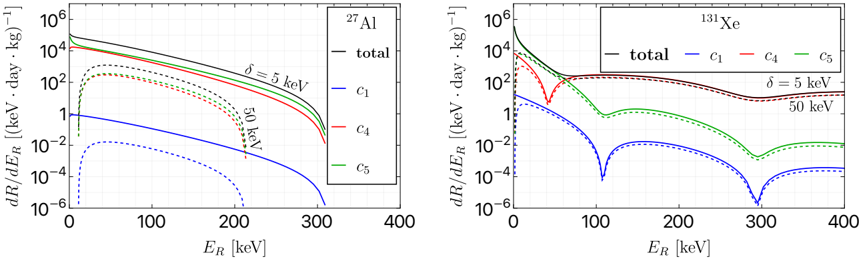
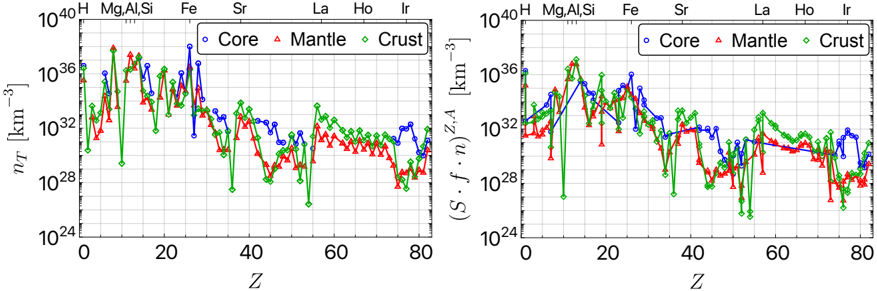
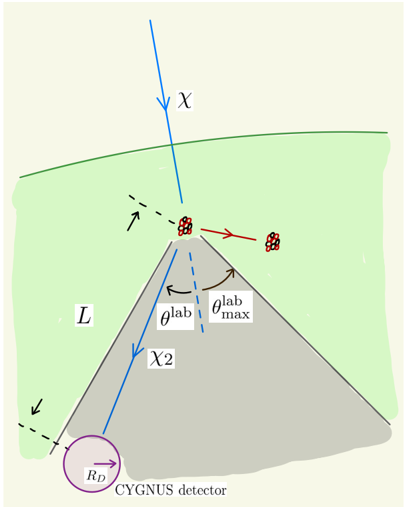
A bstract: Inelastic dark matter with moderate splittings, $$ \mathcal{O} $$ O (few to 150) keV, can upscatter to an excited state in the Earth, with the excited state subsequently decaying, leaving a distinctive monoenergetic photon signal in large underground detectors. The photon signal can exhibit sidereal-daily modulation, providing excellent separation from backgrounds. Using a detailed numerical simulation, we examine this process as a search strategy for magnetic inelastic dark matter with the dark matter mass near the weak scale, where the upscatter to the excited state and decay proceed through the same magnetic dipole transition operator. At lower inelastic splittings, the scattering is dominated by moderate mass elements in the Earth with high spin, especially 27 Al, while at larger splittings, 56 Fe becomes the dominant target. We show that the proposed large volume gaseous detector CYGNUS will have excellent sensitivity to this signal. Xenon detectors also provide excellent sensitivity through the inelastic nuclear recoil signal, and if a future signal is seen, we show that the synergy among both types of detection can provide strong evidence for magnetic inelastic dark matter. In the course we have calculated nuclear response functions for elements relevant for scattering in the Earth, which are publicly available on GitHub .
Checked 2026-11-23 · 1 reference not checked yet
Overview
CoChat Summary
TL;DR
The paper proposes detecting magnetic inelastic dark matter (MIDM) via Earth upscattering to an excited state that decays to a monoenergetic photon in large underground detectors, with sidereal-daily modulation separating signal from background. It projects strong sensitivity for a 1000 m³ CYGNUS detector and recasts LZ nuclear-recoil constraints, finding ²⁷Al and ⁵⁶Fe dominate Earth scattering for splittings from few to 150 keV.
Key findings
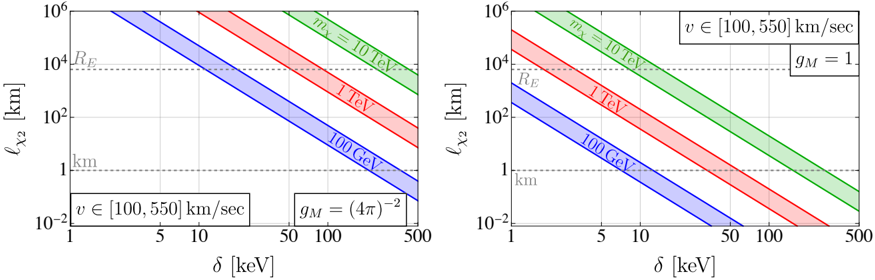
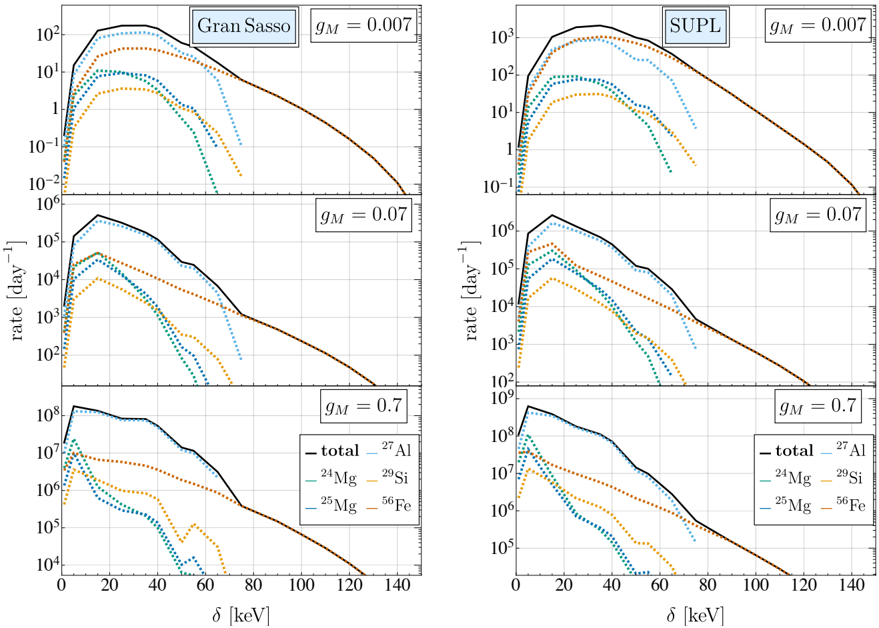
- For mχ = 1 TeV and δ ∼ few–150 keV with gM < 1, the photon signal can be many events per day with substantial sidereal-daily modulation; the optimal excited-state decay length is km ≲ ℓχ₂ ≲ R_E. At lower δ, scattering is dominated by ²⁷Al; at larger δ, ⁵⁶Fe becomes the dominant target.
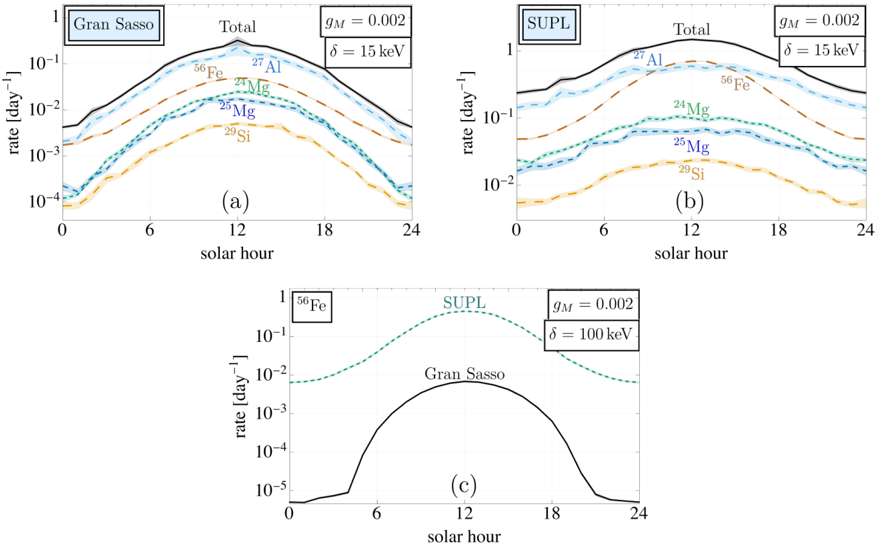
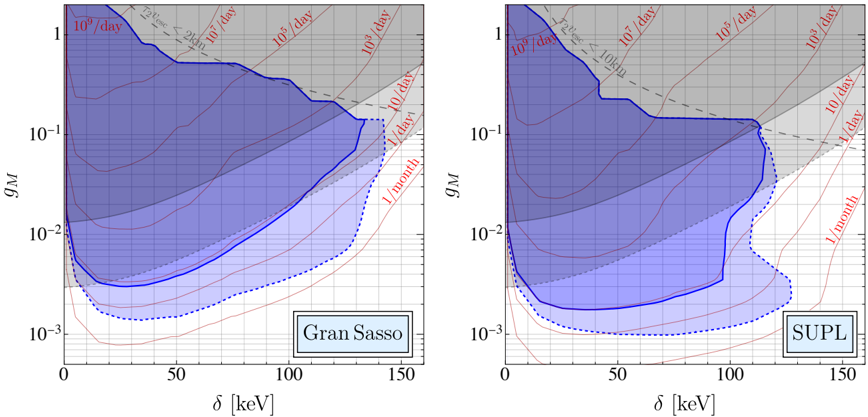
- A 1000 m³ CYGNUS detector at Gran Sasso or SUPL with 6 years and projected backgrounds gives sensitivity competitive with direct detection; 1 year of zero-background running gives substantial improvement. At δ = 15 keV, gM = 2 × 10⁻³, mχ = 1 TeV, the SUPL rate is an order of magnitude larger than at Gran Sasso; at δ = 100 keV only iron scattering is possible.
- Recasting LZ nuclear-recoil data with 11 events and N_sig ≲ 16.6 (90% CL) gives gM ≲ 0.0026 for mχ = 1 TeV. For a magnetic dipole moment, this implies mχ > 1.0 TeV for gM = g²/(16π²), mχ > 52 TeV for gM = 1, and mχ > 126 TeV for gM = g_neutron = −3.83.
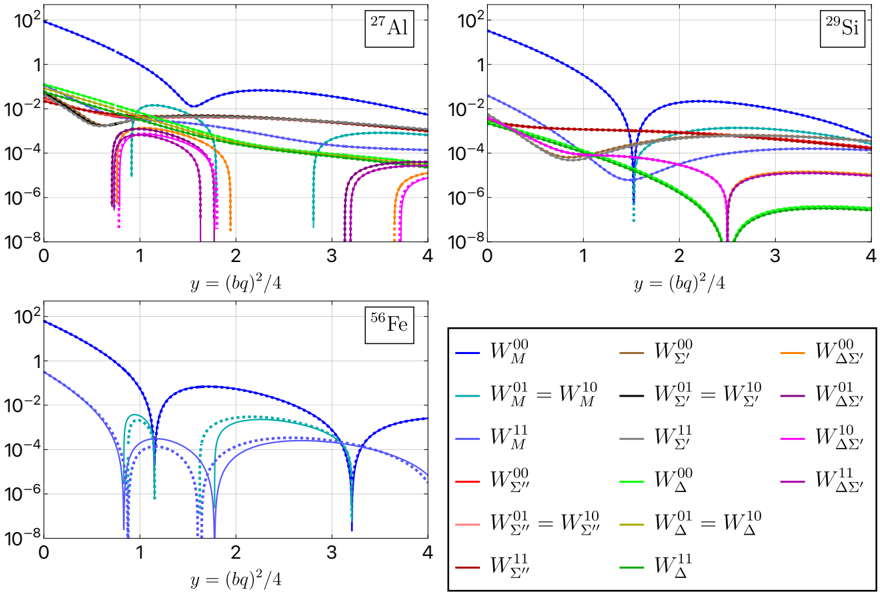
- Nuclear response functions were calculated for elements relevant to Earth scattering and are publicly available on GitHub; results were cross-checked with previous works where overlapping.
Methods
- Numerical simulation of χ + N → χ₂ + N upscattering in the Earth followed by χ₂ → χγ decay in the detector, using a three-layer Earth model (core, mantle, crust) with isotopic abundances; dominant isotopes are ²⁴Mg, ²⁵Mg, ²⁷Al, ²⁹Si, and ⁵⁶Fe. Detector locations are Gran Sasso (42.6°N, 1.4 km depth) and SUPL (37.1°S, 1 km depth), with a 1000 m³ CYGNUS volume, 6 years with background, and 1 year zero-background.
- Signal rate computed from eq. (3.8), integrating over scattering sites and a Maxwell-Boltzmann velocity distribution with v_esc = 550 km/s, velocity dispersion 220 km/s, and ρχ = 0.3 GeV/cm³. Sensitivity uses a sidereal-day on/off modulation analysis requiring Γ_signal/Γ_off ≲ n × 1.64/√N_off.
- Direct-detection recast for LZ uses 5.5 t fiducial mass, 60 live days, 11 observed events, and N_sig ≲ 16.6 (90% CI); nuclear response functions are computed with the BIGSTICK shell-model code and a Mathematica package.
Limitations
- The paper states CYGNUS remains at the proposal stage; nuclear-physics uncertainties are sub-percent for light elements (Z ≲ 20) but grow to O(10%–50%) for elements as heavy as iron and beyond. ⁵⁷Fe was excluded due to high sensitivity to nuclear-model details, making bounds conservative. The LZ nuclear-recoil band was calibrated with neutron scattering and may not accurately represent the O₅-dominated MIDM response, so the true limit lies between the light and dark gray regions shown. The simplified two-bin modulation analysis may be improved by a more robust analysis.
- The paper states it assumes 100% efficiency for 5 keV ≲ E_R ≲ 55 keV and 0% elsewhere, ignores readout noise, and uses the January 1 Earth position conservatively. For mχ near or below m_N, nonlinearities prevent simple scaling.
- Evident from the text: sensitivity projections depend on assumed backgrounds, Earth composition and isotopic abundances, local dark matter density and velocity distribution, and detector location/depth; no experimental data are presented.
Model-written summary. Check it against the paper before relying on it.
Integrity signals
Registry
Cites
Statistics
Figures
Verification
Claims the paper makes
0 Valid · 3 Not valid · 17 Not checked · 115 Own results and interpretations
A result the paper reports from its own data — it cites no other source for it, so there is none to check. The quote shows it is in the paper.
In the paper
“while at larger splittings, 56 Fe becomes the dominant target.”
§ Earth-catalyzed detection of magnetic inelastic dark matter with photons in large underground detectors > Abstract
plainstates a cause- Asserted: passes — The authors put it forward as true.
- Checkable: passes — It can be checked against evidence.
- Load-bearing: passes — The paper’s conclusions depend on it.
- Based: passes — The paper gives a reason why it holds.
A result the paper reports from its own data — it cites no other source for it, so there is none to check. The quote shows it is in the paper.
In the paper
“We show the rate for various elements but it is dominated at this latitude by scattering off elements in the crust, in particular aluminum.”
§ Earth-catalyzed detection of magnetic inelastic dark matter with photons in large underground detectors > 3.1 Rates at a typical detector
plainstates a cause- Asserted: passes — The authors put it forward as true.
- Checkable: passes — It can be checked against evidence.
- Load-bearing: passes — The paper’s conclusions depend on it.
- Based: passes — The paper gives a reason why it holds.
A result the paper states — it cites no source for it, so there is none to check. The quote shows it is in the paper.
In the paper
“At large mass splitting and large coupling, where the distance traveled by χ 2 is < ∼ O(1) km, there is little difference between the rates expected at SUPL and Gran Sasso.”
§ Earth-catalyzed detection of magnetic inelastic dark matter with photons in large underground detectors > 3.1 Rates at a typical detector
plain- Asserted: passes — The authors put it forward as true.
- Checkable: passes — It can be checked against evidence.
- Load-bearing: unclear — It is unclear whether the paper’s conclusions depend on it.
- Based: passes — The paper gives a reason why it holds.
A result the paper states — it cites no source for it, so there is none to check. The quote shows it is in the paper.
In the paper
“Comparing this to the typical distance traveled before a decay eq.(2.6) we find that for δ ≳ 1 keV and above range the downscattering process is negligible.”
§ Earth-catalyzed detection of magnetic inelastic dark matter with photons in large underground detectors > JHEP06(2024)165
plain- Asserted: passes — The authors put it forward as true.
- Checkable: passes — It can be checked against evidence.
- Load-bearing: passes — The paper’s conclusions depend on it.
- Based: passes — The paper gives a reason why it holds.
A result the paper reports from its own data — it cites no other source for it, so there is none to check. The quote shows it is in the paper.
In the paper
“At lower inelastic splittings, the scattering is dominated by moderate mass elements in the Earth with high spin, especially 27 Al”
§ Earth-catalyzed detection of magnetic inelastic dark matter with photons in large underground detectors > Abstract
plainstates a cause- Asserted: passes — The authors put it forward as true.
- Checkable: passes — It can be checked against evidence.
- Load-bearing: passes — The paper’s conclusions depend on it.
- Based: passes — The paper gives a reason why it holds.
75 more claims
Create a free account to see all 135 claims and to verify the 15 references still open.
- It may state two separate claims as one. 38
- Probably not a substantial claim. 21
- The quote only partly states this claim. 2
Citations
Cites
Composition of the Continental Crust
Rudnick, R. L., & Gao, S. (2014) · Treatise on Geochemistry · doi:10.1016/b978-0-08-095975-7.00301-6 · Cited by 5,691
Table of nuclear magnetic dipole and electric quadrupole moments
Stone, N. J. (2005) · Atomic Data and Nuclear Data Tables · doi:10.1016/j.adt.2005.04.001 · Cited by 1,256
Cosmochemical Estimates of Mantle Composition
Palme, H., & O'Neill, H. S. C. (2014) · Treatise on Geochemistry · doi:10.1016/b978-0-08-095975-7.00201-1 · Cited by 1,238
Smith, D., & Weiner, N. (2001) · Physical Review D · doi:10.1103/physrevd.64.043502 · Cited by 819
The Shell-Model Code NuShellX@MSU
BROWN, B. A., & Rae, W. D. M. (2014) · Nuclear Data Sheets · doi:10.1016/j.nds.2014.07.022 · Cited by 719
First Dark Matter Search Results from the LUX-ZEPLIN (LZ) Experiment
Aalbers, J., Akerib, D. S., Akerlof, C. W., Al Musalhi, A. K., Alder, F., Alqahtani, A., Alsum, S. K., Amarasinghe, C. S., Ames, A., Anderson, T. J., et al. (2023) · Physical Review Letters · doi:10.1103/physrevlett.131.041002 · Cited by 690
Two-component spinor techniques and Feynman rules for quantum field theory and supersymmetry
Dreiner, H. K., Haber, H. E., & Martin, S. P. (2010) · Physics Reports · doi:10.1016/j.physrep.2010.05.002 · Cited by 531
The effective field theory of dark matter direct detection
Fitzpatrick, A. L., Haxton, W., Katz, E., Lubbers, N., & Xu, Y. (2013) · Journal of Cosmology and Astroparticle Physics · doi:10.1088/1475-7516/2013/02/004 · Cited by 487
Excess electronic recoil events in XENON1T
Aprile, E., Aalbers, J., Agostini, F., Alfonsi, M., Althueser, L., Amaro, F. D., Antochi, V. C., Angelino, E., Angevaare, J. R., Arneodo, F., et al. (2020) · Physical Review D · doi:10.1103/physrevd.102.072004 · Cited by 481
Colloquium: Annual modulation of dark matter
Freese, K., Lisanti, M., & Savage, C. (2013) · Reviews of Modern Physics · doi:10.1103/revmodphys.85.1561 · Cited by 349
Exciting dark matter and the INTEGRAL/SPI 511 keV signal
Finkbeiner, D. P., & Weiner, N. (2007) · Physical Review D · doi:10.1103/physrevd.76.083519 · Cited by 341
Weakly interacting massive particle-nucleus elastic scattering response
Anand, N., Fitzpatrick, A. L., & Haxton, W. C. (2014) · Physical Review C · doi:10.1103/physrevc.89.065501 · Cited by 258
Inelastic dark matter in light of DAMA/LIBRA
Chang, S., Kribs, G. D., Tucker-Smith, D., & Weiner, N. (2009) · Physical review. D. Particles, fields, gravitation, and cosmology/Physical review. D. Particles and fields · doi:10.1103/physrevd.79.043513 · Cited by 242
Self-citationStatus of inelastic dark matter
Tucker-Smith, D., & Weiner, N. (2005) · Physical Review D · doi:10.1103/physrevd.72.063509 · Cited by 239
Sneutrino cold dark matter, a new analysis: relic abundance and detection rates
Arina, C., & Fornengo, N. (2007) · Journal of High Energy Physics · doi:10.1088/1126-6708/2007/11/029 · Cited by 214
Sneutrino cold dark matter with lepton-number violation
Hall, L. J., Moroi, T., & Murayama, H. (1998) · Physics Letters B · doi:10.1016/s0370-2693(98)00196-8 · Cited by 213
Candidates for inelastic dark matter
Cui, Y., Morrissey, D. E., Poland, D., & Randall, L. (2009) · Journal of High Energy Physics · doi:10.1088/1126-6708/2009/05/076 · Cited by 192
Compositional Model for the Earth's Core
McDonough, W. F. (2013) · Elsevier eBooks · doi:10.1016/b978-0-08-095975-7.00215-1 · Cited by 192
Heating up neutron stars with inelastic dark matter
Bell, N. F., Busoni, G., & Robles, S. (2018) · Journal of Cosmology and Astroparticle Physics · doi:10.1088/1475-7516/2018/09/018 · Cited by 156
Dark Photon and Muon g−2 Inspired Inelastic Dark Matter Models at the High-Energy Intensity Frontier
Tsai, Y.-D., deNiverville, P., & Liu, M. X. (2021) · Physical Review Letters · doi:10.1103/physrevlett.126.181801 · Cited by 153
Exploring new physics with O(keV) electron recoils in direct detection experiments
Bloch, I. M., Caputo, A., Essig, R., Redigolo, D., Sholapurkar, M., & Volansky, T. (2021) · Journal of High Energy Physics · doi:10.1007/jhep01(2021)178 · Cited by 151
The SABRE project and the SABRE Proof-of-Principle
Antonello, M., Barberio, E. L., Baroncelli, T., Benziger, J. B., Bignell, L. J., Bolognino, I., Calaprice, F., Copello, S., D'Angelo, D., D’Imperio, G., et al. (2019) · The European Physical Journal C · doi:10.1140/epjc/s10052-019-6860-y · Cited by 146
Multipole operators in semileptonic weak and electromagnetic interactions with nuclei
Donnelly, T. W., & Haxton, W. C. (1979) · Atomic Data and Nuclear Data Tables · doi:10.1016/0092-640x(79)90003-2 · Cited by 141
Vahsen, S. E., O’Hare, C. A. J., Lynch, W., Spooner, N. J. C., Baracchini, E., Barbeau, P. S., Battat, J., Crow, B., Deaconu, C., Eldridge, C., et al. (2020) · White Rose Research Online (University of Leeds, The University of Sheffield, University of York) · doi:10.48550/arxiv.2008.12587 · Cited by 133
BIGSTICK: A flexible configuration-interaction shell-model code (updated)Preprint
Johnson, C. W., Ormand, W. E., McElvain, K., Zbikowski, R., & Shan, H. (2018) · arXiv (Cornell University) · doi:10.48550/arxiv.1801.08432 · Cited by 128
Global interpretation of direct Dark Matter searches after CDMS-II results
Kopp, J., Schwetz, T., & Zupan, J. (2010) · Journal of Cosmology and Astroparticle Physics · doi:10.1088/1475-7516/2010/02/014 · Cited by 124
Magnetic inelastic dark matter
Chang, S., Weiner, N., & Yavin, I. (2010) · Physical Review D · doi:10.1103/physrevd.82.125011 · Cited by 121
Fox, P. J., Kribs, G. D., & Tait, T. M. P. (2011) · Physical review. D. Particles, fields, gravitation, and cosmology/Physical review. D. Particles and fields · doi:10.1103/physrevd.83.034007 · Cited by 120
Self-citationA model independent approach to inelastic dark matter scattering
Barello, G., Chang, S., & Newby, C. A. (2014) · Physical review. D. Particles, fields, gravitation, and cosmology/Physical review. D. Particles and fields · doi:10.1103/physrevd.90.094027 · Cited by 118
Electromagnetic signals of inelastic dark matter scattering
Baryakhtar, M., Berlin, A., Liu, H., & Weiner, N. (2022) · Journal of High Energy Physics · doi:10.1007/jhep06(2022)047 · Cited by 106
Form factors for dark matter capture by the Sun in effective theories
Catena, R., & Schwabe, B. (2015) · Journal of Cosmology and Astroparticle Physics · doi:10.1088/1475-7516/2015/04/042 · Cited by 104
Exploring new physics with O(keV) electron recoils in direct detection experiments
Bloch, I. M., Caputo, A., Essig, R., Redigolo, D., Sholapurkar, M., & Volansky, T. (2021) · OSTI OAI (U.S. Department of Energy Office of Scientific and Technical Information) · doi:10.1007/jhep01%282021%29178 · Cited by 102
Last electroweak WIMP standing: pseudo-dirac higgsino status and compact stars as future probes
Krall, R., & Reece, M. (2018) · Chinese Physics C · doi:10.1088/1674-1137/42/4/043105 · Cited by 101
Messenger sneutrinos as cold dark matter
Han, T., & Hempfling, R. (1997) · Physics Letters B · doi:10.1016/s0370-2693(97)01205-7 · Cited by 100
Vahsen, S. E., O’Hare, C. A. J., & Loomba, D. (2021) · Annual Review of Nuclear and Particle Science · doi:10.1146/annurev-nucl-020821-035016 · Cited by 97
Sneutrino Dark Matter in Gauged Inverse Seesaw Models for Neutrinos
An, H., Dev, P. S. B., Cai, Y., & Mohapatra, R. N. (2012) · Physical Review Letters · doi:10.1103/physrevlett.108.081806 · Cited by 94
Explaining the XENON1T Excess with Luminous Dark Matter
Bell, N. F., Dent, J. B., Dutta, B., Ghosh, S., Kumar, J., & Newstead, J. L. (2020) · Physical Review Letters · doi:10.1103/physrevlett.125.161803 · Cited by 90
Feldstein, B., Graham, P. W., & Rajendran, S. (2010) · Physical review. D. Particles, fields, gravitation, and cosmology/Physical review. D. Particles and fields · doi:10.1103/physrevd.82.075019 · Cited by 83
Electric But Not Eclectic: Thermal Relic Dark Matter for the XENON1T Excess
Bramante, J., & Song, N. (2020) · Physical Review Letters · doi:10.1103/physrevlett.125.161805 · Cited by 78
Cosmic-ray upscattered inelastic dark matter
Bell, N. F., Dent, J. B., Dutta, B., Ghosh, S., Kumar, J., Newstead, J. L., & Shoemaker, I. M. (2021) · Physical review. D/Physical review. D. · doi:10.1103/physrevd.104.076020 · Cited by 73
Dark-Matter Decay as a Complementary Probe of Multicomponent Dark Sectors
Dienes, K. R., Kumar, J., Thomas, B., & Yaylali, D. (2015) · Physical Review Letters · doi:10.1103/physrevlett.114.051301 · Cited by 65
Inelastic frontier: Discovering dark matter at high recoil energy
Bramante, J., Fox, P. J., Kribs, G. D., & Martin, A. (2016) · Physical Review D · doi:10.1103/physrevd.94.115026 · Cited by 63
Self-citationCosmology and signals of light pseudo-Dirac dark matter
González, M. C., & Toro, N. (2022) · Journal of High Energy Physics · doi:10.1007/jhep04(2022)060 · Cited by 60
The Theory of Direct Dark Matter Detection: A Guide to Computations
Nobile, E. D. (2022) · Lecture notes in physics · doi:10.1007/978-3-030-95228-0 · Cited by 59
Luminous solar neutrinos. I. Dipole portals
Plestid, R. (2021) · Physical review. D/Physical review. D. · doi:10.1103/physrevd.104.075027 · Cited by 58
Metastable nuclear isomers as dark matter accelerators
Pospelov, M., Rajendran, S., & Ramani, H. (2020) · Physical review. D/Physical review. D. · doi:10.1103/physrevd.101.055001 · Cited by 58
Low-mass inelastic dark matter direct detection via the Migdal effect
Bell, N. F., Dent, J. B., Dutta, B., Ghosh, S., Kumar, J., & Newstead, J. L. (2021) · Physical review. D/Physical review. D. · doi:10.1103/physrevd.104.076013 · Cited by 56
Split Dirac supersymmetry: An ultraviolet completion of Higgsino dark matter
Fox, P. J., Kribs, G. D., & Martin, A. (2014) · Physical review. D. Particles, fields, gravitation, and cosmology/Physical review. D. Particles and fields · doi:10.1103/physrevd.90.075006 · Cited by 53
Self-citationDark matter detection in two easy steps
Pospelov, M., Weiner, N., & Yavin, I. (2014) · Physical review. D. Particles, fields, gravitation, and cosmology/Physical review. D. Particles and fields · doi:10.1103/physrevd.89.055008 · Cited by 50
Search for Dark Matter Induced Deexcitation of Tam180
Lehnert, B., Ramani, H., Hult, M., Lutter, G., Pospelov, M., Rajendran, S., & Zuber, K. (2020) · Physical Review Letters · doi:10.1103/physrevlett.124.181802 · Cited by 42
Reviving MeV-GeV indirect detection with inelastic dark matter
Berlin, A., Krnjaic, G., & Pinetti, E. (2024) · Physical review. D/Physical review. D. · doi:10.1103/physrevd.110.035015 · Cited by 37
Filimonova, A., Junius, S., Lopez-Honorez, L., & Westhoff, S. (2022) · Journal of High Energy Physics · doi:10.1007/jhep06(2022)048 · Cited by 36
Electron recoils from terrestrial upscattering of inelastic dark matter
Emken, T., Frerick, J., Heeba, S., & Kahlhoefer, F. (2022) · Physical review. D/Physical review. D. · doi:10.1103/physrevd.105.055023 · Cited by 31
Effective field theory and inelastic dark matter results from XENON1T
Aprile, E., Abe, K., Agostini, F., Maouloud, S. A., Althueser, L., Andrieu, B., Angelino, E., Angevaare, J. R., Antochi, V. C., Martin, D. A., et al. (2024) · Physical review. D/Physical review. D. · doi:10.1103/physrevd.109.112017 · Cited by 28
Extending the discovery potential for inelastic-dipole dark matter with FASER
Dienes, K. R., Feng, J. L., Fieg, M., Huang, F., Lee, S. J., & Thomas, B. (2023) · Physical review. D/Physical review. D. · doi:10.1103/physrevd.107.115006 · Cited by 28
Heeba, S., Lin, T., & Schutz, K. (2023) · Physical review. D/Physical review. D. · doi:10.1103/physrevd.108.095016 · Cited by 27
Pushing the frontier of WIMPy inelastic dark matter: Journey to the end of the periodic table
Song, N., Nagorny, S. S., & Vincent, A. C. (2021) · Physical review. D/Physical review. D. · doi:10.1103/physrevd.104.103032 · Cited by 26
New constraints on inelastic dark matter from IceCube
Catena, R., & Hellström, F. (2018) · Journal of Cosmology and Astroparticle Physics · doi:10.1088/1475-7516/2018/10/039 · Cited by 26
Magnetic inelastic dark matter: Directional signals without a directional detector
Lin, T., & Finkbeiner, D. P. (2011) · Physical review. D. Particles, fields, gravitation, and cosmology/Physical review. D. Particles and fields · doi:10.1103/physrevd.83.083510 · Cited by 26
Luminous solar neutrinos. II. Mass-mixing portals
Plestid, R. (2021) · Physical review. D/Physical review. D. · doi:10.1103/physrevd.104.075028 · Cited by 23
Neutrino constraints on inelastic dark matter captured in the Sun
Chauhan, B., Reno, M. H., Rott, C., & Sarcevic, I. (2024) · Journal of Cosmology and Astroparticle Physics · doi:10.1088/1475-7516/2024/01/030 · Cited by 22
Luminous signals of inelastic dark matter in large detectors
Eby, J., Fox, P. J., Harnik, R., & Kribs, G. D. (2019) · Journal of High Energy Physics · doi:10.1007/jhep09(2019)115 · Cited by 21
Self-citationThe effect of multiple cooling channels on the formation of dark compact objects
Bramante, J., Diamond, M. D., & Kim, J. L. (2024) · Journal of Cosmology and Astroparticle Physics · doi:10.1088/1475-7516/2024/02/002 · Cited by 18
Detection of inelastic dark matter via electron recoils in SENSEI
Gu, Y., Wu, L., & Zhu, B. (2022) · Physical review. D/Physical review. D. · doi:10.1103/physrevd.106.075004 · Cited by 18
Sub-GeV dark matter search at ILC beam dumps
Asai, K., Iwamoto, S., Perelstein, M. E., Sakaki, Y., & Ueda, D. (2024) · Journal of High Energy Physics · doi:10.1007/jhep02(2024)129 · Cited by 17
A search for rare and induced nuclear decays in hafnium
Broerman, B., Laubenstein, M., Nagorny, S. S., Song, N., & Vincent, A. C. (2021) · Nuclear Physics A · doi:10.1016/j.nuclphysa.2021.122212 · Cited by 16
Probing inelastic dark matter at the LHC, FASER, and STCF
Lu, C.-T., Tu, J., & Wu, L. (2024) · Physical review. D/Physical review. D. · doi:10.1103/physrevd.109.015018 · Cited by 16
Indirect detection of low mass dark matter in direct detection experiments with inelastic scattering
Bell, N. F., Dent, J. B., Dutta, B., Kumar, J., & Newstead, J. L. (2022) · Physical review. D/Physical review. D. · doi:10.1103/physrevd.106.103016 · Cited by 12
Looking forward to inelastic DM with electromagnetic form factors at FASER and beam dump experiments
Jodłowski, K. (2023) · Physical review. D/Physical review. D. · doi:10.1103/physrevd.108.115025 · Cited by 11
Yuan, Y., Abdukerim, A., Bo, Z., Chen, W., Chen, X., Chen, Y., Cheng, C., Cui, X., Fan, Y., Fang, D., et al. (2022) · Physics Letters B · doi:10.1016/j.physletb.2022.137254 · Cited by 10
The Effective Field Theory of Dark Matter Direct Detection
Fitzpatrick, A. L., Haxton, W., Katz, E., Lubbers, N., & Xu, Y. (2012) · arXiv
Smith, D., & Weiner, N. (2001) · arXiv · doi:10.48550/arxiv.hep-ph/0101138
Effective field theory and inelastic dark matter results from XENON1T
Aprile, E., Abe, K., Agostini, F., Maouloud, S. A., Althueser, L., Andrieu, B., Angelino, E., Angevaare, J. R., Antochi, V. C., Martin, D. A., et al. (2022) · arXiv · doi:10.48550/arxiv.2210.07591
Reviving MeV-GeV Indirect Detection with Inelastic Dark Matter
Berlin, A., Krnjaic, G., & Pinetti, E. (2023) · arXiv · doi:10.48550/arxiv.2311.00032
Yuan, Y., Abdukerim, A., Bo, Z., Chen, W., Chen, X., Chen, Y., Cheng, C., Cui, X., Fan, Y., Fang, D., et al. (2022) · arXiv · doi:10.48550/arxiv.2205.08066
Excess Electronic Recoil Events in XENON1T
Aprile, E., Aalbers, J., Agostini, F., Alfonsi, M., Althueser, L., Amaro, F. D., Antochi, V. C., Angelino, E., Angevaare, J. R., Arneodo, F., et al. (2020) · arXiv · doi:10.48550/arxiv.2006.09721
The SABRE project and the SABRE PoP
Antonello, M., Barberio, E., Baroncelli, T., Benziger, J., Bignell, L. J., Bolognino, I., Calaprice, F., Copello, S., D'Angelo, D., D'Imperio, G., et al. (2018) · arXiv · doi:10.48550/arxiv.1806.09340
First Dark Matter Search Results from the LUX-ZEPLIN (LZ) Experiment
Aalbers, J., Akerib, D. S., Akerlof, C. W., Musalhi, A. K. A., Alder, F., Alqahtani, A., Alsum, S. K., Amarasinghe, C. S., Ames, A., Anderson, T. J., et al. (2022) · arXiv · doi:10.48550/arxiv.2207.03764
Messenger sneutrinos as cold dark matter
Han, T., & Hempfling, R. (1997) · arXiv · doi:10.48550/arxiv.hep-ph/9708264
Sneutrino Cold Dark Matter With Lepton-Number Violation
Hall, L. J., Moroi, T., & Murayama, H. (1997) · arXiv · doi:10.48550/arxiv.hep-ph/9712515
The Status of Inelastic Dark Matter
Tucker-Smith, D., & Weiner, N. (2004) · arXiv · doi:10.48550/arxiv.hep-ph/0402065
Exciting Dark Matter and the INTEGRAL/SPI 511 keV signal
Finkbeiner, D. P., & Weiner, N. (2007) · arXiv · doi:10.48550/arxiv.astro-ph/0702587
Sneutrino cold dark matter, a new analysis: relic abundance and detection rates
Arina, C., & Fornengo, N. (2007) · arXiv · doi:10.48550/arxiv.0709.4477
Inelastic Dark Matter in Light of DAMA/LIBRA
Chang, S., Kribs, G. D., Tucker-Smith, D., & Weiner, N. (2008) · arXiv · doi:10.48550/arxiv.0807.2250
Self-citationCandidates for Inelastic Dark Matter
Cui, Y., Morrissey, D. E., Poland, D., & Randall, L. (2009) · arXiv · doi:10.48550/arxiv.0901.0557
Fox, P. J., Kribs, G. D., & Tait, T. M. P. (2010) · arXiv · doi:10.48550/arxiv.1011.1910
Self-citationMagnetic Inelastic Dark Matter: Directional Signals Without a Directional Detector
Lin, T., & Finkbeiner, D. P. (2010) · arXiv · doi:10.48550/arxiv.1011.3052
Sneutrino Dark Matter in Gauged Inverse Seesaw Models for Neutrinos
An, H., Dev, P. S. B., Cai, Y., & Mohapatra, R. N. (2011) · arXiv · doi:10.48550/arxiv.1110.1366
Dark matter detection in two easy steps
Pospelov, M., Weiner, N., & Yavin, I. (2013) · arXiv · doi:10.48550/arxiv.1312.1363
A Model Independent Approach to Inelastic Dark Matter Scattering
Barello, G., Chang, S., & Newby, C. A. (2014) · arXiv · doi:10.48550/arxiv.1409.0536
The Inelastic Frontier: Discovering Dark Matter at High Recoil Energy
Bramante, J., Fox, P. J., Kribs, G. D., & Martin, A. (2016) · arXiv · doi:10.48550/arxiv.1608.02662
Self-citationLast Electroweak WIMP Standing: Pseudo-Dirac Higgsino Status and Compact Stars as Future Probes
Krall, R., & Reece, M. (2017) · arXiv · doi:10.48550/arxiv.1705.04843
Pushing the frontier of WIMPy inelastic dark matter: journey to the end of the periodic table
Song, N., Nagorny, S., & Vincent, A. C. (2021) · arXiv · doi:10.48550/arxiv.2104.09517
Heating up Neutron Stars with Inelastic Dark Matter
Bell, N. F., Busoni, G., & Robles, S. (2018) · arXiv · doi:10.48550/arxiv.1807.02840
New constraints on inelastic dark matter from IceCube
Catena, R., & Hellström, F. (2018) · arXiv · doi:10.48550/arxiv.1808.08082
Metastable Nuclear Isomers as Dark Matter Accelerators
Pospelov, M., Rajendran, S., & Ramani, H. (2019) · arXiv · doi:10.48550/arxiv.1907.00011
Search for dark matter induced de-excitation of $^{180}$Ta$\rm ^m$
Lehnert, B., Ramani, H., Hult, M., Lutter, G., Pospelov, M., Rajendran, S., & Zuber, K. (2019) · arXiv · doi:10.48550/arxiv.1911.07865
A search for rare and induced nuclear decays in hafnium
Broerman, B., Laubenstein, M., Nagorny, S., Song, N., & Vincent, A. C. (2020) · arXiv · doi:10.48550/arxiv.2012.08339
Low-mass inelastic dark matter direct detection via the Migdal effect
Bell, N. F., Dent, J. B., Dutta, B., Ghosh, S., Kumar, J., & Newstead, J. L. (2021) · arXiv · doi:10.48550/arxiv.2103.05890
Cosmic-ray upscattered inelastic dark matter
Bell, N. F., Dent, J. B., Dutta, B., Ghosh, S., Kumar, J., Newstead, J. L., & Shoemaker, I. M. (2021) · arXiv · doi:10.48550/arxiv.2108.00583
Cosmology and Signals of Light Pseudo-Dirac Dark Matter
González, M. C., & Toro, N. (2021) · arXiv · doi:10.48550/arxiv.2108.13422
Filimonova, A., Junius, S., Honorez, L. L., & Westhoff, S. (2022) · arXiv · doi:10.48550/arxiv.2201.08409
Low-Mass dark matter (in)direct detection with inelastic scattering
Bell, N. F., Dent, J. B., Dutta, B., Kumar, J., & Newstead, J. L. (2022) · arXiv · doi:10.48550/arxiv.2208.08020
The Effect of Multiple Cooling Channels on the Formation of Dark Compact Objects
Bramante, J., Diamond, M., & Kim, J. L. (2023) · arXiv · doi:10.48550/arxiv.2309.13148
Extending the Discovery Potential for Inelastic-Dipole Dark Matter with FASER
Dienes, K. R., Feng, J. L., Fieg, M., Huang, F., Lee, S. J., & Thomas, B. (2023) · arXiv · doi:10.48550/arxiv.2301.05252
Sub-GeV dark matter search at ILC beam dumps
Asai, K., Iwamoto, S., Perelstein, M., Sakaki, Y., & Ueda, D. (2023) · arXiv · doi:10.48550/arxiv.2301.03816
Probing Inelastic Dark Matter at the LHC, FASER and STCF
Lu, C.-T., Tu, J., & Wu, L. (2023) · arXiv · doi:10.48550/arxiv.2309.00271
Neutrino constraints on inelastic dark matter captured in the Sun
Chauhan, B., Reno, M. H., Rott, C., & Sarcevic, I. (2023) · arXiv · doi:10.48550/arxiv.2308.16134
Heeba, S., Lin, T., & Schutz, K. (2023) · arXiv · doi:10.48550/arxiv.2304.06072
Detection of Inelastic Dark Matter via Electron Recoils in SENSEI
Gu, Y., Wu, L., & Zhu, B. (2022) · arXiv · doi:10.48550/arxiv.2203.06664
Explaining the XENON1T excess with Luminous Dark Matter
Bell, N. F., Dent, J. B., Dutta, B., Ghosh, S., Kumar, J., & Newstead, J. L. (2020) · arXiv · doi:10.48550/arxiv.2006.12461
Electric But Not Eclectic: Thermal Relic Dark Matter for the XENON1T Excess
Bramante, J., & Song, N. (2020) · arXiv · doi:10.48550/arxiv.2006.14089
Electromagnetic Signals of Inelastic Dark Matter Scattering
Baryakhtar, M., Berlin, A., Liu, H., & Weiner, N. (2020) · arXiv · doi:10.48550/arxiv.2006.13918
Exploring New Physics with O(keV) Electron Recoils in Direct Detection Experiments
Bloch, I. M., Caputo, A., Essig, R., Redigolo, D., Sholapurkar, M., & Volansky, T. (2020) · arXiv · doi:10.48550/arxiv.2006.14521
The ups and downs of inelastic dark matter: Electron recoils from terrestrial upscattering
Emken, T., Frerick, J., Heeba, S., & Kahlhoefer, F. (2021) · arXiv · doi:10.48550/arxiv.2112.06930
Feldstein, B., Graham, P. W., & Rajendran, S. (2010) · arXiv · doi:10.48550/arxiv.1008.1988
Luminous Signals of Inelastic Dark Matter in Large Detectors
Eby, J., Fox, P. J., Harnik, R., & Kribs, G. D. (2019) · arXiv · doi:10.48550/arxiv.1904.09994
Self-citationSplit Dirac Supersymmetry: An Ultraviolet Completion of Higgsino Dark Matter
Fox, P. J., Kribs, G. D., & Martin, A. (2014) · arXiv · doi:10.48550/arxiv.1405.3692
Self-citationLuminous solar neutrinos I: Dipole portals
Plestid, R. (2020) · arXiv · doi:10.48550/arxiv.2010.04193
Luminous solar neutrinos II: Mass-mixing portals
Plestid, R. (2020) · arXiv · doi:10.48550/arxiv.2010.09523
Global interpretation of direct Dark Matter searches after CDMS-II results
Kopp, J., Schwetz, T., & Zupan, J. (2009) · arXiv · doi:10.48550/arxiv.0912.4264
Magnetic Inelastic Dark Matter
Chang, S., Weiner, N., & Yavin, I. (2010) · arXiv · doi:10.48550/arxiv.1007.4200
Vahsen, S. E., O'Hare, C. A. J., & Loomba, D. (2021) · arXiv · doi:10.48550/arxiv.2102.04596
Form factors for dark matter capture by the Sun in effective theories
Catena, R., & Schwabe, B. (2015) · arXiv · doi:10.48550/arxiv.1501.03729
Two-component spinor techniques and Feynman rules for quantum field theory and supersymmetry
Dreiner, H. K., Haber, H. E., & Martin, S. P. (2008) · arXiv · doi:10.48550/arxiv.0812.1594
Cited by
Cosmic-ray cooling in active galactic nuclei as a new probe of inelastic dark matter
Gustafson, R. A., Herrera, G., Mukhopadhyay, M., Murase, K., & Shoemaker, I. M. (2025) · Physical review. D/Physical review. D. · doi:10.1103/5m57-vgt2 · Cited by 25
A common origin of the Higgs boson and the flavor hierarchies
Lizana, J. M. (2025) · Journal of High Energy Physics · doi:10.1007/jhep05(2025)176 · Cited by 19
Direct detection of dark baryons naturally suppressed by H -parity
Asadi, P., Kribs, G. D., & Mantel, C. J. H. (2025) · Physical review. D/Physical review. D. · doi:10.1103/physrevd.111.095030 · Cited by 12
Self-citationNoble dark matter: Surprising elusiveness of dark baryons
Asadi, P., Batz, A., & Kribs, G. D. (2025) · Physical review. D/Physical review. D. · doi:10.1103/physrevd.111.095025 · Cited by 9
Self-citationMissing energy signatures of inelastic magnetic dipole DM at NA64e
Gninenko, S., Krasnikov, N. V., Voronchikhin, I. V., & Kirpichnikov, D. V. (2026) · Physical review. D/Physical review. D. · doi:10.1103/w86p-8mj9 · Cited by 2
Metadata
- Authors
- Eby, J., Fox, P. J., & Kribs, G. D.
- Affiliations
- Stockholm University (SE)
- Fermi National Accelerator Laboratory (US)
- University of Oregon (US)
- Corresponding author
- Eby, Joshua
- Venue
- Journal of High Energy Physics
- Published
- 2024-06-25
- Volume
- 2024
- Issue
- 6
- Pages
- 165
- ISSN
- 1029-8479 (ISSN-L)
- OpenAlex
- W4400057089
- Cited by
- 8
- References
- 70
- Citations by year
- 2026: 4 · 2025: 4
- FWCI
- 0.97
- Type
- journal article
- Language
- en
- Open access
- diamond
- doi.org
- Licence
- cc-by
- creativecommons.org/licenses/by/4.0 (tdm)
- creativecommons.org/licenses/by/4.0 (vor)
- Locations
- Journal of High Energy Physics (publishedVersion, cc-by)
- DOAJ (DOAJ: Directory of Open Access Journals) (submittedVersion)
- Funders
- U.S. Department of Energy (DESC0011640, AC02-07CH11359, DESC0007859, DE‐AC02‐07CH11359)
- Ministry of Education, Culture, Sports, Science and Technology
- Vetenskapsrådet (2019-02337, 2018-03641)
- Japan Society for the Promotion of Science (21H05451, 21K20366)
- Fermilab (DEAC02-07CH11359, DE-SC0007859)
- Topics
- Physical Sciences › Physics and Astronomy › Nuclear and High Energy Physics › Dark Matter and Cosmic Phenomena
- Physical Sciences › Physics and Astronomy › Nuclear and High Energy Physics › Neutrino Physics Research
- Physical Sciences › Physics and Astronomy › Nuclear and High Energy Physics › Particle physics theoretical and experimental studies
- Keywords
- inelastic dark matter, magnetic dipole transitions, sidereal modulation, xenon detectors, nuclear recoil, nuclear response functions, 27Al, 56Fe, dark matter direct detection, underground detectors
About these checks
Registry, retraction, Cites and statistics results are computed, not judged, with one exception: a printed reference that no index lists is read once by a model before it counts as a citation error. Claims are extracted by a model and kept only when their quote appears verbatim in the text; each cited source is then checked, with a model’s help, for whether it says what the claim relies on. Those verdicts can be wrong — read the claim’s quote and the cited source before relying on one.
A language model drew the claims from the paper on 2026-11-23, under version 3 of the claim definition (model deepseek-v4.1-flash, prompt extract-v3).
A second model labelled each claim on 2026-11-23 (model jev-1.13-20260917, definition revision gold-guideline-v0.2).
Statistics and arithmetic are recomputed, not judged.
Confidence bands are shown only for fields calibrated on our annotated test set. None is calibrated yet, so no band is shown.
What counts as a claim ›How we measure confidence ›How we check this ›
Are you an author, or do you see a problem with this page? Request a review
Data sources
Bibliographic data: Semantic Scholar, OpenAlex, Crossref.
Contains information from the Semantic Scholar Academic Graph Datasets, made available under the ODC Attribution License (ODC-BY 1.0).
Semantic Scholar’s data is described in: Kinney, R., et al. (2023). The Semantic Scholar Open Data Platform. arXiv:2301.10140.
