

The DOI matches its Crossref record; 16 of the 16 references it cites were found in a registry or an index.
Cosmology from random entanglement
Abstract
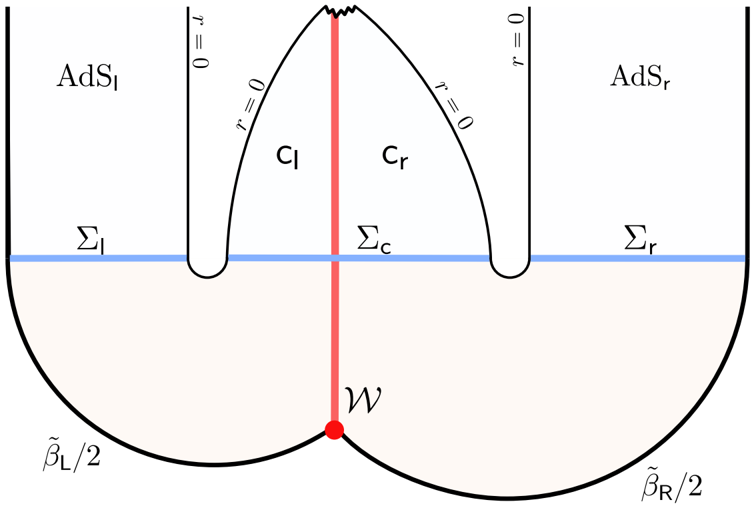
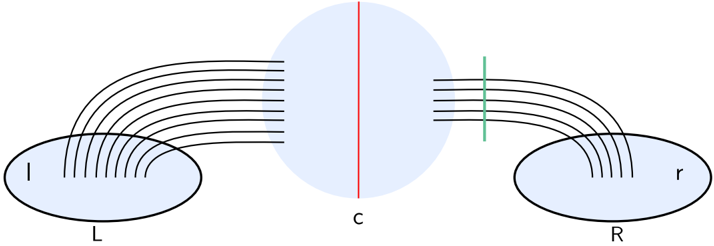
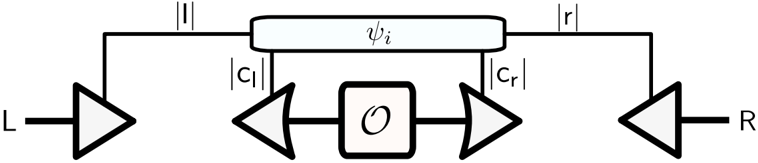
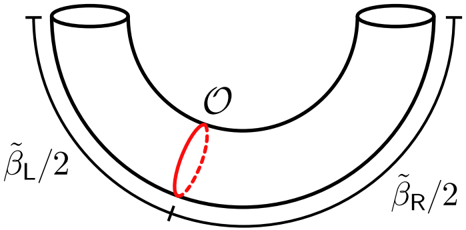
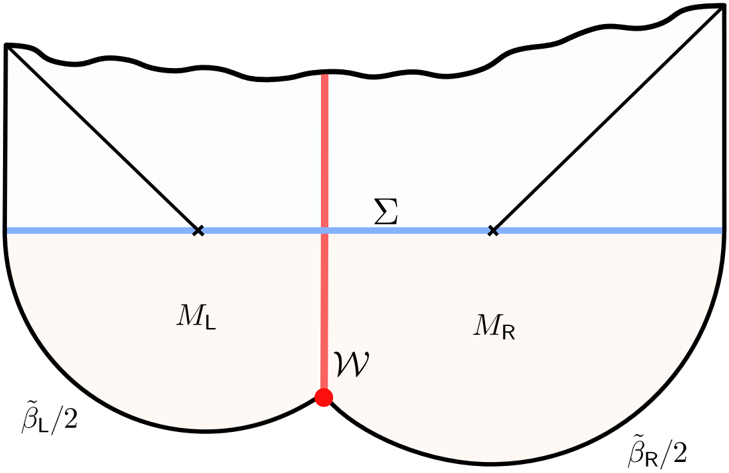
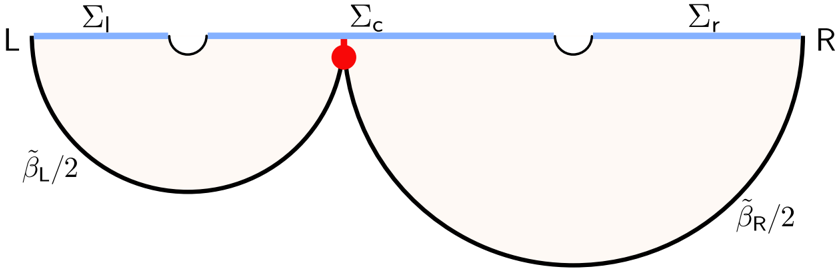
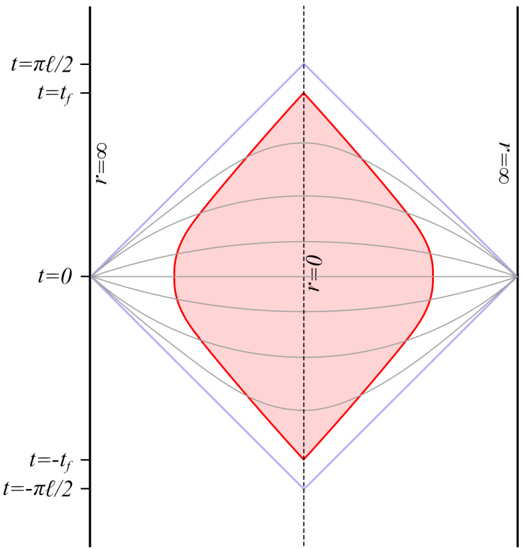
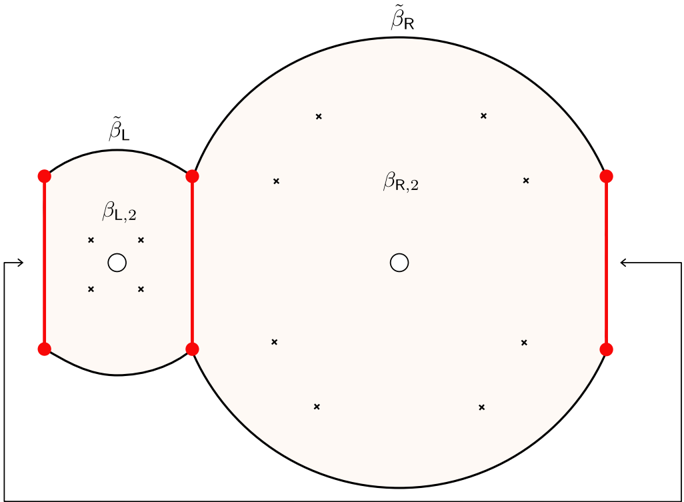
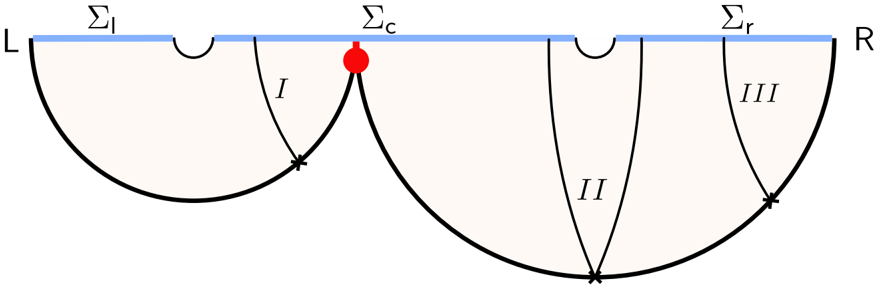
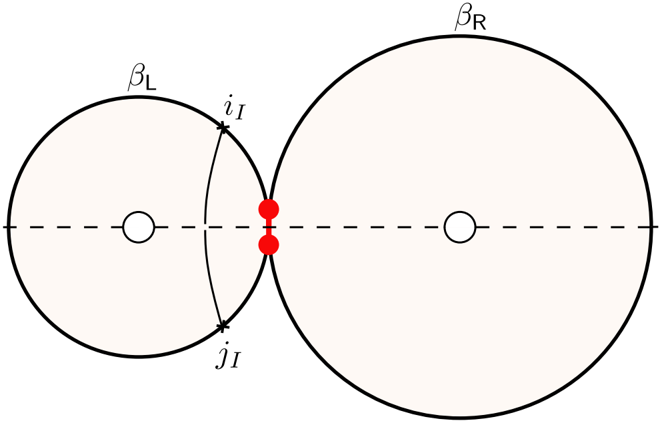
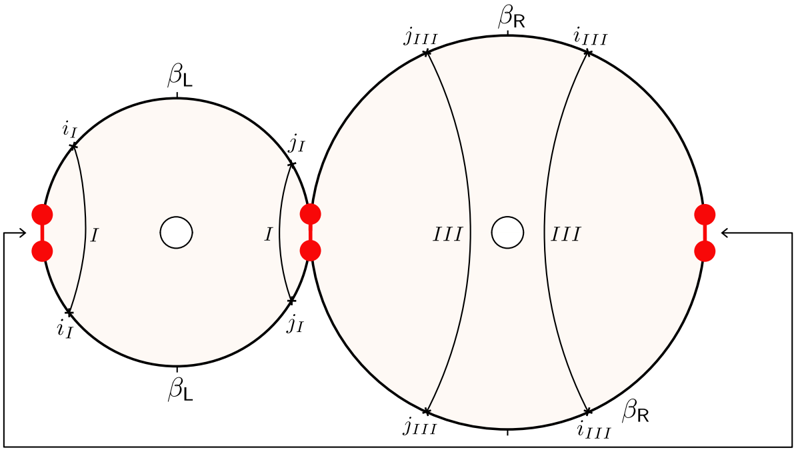
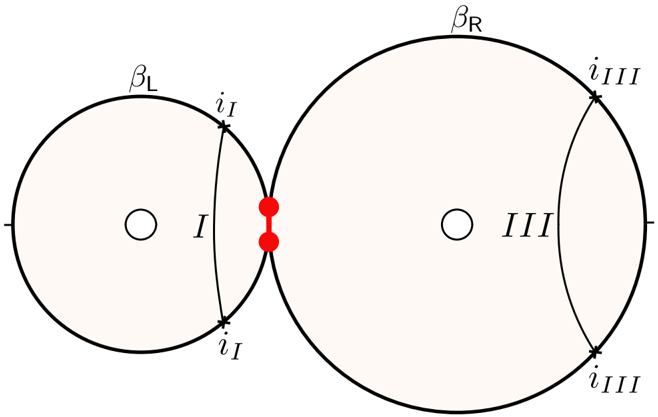
A bstract: We construct entangled microstates of a pair of holographic CFTs whose dual semiclassical description includes big bang-big crunch AdS cosmologies in spaces without boundaries. The cosmology is supported by inhomogeneous heavy matter and it partially purifies the bulk entanglement of two disconnected auxiliary AdS spacetimes. We show that the island formula for the fine grained entropy of one of the CFTs follows from a standard gravitational replica trick calculation. In generic settings, the cosmology is contained in the entanglement wedge of one of the two CFTs. We then investigate properties of the cosmology-to-boundary encoding map, and in particular, its non-isometric character. Restricting our attention to a specific class of states on the cosmology, we provide an explicit, and state-dependent, boundary representation of operators acting on the cosmology. Finally, under genericity assumptions, we argue for a non-isometric to approximately-isometric transition of the cosmology-to-boundary map for “simple” states on the cosmology as a function of the bulk entanglement, with tensor network toy models of our setup as a guide.
Overview
The claims and statistics of this paper haven’t been checked yet.
Run the check — free, no account needed. It reads the open-access text and checks the sources it cites.
Integrity signals
Registry
Cites
Statistics
Figures

Verification
Claims the paper makes
The claims and statistics of this paper haven’t been checked yet.
Run the check — free, no account needed. It reads the open-access text and checks the sources it cites.
Claims other papers make about this one
Each is checked against this paper’s own text: does it say what the citing paper says it does?
The source backs part of the claim, not all of it — or backs it for a different population, condition or comparison.
In the citing paper
“Moreover, although less general, the physical status of the clone is more transparent in the specific setup [6], and it corresponds to a collection of entangled particles in the AdS regions.”
From The baby universe is fine and the CFT knows it: on holography for closed universes (2025) · cites this paper as [6]
Experimental — accuracy not yet measuredIn the citing paper
“we argue that the physical interpretation of [52] is already implicit in [6] and, indeed, in the structure of EFT more generally.”
From The baby universe is fine and the CFT knows it: on holography for closed universes (2025) · cites this paper as [6]
In the citing paper
“the two-replica wormhole of [6] predicts a statistical variance to the norm of the state”
From The baby universe is fine and the CFT knows it: on holography for closed universes (2025) · cites this paper as [6]
In the citing paper
“Big bang/big crunch closed universes can be realized in AdS/CFT, even though they lack asymptotically AdS boundaries.”
From The baby universe is fine and the CFT knows it: on holography for closed universes (2025) · cites this paper as [6]
In the citing paper
“In particular, as shown in [6], the universe belongs to the entanglement wedge of the CFTs, and it can be understood as an entanglement island.”
From The baby universe is fine and the CFT knows it: on holography for closed universes (2025) · cites this paper as [6]
In the citing paper
“For us and [6], the clones are just AdS gas degrees of freedom, holographically encoded in the CFTs.They thus have a very clear physical existence, and we could identify the fundamental description with the CFT.”
From The baby universe is fine and the CFT knows it: on holography for closed universes (2025) · cites this paper as [6]
In the citing paper
“Taking this into account, we now argue that the rules used in [6] and extended to generic settings by [52] are naturally compatible with an observer interpretation in a standard way, even though [6] did not use the language of observers.”
From The baby universe is fine and the CFT knows it: on holography for closed universes (2025) · cites this paper as [6]
In the citing paper
“From (3.5) and the higher moments, a conventional resolvent calculation outlined in [6] yields that the states |Ψ i y span the microcanonical Hilbert space dimension of the clone, dimpH Ob 1 q “ rankpG ij q “ e Splrq . (3.6)”
From The baby universe is fine and the CFT knows it: on holography for closed universes (2025) · cites this paper as [6]
In the citing paper
“This model makes many features of the closed universe and its relation to the CFT manifest, and it suggests a framework for an intrinsic description of the closed universe that connects to CFT data.”
From The baby universe is fine and the CFT knows it: on holography for closed universes (2025) · cites this paper as [6]
In the citing paper
“In the special case in which the bulk EFT is highly entangled between the closed universe and the AdS spacetimes in [6], an effectively isometric map between the closed universe EFT Hilbert space and the CFT Hilbert space emerges for a set of semiclassical states as discussed in Section 2.5.”
From The baby universe is fine and the CFT knows it: on holography for closed universes (2025) · cites this paper as [6]
In the citing paper
“In [6], the state |O c y was drawn from a Gaussian random distribution; with this choice, this very simple random tensor network model captures many of the properties of the gravitational setup.”
From The baby universe is fine and the CFT knows it: on holography for closed universes (2025) · cites this paper as [6]
In the citing paper
“In this sense, the setup of [6] and discussed here is equivalent to considering the setup of [52] after the cloning procedure has been carried out.”
From The baby universe is fine and the CFT knows it: on holography for closed universes (2025) · cites this paper as [6]
In the citing paper
“From a counting argument, it then follows from (2.21) that with extremely high probability, the map acts effectively isometrically for all of them as long as the entropy in the closed universe remains sub-exponential in the entropy of the AdS spaces, Splrq “ log Spcq (see [6,68]).”
From The baby universe is fine and the CFT knows it: on holography for closed universes (2025) · cites this paper as [6]
In the citing paper
“As pointed out in [6], this signals a clear limitation of the conventional holographic encoding of the closed universe as the map W breaks down.”
From The baby universe is fine and the CFT knows it: on holography for closed universes (2025) · cites this paper as [6]
In the citing paper
“The ETH ansatz is also the reason to select a random tensor |O c y in the tensor network of Figure 2; with this choice, the model reproduces (2.9) and other gravitational properties [6].”
From The baby universe is fine and the CFT knows it: on holography for closed universes (2025) · cites this paper as [6]
In the citing paper
“as argued in Sec.3.1, the mathematical rules of [52] are explicit in [6] (where they were derived from the rules of AdS/CFT) and the physical content was implicit as well.”
From The baby universe is fine and the CFT knows it: on holography for closed universes (2025) · cites this paper as [6]
In the citing paper
“The situation with the closed universe is essentially the same, right down to the erratic/random nature of the states [6].”
From The baby universe is fine and the CFT knows it: on holography for closed universes (2025) · cites this paper as [6]
In the citing paper
“We have advocated that the physical definition of the observer, as a subsystem which decoheres the wavefunction in a basis of physical pointer states, was implicit in [6].”
From The baby universe is fine and the CFT knows it: on holography for closed universes (2025) · cites this paper as [6]
In the citing paper
“We would like to point out that one advantage of the model introduced in [6] and considered here is that one can study questions analogous to the experience of interior observers in a black hole without having to deal with regions of large curvature where semiclassical physics would be expected to break down.”
From The baby universe is fine and the CFT knows it: on holography for closed universes (2025) · cites this paper as [6]
In the citing paper
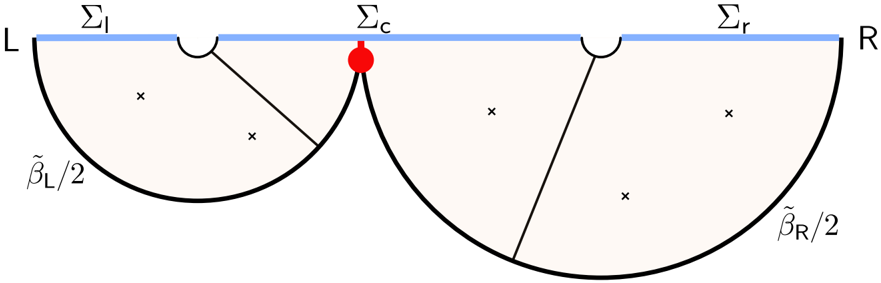
“To recall the basic elements of the setup, there exist entangled states between two copies of a holographic CFT whose dual spacetime is formed by three disconnected pieces: two AdS regions and a crunching closed universe supported by a thin shell of dust.”
From The baby universe is fine and the CFT knows it: on holography for closed universes (2025) · cites this paper as [6]
In the citing paper
“This relationship between the closed universe and the entanglement wedge of various CFTs was already discussed in [6].”
From The baby universe is fine and the CFT knows it: on holography for closed universes (2025) · cites this paper as [6]
In the citing paper
“Based on [6], we expect these states and operations to look random from the CFT perspective, but from the closed universe perspective, they can be ordered structures.”
From The baby universe is fine and the CFT knows it: on holography for closed universes (2025) · cites this paper as [6]
In the citing paper
“In particular, we have argued that the model presented in [52], which relies on the definition of an”
From The baby universe is fine and the CFT knows it: on holography for closed universes (2025) · cites this paper as [6]
Self-check
Percentages, sums and reported differences re-computed from the paper’s own numbers.
The self-check needs the paper’s full text.
Citations
Cites
Thermodynamics of black holes in anti-de Sitter space
Hawking, S. W., & Page, D. N. (1983) · Communications in Mathematical Physics · doi:10.1007/bf01208266 · Cited by 3,045
Quantum statistical mechanics in a closed system
Deutsch, J. M. (1991) · Physical Review A · doi:10.1103/physreva.43.2046 · Cited by 2,860
Cool horizons for entangled black holes
Maldacena, J., & Susskind, L. (2013) · Fortschritte der Physik · doi:10.1002/prop.201300020 · Cited by 1,304
The stretched horizon and black hole complementarity
Susskind, L., Thorlacius, L., & Uglum, J. (1993) · Physical Review D · doi:10.1103/physrevd.48.3743 · Cited by 1,081
Entanglement wedge reconstruction and the information paradox
Penington, G. (2020) · Journal of High Energy Physics · doi:10.1007/jhep09(2020)002 · Cited by 968 · cited 1×
“29) acquires the form of a Schwinger-Dyson equation (see [16, 66] for details).”
BackgroundReplica wormholes and the entropy of Hawking radiation
Almheiri, A., Hartman, T., Maldacena, J., Shaghoulian, E., & Tajdini, A. (2020) · Journal of High Energy Physics · doi:10.1007/jhep05(2020)013 · Cited by 910
Replica wormholes and the black hole interior
Penington, G., Shenker, S. H., Stanford, D., & Yang, Z. (2019) · arXiv · doi:10.48550/arxiv.1911.11977 · Cited by 809
Bulk locality and quantum error correction in AdS/CFT
Almheiri, A., Dong, X., & Harlow, D. (2015) · Journal of High Energy Physics · doi:10.1007/jhep04(2015)163 · Cited by 802
Surface terms as counterterms in the AdS-CFT correspondence
Emparan, R., Johnson, C. V., & Myers, R. C. (1999) · Physical Review D · doi:10.1103/physrevd.60.104001 · Cited by 703
An infalling observer in AdS/CFT
Papadodimas, K., & Raju, S. (2013) · Journal of High Energy Physics · doi:10.1007/jhep10(2013)212 · Cited by 335
Research works printed but not linked: 90
- G. ’t Hooft, Dimensional reduction in quantum gravity, Conf. Proc. C 930308 (1993) 284 [gr-qc/9310026] [INSPIRE]. · arXiv
- L. Susskind, The world as a hologram, J. Math. Phys. 36 (1995) 6377 [hep-th/9409089] [INSPIRE]. · DOI · Paper page
- J.M. Maldacena, The large N limit of superconformal field theories and supergravity, Adv. Theor. Math. Phys. 2 (1998) 231 [hep-th/9711200] [INSPIRE]. · DOI · Paper page
- S. Ryu and T. Takayanagi, Aspects of Holographic Entanglement Entropy, JHEP 08 (2006) 045 [hep-th/0605073] [INSPIRE]. · DOI · Paper page
- B. Swingle, Entanglement Renormalization and Holography, Phys. Rev. D 86 (2012) 065007 [arXiv:0905.1317] [INSPIRE]. · DOI · Paper page
- M. Van Raamsdonk, Building up spacetime with quantum entanglement, Gen. Rel. Grav. 42 (2010) 2323 [arXiv:1005.3035] [INSPIRE]. · DOI · Paper page
- A. Lewkowycz and J. Maldacena, Generalized gravitational entropy, JHEP 08 (2013) 090 [arXiv:1304.4926] [INSPIRE]. · DOI · Paper page
- T. Faulkner, A. Lewkowycz and J. Maldacena, Quantum corrections to holographic entanglement entropy, JHEP 11 (2013) 074 [arXiv:1307.2892] [INSPIRE]. · DOI · Paper page
- D. Stanford and L. Susskind, Complexity and Shock Wave Geometries, Phys. Rev. D 90 (2014) 126007 [arXiv:1406.2678] [INSPIRE]. · DOI
- J. Maldacena, S.H. Shenker and D. Stanford, A bound on chaos, JHEP 08 (2016) 106 [arXiv:1503.01409] [INSPIRE]. · DOI
- F. Pastawski, B. Yoshida, D. Harlow and J. Preskill, Holographic quantum error-correcting codes: Toy models for the bulk/boundary correspondence, JHEP 06 (2015) 149 [arXiv:1503.06237] [INSPIRE]. · DOI · Paper page
- A.R. Brown et al., Holographic Complexity Equals Bulk Action?, Phys. Rev. Lett. 116 (2016) 191301 [arXiv:1509.07876] [INSPIRE]. · DOI
- P. Hayden et al., Holographic duality from random tensor networks, JHEP 11 (2016) 009 [arXiv:1601.01694] [INSPIRE]. · DOI · Paper page
- A. Almheiri, N. Engelhardt, D. Marolf and H. Maxfield, The entropy of bulk quantum fields and the entanglement wedge of an evaporating black hole, JHEP 12 (2019) 063 [arXiv:1905.08762] [INSPIRE]. · DOI · Paper page
- J.B. Hartle, S.W. Hawking and T. Hertog, Accelerated Expansion from Negative Λ, arXiv:1205.3807 [INSPIRE]. · arXiv
- P.J.E. Peebles and B. Ratra, Cosmology with a Time Variable Cosmological Constant, Astrophys. J. Lett. 325 (1988) L17 [INSPIRE]. · DOI · Paper page
- B. Ratra and P.J.E. Peebles, Cosmological Consequences of a Rolling Homogeneous Scalar Field, Phys. Rev. D 37 (1988) 3406 [INSPIRE]. · DOI · Paper page
- S. Tsujikawa, Quintessence: A Review, Class. Quant. Grav. 30 (2013) 214003 [arXiv:1304.1961] [INSPIRE]. · DOI
- S. Antonini, P. Simidzija, B. Swingle and M. Van Raamsdonk, Accelerating Cosmology from a Holographic Wormhole, Phys. Rev. Lett. 130 (2023) 221601 [arXiv:2206.14821] [INSPIRE]. · DOI
- S. Antonini et al., Accelerating cosmology from Λ < 0 gravitational effective field theory, JHEP 05 (2023) 203 [arXiv:2212.00050] [INSPIRE]. · DOI
- M. Van Raamsdonk and C. Waddell, Possible hints of decreasing dark energy from supernova data, arXiv:2305.04946 [INSPIRE]. · arXiv
- A. Strominger, The dS / CFT correspondence, JHEP 10 (2001) 034 [hep-th/0106113] [INSPIRE]. · DOI
- M. Alishahiha, A. Karch, E. Silverstein and D. Tong, The dS/dS correspondence, AIP Conf. Proc. 743 (2004) 393 [hep-th/0407125] [INSPIRE]. · DOI
- X. Dong, E. Silverstein and G. Torroba, De Sitter Holography and Entanglement Entropy, JHEP 07 (2018) 050 [arXiv:1804.08623] [INSPIRE]. · DOI · Paper page
- V. Gorbenko, E. Silverstein and G. Torroba, dS/dS and $$ T\overline{T} $$, JHEP 03 (2019) 085 [arXiv:1811.07965] [INSPIRE]. · DOI
- E. Coleman et al., De Sitter microstates from $$ T\overline{T} $$ + Λ2 and the Hawking-Page transition, JHEP 07 (2022) 140 [arXiv:2110.14670] [INSPIRE]. · DOI
- L. Susskind, Black Holes Hint towards De Sitter Matrix Theory, Universe 9 (2023) 368 [arXiv:2109.01322] [INSPIRE]. · DOI
- L. Susskind, De Sitter Holography: Fluctuations, Anomalous Symmetry, and Wormholes, Universe 7 (2021) 464 [arXiv:2106.03964] [INSPIRE]. · DOI
- L. Susskind, Entanglement and Chaos in De Sitter Space Holography: An SYK Example, JHAP 1 (2021) 1 [arXiv:2109.14104] [INSPIRE]. · arXiv
- E. Shaghoulian and L. Susskind, Entanglement in De Sitter space, JHEP 08 (2022) 198 [arXiv:2201.03603] [INSPIRE]. · DOI
- P. McFadden and K. Skenderis, Holography for Cosmology, Phys. Rev. D 81 (2010) 021301 [arXiv:0907.5542] [INSPIRE]. · DOI
- N. Afshordi, E. Gould and K. Skenderis, Constraining holographic cosmology using Planck data, Phys. Rev. D 95 (2017) 123505 [arXiv:1703.05385] [INSPIRE]. · DOI
- H. Nastase, Solution of the cosmological constant problem within holographic cosmology, Phys. Lett. B 801 (2020) 135168 [arXiv:1812.07597] [INSPIRE]. · DOI
- H. Nastase and K. Skenderis, Holography for the very early Universe and the classic puzzles of Hot Big Bang cosmology, Phys. Rev. D 101 (2020) 021901 [arXiv:1904.05821] [INSPIRE]. · DOI
- J.M. Maldacena and L. Maoz, Wormholes in AdS, JHEP 02 (2004) 053 [hep-th/0401024] [INSPIRE]. · DOI · Paper page
- B. McInnes, Answering a basic objection to bang/crunch holography, JHEP 10 (2004) 018 [hep-th/0407189] [INSPIRE]. · DOI
- B. McInnes, Pre-inflationary spacetime in string cosmology, Nucl. Phys. B 748 (2006) 309 [hep-th/0511227] [INSPIRE]. · DOI
- B. Freivogel et al., Inflation in AdS/CFT, JHEP 03 (2006) 007 [hep-th/0510046] [INSPIRE]. · DOI
- N. Engelhardt, T. Hertog and G.T. Horowitz, Holographic Signatures of Cosmological Singularities, Phys. Rev. Lett. 113 (2014) 121602 [arXiv:1404.2309] [INSPIRE]. · DOI
- S. Cooper et al., Black hole microstate cosmology, JHEP 07 (2019) 065 [arXiv:1810.10601] [INSPIRE]. · DOI
- S. Antonini and B. Swingle, Cosmology at the end of the world, Nature Phys. 16 (2020) 881 [arXiv:1907.06667] [INSPIRE]. · DOI
- Y. Chen, V. Gorbenko and J. Maldacena, Bra-ket wormholes in gravitationally prepared states, JHEP 02 (2021) 009 [arXiv:2007.16091] [INSPIRE]. · DOI
- M. Van Raamsdonk, Comments on wormholes, ensembles, and cosmology, JHEP 12 (2021) 156 [arXiv:2008.02259] [INSPIRE]. · DOI
- M. Van Raamsdonk, Cosmology from confinement?, JHEP 03 (2022) 039 [arXiv:2102.05057] [INSPIRE]. · DOI
- S. Antonini, P. Simidzija, B. Swingle and M. Van Raamsdonk, Cosmology from the vacuum, arXiv:2203.11220 [INSPIRE]. · arXiv
- S. Fallows and S.F. Ross, Constraints on cosmologies inside black holes, JHEP 05 (2022) 094 [arXiv:2203.02523] [INSPIRE]. · DOI
- S.F. Ross, Cosmologies inside hyperbolic black holes, JHEP 11 (2022) 168 [arXiv:2209.11620] [INSPIRE]. · DOI
- A. Sahu, P. Simidzija and M. Van Raamsdonk, Bubbles of cosmology in AdS/CFT, JHEP 11 (2023) 010 [arXiv:2306.13143] [INSPIRE]. · DOI
- C. Akers, T. Faulkner, S. Lin and P. Rath, The page curve for reflected entropy, JHEP 06 (2022) 089 [arXiv:2201.11730] [INSPIRE]. · DOI
- T. Hartman, Y. Jiang and E. Shaghoulian, Islands in cosmology, JHEP 11 (2020) 111 [arXiv:2008.01022] [INSPIRE]. · DOI
- V. Balasubramanian, A. Kar and T. Ugajin, Islands in de Sitter space, JHEP 02 (2021) 072 [arXiv:2008.05275] [INSPIRE]. · DOI
- V. Balasubramanian, A. Kar and T. Ugajin, Entanglement between two disjoint universes, JHEP 02 (2021) 136 [arXiv:2008.05274] [INSPIRE]. · DOI
- V. Balasubramanian, A. Kar and T. Ugajin, Entanglement between two gravitating universes, Class. Quant. Grav. 39 (2022) 174001 [arXiv:2104.13383] [INSPIRE]. · DOI
- R. Bousso and E. Wildenhain, Islands in closed and open universes, Phys. Rev. D 105 (2022) 086012 [arXiv:2202.05278] [INSPIRE]. · DOI
- N. Engelhardt, G. Penington and A. Shahbazi-Moghaddam, A world without pythons would be so simple, Class. Quant. Grav. 38 (2021) 234001 [arXiv:2102.07774] [INSPIRE]. · DOI · Paper page
- N. Engelhardt, G. Penington and A. Shahbazi-Moghaddam, Finding pythons in unexpected places, Class. Quant. Grav. 39 (2022) 094002 [arXiv:2105.09316] [INSPIRE]. · DOI
- C. Akers et al., The black hole interior from non-isometric codes and complexity, arXiv:2207.06536 [INSPIRE]. · arXiv
- C.J. Cao, W. Chemissany, A. Jahn and Z. Zimborás, Overlapping qubits from non-isometric maps and de Sitter tensor networks, arXiv:2304.02673 [INSPIRE]. · arXiv
- V. Balasubramanian, A. Lawrence, J.M. Magan and M. Sasieta, Microscopic origin of the entropy of black holes in general relativity, arXiv:2212.02447 [INSPIRE]. · arXiv
- M. Sasieta, Wormholes from heavy operator statistics in AdS/CFT, JHEP 03 (2023) 158 [arXiv:2211.11794] [INSPIRE]. · DOI · Paper page
- J.A. Wheeler, Geometrodynamics and the issue of final state, in the proceedings of the Les Houches Summer Shcool of Theoretical Physics: Relativity, Groups and Topology, Les Houches, France, July 1 – 24 August (1963), p. 317–522. [INSPIRE].
- Z. Fu and D. Marolf, Bag-of-gold spacetimes, Euclidean wormholes, and inflation from domain walls in AdS/CFT, JHEP 11 (2019) 040 [arXiv:1909.02505] [INSPIRE]. · DOI
- A. Hamilton, D.N. Kabat, G. Lifschytz and D.A. Lowe, Local bulk operators in AdS/CFT: A boundary view of horizons and locality, Phys. Rev. D 73 (2006) 086003 [hep-th/0506118] [INSPIRE]. · DOI
- A. Hamilton, D.N. Kabat, G. Lifschytz and D.A. Lowe, Holographic representation of local bulk operators, Phys. Rev. D 74 (2006) 066009 [hep-th/0606141] [INSPIRE]. · DOI · Paper page
- A. Goel, H.T. Lam, G.J. Turiaci and H. Verlinde, Expanding the Black Hole Interior: Partially Entangled Thermal States in SYK, JHEP 02 (2019) 156 [arXiv:1807.03916] [INSPIRE]. · DOI
- H.W. Lin, J. Maldacena, L. Rozenberg and J. Shan, Holography for people with no time, SciPost Phys. 14 (2023) 150 [arXiv:2207.00407] [INSPIRE]. · DOI
- H.W. Lin, J. Maldacena, L. Rozenberg and J. Shan, Looking at supersymmetric black holes for a very long time, SciPost Phys. 14 (2023) 128 [arXiv:2207.00408] [INSPIRE]. · DOI
- J. Chandra, Euclidean wormholes for individual 2d CFTs, arXiv:2305.07183 [INSPIRE]. · arXiv
- I. Kourkoulou and J. Maldacena, Pure states in the SYK model and nearly-AdS2 gravity, arXiv:1707.02325 [INSPIRE]. · arXiv
- J. Chandra and T. Hartman, Coarse graining pure states in AdS/CFT, JHEP 10 (2023) 030 [arXiv:2206.03414] [INSPIRE]. · DOI
- V. Balasubramanian, A. Lawrence, J.M. Magan and M. Sasieta, Microscopic origin of the entropy of astrophysical black holes, arXiv:2212.08623 [INSPIRE]. · arXiv
- T. Anous, T. Hartman, A. Rovai and J. Sonner, Black Hole Collapse in the 1/c Expansion, JHEP 07 (2016) 123 [arXiv:1603.04856] [INSPIRE]. · DOI · Paper page
- S. de Haro, S.N. Solodukhin and K. Skenderis, Holographic reconstruction of space-time and renormalization in the AdS / CFT correspondence, Commun. Math. Phys. 217 (2001) 595 [hep-th/0002230] [INSPIRE]. · DOI · Paper page
- K. Skenderis, Lecture notes on holographic renormalization, Class. Quant. Grav. 19 (2002) 5849 [hep-th/0209067] [INSPIRE]. · DOI
- G. Darmois, Les équations de la gravitation einsteinienne, Mémorial des sciences mathématiques 25 (1927) 58.
- W. Israel, Singular hypersurfaces and thin shells in general relativity, Nuovo Cim. B 44S10 (1966) 1 [Erratum ibid. 48 (1967) 463] [INSPIRE]. · DOI · Paper page
- M. Sasieta, Ergodic equilibration of Rényi entropies and replica wormholes, JHEP 08 (2021) 014 [arXiv:2103.09880] [INSPIRE]. · DOI
- T. Takayanagi, Holographic Dual of BCFT, Phys. Rev. Lett. 107 (2011) 101602 [arXiv:1105.5165] [INSPIRE]. · DOI · Paper page
- M. Fujita, T. Takayanagi and E. Tonni, Aspects of AdS/BCFT, JHEP 11 (2011) 043 [arXiv:1108.5152] [INSPIRE]. · DOI · Paper page
- D.N. Page, Average entropy of a subsystem, Phys. Rev. Lett. 71 (1993) 1291 [gr-qc/9305007] [INSPIRE]. · DOI · Paper page
- E. Witten, A Note On Complex Spacetime Metrics, arXiv:2111.06514 [INSPIRE]. · arXiv
- M. Kontsevich and G. Segal, Wick Rotation and the Positivity of Energy in Quantum Field Theory, Quart. J. Math. Oxford Ser. 72 (2021) 673 [arXiv:2105.10161] [INSPIRE]. · DOI
- H. Geng et al., Inconsistency of islands in theories with long-range gravity, JHEP 01 (2022) 182 [arXiv:2107.03390] [INSPIRE]. · DOI
- H. Geng and A. Karch, Massive islands, JHEP 09 (2020) 121 [arXiv:2006.02438] [INSPIRE]. · DOI · Paper page
- J. Chandra and T. Hartman, Toward random tensor networks and holographic codes in CFT, JHEP 05 (2023) 109 [arXiv:2302.02446] [INSPIRE]. · DOI
- A. Kar, Non-isometric quantum error correction in gravity, JHEP 02 (2023) 195 [arXiv:2210.13476] [INSPIRE]. · DOI · Paper page
- C. Akers and G. Penington, Quantum minimal surfaces from quantum error correction, SciPost Phys. 12 (2022) 157 [arXiv:2109.14618] [INSPIRE]. · DOI · Paper page
- V. Balasubramanian and P. Kraus, A stress tensor for Anti-de Sitter gravity, Commun. Math. Phys. 208 (1999) 413 [hep-th/9902121] [INSPIRE]. · DOI · Paper page
- S.W. Hawking, Zeta Function Regularization of Path Integrals in Curved Space-Time, Commun. Math. Phys. 55 (1977) 133 [INSPIRE]. · DOI · Paper page
- M. Srednicki, Chaos and Quantum Thermalization, cond-mat/9403051 [https://doi.org/10.1103/PhysRevE.50.888] [INSPIRE]. · DOI · Paper page
Cited by
Sorted by citations
The baby universe is fine and the CFT knows it: on holography for closed universes
Antonini, S., Rath, P., Sasieta, M., Swingle, B., & Vilar López, A. (2025) · Journal of High Energy Physics · doi:10.1007/jhep12(2025)159 · Cited by 35
Self-citationFurther Evidence Against a Semiclassical Baby Universe in AdS/CFT
Engelhardt, N., & Gesteau, E. (2025) · arXiv · doi:10.48550/arxiv.2504.14586 · Cited by 28
Metadata
- Authors
- Antonini, S., Sasieta, M., & Swingle, B.
- Venue
- Journal of High Energy Physics
- Published
- 2023-11-27
- Volume
- 2023
- Issue
- 11
- ISSN
- 1029-8479
- Cited by
- 43
- References
- 16
- Language
- en
About these checks
Registry, retraction, Cites and statistics results are computed, not judged, with one exception: a printed reference that no index lists is read once by a model before it counts as a citation error. Claims are extracted by a model and kept only when their quote appears verbatim in the text; each cited source is then checked, with a model’s help, for whether it says what the claim relies on. Those verdicts can be wrong — read the claim’s quote and the cited source before relying on one.
Statistics and arithmetic are recomputed, not judged.
Confidence bands are shown only for fields calibrated on our annotated test set. None is calibrated yet, so no band is shown.
What counts as a claim ›How we measure confidence ›How we check this ›
Are you an author, or do you see a problem with this page? Request a review
