

Changing the glucose cut-off values that define hypoglycaemia has a major effect on reported frequencies of hypoglycaemia
Open accessThe DOI matches its Crossref record; 12 of the 12 references it cites were found in a registry or an index.
Abstract
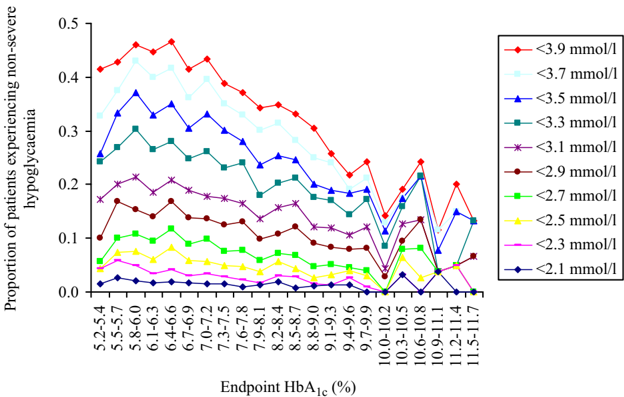
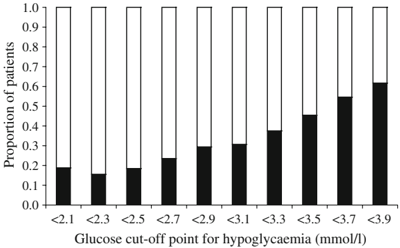
AIMS/HYPOTHESIS: The aim of this analysis was to quantify the relationship between the frequency of hypoglycaemia and various glucose cut-off points for the definition of hypoglycaemia, within a range of HbA(1c) strata. METHODS: Data from two trials examining insulin glargine dose titration in 12,837 type 2 diabetic participants starting insulin therapy were combined. Curves for hypoglycaemia frequency plotted against endpoint HbA(1c) level were constructed, using a range of glucose cut-off points for hypoglycaemia. RESULTS: During the 12-week study period, 3,912 patients recorded 21,592 hypoglycaemic episodes, comprising 242 severe, 8,871 symptomatic and 12,479 asymptomatic events, corresponding to hypoglycaemia event rates of 0.10, 3.8 and 5.3 events per patient year. Increasing the hypoglycaemia cut-off point from, for instance, <3.1 to <3.9 mmol/l more than doubled the percentage of affected patients, e.g. from 17.7 to 43.3% at HbA(1c) 7.0-7.2%. At higher hypoglycaemia cut-off points the proportion of patients having only asymptomatic hypoglycaemia increased, e.g. from 30.7% at <3.1 mmol/l to 61.7% of patients at a cut-off point of <3.9 mmol/l. In sensitivity analysis, 121 of 1,756 patients with at least one self-monitored blood glucose value <3.1 mmol/l experienced severe hypoglycaemia, compared with 149 of 3,912 patients with a self-monitored blood glucose level of <3.9 mmol/l. Thus, to identify 28 more patients with severe hypoglycaemia, the number of patients experiencing only non-severe hypoglycaemia more than doubled. CONCLUSIONS/INTERPRETATION: The glucose cut-off point defining hypoglycaemia greatly affects the reported frequency of hypoglycaemia. When hypoglycaemia is to be defined by a predetermined glucose level, to have clinical relevance the cut-off should be set at a lower level than the threshold of 3.9 mmol/l proposed by the American Diabetes Association.
Overview
The claims and statistics of this paper haven’t been checked yet.
Free: it reads the open-access text and checks the first 5 claims that cite a source we can check. Create a free account to check every claim.
Integrity signals
Registry
Cites
Statistics
Figures
Verification
Claims the paper makes
The claims and statistics of this paper haven’t been checked yet.
Free: it reads the open-access text and checks the first 5 claims that cite a source we can check. Create a free account to check every claim.
Claims other papers make about this one
Each is checked against this paper’s own text: does it say what the citing paper says it does?
The source backs part of the claim, not all of it — or backs it for a different population, condition or comparison.
In the citing paper
“plasma glucose concentrations ≤3.9 mmol/l (70 mg/dl) sometimes occur in non-diabetic individuals [1,3].This is true, particularly in women and children, albeit generally during prolonged fasting.”
From Preventing hypoglycaemia: what is the appropriate glucose alert value? (2009) · cites this paper as [1]
Experimental — accuracy not yet measuredThe cited source says what the claim attributes to it.
In the citing paper
“The higher the cut-off level for hypoglycaemia, the greater the reported frequency, predominantly of asymptomatic events.”
From Defining hypoglycaemia: what level has clinical relevance? (2009) · cites this paper as [3]
In the citing paper
“Their data also indicate that a higher cut-off value identifies a higher percentage of patients who suffer severe hypoglycaemia, i.e. it increases sensitivity, albeit at the expense of specificity.”
From Preventing hypoglycaemia: what is the appropriate glucose alert value? (2009) · cites this paper as [1]
In the citing paper
“To illustrate this, Swinnen et al. [3] applied a range of different glucose levels defining hypoglycaemia to the blood glucose data from two large prospective trials of people with type 2 diabetes who had commenced treatment with insulin.”
From Defining hypoglycaemia: what level has clinical relevance? (2009) · cites this paper as [3]
In the citing paper
“The authors suggest that exposure to blood glucose levels between 3.5 and 3.9 mmol/l is unlikely to be of great clinical consequence and argue that the ADA definition of 3.9 mmol/l is set at too high a level to have clinical credibility.”
From Defining hypoglycaemia: what level has clinical relevance? (2009) · cites this paper as [3]
3 more claims about this paper
Create a free account to see every claim other papers make about this one.
Self-check
Percentages, sums and reported differences re-computed from the paper’s own numbers.
The self-check needs the paper’s full text.
Citations
Cites
Turner, R. C., Fox, C., Matthews, McElroy, H. H., Cull, C. A., Holman, R. R., Neil, P., Hadden, D. R., Wright, D., Manley, E., et al. (1998) · The Lancet · Cited by 8,419
Gupta, A., & Uribarri, J. (2016) · Hormone Research in Paediatrics · doi:10.1159/000444053 · Cited by 4,006
Defining and Reporting Hypoglycemia in Diabetes
American Diabetes Association Workgroup on Hypoglycemia (2005) · Diabetes Care · doi:10.2337/diacare.28.5.1245 · Cited by 1,146
Risk of hypoglycaemia in types 1 and 2 diabetes: Effects of treatment modalities and their duration
UK Hypoglycaemia Study Group (2007) · Diabetologia · doi:10.1007/s00125-007-0599-y · Cited by 825
Gold, A. E., Macleod, K. M., & Frier, B. M. (1994) · Diabetes Care · doi:10.2337/diacare.17.7.697 · Cited by 810 · cited 2×
“Finally, the presence of hypoglycaemia unawareness, which was not formally assessed, could have confounded our results because this is associated with an increasedfrequencyof(severe)hypoglycaemia but fewerselfreportedevents[ 4 , 5]. However, hypoglycaemia unawareness is rare in patients with type 2 diabetes recently i…”
BackgroundResultInfluentialDonnelly, L. A., Morris, A. D., Frier, B. M., Ellis, J. D., Donnan, P. T., Durrant, R., Band, M. M., Reekie, G., & Leese, G. P. (2005) · Diabetic Medicine · doi:10.1111/j.1464-5491.2005.01501.x · Cited by 511 · cited 1×
“With regard to severe hypoglycaemia, population-based and retrospective studies of insulintreated individuals with type 2 diabetes reported higher event rates [8–10].”
BackgroundHypoglycaemia in Type 2 diabetes
Amiel, S. A., Dixon, T., Mann, R., & Jameson, K. (2008) · Diabetic Medicine · doi:10.1111/j.1464-5491.2007.02341.x · Cited by 472 · cited 2×
“0 mmol/l may lead to overestimation of the frequency of (clinically significant) hypoglycaemia [2].”
BackgroundHypoglycaemia in insulin‐treated Type 2 diabetes: frequency, symptoms and impaired awareness
Henderson, J. N., Allen, K. V., Deary, I. J., & Frier, B. M. (2003) · Diabetic Medicine · doi:10.1046/j.1464-5491.2003.01072.x · Cited by 287
Frequency and Morbidity of Severe Hypoglycaemia in Insulin‐treated Diabetic Patients
MacLeod, K. M., Hepburn, D. A., & Frier, B. M. (1993) · Diabetic Medicine · doi:10.1111/j.1464-5491.1993.tb00051.x · Cited by 251 · cited 1×
“With regard to severe hypoglycaemia, population-based and retrospective studies of insulintreated individuals with type 2 diabetes reported higher event rates [8–10].”
Background
Cited by
Hypoglycaemia in diabetes mellitus: epidemiology and clinical implications
Frier, B. M. (2014) · Nature Reviews Endocrinology · doi:10.1038/nrendo.2014.170 · Cited by 481
Kosiborod, M. (2009) · JAMA · doi:10.1001/jama.2009.496 · Cited by 364
Hahner, S., Loeffler, M., Bleicken, B., Drechsler, C., Milovanovic, D., Fassnacht, M., Ventz, M., Quinkler, M., & Allolio, B. (2010) · European Journal of Endocrinology · doi:10.1530/eje-09-0884 · Cited by 346
International consensus on the diagnosis and management of dumping syndrome
Scarpellini, E., Arts, J., Karamanolis, G., Laurenius, A., Siquini, W., Suzuki, H., Ukleja, A., Van Beek, A., Vanuytsel, T., Bor, S., et al. (2020) · Nature Reviews Endocrinology · doi:10.1038/s41574-020-0357-5 · Cited by 306
Barendse, S., Singh, H., Frier, B. M., & Speight, J. (2012) · Diabetic Medicine · doi:10.1111/j.1464-5491.2011.03416.x · Cited by 161
Elliott, L., Fidler, C., Ditchfield, A., & Stissing, T. (2016) · Diabetes Therapy · doi:10.1007/s13300-016-0157-z · Cited by 135
“0 mmol/L are unlikely to be of clinical significance [18, 59].”
BackgroundImpaired awareness of hypoglycaemia: a review
Graveling, A. J., & Frier, B. M. (2010) · Diabetes & Metabolism · doi:10.1016/s1262-3636(10)70470-5 · Cited by 162
Schopman, J. E., Simon, A. C. R., Hoefnagel, S. J. M., Hoekstra, J. B. L., Scholten, R. J. P. M., & Holleman, F. (2014) · Diabetes/Metabolism Research and Reviews · doi:10.1002/dmrr.2470 · Cited by 120
Self-citationCardiac implications of hypoglycaemia in patients with diabetes – a systematic review
Hanefeld, M., Duetting, E., & Bramlage, P. (2013) · Cardiovascular Diabetology · doi:10.1186/1475-2840-12-135 · Cited by 93
“There has been some debate over which biochemical definition of hypoglycaemia should be used in clinical settings [21]; however, the most well-known classification put forth by the American Diabetes Association (ADA) Workgroup on Hypoglycaemia [22] included criteria for five categories of hypoglycaemia: severe hypogly…”
MethodRodbard, D. (2012) · Diabetes Technology & Therapeutics · doi:10.1089/dia.2012.0062 · Cited by 88
Graveling, A. J., & Frier, B. M. (2009) · Primary care diabetes · doi:10.1016/j.pcd.2009.08.007 · Cited by 95
“Differences in the reported frequencies of mild hypoglycaemia between clinical studies may be related to the heterogeneity of the populations studied and differing hypoglycaemia definitions [10].”
BackgroundPreventing hypoglycaemia: what is the appropriate glucose alert value?
Cryer, P. E. (2009) · Diabetologia · doi:10.1007/s00125-008-1205-7 · Cited by 77
“Second, use of a glucose cut-off value of ≤3.9 mmol/l (70 mg/dl) would overestimate the frequency of clinically important hypoglycaemia [ 1 , 3] or inflate the frequency of clinically meaningless biochemical hypoglycaemia [2].”
BackgroundResultInfluentialLandman, G. W. D., de Bock, G. H., van Hateren, K. J. J., van Dijk, P. R., Groenier, K. H., Gans, R. O. B., Houweling, S. T., Bilo, H. J. G., & Kleefstra, N. (2014) · PLoS ONE · doi:10.1371/journal.pone.0082880 · Cited by 85
“Regarding hypoglycemic events, it should be noted that cut-off values can have great impact on the event rate [39] and nonsymptomatic confirmed hypoglycemic events were not included in the meta-analyses because of concerns for overestimation of the event rate.”
BackgroundDefining hypoglycaemia: what level has clinical relevance?
Frier, B. M. (2009) · Diabetologia · doi:10.1007/s00125-008-1209-3 · Cited by 71
“[3] applied a range of different glucose levels defining hypoglycaemia to the blood glucose data from two large prospective trials of people with type 2 diabetes who had commenced treatment with insulin.”
Tschöpe, D., Bramlage, P., Binz, C., Krekler, M., Deeg, E., & Gitt, A. K. (2012) · BMC Endocrine Disorders · doi:10.1186/1472-6823-12-23 · Cited by 67
“78 or 50 mg/dl in case of symptoms) and defined as being with or without specific symptoms but manageable without external help [13,14].”
Little, S. A., Leelarathna, L., Barendse, S. M., Walkinshaw, E., Tan, H. K., Lubina Solomon, A., de Zoysa, N., Rogers, H., Choudhary, P., Amiel, S. A., et al. (2014) · Diabetes/Metabolism Research and Reviews · doi:10.1002/dmrr.2492 · Cited by 48
“9 mmol/L) proposed by the ADA may artificially inflate the amount of hypoglycaemia reported by inclusion of episodes with no clinical significance [17].”
BackgroundHypoglycaemia unawareness in patients with type 1 diabetes
Szadkowska, A., Czyżewska, K., Pietrzak, I., Mianowska, B., Jarosz-Chobot, P. A., & Myśliwiec, M. (2018) · Pediatric Endocrinology Diabetes and Metabolism · doi:10.5114/pedm.2018.80994 · Cited by 46
Medically minimising the impact of hypoglycaemia in type 2 diabetes: a review
Noh, R. M., Graveling, A. J., & Frier, B. M. (2011) · Expert Opinion on Pharmacotherapy · doi:10.1517/14656566.2011.589835 · Cited by 36
“2 mg/dl) more than doubled the incidence of biochemical hypoglycaemia [8].”
BackgroundClinical Utility of SMBG: Recommendations on the Use and Reporting of SMBG in Clinical Research
Schnell, O., Barnard, K., Bergenstal, R., Bosi, E., Garg, S., Guerci, B., Haak, T., Hirsch, I. B., Ji, L., Joshi, S. R., et al. (2015) · Diabetes Care · doi:10.2337/dc14-2919 · Cited by 36
Barnett, A. H. (2010) · Current Medical Research and Opinion · doi:10.1185/03007991003738063 · Cited by 37
Willis, M. S., Asseburg, C., Nilsson, A., Johnsson, K. M., & Kartman, B. (2016) · Value in Health · doi:10.1016/j.jval.2016.10.004 · Cited by 37
“[18] Swinnen SG, Mullins P, Miller M, et al.”
BackgroundFrequency, Causes and Risk Factors for Hypoglycaemia in Type 1 Diabetes
Strachan, M. W. J. (2013) · Wiley eBooks · doi:10.1002/9781118695432.ch4 · Cited by 27
Mezquita‐Raya, P., Reyes‐García, R., Moreno, Ó., Muñoz‐Torres, M., Merino-Torres, J. F., Martínez, J. J. G., Jódar-Gimeno, E., Escalada, J., Gargallo-Fernández, M., Soto-González, A., et al. (2013) · Endocrinología y Nutrición · doi:10.1016/j.endonu.2013.04.005 · Cited by 32
Insight into hypoglycemia in pediatric type 1 diabetes mellitus
Sawyer, K. E., Renukuntla, V. S., & Heptulla, R. A. (2012) · International Journal of Pediatric Endocrinology · doi:10.1186/1687-9856-2012-19 · Cited by 23
“; licensee BioMed Centra Commons Attribution License (http://creativec reproduction in any medium, provided the or [4,5].”
BackgroundMezquita‐Raya, P., Reyes‐García, R., Moreno, Ó., Muñoz‐Torres, M., Merino-Torres, J. F., Martínez, J. J. G., Jódar-Gimeno, E., Martín, J. E. S., Gargallo-Fernández, M., Soto-González, A., et al. (2013) · Endocrinología y Nutrición (English Edition) · doi:10.1016/j.endoen.2013.11.009 · Cited by 27
Hypoglycemia in Type 2 Diabetes: Current Controversies and Changing Practices
Bloomgarden, Z. T., & EINHORN, D. F. (2012) · Frontiers in Endocrinology · doi:10.3389/fendo.2012.00066 · Cited by 16
“…association of severe hypoglycemia with mortality may reflect incomplete ascertainment of events, as the investigators only tracked severe symptomatic hypoglycemia, while, in fact, episodes with minor symptoms or lacking symptoms occur more frequently than symptomatic ones (Swinnen et al., 2009).”
BackgroundAu, N. H., Ratzki-Leewing, A., Zou, G., Ryan, B. L., Webster-Bogaert, S., Reichert, S. M., Brown, J. B., & Harris, S. B. (2022) · Canadian Journal of Diabetes · doi:10.1016/j.jcjd.2021.09.004 · Cited by 14
Hypoglycemia in the Hospital: Systems-Based Approach to Recognition, Treatment, and Prevention
Varlamov, E. V., Kulaga, M. E., Khosla, A. J., Prime, D. L., & Rennert, N. J. (2014) · Hospital Practice · doi:10.3810/hp.2014.10.1153 · Cited by 15
Dietary treatment of hypoglycaemia: should the Australian recommendation be increased?
Vindedzis, S., Marsh, B., Sherriff, J., Dhaliwal, S., & Stanton, K. (2012) · Internal Medicine Journal · doi:10.1111/j.1445-5994.2012.02831.x · Cited by 12
Tschöpe, D., Bramlage, P., Schneider, S., & Gitt, A. K. (2016) · Diabetes and Vascular Disease Research · doi:10.1177/1479164115610470 · Cited by 12
Khunti, K., Berković, M. C., Ludvik, B. H., Moberg, E., Lekdorf, J. B., Gydesen, H., & Pedersen‐Bjergaard, U. (2018) · Diabetic Medicine · doi:10.1111/dme.13662 · Cited by 12
DeVries, J. H., Meneghini, L., Barnett, A. H., Reid, T., Dain, M., Sanofi, P., Landgraf, W., Vlajnic, A., Traylor, L., & Bergenstal, R. M. (2014) · touchREVIEWS in Endocrinology · doi:10.17925/ee.2014.10.01.23 · Cited by 11
Hypoglycemia evaluation and reporting in diabetes: Importance for the development of new therapies
Klonoff, D. C., Fleming, G. A., Muchmore, D. B., & Frier, B. M. (2017) · Diabetes/Metabolism Research and Reviews · doi:10.1002/dmrr.2883 · Cited by 11
“FIGURE 1 Proportion of patients experiencing at least 1 nonsevere hypoglycemic episode during the 12‐week analysis period for a range of predefined glucose cut‐off points for the definition of hypoglycemia, plotted against endpoint HbA1c categories.(57) (reproduced from an open access article distributed under the ter…”
BackgroundInfluentialLandgraf, R., Kellerer, M., Aberle, J., Fach, E.-M., Gallwitz, B., Hamann, A., Joost, H., Klein, H., Müller‐Wieland, D., Nauck, M. A., et al. (2018) · Diabetologie und Stoffwechsel · doi:10.1055/a-0598-0475 · Cited by 21
Fulcher, G., Mehta, R., Fita, E. G., Ekelund, M., & Bain, S. C. (2018) · Diabetes Therapy · doi:10.1007/s13300-018-0531-0 · Cited by 12
Bajwa, S. J., Sehgal, V., Khaira, U., Sehgal, R., & Bajaj, A. (2013) · Journal of the Scientific Society · doi:10.4103/0974-5009.120052 · Cited by 10
Damcı, T., Emral, R., Svendsen, A. L., Balkir, T., & Vora, J. P. (2014) · BMC Endocrine Disorders · doi:10.1186/1472-6823-14-61 · Cited by 11
“1 mmol/L) are consistent with other studies involving insulin detemir, and is a level at which autonomic symptoms of hypoglycemia are known to occur [35].”
ResultManaging post stroke hyperglycaemia
Sulaiman, W. A. W., Hashim, H. Z., Abdullah, S. T. C., Hoo, F. K., & Basri, H. (2014) · EXCLI journal · doi:10.17877/de290r-6732 · Cited by 8
“Perhaps the current much anticipated on-going SHINE trial will provide a clear lead to this controversial PSH management (Bruno et al., 2014).”
InfluentialTan, P., Chen, H., Taylor, B. J., & Hegney, D. G. (2012) · International Journal of Nursing Practice · doi:10.1111/j.1440-172x.2012.02031.x · Cited by 10
Hypoglycaemia in inpatients with diabetes on nasogastric feeding
Vindedzis, S. A., Marsh, B., Sherriff, J. L., & Stanton, K. G. (2014) · Practical Diabetes · doi:10.1002/pdi.1824 · Cited by 4
Laguna, J., Macías‐Muñoz, L., Bedini, J. L., & Rico, N. (2021) · Clinical Chemistry and Laboratory Medicine (CCLM) · doi:10.1515/cclm-2021-0495 · Cited by 3
Norwood, P. C., Chen, R., Jaeckel, E., Lingvay, I., Jarlov, H., Lehmann, L., & Heller, S. R. (2017) · Diabetes Obesity and Metabolism · doi:10.1111/dom.12972 · Cited by 2
“clinical trial will inevitably be affected by the definitions used.(5)”
BackgroundS2e-Leitlinie Diabetes und Straßenverkehr: 1. Auflage 2017– AWMF-Register-Nr. 057-026
(DDG), D. D. G., Ebert, O., Bohn, B., Bertram, B., Buchberger, B., Finck, H., Hoß, J., Hubner, P. J. B., Krabbe, L. M., Kulzer, B., et al. (2018) · Diabetologie und Stoffwechsel · doi:10.1055/s-0043-124953 · Cited by 2
Vindedzis, S. A., Sherriff, J. L., & Stanton, K. G. (2014) · The Science of Diabetes Self-Management and Care · doi:10.1177/0145721714523510 · Cited by 1
Khalil, V., Sajan, C., Tsai, T., & Ma, D. (2018) · Diabetes & Metabolic Syndrome Clinical Research & Reviews · doi:10.1016/j.dsx.2018.04.005 · Cited by 2
Hypoglycemia and other complications of insulin therapy
Amiel, S. A. (2015) · Wiley eBooks · doi:10.1002/9781118387658.ch53
Inhalatie-insuline, een reële nieuwe optie?
Veneman, T. F. (2015) · Nederlands Tijdschrift voor Diabetologie · doi:10.1007/s12467-015-0005-1
Dietary practices in treatment of Hypoglycaemia in elevated one-hour postload glucose and diabetes
Vindedzis, S. A. (2014) · eSpace (Curtin University)
Current literature in diabetes
(2009) · Diabetes/Metabolism Research and Reviews · doi:10.1002/dmrr.973
Altynbekova, S., Fadeev, V. V., Abylaiuly, Z., & Bolshakova, S. (2024) · Diabetes Mellitus · doi:10.14341/dm13179 · Cited by 1
Haralabopoulos, T., Nguyen, H. V., Thomas, P., & Brzozowska, M. M. (2025) · Internal Medicine Journal · doi:10.1111/imj.70110
Metadata
- Authors
- Swinnen, S. G. H. A., Mullins, P., Miller, M., Hoekstra, J. B. L., & Holleman, F.
- Affiliations
- Amsterdam UMC Location University of Amsterdam (NL)
- University of Auckland (NZ)
- Sanofi (France) (FR)
- Corresponding author
- Swinnen, S. G. H. A.
- ORCID
- Holleman, F.
- Venue
- Diabetologia
- Published
- 2008-09-20
- Volume
- 52
- Issue
- 1
- Pages
- 38-41
- ISSN
- 0012-186X (ISSN-L)
- 1432-0428
- OpenAlex
- W2083554831
- Cited by
- 52
- References
- 12
- Citations by year
- 2025: 1 · 2024: 1 · 2021: 2 · 2020: 1 · 2018: 6 · 2017: 2 · 2016: 2 · 2015: 4 · 2014: 10 · 2013: 7 · 2012: 6
- FWCI
- 2.41
- Type
- journal article
- Language
- en
- Open access
- hybrid
- doi.org
- Licence
- cc-by-nc
- Locations
- Diabetologia (publishedVersion, cc-by-nc)
- PubMed (publishedVersion)
- Data Archiving and Networked Services (DANS) (submittedVersion)
- Pure Amsterdam UMC (submittedVersion)
- Funders
- Sanofi
- Novo Nordisk
- Topics
- Health Sciences › Medicine › Endocrinology, Diabetes and Metabolism › Diabetes Management and Research
- Health Sciences › Medicine › Endocrinology, Diabetes and Metabolism › Diabetes Treatment and Management
- Health Sciences › Medicine › Public Health, Environmental and Occupational Health › Patient Safety and Medication Errors
- Keywords
- hypoglycemia, HbA1c, type 2 diabetes, insulin glargine, insulin dose adjustment, self-monitoring of blood glucose, severe hypoglycemia, hypoglycemia risk
- MeSH terms
- Awareness, Blood Glucose, Clinical Trials as Topic, Diabetes Mellitus, Glycated Hemoglobin, Humans, Hypoglycemia, Insulin, Incidence, History, 17th Century
About these checks
Registry, retraction, Cites and statistics results are computed, not judged, with one exception: a printed reference that no index lists is read once by a model before it counts as a citation error. Claims are extracted by a model and kept only when their quote appears verbatim in the text; each cited source is then checked, with a model’s help, for whether it says what the claim relies on. Those verdicts can be wrong — read the claim’s quote and the cited source before relying on one.
Statistics and arithmetic are recomputed, not judged.
Confidence bands are shown only for fields calibrated on our annotated test set. None is calibrated yet, so no band is shown.
What counts as a claim ›How we measure confidence ›How we check this ›
Are you an author, or do you see a problem with this page? Request a review
Data sources
Bibliographic data: Semantic Scholar, OpenAlex, Crossref.
Contains information from the Semantic Scholar Academic Graph Datasets, made available under the ODC Attribution License (ODC-BY 1.0).
Semantic Scholar’s data is described in: Kinney, R., et al. (2023). The Semantic Scholar Open Data Platform. arXiv:2301.10140.
