

Effect of population screening for type 2 diabetes and cardiovascular risk factors on mortality rate and cardiovascular events: a controlled trial among 1,912,392 Danish adults
Open accessThe DOI matches its Crossref record; 35 of the 35 references it cites were found in a registry or an index.
Abstract
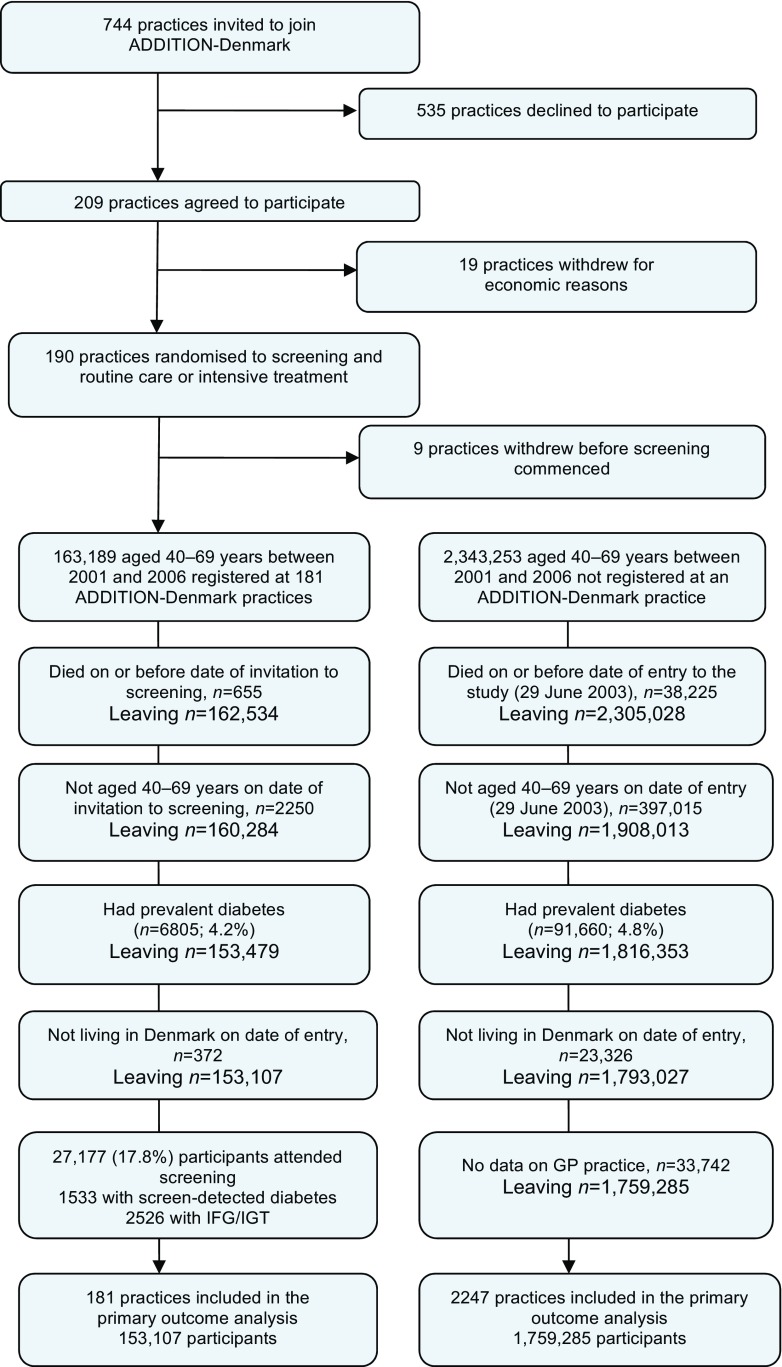
AIMS/HYPOTHESIS: Health check programmes for chronic disease have been introduced in a number of countries. However, there are few trials assessing the benefits and harms of these screening programmes at the population level. In a post hoc analysis, we evaluated the effect of population-based screening for type 2 diabetes and cardiovascular risk factors on mortality rates and cardiovascular events. METHODS: This register-based, non-randomised, controlled trial included men and women aged 40-69 years without known diabetes who were registered with a general practice in Denmark (n = 1,912,392). Between 2001 and 2006, 153,107 individuals registered with 181 practices participating in the Anglo-Danish-Dutch Study of Intensive Treatment in People with Screen-Detected Diabetes in Primary Care (ADDITION)-Denmark study were sent a diabetes risk score questionnaire. Individuals at moderate-to-high risk were invited to visit their GP for assessment of diabetes status and cardiovascular risk (screening group). The 1,759,285 individuals registered with all other general practices in Denmark constituted the retrospectively constructed no-screening (control) group. Outcomes were mortality rate and cardiovascular events (cardiovascular disease death, non-fatal ischaemic heart disease or stroke). The analysis was performed according to the intention-to-screen principle. RESULTS: Among the screening group, 27,177 (18%) individuals attended for assessment of diabetes status and cardiovascular risk. Of these, 1,533 were diagnosed with diabetes. During a median follow-up of 9.5 years, there were 11,826 deaths in the screening group and 141,719 in the no-screening group (HR 0.99 [95% CI 0.96, 1.02], p = 0.66). There were 17,941 cardiovascular events in the screening group and 208,476 in the no-screening group (HR 0.99 [0.96, 1.02], p = 0.49). CONCLUSIONS/INTERPRETATION: A population-based stepwise screening programme for type 2 diabetes and cardiovascular risk factors among all middle-aged adults in Denmark was not associated with a reduction in rate of mortality or cardiovascular events between 2001 and 2012.
Overview
The claims and statistics of this paper haven’t been checked yet.
Free: it reads the open-access text and checks the first 5 claims that cite a source we can check. Create a free account to check every claim.
Integrity signals
Registry
Cites
Statistics
Figures
Verification
Claims the paper makes
The claims and statistics of this paper haven’t been checked yet.
Free: it reads the open-access text and checks the first 5 claims that cite a source we can check. Create a free account to check every claim.
Claims other papers make about this one
Each is checked against this paper’s own text: does it say what the citing paper says it does?
The cited source says what the claim attributes to it.
In the citing paper
“The same researchers found that population-based stepwise screening for T2DM and CVD among all middle-aged adults was not associated with a reduction in mortality or CV events.”
From Prevalence of cardiovascular disease in type 2 diabetes: a systematic literature review of scientific evidence from across the world in 2007–2017 (2018) · cites this paper as [76]
The cited source says what the claim attributes to it.
In the citing paper
“Therefore, the benefits of population-based screening are limited in this context [76].”
From Prevalence of cardiovascular disease in type 2 diabetes: a systematic literature review of scientific evidence from across the world in 2007–2017 (2018) · cites this paper as [76]
Self-check
Percentages, sums and reported differences re-computed from the paper’s own numbers.
The self-check needs the paper’s full text.
Citations
Cites
10-year follow-up of intensive glucose control in type 2 diabetes
Holman, R. R., Paul, S. K., Bethel, M. A., Matthews, D. R., & Neil, H. A. W. (2008) · New England Journal of Medicine · doi:10.1056/nejmoa0806470 · Cited by 7,751
Estimation of ten-year risk of fatal cardiovascular disease in Europe: the SCORE project
Conroy, R. (2003) · European Heart Journal · doi:10.1016/s0195-668x(03)00114-3 · Cited by 5,290 · cited 4×
“%) had high CVD risk (European Heart SCORE ≥ 5 points).”
BackgroundInfluential(1967) · Project Euclid (Cornell University) · Cited by 4,720
Screening and Prostate-Cancer Mortality in a Randomized European Study
Schröder, F. H., Hugosson, J., Roobol, M. J., Tammela, T. L. J., Ciatto, S., Nelen, V., Kwiatkowski, M., Lujan, M., Lilja, H., Zappa, M., et al. (2009) · New England Journal of Medicine · doi:10.1056/nejmoa0810084 · Cited by 4,014 · cited 1×
“For cancers such as prostate, any effect of screening on population mortality rates is achieved largely through the effect of treatment in the lead time between detection by screening and clinical diagnosis [24].”
BackgroundProceedings of the fifth Berkeley symposium on mathematical statistics and probability.
Kojima, K.-I. (1969) · Europe PMC (PubMed Central) · Cited by 3,648
International Standard Classification of Education, ISCED 1997
UNESCO United Nations Educational, S. A. C. O. (2003) · Advances in Cross-National Comparison · doi:10.1007/978-1-4419-9186-7_10 · Cited by 2,351
The International Standard Classification of Education 2011
Schneider, S. L. (2013) · Comparative Social Research · doi:10.1108/s0195-6310(2013)0000030017 · Cited by 886
Griffin, S. J., Borch-Johnsen, K., Davies, M. J., Khunti, K., Rutten, G. E., Sandbæk, A., Sharp, S. J., Simmons, R. K., van den Donk, M., Wareham, N. J., et al. (2011) · The Lancet · doi:10.1016/s0140-6736(11)60698-3 · Cited by 462 · cited 5×
“Although earlier detection may have benefitted those diagnosed with diabetes [18], the proportion was probably too small to affect population mortality rates.”
BackgroundMethodResultInfluentialSelf-citationHerman, W. H., Ye, W., Griffin, S. J., Simmons, R. K., Davies, M. J., Khunti, K., Rutten, G. E. H. M., Sandbaek, A., Lauritzen, T., Borch-Johnsen, K., et al. (2015) · Diabetes Care · doi:10.2337/dc14-2459 · Cited by 340
Self-citationA Danish Diabetes Risk Score for Targeted Screening
Glümer, C., Carstensen, B., Sandbæk, A., Lauritzen, T., Jørgensen, T., & Borch-Johnsen, K. (2004) · Diabetes Care · doi:10.2337/diacare.27.3.727 · Cited by 324 · cited 4×
“We used a validated risk score developed and evaluated in a Danish population to identify those at high risk of undiagnosed diabetes [15].”
BackgroundMethodInfluentialSelf-citation
Cited by
Einarson, T. R., Acs, A., Ludwig, C., & Panton, U. H. (2018) · Cardiovascular Diabetology · doi:10.1186/s12933-018-0728-6 · Cited by 2,312
General health checks in adults for reducing morbidity and mortality from disease
Krogsbøll, L. T., Jørgensen, K. J., & Gøtzsche, P. C. (2019) · Cochrane Database of Systematic Reviews · doi:10.1002/14651858.cd009009.pub3 · Cited by 202
INTERDISCIPLINARY CLINICAL PRACTICE GUIDELINES "MANAGEMENT OF OBESITY AND ITS COMORBIDITIES"
Dedov, I. I., Shestakova, M. V., Mel'nichenko, G. A., Mazurina, N. V., Andreeva, E. N., Bondarenko, I. Z., Руслановна, Г. З., Dzgoeva, F. K., Елисеев, М. С., Ershova, E. V., et al. (2021) · Obesity and metabolism · doi:10.14341/omet12714 · Cited by 215
Screening for type 2 diabetes mellitus
Peer, N., Balakrishna, Y., & Durão, S. (2020) · Cochrane Database of Systematic Reviews · doi:10.1002/14651858.cd005266.pub2 · Cited by 123
“Another study evaluated the impact of training general practitioners for intensive management of patients with screen-detected diabetes (Simmons 2017).”
BackgroundSimmons, R. K., Griffin, S. J., Lauritzen, T., & Sandbæk, A. (2017) · Diabetologia · doi:10.1007/s00125-017-4299-y · Cited by 69
Self-citationSulaiman, N. D., Mahmoud, I., Hussein, A., Elbadawi, S., Abusnana, S., Zimmet, P., & Shaw, J. E. (2018) · BMJ Open Diabetes Research & Care · doi:10.1136/bmjdrc-2017-000489 · Cited by 80
“6 Therefore, identifying individuals with current undiagnosed diabetes or those at high risk of developing T2D in the future is of great importance in reducing the burden of diabetes and its complications.(7) 8 In this context, several researchers have already developed risk assessment tools for other nations based on…”
BackgroundGriffin, S. J., Rutten, G. E. H. M., Khunti, K., Witte, D. R., Lauritzen, T., Sharp, S. J., Dalsgaard, E.-M., Davies, M. J., Irving, G. J., Vos, R. C., et al. (2019) · The Lancet Diabetes & Endocrinology · doi:10.1016/s2213-8587(19)30349-3 · Cited by 55
Self-citationScreening for type 2 diabetes: do screen-detected cases fare better?
Feldman, A. L., Griffin, S. J., Fhärm, E., Norberg, M., Wennberg, P., Weinehall, L., & Rolandsson, O. (2017) · Diabetologia · doi:10.1007/s00125-017-4402-4 · Cited by 49
“in primary care [ADDITION]-Cambridge [2]) and a controlled trial in a high-risk Danish population (ADDITION-Denmark [3]) found no effect on mortality in”
BackgroundSelf-citationPedersen, M. L. (2019) · International Journal of Circumpolar Health · doi:10.1080/22423982.2019.1709257 · Cited by 36
“using a population-based screening for diabetes [239].”
Alawadi, F., Hassanein, M., Hussain, H. Y., Mohammed, H., Ibrahim, G. M., Khater, A., & Suliman, E. A. (2020) · Dubai Diabetes and Endocrinology Journal · doi:10.1159/000512428 · Cited by 35
Sortsø, C., Komkova, A., Sandbæk, A., Griffin, S. J., Emneus, M., Lauritzen, T., & Simmons, R. K. (2018) · Diabetologia · doi:10.1007/s00125-018-4594-2 · Cited by 33
“We have previously shown that screening for type 2 diabetes and cardiovascular risk factors does not reduce mortality and cardiovascular disease (CVD) in the general population in Denmark [5], but for individuals diagnosed with diabetes, screening was associated with a reduction in mortality and risk of CVD [6].”
BackgroundInfluentialSelf-citationMammographic features are associated with cardiometabolic disease risk and mortality
Graßmann, F., Fang, F., Eriksson, M., Azam, S., Hall, P., & Czene, K. (2021) · European Heart Journal · doi:10.1093/eurheartj/ehab502 · Cited by 32
Du, Y., Baumert, J., Paprott, R., Teti, A., Heidemann, C., & Scheidt‐Nave, C. (2020) · BMJ Open Diabetes Research & Care · doi:10.1136/bmjdrc-2020-001707 · Cited by 29
Larsen, L. B., Søndergaard, J., Thomsen, J. L., Halling, A., Sønderlund, A. L., Christensen, J. R., & Thilsing, T. (2019) · BMC Public Health · doi:10.1186/s12889-019-7419-4 · Cited by 31
“Background General health checks to prevent type-2 diabetes mellitus (T2DM) and cardiovascular disease (CVD) have shown no population-level effects above and beyond those attained by opportunistic case finding [1, 2].”
BackgroundShould we screen for type 2 diabetes among asymptomatic individuals? Yes
Simmons, D. S., & Zgibor, J. C. (2017) · Diabetologia · doi:10.1007/s00125-017-4397-x · Cited by 20
“One of these studies shows no reduction in mortality rate in participants in the screening programme vs the general Danish population [7], while the other [8] shows an association with participation in ADDITION and a significant reduction in adjusted HRs for all-cause mortality (0.”
BackgroundInfluentialShahim, B., Gyberg, V., Bacquer, D. D., Kotseva, K., Backer, G. D., Schnell, O., Tuomilehto, J. O., Wood, D., & Rydén, L. (2018) · Cardiovascular Diabetology · doi:10.1186/s12933-018-0665-4 · Cited by 26
Cacciatori, V., Zoppini, G., Bellavere, F., Rigolon, R., Thomaseth, K., Pichiri, I., Trombetta, M., Dauriz, M., De Santi, F., Targher, G., et al. (2018) · Journal of the Endocrine Society · doi:10.1210/js.2017-00300 · Cited by 18
“Despite the important advances in antihyperglycemic therapies, macrovascular complications are still the most common cause of death in patients affected by type 2 diabetes [7, 19].”
BackgroundShahim, B., Hasselberg, S., Boldt-Christmas, O., Gyberg, V., Mellbin, L., & Rydén, L. (2018) · European Journal of Preventive Cardiology · doi:10.1177/2047487318805582 · Cited by 19
Alzubaidi, H., Hasan, S., Saidawi, W., Namara, K. M., Chandir, S., & Krass, I. (2021) · Diabetic Medicine · doi:10.1111/dme.14598 · Cited by 14
Nguyen, B., Lin, K. W., & Mishori, R. (2018) · Public health reviews · doi:10.1186/s40985-018-0095-6 · Cited by 16
“A later population-based controlled trial of screening for type 2 diabetes and cardiovascular risk factors found no differences between the intervention and control groups in mortality or cardiovascular events [36].”
Boersma, H. E., van der Klauw, M. M., Smit, A. J., & Wolffenbuttel, B. H. R. (2022) · Scientific Reports · doi:10.1038/s41598-022-26313-9 · Cited by 14
“70 mmol/l and/or use of triglyceride-lowering medication; (4) waist circumference ≥ 102 cm in men and ≥ 88 cm in women; (5) fasting glucose levels > 5.”
MethodJairoun, A. A., Al‐Hemyari, S. S., Shahwan, M. J., Jairoun, S., Alorfi, N. M., Zyoud, S. H., Suliman, A., Shahwan, M., Alnuaimi, G. R. H., Shahwan, M., et al. (2024) · Journal of Multidisciplinary Healthcare · doi:10.2147/jmdh.s447450 · Cited by 16
Legacy in Cardiovascular Risk Factors Control: From Theory to Future Therapeutic Strategies?
Pothen, L., & Balligand, J. (2021) · Antioxidants · doi:10.3390/antiox10111849 · Cited by 11
“On the other hand, additional real-life studies reinforced the legacy effect theory in diabetes control, such as the Fremantle Diabetes Study [18], the Anglo–Danish-Dutch Study of Intensive Treatment in People with Screen-Detected Diabetes in Primary Care (ADDITION) [19,20], and the Diabetes and Aging Study (DAS) [21].”
BackgroundInfluentialPedron, S., Hanselmann, M., Burns, J., Rich, A., Peters, A., Heier, M., Schwettmann, L., Bor, J. H., Bärnighausen, T., & Laxy, M. (2022) · PLoS Medicine · doi:10.1371/journal.pmed.1004151 · Cited by 9
Akpotu, A. E., Ghasi, S. I., Ewhre, L. O., Adebayo, O. G., & Asiwe, J. N. (2021) · Biomarkers · doi:10.1080/1354750x.2021.1990408 · Cited by 9
Does the evidence support population-wide screening for type 2 diabetes? No
Shaw, J. E. (2017) · Diabetologia · doi:10.1007/s00125-017-4393-1 · Cited by 7
Missed Opportunities in Type 2 Diabetes Mellitus: A Narrative Review
Kwok, C. S., Phillips, A., Mukherjee, S., Patel, M., & Hanif, W. (2024) · Current Diabetes Reviews · doi:10.2174/0115733998274651231117101511 · Cited by 8
Schmidt, K., Færch, K., Zoffmann, V., Amadid, H., & Varming, A. R. (2021) · Diabetic Medicine · doi:10.1111/dme.14748 · Cited by 10
The Main Diseases Related to Type 2 Diabetes Mellitus: A Scoping Review
Silva, J. V. F. D., Borges, W. R., & Ferracioli, P. R. B. (2024) · Scientia. Technology, science and society. · doi:10.59324/stss.2024.1(2).02 · Cited by 6
“…one of the main causes of end-stage renal failure.30 Furthermore, nephropathy is associated with a significant increase in the risk of all-cause death and cardiovascular mortality in patients with DM2 (Ong, 2021; Nomura, 2021; Lin, 2022; Simmons, 2017; Odnoletkova, 2014; Schrieks, 2018).”
BackgroundFukuma, S., Mukaigawara, M., Iizuka, T., & Tsugawa, Y. (2022) · BMJ Open · doi:10.1136/bmjopen-2021-056996 · Cited by 4
Ke, C., Chu, A., Shah, B. R., Tobe, S. W., Tu, K., Fang, J., Vaid, H. M., Liu, P. P., Cader, A., & Lee, D. S. (2023) · Cardiovascular Diabetology · doi:10.1186/s12933-023-01952-y · Cited by 6
“In these targeted populations, screening is likely to reduce the incidence of cardiovascular complications [4, 5], while screening the entire population does not yield similar benefits [6].”
BackgroundVos, R. C., den Ouden, H., Daamen, L. A., Bilo, H. J. G., Denig, P., & Rutten, G. E. H. M. (2020) · BMJ Open Diabetes Research & Care · doi:10.1136/bmjdrc-2019-000949 · Cited by 4
Andersen, J. W., Dahl, M., Yderstræde, K. B., & Høgh, A. L. (2018) · Diabetic Medicine · doi:10.1111/dme.13759 · Cited by 3
van der Ende, M. Y., Waardenburg, I. E., Lipsic, E., Bos, J., Hak, E., Snieder, H., & van der Harst, P. (2020) · International Journal of Cardiology Hypertension · doi:10.1016/j.ijchy.2020.100042 · Cited by 3
Kunyiha, N., Adan, R., Ngugi, R., Odhiambo, J., & Sokwalla, S. (2025) · Current Diabetes Reports · doi:10.1007/s11892-025-01581-7 · Cited by 3
Development of type 2 diabetes risk assessment model for Turkish society
Çelikkanat, Ş., Güngörmüş, Z., & Akay, Ö. (2023) · Journal of Diabetes & Metabolic Disorders · doi:10.1007/s40200-023-01315-0 · Cited by 2
“In the first stage, a draft form was created by grouping the literature information on the factors playing a role in the etiology of diabetes [1–6].”
Rathmann, W., & Jacobs, E. M. G. (2020) · Der Diabetologe · doi:10.1007/s11428-019-00564-z · Cited by 2
“Sie ist die größte kontrollierte Studie, die die Auswirkungen eines Diabetesscreenings mit anschließender intensivierter Therapie untersucht hat [22, 23, 24].”
BackgroundCharles, M., Bruun, N. H., Simmons, R. K., Dalsgaard, E., Witte, D. R., Jørgensen, M. E., Christensen, B., Maindal, H. T., Rubak, S., Sandbæk, A., et al. (2020) · BJGP Open · doi:10.3399/bjgpopen20x101012 · Cited by 2
Self-citationMateu, N. C., Rossing, P. R., Neergaard, K. P., & Thybo, T. (2026) · BMJ Open Diabetes Research & Care · doi:10.1136/bmjdrc-2025-005539 · Cited by 1
“12 This is, however, not surprising, as screening for type 2 diabetes identifies only a small fraction of the individuals in the general population, who will experience CVD or advanced mortality.”
Association between nonrestorative sleep and increased healthcare costs: a 6-year cohort study
Matsunaga, S., Sado, M., Kaneita, Y., Sasaki, N., Tanaka, K., & Kuriyama, K. (2026) · Sleep and Biological Rhythms · doi:10.1007/s41105-026-00642-y · Cited by 1
“To address this issue, many countries have implemented health checkup programs aimed at controlling healthcare costs [ 2, 3].”
Nationale Diabetesstrategie – Chancen und Grenzen nationaler Kampagnen
Mühlhauser, I. (2019) · Gesundheits- und Sozialpolitik · doi:10.5771/1611-5821-2019-3-7 · Cited by 1
Screening strategies for dysglycaemia in relation to cardiovascular risk
Shahim, B. (2019) · Figshare · Cited by 1
Does routine screening for diabetes mellitus improve outcomes?
Dennis, S. N., Banks, J., & Bartow, M. J. (2019) · Evidence-Based Practice · doi:10.1097/ebp.0000000000000347
Wolffenbuttel, B. H. R., Boersma, H. E., van der Klauw, M. M., & Smit, A. J. (2022) · Research Square · doi:10.21203/rs.3.rs-1269498/v1
Wolffenbuttel, B. H. R., Boersma, H. E., van der Klauw, M. M., & Smit, A. J. (2022) · Research Square · doi:10.21203/rs.3.rs-1269498/v2
Peydayesh, A., Najafipour, H., Rahaei, Z., Shadkam-Farokhi, M., & Jambarsang, S. (2022) · Journal of Pharmaceutical Negative Results · doi:10.47750/pnr.2022.13.s03.240
León, J. S. T., Ardila, L. J. P., Santamaria, M. J. C., Quintero, V. Q., Campo, E. R. Z., Corzo, M. J. O., Cantillo, F. A. A., Romero, L. D. J., Medina, R. A. A., Solano, M. J. C., et al. (2024) · Ciencia Latina Revista Científica Multidisciplinar · doi:10.37811/cl_rcm.v8i1.10179
“…real reforzaron la teoría del efecto legado en el control de la diabetes, como el Fremantle Diabetes Study (18), el Anglo – Danish-Dutch Study of Intensive Treatment in People with Screen-Detected Diabetes in Primary Care (ADICTION) (19, 20), y el Estudio de Diabetes y Envejecimiento (DAS) (21).”
Andersen, J. W., Høgh, A. L., Lindholt, J. S., Søgaard, R., Støvring, H., Yderstræde, K. B., Sandbæk, A., & Dahl, M. (2025) · Clinical Epidemiology · doi:10.2147/clep.s487825
“14,15 16 The prevalence of unknown DM, the relevance of screening and the discrepancy between expectations and findings in studies on the effects of screening for DM highlight the need to further understand possible mechanisms facilitating the effect of population-based screening for DM.”
Self-citationDoes screening for diabetes improve morbidity and mortality?
Martin, R., & Guthmann, R. (2025) · Evidence-Based Practice · doi:10.1097/ebp.0000000000002369
Ke, C., Chu, A., Shah, B. R., Tobe, S., Tu, K., Fang, J., Vaid, H. M., Liu, P., Cader, A., & Lee, D. S. (2024) · Figshare · doi:10.6084/m9.figshare.26613395
Frison, É. (2019) · theses.fr (ABES) · doi:10.70675/a527bd03zb814z44e5z8848z942b662a0847 · Cited by 2
Metadata
- Authors
- Simmons, R. K., Griffin, S. J., Witte, D. R., Borch-Johnsen, K., Lauritzen, T., & Sandbæk, A.
- Affiliations
- Steno Diabetes Centers (DK)
- Aarhus University (DK)
- Corresponding author
- Simmons, Rebecca K.
- Venue
- Diabetologia
- Published
- 2017-08-23
- Volume
- 60
- Issue
- 11
- Pages
- 2183-2191
- ISSN
- 0012-186X (ISSN-L)
- 1432-0428
- PMC
- PMC6086322
- OpenAlex
- W2617354269
- Cited by
- 51
- References
- 35
- Citations by year
- 2026: 2 · 2025: 3 · 2024: 5 · 2023: 2 · 2022: 6 · 2021: 6 · 2020: 7 · 2019: 8 · 2018: 7 · 2017: 5
- FWCI
- 6.93
- Type
- journal article
- Language
- en
- Open access
- hybrid
- doi.org
- Locations
- Diabetologia (publishedVersion, cc-by)
- Europe PMC (PubMed Central) (publishedVersion, cc-by)
- PubMed Central (publishedVersion, cc-by)
- PubMed (publishedVersion)
- University of Southern Denmark Research Portal (University of Southern Denmark) (submittedVersion, other-oa)
- Apollo (University of Cambridge) (submittedVersion, cc-by)
- Apollo (cc-by)
- Funders
- Pfizer
- GlaxoSmithKline
- Strategiske Forskningsråd
- Aarhus Universitet
- Sundhed og Sygdom, Det Frie Forskningsråd
- Steno Diabetes Center Copenhagen (SDCC 3.A Complications)
- National Institute for Health and Care Research (NF-SI-0515-10119)
- Aarhus Universitets Forskningsfond
- Novo Nordisk
- Servier
- Medical Research Council (MC_UU_12015/4)
- Topics
- Health Sciences › Medicine › Public Health, Environmental and Occupational Health › Health Promotion and Cardiovascular Prevention
- Health Sciences › Medicine › Endocrinology, Diabetes and Metabolism › Diabetes, Cardiovascular Risks, and Lipoproteins
- Health Sciences › Medicine › Oncology › Global Cancer Incidence and Screening
- Keywords
- type 2 diabetes screening, cardiovascular risk factors, mass screening, mortality, cardiovascular events, ischemic heart disease, stroke, middle-aged adults, primary care, screening benefits and harms, Denmark, cardiovascular mortality, intention-to-treat analysis, post hoc analysis
- MeSH terms
- Adult, Aged, Blood Glucose, Cardiovascular Diseases, Denmark, Diabetes Mellitus, Type 2, Female, Glycated Hemoglobin, Humans, Male, Mass Screening, Middle Aged, Risk Factors
About these checks
Registry, retraction, Cites and statistics results are computed, not judged, with one exception: a printed reference that no index lists is read once by a model before it counts as a citation error. Claims are extracted by a model and kept only when their quote appears verbatim in the text; each cited source is then checked, with a model’s help, for whether it says what the claim relies on. Those verdicts can be wrong — read the claim’s quote and the cited source before relying on one.
Statistics and arithmetic are recomputed, not judged.
Confidence bands are shown only for fields calibrated on our annotated test set. None is calibrated yet, so no band is shown.
What counts as a claim ›How we measure confidence ›How we check this ›
Are you an author, or do you see a problem with this page? Request a review
Data sources
Bibliographic data: Semantic Scholar, OpenAlex, Crossref.
Contains information from the Semantic Scholar Academic Graph Datasets, made available under the ODC Attribution License (ODC-BY 1.0).
Semantic Scholar’s data is described in: Kinney, R., et al. (2023). The Semantic Scholar Open Data Platform. arXiv:2301.10140.
