

Age-, sex-and ethnicity-related differences in body weight, blood pressure, HbA1c and lipid levels at the diagnosis of type 2 diabetes relative to people without diabetes
Open accessThe DOI matches its Crossref record; 41 of the 41 references it cites were found in a registry or an index.
Abstract
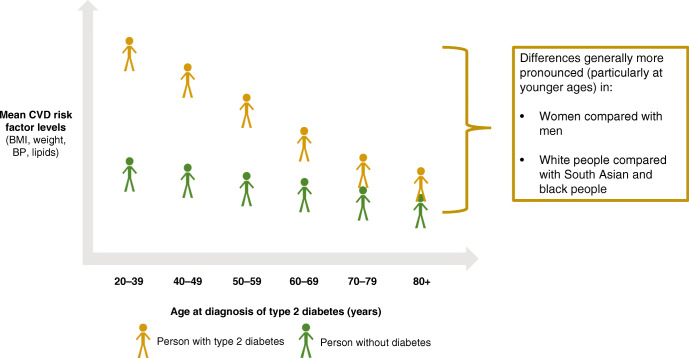
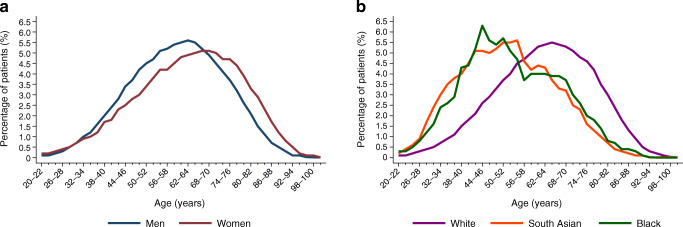
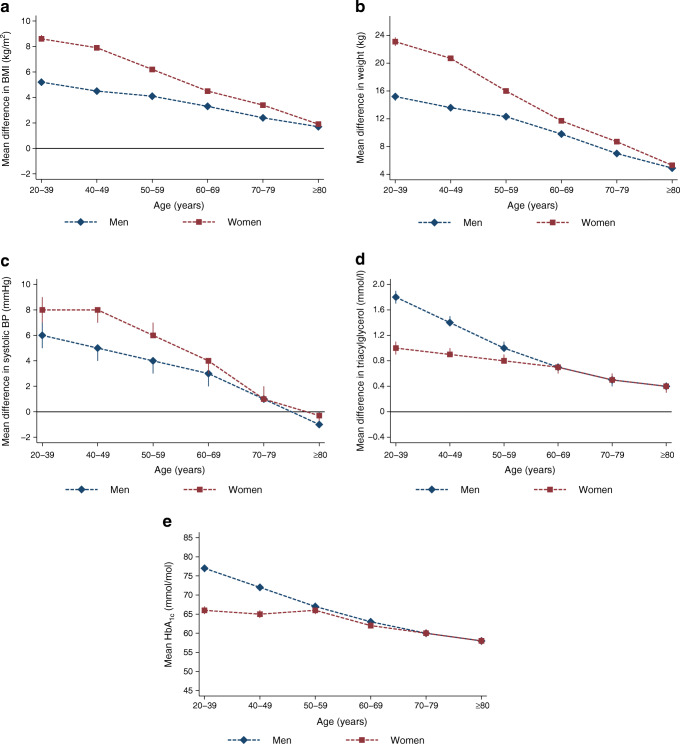
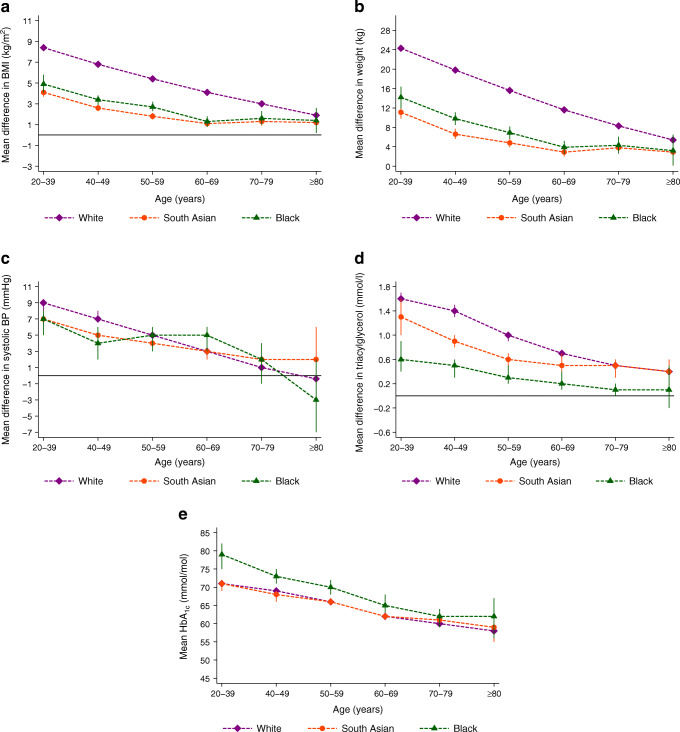
Aims/hypothesis: The aim of this work was to determine how weight patterns together with blood glucose, BP and lipids vary at diagnosis of diabetes by age, sex and ethnicity. Methods: Using the UK Clinical Practice Research Datalink, we identified people with type 2 diabetes (n = 187,601) diagnosed in 1998–2015 and compared their weights, HbA 1c, BP and lipid levels at diagnosis with age-matched people without diabetes (n = 906,182), by sex and ethnic group. Results: Younger age at diagnosis was associated with greater adjusted mean difference (95% CI) in weight between those with vs without type 2 diabetes: 18.7 (18.3, 19.1) kg at age 20–39 years and 5.3 (5.0, 5.5) kg at age ≥ 80 years. Weight differentials were maximal in white women, and were around double in white people compared with South Asian and black people. Despite lower absolute values, BP differences were also greater at younger age of diabetes onset: 7 (6, 7) mmHg at age 20–39 years vs −0.5 (−0.9, −0.2) at age ≥ 80 years. BP differences were greatest in white people, and especially in women. Triacylglycerol level differences were greatest in younger men. Finally, HbA 1c levels were also higher with younger onset diabetes, particularly in black people. Conclusions/interpretation: At diagnosis of type 2 diabetes, when compared with people without diabetes, weight and BP differentials were greater in younger vs older people, in women vs men and in white vs South Asian and black people. These differences were observed even though South Asian and black people tend to develop diabetes a decade earlier with either similar or greater dysglycaemia. These striking patterns may have implications for management and prevention.
Overview
The claims and statistics of this paper haven’t been checked yet.
Free: it reads the open-access text and checks the first 5 claims that cite a source we can check. Create a free account to check every claim.
Integrity signals
Registry
Cites
Statistics
Figures
Verification
Claims the paper makes
The claims and statistics of this paper haven’t been checked yet.
Free: it reads the open-access text and checks the first 5 claims that cite a source we can check. Create a free account to check every claim.
Claims other papers make about this one
Each is checked against this paper’s own text: does it say what the citing paper says it does?
The source backs part of the claim, not all of it — or backs it for a different population, condition or comparison.
In the citing paper
“Women usually show greater differences in BP and higher proportions of hypertension than men already at diagnosis of T2DM compared with women and men without T2DM, and worse BP control thereafter.191,230”
From 2023 ESC guidelines for the management of cardiovascular disease in patients with diabetes. (2023) · cites this paper as [230]
Experimental — accuracy not yet measuredIn the citing paper
“In a UK study of data from Clinical Practice Research Datalink, people with early onset type 2 diabetes had significantly more cardiovascular risk factors compared to age‐matched controls. However, the difference was attenuated for Asian and Black individuals with type 2 diabetes. 13”
From Developing services to support the delivery of care to people with early‐onset type 2 diabetes (2022) · cites this paper as [13]
In the citing paper
“Type 2 diabetes also presents at lower BMI in some ethnic groups, for example, south Asian people who are relatively leaner at diagnosis, 54 , 55 although significant obesity appears to accompany a diagnosis of early‐onset type 2 diabetes in most cases coded by practitioners. 13”
From Developing services to support the delivery of care to people with early‐onset type 2 diabetes (2022) · cites this paper as [13]
Self-check
Percentages, sums and reported differences re-computed from the paper’s own numbers.
The self-check needs the paper’s full text.
Citations
Cites
Multiple imputation after 18+ years
Rubin, D. B. (1996) · Journal of the American Statistical Association · doi:10.1080/01621459.1996.10476908 · Cited by 4,072
Multiple Imputation After 18+ Years
Rubin, D. B. (1996) · Journal of the American Statistical Association · doi:10.2307/2291635 · Cited by 2,686 · cited 1×
“Estimates were combined across the five datasets using Rubin’s rules [22].”
MethodData Resource Profile: Clinical Practice Research Datalink (CPRD)
Herrett, E., Gallagher, A. M., Bhaskaran, K., Forbes, H., Mathur, R., van Staa, T., & Smeeth, L. (2015) · International Journal of Epidemiology · doi:10.1093/ije/dyv098 · Cited by 2,667
Huxley, R., Barzi, F., & Woodward, M. (2006) · BMJ · doi:10.1136/bmj.38678.389583.7c · Cited by 1,534
Screening for type 2 diabetes.
Engelgau, M. M., Narayan, K. M., & Herman, W. H. (2000) · Diabetes Care · doi:10.2337/diacare.23.10.1563 · Cited by 1,027
Peters, S. A. E., Huxley, R. R., & Woodward, M. (2014) · The Lancet · doi:10.1016/s0140-6736(14)60040-4 · Cited by 805
Peters, S. A. E., Huxley, R. R., & Woodward, M. (2014) · Diabetologia · doi:10.1007/s00125-014-3260-6 · Cited by 701
JBS3 Board (2014) · Heart · doi:10.1136/heartjnl-2014-305693 · Cited by 608
College of General Practitioners
Abercrombie, G. F., Hughes, H. L. G., & Hunt, J. H. (1954) · BMJ · doi:10.1136/bmj.1.4857.336-c · Cited by 504
Sex Disparities in Treatment of Cardiac Risk Factors in Patients With Type 2 Diabetes
Wexler, D. J., Grant, R. W., Meigs, J. B., Nathan, D. M., & Cagliero, E. (2005) · Diabetes Care · doi:10.2337/diacare.28.3.514 · Cited by 339
Cited by
Items 101–143 of 143
Mens, M. M. J., Jopling, E., Hare, M., Drury, S. S., Nelson, C. A., Zeanah, C. H., Fox, N. A., & Slopen, N. (2026) · Development and Psychopathology · doi:10.1017/s0954579426101540 · Cited by 1
“Individuals who develop type 2 diabetes at a younger age are often characterized by higher body mass index (BMI), high blood pressure, dyslipidemia, and abnormal glucose function (Steinarsson et al., 2018; Wright et al., 2020).”
Darwish, M. H., El‐Tamawy, M. S., Alhirsan, S. M., El‐Anany, M., & Khalifa, H. A. (2025) · Physiotherapy Research International · doi:10.1002/pri.70063 · Cited by 1
Siddiqui, M. K., Dupuis, T., Anjana, R. M., Dawed, A. Y., Bigossi, M., Srinivasan, S., Hodgson, S., Adedire, E. T., Taylor, A., Jebarani, S., et al. (2025) · Communications Medicine · doi:10.1038/s43856-025-01076-2 · Cited by 1
“This , in part, leads to the higher frequencyof young-onsetdiabetesinpeopleofAsianand Africanancestry 7 .”
Self-citationKhan, S. H., Khan, M. Q. A., Hayat, A., Munir, M. U., Anwar, M. N., Ali, A., & Ghani, E. (2025) · Pakistan Armed Forces Medical Journal · doi:10.51253/pafmj.v75isuppl-7.12781 · Cited by 1
Ahmad, F., Abubakar, S., Alwi, S. S. S., Ng, O. C., & Saidi, H. I. (2026) · Journal of Racial and Ethnic Health Disparities · doi:10.1007/s40615-025-02803-0 · Cited by 1
Real‐world predictors of progression to type 2 diabetes among adults with prediabetes
Dunn, T. J., Doshi, R., Divino, V. M., Chen, J., Radin, M. S., Tian, D., Xie, L., & Solis‐Herrera, C. (2026) · Diabetes Obesity and Metabolism · doi:10.1111/dom.70583 · Cited by 2
Sex‐Specific Regulation of Glycemic Homeostasis by Theabrownin from Pu‐erh Tea
Li, Y., Kuang, J., Zheng, D., Wang, J., Ge, K., Qu, C., Zheng, X., Ren, Z., Huang, F., Zhao, M., et al. (2026) · Advanced Science · doi:10.1002/advs.202519337 · Cited by 1
“Factors including obesity, polycystic ovary syndrome (PCOS), gestational diabetes, menopausal hormonal changes, and psychosocial stress increase T2D risk in females [ 4–8 ].”
Davies, M. J., Aroda, V. R., Bajaj, M. S., ElSayed, N. A., Giorgino, F., Green, J., Kalyani, R. R., Maruthur, N. M., Mathieu, C., Rosas, S. E., et al. (2026) · Diabetologia · doi:10.1007/s00125-026-06855-7 · Cited by 1
Ambrož, M., de Vries, S. T., Hoogenberg, K., & Denig, P. (2022) · Frontiers in Pharmacology · doi:10.3389/fphar.2022.883103 · Cited by 1
“A previous study showed higher HbA1c levels in males than females at diagnosis of diabetes (Wright et al., 2020).”
BackgroundThe Profile of Clinically Diagnosed New Type 2 Diabetes among Asian Indians
(2020) · doi:10.31038/edmj.2020434 · Cited by 1
“Similarly, in two large multi-ethnic studies from UK [15,16], the age at diagnosis of T2DM was found to be lower (51.”
BackgroundLu, Y., Wang, X., Zhang, Q., & Xue, Y. (2024) · International Journal of Diabetes in Developing Countries · doi:10.1007/s13410-023-01305-1 · Cited by 1
“It is acknowledged that the racial discordance affects the relationship between average glucose and HbA1c [22, 23].”
Cardiovascular risk and disease management in diabetes: differences between women and men.
de Jong, M. (2021) · Utrecht University Repository (Utrecht University) · doi:10.33540/590 · Cited by 1
Yücel, H. E., Ulcay, T., Görgülü, Ö., & Öncü, R. (2024) · Research Square · doi:10.21203/rs.3.rs-5057249/v1 · Cited by 1
Extraction of CPRD additional clinical data using R
Nash, A., & Cader, M. Z. (2020) · F1000Research · doi:10.12688/f1000research.26228.1
Stärker auf junge Zielgruppe achten
(2020) · Diabetologie und Stoffwechsel · doi:10.1055/a-1265-1680
Almousawy, M. H., & Jabir, F. A. (2022) · Pakistan Journal of Medical and Health Sciences · doi:10.53350/pjmhs22164953
Rutten, G. E. H. M., & Vos, R. C. (2021) · Bohn Stafleu van Loghum eBooks · doi:10.1007/978-90-368-2707-2_19
Management of Early-Onset Type 2 Diabetes
Kim, J. H. (2024) · Journal of Korean Diabetes · doi:10.4093/jkd.2024.25.1.4
Orazumbekova, B., Zöllner, J., Hodgson, S., Bigossi, M., Samuel, M., Finer, S., Mathur, R., & Siddiqui, M. K. (2025) · medRxiv · doi:10.1101/2025.06.12.25329480
Srivastava, S., Visaria, A., Reddi, S., Dave, P., & Sharma, R. (2025) · Journal of General Internal Medicine · doi:10.1007/s11606-025-09743-9
Ábel, T., & Csobod, É. C. (2025) · IntechOpen eBooks · doi:10.5772/intechopen.1010879
Determining A1C Normal Values in Rhesus Macaques (Macaca mulatta)
Dufour, J., Doyle‐Meyers, L. A., Falkenstein, K. P., & Shimwa, A. K. (2025) · Journal of the American Association for Laboratory Animal Science · doi:10.30802/aalas-jaalas-25-129
Ohkuma, T., Iwase, M., Fujii, H., & Kitazono, T. (2024) · Figshare · doi:10.6084/m9.figshare.26590757
Angelantonio, E. D., Kaptoge, S. K., Walker, M. R., Bolton, T. R., Spackman, S., Burgess, S., Pennells, L. A. M., Wood, A., & Danesh, J. (2023) · Apollo (University of Cambridge) · doi:10.17863/cam.99961
Watkinson, R., McManus, E., Meacock, R., & Sutton, M. (2024) · Figshare · doi:10.6084/m9.figshare.26759090
Annibali, C., Bergemann, A., & Alessie, R. J. M. (2025) · Econstor (Econstor)
Diabète de type 2 à début précoce : une épidémie menaçante
Halimi, S. (2026) · Médecine des Maladies Métaboliques · doi:10.1016/j.mmm.2026.01.008
Différences de soins liées au sexe chez les personnes diabétiques de type 2 de la cohorte Constances
Paquet, S. (2023) · theses.fr (ABES) · doi:10.70675/ac7c0a65zf6d4z4138za1c8z2b3db605bfe1
Farhat, G., Shariff, M., Hopkinson, C., Yaqub, Z., & Majeed, S. (2026) · Public Health Nutrition · doi:10.1017/s136898002610250x
Kimber, T. B., Hunter, D. J., Akam, E. C., Singh, M., Singh, P., & Mastana, S. S. (2026) · International Journal of Molecular Sciences · doi:10.3390/ijms27219827
Predicting complications for diabetes in South Asians: Beyond convention
Lin, B., Lim, L.-L., Mohan, V., & Shaw, J. E. (2026) · Best Practice & Research Clinical Endocrinology & Metabolism · doi:10.1016/j.beem.2026.102119
Wang, J., Peng, H., Tao, J., Yong, J., Zeng, L., Zhang, K., zhao, Q., Wang, Y., Liu, J., Zheng, B., et al. (2026) · Diabetes Research and Clinical Practice · doi:10.1016/j.diabres.2026.113324
Age-related patterns of cardiometabolic risk factors for complications in type 2 diabetes
Sajjadi, S. F., Sacre, J. W., Kowlessur, S., Söderberg, S., Zimmet, P. Z., Tuomilehto, J., Deepa, M., Pradeepa, R., Anjana, R. M., Mohan, V., et al. (2026) · Diabetologia · doi:10.1007/s00125-026-06753-y
Kong, C. Y. A., Amaravadi, S. K., Costa, J., Ferreira, A. D. S., Vigário, P. D. S., & Alaparthi, G. K. (2026) · F1000Research · doi:10.12688/f1000research.180073.1
Baseline serum metabolites predict fractures in individuals who were Black and had type 2 diabetes
Chlebek, C., Bussberg, V., Narain, N. R., Kiebish, M. A., Tseng, Y., Rosen, C. J., & Lynes, M. D. (2026) · Frontiers in Endocrinology · doi:10.3389/fendo.2026.1777636
Gai, B. (2026) · BCU Open Access Repository (Birmingham City University)
Levine, C. M., Caggiano, C., Anderson, T., Kelberman, M. A., Weinshenker, D., Lail, H. L., Wanders, D., Bangasser, D. A., Kanoski, S. E., & Parent, M. B. (2026) · Molecular Neurobiology · doi:10.1007/s12035-026-06014-4
Mendonca, A., Kumar, J. S., & Sujatha, S. (2026) · Diabetes Research and Clinical Practice · doi:10.1016/j.diabres.2026.113443
Sharma, R. (2026) · Directory of Open access Books (OAPEN Foundation)
Gai, B., Kamal, A., Carter, P., & Tufte‐Hewett, A. (2026) · Healthcare · doi:10.3390/healthcare14172808
“The prevalence of diabetes in Black communities can be four to five times higher than in the White population [16,17], with Black people presenting with type 2 diabetes approximately nine to ten years younger than their White counterparts [2,18].”
Munthali-Mkandawire, S., Chabwera, M., Banda, L., Edwards, C. A., Gray, C. M., Gray, S. R., Sattar, N., Bunn, C., Crampin, A. C., & Gill, J. M. R. (2026) · Diabetes Obesity and Metabolism · doi:10.1111/dom.71461
Self-citationEvolving phenotype of newly diagnosed type 2 diabetes: a 15-year population-based comparison
Kirshner, D., & Hauzer, M. (2026) · Diabetologia · doi:10.1007/s00125-026-06901-4
Metadata
- Authors
- Wright, A. K., Welsh, P., Gill, J. M. R., Kontopantelis, E., Emsley, R., Buchan, I., Ashcroft, D. M., Rutter, M. K., & Sattar, N.
- Affiliations
- Manchester Academic Health Science Centre (GB)
- University of Glasgow (GB)
- University of Manchester (GB)
- King's College London (GB)
- University of Liverpool (GB)
- Corresponding author
- Sattar, Naveed
- ORCID
- Venue
- Diabetologia
- Published
- 2020-05-21
- Volume
- 63
- Issue
- 8
- Pages
- 1542-1553
- ISSN
- 0012-186X (ISSN-L)
- 1432-0428
- PMC
- PMC7351865
- OpenAlex
- W3014213400
- Cited by
- 124
- References
- 40
- Citations by year
- 2026: 17 · 2025: 32 · 2024: 26 · 2023: 21 · 2022: 13 · 2021: 10 · 2020: 5
- FWCI
- 9.24
- Type
- journal article
- Language
- en
- Open access
- hybrid
- doi.org
- Licence
- cc-by
- creativecommons.org/licenses/by/4.0 (tdm)
- creativecommons.org/licenses/by/4.0 (vor)
- Locations
- Diabetologia (publishedVersion, cc-by)
- PubMed Central (publishedVersion, cc-by)
- PubMed (publishedVersion)
- Research Explorer (The University of Manchester) (publishedVersion, other-oa)
- ENLIGHTEN (Jurnal Bimbingan dan Konseling Islam) (acceptedVersion, cc-by-sa)
- Funders
- Diabetes UK (BDA: 14/0004971)
- Topics
- Health Sciences › Medicine › Endocrinology, Diabetes and Metabolism › Diabetes, Cardiovascular Risks, and Lipoproteins
- Health Sciences › Medicine › Endocrinology, Diabetes and Metabolism › Diabetes Treatment and Management
- Health Sciences › Medicine › Endocrinology, Diabetes and Metabolism › Diabetes Management and Research
- Keywords
- type 2 diabetes, age at diagnosis, sex differences, ethnic differences, body weight, blood pressure, HbA1c, serum lipids, triglycerides, South Asian ethnicity, Black ethnicity, white ethnicity, young-onset diabetes, dysglycemia
- MeSH terms
- Adult, Age Factors, Aged, Blood Glucose, Blood Pressure, Diabetes Mellitus, Type 2, Female, Glycated Hemoglobin, Humans, Male, Middle Aged, Sex Factors, White People, Young Adult
About these checks
Registry, retraction, Cites and statistics results are computed, not judged, with one exception: a printed reference that no index lists is read once by a model before it counts as a citation error. Claims are extracted by a model and kept only when their quote appears verbatim in the text; each cited source is then checked, with a model’s help, for whether it says what the claim relies on. Those verdicts can be wrong — read the claim’s quote and the cited source before relying on one.
Statistics and arithmetic are recomputed, not judged.
Confidence bands are shown only for fields calibrated on our annotated test set. None is calibrated yet, so no band is shown.
What counts as a claim ›How we measure confidence ›How we check this ›
Are you an author, or do you see a problem with this page? Request a review
Data sources
Bibliographic data: Semantic Scholar, OpenAlex, Crossref.
Contains information from the Semantic Scholar Academic Graph Datasets, made available under the ODC Attribution License (ODC-BY 1.0).
Semantic Scholar’s data is described in: Kinney, R., et al. (2023). The Semantic Scholar Open Data Platform. arXiv:2301.10140.
