

The network structure of paranoia in the general population
Open accessThe DOI matches its Crossref record; 36 of the 37 references it cites were found in a registry or an index.
Abstract
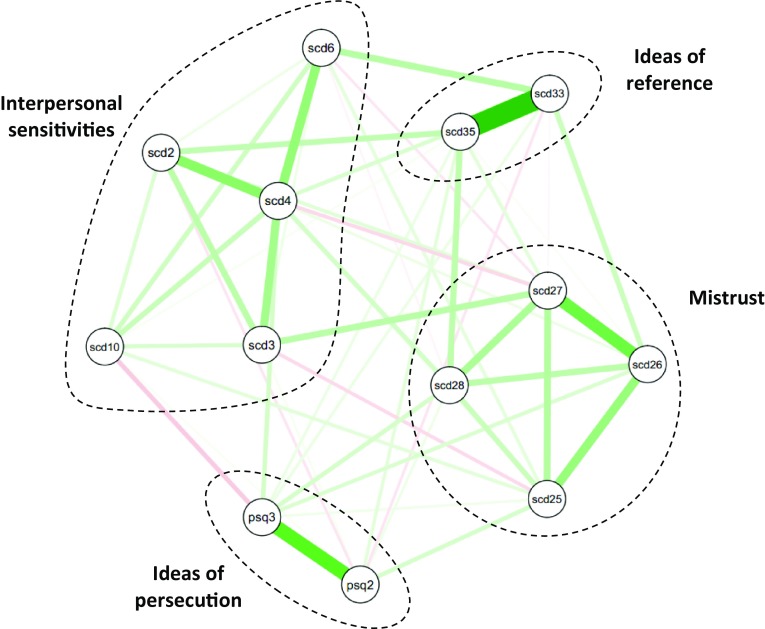
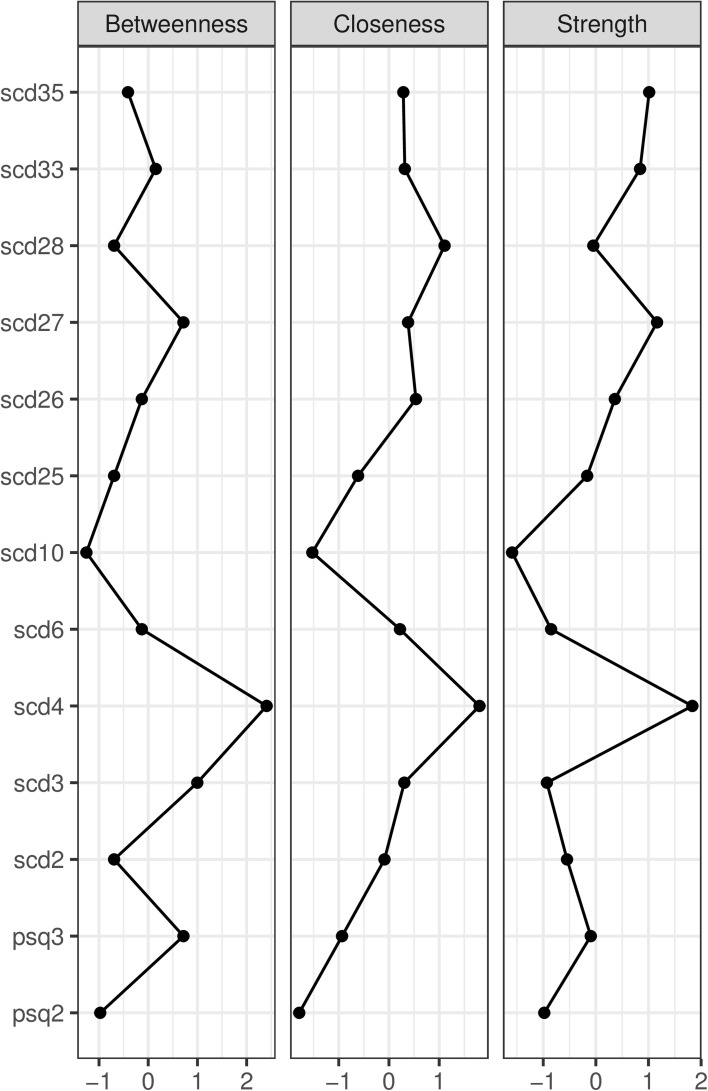
PURPOSE: Bebbington and colleagues' influential study on 'the structure of paranoia in the general population' used data from the British National Psychiatric Morbidity Survey and latent variable analysis methods. Network analysis is a relatively new approach in psychopathology research that considers mental disorders to be emergent phenomena from causal interactions among symptoms. This study re-analysed the British National Psychiatric Morbidity Survey data using network analysis to examine the network structure of paranoia in the general population. METHODS: We used a Graphical Least Absolute Shrinkage and Selection Operator (glasso) method that estimated an optimal network structure based on the Extended Bayesian Information Criterion. Network sub-communities were identified by spinglass and EGA algorithms and centrality metrics were calculated per item and per sub-community. RESULTS: We replicated Bebbington's four component structure of paranoia, identifying 'interpersonal sensitivities', 'mistrust', 'ideas of reference' and 'ideas of persecution' as sub-communities in the network. In line with previous experimental findings, worry was the most central item in the network. However, 'mistrust' and 'ideas of reference' were the most central sub-communities. CONCLUSIONS: Rather than a strict hierarchy, we argue that the structure of paranoia is best thought of as a heterarchy, where the activation of high-centrality nodes and communities is most likely to lead to steady state paranoia. We also highlight the novel methodological approach used by this study: namely, using network analysis to re-examine a population structure of psychopathology previously identified by latent variable approaches.
Overview
The claims and statistics of this paper haven’t been checked yet.
Free: it reads the open-access text and checks the first 5 claims that cite a source we can check. Create a free account to check every claim.
Integrity signals
Registry
Cites
Statistics
Figures
Verification
Claims the paper makes
The claims and statistics of this paper haven’t been checked yet.
Free: it reads the open-access text and checks the first 5 claims that cite a source we can check. Create a free account to check every claim.
Claims other papers make about this one
Each is checked against this paper’s own text: does it say what the citing paper says it does?
The cited source says what the claim attributes to it.
In the citing paper
“Mistrust is a likely candidate for this relationship, as it is a subcomponent of the paranoia spectrum often present in subclinical populations (Bebbington et al., 2013; Bell & O’Driscoll, 2018)”
From Mistrust and negative self‐esteem: Two paths from attachment styles to paranoia. (2021) · cites this paper as Bell & O’Driscoll, 2018
The cited source says what the claim attributes to it.
In the citing paper
“Mistrust is a likely candidate for this relationship, as it is a subcomponent of the paranoia spectrum often present in subclinical populations (Bebbington et al., 2013; Bell & O’Driscoll, 2018), and insecure attachment styles are associated with reduced interpersonal trust (Fett et al., 2016; Mikulincer, 1995, 1998).”
From Mistrust and negative self‐esteem: Two paths from attachment styles to paranoia. (2021) · cites this paper as Bell & O’Driscoll, 2018
The check wasn’t confident either way, so it gives no verdict — never disputed.
In the citing paper
“Sub-clusters exchanging information are likely to average towards their local centre [137,138,139], which entails a form of opinion stability within the group.”
From Epistemic Communities under Active Inference (2022) · cites this paper as [139]
Experimental — accuracy not yet measured
Self-check
Percentages, sums and reported differences re-computed from the paper’s own numbers.
The self-check needs the paper’s full text.
Citations
Cites
Regularization Paths for Generalized Linear Models via Coordinate Descent
Friedman, J., Hastie, T., & Tibshirani, R. (2010) · Journal of Statistical Software · doi:10.18637/jss.v033.i01 · Cited by 19,927 · cited 1×
“The final network structure was derived using a Graphical Least Absolute Shrinkage and Selection Operator (glasso) method [18] that estimated a penalized maximum likelihood solution based on the Extended Bayesian Information Criterion (EBIC).”
MethodGraph drawing by force‐directed placement
Fruchterman, T. M. J., & Reingold, E. M. (1991) · Software: Practice and Experience · doi:10.1002/spe.4380211102 · Cited by 6,352
Estimating psychological networks and their accuracy: A tutorial paper
Epskamp, S., Borsboom, D., & Fried, E. I. (2018) · Behavior Research Methods · doi:10.3758/s13428-017-0862-1 · Cited by 5,715
qgraph: Network Visualizations of Relationships in Psychometric Data
Epskamp, S., Cramer, A. O. J., Waldorp, L. J., Schmittmann, V. D., & Borsboom, D. (2012) · Journal of Statistical Software · doi:10.18637/jss.v048.i04 · Cited by 4,856
Network analysis: An integrative approach to the structure of psychopathology
Borsboom, D., & Cramer, A. O. J. (2013) · Annual Review of Clinical Psychology · doi:10.1146/annurev-clinpsy-050212-185608 · Cited by 4,359 · cited 1×
“Each symptom is represented as a node and each partial correlation as an edge, allowing the mathematics of graph theory to be used to further analyse the structure and reveal candidates for the most influential symptoms and clusters of symptoms in networks [5, 6].”
BackgroundCan network analysis transform psychopathology?
McNally, R. J. (2016) · Behaviour Research and Therapy · doi:10.1016/j.brat.2016.06.006 · Cited by 1,072 · cited 1×
“Each symptom is represented as a node and each partial correlation as an edge, allowing the mathematics of graph theory to be used to further analyse the structure and reveal candidates for the most influential symptoms and clusters of symptoms in networks [5, 6].”
BackgroundGolino, H. F., & Epskamp, S. (2017) · PLOS ONE · doi:10.1371/journal.pone.0174035 · Cited by 1,060 · cited 2×
“2) that uses a random walk algorithm to identify sub-communities in networks which has been shown to show greater accuracy in identifying dimensions in psychometric data than both exploratory [25] and confirmatory [27] factor analytic methods.”
MethodMental disorders as networks of problems: a review of recent insights
Fried, E. I., van Borkulo, C. D., Cramer, A. O. J., Boschloo, L., Schoevers, R. A., & Borsboom, D. (2017) · Social Psychiatry and Psychiatric Epidemiology · doi:10.1007/s00127-016-1319-z · Cited by 1,040 · cited 3×
“Measures of ‘centrality’ provide plausible hypotheses for the most influential nodes that mediate and sustain relationships in the wider network and potentially indicate points of intervention for ‘dismantling’ networks of self-sustaining symptoms [7, 8].”
BackgroundMoving Forward: Challenges and Directions for Psychopathological Network Theory and Methodology
Fried, E. I., & Cramer, A. O. J. (2017) · Perspectives on Psychological Science · doi:10.1177/1745691617705892 · Cited by 938
Psychiatric morbidity among adults living in private households, 2000
Singleton, N., Bumpstead, R., O'Brien, M., Lee, A., & Meltzer, H. (2003) · International Review of Psychiatry · doi:10.1080/0954026021000045967 · Cited by 895
Research works printed but not linked: 2
- First MB, Gibbon M, Spitzer RL, Williams JBW, Benjamin L (1997) Structured clinical interview for DSM-IV axis II personality disorders. American Psychiatric Press
- Golino HF Epskamp S Exploratory graph analysis: a new approach for estimating the number of dimensions in psychological research PLOS One 2017 12 e0174035 10.1371/journal.pone.0174035 28594839 PMC5465941 · DOI · Paper page
Cited by
Paranoia as a deficit in non-social belief updating
Reed, E. J., Uddenberg, S., Suthaharan, P., Mathys, C. D., Taylor, J. R., Groman, S. M., & Corlett, P. R. (2020) · eLife · doi:10.7554/elife.56345 · Cited by 139
“This item, along with other SCID-II items, has previously been included as a metric of paranoia in the general population (Bebbington et al., 2013; Bell and O’Driscoll, 2018).”
BackgroundMethodSimione, L., Vagni, M., Gnagnarella, C., Bersani, G., & Pajardi, D. (2021) · Frontiers in Psychology · doi:10.3389/fpsyg.2021.683684 · Cited by 161
An evolutionary perspective on paranoia
Raihani, N. J., & Bell, V. (2018) · Nature Human Behaviour · doi:10.1038/s41562-018-0495-0 · Cited by 134
Self-citationExploratory Graph Analysis of the Multidimensional Schizotypy Scale
Christensen, A. P., Gross, G. M., Golino, H. F., Silvia, P. J., & Kwapil, T. R. (2018) · Schizophrenia Research · doi:10.1016/j.schres.2018.12.018 · Cited by 89
Martela, F., Bradshaw, E. L., & Ryan, R. M. (2019) · Frontiers in Psychology · doi:10.3389/fpsyg.2019.02174 · Cited by 69
Hajdúk, M., Klein, H., Harvey, P. D., Penn, D. L., & Pinkham, A. E. (2018) · British Journal of Clinical Psychology · doi:10.1111/bjc.12199 · Cited by 73
Bobevski, I., Kissane, D. W., Vehling, S., Mehnert-Theuerkauf, A., Murri, M. B., & Grassi, L. G. (2021) · Cancer Medicine · doi:10.1002/cam4.4406 · Cited by 63
Epistemic Communities under Active Inference
Albarracin, M., Demekas, D., Ramstead, M. J. D., & Heins, C. (2022) · Entropy · doi:10.3390/e24040476 · Cited by 60
The network structure of schizotypy in the general population
Polner, B., Faiola, E., Urquijo, M. F., Meyhöfer, I., Steffens, M., Rónai, L., Koutsouleris, N., & Ettinger, U. (2019) · European Archives of Psychiatry and Clinical Neuroscience · doi:10.1007/s00406-019-01078-x · Cited by 49
Paranoia and conspiracy thinking
Greenburgh, A., & Raihani, N. (2022) · Current Opinion in Psychology · doi:10.1016/j.copsyc.2022.101362 · Cited by 50
A Temporal Network Approach to Paranoia: A Pilot Study
Contreras, A., Valiente, C., Heeren, A., & Bentall, R. P. (2020) · Frontiers in Psychology · doi:10.3389/fpsyg.2020.544565 · Cited by 39
“However, only a few studies included paranoia as an element in the network (Isvoranu et al., 2016; Bell and O’Driscoll, 2018; Hajdúk et al., 2019).”
Barnby, J. M., Deeley, Q., Robinson, O. J., Raihani, N., Bell, V., & Mehta, M. A. (2020) · Royal Society Open Science · doi:10.1098/rsos.191525 · Cited by 42
“Paranoia also exists as a continuous trait in the general population and has shown to be characterized by interpersonal sensitivity, mistrust, ideas of reference and ideas of persecution [7,8].”
BackgroundSelf-citationMartínez, A. P., Shevlin, M. E., Valiente, C., Hyland, P., & Bentall, R. P. (2022) · Frontiers in Psychology · doi:10.3389/fpsyg.2022.1023366 · Cited by 34
“The association between mistrust and paranoia is well established in the literature, the former being a subcomponent of the paranoia spectrum usually present in non-clinical populations (Bebbington et al., 2013; Bell and O’Driscoll, 2018).”
BackgroundContreras, A., Valiente, C., Vázquez, C., Trucharte, A., Peinado, V., Varese, F., & Bentall, R. P. (2022) · Schizophrenia Research · doi:10.1016/j.schres.2022.06.005 · Cited by 28
Mistrust and negative self‐esteem: Two paths from attachment styles to paranoia.
Martinez, A. P., Agostini, M., Al‐Suhibani, A., & Bentall, R. P. (2021) · Psychology and Psychotherapy Theory Research and Practice · doi:10.1111/papt.12314 · Cited by 25
“…candidate for this relationship, as it is a subcomponent of the paranoia spectrum often present in subclinical populations (Bebbington et al., 2013; Bell & O’Driscoll, 2018), and insecure attachment styles are associated with reduced interpersonal trust (Fett et al., 2016; Mikulincer, 1995, 1998).”
BackgroundMertens, Y. L., Racioppi, A., Sheinbaum, T., Kwapil, T. R., & Barrantes-Vidal, N. (2021) · European Journal of Psychotraumatology · doi:10.1080/20008198.2021.1888539 · Cited by 26
Dopamine manipulations modulate paranoid social inferences in healthy people
Barnby, J. M., Bell, V., Deeley, Q., & Mehta, M. A. (2020) · Translational Psychiatry · doi:10.1038/s41398-020-00912-4 · Cited by 28
Self-citationJanuška, J., Straková, A., Dančík, D., Pečeňák, J., Heretik, A., & Hajdúk, M. (2021) · Journal of Experimental Psychopathology · doi:10.1177/20438087211067626 · Cited by 22
“The abovementioned study by Bell and O’Driscoll (2018) identified these four factors in the same dataset using exploratory graph analysis, with the items measuring ideas of reference and ideas of persecution being most central.”
BackgroundMoral Orientation Guilt Scale (MOGS): Development and validation of a novel guilt measurement
Mancini, A., Granziol, U., Migliorati, D., Gragnani, A., Femia, G., Cosentino, T., Saliani, A. M., Tenore, K., Luppino, O. I., Perdighe, C., et al. (2022) · Personality and Individual Differences · doi:10.1016/j.paid.2021.111495 · Cited by 24
Martínez, A. P., Dorahy, M. J., Nesbit, A., Palmer, R., & Middleton, W. (2020) · Journal of Psychiatric Research · doi:10.1016/j.jpsychires.2020.09.015 · Cited by 19
Examining the structure of ideas of reference in clinical and community samples
Testal, J. F. R., Bendala-Rodríguez, P., Garcelán, S. P., & Senín‐Calderón, C. (2019) · Comprehensive Psychiatry · doi:10.1016/j.comppsych.2019.06.006 · Cited by 17
Ellett, L., Varese, F., Owens, J., Rafiq, S., Penn, G., & Berry, K. (2023) · Psychological Medicine · doi:10.1017/s0033291723001708 · Cited by 15
Politicians' Expressions of Anger and Leadership Evaluations: Empirical Evidence from Germany
Masch, L. (2020) · Nomos Verlagsgesellschaft mbH & Co. KG eBooks · doi:10.5771/9783748906803 · Cited by 17
Sarti, P., Surbeck, W., Cecere, G., Dannecker, N., Horisberger, R., Kallen, N., Omlor, W., Steiner, A., Palpella, D., Brandenberg, M., et al. (2025) · Schizophrenia · doi:10.1038/s41537-025-00584-3 · Cited by 12
What motivates avoidance in paranoia? Three failures to find a betrayal aversion effect
Greenburgh, A., Barnby, J. M., Delpech, R., Kenny, A. R., Bell, V., & Raihani, N. (2021) · Journal of Experimental Social Psychology · doi:10.1016/j.jesp.2021.104206 · Cited by 14
“Given the high level of interpersonal sensitivity in paranoia (Bebbington et al., 2013; Bell and O'Driscoll, 2018) we predicted that betrayal aversion would increase with paranoia.”
BackgroundSelf-citationWorry, intolerance of uncertainty, negative urgency, and their associations to paranoid thinking
Zheng, S., Marcos, M., Stewart, K. E., Szabo, J., Pawluk, E. J., Girard, T. A., & Koerner, N. (2021) · Personality and Individual Differences · doi:10.1016/j.paid.2021.111382 · Cited by 12
Granziol, U., & Cona, G. (2023) · Current Psychology · doi:10.1007/s12144-023-04698-8 · Cited by 12
“This sample size was coherent with other studies using such technique (Bell & O’Driscoll, 2018; Christensen, Gross, et al., 2019; Golino & Epskamp, 2017 ).”
Sleep problems and worrying precede psychotic symptoms during an online intervention for psychosis
Lüdtke, T., Pfuhl, G., Moritz, S., Rüegg, N., Berger, T., & Westermann, S. (2020) · British Journal of Clinical Psychology · doi:10.1111/bjc.12270 · Cited by 14
“Harvey (2008) describes insomnia as a transdiagnostic process, and both worry (Bell & O’Driscoll, 2018) and sleep (Hennig & Lincoln, 2018) are associated with paranoia in general population samples, indicating that associations betweenworry/sleep and subclinical psychotic symptoms could be…”
BackgroundMoroń, M., & Kocur, D. J. (2023) · Mindfulness · doi:10.1007/s12671-023-02256-8 · Cited by 12
“It performs similarly to principal components analysis, factor analysis, and parallel analysis (Golino et al., 2020), replicating the findings of these methods (Bell & O’Driscoll, 2018) but also helping to discover new dimensions of constructs (Christensen et al., 2019a, 2019b).”
In search of hidden threats: A scoping review on paranoid presentations in personality disorders
Fanti, E., Sarno, M. D., & Pierro, R. D. (2023) · Clinical Psychology & Psychotherapy · doi:10.1002/cpp.2913 · Cited by 13
So, S. H., Zhu, C., Lincoln, T. M., Gaudiano, B. A., Kingston, J. L., Ellett, L., & Morris, E. M. J. (2022) · Schizophrenia Research · doi:10.1016/j.schres.2022.01.045 · Cited by 12
The Sensory and Perceptual Scaffolding of Absorption, Inner Speech, and Self in Psychosis
Rosen, C., Tufano, M., Humpston, C. S., Chase, K. A., Jones, N., Abramowitz, A., Chakkalakal, A. F., & Sharma, R. P. (2021) · Frontiers in Psychiatry · doi:10.3389/fpsyt.2021.649808 · Cited by 11
Moret‐Tatay, C., Baixauli, I., Sevilla, M. D. G., & Irigaray, T. Q. (2020) · Mathematics · doi:10.3390/math8050699 · Cited by 9
Barnby, J. M., Haslbeck, J. M. B., Rosen, C., Sharma, R. P., & Harrow, M. (2024) · Schizophrenia Research · doi:10.1016/j.schres.2024.06.055 · Cited by 10
Neidhart, M., Mohnke, S., Vogel, B. O., & Walter, H. (2024) · Schizophrenia Research · doi:10.1016/j.schres.2024.07.021 · Cited by 9
Conjecturing Harmful Intent and Preemptive Strike in Paranoia
Horita, Y. (2021) · Frontiers in Psychology · doi:10.3389/fpsyg.2021.726081 · Cited by 8
“However, paranoid ideation is a continuum ranging from low- to high-level even among a general population (Freeman et al., 2005; Green et al., 2008; Bebbington et al., 2013; Freeman, 2016; Bell and O’Driscoll, 2018).”
The profile of unusual beliefs associated with metacognitive thinking and attributional styles
Coleman, E. P., Croft, R. J., & Barkus, E. (2022) · PsyCh Journal · doi:10.1002/pchj.528 · Cited by 8
“Magical ideation, paranormal beliefs, and paranoid thoughts were selected as the to-be-grouped unusual beliefs due to their commonality in general population samples (Bell & O’Driscoll, 2018; Tobacyk & Wilkinson, 1990).”
MethodA cross-disasters comparison of psychological distress: Symptoms network analysis
Levin, Y., Bachem, R., Ben‐Ezra, M., & Goodwin, R. B. (2023) · Journal of Affective Disorders · doi:10.1016/j.jad.2023.07.099 · Cited by 9
Measuring Reasoning in Paranoia: Development of the Fast and Slow Thinking Questionnaire
Hardy, A., Tolmeijer, E., Edwards, V., Ward, T., Freeman, D. H., Emsley, R., Green, C., Rus‐Calafell, M., Greenwood, K., Bebbington, P., et al. (2020) · Schizophrenia Bulletin Open · doi:10.1093/schizbullopen/sgaa035 · Cited by 9
“Independent t-tests were conducted to compare scale scores between (1) people who indicated they could and could not be mistaken about their upsetting belief on the MADS, (2) people who did or did not have an alternative explanation for their upsetting belief on the EoE, and (3) people who did (≤2 beads) or did not ju…”
Pappa, E., PETERS, E. R., & Bell, V. (2020) · European Archives of Psychiatry and Clinical Neuroscience · doi:10.1007/s00406-020-01166-3 · Cited by 8
“[17] examined the inter-relationships between trauma and psychotic symptoms, Bell and O’Driscoll [18] and Murphy et al.”
BackgroundSelf-citationLibera, C. D., Larøi, F., Raffard, S., Quertemont, É., & Laloyaux, J. (2020) · Cognitive Neuropsychiatry · doi:10.1080/13546805.2020.1824868 · Cited by 8
Ward, T., Garety, P. A., Jackson, M. C., & PETERS, E. R. (2019) · Psychological Medicine · doi:10.1017/s0033291719000576 · Cited by 9
“Future research will increasingly harness the power of novel statistical techniques such as network analysis (Looijestijn et al., 2015; Isvoranu et al., 2017; Bell and O’Driscoll, 2018).”
MethodUsing 360° immersive videos to assess paranoia in a non-clinical population
Libera, C. D., Quertemont, É., Laloyaux, J., Thonon, B., & Larøi, F. (2021) · Cognitive Neuropsychiatry · doi:10.1080/13546805.2021.1956885 · Cited by 9
“…refers to a spectrum of unfounded beliefs regarding an intended threat (Freeman & Garety, 2000) that vary on a continuum from common mild social concerns (e.g. fear of rejection) to less frequent persecutory thoughts (e.g. believing in conspiracies) (Freeman et al., 2005a; Bell & O’Driscoll, 2018).”
BackgroundThe roles of coalitional threat and safety in paranoia: A network approach
Greenburgh, A., Bell, V., & Raihani, N. (2021) · British Journal of Clinical Psychology · doi:10.1111/bjc.12342 · Cited by 7
Self-citationA temporal network approach to paranoia: A pilot studyPreprint
Contreras, A., Valiente, C., Heeren, A., & Bentall, R. P. (2020) · PsyArXiv (OSF Preprints) · doi:10.31234/osf.io/fvpt5 · Cited by 7
Lee, C., Park, Y., & Cho, B. (2023) · Research in Gerontological Nursing · doi:10.3928/19404921-20230104-03 · Cited by 6
Jagtap, S., & Best, M. W. (2023) · Journal of Behavior Therapy and Experimental Psychiatry · doi:10.1016/j.jbtep.2023.101935 · Cited by 6
Catone, G., Senese, V. P., Pascotto, A., Pisano, S., & Broome, M. R. (2024) · European Child & Adolescent Psychiatry · doi:10.1007/s00787-024-02563-y · Cited by 5
“Mistrust refers to a more attenuated form of suspicious-ness and it has been associated, theoretically, with vulnerability to paranoia [18]; as already noted, it is considered one of the core dimension in the hierarchical structure of para-noia [4, 7, 19].”
Martínez, A. P., Milne, E., Rowse, G., & Bentall, R. P. (2025) · Frontiers in Psychology · doi:10.3389/fpsyg.2024.1474562 · Cited by 5
Czech Validation of the Online Gambling Disorder Questionnaire (OGD-Q)
Helvich, J., Novák, L., Meier, Z., & Tavel, P. (2025) · International Journal of Mental Health and Addiction · doi:10.1007/s11469-025-01539-6 · Cited by 5
“The structure of the scale was further examined through network analysis, which inter-prets the associations among observed variables as a set of interconnected nodes rather than attributing them to underlying latent constructs (Bell & O’Driscoll, 2018).”
Factor mixture analysis of paranoia in young people
Preti, A., Massidda, D., Cella, M., Raballo, A., Scanu, R., Tronci, D., Gabbrielli, M., Muratore, T., Carta, M. G., & Петретто, Д. Р. (2018) · Social Psychiatry and Psychiatric Epidemiology · doi:10.1007/s00127-018-1642-7 · Cited by 5
Modeling psychopathology: 4D multiplexes to the rescue
Kästner, L. (2022) · Synthese · doi:10.1007/s11229-022-04008-y · Cited by 5
“…al., 2018), functional connectivity models (e.g. Woodward & Cascio, 2015; Satterthwaite et al. 2018), symptom network models (e.g. Borsboom, 2017, Bell & O’Driscoll, 2018, Bringmann & Eronen, 2018, Colombo & Weinberger, 2018, Borsboom, Cramer & Kalis, 2019) and—most recently—multi-plexes (e.g.…”
English teachers’ gamification satisfaction and perception scale (ETGSPS) development and validation
Helvich, J., Novák, L., Mikoška, P., Hubálovský, Š., & Juklová, K. (2024) · Education and Information Technologies · doi:10.1007/s10639-024-13001-6 · Cited by 5
“Rather than explaining relationships between variables by an underlying latent construct, network analysis examines mutual dynamics between these variables (Bell & O’Driscoll, 2018).”
Testal, J. F. R., Senín‐Calderón, C., & Moreno, R. (2021) · Frontiers in Psychology · doi:10.3389/fpsyg.2021.533795 · Cited by 5
“This suggests a gradation from phenomena that are not necessarily pathological, such as self-references, overvalued ideas, or depersonalization (Reininghaus et al., 2016; Baumeister et al., 2017; Bell and O’Driscoll, 2018), not discussed here for reasons of space.”
BackgroundShiratori, Y., Ogawa, T., Ota, M., Sodeyama, N., Arai, T., & Tachikawa, H. (2024) · Brain Sciences · doi:10.3390/brainsci14050447 · Cited by 4
Sun, X., & Zhong, J. (2023) · Schizophrenia Research · doi:10.1016/j.schres.2023.10.031 · Cited by 4
Paranoid thinking and perceived competitive intention
Horita, Y. (2023) · PeerJ · doi:10.7717/peerj.15003 · Cited by 3
“Individuals with more paranoid thoughts show low generosity in economic games (Fett et al., 2012; Ellett et al., 2013; Raihani & Bell, 2018; Savulich et al., 2018).”
BackgroundResultInfluentialZavlis, O., Elahi, A., Contreras, A., Valiente, C., Hartman, T. K., & Bentall, R. P. (2023) · Schizophrenia Research · doi:10.1016/j.schres.2023.07.016 · Cited by 4
Dopamine manipulations modulate paranoid social inferences in healthy peoplePreprint
Barnby, J. M., Bell, V., Deeley, Q., & Mehta, M. A. (2019) · bioRxiv (Cold Spring Harbor Laboratory) · doi:10.1101/2019.12.18.874255 · Cited by 4
Self-citationChristensen, A. P., Cotter, K. N., Silvia, P. J., & Benedek, M. (2018) · PsyArXiv (OSF Preprints) · doi:10.31234/osf.io/3raxt · Cited by 3
Bagrowska, P., Nelson, B., & Gawęda, Ł. (2025) · Social Psychiatry and Psychiatric Epidemiology · doi:10.1007/s00127-025-02964-7 · Cited by 2
“Several central factors within the networks have been identified, including fears of criticism or social rejection [6, 18], perceptions of being talked about by others [41], and loneliness [18, 43].”
Barnby, J. M., Deeley, Q., Robinson, O. J., Raihani, N., Bell, V., & Mehta, M. A. (2019) · PsyArXiv (OSF Preprints) · doi:10.31234/osf.io/2j7ms · Cited by 2
Self-citationWhistle Variability and Social Acoustic Interactions in Bottlenose DolphinsPreprint
Mustun, F., Semenzin, C., Rance, D., Marachlian, E., Guillerm, Z.-L., Mancini, A., Bouaziz, I., Fleck, E., Shashar, N., de Polavieja, G. G., et al. (2024) · SSRN Electronic Journal · doi:10.1101/2024.10.15.618471 · Cited by 2
Helvich, J., Novák, L., Hubálovský, Š., & Juklová, K. (2025) · International Journal of Technology in Education · doi:10.46328/ijte.994 · Cited by 2
Bagrowska, P., & Gawęda, Ł. (2025) · Schizophrenia Bulletin Open · doi:10.1093/schizbullopen/sgaf021 · Cited by 1
“32 Recent studies have employed this approach to paranoia research, 33–36 but the findings are based on cross-sectional data, employing a rather static approach.”
Author response: Paranoia as a deficit in non-social belief updating
Reed, E., Uddenberg, S., Suthaharan, P., Mathys, C. D., Taylor, J. R., Groman, S. M., & Corlett, P. R. (2020) · eLife · doi:10.7554/elife.56345.sa2 · Cited by 1
Initial reflections on assessing paranoia in autism via the GPTSPreprint
Beattie, L., Davidson, C., Gumley, A. I., & Biello, S. M. (2021) · PsyArXiv (OSF Preprints) · doi:10.31234/osf.io/ykavq · Cited by 1
Contreras, A. (2020) · Docta Complutense (Universidad Complutense de Madrid) · Cited by 2
Vassall, S. G., Kittleson, A. R., Halverson, A. S., Schock, G. V., Leslie, E., Dykens, E. M., Roof, E., Sheffield, J. M., & Bress, K. S. (2025) · medRxiv · doi:10.64898/2025.12.15.25341842 · Cited by 1
Saliencia Aberrante y Componentes del Modelo de Gray en el Desarrollo de la Sintomatología Positiva
de Prado, M. S.-A. C., Martínez, R., Senín‐Calderón, C., & Testal, J. F. R. (2019) · Acción Psicológica · doi:10.5944/ap.16.1.22205
Paranoia and game theory: Altered interpersonal functioning through the lens of interactive games
Vass, Á., & Polner, B. (2022) · Schizophrenia Research · doi:10.1016/j.schres.2022.01.034
Martínez, A. P., & Bentall, R. P. (2023) · Elsevier eBooks · doi:10.1016/b978-0-323-91497-0.00247-2
Moroń, M., & Kocur, D. J. (2023) · Mindfulness · doi:10.1007/s12671-023-02284-4
Açıklayıcı Grafik Analizi: EGAnet R paketiyle Bir Uygulama
Arıkan, Ç. A., & Demirkol, S. (2024) · Çankırı Karatekin Üniversitesi Sosyal Bilimler Enstitüsü Dergisi · doi:10.54558/jiss.1449101
Evaluations of Dominant Leadership in Workplaces Are Associated with Paranoia
Horita, Y., & Kawada, K. (2025) · Letters on Evolutionary Behavioral Science · doi:10.5178/lebs.2025.123
Stogios, N., Francis, T., Peiris, R., Stanimirovic, A., Rac, V. E., & Nolan, R. P. (2025) · Frontiers in Public Health · doi:10.3389/fpubh.2025.1522133
Lasagna, C. A., Pleskac, T. J., Weigard, A. S., & Tso, I. F. (2025) · PsyArXiv (OSF Preprints) · doi:10.31234/osf.io/9b23k_v2
Lasagna, C. A., Pleskac, T. J., Weigard, A. S., & Tso, I. F. (2025) · PsyArXiv (OSF Preprints) · doi:10.31234/osf.io/9b23k_v1
Paranoia and mistrust: Epidemiological, Experimental, and Clinical Investigations
Martinez, A. P. (2023) · White Rose eTheses Online (University of Leeds, The University of Sheffield, University of York)
Twigg, J. (2024) · White Rose eTheses Online (University of Leeds, The University of Sheffield, University of York) · Cited by 1
Pätsi, L.-M. (2021) · Helda - University of Helsinki Institutional Repository
Trauma-induced threat-based mechanisms underlying psychosis
Jung, P. (2023) · UCL Discovery (University College London)
The Network Structure of Schizotypy in the General PopulationPreprint
Steffens, M., Koutsouleris, N., Faiola, E., Urquijo, M. F., Polner, B., Ettinger, U., Meyhöfer, I., & Rónai, L. (2024) · OSF Preprints (OSF Preprints)
Jagtap, S. S. (2022) · TSpace (University of Toronto)
The Role of Self-Perception in Mental Health: Current Insights on Self-Esteem and Self-Schemas
(2026) · Frontiers research topics · doi:10.3389/978-2-8325-8103-2
Tang, Y., Liu, C., Lei, P., Zhang, H., Xu, X., Ning, X., Li, J., & Fan, W. (2026) · Behavioral Sciences · doi:10.3390/bs16071171
“Increasing evidence suggests that paranoia in the general population is not an isolated psychopathological phenomenon but rather a cognitive disposition closely associated with social threat processing and perceptions of interpersonal safety (Bell & O’Driscoll, 2018; Greenburgh et al., 2022).”
Widyasari, D. C., Kingston, J., Schlier, B., Clark, T., & Bentall, R. (2026) · Clinical Child Psychology and Psychiatry · doi:10.1177/13591045261494383
Metadata
- Authors
- Bell, V., & O’Driscoll, C.
- Affiliations
- South London and Maudsley NHS Foundation Trust (GB)
- North East London NHS Foundation Trust (GB)
- Corresponding author
- Bell, Vaughan
- Venue
- Social Psychiatry and Psychiatric Epidemiology
- Published
- 2018-02-09
- Volume
- 53
- Issue
- 7
- Pages
- 737-744
- ISSN
- 0933-7954 (ISSN-L)
- 1433-9285
- PMC
- PMC6003969
- OpenAlex
- W2786392325
- Cited by
- 83
- References
- 37
- Citations by year
- 2026: 2 · 2025: 8 · 2024: 9 · 2023: 16 · 2022: 10 · 2021: 11 · 2020: 15 · 2019: 7 · 2018: 5
- FWCI
- 12.44
- Type
- journal article
- Language
- en
- Open access
- hybrid
- doi.org
- Licence
- cc-by
- creativecommons.org/licenses/by/4.0 (tdm)
- Locations
- Social Psychiatry and Psychiatric Epidemiology (publishedVersion, cc-by)
- Europe PMC (PubMed Central) (publishedVersion, cc-by)
- PubMed Central (publishedVersion, cc-by)
- PubMed (publishedVersion)
- UCL Discovery (University College London) (submittedVersion)
- Funders
- Wellcome Trust (200589/Z/16/Z)
- Topics
- Social Sciences › Psychology › Experimental and Cognitive Psychology › Mental Health Research Topics
- Health Sciences › Medicine › Psychiatry and Mental health › Schizophrenia research and treatment
- Social Sciences › Psychology › Experimental and Cognitive Psychology › Anxiety, Depression, Psychometrics, Treatment, Cognitive Processes
- Keywords
- paranoia, general population, distrust, ideas of reference, interpersonal sensitivity, worry, symptom centrality, heterarchy
- MeSH terms
- Adolescent, Adult, Aged, Algorithms, Anxiety, Bayes Theorem, Female, United Kingdom, Humans, Interpersonal Relations, Male, Middle Aged, Paranoid Disorders, Surveys and Questionnaires, Thinking, Trust, Young Adult
About these checks
Registry, retraction, Cites and statistics results are computed, not judged, with one exception: a printed reference that no index lists is read once by a model before it counts as a citation error. Claims are extracted by a model and kept only when their quote appears verbatim in the text; each cited source is then checked, with a model’s help, for whether it says what the claim relies on. Those verdicts can be wrong — read the claim’s quote and the cited source before relying on one.
Statistics and arithmetic are recomputed, not judged.
Confidence bands are shown only for fields calibrated on our annotated test set. None is calibrated yet, so no band is shown.
What counts as a claim ›How we measure confidence ›How we check this ›
Are you an author, or do you see a problem with this page? Request a review
Data sources
Bibliographic data: Semantic Scholar, OpenAlex, Crossref.
Contains information from the Semantic Scholar Academic Graph Datasets, made available under the ODC Attribution License (ODC-BY 1.0).
Semantic Scholar’s data is described in: Kinney, R., et al. (2023). The Semantic Scholar Open Data Platform. arXiv:2301.10140.
