

Toy story or children story? Putting children and their rights at the forefront of the artificial intelligence revolution
Open accessThe DOI matches its Crossref record; 124 of the 124 references it cites were found in a registry or an index.
Abstract
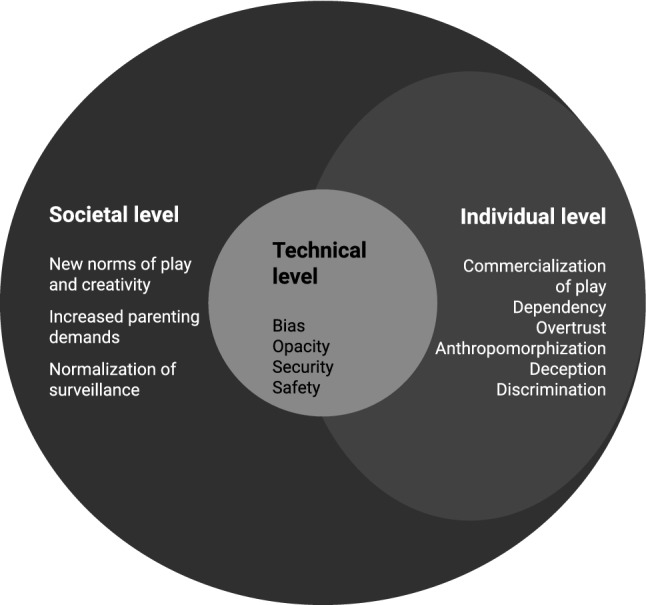
Policymakers need to start considering the impact smart connected toys (SCTs) have on children. Equipped with sensors, data processing capacities, and connectivity, SCTs targeting children increasingly penetrate pervasively personal environments. The network of SCTs forms the Internet of Toys (IoToys) and often increases children's engagement and playtime experience. Unfortunately, this young part of the population and, most of the time, their parents are often unaware of SCTs’ far-reaching capacities and limitations. The capabilities and constraints of SCTs create severe side effects at the technical, individual, and societal level. These side effects are often unforeseeable and unexpected. They arise from the technology's use and the interconnected nature of the IoToys, without necessarily involving malevolence from their creators. Although existing regulations and new ethical guidelines for artificial intelligence provide remedies to address some of the side effects, policymakers did not develop these redress mechanisms having children and SCTs in mind. This article provides an analysis of the arising side effects of SCTs and contrasts them with current regulatory redress mechanisms. We thereby highlight misfits and needs for further policymaking efforts.
Overview
The claims and statistics of this paper haven’t been checked yet.
Free: it reads the open-access text and checks the first 5 claims that cite a source we can check. Create a free account to check every claim.
Integrity signals
Registry
Cites
Statistics
Figures
Verification
Claims the paper makes
The claims and statistics of this paper haven’t been checked yet.
Free: it reads the open-access text and checks the first 5 claims that cite a source we can check. Create a free account to check every claim.
Claims other papers make about this one
Each is checked against this paper’s own text: does it say what the citing paper says it does?
The source backs part of the claim, not all of it — or backs it for a different population, condition or comparison.
In the citing paper
“AI chatbots may promise parasocial connection, using design affordances such as responsivity, attempting to meet an emotional need, and prolonging interactions,192”
From Digital Ecosystems, Children, and Adolescents: Technical Report (2026) · cites this paper as [192]
Experimental — accuracy not yet measured
Self-check
Percentages, sums and reported differences re-computed from the paper’s own numbers.
The self-check needs the paper’s full text.
Citations
Cites
Reassembling the Social: An Introduction to Actor-Network-Theory
Latour, B. (2005) · doi:10.1093/oso/9780199256044.001.0001 · Cited by 16,778
(1990) · Choice Reviews Online · doi:10.5860/choice.27-6637 · Cited by 16,594
Science in Action: How to Follow Scientists and Engineers through Society
Bijker, W. E., & Latour, B. (1988) · Technology and Culture · doi:10.2307/3105094 · Cited by 10,767
(1987) · Cited by 8,955
Gamst, F. C. (1991) · Anthropology of Work Review · doi:10.1525/awr.1991.12.3.19 · Cited by 7,932
Reassembling the social: An introduction to actor‐network‐theory
Turnbull, J. (2008) · New Zealand Geographer · doi:10.1111/j.1745-7939.2008.00151_4.x · Cited by 7,617
The global landscape of AI ethics guidelines
Jobin, A., Ienca, M., & Vayena, E. (2019) · Nature Machine Intelligence · doi:10.1038/s42256-019-0088-2 · Cited by 6,220 · cited 4×
“Although there is an increasing interest in artificial intelligence (AI) in policymaking (Gasser and Almeida 2017; Jobin et al. 2019), how AI impacts children and their rights has received inadequate attention.”
InfluentialBig other: Surveillance Capitalism and the Prospects of an Information Civilization
Zuboff, S. (2015) · Journal of Information Technology · doi:10.1057/jit.2015.5 · Cited by 3,205 · cited 1×
“…technologies more generally, introducing useful concepts such as datafication (Sadowski 2019), dataveillance (Van Dijck 2014), surveillance capitalism (Zuboff 2015, 2019) and data capitalism (West 2019), less research has reflected on the implications of digital surveillance for children.”
BackgroundHow the machine “thinks”: Understanding opacity in machine learning algorithms
Burrell, J. (2016) · Big Data & Society · doi:10.1177/2053951715622512 · Cited by 3,196 · cited 1×
“The side effect of opacity, as the absence of transparency, has been well documented in literature on social robots, AI and automated decision-making systems (Burrell 2016; Felzmann et al. 2019a, b, 2020; Larsson & Heintz 2020; Wachter et al 2017; Walmsley 2020; Zerilli et al. 2019).”
BackgroundA survey of socially interactive robots
Fong, T., Nourbakhsh, I., & Dautenhahn, K. (2003) · Robotics and Autonomous Systems · doi:10.1016/s0921-8890(02)00372-x · Cited by 3,162
Research works printed but not linked: 9
- Berman G, Albright K (2017) Children and the data cycle: rights and ethics in a big data world. arXiv preprint arXiv: 1710.06881. https://arxiv.org/abs/1710.06881 · arXiv
- Hung PC, Fantinato M, Rafferty L (2016) A study of privacy requirements for SCT. In: Pacific Asia Conference on Information Systems. Association for Information Systems, pp 71–79.
- Jadi A (2019) Improving the communication for children with speech disorder using the SCT. arXiv preprint arXiv: 1906.04251. https://arxiv.org/abs/1906.04251 · arXiv
- Lutz C Tamò A Guzman AL Communicating with robots: ANTalyzing the interaction between healthcare robots and humans with regards to privacy Human-machine communication: rethinking communication, technology, and ourselves 2018 Peter Lang 145 165
- Martinetti A Chemweno P Nizamis K Fosch-Villaronga E Redefining safety in light of human-robot interaction Front Chem Eng Res Top Artif Intell Chem Eng 2021 32 1 12
- Mukherjee S Pothong K Livingstone S Child rights impact assessment: a tool to realise child rights in the digital environment 2021 London 5Rights Foundation
- Noto La Diega G Walden I Contracting for the ‘Internet of Things’: looking into the Nest Eur J Law Technol 2016 7 2 1 38
- Solomon G Project-based learning: a primer Technol Learn Dayton 2003 23 6 20 20
- Westlund JK, Breazeal C, Story A (2015) Deception, secrets, children, and robots: what’s acceptable. In: Workshop on The Emerging Policy and Ethics of Human-Robot Interaction, held in conjunction with the 10th ACM/IEEE International Conference on Human-Robot Interaction
Cited by
Kurian, N. (2025) · Contemporary Issues in Early Childhood · doi:10.1177/14639491231206004 · Cited by 117
Ho, M.-T., Mantello, P., & Vuong, Q.-H. (2024) · Heliyon · doi:10.1016/j.heliyon.2024.e36251 · Cited by 37
“However, a growing number of critics warn that AI-driven toys may, in fact, open children to a myriad of harms such as hacking or data theft by malicious actors [63], algorithmic bias or discrimination, eroding a parent ’ s ‘duty of care ’ [27] and forcing attitudinal conformity upon children [28].”
BackgroundPande, D., & Taeihagh, A. (2023) · Journal of Economic Policy Reform · doi:10.1080/17487870.2023.2197599 · Cited by 44
“technological, social, individual, and ethical perspectives (Tan and Taeihagh 2021; Taeihagh and Si Min Lim 2019; Fosch-Villaronga et al. 2021).”
Chen, J. J., & Delaney, V. (2025) · Early Childhood Education Journal · doi:10.1007/s10643-025-02036-0 · Cited by 32
“Humanity's new frontier”: Human rights implications of artificial intelligence and new technologies
Nagy, N. (2023) · Hungarian Journal of Legal Studies · doi:10.1556/2052.2023.00481 · Cited by 40
Our business, not the robot’s: family conversations about privacy with social robots in the home
Levinson, L., McKinney, J., Nippert-Eng, C. E., Gómez, R., & Šabanović, S. (2024) · Frontiers in Robotics and AI · doi:10.3389/frobt.2024.1331347 · Cited by 25
Digital Ecosystems, Children, and Adolescents: Technical Report
Munzer, T., Milkovich, L. M., Madigan, S., Tomopoulos, S., Parga-Belinkie, J., Ajumobi, T., Cross, C., Gerwin, R., Council on Communications and Media, Radesky, J., et al. (2026) · Pediatrics · doi:10.1542/peds.2025-075321 · Cited by 14
“Won’t somebody please (actually) think of the children?” AI Ethics for Children: A Scoping Review
Collyer-Hoar, G., & Rubegni, E. (2025) · ACM Journal on Responsible Computing · doi:10.1145/3745031 · Cited by 22
“…the descriptions aied [1, 2, 5, 20, 36, 37, 47, 51, 108, 124, 131, 147, 157, 169, 182], healthcare [6, 7, 14, 23, 29, 30, 42, 44, 64, 66, 99, 114, 140], societal [17, 25, 35, 40, 41, 65, 98, 101, 102, 120, 189, 190] 188, 193, 194, 198, 200, 202–204], healthcare [192], societal [13, 59, 135, 195]”
Adako, O. P., Adeusi, O. C., & Alaba, P. A. (2025) · Disability and Rehabilitation Assistive Technology · doi:10.1080/17483107.2025.2477678 · Cited by 29
Yıldırım, Y., Çelikten, S., & Avcioglu, B. (2025) · Acta Psychologica · doi:10.1016/j.actpsy.2025.105265 · Cited by 19
Bar, L. B., Ivan, D. L., & Manea, T. (2022) · International Journal of Law in Changing World · doi:10.54934/ijlcw.v1i1.15 · Cited by 14
Artificial Intelligence in Computer Science
Sihare, S. R. (2023) · Advances in computational intelligence and robotics book series · doi:10.4018/979-8-3693-1301-5.ch001 · Cited by 9
Xiao, W., & Gonçalves, A. (2025) · Big Data & Society · doi:10.1177/20539517251389860 · Cited by 17
Should we develop AGI? Artificial suffering and the moral development of humans
Li, O. (2024) · AI and Ethics · doi:10.1007/s43681-023-00411-4 · Cited by 14
“They suggest the need of new norms and increased demands on parents on the societal level and they also hint effects on the moral development of children ([13], 136, 140).”
KEDISIPLINAN BELAJAR SISWA DITINJAU DARI PERAN ORANG TUA DALAM MENGONTROL PENGGUNAAN GADGET
Widiyanti, D. A., Wulandari, I. G. A. A., & Wiarta, I. W. (2023) · Prima Magistra Jurnal Ilmiah Kependidikan · doi:10.37478/jpm.v4i2.2493 · Cited by 3
Adams, C., Groten, S., & Yin, Y. (2024) · Research in networked learning · doi:10.1007/978-3-031-62780-4_8 · Cited by 3
Ethical AI Development and Deployment
Gaurav, A., Gupta, B. B., & Castiglione, A. (2024) · Advances in computational intelligence and robotics book series · doi:10.4018/979-8-3693-3860-5.ch004 · Cited by 2
Defining Socially Assistive Robots for the Law: Preliminary Results of a Systematic Review
Schwed-Shenker, M., Fosch‐Villaronga, E., & Custers, B. H. M. (2025) · Lecture notes in computer science · doi:10.1007/978-981-96-3525-2_23 · Cited by 2
Self-citationYue, M., & Jong, M. S. (2026) · International Journal of STEM Education · doi:10.1186/s40594-026-00604-3 · Cited by 4
The price of play: A scoping review of ethical, privacy, and regulatory challenges in AI toys
Xiao, W., & Gonçalves, A. (2026) · Computers in Human Behavior Reports · doi:10.1016/j.chbr.2026.101015 · Cited by 1
How Reflection Enhances Task Factuality in the Use of Large Language Models
Tarafdar, M., Adam, M., & Nguyen, L. T. (2026) · Journal of Management Information Systems · doi:10.1080/07421222.2026.2692283 · Cited by 2
“Existing regulations, beyond specifying that use of AI should be ‘ethical, safe and responsible’ [48], do not provide specific guidelines to this effect.”
Social and Societal Issues in AAL
Lutz, C., Miguel, C., Mujirishvili, T., Perez‐Vega, R., & Fedosov, A. (2025) · Intelligent systems reference library · doi:10.1007/978-3-031-84158-3_13 · Cited by 2
Self-citationNavigating the Digital Landscape: Balancing Risks and Opportunities for Children
Asrifan, A., & Rismawati, R. (2025) · IGI Global eBooks · doi:10.4018/979-8-3373-5132-2.ch016 · Cited by 1
Child Participation in AI Governance: Advancing Rights-Based Approaches to Technology Policy
Mathiyazhagan, S., Zhou, Y., & Patton, D. U. (2025) · Oxford University Press eBooks · doi:10.1093/9780198945215.003.0092 · Cited by 1
Fazit: Mystifizierung und Vermenschlichung von KI im Film
Hammele, N. (2024) · Film · doi:10.14361/9783839467947-009
Hammele, N. (2024) · Film · doi:10.14361/9783839467947-011
4. Das Befreiungsnarrativ von 1980 bis 2020
Hammele, N. (2024) · Film · doi:10.14361/9783839467947-006
1. Künstliche Intelligenz in Medien und Kultur
Hammele, N. (2024) · Film · doi:10.14361/9783839467947-003
Hammele, N. (2024) · Film · doi:10.14361/9783839467947-toc
Einleitung: Warum sich ein Blick auf Filme über Künstliche Intelligenz lohnt
Hammele, N. (2024) · Film · doi:10.14361/9783839467947-002
Künstliche Intelligenz im Film: Narrative und ihre Entwicklung von 1970 bis 2020
Hammele, N. (2024) · Film · doi:10.14361/9783839467947 · Cited by 4
3. Das Bedrohungsnarrativ von 1970 bis 2020
Hammele, N. (2024) · Film · doi:10.14361/9783839467947-005
5. Das Beziehungsnarrativ von 1980 bis 2020
Hammele, N. (2024) · Film · doi:10.14361/9783839467947-007
Hammele, N. (2024) · Film · doi:10.14361/9783839467947-013
Hammele, N. (2024) · Film · doi:10.14361/9783839467947-012
Hammele, N. (2024) · Film · doi:10.14361/9783839467947-010
Hammele, N. (2024) · Film · doi:10.14361/9783839467947-fm
Hammele, N. (2024) · Film · doi:10.14361/9783839467947-001
2. Narrative Analyse und Kategorienbildung
Hammele, N. (2024) · Film · doi:10.14361/9783839467947-004
6. KI-Narrative und ihre Entwicklung von 1970 bis 2020
Hammele, N. (2024) · Film · doi:10.14361/9783839467947-008 · Cited by 2
Child-Centered AI: An Ethics Framework and Future Directions
Jeong, K. S., Yang, J., & Park, K. C. (2024) · Journal of Digital Contents Society · doi:10.9728/dcs.2024.25.8.2225
Children, Rights and Algorithms in the Age of Generative AI
Peinado, R. G. (2024) · The European Educational Researcher · doi:10.31757/euer.821 · Cited by 2
Practice of Artificial Intelligence for Iron Ore Pelletizing System
Honpeng, F., & Runlong, G. (2024) · IEEE Global Conference for Advancement in Technology (GCAT) · doi:10.1109/gcat62922.2024.10923946
“In addition, some experts believe that as an important ore processing process, the particle process from kiln to tank has increasingly high requirements for automatic control [5-6].”
Ethical AI for Sustainable Brand Trust: Safeguarding Consumer Data in Marketing Ecosystems
Rahman, M. A., Ahid, M. M. H., Tasnim, Z., Aziz, A., Jahan, S., & Hamid, A. E. (2025) · IGI Global eBooks · doi:10.4018/979-8-3373-4596-3.ch009
Privacy and Security Assessment Rating System of Smart Toys Using Fuzzy Inference System
Khokhar, S.-U.-D., Saeed, F., Unar, S., Badar, H. M. S., & Zafar, D. F. (2026) · IEEE Internet of Things Journal · doi:10.1109/jiot.2026.3675688
“Continuing on the regulation and societal aspects, Fosch-Villaronga et al. [27] touched upon the drawbacks of current policy frameworks in responding to the threat of smart connected toys.”
Children Envision Future GenAI Chatbots that are Bounded, Helpful, and Safe
Hong, T. L., Lao, Y., Iwata, M., Tanaka, J., Sharma, S., White, E. P. G., Tiensuu, H., & Howell, N. (2026) · ACM International Conference on Interaction Design and Children (IDC) · doi:10.1145/3773077.3806128
Mallick, N., Sahu, S., & Nanda, H. (2026) · Elsevier eBooks · doi:10.1016/b978-0-443-45875-0.00027-2
A smart art toy interaction system based on multimodal biofeedback
Xu, C. (2026) · PeerJ Computer Science · doi:10.7717/peerj-cs.4013
Integral Human Accountability and AI: Anticipatory Ethics for Fragile Stakeholders
Fioravante, R., & Vaccaro, A. (2026) · Humanism in business series · doi:10.1007/978-3-032-17121-4_6
Robots for behavioral and mental healthcare: challenges and opportunities
Riek, L. D. (2026) · Elsevier eBooks · doi:10.1016/b978-0-443-33151-0.00007-1
A Risk-Governed Deployment Framework for LLM-Powered Educational Companion Robots in K--12 Education
Wu, L., Zhang, M., Zhai, P., & Cao, Y. (2026) · International Conference on Digital Society and Artificial Intelligence (DSAI) · doi:10.1145/3833541.3833774
Ивановна, К. Н., Николаевна, Д. Е., Sladkova, Y. N., & Kriyt, V. E. (2026) · Hygiene and Sanitation · doi:10.47470/0016-9900-2026-105-8-900-904
Oyenuga, M. O. (2026) · Advances in computational intelligence and robotics book series · doi:10.4018/979-8-3373-9425-1.ch005
Algorithmic Persuasion and the Commodification of the Indian Child Consumer
Krishnappa, R., Gurugopinath, R., & Hommaradi, R. M. (2026) · Advances in computational intelligence and robotics book series · doi:10.4018/979-8-2600-4926-6.ch001
Metadata
- Authors
- Fosch-Villaronga, E., van der Hof, S., Lutz, C., & Tamò-Larrieux, A.
- Affiliations
- BI Norwegian Business School (NO)
- Venue
- AI & SOCIETY
- Published
- 2021-10-06
- Volume
- 38
- Issue
- 1
- Pages
- 133-152
- ISSN
- 0951-5666 (ISSN-L)
- 1435-5655
- PMC
- PMC8494166
- OpenAlex
- W3204646382
- Cited by
- 54
- References
- 124
- Citations by year
- 2026: 14 · 2025: 10 · 2024: 24 · 2023: 5 · 2022: 1
- FWCI
- 9.38
- Type
- journal article
- Language
- en
- Open access
- hybrid
- doi.org
- Licence
- cc-by
- creativecommons.org/licenses/by/4.0 (tdm)
- creativecommons.org/licenses/by/4.0 (vor)
- Locations
- AI & Society (publishedVersion, cc-by)
- PubMed Central (publishedVersion, cc-by)
- PubMed (publishedVersion)
- Leiden Repository (Leiden University) (submittedVersion, cc-by)
- NORA - Norwegian Open Research Archives (submittedVersion, cc-by)
- Data Archiving and Networked Services (DANS) (submittedVersion, cc-by)
- Funders
- Norges Forskningsråd (299178, 275347)
- Topics
- Physical Sciences › Computer Science › Artificial Intelligence › Ethics and Social Impacts of AI
- Social Sciences › Law › Digitalization, Law, and Regulation
- Social Sciences › Education › Child Development and Digital Technology
- Keywords
- Internet of Toys, children's rights, AI regulation, parental awareness, AI ethics guidelines
About these checks
Registry, retraction, Cites and statistics results are computed, not judged, with one exception: a printed reference that no index lists is read once by a model before it counts as a citation error. Claims are extracted by a model and kept only when their quote appears verbatim in the text; each cited source is then checked, with a model’s help, for whether it says what the claim relies on. Those verdicts can be wrong — read the claim’s quote and the cited source before relying on one.
Statistics and arithmetic are recomputed, not judged.
Confidence bands are shown only for fields calibrated on our annotated test set. None is calibrated yet, so no band is shown.
What counts as a claim ›How we measure confidence ›How we check this ›
Are you an author, or do you see a problem with this page? Request a review
Data sources
Bibliographic data: Semantic Scholar, OpenAlex, Crossref.
Contains information from the Semantic Scholar Academic Graph Datasets, made available under the ODC Attribution License (ODC-BY 1.0).
Semantic Scholar’s data is described in: Kinney, R., et al. (2023). The Semantic Scholar Open Data Platform. arXiv:2301.10140.
