

Understanding patient experiences and challenges to osteoporosis care delivered virtually by telemedicine: a mixed methods study
Open accessThe DOI matches its Crossref record; 26 of the 26 references it cites were found in a registry or an index.
Abstract
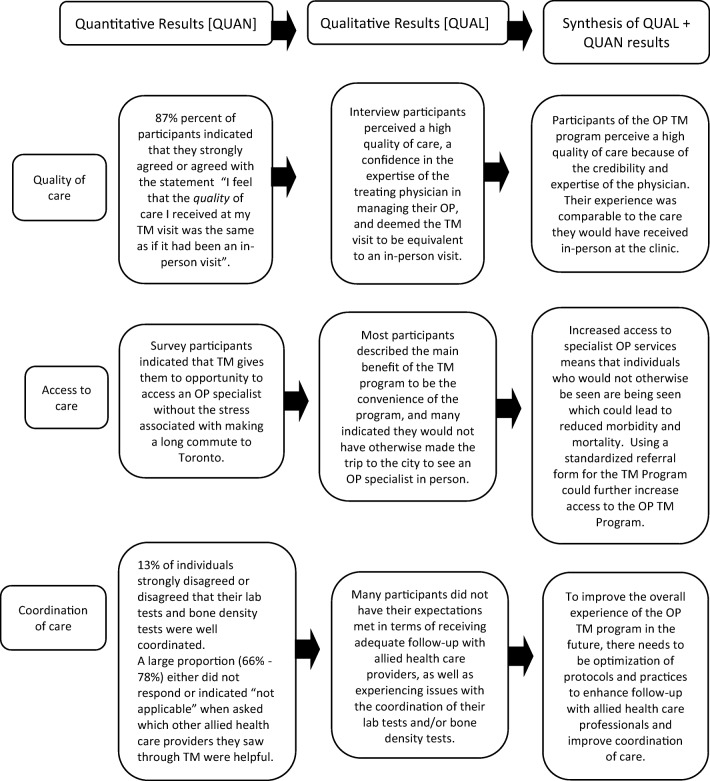
This study sought to understand patient experiences, benefits, and challenges to osteoporosis care delivered virtually by telemedicine. Telemedicine bridges the access gap to specialized osteoporosis care in remote areas. Improving coordination of investigations, access to allied health members, and future initiatives may improve osteoporosis-related morbidity and mortality in this population. INTRODUCTION: There is limited research on the role of telemedicine (TM) in the management of osteoporosis (OP). We previously reported that OP patients assessed by TM had a higher prevalence of fragility fractures, co-morbidities, and need for allied health resources than those serviced by the outpatient clinic. The purpose of this study is to understand the experiences, benefits, and challenges associated with receiving OP care by TM from the patient perspective. METHODS: We adopted a convergent, mixed methods study design whereby both a quantitative component (mailed survey) and qualitative component (30-min telephone interviews) were conducted simultaneously. In addition to reporting survey data, thematic analysis was applied to interview data. RESULTS: Participants were comfortable with virtual technology and perceived that their quality of care by TM was comparable to in-person visits. Expressed benefits included the convenience of timely care close to home, reduced burden of travel and costs, and enhanced sense of confidence with being assessed by an osteoporosis specialist. Perceived barriers included poor follow-up with allied health professionals in the TM program (e.g., physiotherapist) and coordination of tests and investigations. Many participants indicated interest in an OP self-management program, with content focusing on diet and lifestyle factors. CONCLUSION: The TM program bridges the access gap for those living with OP in underserviced and remote areas. However, we identified the need to improve the existing processes to better coordinate access to allied health team members and arrangements for investigations. Participants also expressed interest for a virtual osteoporosis self-management program.
Overview
The claims and statistics of this paper haven’t been checked yet.
Free: it reads the open-access text and checks the first 5 claims that cite a source we can check. Create a free account to check every claim.
Integrity signals
Registry
Cites
Statistics
Figures
Verification
Claims the paper makes
The claims and statistics of this paper haven’t been checked yet.
Free: it reads the open-access text and checks the first 5 claims that cite a source we can check. Create a free account to check every claim.
Claims other papers make about this one
Each is checked against this paper’s own text: does it say what the citing paper says it does?
The source backs part of the claim, not all of it — or backs it for a different population, condition or comparison.
In the citing paper
“Digital health interventions can facilitate better self-management of chronic diseases and may bridge access gaps for patients with osteoporosis living in underserviced and remote areas [10].”
From Feasibility and effectiveness of a digital voice assistant for improving anti-osteoporosis medication adherence, and osteoporosis knowledge and attitudes, in postmenopausal women with osteoporosis: A 12-month randomised controlled trial (2025) · cites this paper as [10]
Experimental — accuracy not yet measured
Self-check
Percentages, sums and reported differences re-computed from the paper’s own numbers.
The self-check needs the paper’s full text.
Citations
Cites
Using thematic analysis in psychology
Braun, V., & Clarke, V. (2006) · Qualitative Research in Psychology · doi:10.1191/1478088706qp063oa · Cited by 194,414
Research Design: Qualitative, Quantitative, and Mixed Methods Approaches
Creswell, J. W. (1994) · Cited by 35,500
Designing and Conducting Mixed Methods Research
Robinson, P. (2007) · Australian and New Zealand Journal of Public Health · doi:10.1111/j.1753-6405.2007.00096.x · Cited by 23,258
What's in a name? Qualitative description revisited
Sandelowski, M. (2010) · Research in Nursing & Health · doi:10.1002/nur.20362 · Cited by 4,975
Research Design: Qualitative, Quantitative, and Mixed Method Approaches
อุ่นอารมย์เลิศ, ร. ด. ธ. (2016) · Silpakorn Educational Research Journal · Cited by 4,515
Papaioannou, A., Morin, S., Cheung, A. M., Atkinson, S., Brown, J. P., Feldman, S., Hanley, D. A., Hodsman, A., Jamal, S. A., Kaiser, S. M., et al. (2010) · Canadian Medical Association Journal · doi:10.1503/cmaj.100771 · Cited by 1,749
Recovery From Hip Fracture in Eight Areas of Function
Magaziner, J., Hawkes, W., Hebel, J. R., Zimmerman, S. I., Fox, K. M., Dolan, M., Felsenthal, G., & Kenzora, J. (2000) · The Journals of Gerontology Series A: Biological Sciences and Medical Sciences · doi:10.1093/gerona/55.9.m498 · Cited by 733
The crippling consequences of fractures and their impact on quality of life
Cooper, C. (1997) · The American Journal of Medicine · doi:10.1016/s0002-9343(97)90022-x · Cited by 699
Hannan, E. L., Magaziner, J., Wang, J. J., Eastwood, E. A., Silberzweig, S. B., Gilbert, M., Morrison, R. S., McLaughlin, M. A., Orosz, G. M., & Siu, A. L. (2001) · JAMA · doi:10.1001/jama.285.21.2736 · Cited by 455
The Empirical Foundations of Telemedicine Interventions for Chronic Disease Management
Bashshur, R. L., Shannon, G. W., Smith, B. R., Alverson, D. C., Antoniotti, N., Barsan, W. G., Bashshur, N., Brown, E. M., Coye, M. J., Doarn, C. R., et al. (2014) · Telemedicine and e-Health · doi:10.1089/tmj.2014.9981 · Cited by 452
Cited by
The role of telemedicine in the delivery of health care in the COVID‐19 pandemic
Valentino, L. A., Skinner, M. W., & Pipe, S. W. (2020) · Haemophilia · doi:10.1111/hae.14044 · Cited by 88
How has COVID-19 affected the treatment of osteoporosis? An IOF-NOF-ESCEO global survey
Fuggle, N. R., Singer, A. J., Gill, C., Patel, A., Medeiros, A., Mlotek, A. S., Pierroz, D. D., Halbout, P., Harvey, N. C., Reginster, J., et al. (2021) · Osteoporosis International · doi:10.1007/s00198-020-05793-3 · Cited by 60
“The move toward telemedicine may be advantageous in the long term with previous studies demonstrating financial savings and increased efficiencies for healthcare systems [6], and increased convenience and satisfaction for patients [7].”
BackgroundDiagnosis and Management of Osteoporosis During COVID-19: Systematic Review and Practical Guidance
Hampson, G., Stone, M. D., Lindsay, J. R., Crowley, R. K., & Ralston, S. H. (2021) · Calcified Tissue International · doi:10.1007/s00223-021-00858-9 · Cited by 57
“They also expressed interest in the design of an osteoporosis virtual self-management program focusing on advice about diet and lifestyle factors [50].”
BackgroundTelemedicine in rheumatology care: A systematic review
Jackson, L. E., Edgil, T. A., Hill, B., Owensby, J. K., Smith, K. H., Singh, J. A., & Danila, M. I. (2022) · Seminars in Arthritis and Rheumatism · doi:10.1016/j.semarthrit.2022.152045 · Cited by 56
Åkesson, K., Ganda, K., Deignan, C., Oates, M. K., Volpert, A., Brooks, K., Lee, D., Dirschl, D. R., & Singer, A. J. (2022) · Osteoporosis International · doi:10.1007/s00198-022-06358-2 · Cited by 49
Identifying and managing osteoporosis before and after COVID-19: rise of the remote consultation?
Paskins, Z., Manning, F., Bullock, L., & Jinks, C. (2020) · Osteoporosis International · doi:10.1007/s00198-020-05465-2 · Cited by 40
“A recent mixed methods study of a Canadian telemedicine delivered osteoporosis programme identified that patient participants perceived high-quality care and valued the experience and credibility of the treating clinician, but also raised issues about the coordination of their care with investigation results and poor…”
BackgroundFeng, G., Posa, S., Sureshkumar, A., Simpson, S., Bruno, T. R., Morrow, S. A., Donkers, S. J., Knox, K. B., Feinstein, A., Bayley, M. T., et al. (2024) · Journal of Neurology · doi:10.1007/s00415-023-12116-z · Cited by 17
“…into CBT interventions was suggested and may be especially relevant in terms of addressing family dynamics/ invalidating social experiences described by PwMS. Improving the accessibility and format of CBTs (e.g., cost, online delivery, length, allocation of time) were also discussed [52, 53].”
Self-citationHealthcare disparities in telemedicine for rheumatology care
Jackson, L. E., & Danila, M. I. (2022) · Current Opinion in Rheumatology · doi:10.1097/bor.0000000000000869 · Cited by 17
Healthcare Professionals’ Experience of Performing Digital Care Visits—A Scoping Review
Lampickienė, I., & Davoody, N. (2022) · Life · doi:10.3390/life12060913 · Cited by 16
Osteoporosis care amidst the prolonged pandemic
Narla, R. R., & Adler, R. A. (2021) · Journal of Endocrinological Investigation · doi:10.1007/s40618-021-01542-3 · Cited by 16
Pongiglione, B., Carrone, F., Angelucci, A., Mazziotti, G., & Compagni, A. (2023) · BMC Health Services Research · doi:10.1186/s12913-023-09224-x · Cited by 15
“During the COVID-19 pandemic, osteoporotic patients experienced an increase in the use of TCs for their care [19] accompanied by an increase in the degree of acceptability of this service modality [17, 20].”
BackgroundCongiusta, D. V., Otero, K., Ippolito, J. A., Thomson, J. E., & Beebe, K. S. (2020) · Journal of Shoulder and Elbow Surgery · doi:10.1016/j.jse.2020.07.020 · Cited by 14
“These modalities will undoubtedly continue to increase in popularity because of demand and current restrictions on elective in-person visits.(5,7,20,26,32)”
BackgroundRemote Management of Osteoporosis
Saag, J. L., & Danila, M. I. (2022) · Current Treatment Options in Rheumatology · doi:10.1007/s40674-022-00195-4 · Cited by 14
A New Dimension of Health Care: The Benefits, Limitations and Implications of Virtual Medicine
Shah, K., & Tomljenovic-Berube, A. M. (2021) · Journal of Undergraduate Life Sciences · doi:10.33137/juls.v15i1.37034 · Cited by 14
Approach to the Patient With Thyrotoxicosis Using Telemedicine
Griffith, M. L., Bischoff, L. A., & Baum, H. B. A. (2020) · The Journal of Clinical Endocrinology & Metabolism · doi:10.1210/clinem/dgaa373 · Cited by 13
“In a study of osteoporosis patients seeing consultants on telemedicine, patients felt the care provided was of high quality but desired improved coordination of their testing and ancillary health services (29).”
BackgroundA review of questionnaires used for the assessment of telemedicine
Agbali, R., Balas, E. A., Beltrame, F., Heboyan, V., & Leo, G. D. (2023) · Journal of Telemedicine and Telecare · doi:10.1177/1357633x231166161 · Cited by 12
Yemeshev, Y., Nurmashev, B., Zimba, O., & Koçyiğit, B. F. (2025) · Rheumatology International · doi:10.1007/s00296-025-05810-w · Cited by 10
“Telemedicine and teleradiology have emerged as a critical instrument in assessing and treating osteoporosis, a disorder defined by diminished bone density and heightened fracture susceptibility [18].”
Alshalalfah, M., Pit, S., Bagade, T., Hamiduzzaman, M., Burrows, J. M., & Brown, L. (2025) · Age and Ageing · doi:10.1093/ageing/afaf123 · Cited by 10
“( P a l c u e t a l ., 2020 ) [ 64 ] U n d e r s t a n d i n g p a t i e n t e x p e r i e n c e s a n d c h a ll e n g e s t o o s t e o p o r o s i s c a r e d e l i v e r e d v i r t u a ll y b y t e l e m e d i c i n e : a m i x e d m e t h o d s s t u d y W a i t i n g t i m e , t e l e m e d…”
Rovira, A., Brar, S., Munroe-Gray, T., Ofo, E., Rodriguez, C., & Kim, D. (2021) · The Journal of Laryngology & Otology · doi:10.1017/s0022215121003157 · Cited by 10
Hayes, K., dos Santos, V., Costigan, M., & Morante, D. (2022) · Australian Occupational Therapy Journal · doi:10.1111/1440-1630.12844 · Cited by 10
Gani, L. U., Tan, F. C. L., & King, T. (2022) · Singapore Medical Journal · doi:10.11622/smedj.2022068 · Cited by 9
Hunegnaw, M. T., Mesinovic, J., Jansons, P., George, E. S., De Ross, B., Kiss, N., Ebeling, P. R., Daly, R. M., Gvozdenko, E., & Scott, D. (2025) · Archives of Osteoporosis · doi:10.1007/s11657-025-01529-0 · Cited by 8
“Digital health interventions can facilitate better self-management of chronic diseases and may bridge access gaps for patients with osteoporosis living in underserviced and remote areas [10].”
Bone health in rural Australia: a mixed methods study of consumer needs
Jones, A., Garth, B., Haigh, C., Ebeling, P. R., Teede, H. J., & Vincent, A. J. (2023) · Archives of Osteoporosis · doi:10.1007/s11657-023-01333-8 · Cited by 8
“The interview schedule (Online resource 2) was developed by the research team and informed by previous literature [23–25].”
MethodAngelucci, A., Pongiglione, B., Bernasconi, S., Carrone, F., Mazziotti, G., Costantino, M. L., Aliverti, A., & Compagni, A. (2023) · Digital Health · doi:10.1177/20552076231218858 · Cited by 7
The current role of telehealth in the management of patients with osteoporosis
Lewiecki, E. M., & Bouchonville, M. F. (2022) · Expert Review of Endocrinology & Metabolism · doi:10.1080/17446651.2022.2078304 · Cited by 7
“used a mailed quantitative patient survey followed by a 30minute qualitative telephone interview to understand the patient experience with osteoporosis care delivered by telemedicine from 2013 to 2018 [67].”
MethodVerdonck, C., Willems, R. P., & Borgermans, L. A. D. (2023) · BMJ Open · doi:10.1136/bmjopen-2023-072031 · Cited by 7
On-time denosumab dosing recovered rapidly during the COVID-19 pandemic, yet remains suboptimal
Rzepka, A. M., Cheung, A. M., Kim, S. S. Y., Gomes, T., & Cadarette, S. M. (2024) · JBMR Plus · doi:10.1093/jbmrpl/ziae027 · Cited by 6
“35 Self-injection and home care visits may also have contributed to the timeliness of denosumab therapy during the pandemic, yet uptake of these alternatives in Ontario is unclear.”
BackgroundSelf-citationPatient experience of telemedicine for osteoporosis care during the COVID‐19 pandemic
Jones, A., Ebeling, P. R., Teede, H. J., Milat, F., & Vincent, A. J. (2021) · Clinical Endocrinology · doi:10.1111/cen.14661 · Cited by 5
“This differs from a study of telemedicine for osteoporosis in Canada before the COVID‐19 pandemic, where only 5% thought the quality of care differed.(4) Reasons given for the lack of satisfaction included”
BackgroundMethodLessons on Telemedicine in Rheumatology
Smith, I. D., Leverenz, D. L., & Bolster, M. B. (2024) · Rheumatic Disease Clinics of North America · doi:10.1016/j.rdc.2024.08.006 · Cited by 4
Greffin, K., Schmidt, S., van den Berg, N., Hoffmann, W. U., Ritter, O., Oeff, M., Schomerus, G., & Muehlan, H. (2021) · Health and Quality of Life Outcomes · doi:10.1186/s12955-021-01807-8 · Cited by 4
Trujillo, J. M. C., Capdevila-Reniu, A., Casanova, T., Cuadra-Llopart, L., Ivanov, A., Llopis, A., Santiago, J. R., & Sopena, E. (2021) · Revista de Osteoporosis y Metabolismo Mineral · doi:10.4321/s1889-836x2021000100008 · Cited by 2
Telerheumatology during the COVID-19 Pandemic: Impact on Clinical Practice, Education, and Research
Yeoh, S., & Madenidou, A. (2022) · Indian Journal of Rheumatology · doi:10.4103/injr.injr_229_21 · Cited by 2
“[32] In Canada, telemedicine has been used to provide a service for osteoporosis patients, [33] which relies less on clinical examination in comparison to other rheumatic conditions.”
Roblin, D. W., Goodrich, G. K., Davis, T. L., Gander, J. C., McCracken, C., Weinfield, N. S., & Ritzwoller, D. P. (2023) · Medical Care · doi:10.1097/mlr.0000000000001832 · Cited by 2
Vaughn, N. H., Akelman, M. R., Marenghi, N., Lake, A. F., & Graves, B. R. (2022) · Archives of Osteoporosis · doi:10.1007/s11657-022-01122-9 · Cited by 1
“Incorporating tele-health visits has also shown promise for improving patient participation in screening [40].”
Background“It’s a Very Good Second Option”: Older Adults’ Experience of Telehealth
Buist, B. D., Kramer, B., Wright, K. E., Edwards, P. K., Petrofes, A. M., & Furzer, B. J. (2024) · Journal of Physical Activity and Health · doi:10.1123/jpah.2023-0176 · Cited by 1
Ahmidati, A., Herawati, T., & Waluyo, A. (2023) · PREPOTIF Jurnal Kesehatan Masyarakat · Cited by 1
Sroge, R. A. (2023) · ORCA Online Research @Cardiff (Cardiff University) · Cited by 1
Aljahdali, S. (2024) · ORCA Online Research @Cardiff (Cardiff University) · Cited by 1
Nguyen, V. H. (2021) · Geriatric Orthopaedic Surgery & Rehabilitation · doi:10.1177/21514593211020712
“A recent study found that osteoporosis care delivered via telemedicine produces perceived quality of care comparable with in-person visits, and patients were comfortable with the use of virtual technology, while expressing the benefits of convenience with reduced burden of time and cost to travel, as well as confidenc…”
BackgroundOsteoporosis during COVID-19 Pandemic
Mohamed, R. M. P. (2021) · Medicine & health · doi:10.17576/mh.2021.1602.01
“convenience, decreased travel time and cost savings (Palcu et al. 2020).”
BackgroundPatient Perspectives and Narratives
Nowell, W. B., Wells, C. K., Rothblatt, Z., & Venkatachalam, S. (2022) · Springer eBooks · doi:10.1007/978-3-031-00936-5_22
Heidari, N., Rajati, F., Rajati, M., & Heidari, P. (2024) · Journal of Health Reports and Technology · doi:10.5812/jhrt-147195
Remote Consultation and Telemedicine for Musculoskeletal Diseases in Primary Care
Smith, L., & Demurtas, J. (2025) · TELe-Health · doi:10.1007/978-3-031-89661-3_19
Greffin, K., Schmidt, S., van den Berg, N., Hoffmann, W., Ritter, O., Oeff, M., Schomerus, G., & Muehlan, H. (2021) · Figshare · doi:10.6084/m9.figshare.14913335
Greffin, K., Schmidt, S., van den Berg, N., Hoffmann, W., Ritter, O., Oeff, M., Schomerus, G., & Muehlan, H. (2021) · Figshare · doi:10.6084/m9.figshare.14913332
Greffin, K., Schmidt, S., van den Berg, N., Hoffmann, W., Ritter, O., Oeff, M., Schomerus, G., & Muehlan, H. (2021) · Figshare · doi:10.6084/m9.figshare.14913329
Pongiglione, B., Carrone, F., Angelucci, A., Mazziotti, G., & Compagni, A. (2024) · Figshare · doi:10.6084/m9.figshare.26573746
Pongiglione, B., Carrone, F., Angelucci, A., Mazziotti, G., & Compagni, A. (2024) · Figshare · doi:10.6084/m9.figshare.26573749
Huallpa Sandivar, L. M., & Bendezú, D. L. B. (2023) · Repositorio Académico UPC (Universidad Peruana de Ciencias Aplicadas) · doi:10.19083/tesis/673442
Pongiglione, B., Carrone, F., Angelucci, A., Mazziotti, G., & Compagni, A. (2024) · Figshare · doi:10.6084/m9.figshare.26573752
Pongiglione, B., Carrone, F., Angelucci, A., Mazziotti, G., & Compagni, A. (2024) · Figshare · doi:10.6084/m9.figshare.26573755
Patients' perspectives as a catalyst for action to improving osteoporosis care
Verdonck, C., Borgermans, L. A. D., & Willems, R. (2022) · Ghent University Academic Bibliography (Ghent University)
Grönkvist, F., & Knuts, S. (2024) · DiVA (Digitala Vetenskapliga Arkivet)
Patient resource to support the utilization of virtual care at home in rural communities
Dominey, C. (2021) · Memorial University Research Repository (Memorial University)
Hälsovårdares erfarenheter av distansmottagning på mödrarådgivningen
Nybohm, L. (2023) · Theseus (Ammattikorkeakoulujen)
Exploring Telemedicine Needs and Barriers in Women with Osteoporosis: A Cross-Sectional Study
Muluk, S. Y., Muluk, E., & Ugur, S. (2026) · Telemedicine Journal and e-Health · doi:10.1177/15305627261443207
“14 Paskins et al. emphasized the role of TM during COVID-19, when it enabled remote consultations, monitoring, and treatment adjustments (e.g., for denosumab or bisphosphonates) to avoid in-person visits.”
An intention-oriented multi-agent dialogue system for patient-centered decision-making
Liu, P., & Xiao, L. (2026) · BMC Medical Informatics and Decision Making · doi:10.1186/s12911-026-03498-x
“…the relevance of the application domains, including the assessment metrics commonly used in the application domains such as teleconsultation [33, 34], virtual clinics [35], and chronic disease management applications [36], and excluded metrics that were not relevant to the objectives of…”
La telemedicina in ambito ortopedico: nostra esperienza preliminare e aspetti medico legali
Galmarini, V., Basile, G., Molinari, G., Passeri, A., & Capelli, R. M. (2022) · Giornale Italiano di Ortopedia e Traumatologia
Ganyakam, P. (2025) · YASOTHON MEDICAL JOURNAL
Metadata
- Authors
- Palcu, P., Munce, S., Jaglal, S. B., Allin, S., Chishtie, J. A., Silverstein, A., & Kim, S.
- Affiliations
- University of Toronto (CA)
- University Health Network (CA)
- Women's College Hospital (CA)
- Corresponding author
- Kim, S.
- Venue
- Osteoporosis International
- Published
- 2019-11-23
- Volume
- 31
- Issue
- 2
- Pages
- 351-361
- ISSN
- 0937-941X (ISSN-L)
- 1433-2965
- PMC
- PMC7010610
- OpenAlex
- W2991577059
- Cited by
- 49
- References
- 26
- Citations by year
- 2026: 2 · 2025: 4 · 2024: 9 · 2023: 6 · 2022: 11 · 2021: 13 · 2020: 4
- FWCI
- 6.44
- Type
- journal article
- Language
- en
- Open access
- hybrid
- doi.org
- Licence
- cc-by-nc
- creativecommons.org/licenses/by-nc/4.0 (tdm)
- creativecommons.org/licenses/by-nc/4.0 (vor)
- Locations
- Osteoporosis International (publishedVersion, cc-by-nc)
- PubMed Central (publishedVersion, cc-by-nc)
- PubMed (publishedVersion)
- Funders
- Ontario Ministry of Health and Long-Term Care
- Women's College Hospital
- Topics
- Health Sciences › Medicine › Public Health, Environmental and Occupational Health › Telemedicine and Telehealth Implementation
- Health Sciences › Medicine › Orthopedics and Sports Medicine › Bone health and osteoporosis research
- Health Sciences › Medicine › Public Health, Environmental and Occupational Health › Healthcare Systems and Technology
- Keywords
- osteoporosis, telemedicine, patient experience, virtual care, physiotherapy, fragility fractures, self-management program, access to specialist care, travel burden
- MeSH terms
- Aged, Ambulatory Care Facilities, Female, Humans, Male, Middle Aged, Osteoporosis, Telemedicine, Fractures, Bone, Patient Outcome Assessment
About these checks
Registry, retraction, Cites and statistics results are computed, not judged, with one exception: a printed reference that no index lists is read once by a model before it counts as a citation error. Claims are extracted by a model and kept only when their quote appears verbatim in the text; each cited source is then checked, with a model’s help, for whether it says what the claim relies on. Those verdicts can be wrong — read the claim’s quote and the cited source before relying on one.
Statistics and arithmetic are recomputed, not judged.
Confidence bands are shown only for fields calibrated on our annotated test set. None is calibrated yet, so no band is shown.
What counts as a claim ›How we measure confidence ›How we check this ›
Are you an author, or do you see a problem with this page? Request a review
Data sources
Bibliographic data: Semantic Scholar, OpenAlex, Crossref.
Contains information from the Semantic Scholar Academic Graph Datasets, made available under the ODC Attribution License (ODC-BY 1.0).
Semantic Scholar’s data is described in: Kinney, R., et al. (2023). The Semantic Scholar Open Data Platform. arXiv:2301.10140.
