

Prospective memory impairments in heavy social drinkers are partially overcome by future event simulation
Open accessThe DOI matches its Crossref record; 31 of the 33 references it cites were found in a registry or an index.
Abstract
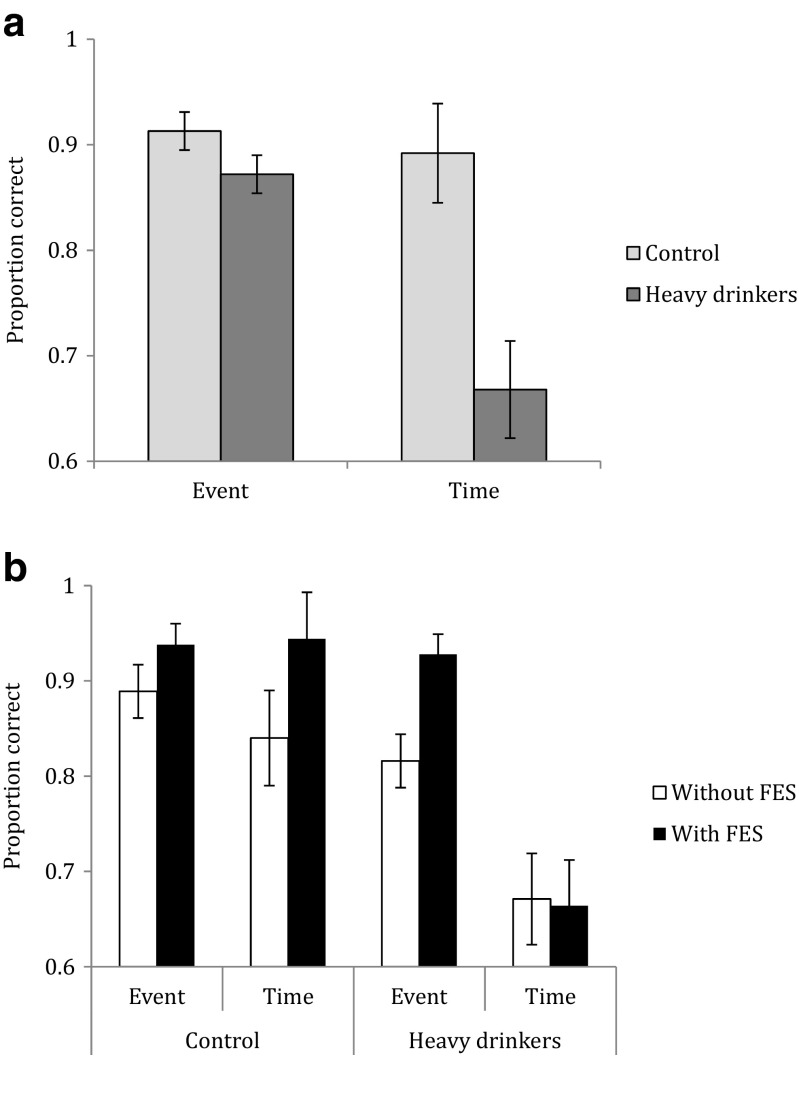
BACKGROUND: Recent research suggests that alcohol acutely impairs prospective memory (PM), and this impairment can be overcome using a strategy called 'future event simulation' (FES). Impairment in event-based PM found in detoxifying alcohol-dependent participants is reversed through FES. However, the impact of the most common problematic drinking patterns that do not involve alcohol dependence on PM remains unclear. AIMS: Here, we examine the impact of frequent heavy drinking on PM and the degree to which any impairments can be reversed through FES. METHODS: PM was assessed in 19 heavy drinkers (AUDIT scores ≥ 15) and 18 matched control participants (AUDIT scores ≤ 7) using the 'Virtual Week' task both at baseline and again following FES. RESULTS: Heavy drinkers performed significantly worse than controls on regular and irregular time-based PM tasks. FES improved the performance of controls but not of heavy drinkers on time-based tasks. In contrast, FES improved heavy drinkers' performance on event-based PM tasks. CONCLUSIONS: These findings suggest that heavy drinkers experience deficits in strategic monitoring processing associated with time-based PM tasks which do not abate after FES. That the same strategy improves their event-based PM suggests that FES may be helpful for individuals with problematic drinking patterns in improving their prospective memory.
Overview
The claims and statistics of this paper haven’t been checked yet.
Free: it reads the open-access text and checks the first 5 claims that cite a source we can check. Create a free account to check every claim.
Integrity signals
Registry
Cites
Statistics
Figures
Verification
Claims the paper makes
The claims and statistics of this paper haven’t been checked yet.
Free: it reads the open-access text and checks the first 5 claims that cite a source we can check. Create a free account to check every claim.
Claims other papers make about this one
Each is checked against this paper’s own text: does it say what the citing paper says it does?
The source backs part of the claim, not all of it — or backs it for a different population, condition or comparison.
In the citing paper
“but were reduced in heavy social drinkers, who also show episodic simulation deficits (91).”
From Episodic Future Thinking: Mechanisms and Functions (2017) · cites this paper as [91]
Experimental — accuracy not yet measuredThe source backs part of the claim, not all of it — or backs it for a different population, condition or comparison.
In the citing paper
“Simulating performing an upcoming intention makes it more likely that this intention will actually be carried out (89–91).”
From Episodic Future Thinking: Mechanisms and Functions (2017) · cites this paper as [91]
Experimental — accuracy not yet measured
Self-check
Percentages, sums and reported differences re-computed from the paper’s own numbers.
The self-check needs the paper’s full text.
Citations
Cites
Statistical Power Analysis for the Behavioral Sciences
Muller, K. (1989) · Technometrics · doi:10.1080/00401706.1989.10488618 · Cited by 99,167
Statistical power analysis for the behavioral sciences
(1990) · Computers, Environment and Urban Systems · doi:10.1016/0198-9715(90)90050-4 · Cited by 65,269
The Hospital Anxiety and Depression Scale
Zigmond, A. S., & Snaith, R. P. (1983) · Acta Psychiatrica Scandinavica · doi:10.1111/j.1600-0447.1983.tb09716.x · Cited by 47,139
Depression and quality of life in older persons: A review
Sivertsen, H., Bjørkløf, G. H., Engedal, K., Selbæk, G., & Helvik, A.-S. (2015) · Dementia and Geriatric Cognitive Disorders · doi:10.1159/000437299 · Cited by 14,152
(2001) · Cited by 5,455
Wechsler Adult Intelligence Scale--Fourth Edition
Wechsler, D. (2012) · PsycTESTS Dataset · doi:10.1037/t15169-000 · Cited by 2,232
The cognitive neuroscience of constructive memory: remembering the past and imagining the future
Schacter, D. L., & Addis, D. R. (2007) · Philosophical Transactions of the Royal Society B: Biological Sciences · doi:10.1098/rstb.2007.2087 · Cited by 1,836 · cited 2×
“According to the constructive episodic simulation hypothesis, episodic memory combines the details of past experiences (e.g. objects, people and locations) to depict future events that have not yet been experienced in the same form (Schacter and Addis 2007; Schacter et al. 2008).”
BackgroundPatients with hippocampal amnesia cannot imagine new experiences
Hassabis, D., Kumaran, D., Vann, S. D., & Maguire, E. A. (2007) · Proceedings of the National Academy of Sciences · doi:10.1073/pnas.0610561104 · Cited by 1,414 · cited 1×
“Notably, it has been demonstrated that individuals with organic episodic memory deficits from brain injuries present with difficulties in imagining future events (Addis et al. 2009; D’Argembeau et al. 2008; Hassabis et al. 2007).”
BackgroundRivermead Behavioural Memory Test: Præsentation og vurdering af en ny psykologisk prøve
COUR, P. L., & GALLAGHER, K. (1990) · Nordisk Psykologi · doi:10.1080/00291463.1990.10636996 · Cited by 988
Episodic Simulation of Future Events: Concepts, Data, and Applications
Schacter, D. L., Addis, D. R., & Buckner, R. L. (2008) · Annals of the New York Academy of Sciences · doi:10.1196/annals.1440.001 · Cited by 840
Research works printed but not linked: 1
- Curran HV Weingartner H Baddeley AD Kopelman MD Wilson BA Psychopharmacology of human memory Handbook of memory disorders 2002 New York Wiley 123 141
Cited by
Episodic Future Thinking: Mechanisms and Functions
Schacter, D. L., Benoit, R. G., & Szpunar, K. K. (2017) · Current Opinion in Behavioral Sciences · doi:10.1016/j.cobeha.2017.06.002 · Cited by 771
“These beneficial effects were of similar magnitude in older and younger adults despite the existence of episodic future thinking deficits in older adults [89], but were reduced in heavy social drinkers, who also show episodic simulation deficits [91].”
Working Memory Training Improves Alcohol Users’ Episodic Future Thinking: A Rate-Dependent Analysis
Snider, S. E., Deshpande, H. U., Lisinski, J. M., Koffarnus, M. N., LaConte, S. M., & Bickel, W. K. (2017) · Biological Psychiatry Cognitive Neuroscience and Neuroimaging · doi:10.1016/j.bpsc.2017.11.002 · Cited by 95
Mioni, G., Bertucci, E., Rosato, A., Terrett, G., Rendell, P. G., Zamuner, M., & Stablum, F. (2017) · British Journal of Clinical Psychology · doi:10.1111/bjc.12126 · Cited by 30
Self-citationLechner, W. V., Sidhu, N. K., Kittaneh, A. A., & Anand, A. (2019) · Current Opinion in Psychology · doi:10.1016/j.copsyc.2019.01.017 · Cited by 40
Caballería, E., Oliveras, C., Nuño, L., Balcells‐Oliveró, M., Gual, A., & López‐Pelayo, H. (2020) · Psychological Medicine · doi:10.1017/s0033291720002925 · Cited by 29
Spreng, R. N., Madore, K. P., & Schacter, D. L. (2018) · Neuropsychologia · doi:10.1016/j.neuropsychologia.2018.03.025 · Cited by 28
The effects of licit and illicit recreational drugs on prospective memory: a meta-analytic review
Platt, B., O’Driscoll, C., Curran, V. H., Rendell, P. G., & Kamboj, S. K. (2019) · Psychopharmacology · doi:10.1007/s00213-019-05245-9 · Cited by 27
Self-citationMemory as Prediction: From Looking Back to Looking Forward
Vecchi, T., & Gatti, D. (2020) · The MIT Press eBooks · doi:10.7551/mitpress/13543.001.0001 · Cited by 39
The fuzzy future: Time horizon, memory failures, and emotional distress in gambling disorder
Nigro, G., D’Olimpio, F., Ciccarelli, M., & Cosenza, M. (2019) · Addictive Behaviors · doi:10.1016/j.addbeh.2019.05.012 · Cited by 23
Laera, G., Borghese, F., Hering, A., Kliegel, M., & Mioni, G. (2023) · Memory · doi:10.1080/09658211.2023.2191901 · Cited by 23
Subjective Time in Dementia: A Critical Review
Liu, L., Bulley, A., & Irish, M. (2021) · Brain Sciences · doi:10.3390/brainsci11111502 · Cited by 22
Effects of drinking patterns on prospective memory performance in college students.
Zamroziewicz, M. K., Raskin, S. A., Tennen, H. A., Austad, C. S., Wood, R. M., Fallahi, C. R., Dager, A. D., Sawyer, B. A., Leen, S., & Pearlson, G. D. (2017) · Neuropsychology · doi:10.1037/neu0000313 · Cited by 20
Recreational drug use and prospective memory
Levent, A., & Davelaar, E. J. (2022) · Psychopharmacology · doi:10.1007/s00213-022-06081-0 · Cited by 10
“It should be noted, however, that most participants in those studies were diagnosed with alcohol dependency (Griffiths et al. 2012; Laloyaux et al. 2012; Platt et al. 2016) or binge/heavy drinkers (Heffernan et al.”
Braidwood, R., Mansell, S., Waldron, J., Rendell, P. G., Kamboj, S. K., & Curran, H. V. (2018) · Frontiers in Psychiatry · doi:10.3389/fpsyt.2018.00097 · Cited by 9
Self-citationProspective memory deficits following acute alcohol consumption
Elliott, M., Terrett, G., Curran, H. V., Bono, N. D., Rendell, P. G., & Henry, J. D. (2021) · Journal of Psychopharmacology · doi:10.1177/02698811211056195 · Cited by 9
Self-citationWithin‐person associations between alcohol use and memory lapses among middle‐aged and older adults
Miller, S. E., Mogle, J. A., Linden‐Carmichael, A. N., & Almeida, D. M. (2023) · Drug and Alcohol Review · doi:10.1111/dar.13721 · Cited by 5
Duan, F., Xia, L., Li, J., Li, X., Zhou, Y., Luo, H., Wang, Z., Song, X., Wang, J., Chen, J., et al. (2023) · Frontiers in Public Health · doi:10.3389/fpubh.2023.1292422 · Cited by 7
Johnson, S. J., Verster, J. C., & Alford, C. (2022) · Alcohol and Alcoholism · doi:10.1093/alcalc/agab086 · Cited by 4
“The ability to accurately recall the number and type of drinks consumed, as well as the number of negative alcohol-related consequences experienced, is likely to be affected by the amount of time passed as well as alcohol-related amnesic effects (Verster et al ., 2003; Platt et al ., 2016).”
An on‐premise study to investigate the effects of mixing alcohol with caffeinated beverages
Johnson, S. J., Verster, J. C., & Alford, C. (2022) · Brain and Behavior · doi:10.1002/brb3.2445 · Cited by 1
(2026) · Configurações · doi:10.4000/configuracoes · Cited by 1
Ecos de um futuro passado: pós-memórias da nanotecnologia no cinema e videojogos
Cruz, R. V. (2017) · Configurações · doi:10.4000/configuracoes.3969
Chan, C. (2018) · Trinity College Digital Repository (Trinity College, Hartford CT)
Influencing Factors and Improving Strategies of Prospective Memory
幸, 琪. (2020) · Advances in Social Sciences · doi:10.12677/ass.2020.910222
Prospection and goals in health aging
Lapp, L. K. (2021) · doi:10.32920/ryerson.14649417
Prospection and goals in health aging
Lapp, L. K. (2021) · doi:10.32920/ryerson.14649417.v1
Raza, H., Mao, W., & Gebresilase, B. M. (2025) · Journal of Substance Use · doi:10.1080/14659891.2025.2494537
Agrawal, S., & Sharma, V. (2025) · Annals of Neurosciences · doi:10.1177/09727531251379152
Metadata
- Authors
- Platt, B., Kamboj, S. K., Italiano, T., Rendell, P. G., & Curran, H. V.
- Affiliations
- University College London (GB)
- Australian Catholic University (AU)
- Corresponding author
- Curran, H Valerie
- Venue
- Psychopharmacology
- Published
- 2015-11-27
- Volume
- 233
- Issue
- 3
- Pages
- 499-506
- ISSN
- 0033-3158 (ISSN-L)
- 1432-2072
- PMC
- PMC4710660
- OpenAlex
- W2180580359
- Cited by
- 27
- References
- 33
- Citations by year
- 2026: 1 · 2025: 2 · 2023: 3 · 2022: 3 · 2021: 4 · 2020: 3 · 2019: 3 · 2018: 3 · 2017: 4 · 2016: 1
- FWCI
- 4.02
- Type
- journal article
- Language
- en
- Open access
- hybrid
- doi.org
- Locations
- Psychopharmacology (publishedVersion, cc-by)
- PubMed Central (publishedVersion, cc-by)
- PubMed (publishedVersion)
- UCL Discovery (University College London) (submittedVersion)
- Topics
- Social Sciences › Psychology › Experimental and Cognitive Psychology › Cognitive Functions and Memory
- Health Sciences › Medicine › Epidemiology › Substance Abuse Treatment and Outcomes
- Life Sciences › Neuroscience › Cognitive Neuroscience › Neural and Behavioral Psychology Studies
- Keywords
- prospective memory, heavy drinking, social drinkers, time-based prospective memory, event-based prospective memory, alcohol-related cognitive impairment, strategic monitoring, auditing
- MeSH terms
- Adult, Affect, Alcoholism, Attention, Female, Humans, Intelligence, Intelligence Tests, Male, Memory Disorders, Neuropsychological Tests, Psychomotor Performance, Mental Recall, User-Computer Interface, Substance-Related Disorders, Young Adult, Executive Function
About these checks
Registry, retraction, Cites and statistics results are computed, not judged, with one exception: a printed reference that no index lists is read once by a model before it counts as a citation error. Claims are extracted by a model and kept only when their quote appears verbatim in the text; each cited source is then checked, with a model’s help, for whether it says what the claim relies on. Those verdicts can be wrong — read the claim’s quote and the cited source before relying on one.
Statistics and arithmetic are recomputed, not judged.
Confidence bands are shown only for fields calibrated on our annotated test set. None is calibrated yet, so no band is shown.
What counts as a claim ›How we measure confidence ›How we check this ›
Are you an author, or do you see a problem with this page? Request a review
Data sources
Bibliographic data: Semantic Scholar, OpenAlex, Crossref.
Contains information from the Semantic Scholar Academic Graph Datasets, made available under the ODC Attribution License (ODC-BY 1.0).
Semantic Scholar’s data is described in: Kinney, R., et al. (2023). The Semantic Scholar Open Data Platform. arXiv:2301.10140.
