

Prospective memory impairments in heavy social drinkers are partially overcome by future event simulation
Open accessThe DOI matches its Crossref record; 31 of the 33 references it cites were found in a registry or an index.
Abstract
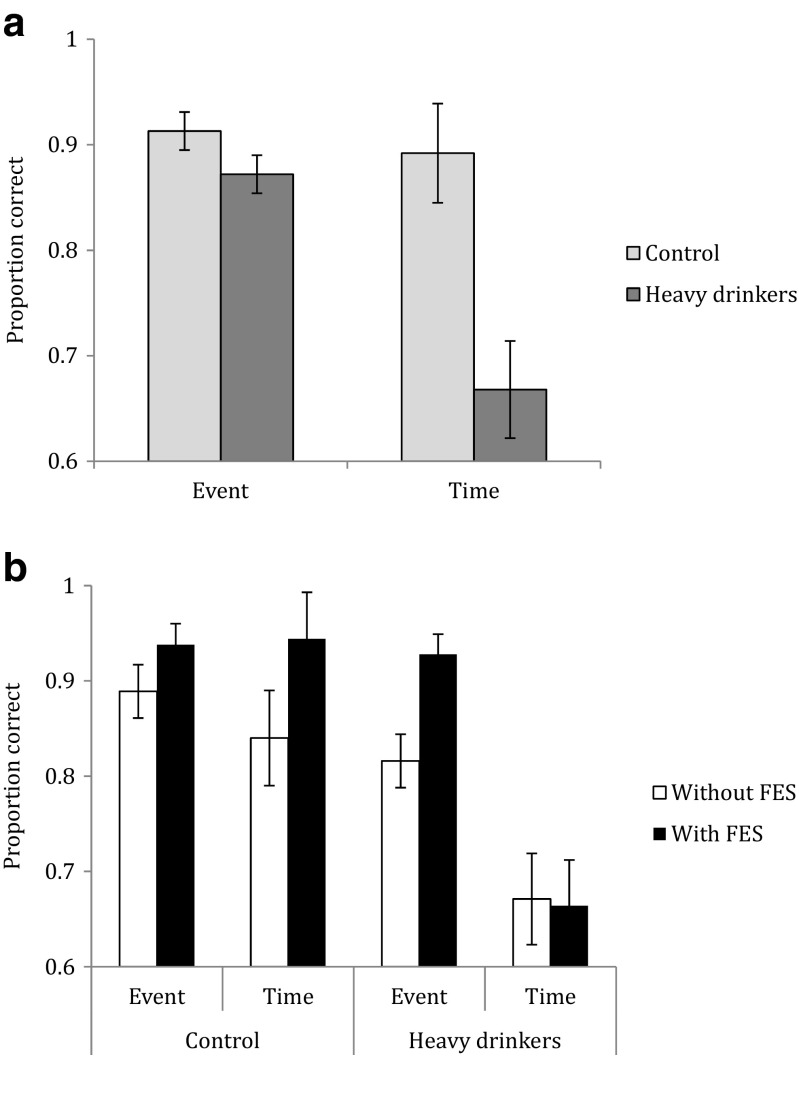
BACKGROUND: Recent research suggests that alcohol acutely impairs prospective memory (PM), and this impairment can be overcome using a strategy called 'future event simulation' (FES). Impairment in event-based PM found in detoxifying alcohol-dependent participants is reversed through FES. However, the impact of the most common problematic drinking patterns that do not involve alcohol dependence on PM remains unclear. AIMS: Here, we examine the impact of frequent heavy drinking on PM and the degree to which any impairments can be reversed through FES. METHODS: PM was assessed in 19 heavy drinkers (AUDIT scores ≥ 15) and 18 matched control participants (AUDIT scores ≤ 7) using the 'Virtual Week' task both at baseline and again following FES. RESULTS: Heavy drinkers performed significantly worse than controls on regular and irregular time-based PM tasks. FES improved the performance of controls but not of heavy drinkers on time-based tasks. In contrast, FES improved heavy drinkers' performance on event-based PM tasks. CONCLUSIONS: These findings suggest that heavy drinkers experience deficits in strategic monitoring processing associated with time-based PM tasks which do not abate after FES. That the same strategy improves their event-based PM suggests that FES may be helpful for individuals with problematic drinking patterns in improving their prospective memory.
Overview
The claims and statistics of this paper haven’t been checked yet.
Free: it reads the open-access text and checks the first 5 claims that cite a source we can check. Create a free account to check every claim.
Integrity signals
Registry
Cites
Statistics
Figures
Verification
Claims the paper makes
The claims and statistics of this paper haven’t been checked yet.
Free: it reads the open-access text and checks the first 5 claims that cite a source we can check. Create a free account to check every claim.
Claims other papers make about this one
Each is checked against this paper’s own text: does it say what the citing paper says it does?
The source backs part of the claim, not all of it — or backs it for a different population, condition or comparison.
In the citing paper
“but were reduced in heavy social drinkers, who also show episodic simulation deficits (91).”
From Episodic Future Thinking: Mechanisms and Functions (2017) · cites this paper as [91]
Experimental — accuracy not yet measuredThe source backs part of the claim, not all of it — or backs it for a different population, condition or comparison.
In the citing paper
“Simulating performing an upcoming intention makes it more likely that this intention will actually be carried out (89–91).”
From Episodic Future Thinking: Mechanisms and Functions (2017) · cites this paper as [91]
Experimental — accuracy not yet measured
Self-check
Percentages, sums and reported differences re-computed from the paper’s own numbers.
The self-check needs the paper’s full text.
Citations
Cites
Statistical Power Analysis for the Behavioral Sciences
Muller, K. (1989) · Technometrics · doi:10.1080/00401706.1989.10488618 · Cited by 99,167
Statistical power analysis for the behavioral sciences
(1990) · Computers, Environment and Urban Systems · doi:10.1016/0198-9715(90)90050-4 · Cited by 65,269
The Hospital Anxiety and Depression Scale
Zigmond, A. S., & Snaith, R. P. (1983) · Acta Psychiatrica Scandinavica · doi:10.1111/j.1600-0447.1983.tb09716.x · Cited by 47,139
Depression and quality of life in older persons: A review
Sivertsen, H., Bjørkløf, G. H., Engedal, K., Selbæk, G., & Helvik, A.-S. (2015) · Dementia and Geriatric Cognitive Disorders · doi:10.1159/000437299 · Cited by 14,152
(2001) · Cited by 5,455
Wechsler Adult Intelligence Scale--Fourth Edition
Wechsler, D. (2012) · PsycTESTS Dataset · doi:10.1037/t15169-000 · Cited by 2,232
The cognitive neuroscience of constructive memory: remembering the past and imagining the future
Schacter, D. L., & Addis, D. R. (2007) · Philosophical Transactions of the Royal Society B: Biological Sciences · doi:10.1098/rstb.2007.2087 · Cited by 1,836 · cited 2×
“According to the constructive episodic simulation hypothesis, episodic memory combines the details of past experiences (e.g. objects, people and locations) to depict future events that have not yet been experienced in the same form (Schacter and Addis 2007; Schacter et al. 2008).”
BackgroundPatients with hippocampal amnesia cannot imagine new experiences
Hassabis, D., Kumaran, D., Vann, S. D., & Maguire, E. A. (2007) · Proceedings of the National Academy of Sciences · doi:10.1073/pnas.0610561104 · Cited by 1,414 · cited 1×
“Notably, it has been demonstrated that individuals with organic episodic memory deficits from brain injuries present with difficulties in imagining future events (Addis et al. 2009; D’Argembeau et al. 2008; Hassabis et al. 2007).”
BackgroundRivermead Behavioural Memory Test: Præsentation og vurdering af en ny psykologisk prøve
COUR, P. L., & GALLAGHER, K. (1990) · Nordisk Psykologi · doi:10.1080/00291463.1990.10636996 · Cited by 988
Episodic Simulation of Future Events: Concepts, Data, and Applications
Schacter, D. L., Addis, D. R., & Buckner, R. L. (2008) · Annals of the New York Academy of Sciences · doi:10.1196/annals.1440.001 · Cited by 840
Prospective Memory : Cognitive, Neuroscience, Developmental, and Applied Perspectives
Kliegel, M., McDaniel, M. A., & Einstein, G. O. (2007) · Cited by 627
The Spot‐the‐Word test: A robust estimate of verbal intelligence based on lexical decision
Baddeley, A., Emslie, H., & Nimmo‐Smith, I. (1993) · British Journal of Clinical Psychology · doi:10.1111/j.2044-8260.1993.tb01027.x · Cited by 372
Virtual week and actual week: Age‐related differences in prospective memory
Rendell, P. G., & Craik, F. I. M. (2000) · Applied Cognitive Psychology · doi:10.1002/acp.770 · Cited by 360
Self-citationProspective controlled study of psychiatric out-patient non-attendance: Characteristics and outcome
Killaspy, H., Banerjee, S., King, M., & Lloyd, M. (2000) · British Journal of Psychiatry · doi:10.1192/bjp.176.2.160 · Cited by 325 · cited 1×
“Previous research has shown people with substance misuse to be significantly more likely than others to miss their NHS appointments (Sparr et al. 1993), and forgetting to be the most common reason for people missing follow-up appointments (Killaspy et al. 2000).”
BackgroundRemembering the past and imagining the future in schizophrenia.
D'Argembeau, A., Raffard, S., & Van der Linden, M. (2008) · Journal of Abnormal Psychology · doi:10.1037/0021-843x.117.1.247 · Cited by 321
Episodic simulation of future events is impaired in mild Alzheimer's disease
Addis, D. R., Sacchetti, D. C., Ally, B. A., Budson, A. E., & Schacter, D. L. (2009) · Neuropsychologia · doi:10.1016/j.neuropsychologia.2009.05.018 · Cited by 287 · cited 1×
“Notably, it has been demonstrated that individuals with organic episodic memory deficits from brain injuries present with difficulties in imagining future events (Addis et al. 2009; D’Argembeau et al. 2008; Hassabis et al. 2007).”
BackgroundA selective and critical review of neuropsychological deficits and the frontal lobes
Reitan, R. M., & Wolfson, D. (1994) · Neuropsychology Review · doi:10.1007/bf01874891 · Cited by 249
Tobias, R. (2009) · Psychological Review · doi:10.1037/a0015512 · Cited by 165 · cited 2×
“the ability to apply planned abstinence strategies relies crucially on intact PM (Tobias 2009).”
BackgroundMissed psychiatric appointments: who returns and who stays away
(1993) · American Journal of Psychiatry · doi:10.1176/ajp.150.5.801 · Cited by 139
Drinking and future thinking: acute effects of alcohol on prospective memory and future simulation
Paraskevaides, T., Morgan, C. J. A., Leitz, J. R., Bisby, J. A., Rendell, P. G., & Curran, H. V. (2009) · Psychopharmacology · doi:10.1007/s00213-009-1731-0 · Cited by 133
Self-citationNorton, J. C. (2021) · Handbook of Psychology and Health · doi:10.4324/9781003161530-1 · Cited by 126
Reducing non-attendance at outpatient clinics
Stone, C. A., Palmer, J. H., Saxby, P. J., & Devaraj, V. S. (1999) · Journal of the Royal Society of Medicine · doi:10.1177/014107689909200304 · Cited by 113
A Review of Virtual Week for Prospective Memory Assessment: Clinical Implications
Rendell, P. G., & Henry, J. D. (2009) · Brain Impairment · doi:10.1375/brim.10.1.14 · Cited by 109
Self-citationGlobal impairment of prospective memory following acute alcohol
Leitz, J. R., Morgan, C. J. A., Bisby, J. A., Rendell, P. G., & Curran, H. V. (2009) · Psychopharmacology · doi:10.1007/s00213-009-1546-z · Cited by 88
Self-citation(2010) · Wiley eBooks · doi:10.1002/9781444318852 · Cited by 80
Prospective memory and future event simulation in individuals with alcohol dependence
Griffiths, A., Hill, R., Morgan, C., Rendell, P. G., Karimi, K., Wanagaratne, S., & Curran, H. V. (2012) · Addiction · doi:10.1111/j.1360-0443.2012.03941.x · Cited by 55
Self-citationTen years on: realizing delayed intentions
Ellis, J. A., & Freeman, J. E. (2008) · Cited by 53
Heffernan, T., & O'Neill, T. S. (2011) · Drug and Alcohol Dependence · doi:10.1016/j.drugalcdep.2011.11.014 · Cited by 51
Decreases in recollective experience following acute alcohol: a dose–response study
Bisby, J. A., Leitz, J. R., Morgan, C. J. A., & Curran, H. V. (2009) · Psychopharmacology · doi:10.1007/s00213-009-1709-y · Cited by 50
Self-citationLinking science to policy. The role of international collaborative research.
Babor, T. F. (2002) · PubMed · Cited by 26
Cognitive Rehabilitation in Schizophrenia
Hurford, I. M., Kalkstein, S., & Hurford, M. O. (2011) · Cited by 12
Research works printed but not linked: 1
- Curran HV Weingartner H Baddeley AD Kopelman MD Wilson BA Psychopharmacology of human memory Handbook of memory disorders 2002 New York Wiley 123 141
Cited by
Episodic Future Thinking: Mechanisms and Functions
Schacter, D. L., Benoit, R. G., & Szpunar, K. K. (2017) · Current Opinion in Behavioral Sciences · doi:10.1016/j.cobeha.2017.06.002 · Cited by 771
“These beneficial effects were of similar magnitude in older and younger adults despite the existence of episodic future thinking deficits in older adults [89], but were reduced in heavy social drinkers, who also show episodic simulation deficits [91].”
Working Memory Training Improves Alcohol Users’ Episodic Future Thinking: A Rate-Dependent Analysis
Snider, S. E., Deshpande, H. U., Lisinski, J. M., Koffarnus, M. N., LaConte, S. M., & Bickel, W. K. (2017) · Biological Psychiatry Cognitive Neuroscience and Neuroimaging · doi:10.1016/j.bpsc.2017.11.002 · Cited by 95
Mioni, G., Bertucci, E., Rosato, A., Terrett, G., Rendell, P. G., Zamuner, M., & Stablum, F. (2017) · British Journal of Clinical Psychology · doi:10.1111/bjc.12126 · Cited by 30
Self-citationLechner, W. V., Sidhu, N. K., Kittaneh, A. A., & Anand, A. (2019) · Current Opinion in Psychology · doi:10.1016/j.copsyc.2019.01.017 · Cited by 40
Caballería, E., Oliveras, C., Nuño, L., Balcells‐Oliveró, M., Gual, A., & López‐Pelayo, H. (2020) · Psychological Medicine · doi:10.1017/s0033291720002925 · Cited by 29
Metadata
- Authors
- Platt, B., Kamboj, S. K., Italiano, T., Rendell, P. G., & Curran, H. V.
- Affiliations
- University College London (GB)
- Australian Catholic University (AU)
- Corresponding author
- Curran, H Valerie
- Venue
- Psychopharmacology
- Published
- 2015-11-27
- Volume
- 233
- Issue
- 3
- Pages
- 499-506
- ISSN
- 0033-3158 (ISSN-L)
- 1432-2072
- PMC
- PMC4710660
- OpenAlex
- W2180580359
- Cited by
- 27
- References
- 33
- Citations by year
- 2026: 1 · 2025: 2 · 2023: 3 · 2022: 3 · 2021: 4 · 2020: 3 · 2019: 3 · 2018: 3 · 2017: 4 · 2016: 1
- FWCI
- 4.02
- Type
- journal article
- Language
- en
- Open access
- hybrid
- doi.org
- Locations
- Psychopharmacology (publishedVersion, cc-by)
- PubMed Central (publishedVersion, cc-by)
- PubMed (publishedVersion)
- UCL Discovery (University College London) (submittedVersion)
- Topics
- Social Sciences › Psychology › Experimental and Cognitive Psychology › Cognitive Functions and Memory
- Health Sciences › Medicine › Epidemiology › Substance Abuse Treatment and Outcomes
- Life Sciences › Neuroscience › Cognitive Neuroscience › Neural and Behavioral Psychology Studies
- Keywords
- prospective memory, heavy drinking, social drinkers, time-based prospective memory, event-based prospective memory, alcohol-related cognitive impairment, strategic monitoring, auditing
- MeSH terms
- Adult, Affect, Alcoholism, Attention, Female, Humans, Intelligence, Intelligence Tests, Male, Memory Disorders, Neuropsychological Tests, Psychomotor Performance, Mental Recall, User-Computer Interface, Substance-Related Disorders, Young Adult, Executive Function
About these checks
Registry, retraction, Cites and statistics results are computed, not judged, with one exception: a printed reference that no index lists is read once by a model before it counts as a citation error. Claims are extracted by a model and kept only when their quote appears verbatim in the text; each cited source is then checked, with a model’s help, for whether it says what the claim relies on. Those verdicts can be wrong — read the claim’s quote and the cited source before relying on one.
Statistics and arithmetic are recomputed, not judged.
Confidence bands are shown only for fields calibrated on our annotated test set. None is calibrated yet, so no band is shown.
What counts as a claim ›How we measure confidence ›How we check this ›
Are you an author, or do you see a problem with this page? Request a review
Data sources
Bibliographic data: Semantic Scholar, OpenAlex, Crossref.
Contains information from the Semantic Scholar Academic Graph Datasets, made available under the ODC Attribution License (ODC-BY 1.0).
Semantic Scholar’s data is described in: Kinney, R., et al. (2023). The Semantic Scholar Open Data Platform. arXiv:2301.10140.
