

The DOI matches its Crossref record; 39 of the 39 references it cites were found in a registry or an index; none of the 8 sources its claims cite is checked for support yet.
Natural deep eutectic solvent-based microextraction for mercury speciation in water samples
Open accessAbstract
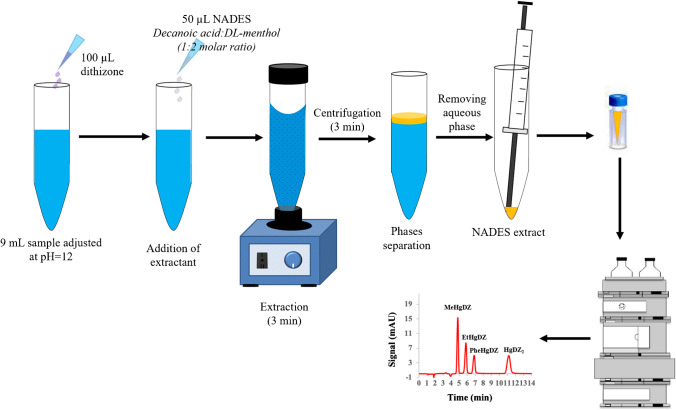
A new natural deep eutectic solvent (NADES)-based analytical method for mercury speciation in water samples is presented. A NADES (i.e., decanoic acid:DL-menthol in a molar ratio of 1:2) is used as an environmentally friendly extractant for separation and preconcentration using dispersive liquid–liquid microextraction before LC-UV–Vis. Under optimal extraction conditions (i.e., NADES volume, 50 µL; sample pH, 12; volume of the complexing agent, 100 µL; extraction time, 3 min; centrifugation speed, 3000 rpm; and centrifugation time, 3 min), the limit of detection values were 0.9 µg L−1 for the organomercurial species and 3 µg L−1 for Hg 2+, which had a slightly higher value. The relative standard deviation (RSD, n = 6) has been evaluated at two concentration levels (25 and 50 µg L−1) obtaining values for all the mercury complexes within the range of 6–12% and 8–12%, respectively. The trueness of the methodology has been evaluated using five real water samples from four different sources (i.e., tap, river, lake, and wastewater). The recovery tests have been performed in triplicate obtaining relative recoveries between 75 and 118%, with RSD (n = 3) between 1 and 19%, for all the mercury complexes in surface water samples. However, wastewater sample showed a significant matrix effect (recoveries ranged between 45 and 110%), probably due to the high amount of organic matter. Finally, the greenness of the method has also been evaluated by the analytical greenness metric for sample preparation (i.e., AGREEprep). Graphical Abstract
Overview
CoChat Summary
TL;DR
A hydrophobic natural deep eutectic solvent (decanoic acid:DL-menthol, 1:2 molar ratio) was used as extractant in dispersive liquid–liquid microextraction for mercury speciation in water samples before LC-UV–Vis. The method gave LODs of 0.9 µg L−1 for organomercurial species and 3 µg L−1 for Hg2+, with acceptable recoveries in tap and surface waters but matrix effects in wastewater.
Key findings
- Under optimized conditions (NADES volume 50 µL; sample pH 12; complexing agent volume 100 µL; extraction time 3 min; centrifugation 3000 rpm for 3 min), LODs were 0.9 µg L−1 for organomercurial species and 3 µg L−1 for Hg2+.
- Repeatability (RSD, n = 6) was 6–12% at 25 µg L−1 and 8–12% at 50 µg L−1; working ranges were 3–100 µg L−1 for organomercurial compounds and 12–200 µg L−1 for Hg2+, with correlation coefficients 0.990–0.996.
- In five real water samples from four sources (tap, river, lake, wastewater), relative recoveries were 75–118% with RSD (n = 3) between 1 and 19% for surface waters; wastewater showed a significant matrix effect, with recoveries 45–110%, probably due to high organic matter.
- The AGREEprep greenness score was 0.6, indicating an acceptable green analytical method but with room for improvement in sample preparation placement, sustainability/renewability of materials, waste generation, and automation.
Methods
- DLLME procedure: aqueous sample conditioned to pH 12 with phosphate buffer, dithizone added to complex mercury species, NADES added, vortexed 3 min, centrifuged 3 min at 3000 rpm, and the analyte-enriched NADES directly injected into LC-UV–Vis.
- Optimization used a two-step multivariate strategy: Plackett–Burman screening followed by central composite design; LC-UV–Vis peak areas of methylmercury, ethylmercury, phenylmercury, and mercury dithizonates were the response function.
- Real water samples were from Spain: Serpis river, Albufera lake, Cinca river, wastewater from Aguas Municipalizadas de Alicante, and tap water from San Vicente del Raspeig; samples were spiked at 12 and 50 µg L−1 for organomercurial species and 24 and 100 µg L−1 for Hg2+, with triplicate analyses.
Limitations
- The paper states that wastewater showed a significant matrix effect (recoveries 45–110%), likely due to high organic matter, and that AGREEprep indicates improvement opportunities in sample preparation placement, sustainability/renewability, waste generation, and automation.
- Evident from the text: all real water samples had mercury species contents below the corresponding LODs, so method performance in real samples was assessed only through spiked recovery tests.
- Evident from the text: Hg2+ had a higher LOD (3 µg L−1) than the organomercurial species (0.9 µg L−1), and the method was tested only on water samples.
Model-written summary. Check it against the paper before relying on it.
Integrity signals
Registry
Cites
Statistics
Figures

Verification
Claims the paper makes
0 Valid · 0 Not valid · 6 Not checked · 32 Own results and interpretations
A result the paper reports from its own data — it cites no other source for it, so there is none to check. The quote shows it is in the paper.
In the paper
“The relative standard deviation (RSD, n = 6) has been evaluated at two concentration levels (25 and 50 µg L−1) obtaining values for all the mercury complexes within the range of 6–12% and 8–12%, respectively.”
- Also stated in: § Analytical figures of merit · plain
“For the four analytes, relative standard deviations (RSD) ranged from 6 to 12% at the low level and from 8 to 12% at the high level.”
§ Natural deep eutectic solvent-based microextraction for mercury speciation in water samples > Abstract
plainn = 6- Asserted: passes — The authors put it forward as true.
- Checkable: passes — It can be checked against evidence.
- Load-bearing: unclear — It is unclear whether the paper’s conclusions depend on it.
- Based: passes — The paper gives a reason why it holds.
- Also stated in: § Analytical figures of merit · plain
A result the paper reports from its own data — it cites no other source for it, so there is none to check. The quote shows it is in the paper.
In the paper
“the limit of detection values were 0.9 µg L−1 for the organomercurial species and 3 µg L−1 for Hg2+, which had a slightly higher value.”
§ Natural deep eutectic solvent-based microextraction for mercury speciation in water samples > Abstract
plain- Asserted: passes — The authors put it forward as true.
- Checkable: passes — It can be checked against evidence.
- Load-bearing: passes — The paper’s conclusions depend on it.
- Based: passes — The paper gives a reason why it holds.
A result the paper reports from its own data — it cites no other source for it, so there is none to check. The quote shows it is in the paper.
In the paper
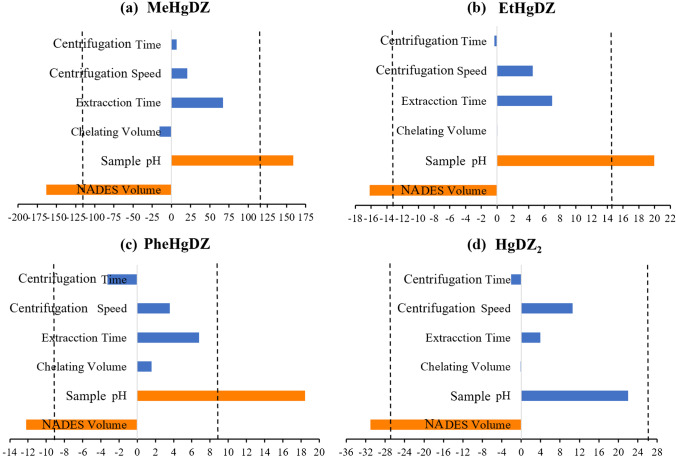
“In Fig. 2, only the NADES volume and sample pH were reported as statistically significant factors with a 95% probability, indicating a negative influence for the NADES volume and a positive effect for the sample pH.”
§ Natural deep eutectic solvent-based microextraction for mercury speciation in water samples > Results and discussion > Multivariate optimization
hedgedstates a cause- Asserted: passes — The authors put it forward as true.
- Checkable: passes — It can be checked against evidence.
- Load-bearing: unclear — It is unclear whether the paper’s conclusions depend on it.
- Based: passes — The paper gives a reason why it holds.
A result the paper states — it cites no source for it, so there is none to check. The quote shows it is in the paper.
In the paper
“However, wastewater sample showed a significant matrix effect (recoveries ranged between 45 and 110%), probably due to the high amount of organic matter.”
- Also stated in: § Analysis of real water samples · hedged
“Matrix effects were detected in this case (recoveries ranged between 45 and 110%), most likely due to the high amount of organic matter.”
§ Natural deep eutectic solvent-based microextraction for mercury speciation in water samples > Abstract
hedgedstates a possible causeSingle case- Asserted: passes — The authors put it forward as true.
- Checkable: passes — It can be checked against evidence.
- Load-bearing: passes — The paper’s conclusions depend on it.
- Based: passes — The paper gives a reason why it holds.
- Also stated in: § Analysis of real water samples · hedged
A result the paper reports from its own data — it cites no other source for it, so there is none to check. The quote shows it is in the paper.
In the paper
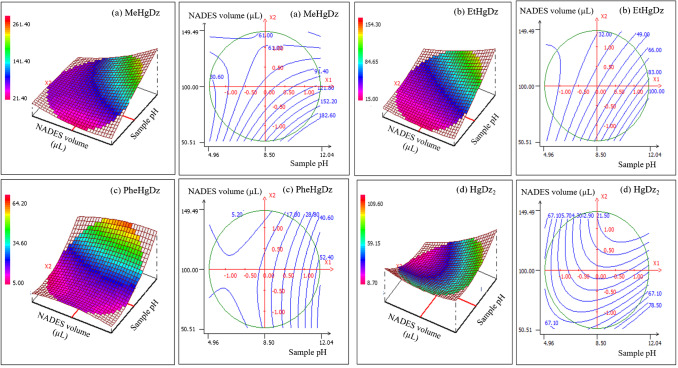
“The response surfaces in Fig. 3 show that the four analytes have the same optimal values, being the lowest value of NADES volume and the highest value of sample pH.”
§ Natural deep eutectic solvent-based microextraction for mercury speciation in water samples > Results and discussion > Multivariate optimization
plain- Asserted: passes — The authors put it forward as true.
- Checkable: passes — It can be checked against evidence.
- Load-bearing: passes — The paper’s conclusions depend on it.
- Based: passes — The paper gives a reason why it holds.
19 more claims
Create a free account to see all 38 claims and every source verdict.
- It may state two separate claims as one. 8
- Probably not a substantial claim. 6
Claims other papers make about this one
Each is checked against this paper’s own text: does it say what the citing paper says it does?
In the citing paper
“Unlike liquid-phase microextraction techniques, solid-phase extraction (SPE), magnetic solid-phase extraction (MSPE), membrane-assisted extraction, and DES-modified sorbents are primarily designed to enhance selectivity and improve matrix purification [51,72,73,76,96].”
From Eco-Friendly Deep Eutectic Solvent-Based Extraction Technologies: A Comprehensive Review of Principles, Applications, and Comparative Insights (2026) · cites this paper as [72]
Citations
Cites
Determination of organic compounds in water using dispersive liquid–liquid microextraction
Rezaee, M., Assadi, Y., Milani Hosseini, M.-R., Aghaee, E., Ahmadi, F., & Berijani, S. (2006) · Journal of Chromatography A · doi:10.1016/j.chroma.2006.03.007 · Cited by 3,402 · cited 1×
“[13], and it is an effective extraction method that involves distributing the immiscible extractant phase within the sample with the help of a dispersant agent (e.”
MethodGałuszka, A., Migaszewski, Z., & Namieśnik, J. (2013) · TrAC Trends in Analytical Chemistry · doi:10.1016/j.trac.2013.04.010 · Cited by 2,461
Choi, Y. H., van Spronsen, J., Dai, Y., Verberne, M., Hollmann, F., Arends, I. W. C. E., Witkamp, G.-J., & Verpoorte, R. (2011) · Plant Physiology · doi:10.1104/pp.111.178426 · Cited by 1,368
Natural deep eutectic solvents: Properties, applications, and perspectives
Liu, Y., Friesen, J. B., McAlpine, J. B., Lankin, D. C., Chen, S.-N., & Pauli, G. F. (2018) · Journal of Natural Products · doi:10.1021/acs.jnatprod.7b00945 · Cited by 1,304
Human Exposure and Health Effects of Inorganic and Elemental Mercury
Park, J.-D., & Zheng, W. (2012) · Journal of Preventive Medicine & Public Health · doi:10.3961/jpmph.2012.45.6.344 · Cited by 770 · cited 1×
“We may include harm to the gastrointestinal tract, neurological system, kidneys, respiratory failures, and issues with organ development in utero as some of the most important health repercussions [1, 3].”
BackgroundGreen analytical chemistry metrics: a review
Sajid, M., & Płotka-Wasylka, J. (2022) · Talanta · doi:10.1016/j.talanta.2021.123046 · Cited by 744
The ten principles of green sample preparation
López-Lorente, Á. I., Pena-Pereira, F., Pedersen-Bjergaard, S., Zuin, V. G., Ozkan, S. A., & Psillakis, E. (2022) · TrAC Trends in Analytical Chemistry · doi:10.1016/j.trac.2022.116530 · Cited by 721
A Search for Natural Hydrophobic Deep Eutectic Solvents Based on Natural Components
van Osch, D. J. G. P., Dietz, C. H. J. T., van Spronsen, J., Kroon, M. C., Gallucci, F., van Sint Annaland, M., & Tuinier, R. (2019) · ACS Sustainable Chemistry & Engineering · doi:10.1021/acssuschemeng.8b03520 · Cited by 580
Application of deep eutectic solvents in analytical chemistry. A review
Shishov, A., Bulatov, A., Locatelli, M., Carradori, S., & Andruch, V. (2017) · Microchemical Journal · doi:10.1016/j.microc.2017.07.015 · Cited by 561
Armbruster, D. A., Tillman, M. D., & Hubbs, L. M. (1994) · Clinical Chemistry · doi:10.1093/clinchem/40.7.1233 · Cited by 483
Research works printed but not linked: 2
- Ramon DJ and Guillena G. (Eds.) Deep eutectic solvents: synthesis, properties, and applications. John Wiley & Sons. 2022.
- Montgomery DC. Design and analysis of experiments. 10th ed. John Wiley & Sons; 2019.
Cited by
Applications of (natural) deep eutectic solvents in liquid phase microextraction: A review
Mansour, F. R., Bedair, A., Hamed, M., Magdy, G., Ali, I., & Locatelli, M. (2024) · Microchemical Journal · doi:10.1016/j.microc.2024.110178 · Cited by 107
Hu, C., Feng, J., Cao, Y., Chen, L., & Li, Y. (2023) · Talanta · doi:10.1016/j.talanta.2023.125092 · Cited by 74
Yahaya, N., Mohamed, A. H., Miskam, M., Keyon, A. S. A., Loh, S. H., Zain, N. N. M., & Sajid, M. (2024) · TrAC Trends in Analytical Chemistry · doi:10.1016/j.trac.2024.117587 · Cited by 61
Green extraction techniques in green analytical chemistry: A 2019–2023 up-date
Esteve-Turrillas, F. A., Garrigues, S., & de la Guárdia, M. (2023) · TrAC Trends in Analytical Chemistry · doi:10.1016/j.trac.2023.117464 · Cited by 59
Hashim, N. M., Waras, M. N., Yahaya, N., Raoov, M., Kabir, A., & Zain, N. N. M. (2024) · TrAC Trends in Analytical Chemistry · doi:10.1016/j.trac.2024.117598 · Cited by 30
Metadata
- Authors
- Ripoll, L., Rayos, J., Aguirre, M. Á., Vidal, L., & Canals, A.
- Affiliations
- University of Alicante (ES)
- Corresponding author
- Vidal, Lorena
- Canals, Antonio
- Venue
- Analytical and Bioanalytical Chemistry
- Published
- 2023-03-06
- Volume
- 415
- Issue
- 18
- Pages
- 4435-4444
- ISSN
- 1618-2642 (ISSN-L)
- 1618-2650
- PMC
- PMC10328898
- OpenAlex
- W4323270186
- Cited by
- 30
- References
- 39
- Citations by year
- 2026: 7 · 2025: 12 · 2024: 8 · 2023: 3
- FWCI
- 3.83
- Type
- journal article
- Language
- en
- Open access
- hybrid
- doi.org
- Licence
- cc-by
- creativecommons.org/licenses/by/4.0 (tdm)
- creativecommons.org/licenses/by/4.0 (vor)
- Locations
- Analytical and Bioanalytical Chemistry (publishedVersion, cc-by)
- PubMed Central (publishedVersion, cc-by)
- PubMed (publishedVersion)
- RUA, Repositorio Institucional de la Universidad de Alicante (Universidad de Alicante) (submittedVersion, cc-by)
- Funders
- Generalitat Valenciana (CIPROM/2021/062)
- Ministerio de Ciencia e Innovación (PID2021-126155OB-I00)
- Universidad de Alicante
- Topics
- Physical Sciences › Chemistry › Analytical Chemistry › Analytical chemistry methods development
- Physical Sciences › Environmental Science › Health, Toxicology and Mutagenesis › Mercury impact and mitigation studies
- Physical Sciences › Chemistry › Electrochemistry › Electrochemical Analysis and Applications
- Keywords
- natural deep eutectic solvents, mercury speciation, dispersive liquid-liquid microextraction, preconcentration, capric acid, DL-menthol, Hg2+, water samples, wastewater, matrix effects, green analytical chemistry, AGREEprep
- MeSH terms
- Deep Eutectic Solvents, Mercury, Solvents, Water, Water Pollutants, Chemical, Limit of Detection, Liquid Phase Microextraction, Wastewater
About these checks
Registry, retraction, Cites and statistics results are computed, not judged, with one exception: a printed reference that no index lists is read once by a model before it counts as a citation error. Claims are extracted by a model and kept only when their quote appears verbatim in the text; each cited source is then checked, with a model’s help, for whether it says what the claim relies on. Those verdicts can be wrong — read the claim’s quote and the cited source before relying on one.
A language model drew the claims from the paper on 2026-09-29, under version 3 of the claim definition (model deepseek-v4.1-flash, prompt extract-v3).
A second model labelled each claim on 2026-09-29 (model jev-1.13-20260917, definition revision gold-guideline-v0.2).
Statistics and arithmetic are recomputed, not judged.
Confidence bands are shown only for fields calibrated on our annotated test set. None is calibrated yet, so no band is shown.
What counts as a claim ›How we measure confidence ›How we check this ›
Are you an author, or do you see a problem with this page? Request a review
How to cite
Cite CoChat for the checks on this page, and the paper for its own findings.
- This page
- CoChat. (2026). Citation check: Natural deep eutectic solvent-based microextraction for mercury speciation in water samples. https://app.cochat.ai/papers/10.1007/s00216-023-04610-0
- The paper
- Ripoll, L., Rayos, J., Aguirre, M. Á., Vidal, L., & Canals, A. (2023). Natural deep eutectic solvent-based microextraction for mercury speciation in water samples. Analytical and Bioanalytical Chemistry. https://doi.org/10.1007/s00216-023-04610-0
Data sources
Bibliographic data: Semantic Scholar, OpenAlex, Crossref.
Contains information from the Semantic Scholar Academic Graph Datasets, made available under the ODC Attribution License (ODC-BY 1.0).
Semantic Scholar’s data is described in: Kinney, R., et al. (2023). The Semantic Scholar Open Data Platform. arXiv:2301.10140.
