

The DOI matches its Crossref record; 35 of the 36 references it cites were found in a registry or an index.
Dividing Quantum Channels
Open accessAbstract
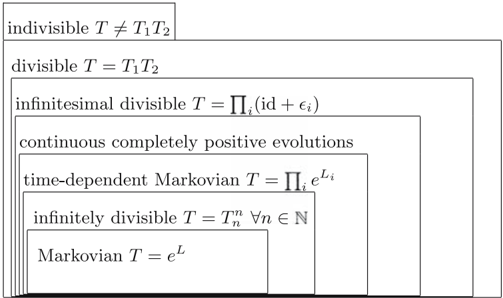
We investigate the possibility of dividing quantum channels into concatenations of other channels, thereby studying the semigroup structure of the set of completely-positive trace-preserving maps. We show the existence of ‘ indivisible ’ channels which can not be written as non-trivial products of other channels and study the set of ‘ infinitesimal divisible ’ channels which are elements of continuous completely positive evolutions. For qubit channels we obtain a complete characterization of the sets of indivisible and infinitesimal divisible channels. Moreover, we identify those channels which are solutions of time-dependent master equations for both positive and completely positive evolutions. For arbitrary finite dimension we prove a representation theorem for elements of continuous completely positive evolutions based on new results on determinants of quantum channels and Markovian approximations.
Overview
The claims and statistics of this paper haven’t been checked yet.
Run the check — free, no account needed. It reads the open-access text and checks the sources it cites.
Integrity signals
Registry
Cites
Statistics
Figures
Verification
Claims the paper makes
The claims and statistics of this paper haven’t been checked yet.
Run the check — free, no account needed. It reads the open-access text and checks the sources it cites.
Claims other papers make about this one
Each is checked against this paper’s own text: does it say what the citing paper says it does?
The cited source says what the claim attributes to it.
In the citing paper
“It can be proven that, since E (t,t 0 ) is a composition of completely positive maps, the absolute value of the determinant of M (t,t 0 ) decreases monotonically with time [27].”
From Quantum non-Markovianity: characterization, quantification and detection (2014) · cites this paper as [27]
In the citing paper
“Moreover, it is easy to show with the help of Eq. (78) that the maximum in Eq. (76) is attained for a = 0 and | b | = 1 [38]. This means that the optimal pairs of initial states correspond to antipodal points on the equator of the Bloch sphere representing the qubit.”
From Foundations and measures of quantum non-Markovianity (2012) · cites this paper as [38]
Self-check
Percentages, sums and reported differences re-computed from the paper’s own numbers.
The self-check needs the paper’s full text.
Citations
Cites
Quantum Computation and Quantum Information
Nielsen, M. A., Chuang, I., & Grover, L. K. (2002) · American Journal of Physics · doi:10.1119/1.1463744 · Cited by 21,895
Quantum computation and quantum information
Law, J. (2001) · ACM SIGSOFT Software Engineering Notes · doi:10.1145/505482.505499 · Cited by 18,842
On the generators of quantum dynamical semigroups
Lindblad, G. (1976) · Communications in Mathematical Physics · doi:10.1007/bf01608499 · Cited by 7,548
Completely positive dynamical semigroups of N -level systems
Gorini, V., Kossakowski, A., & Sudarshan, E. C. G. (1976) · Journal of Mathematical Physics · doi:10.1063/1.522979 · Cited by 3,998
Bhatia, R. (1996) · Cited by 2,847
Completely positive linear maps on complex matrices
Choi, M.-D. (1975) · Linear Algebra and its Applications · doi:10.1016/0024-3795(75)90075-0 · Cited by 2,659
Scott, W. R. (1964) · Cited by 2,606
Bhatia, R. (1997) · Graduate Texts in Mathematics · doi:10.1007/978-1-4612-0653-8 · Cited by 2,336
The ‘transition probability’ in the state space of a—algebra
Uhlmann, A. (1976) · Reports on Mathematical Physics · doi:10.1016/0034-4877(76)90060-4 · Cited by 1,649
Linear transformations which preserve trace and positive semidefiniteness of operators
Jamiołkowski, A. (1972) · Reports on Mathematical Physics · doi:10.1016/0034-4877(72)90011-0 · Cited by 1,512
Research works printed but not linked: 4
- Holevo A.S. (1986). Theor. Probab. Appl. 32: 560
- Kraus K. (1983). States, Effects and Operations. Springer, Berlin-Heidelberg-New York
- Verstraete, F., Verschelde, H.: http://arxiv.org/list/quant-ph/0202124, 2002
- Wolf, M.M., Eisert, J., Cubitt, T.S., Cirac, J.I.: arXiv: 0711.3172 (2007) · arXiv
Cited by
Ashida, Y., Gong, Z., & Ueda, M. (2020) · Advances in Physics · doi:10.1080/00018732.2021.1876991 · Cited by 1,788
Quantum computation and quantum-state engineering driven by dissipation
Verstraete, F., Wolf, M. M., & Ignacio Cirac, J. (2009) · Nature Physics · doi:10.1038/nphys1342 · Cited by 1,570
Self-citationTopological Phases of Non-Hermitian Systems
Gong, Z., Ashida, Y., Kawabata, K., Takasan, K., Higashikawa, S., & Ueda, M. (2018) · Physical Review X · doi:10.1103/physrevx.8.031079 · Cited by 1,462
Measure for the Degree of Non-Markovian Behavior of Quantum Processes in Open Systems
Breuer, H.-P., Laine, E.-M., & Piilo, J. (2009) · Physical Review Letters · doi:10.1103/physrevlett.103.210401 · Cited by 1,480
Entanglement and Non-Markovianity of Quantum Evolutions
Rivas, Á., Huelga, S. F., & Plenio, M. B. (2010) · Physical Review Letters · doi:10.1103/physrevlett.105.050403 · Cited by 1,037
Metadata
- Authors
- Wolf, M. M., & Cirac, J. I.
- Affiliations
- Max Planck Society (DE)
- Corresponding author
- Wolf, Michael M.
- Venue
- Communications in Mathematical Physics
- Published
- 2008-02-01
- Volume
- 279
- Issue
- 1
- Pages
- 147-168
- ISSN
- 0010-3616 (ISSN-L)
- 1432-0916
- OpenAlex
- W2052344514
- Semantic Scholar
- 0bd4e105fb4e18ab74c88a52b58bdad786127a30
- Cited by
- 288
- References
- 36
- Citations by year
- 2026: 11 · 2025: 14 · 2024: 25 · 2023: 17 · 2022: 24 · 2021: 21 · 2020: 22 · 2019: 23 · 2018: 19 · 2017: 15 · 2016: 11 · 2015: 19 · 2014: 14 · 2013: 12 · 2012: 13
- FWCI
- 14.80
- Type
- journal article
- Language
- en
- Open access
- hybrid
- doi.org
- Licence
- cc-by-nc
- creativecommons.org/licenses/by-nc/2.0 (tdm)
- creativecommons.org/licenses/by-nc/2.0 (vor)
- Locations
- Communications in Mathematical Physics (publishedVersion, cc-by-nc)
- arXiv (Cornell University) (submittedVersion)
- Max Planck Institute for Plasma Physics (submittedVersion)
- MPG.PuRe (Max Planck Society) (submittedVersion)
- arXiv (Cornell University)
- Topics
- Physical Sciences › Physics and Astronomy › Atomic and Molecular Physics, and Optics › Quantum Information and Cryptography
- Physical Sciences › Physics and Astronomy › Atomic and Molecular Physics, and Optics › Quantum Mechanics and Applications
- Physical Sciences › Mathematics › Mathematical Physics › Advanced Operator Algebra Research
- Keywords
- quantum channels, completely positive trace-preserving maps, semigroup structure, qubit channels, Markov approximation, quantum dynamical systems
About these checks
Registry, retraction, Cites and statistics results are computed, not judged, with one exception: a printed reference that no index lists is read once by a model before it counts as a citation error. Claims are extracted by a model and kept only when their quote appears verbatim in the text; each cited source is then checked, with a model’s help, for whether it says what the claim relies on. Those verdicts can be wrong — read the claim’s quote and the cited source before relying on one.
Statistics and arithmetic are recomputed, not judged.
Confidence bands are shown only for fields calibrated on our annotated test set. None is calibrated yet, so no band is shown.
What counts as a claim ›How we measure confidence ›How we check this ›
Are you an author, or do you see a problem with this page? Request a review
How to cite
Cite CoChat for the checks on this page, and the paper for its own findings.
- This page
- CoChat. (2026). Citation check: Dividing Quantum Channels. https://app.cochat.ai/papers/10.1007/s00220-008-0411-y
- The paper
- Wolf, M. M., & Cirac, J. I. (2008). Dividing Quantum Channels. Communications in Mathematical Physics. https://doi.org/10.1007/s00220-008-0411-y
Data sources
Bibliographic data: Semantic Scholar, OpenAlex, Crossref.
Contains information from the Semantic Scholar Academic Graph Datasets, made available under the ODC Attribution License (ODC-BY 1.0).
Semantic Scholar’s data is described in: Kinney, R., et al. (2023). The Semantic Scholar Open Data Platform. arXiv:2301.10140.
