

Dividing Quantum Channels
Open accessThe DOI matches its Crossref record; 35 of the 36 references it cites were found in a registry or an index.
Abstract
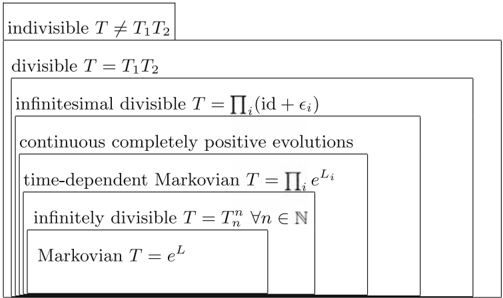
We investigate the possibility of dividing quantum channels into concatenations of other channels, thereby studying the semigroup structure of the set of completely-positive trace-preserving maps. We show the existence of ‘ indivisible ’ channels which can not be written as non-trivial products of other channels and study the set of ‘ infinitesimal divisible ’ channels which are elements of continuous completely positive evolutions. For qubit channels we obtain a complete characterization of the sets of indivisible and infinitesimal divisible channels. Moreover, we identify those channels which are solutions of time-dependent master equations for both positive and completely positive evolutions. For arbitrary finite dimension we prove a representation theorem for elements of continuous completely positive evolutions based on new results on determinants of quantum channels and Markovian approximations.
Overview
The claims and statistics of this paper haven’t been checked yet.
Free: it reads the open-access text and checks the first 5 claims that cite a source we can check. Create a free account to check every claim.
Integrity signals
Registry
Cites
Statistics
Figures
Verification
Claims the paper makes
The claims and statistics of this paper haven’t been checked yet.
Free: it reads the open-access text and checks the first 5 claims that cite a source we can check. Create a free account to check every claim.
Claims other papers make about this one
Each is checked against this paper’s own text: does it say what the citing paper says it does?
The cited source says what the claim attributes to it.
In the citing paper
“It can be proven that, since E (t,t 0 ) is a composition of completely positive maps, the absolute value of the determinant of M (t,t 0 ) decreases monotonically with time [27].”
From Quantum non-Markovianity: characterization, quantification and detection (2014) · cites this paper as [27]
In the citing paper
“Moreover, it is easy to show with the help of Eq. (78) that the maximum in Eq. (76) is attained for a = 0 and | b | = 1 [38]. This means that the optimal pairs of initial states correspond to antipodal points on the equator of the Bloch sphere representing the qubit.”
From Foundations and measures of quantum non-Markovianity (2012) · cites this paper as [38]
Self-check
Percentages, sums and reported differences re-computed from the paper’s own numbers.
The self-check needs the paper’s full text.
Citations
Cites
Quantum Computation and Quantum Information
Nielsen, M. A., Chuang, I., & Grover, L. K. (2002) · American Journal of Physics · doi:10.1119/1.1463744 · Cited by 21,895
Quantum computation and quantum information
Law, J. (2001) · ACM SIGSOFT Software Engineering Notes · doi:10.1145/505482.505499 · Cited by 18,842
On the generators of quantum dynamical semigroups
Lindblad, G. (1976) · Communications in Mathematical Physics · doi:10.1007/bf01608499 · Cited by 7,548
Completely positive dynamical semigroups of N -level systems
Gorini, V., Kossakowski, A., & Sudarshan, E. C. G. (1976) · Journal of Mathematical Physics · doi:10.1063/1.522979 · Cited by 3,998
Bhatia, R. (1996) · Cited by 2,847
Completely positive linear maps on complex matrices
Choi, M.-D. (1975) · Linear Algebra and its Applications · doi:10.1016/0024-3795(75)90075-0 · Cited by 2,659
Scott, W. R. (1964) · Cited by 2,606
Bhatia, R. (1997) · Graduate Texts in Mathematics · doi:10.1007/978-1-4612-0653-8 · Cited by 2,336
The ‘transition probability’ in the state space of a—algebra
Uhlmann, A. (1976) · Reports on Mathematical Physics · doi:10.1016/0034-4877(76)90060-4 · Cited by 1,649
Linear transformations which preserve trace and positive semidefiniteness of operators
Jamiołkowski, A. (1972) · Reports on Mathematical Physics · doi:10.1016/0034-4877(72)90011-0 · Cited by 1,512
Research works printed but not linked: 4
- 3. Holevo, A.S.: Theor. Probab. Appl. 32, 560 (1986)
- 7. Kraus, K.: States, Effects, and Operations. Berlin-Heidelberg-New York: Springer, 1983
- 27. Verstraete, F., Verschelde, H.: http://arxiv.org/list/quant-ph/0202124, 2002;
- 33. Wolf, M.M., Eisert, J., Cubitt, T.S., Cirac, J.I.: arXiv: 0711.3172 (2007) · arXiv
Cited by
Ashida, Y., Gong, Z., & Ueda, M. (2020) · Advances in Physics · doi:10.1080/00018732.2021.1876991 · Cited by 1,788
Quantum computation and quantum-state engineering driven by dissipation
Verstraete, F., Wolf, M. M., & Ignacio Cirac, J. (2009) · Nature Physics · doi:10.1038/nphys1342 · Cited by 1,570
Self-citationTopological Phases of Non-Hermitian Systems
Gong, Z., Ashida, Y., Kawabata, K., Takasan, K., Higashikawa, S., & Ueda, M. (2018) · Physical Review X · doi:10.1103/physrevx.8.031079 · Cited by 1,462
“With the TP property imposed, the eigenvalues of E are enforced to be on or inside the unit circle in the complex plane [155].”
BackgroundMeasure for the Degree of Non-Markovian Behavior of Quantum Processes in Open Systems
Breuer, H.-P., Laine, E.-M., & Piilo, J. (2009) · Physical Review Letters · doi:10.1103/physrevlett.103.210401 · Cited by 1,480
Entanglement and Non-Markovianity of Quantum Evolutions
Rivas, Á., Huelga, S. F., & Plenio, M. B. (2010) · Physical Review Letters · doi:10.1103/physrevlett.105.050403 · Cited by 1,037
Quantum non-Markovianity: characterization, quantification and detection
Rivas, Á., Huelga, S. F., & Plenio, M. B. (2014) · Reports on Progress in Physics · doi:10.1088/0034-4885/77/9/094001 · Cited by 1,035
Matrix product states and projected entangled pair states: Concepts, symmetries, theorems
Cirac, J. I., Pérez-García, D., Schuch, N., & Verstraete, F. (2021) · Reviews of Modern Physics · doi:10.1103/revmodphys.93.045003 · Cited by 769
“However, this is subtle as there exist quantum channels T that cannot be divided (Wolf and Cirac, 2008), in the sense that there does not exist any other quantum channel R so that R2 = T .”
BackgroundSelf-citationPreparation of entangled states by quantum Markov processes
Kraus, B., Büchler, H. P., Diehl, S., Kantian, A., Micheli, A., & Zoller, P. (2008) · Physical Review A · doi:10.1103/physreva.78.042307 · Cited by 760
Assessing Non-Markovian Quantum Dynamics
Wolf, M. M., Eisert, J., Cubitt, T. S., & Cirac, J. I. (2008) · Physical Review Letters · doi:10.1103/physrevlett.101.150402 · Cited by 596
Self-citationQuantum Fisher information flow and non-Markovian processes of open systems
Lu, X.-M., Wang, X., & Sun, C. P. (2010) · Physical Review A · doi:10.1103/physreva.82.042103 · Cited by 540
Measure for the non-Markovianity of quantum processes
Laine, E.-M., Piilo, J., & Breuer, H.-P. (2010) · Physical Review A · doi:10.1103/physreva.81.062115 · Cited by 484
Koch, C. P., Boscain, U., Calarco, T., Dirr, G., Filipp, S., Glaser, S. J., Kosloff, R., Montangero, S., Schulte-Herbrüggen, T., Sugny, D., et al. (2022) · EPJ Quantum Technology · doi:10.1140/epjqt/s40507-022-00138-x · Cited by 405
“corresponding decision problem (encompassing both the time-independent and timedependent notion via infinitesimal cp-divisibility [622] on all time scales) is np hard [152, 153].”
BackgroundConcepts of quantum non-Markovianity: A hierarchy
Li, L., Hall, M. J. W., & Wiseman, H. M. (2018) · Physics Reports · doi:10.1016/j.physrep.2018.07.001 · Cited by 353
“Wolf and Cirac originally considered only a particular subclass of divisible dynamical maps to be ‘Markovian’ [110] (see also Section 3.”
BackgroundCanonical form of master equations and characterization of non-Markovianity
Hall, M. J. W., Cresser, J. D., Li, L., & Andersson, E. (2014) · Physical Review A · doi:10.1103/physreva.89.042120 · Cited by 382
Degree of Non-Markovianity of Quantum Evolution
Chruściński, D., & Maniscalco, S. (2014) · Physical Review Letters · doi:10.1103/physrevlett.112.120404 · Cited by 352
Quantum channels and memory effects
Caruso, F., Giovannetti, V., Lupo, C., & Mancini, S. (2012) · arXiv · doi:10.48550/arxiv.1207.5435 · Cited by 331
“According to (Wolf and Cirac, 2008) a quantum channel is called Markovian if it is an element of a completely positive continuous one-parameter semigroup.”
BackgroundInfluentialQuantum channels and memory effects
Caruso, F., Giovannetti, V., Lupo, C., & Mancini, S. (2014) · Reviews of Modern Physics · doi:10.1103/revmodphys.86.1203 · Cited by 330
“According to (Wolf and Cirac, 2008) a quantum channel is called Markovian if it is an element of a completely positive continuous one-parameter semigroup.”
BackgroundInfluentialMeasures of non-Markovianity: Divisibility versus backflow of information
Chruściński, D., Kossakowski, A., & Rivas, Á. (2011) · Physical Review A · doi:10.1103/physreva.83.052128 · Cited by 270
Geometrical characterization of non-Markovianity
Lorenzo, S., Plastina, F., & Paternostro, M. (2013) · Physical Review A · doi:10.1103/physreva.88.020102 · Cited by 268
Markovian master equations: a critical study
Rivas, Á., K Plato, A. D., Huelga, S. F., & B Plenio, M. (2010) · New Journal of Physics · doi:10.1088/1367-2630/12/11/113032 · Cited by 258
Quantum collision models: Open system dynamics from repeated interactions
Ciccarello, F., Lorenzo, S., Giovannetti, V., & Palma, G. M. (2022) · Physics Reports · doi:10.1016/j.physrep.2022.01.001 · Cited by 246
Algebraic versus Exponential Decoherence in Dissipative Many-Particle Systems
Cai, Z., & Barthel, T. (2013) · Physical Review Letters · doi:10.1103/physrevlett.111.150403 · Cited by 243
Foundations and measures of quantum non-Markovianity
Breuer, H.-P. (2012) · Journal of Physics B: Atomic, Molecular and Optical Physics · doi:10.1088/0953-4075/45/15/154001 · Cited by 225
Observation of non-Markovian micromechanical Brownian motion
Gröblacher, S., Trubarov, A., Prigge, N., Cole, G. D., Aspelmeyer, M., & Eisert, J. (2015) · Nature Communications · doi:10.1038/ncomms8606 · Cited by 199
Markovianity and non-Markovianity in quantum and classical systems
Vacchini, B., Smirne, A., Laine, E.-M., Piilo, J., & Breuer, H.-P. (2011) · New Journal of Physics · doi:10.1088/1367-2630/13/9/093004 · Cited by 198
Estimating the coherence of noise
Wallman, J., Granade, C., Harper, R., & Flammia, S. T. (2015) · New Journal of Physics · doi:10.1088/1367-2630/17/11/113020 · Cited by 192
“However, the only channels with |detE| = 1 are unitary channels [25].”
BackgroundQuantum Stochastic Processes and Quantum non-Markovian Phenomena
Milz, S., & Modi, K. (2021) · PRX Quantum · doi:10.1103/prxquantum.2.030201 · Cited by 174
A Postquantum Theory of Classical Gravity?
Oppenheim, J. (2023) · Physical Review X · doi:10.1103/physrevx.13.041040 · Cited by 164
“…for quantum systems, a linear map E ð ˆ σ Þ which is completely positive trace preserving at every time t (we say it is infinitesimally divisible [122]) is always generated by the GKSL or Lindblad equation [108,109] with ˆ H ð t Þ the Hamiltonian, the set f ˆ L α g a traceless basis of operators…”
Randomized benchmarking with confidence
Wallman, J. J., & Flammia, S. T. (2014) · New Journal of Physics · doi:10.1088/1367-2630/16/10/103032 · Cited by 164
“[27] Michael M.”
Dissipative Quantum Church-Turing Theorem
Kliesch, M., Barthel, T., Gogolin, C., Kastoryano, M., & Eisert, J. (2011) · Physical Review Letters · doi:10.1103/physrevlett.107.120501 · Cited by 154
Markovian master equations: a critical study
Rivas, ́., Plato, A. D. K., Huelga, S. F., & Plenio, M. B. (2010) · OPen Access Repositorium der Universität Ulm (OPARU) (Ulm University) · doi:10.18725/oparu-43232 · Cited by 162
The Mathematical Language of Quantum Theory: From Uncertainty to Entanglement
Heinosaari, T., & Ziman, M. (2012) · CERN Document Server (European Organization for Nuclear Research) · Cited by 173
Completely Positive Divisibility Does Not Mean Markovianity
Milz, S., Kim, M. S., Pollock, F. A., & Modi, K. K. (2019) · Physical Review Letters · doi:10.1103/physrevlett.123.040401 · Cited by 161
Experimental observation of weak non-Markovianity
Bernardes, N. K., Cuevas, Á., Orieux, A., Monken, C. H., Mataloni, P., Sciarrino, F., & Santos, M. F. (2015) · Scientific Reports · doi:10.1038/srep17520 · Cited by 126
Monotonicity of the Quantum Relative Entropy Under Positive Maps
Müller‐Hermes, A., & Reeb, D. (2017) · Annales Henri Poincaré · doi:10.1007/s00023-017-0550-9 · Cited by 148
Dynamical maps beyond Markovian regime
Chruściński, D. (2022) · Physics Reports · doi:10.1016/j.physrep.2022.09.003 · Cited by 175
Non-Markovian random unitary qubit dynamics
Chruściński, D., & Wudarski, F. (2013) · Physics Letters A · doi:10.1016/j.physleta.2013.04.020 · Cited by 110
Variational-state quantum metrology
Koczor, B., Endo, S., Jones, T., Matsuzaki, Y., & Benjamin, S. C. (2020) · New Journal of Physics · doi:10.1088/1367-2630/ab965e · Cited by 101
When Is a Non-Markovian Quantum Process Classical?
Milz, S., Egloff, D., Taranto, P., Theurer, T., Plenio, M. B., Smirne, A., & Huelga, S. F. (2020) · Physical Review X · doi:10.1103/physrevx.10.041049 · Cited by 126
“Additionally, let us also assume that the dynamics is divisible [71]; i.”
BackgroundSimulation of indivisible qubit channels in collision models
Rybár, T., Filippov, S. N., Ziman, M., & Bužek, V. (2012) · Journal of Physics B Atomic Molecular and Optical Physics · doi:10.1088/0953-4075/45/15/154006 · Cited by 114
Ergodic and mixing quantum channels in finite dimensions
Burgarth, D. K., Chiribella, G., Giovannetti, V., Perinotti, P., & Yuasa, K. (2013) · New Journal of Physics · doi:10.1088/1367-2630/15/7/073045 · Cited by 126
“ical semigroup showing how this problem can be related to the ergodicity problem of CPTP transformations. A. Ergodic Channels as Generators for Mixing CPTP Semigroups It has recently been pointed out [28] that any CPTP channel M can be used to induce a continuous CPTP semigroup evolution on S(H), described by a Markov…”
BackgroundMethodPurifications of multipartite states: limitations and constructive methods
Cuevas, G. D. L., Schuch, N., Pérez-García, D., & Cirac, J. I. (2013) · New Journal of Physics · doi:10.1088/1367-2630/15/12/123021 · Cited by 118
Self-citationEternal non-Markovianity: from random unitary to Markov chain realisations
Megier, N., Chruściński, D., Piilo, J., & Strunz, W. T. (2017) · Scientific Reports · doi:10.1038/s41598-017-06059-5 · Cited by 111
Calculus of continuous matrix product states
Haegeman, J., Cirac, J. I., Osborne, T. J., & Verstraete, F. (2013) · Physical Review B · doi:10.1103/physrevb.88.085118 · Cited by 87
Self-citationDivisibility of quantum dynamical maps and collision models
Filippov, S. N., Piilo, J., Maniscalco, S., & Ziman, M. (2017) · Physical Review A · doi:10.1103/physreva.96.032111 · Cited by 92
“In particular, the divisibility approach is based on the decomposition property Φt+s = Θt,t+sΦt and explores features of the intermediate map Θt,t+s [23].”
MethodAsymptotic Floquet states of open quantum systems: the role of interaction
Hartmann, M., Poletti, D., Ivanchenko, M., Denisov, S., & Hänggi, P. (2017) · New Journal of Physics · doi:10.1088/1367-2630/aa7ceb · Cited by 89
Solving quasi-free and quadratic Lindblad master equations for open fermionic and bosonic systems
Barthel, T., & Zhang, Y. (2022) · Journal of Statistical Mechanics Theory and Experiment · doi:10.1088/1742-5468/ac8e5c · Cited by 81
“In Markovian systems, the dynamics is governed by a Lindblad master equation [1–5] (1) In addition to the Hamiltonian part − i[ ˆ H , ˆ ρ ], the Liouville super-operator L contains dissipative terms, where Lindblad operators ˆ L r and ˆ M s describe the environment couplings.”
Non-Markovian Behavior of Small and Large Complex Quantum Systems
Žnidarič, M., Pineda, C., & García-Mata, I. (2011) · Physical Review Letters · doi:10.1103/physrevlett.107.080404 · Cited by 80
Using non-Markovian measures to evaluate quantum master equations for photosynthesis
Chen, H.-B., Lambert, N., Cheng, Y., Chen, Y.-N., & Nori, F. (2015) · Scientific Reports · doi:10.1038/srep12753 · Cited by 89
Environmental correlations and Markovian to non-Markovian transitions in collisional models
Bernardes, N. K., Carvalho, A. R. R., Monken, C. H., & Santos, M. F. (2014) · Physical Review A · doi:10.1103/physreva.90.032111 · Cited by 78
Quasilocality and Efficient Simulation of Markovian Quantum Dynamics
Barthel, T., & Kliesch, M. (2012) · Physical Review Letters · doi:10.1103/physrevlett.108.230504 · Cited by 110
Non-Markovian quantum dynamics: What does it mean?
Li, C.-F., Guo, G.-C., & Piilo, J. (2019) · Europhysics Letters (EPL) · doi:10.1209/0295-5075/127/50001 · Cited by 92
Dirr, G., Helmke, U., Kurniawan, I., & Schulte‐Herbrüggen, T. (2009) · Reports on Mathematical Physics · doi:10.1016/s0034-4877(09)90022-2 · Cited by 87
All-optical non-Markovian stroboscopic quantum simulator
Jin, J., Giovannetti, V., Fazio, R., Sciarrino, F., Mataloni, P., Crespi, A., & Osellame, R. (2015) · Physical Review A · doi:10.1103/physreva.91.012122 · Cited by 66
Nonunital non-Markovianity of quantum dynamics
Liu, J., Lu, X.-M., & Wang, X. (2013) · Physical Review A · doi:10.1103/physreva.87.042103 · Cited by 62
Detecting Non-Markovianity of Quantum Evolution via Spectra of Dynamical Maps
Chruściński, D., Macchiavello, C., & Maniscalco, S. (2017) · Physical Review Letters · doi:10.1103/physrevlett.118.080404 · Cited by 58
Quantum channel construction with circuit quantum electrodynamics
Shen, C., Noh, K., Albert, V. V., Krastanov, S., Devoret, M., Schoelkopf, R. J., Girvin, S. M., & Jiang, L. (2017) · Physical review. B./Physical review. B · doi:10.1103/physrevb.95.134501 · Cited by 66
Lieb-Robinson Bounds and the Simulation of Time-Evolution of Local Observables in Lattice Systems
Kliesch, M., Gogolin, C., & Eisert, J. (2014) · Mathematical physics studies · doi:10.1007/978-3-319-06379-9_17 · Cited by 94
Fast Quantum State Discrimination with Nonlinear Positive Trace‐Preserving Channels
Geller, M. R. (2023) · Advanced Quantum Technologies · doi:10.1002/qute.202200156 · Cited by 67
“In contrast with [60], we do not assume a semigroup property at long times, which can be violated in the presence of initial system-environment correlation [82, 90].”
BackgroundSolovay-Kitaev Decomposition Strategy for Single-Qubit Channels
Wang, D.-S., Berry, D. W., de Oliveira, M. C., & Sanders, B. C. (2013) · Physical Review Letters · doi:10.1103/physrevlett.111.130504 · Cited by 72
Non-Markovian dynamics of a qubit due to single-photon scattering in a waveguide
Fang, Y.-L. L., Ciccarello, F., & Baranger, H. U. (2018) · New Journal of Physics · doi:10.1088/1367-2630/aaba5d · Cited by 70
Markovianity criteria for quantum evolution
Chruściński, D., & Kossakowski, A. (2012) · Journal of Physics B: Atomic, Molecular and Optical Physics · doi:10.1088/0953-4075/45/15/154002 · Cited by 54
Quantum natural gradient generalised to noisy and non-unitary circuits
Koczor, B., & Benjamin, S. C. (2019) · arXiv · doi:10.48550/arxiv.1912.08660 · Cited by 54
Extracting Dynamical Equations from Experimental Data is NP Hard
Cubitt, T. S., Eisert, J., & Wolf, M. M. (2012) · Physical Review Letters · doi:10.1103/physrevlett.108.120503 · Cited by 52
Self-citationQuantum natural gradient generalized to noisy and nonunitary circuits
Koczor, B., & Benjamin, S. C. (2022) · Physical Review A · doi:10.1103/physreva.106.062416 · Cited by 128
Fundamental limits on quantum dynamics based on entropy change
Das, S., Khatri, S., Siopsis, G., & Wilde, M. M. (2018) · Journal of Mathematical Physics · doi:10.1063/1.4997044 · Cited by 57
Witnessing quantum memory in non-Markovian processes
Giarmatzi, C., & Costa, F. (2021) · Quantum · doi:10.22331/q-2021-04-26-440 · Cited by 93
Cuffaro, M. E., & Hartmann, S. (2024) · Philosophy of Physics · doi:10.31389/pop.90 · Cited by 87
SCHULTE-HERBRÜGGEN, T., Glaser, S. J., Dirr, G., & Helmke, U. (2010) · Reviews in Mathematical Physics · doi:10.1142/s0129055x10004053 · Cited by 65
Non-Markovian probes in ultracold gases
Haikka, P., McEndoo, S., & Maniscalco, S. (2013) · Physical Review A · doi:10.1103/physreva.87.012127 · Cited by 48
A Taxonomy of Small Markovian Errors
Blume-Kohout, R., Silva, M. P. D., Nielsen, E., Proctor, T. J., Rudinger, K., Sarovar, M., & Young, K. (2022) · PRX Quantum · doi:10.1103/prxquantum.3.020335 · Cited by 84
Open quantum systems with delayed coherent feedback
Whalen, S. J., Grimsmo, A. L., & Carmichael, H. J. (2017) · Quantum Science and Technology · doi:10.1088/2058-9565/aa8331 · Cited by 63
The Complexity of Relating Quantum Channels to Master Equations
Cubitt, T. S., Eisert, J., & Wolf, M. M. (2012) · Communications in Mathematical Physics · doi:10.1007/s00220-011-1402-y · Cited by 44
“Completely positive semi-groups of CPT maps Et arise naturally as solutions of a Markovian quantum master equation describing the dynamics of the density matrix ρ (indeed, the continuous semi-group structure is essentially the only possible one if we require the evolution to be describable at any time t ≥ 0 [32,33]):”
Self-citationAssessing Quantum Dimensionality from Observable Dynamics
Wolf, M. M., & Perez-Garcia, D. (2009) · Physical Review Letters · doi:10.1103/physrevlett.102.190504 · Cited by 43
Self-citationQuantum Zeno Dynamics from General Quantum Operations
Burgarth, D. K., Facchi, P., Nakazato, H., Pascazio, S., & Yuasa, K. (2020) · Quantum · doi:10.22331/q-2020-07-06-289 · Cited by 71
“This also enables us to unify and to generalize the bang-bang decoupling/dynamical decoupling to the bang-bang decoupling/dynamical decoupling by cycles of multiple quantum operations (Theorem 1), including non-Markovian ones [31].”
MethodBjelaković, I., Boche, H., Janßen, G., & Nötzel, J. (2013) · Lecture notes in computer science · doi:10.1007/978-3-642-36899-8_11 · Cited by 39
“As was shown in [30], this channel is extremal in C(H,K).”
BackgroundQuantum discord and non-Markovianity of quantum dynamics
Alipour, S., Mani, A., & Rezakhani, A. T. (2012) · Physical Review A · doi:10.1103/physreva.85.052108 · Cited by 41
Divisibility of qubit channels and dynamical maps
Davalos, D., Ziman, M., & Pineda, C. (2019) · Quantum · doi:10.22331/q-2019-05-20-144 · Cited by 44
“This is a rank-three qubit unital channel, thus, it is indivisible [23].”
BackgroundMethodInfluentialOn a Class of Quantum Channels, Open Random Walks and Recurrence
Lardizabal, C. F., & Souza, R. R. (2015) · Journal of Statistical Physics · doi:10.1007/s10955-015-1217-x · Cited by 35
“The fact that L is a valid Lindblad generator for a CP semigroup follows from Cirac and Wolf [23], Lemma 1.”
BackgroundOperational Characterization of Divisibility of Dynamical Maps
Bae, J., & Chruściński, D. (2016) · Physical Review Letters · doi:10.1103/physrevlett.117.050403 · Cited by 44
Schmid, D., Ried, K., & Spekkens, R. W. (2019) · Physical Review A · doi:10.1103/physreva.100.022112 · Cited by 52
“Therefore, we expect that our results will have relevance to questions about the divisibility of quantum channels and the detection of nonMarkovianity [57, 58].”
ResultFeshbach Projection Formalism for Open Quantum Systems
Chruściński, D., & Kossakowski, A. (2013) · Physical Review Letters · doi:10.1103/physrevlett.111.050402 · Cited by 36
A universal set of qubit quantum channels
Braun, D., Giraud, O., Nechita, I., Pellegrini, C., & Žnidarič, M. (2014) · Journal of Physics A Mathematical and Theoretical · doi:10.1088/1751-8113/47/13/135302 · Cited by 54
Quantum non-Markovianity: Overview and recent developments
Utagi, S., & Mandayam, P. (2023) · Frontiers in Quantum Science and Technology · doi:10.3389/frqst.2023.1134583 · Cited by 64
“Divisibility is a property of dynamical maps that allows us to write a map as a concatenation of intermediate maps (Wolf and Cirac, 2008; Wolf et al., 2008; Rivas et al., 2010; Chruściński et al., 2011; Chruściński and Maniscalco, 2014; Chruściński et al., 2018; Davalos et al., 2019).”
BackgroundCoarse graining a non-Markovian collisional model
Bernardes, N. K., Carvalho, A. R. R., Monken, C. H., & Santos, M. F. (2017) · Physical Review A · doi:10.1103/physreva.95.032117 · Cited by 35
Quantum current in dissipative systems
Hovhannisyan, K. V., & Imparato, A. (2019) · New Journal of Physics · doi:10.1088/1367-2630/ab1731 · Cited by 34
“(2)) constitute an important class of divisible maps [33, 76].”
BackgroundDynamics of Open Quantum Systems—Markovian Semigroups and Beyond
Czerwiński, A. (2022) · Symmetry · doi:10.3390/sym14081752 · Cited by 37
Characterization of decoherence from an environmental perspective
Helm, J., Strunz, W. T., Rietzler, S., & Würflinger, L. E. (2011) · Physical Review A · doi:10.1103/physreva.83.042103 · Cited by 35
Convex resource theory of non-Markovianity
Bhattacharya, S., Bhattacharya, B., & Majumdar, A. S. (2020) · Journal of Physics A Mathematical and Theoretical · doi:10.1088/1751-8121/abd191 · Cited by 52
Bipartite quantum systems: on the realignment criterion and beyond
Lupo, C., Aniello, P., & Scardicchio, A. (2008) · Journal of Physics A Mathematical and Theoretical · doi:10.1088/1751-8113/41/41/415301 · Cited by 35
Quantum natural gradient generalised to non-unitary circuitsPreprint
Koczor, B., & Benjamin, S. C. (2019) · arXiv (Cornell University) · Cited by 35
Capacity of non-Markovianity to boost the efficiency of molecular switches
Spaventa, G., Huelga, S. F., & Plenio, M. B. (2022) · Physical Review A · doi:10.1103/physreva.105.012420 · Cited by 35
“[31] Michael M Wolf and J Ignacio Cirac.”
BackgroundThe semigroup structure of Gaussian channelsPreprint
Heinosaari, T., Holevo, A. S., & Wolf, M. M. (2009) · arXiv (Cornell University) · doi:10.5555/2011373.2011377 · Cited by 31
Self-citationCriticality and Phase Classification for Quadratic Open Quantum Many-Body Systems
Zhang, Y., & Barthel, T. (2022) · Physical Review Letters · doi:10.1103/physrevlett.129.120401 · Cited by 42
Quantum circuit design for accurate simulation of qudit channels
Wang, D., & Sanders, B. C. (2015) · New Journal of Physics · doi:10.1088/1367-2630/17/4/043004 · Cited by 34
Experimental Investigation of Spectra of Dynamical Maps and their Relation to non-Markovianity
Yu, S., Wang, Y., Ke, Z., Liu, W., Meng, Y., Li, Z.-P., Zhang, W., Chen, G., Tang, J., Li, C., et al. (2018) · Physical Review Letters · doi:10.1103/physrevlett.120.060406 · Cited by 30
Quantum computation, quantum state engineering, and quantum phase transitions driven by dissipationPreprint
Verstraete, F., Wolf, M. M., & Cirac, J. I. (2008) · arXiv (Cornell University) · doi:10.48550/arxiv.0803.1447 · Cited by 29
Self-citationEntanglement negativity as a universal non-Markovianity witness
Kołodyński, J., Rana, S., & Streltsov, A. (2020) · Physical Review A · doi:10.1103/physreva.101.020303 · Cited by 31
Relationship between costs for quantum error mitigation and non-Markovian measures
Hakoshima, H., Matsuzaki, Y., & Endo, S. (2021) · Physical Review A · doi:10.1103/physreva.103.012611 · Cited by 34
On Time-Local Generators of Quantum Evolution
Chruściński, D. (2014) · Open Systems & Information Dynamics · doi:10.1142/s1230161214400046 · Cited by 28
Metadata
- Authors
- Wolf, M. M., & Cirac, J. I.
- Affiliations
- Max Planck Society (DE)
- Corresponding author
- Wolf, Michael M.
- Venue
- Communications in Mathematical Physics
- Published
- 2008-02-01
- Volume
- 279
- Issue
- 1
- Pages
- 147-168
- ISSN
- 0010-3616 (ISSN-L)
- 1432-0916
- OpenAlex
- W2052344514
- Semantic Scholar
- 0bd4e105fb4e18ab74c88a52b58bdad786127a30
- Cited by
- 288
- References
- 36
- Citations by year
- 2026: 11 · 2025: 14 · 2024: 25 · 2023: 17 · 2022: 24 · 2021: 21 · 2020: 22 · 2019: 23 · 2018: 19 · 2017: 15 · 2016: 11 · 2015: 19 · 2014: 14 · 2013: 12 · 2012: 13
- FWCI
- 14.80
- Type
- journal article
- Language
- en
- Open access
- hybrid
- doi.org
- Licence
- cc-by-nc
- creativecommons.org/licenses/by-nc/2.0 (tdm)
- creativecommons.org/licenses/by-nc/2.0 (vor)
- Locations
- Communications in Mathematical Physics (publishedVersion, cc-by-nc)
- arXiv (Cornell University) (submittedVersion)
- Max Planck Institute for Plasma Physics (submittedVersion)
- MPG.PuRe (Max Planck Society) (submittedVersion)
- arXiv (Cornell University)
- Topics
- Physical Sciences › Physics and Astronomy › Atomic and Molecular Physics, and Optics › Quantum Information and Cryptography
- Physical Sciences › Physics and Astronomy › Atomic and Molecular Physics, and Optics › Quantum Mechanics and Applications
- Physical Sciences › Mathematics › Mathematical Physics › Advanced Operator Algebra Research
- Keywords
- quantum channels, completely positive trace-preserving maps, semigroup structure, qubit channels, Markov approximation, quantum dynamical systems
About these checks
Registry, retraction, Cites and statistics results are computed, not judged, with one exception: a printed reference that no index lists is read once by a model before it counts as a citation error. Claims are extracted by a model and kept only when their quote appears verbatim in the text; each cited source is then checked, with a model’s help, for whether it says what the claim relies on. Those verdicts can be wrong — read the claim’s quote and the cited source before relying on one.
Statistics and arithmetic are recomputed, not judged.
Confidence bands are shown only for fields calibrated on our annotated test set. None is calibrated yet, so no band is shown.
What counts as a claim ›How we measure confidence ›How we check this ›
Are you an author, or do you see a problem with this page? Request a review
Data sources
Bibliographic data: Semantic Scholar, OpenAlex, Crossref.
Contains information from the Semantic Scholar Academic Graph Datasets, made available under the ODC Attribution License (ODC-BY 1.0).
Semantic Scholar’s data is described in: Kinney, R., et al. (2023). The Semantic Scholar Open Data Platform. arXiv:2301.10140.
