

Blue–Green Infrastructure for Flood and Water Quality Management in Southeast Asia: Evidence and Knowledge Gaps
Open accessThe DOI matches its Crossref record; 143 of the 143 references it cites were found in a registry or an index.
Abstract
In Southeast Asia, projections of rapid urban growth coupled with high water-related risks call for large investments in infrastructure—including in blue–green infrastructure (BGI) such as forests, parks, or vegetated engineered systems. However, most of the knowledge on BGI is produced in the global North, overlooking the diversity of urban contexts globally. Here, we review the literature on BGI for flood risk mitigation and water quality improvement in Southeast Asian cities to understand the scope of practical knowledge and identify research needs. We searched for evidence of local types of BGI in peer-reviewed and grey literature and assessed the performance of BGI based on hydrological, societal, and environmental metrics. The body of literature on BGI in Southeast Asia is small and dominated by wealthier countries but we found evidence of uptake among researchers and practitioners in most countries. Bioretention systems, constructed wetlands, and green cover received the most attention in research. Evidence from modelling and laboratory studies confirmed the potential for BGI to address flooding and water quality issues in the region. However, practical knowledge to mainstream the implementation of BGI remains limited, with insufficient primary hydrological data and information on societal and environmental impacts. In addition, the performance of BGI in combination with grey infrastructure, under climate change, or in informal settlements is poorly studied. Future research and practice should focus on producing and sharing empirical data, ultimately increasing the regional knowledge base to promote efficient BGI strategies.
Overview
The claims and statistics of this paper haven’t been checked yet.
Free: it reads the open-access text and checks the first 5 claims that cite a source we can check. Create a free account to check every claim.
Integrity signals
Registry
Cites
Statistics
Figures
Verification
Claims the paper makes
The claims and statistics of this paper haven’t been checked yet.
Free: it reads the open-access text and checks the first 5 claims that cite a source we can check. Create a free account to check every claim.
Claims other papers make about this one
Each is checked against this paper’s own text: does it say what the citing paper says it does?
The source backs part of the claim, not all of it — or backs it for a different population, condition or comparison.
In the citing paper
“There is increasing attention to urban heat exposure globally, but there are relatively fewer scientific advances putting NbS into practice for other climate and weather-related threats, such as drought and air pollution (5, 27–33).”
From Global synthesis and regional insights for mainstreaming urban nature-based solutions (2025) · cites this paper as [27]
Experimental — accuracy not yet measuredThe source backs part of the claim, not all of it — or backs it for a different population, condition or comparison.
In the citing paper
“Global South cities were often noted as locations of knowledge gaps (27, 34, 37), with regionally appropriate knowledge generally scant on how to adapt local NbS to larger scales (38).”
From Global synthesis and regional insights for mainstreaming urban nature-based solutions (2025) · cites this paper as [27]
Experimental — accuracy not yet measuredThe source backs part of the claim, not all of it — or backs it for a different population, condition or comparison.
In the citing paper
“An ecological relevance gap mirrors the geographical challenge with a preponderance of evidence originating primarily from northern hemisphere biomes at the expense of other regional ecological knowledge (27).”
From Global synthesis and regional insights for mainstreaming urban nature-based solutions (2025) · cites this paper as [27]
Experimental — accuracy not yet measuredThe source backs part of the claim, not all of it — or backs it for a different population, condition or comparison.
In the citing paper
“Still, since most NbS projects are isolated, it remains difficult to scale-up planning and adopt connectivity approaches at larger scales or in more densely populated areas, including in informal settlements (27, 49).”
From Global synthesis and regional insights for mainstreaming urban nature-based solutions (2025) · cites this paper as [27]
Experimental — accuracy not yet measuredThe source backs part of the claim, not all of it — or backs it for a different population, condition or comparison.
In the citing paper
“This is particularly visible in the context of informal and unplanned urbanized areas where NbS development can enhance land-use conflicts (27, 126).”
From Global synthesis and regional insights for mainstreaming urban nature-based solutions (2025) · cites this paper as [27]
Experimental — accuracy not yet measured
1 more claim about this paper
Create a free account to see every claim other papers make about this one.
Self-check
Percentages, sums and reported differences re-computed from the paper’s own numbers.
The self-check needs the paper’s full text.
Citations
Cites
Present and future Köppen-Geiger climate classification maps at 1-km resolution
Beck, H. E., Zimmermann, N. E., McVicar, T. R., Vergopolan, N., Berg, A., & Wood, E. F. (2018) · Scientific Data · doi:10.1038/sdata.2018.214 · Cited by 6,777
Fletcher, T. D., Shuster, W., Hunt, W. F., Ashley, R., Butler, D., Arthur, S., Trowsdale, S., Barraud, S., Semadeni-Davies, A., Bertrand-Krajewski, J.-L., et al. (2015) · Urban Water Journal · doi:10.1080/1573062x.2014.916314 · Cited by 1,938
Green Infrastructure: Linking Landscapes and Communities
Benedict, M. A., & McMahon, E. (2006) · Cited by 1,078
Fletcher, T. D., Andrieu, H., & Hamel, P. (2013) · Advances in Water Resources · doi:10.1016/j.advwatres.2012.09.001 · Cited by 1,015 · cited 5×
“Stormwater management best practices focus on mimicking the pre-development water cycle—reducing runoff volumes and increasing infiltration—to improve ecological impacts (Fletcher et al. 2013; Shuster et al. 2005).”
BackgroundInfluentialSelf-citationWaters and forests: from historical controversy to scientific debate
Andréassian, V. (2004) · Journal of Hydrology · doi:10.1016/j.jhydrol.2003.12.015 · Cited by 904 · cited 1×
“This confirms the global evidence that forests reduce flood volume and peak flows (Andreassian 2004; Bradshaw et al. 2007), with the caveat that their effect is limited, or even negative (Sriwongsitanon and Taesombat 2011), for large flood events, when soil saturation capacity is reached.”
BackgroundImpacts of impervious surface on watershed hydrology: A review
Shuster, W. D., Bonta, J., Thurston, H., Warnemuende, E., & Smith, D. R. (2005) · Urban Water Journal · doi:10.1080/15730620500386529 · Cited by 887 · cited 2×
“Stormwater management best practices focus on mimicking the pre-development water cycle—reducing runoff volumes and increasing infiltration—to improve ecological impacts (Fletcher et al. 2013; Shuster et al. 2005).”
BackgroundSeven lessons for planning nature-based solutions in cities
Frantzeskaki, N. (2019) · Environmental Science & Policy · doi:10.1016/j.envsci.2018.12.033 · Cited by 828 · cited 3×
“Such BGI specific to the region are of particular importance since they are likely to be more adequate and accepted in an inclusive approach to nature-based solutions (Frantzeskaki 2019).”
BackgroundPerformance and implementation of low impact development – A review
Eckart, K., McPhee, Z., & Bolisetti, T. (2017) · Science of The Total Environment · doi:10.1016/j.scitotenv.2017.06.254 · Cited by 700 · cited 2×
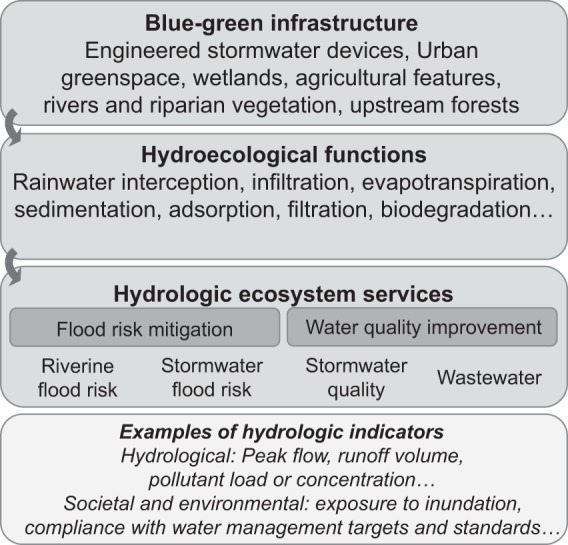
“These solutions leverage ecosystem services, the benefits provided by nature, to improve water management by restoring a more natural water cycle, for example increasing infiltration, evapotranspiration and pollutant removal (Eckart et al. 2017; Fletcher et al. 2013; Liao et al. 2017).”
BackgroundGlobal evidence that deforestation amplifies flood risk and severity in the developing world
BRADSHAW, C. J. A., SODHI, N. S., PEH, K. S. ‐., & BROOK, B. W. (2007) · Global Change Biology · doi:10.1111/j.1365-2486.2007.01446.x · Cited by 626 · cited 1×
“This confirms the global evidence that forests reduce flood volume and peak flows (Andreassian 2004; Bradshaw et al. 2007), with the caveat that their effect is limited, or even negative (Sriwongsitanon and Taesombat 2011), for large flood events, when soil saturation capacity is reached.”
BackgroundResearch gaps in knowledge of the impact of urban growth on biodiversity
McDonald, R. I., Mansur, A. V., Ascensão, F., Colbert, M., Crossman, K., Elmqvist, T., Gonzalez, A., Güneralp, B., Haase, D., Hamann, M., et al. (2019) · Nature Sustainability · doi:10.1038/s41893-019-0436-6 · Cited by 600
Research works printed but not linked: 6
- Ditthabumrung S Weesakul S Nature-based solution for flood management at Nong Sua District 2019 Thailand Rangsit Canal
- Gunawardena A, Zhang F, Fogarty J, Iftekhar MS (2017) Review of non-market values of water sensitive systems and practices: An update. Melbourne, Australia: Cooperative Research Centre for Water Sensitive Cities. Available at: https://watersensitivecities.org.au/content/review-of-non-market-values-of-water-sensitive-systems-and-practices-an-update/. Accessed 11 Apr 2021
- Lallemant D, Hamel P, Balbi M, Schmitt R, Lim TN, Win S (in press) Nature-Based Solutions for Flood Risk Reduction: A Probabilistic Modeling Framework. One Earth
- Ong GS, Kalyanaraman G, Wong KL, Wong THF (2012) Monitoring Singapore’s first bioretention system: rain garden at Balam estate. Proceedings of the 7th International Conference on Water Sensitive Urban Design; Building the Water Sensitive Community, Final Program and Abstract B
- US-EPA Case studies analyzing the economic benefits of low impact development and green infrastructure programs 2013 Washington, DC US-EPA
- Yap KS (2018) Peri-urban transformations in Southeast Asia. In: Padawangi R (ed) Routledge handbook of urbanization in Southeast Asia, 1st edn. Routledge, London. p 12
Cited by
A review of nature‐based infrastructures and their effectiveness for urban flood risk mitigation
Esraz‐Ul‐Zannat, M., Dedekorkut-Howes, A., & Morgan, E. A. (2024) · Wiley Interdisciplinary Reviews Climate Change · doi:10.1002/wcc.889 · Cited by 160
“Research suggests that urban forests could be capable of reducing flood volume and peak flows up to 39% (Hamel & Tan, 2022), though the effectiveness depends on the species intercepting various amounts of rainwater (Zabret & ˇ Sraj, 2015).”
Concepts and evolution of urban hydrology
Fletcher, T. D., Burns, M. J., Russell, K., Hamel, P., Duchesne, S., Cherqui, F., & Roy, A. H. (2024) · Nature Reviews Earth & Environment · doi:10.1038/s43017-024-00599-x · Cited by 134
“104), some with a focus on urban water management 105 .”
Self-citationKaur, R., & Gupta, K. (2022) · City and Environment Interactions · doi:10.1016/j.cacint.2022.100087 · Cited by 115
Lee, T. H. Y., Chuah, J., & Snyder, S. A. (2022) · ACS ES&T Water · doi:10.1021/acsestwater.1c00453 · Cited by 76
Wolff, E., Rauf, H. A., & Hamel, P. (2023) · Environmental Science & Policy · doi:10.1016/j.envsci.2023.04.014 · Cited by 76
Self-citationSpatio-temporal development of the urban heat island in a socioeconomically diverse tropical city
Ramsay, E. E., Duffy, G. A., Burge, K., Taruc, R. R., Fleming, G. M., Faber, P. A., & Chown, S. L. (2022) · Environmental Pollution · doi:10.1016/j.envpol.2022.120443 · Cited by 71
Climate Resilient Cities: A Review of Blue-Green Solutions Worldwide
Przestrzelska, K., Wartalska, K., Rosińska, W., Jurasz, J., & Kaźmierczak, B. (2024) · Water Resources Management · doi:10.1007/s11269-024-03950-5 · Cited by 65
Finding space for nature in cities: the considerable potential of redundant car parking
Croeser, T., Garrard, G. E., Visintin, C., Kirk, H. L., Ossola, A., Furlong, C., Clements, R., Butt, A., Taylor, E. J., & Bekessy, S. A. (2022) · npj Urban Sustainability · doi:10.1038/s42949-022-00073-x · Cited by 67
Gupta, A., & De, B. (2024) · Water Science & Technology · doi:10.2166/wst.2024.014 · Cited by 61
Ma, Y., & Jiang, Y. (2022) · Climate Policy · doi:10.1080/14693062.2022.2131503 · Cited by 66
Diep, L., Mulligan, J., Oloo, M. A., Guthmann, L., Raido, M., & Ndezi, T. (2022) · Frontiers in Sustainable Cities · doi:10.3389/frsc.2022.927723 · Cited by 60
“While there is a gap in both the research and practice of NBS in the context of informal and low-income urban settings worldwide (Breen et al., 2020; Hamel and Tan, 2022), this is particularly true for African cities (du Toit et al.”
BackgroundIrvine, K. N., Suwanarit, A., Likitswat, F., Srilertchaipanij, H., Ingegno, M., Kaewlai, P., Boonkam, P., Tontisirin, N., Sahavacharin, A., Wongwatcharapaiboon, J., et al. (2022) · Urban Science · doi:10.3390/urbansci6010007 · Cited by 62
“Furthermore, it has been our experience that WSUD designs, for example, are frequently implemented with little or no post-project monitoring of water quantity or quality, particularly in tropical climates, but this could be addressed using IoT and big data approaches to confirm their benefits [85,136].”
BackgroundResultIncorporating Ecosystem Services into Water Resources Management—Tools, Policies, Promising Pathways
Vollmer, D., Burkhard, K., Esmail, B. A., Guerrero, P., & Nagabhatla, N. (2022) · Environmental Management · doi:10.1007/s00267-022-01640-9 · Cited by 60
“There is also a need for more research attention to riparian vegetation, river restoration, rice paddy agriculture (due to its unique hydraulic properties), and urban informal settlements when evaluating and designing interventions (Hamel and Tan 2021; De Oliveira Rolo et al. 2021).”
BackgroundImplementing participatory nature-based solutions in the Global South
Wolff, E., Rauf, H. A., Diep, L., Natakun, B., Kelly, K., & Hamel, P. (2022) · Frontiers in Sustainable Cities · doi:10.3389/frsc.2022.956534 · Cited by 56
“This is important because common types of NbS in informal settlements (including wetlands, green areas, and community gardens) are inevitably intertwined with social and ecological dimensions by providing services such as food production and income generation as well as playing cultural and spiritual roles in their co…”
BackgroundSelf-citationAsset management for blue-green infrastructures: a scoping review
Langeveld, J., Cherqui, F., Tscheikner-Gratl, F., Muthanna, T. M., Juárez, M. F.-D., Leitão, J. P., Roghani, B., Kerres, K., Almeida, M. D. C., Werey, C., et al. (2022) · Blue-Green Systems · doi:10.2166/bgs.2022.019 · Cited by 54
McNabb, T., Charters, F. J., Challies, E., & Dionisio, R. (2024) · Blue-Green Systems · doi:10.2166/bgs.2024.007 · Cited by 56
Sunita, S., Kumar, D., Shahnawaz, S., & Shekhar, S. (2023) · Computational Urban Science · doi:10.1007/s43762-023-00091-0 · Cited by 49
Developing a blue-green infrastructure (BGI) community engagement framework template
Everett, G., Adekola, O. A., & Lamond, J. E. (2021) · URBAN DESIGN International · doi:10.1057/s41289-021-00167-5 · Cited by 51
Global synthesis and regional insights for mainstreaming urban nature-based solutions
McPhearson, T., Frantzeskaki, N., Ossola, A., Diep, L., Anderson, P. M. L., Blatch, T., Collier, M. J., Cook, E. M., Culwick Fatti, C., Grabowski, Z. J., et al. (2025) · Proceedings of the National Academy of Sciences · doi:10.1073/pnas.2315910121 · Cited by 47
Low-cost monitoring systems for urban water management: Lessons from the field
Hamel, P., Ding, N., Cherqui, F., Zhu, Q., Walcker, N., Bertrand-Krajewski, J.-L., Champrasert, P., Fletcher, T. D., McCarthy, D., Navrátil, O., et al. (2024) · Water Research X · doi:10.1016/j.wroa.2024.100212 · Cited by 47
“With more sensors, more water management systems can be monitored, which is particularly useful in regions where empirical data are still scarce (Hamel and Tan, 2021).”
BackgroundSelf-citationNature-based solutions to enhance urban flood resiliency: case study of a Thailand Smart District
Irvine, K. N., Suwanarit, A., Likitswat, F., Srilertchaipanij, H., Sahavacharin, A., Wongwatcharapaiboon, J., Boonkam, P., Ingegno, M., & Janpathompong, S. (2023) · Sustainable Water Resources Management · doi:10.1007/s40899-023-00821-6 · Cited by 46
Connecting blue-green infrastructure elements to reduce combined sewer overflows
Cavadini, G. B., Rodríguez, M., & Cook, L. M. (2024) · Journal of Environmental Management · doi:10.1016/j.jenvman.2024.121465 · Cited by 44
Chitwatkulsiri, D., Miyamoto, H., Irvine, K. N., Pilailar, S., & Loc, H. H. (2022) · Water · doi:10.3390/w14101641 · Cited by 38
Haratmeh, B. H., Randle, S., Minchillo, D., & Jaber, F. H. (2022) · Wiley Interdisciplinary Reviews Water · doi:10.1002/wat2.1625 · Cited by 44
“…the lack or inadequacy of GSI performance data, especially those collected through on-site monitoring, for a site-specific climate and watershed, is highlighted in many studies (CohenShacham et al., 2019; Deely et al., 2020; Dhakal & Chevalier, 2017; Hamel & Tan, 2021; Kumar et al., 2020).”
BackgroundCzyża, S., & Kowalczyk, A. M. (2024) · Sustainability · doi:10.3390/su16125187 · Cited by 37
“When properly designed, they mitigate excessive surface runoff and the risk of flooding [33–35].”
BackgroundChen, L., Guo, C., Yu, Y., Zhou, X., Fu, Y., Wang, S., Ma, Y., & Shen, Z. (2024) · Journal of Hydrology · doi:10.1016/j.jhydrol.2024.131682 · Cited by 37
Kumar, R., Maurya, A., & Raj, A. (2023) · Journal of Water Process Engineering · doi:10.1016/j.jwpe.2023.103715 · Cited by 36
Using AHP-PROMOTHEE for Selection of Best Low-Impact Development Designs for Urban Flood Mitigation
Dadrasajirlou, Y., Karami, H., & Mirjalili, S. (2022) · Water Resources Management · doi:10.1007/s11269-022-03378-9 · Cited by 31
“The main idea is to use the LID method to control runoff and reduce pollution on site (Hamel and Tan 2022).”
MethodFlood Hazard Assessment Due to Changes in Land Use and Cover
Supratman, M., Kusuma, M. S. B., Cahyono, M., & Kuntoro, A. A. (2024) · Civil Engineering Journal · doi:10.28991/cej-2024-010-12-04 · Cited by 30
Ecosystem services linked to nature-based solutions for resilient and sustainable cities in India
Ahmad, N., & Hassan, Q. (2025) · Frontiers in Water · doi:10.3389/frwa.2024.1504492 · Cited by 33
Kibii, C., Guerra, F., Bananayo, P. B., & Sandholz, S. (2025) · Nature-Based Solutions · doi:10.1016/j.nbsj.2025.100216 · Cited by 36
Scheiber, L., David, C. G., Jalloul, M. H., Visscher, J., Nguyễn, H. Q., Leitold, R., Diez, J. R., & Schlurmann, T. (2023) · Natural hazards and earth system sciences · doi:10.5194/nhess-23-2333-2023 · Cited by 32
“Finally, only a few working groups have scrutinized the combination of grey and green flood adaptation measures (Hamel and Tan, 2022).”
BackgroundJalloul, M. H., Scheiber, L., Jordan, C., Visscher, J., Nguyễn, H. Q., & Schlurmann, T. (2023) · Natural hazards and earth system sciences · doi:10.5194/nhess-23-2313-2023 · Cited by 29
“With respect to Southeast Asia, many national institutions still refrain from making this crucial input data available for various (technical or political) reasons (Kim et al., 2018; Hamel and Tan, 2021; Liu et al., 2020), which complicates numerical studies, especially for independent parties.”
BackgroundThe Importance of Water and Climate-Related Aspects in the Quality of Urban Life Assessment
Ptak-Wojciechowska, A., Januchta-Szostak, A. B., Gawlak, A., & Matuszewska, M. (2021) · Sustainability · doi:10.3390/su13126573 · Cited by 24
Kadić, A., Maljković, B., Rogulj, K., & Kilić, J. (2025) · Sustainability · doi:10.3390/su17094178 · Cited by 30
McMillan, J. M., Birkmann, J., Tangwanichagapong, S., & Jamshed, A. (2022) · Sustainability · doi:10.3390/su14138022 · Cited by 25
Wongphat, A., Wongcharee, S., Chaiduangsri, N., Suwannahong, K., Kreetachat, T., Imman, S., Suriyachai, N., Hongthong, S., Phadee, P., Thanarat, P., et al. (2024) · ChemEngineering · doi:10.3390/chemengineering8030058 · Cited by 25
“The pollution concerns associated with basic dyes are especially relevant in the textile industry [13].”
BackgroundScaling Nature‐Based Solutions for Fluvial Floods: A Worldwide Systematic Review
Howarth, M., Smithwick, E. A. H., McPhillips, L., & Mejía, A. (2025) · Wiley Interdisciplinary Reviews Water · doi:10.1002/wat2.70011 · Cited by 24
Ecosystem Services in Urban Blue-Green Infrastructure: A Bibliometric Review
Wang, X., Hu, Q., Zhang, R., Sun, C., & Wang, M. (2025) · Water · doi:10.3390/w17152273 · Cited by 24
Diep, L., & McPhearson, T. (2025) · Proceedings of the National Academy of Sciences · doi:10.1073/pnas.2315912121 · Cited by 36
Adhikary, R. K., Sarower-E-Mahfuj, M., Starrs, D., Croke, B., Glass, K., & Lal, A. (2021) · Exposure and Health · doi:10.1007/s12403-021-00447-z · Cited by 26
“A growing global trend of investment in urban-blue infrastructure such as ponds, wetlands, and water sensitive urban design (WSUD)(Hamel and Tan 2021; Global Infrastructure Hub 2021) may increasingly expose communities living near these assets to non-direct contact with these waters and the risks…”
BackgroundElevating Pakistan’s flood preparedness: a fuzzy multi-criteria decision making approach
Alam, Z., Ali, Y., & Pamucar, D. S. (2024) · Financial Innovation · doi:10.1186/s40854-024-00659-7 · Cited by 24
IKEMOTO, A., Kazama, S., Yoshida, T., & Yanagihara, H. (2023) · Water Resources Management · doi:10.1007/s11269-023-03544-7 · Cited by 19
Ariyarathna, R. I. S., Abeyrathna, W. P., Jamei, E., & Chau, H.-W. (2023) · Architecture · doi:10.3390/architecture3030025 · Cited by 21
“Governors and officials in most countries are assessing the possibilities of BGI implementation [26].”
BackgroundParsa, V. A., Istanbuly, M. N., Kronenberg, J., Russo, A., & Amiri, B. J. (2023) · Environmental Management · doi:10.1007/s00267-023-01868-z · Cited by 19
Yuanita, C. N., & Sagala, S. (2025) · International Journal of Disaster Risk Reduction · doi:10.1016/j.ijdrr.2025.105425 · Cited by 21
Tang, M., & Li, X. (2024) · Land · doi:10.3390/land13081182 · Cited by 18
Borah, A., Bardhan, R., & Bhatia, U. (2023) · International Journal of Disaster Risk Reduction · doi:10.1016/j.ijdrr.2023.104075 · Cited by 18
Boongaling, C. G. K., Sevilla‐Nastor, J. B., Espaldon, M. V. O., Sanchez, P. A., Villanueva, J. D., & Jago-on, K. A. B. (2024) · Journal of Environmental Management · doi:10.1016/j.jenvman.2024.122328 · Cited by 20
Quichimbo-Miguitama, F., Matamoros, D., Jiménez, L., & Quichimbo, P. (2022) · Sustainability · doi:10.3390/su14127109 · Cited by 19
Tolentino, P. L. M., Williams, R. D., & Hurst, M. D. (2025) · Wiley Interdisciplinary Reviews Water · doi:10.1002/wat2.70000 · Cited by 20
Irvine, K. N., Likitswat, F., Sahavacharin, A., Suwanarit, A., Lertwarapornpong, T., & Chitwatkulsiri, D. (2023) · Journal of Architectural/Planning Research and Studies (JARS) · doi:10.56261/jars.v21.257520 · Cited by 19
Parameterization for Modeling Blue–Green Infrastructures in Urban Settings Using SWMM-UrbanEVA
Hörnschemeyer, B., Henrichs, M., Dittmer, U., & Uhl, M. (2023) · Water · doi:10.3390/w15152840 · Cited by 16
Rauf, H. A., Wolff, E., Natakun, B., Marome, W. A., & Hamel, P. (2024) · Cities · doi:10.1016/j.cities.2024.105264 · Cited by 16
Self-citationLyu, L., Sho, K., Han, Z., Song, Y., Uchiyama, Y., Kim, J., & Sakai, T. (2024) · Urban forestry & urban greening · doi:10.1016/j.ufug.2024.128545 · Cited by 17
Laboratory performance assessment of low-cost water level sensor for field monitoring in the tropics
Ding, N., Zhu, Q., Cherqui, F., Walcker, N., Bertrand-Krajewski, J.-L., & Hamel, P. (2024) · Water Research X · doi:10.1016/j.wroa.2024.100298 · Cited by 15
“However, such studies often ignore the field performance of WSUD at the site scale, lacking sufficient empirical data from field monitoring for the model calibration and validation (Hamel and Tan, 2021; Yin et al., 2021).”
Self-citationScientific foundations in research in Engineering
Vladlenov, D. (2022) · Іnternational Science Group eBooks · doi:10.46299/isg.2022.mono.tech.2 · Cited by 15
Huang, H., Fu, D., Ding, G., Chen, Y., Xie, X., Gao, Y., & Liu, Q. (2024) · Scientific Reports · doi:10.1038/s41598-024-57567-0 · Cited by 18
The changing rainfall patterns drive the growing flood occurrence in Phnom Penh, Cambodia
Huang, W., Park, E., Wang, J., & Try, S. (2024) · Journal of Hydrology Regional Studies · doi:10.1016/j.ejrh.2024.101945 · Cited by 17
Ngoc, C. H. T., Back, Y., Funke, F., Hauser, M., & Kleidorfer, M. (2024) · Sustainability · doi:10.3390/su16208812 · Cited by 14
Harlis, T. A., & Seo, S. B. (2024) · Water Science & Technology · doi:10.2166/wst.2024.265 · Cited by 13
Irvine, K. N., Likitswat, F., Suwanarit, A., & Koottatep, T. (2022) · Australasian journal of engineering education · doi:10.1080/22054952.2022.2083789 · Cited by 13
Sit, K. Y., Ng, K. Y., & Zhang, H. (2024) · Applied Geography · doi:10.1016/j.apgeog.2024.103345 · Cited by 12
Sustainable Urban Water Management: Reuse, Recycling and Climate-Resilient Strategies
Shaibu, S. E., Adigun, P. O., & Ibuotenang, N. D. (2025) · International Journal of Scientific Research in Science Engineering and Technology · doi:10.32628/ijsrset251217 · Cited by 12
Banerji, A., & Benesh, K. C. (2022) · Ecologies · doi:10.3390/ecologies3040042 · Cited by 13
Cruz, M. A., Xu, J., Foppen, J. W., Pérez, S., Vázquez‐Suñé, E., & Teixidó, M. (2023) · The Science of The Total Environment · doi:10.1016/j.scitotenv.2023.164264 · Cited by 13
Mapping the Social, Economic, and Ecological Impact of Floods in Brisbane
Hou, Y., Wei, Y., Wu, S., & Li, J. (2023) · Water · doi:10.3390/w15213842 · Cited by 11
Conceptual framework to incorporate drainage solutions in the urban open space system
Miguez, M. G., Gomes, M. V. R., Amback, B. C., Neto, H. D. M., Thomaz, F. R., de Mattos, R. R., Veról, A. P., de Sousa, M. M., Rezende, O. M., & de Magalhães, P. C. (2024) · Frontiers in Water · doi:10.3389/frwa.2024.1468975 · Cited by 11
Hysa, A., Löwe, R., & Geist, J. P. (2025) · Landscape and Urban Planning · doi:10.1016/j.landurbplan.2025.105369 · Cited by 11
Core Challenges for Sustainable River Flood Management
Fernandes, J. N. (2025) · Sustainability · doi:10.3390/su172410981 · Cited by 11
Dhanya, B., Ramananda, S., & Dhyani, S. (2022) · Springer eBooks · doi:10.1007/978-981-16-7128-9_23 · Cited by 14
Gebrelassie, S. S., Lechner, A. M., Hill, M. J., Teo, F. Y., & Gibbins, C. N. (2022) · Freshwater Biology · doi:10.1111/fwb.13981 · Cited by 14
McNabb, T., Charters, F. J., Dionisio, R., & Challies, E. (2024) · Nature-Based Solutions · doi:10.1016/j.nbsj.2024.100192 · Cited by 10
Ismail, L. S., & Ismail, O. A. S. (2024) · Advances in public policy and administration (APPA) book series · doi:10.4018/979-8-3693-8069-7.ch001 · Cited by 11
Yang, Y., & Tang, S. (2025) · Buildings · doi:10.3390/buildings15020193 · Cited by 10
Dubois, E., Khouzani, S. T. L., Ottaviani, S., Serrao, L., & Starkey, E. (2025) · Sustainability Nexus Forum · doi:10.1007/s00550-025-00581-1 · Cited by 13
Frinaldi, A., Mubarak, A., Renaldi, I., Saputra, B., Rezeki, A. P. T., Afdalisma, & Syolendra, D. F. (2025) · IOP Conference Series Earth and Environmental Science · doi:10.1088/1755-1315/1556/1/012077 · Cited by 10
Blue-Green Infrastructure for Addressing Urban Resilience and Sustainability in the Warming World
Dhyani, S., Singh, S., Basu, M., Dasgupta, R., & Santhanam, H. (2022) · Springer eBooks · doi:10.1007/978-981-16-7128-9_1 · Cited by 13
Potential sites for blue-green infrastructure in Gurugram, India; a multicriteria analysis
Sehrawat, S., & Shekhar, S. (2024) · GeoJournal · doi:10.1007/s10708-024-11021-w · Cited by 10
“…extensive application in various contexts, including the selection of sites for built-up, hospitals, residential areas, solid waste management, urban green spaces, groundwater potential, and educational facilities (Dağıstanlı et al., 2018; Gupta et al., 2016; Hamel & Tan, 2021; Saha & Roy, 2021).”
Dai, W., & Tan, Y. (2024) · Buildings · doi:10.3390/buildings14123797 · Cited by 11
Blue-Green Infrastructure for Jakarta’s Sustainable Planning and Resilience
Agustine, V., Putra, D. D., & Rilansari, V. (2023) · IOP Conference Series Earth and Environmental Science · doi:10.1088/1755-1315/1211/1/012018 · Cited by 10
Bhattacharjee, S., Sharma, M., & Tiwari, A. (2025) · Land · doi:10.3390/land14091732 · Cited by 10
Ghazvinian, H., & Karami, H. (2023) · Journal of Water and Climate Change · doi:10.2166/wcc.2023.424 · Cited by 10
Lee, T. H. Y., Li, C., dos Santos, M. M., Tan, S. Y., Sureshkumar, M., Srinuansom, K., Ziegler, A. D., & Snyder, S. A. (2024) · Chemosphere · doi:10.1016/j.chemosphere.2024.143067 · Cited by 9
Ma, Y., Ning, X., & Jiang, Y. (2024) · Journal of Urban Technology · doi:10.1080/10630732.2024.2381181 · Cited by 9
“Many of these concepts, while not yet formally adopted as a policy or development standard, contribute to scienti fi c knowledge in addressing climate and water challenges (Hamel and Tan, 2022; Nesshöver et al., 2017).”
Vilca-Campana, K., Carrasco-Valencia, L., Iruri-Ramos, C., Cárdenas-Pillco, B., Escudero, A., & Chanove-Manrique, A. (2025) · Water · doi:10.3390/w17071047 · Cited by 13
“In Asia and the Mediterranean region, research on green infrastructure systems, bioretention, artificial wetlands, and green roofs is predominant [5,8,12,16,34,41,43].”
InfluentialHan, D., Xia, J., & Wu, D. (2025) · Forests · doi:10.3390/f16081305 · Cited by 9
Mallick, R., & Poddar, S. (2025) · Elsevier eBooks · doi:10.1016/b978-0-443-33321-7.00020-2 · Cited by 7
Heidler, A. (2024) · Geoforum · doi:10.1016/j.geoforum.2024.104100 · Cited by 7
Implementing Nature-based Solutions: Learning from Benchakitti Forest Park in Bangkok
Likitswat, F., & Sung, C. (2025) · Journal of Architectural/Planning Research and Studies (JARS) · doi:10.56261/jars.v22.272299 · Cited by 8
Gomes, M. V. R., & Veról, A. P. (2024) · Sustainability · doi:10.3390/su162310276 · Cited by 8
Fappiano, F., Maurer, M., & Leitão, J. P. (2025) · Journal of Environmental Management · doi:10.1016/j.jenvman.2025.127843 · Cited by 6
Jagadisan, S., & Sen, J. (2024) · Springer eBooks · doi:10.1007/978-3-031-62293-9_8 · Cited by 6
ai, P. N., Inta, A., Sommano, S. R., Phinyo, K., Duangjan, K., & Tangpao, T. (2025) · Diversity · doi:10.3390/d17010063 · Cited by 6
“Sustainable practices like natural water purification and phytoremediation, employed by these communities, effectively maintain water quality and remove pollutants without harmful chemicals [21,22].”
Wang, X., Wu, Y., Cushman, S. A., Tie, C., Lawson, G. M., Kollányi, L., Wang, G., Ma, J., Zhang, J., & Bai, T. (2025) · Journal of Hydrology Regional Studies · doi:10.1016/j.ejrh.2025.102341 · Cited by 6
Yang, X., Kinoshita, T., Wang, Q., & Chen, Y. (2025) · Sustainable Development · doi:10.1002/sd.70011 · Cited by 6
Exploring Blue and Green Infrastructure Options for Urban Integration
Kanade, T. M., & Batule, R. B. (2024) · Advances in public policy and administration (APPA) book series · doi:10.4018/979-8-3693-8069-7.ch010 · Cited by 6
Enhancing Blue-Green Infrastructures for Flood and Water Stress Management: A Case Study of Chennai
Ahmad, N., & Hassan, Q. (2023) · Lecture notes in civil engineering · doi:10.1007/978-981-99-2905-4_8 · Cited by 6
Understanding the Role of Blue-Green Infrastructure in Abatement of Urban Heat Island Effect
Gupta, K., Ghale, B., Sarath, R. S., Kaur, R., & Roy, A. (2024) · Springer eBooks · doi:10.1007/978-3-031-62293-9_4 · Cited by 6
Integrating Blue-Green as Next-Generation Urban Infrastructure in Developing Countries
Chaurasia, M., Patel, K., Singh, R., Bhadouria, R., & Rao, K. S. (2024) · Springer eBooks · doi:10.1007/978-3-031-62293-9_3 · Cited by 6
Metadata
- Authors
- Hamel, P., & Tan, L.
- Affiliations
- Nanyang Technological University (SG)
- Corresponding author
- Hamel, Perrine
- ORCID
- Hamel, Perrine
- Venue
- Environmental Management
- Published
- 2021-04-16
- Volume
- 69
- Issue
- 4
- Pages
- 699-718
- ISSN
- 0364-152X (ISSN-L)
- 1432-1009
- PMC
- PMC9012722
- OpenAlex
- W3157007292
- Cited by
- 225
- References
- 142
- Citations by year
- 2026: 55 · 2025: 55 · 2024: 51 · 2023: 25 · 2022: 34 · 2021: 5
- FWCI
- 9.30
- Type
- journal article
- Language
- en
- Open access
- hybrid
- doi.org
- Licence
- cc-by
- creativecommons.org/licenses/by/4.0 (tdm)
- creativecommons.org/licenses/by/4.0 (vor)
- Locations
- Environmental Management (publishedVersion, cc-by)
- PubMed Central (publishedVersion, cc-by)
- PubMed (publishedVersion)
- DR-NTU (Nanyang Technological University) (acceptedVersion)
- Funders
- National Research Foundation Singapore (NRF-NRFF12-2020-0009)
- Topics
- Physical Sciences › Environmental Science › Environmental Engineering › Urban Stormwater Management Solutions
- Physical Sciences › Environmental Science › Environmental Engineering › Urban Heat Island Mitigation
- Physical Sciences › Environmental Science › Global and Planetary Change › Flood Risk Assessment and Management
- Keywords
- blue-green infrastructure, water quality improvement, Southeast Asian cities, bioretention systems, constructed wetlands, green cover, grey infrastructure, climate change adaptation, informal settlements, knowledge gaps, urban hydrology
- MeSH terms
- Asia, Southeastern, Cities, Rain, Floods, Water Quality
About these checks
Registry, retraction, Cites and statistics results are computed, not judged, with one exception: a printed reference that no index lists is read once by a model before it counts as a citation error. Claims are extracted by a model and kept only when their quote appears verbatim in the text; each cited source is then checked, with a model’s help, for whether it says what the claim relies on. Those verdicts can be wrong — read the claim’s quote and the cited source before relying on one.
Statistics and arithmetic are recomputed, not judged.
Confidence bands are shown only for fields calibrated on our annotated test set. None is calibrated yet, so no band is shown.
What counts as a claim ›How we measure confidence ›How we check this ›
Are you an author, or do you see a problem with this page? Request a review
Data sources
Bibliographic data: Semantic Scholar, OpenAlex, Crossref.
Contains information from the Semantic Scholar Academic Graph Datasets, made available under the ODC Attribution License (ODC-BY 1.0).
Semantic Scholar’s data is described in: Kinney, R., et al. (2023). The Semantic Scholar Open Data Platform. arXiv:2301.10140.
