

Cure rate in the elderly patients with diffuse large B cell lymphoma deteriorates after the age of 80-results from a single-center survey
Open accessThe DOI matches its Crossref record; 28 of the 28 references it cites were found in a registry or an index.
Abstract
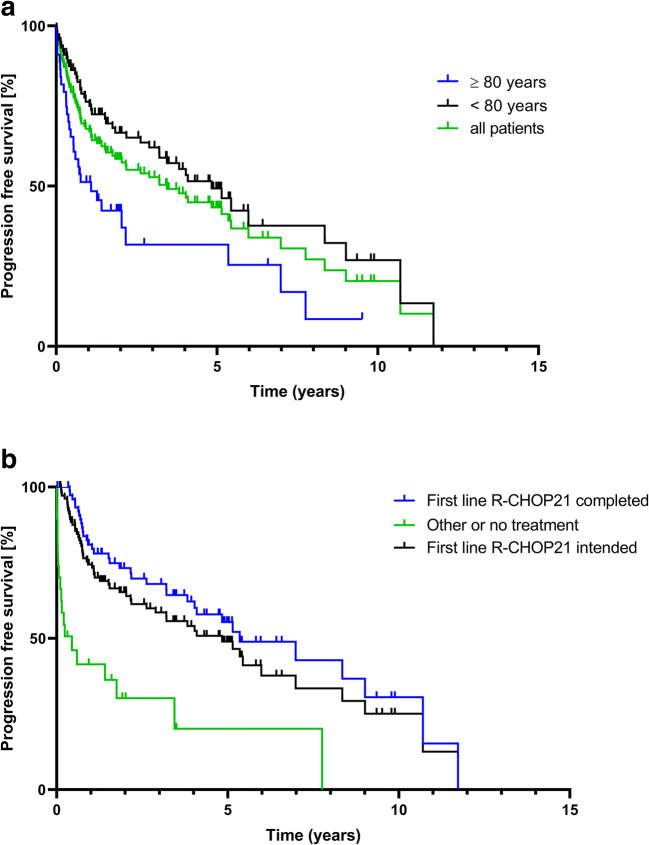
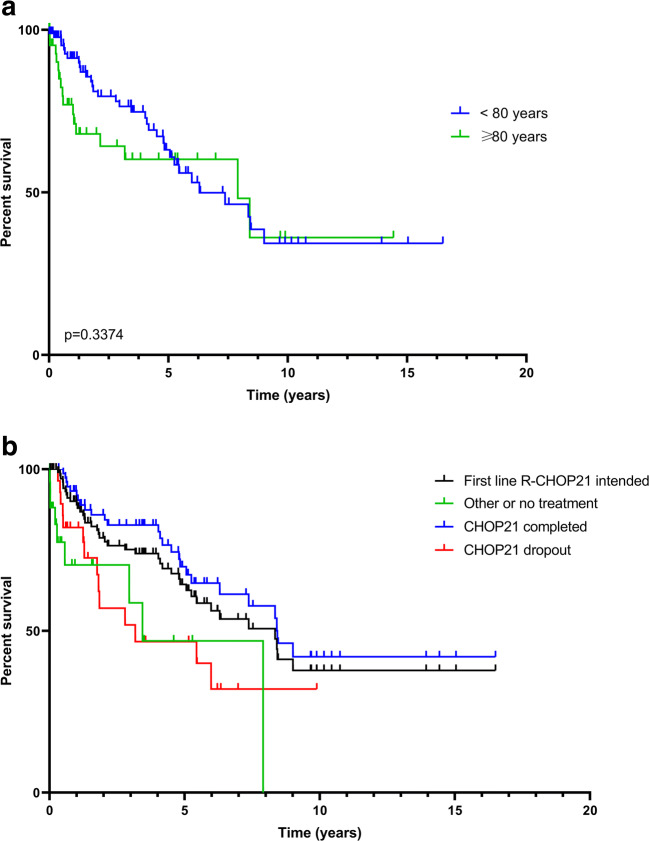
The prognosis of elderly patients diagnosed with diffuse large B cell lymphoma (DLBCL) is considered to be clearly inferior to that of younger patients. Besides tumor biology and comorbidities, treatment selection due to an assumed reduced tolerability may contribute to this difference. With increasingly more patients diagnosed at advanced age, current treatment selections need to be reviewed carefully. Hence, we analyzed the results of patients above the age of 70 in whom a diagnosis of DLBCL was made. Whereas patients up to 80 were frequently selected for and were able to tolerate standard treatment (86% intended use, 74% completion), patients above the age of 80 years were not only treated more cautiously (67 and 60%, respectively) but did show inferior response to treatment with standard treatment (CR rate for intended R-CHOP use 64% vs. 43%). However, on an individual level, patients receiving and completing standard treatment obtained results that resemble the results of younger patients, irrespective if aged more than 80 and impose superior to prior reports in this age cohort. Median PFS for the entire group of patients was 3.44 years, with 4.83 years for patients below 80 and only 1.09 years for patients above the age of 80. The corresponding figures for OS were 7.38 years (estimated); after 2 years, OS was 81% in the younger cohort in contrast to 68% in patients > 80 years. However, for patients not planned to receive or not tolerating R-CHOP, results remain poor; tailored approaches for these patients are required.
Overview
The claims and statistics of this paper haven’t been checked yet.
Free: it reads the open-access text and checks the first 5 claims that cite a source we can check. Create a free account to check every claim.
Integrity signals
Registry
Cites
Statistics
Figures
Verification
Claims the paper makes
The claims and statistics of this paper haven’t been checked yet.
Free: it reads the open-access text and checks the first 5 claims that cite a source we can check. Create a free account to check every claim.
Claims other papers make about this one
Each is checked against this paper’s own text: does it say what the citing paper says it does?
The source backs part of the claim, not all of it — or backs it for a different population, condition or comparison.
In the citing paper
“In patients with diffuse large B cell lymphoma (DLBCL), complete remission rates for intended multimodal chemotherapy plus rituximab drop from 64% to 43% above 80 years of age, in part (but not solely) due to alterations in treatment intensity imposed by patient frailty.265”
From Meta-hallmarks of aging and cancer (2023) · cites this paper as [265]
Experimental — accuracy not yet measured
Self-check
Percentages, sums and reported differences re-computed from the paper’s own numbers.
The self-check needs the paper’s full text.
Citations
Cites
Coiffier, B., Lepage, E., Brière, J., Herbrecht, R., Tilly, H., Bouabdallah, R., Morel, P., Van Den Neste, E., Salles, G., Gaulard, P., et al. (2002) · New England Journal of Medicine · doi:10.1056/nejmoa011795 · Cited by 5,574
A Predictive Model for Aggressive Non-Hodgkin's Lymphoma
(1993) · New England Journal of Medicine · doi:10.1056/nejm199309303291402 · Cited by 4,949
Tisagenlecleucel in Adult Relapsed or Refractory Diffuse Large B-Cell Lymphoma
Schuster, S. J., Bishop, M. R., Tam, C. S., Waller, E. K., Borchmann, P., McGuirk, J. P., Jäger, U., Jaglowski, S., Andreadis, C., Westin, J. R., et al. (2019) · New England Journal of Medicine · doi:10.1056/nejmoa1804980 · Cited by 4,112
Report of an International Workshop to Standardize Response Criteria for Non-Hodgkin's Lymphomas
Cheson, B. D., Horning, S. J., Coiffier, B., Shipp, M. A., Fisher, R. I., Connors, J. M., Lister, T. A., Vose, J., Grillo-López, A., Hagenbeek, A., et al. (1999) · Journal of Clinical Oncology · doi:10.1200/jco.1999.17.4.1244 · Cited by 3,486
Polatuzumab Vedotin in Relapsed or Refractory Diffuse Large B-Cell Lymphoma
Sehn, L. H., Herrera, A. F., Flowers, C. R., Kamdar, M. K., McMillan, A., Hertzberg, M., Assouline, S., Kim, T. M., Kim, W. S., Ozcan, M., et al. (2020) · Journal of Clinical Oncology · doi:10.1200/jco.19.00172 · Cited by 774
Younes, A., Sehn, L. H., Johnson, P., Zinzani, P. L., Hong, X., Zhu, J., Patti, C., Belada, D., Samoilova, O., Suh, C., et al. (2019) · Journal of Clinical Oncology · doi:10.1200/jco.18.02403 · Cited by 608
Peyrade, F., Jardin, F., Thieblemont, C., Thyss, A., Emile, J.-F., Castaigne, S., Coiffier, B., Haioun, C., Bologna, S., Fitoussi, O., et al. (2011) · The Lancet Oncology · doi:10.1016/s1470-2045(11)70069-9 · Cited by 553
Klapper, W., Kreuz, M., Kohler, C. W., Burkhardt, B., Szczepanowski, M., Salaverria, I., Hummel, M., Loeffler, M., Pellissery, S., Woessmann, W., et al. (2012) · Blood · doi:10.1182/blood-2011-10-388470 · Cited by 191
Jurczak, W. J., Zinzani, P. L., Gaïdano, G., Goy, A. H., Provencio, M., Nagy, Z., Robak, T., Maddocks, K. J., Buske, C., Ambarkhane, S., et al. (2018) · Annals of Oncology · doi:10.1093/annonc/mdy056 · Cited by 141
Thiéblemont, C., Grossoeuvre, A., Houot, R., Broussais, F., Salles, G. A., Traullé, C., Espinouse, D., & Coiffier, B. (2007) · Annals of Oncology · doi:10.1093/annonc/mdm563 · Cited by 135
Research works printed but not linked: 1
- Ship M A predictive model for aggressive non-Hodgkin's lymphoma. The International Non-Hodgkin's Lymphoma Prognostic Factors Project N Engl J Med 1993 329 14 987 994 10.1056/NEJM199309303291402 8141877 · DOI · Paper page
Cited by
Meta-hallmarks of aging and cancer
López-Otín, C., Pietrocola, F., Roiz-Valle, D., Galluzzi, L., & Kroemer, G. (2023) · Cell Metabolism · doi:10.1016/j.cmet.2022.11.001 · Cited by 529
Berning, P., Shumilov, E., Maulhardt, M., Boyadzhiev, H., Kerkhoff, A., Call, S., Reicherts, C., Saidy, A. O., Aydilek, E., Hoffmann, M., et al. (2024) · HemaSphere · doi:10.1002/hem3.54 · Cited by 50
Xu, P.-P., Zhu, Y., Shi, Z., Wang, L., Cheng, S., Qian, Y., Zhao, Y., He, Y., Yi, H., Ouyang, B., et al. (2025) · Blood · doi:10.1182/blood.2025028649 · Cited by 12
Niiyama‐Uchibori, Y., Okamoto, H., Miyashita, A., Mizuhara, K., Kawaji‐Kanayama, Y., Fujino, T., Tsukamoto, T., Mizutani, S., Shimura, Y., Teramukai, S., et al. (2024) · Hematological Oncology · doi:10.1002/hon.3252 · Cited by 12
“Indeed, while the elder age has been traditionally considered an independent poor prognostic factor in variousprognosticindicesforDLBCL,suchastherevisedInternational PrognosticIndex(R ‐ IPI),theNationalComprehensiveCancerNetwork International Prognostic Index (NCCN ‐ IPI), and the Kyoto Prognostic index (KPI), 5–7 the…”
ResultThe Interplay of Aging and Cancer: Mechanisms, Implications, and Therapeutic Strategies
Wang, L., Luo, Y., Chen, X., Wang, Y., & Zhang, Y. (2025) · MedComm – Oncology · doi:10.1002/mog2.70041 · Cited by 10
LncRNA OR2A1‐AS1 index predicts survival in germinal center‐like diffuse large B‐cell lymphoma
Ye, S., Ying, W., Lin, Y., Hou, Z., & Su, M. (2022) · Journal of Clinical Laboratory Analysis · doi:10.1002/jcla.24680 · Cited by 6
Kim, K., & Chihara, D. (2024) · Leukemia & lymphoma/Leukemia and lymphoma · doi:10.1080/10428194.2024.2436606 · Cited by 1
“More studies emphasize the need for geriatric and frailty assessments to treat them better [19,20].”
Gonçalves, C. E. F., Arce, I. L., & Figueiredo, V. (2025) · Revista Científica do Iamspe · doi:10.59752/rci.v14i2.261
Pi, J., Liu, Y., Jin, J., Zhang, W., & He, X. (2025) · Frontiers in Medicine · doi:10.3389/fmed.2025.1629168
Zhao, J., Ma, L., Zheng, M., Guo, X., Wen, X., & Su, L. (2026) · Frontiers in Oncology · doi:10.3389/fonc.2026.1785720
Metadata
- Authors
- Freudenberger, F., Ohler, A., Theobald, M., & Hess, G.
- Affiliations
- Johannes Gutenberg University Mainz (DE)
- Corresponding author
- Hess, Georg
- Venue
- Annals of Hematology
- Published
- 2021-02-25
- Volume
- 100
- Issue
- 4
- Pages
- 1013-1021
- ISSN
- 0939-5555 (ISSN-L)
- 1432-0584
- PMC
- PMC7960616
- OpenAlex
- W3131221271
- Cited by
- 9
- References
- 28
- Citations by year
- 2026: 1 · 2025: 3 · 2024: 3 · 2023: 1 · 2022: 1
- FWCI
- 0.83
- Type
- journal article
- Language
- en
- Open access
- hybrid
- doi.org
- Licence
- cc-by
- creativecommons.org/licenses/by/4.0 (tdm)
- creativecommons.org/licenses/by/4.0 (vor)
- Locations
- Annals of Hematology (publishedVersion, cc-by)
- PubMed Central (publishedVersion, cc-by)
- PubMed (publishedVersion)
- Gutenberg Open Science (submittedVersion, cc-by-nd)
- Informationszentrum Lebenswissenschaften (ZB MED) (submittedVersion, cc-by)
- Gutenberg Open Science (cc-by)
- Funders
- Universitätsmedizin der Johannes Gutenberg-Universität Mainz
- Topics
- Health Sciences › Medicine › Pathology and Forensic Medicine › Lymphoma Diagnosis and Treatment
- Health Sciences › Medicine › Clinical Neurology › CNS Lymphoma Diagnosis and Treatment
- Health Sciences › Medicine › Oncology › Viral-associated cancers and disorders
- Keywords
- diffuse large B-cell lymphoma, elderly patients, age over 80, cure rate, complete response, R-CHOP, treatment tolerability, treatment selection, progression-free survival, overall survival, prognosis, geriatric oncology
- MeSH terms
- Rituximab, Progression-Free Survival, Age Factors, Aged, Aged, 80 and over, Antineoplastic Combined Chemotherapy Protocols, Combined Modality Therapy, Cyclophosphamide, Doxorubicin, Female, Humans, Male, Prednisone, Prognosis, Vincristine, Lymphoma, Large B-Cell, Diffuse, Treatment Outcome, Radiotherapy, Adjuvant, Anthracyclines, Kaplan-Meier Estimate
About these checks
Registry, retraction, Cites and statistics results are computed, not judged, with one exception: a printed reference that no index lists is read once by a model before it counts as a citation error. Claims are extracted by a model and kept only when their quote appears verbatim in the text; each cited source is then checked, with a model’s help, for whether it says what the claim relies on. Those verdicts can be wrong — read the claim’s quote and the cited source before relying on one.
Statistics and arithmetic are recomputed, not judged.
Confidence bands are shown only for fields calibrated on our annotated test set. None is calibrated yet, so no band is shown.
What counts as a claim ›How we measure confidence ›How we check this ›
Are you an author, or do you see a problem with this page? Request a review
Data sources
Bibliographic data: Semantic Scholar, OpenAlex, Crossref.
Contains information from the Semantic Scholar Academic Graph Datasets, made available under the ODC Attribution License (ODC-BY 1.0).
Semantic Scholar’s data is described in: Kinney, R., et al. (2023). The Semantic Scholar Open Data Platform. arXiv:2301.10140.
