

The DOI matches its Crossref record.
ERCC6L2-related disease: a novel entity of bone marrow failure disorder with high risk of clonal evolution
Abstract
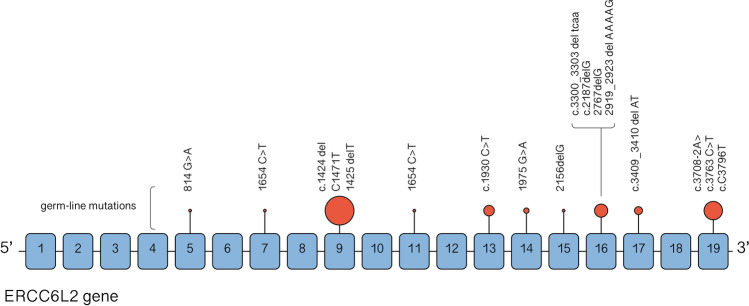
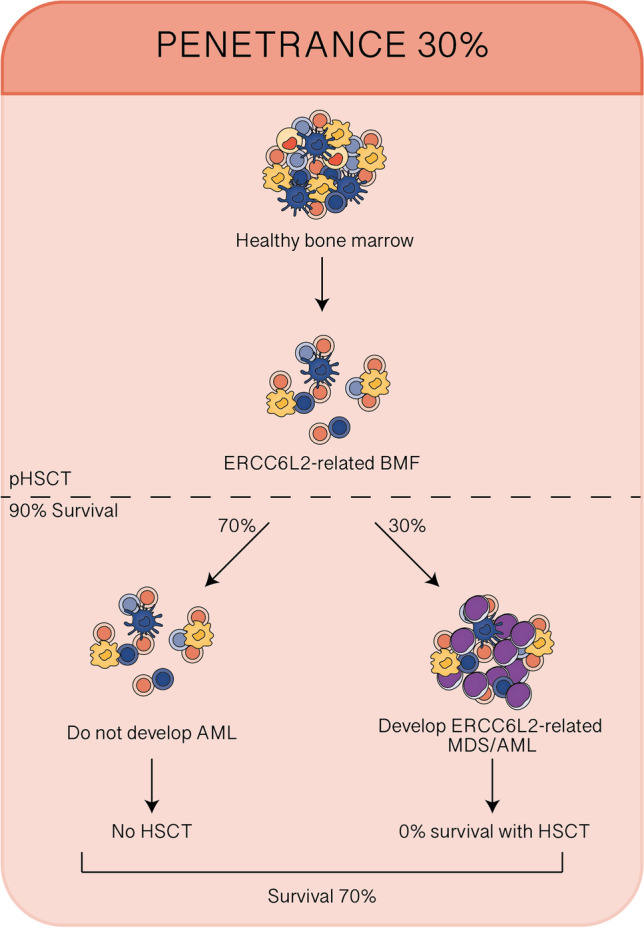
ERCC excision repair 6 like 2 (ERCC6L2) gene encodes for different helicase-like protein members of the Snf2 family involved in transcription-coupled nucleotide excision repair and in cell proliferation. Germline homozygous mutations in children and adults predispose to a peculiar bone marrow failure phenotype characterized by mild hematological alterations with a high risk of developing acute myeloid leukemia. The outcome for patients with leukemia progression is dismal while patients undergoing hematopoietic stem cell transplantation in the early stage have better outcomes. The ERCC6L2-related hematological disease presents a high penetrance, posing important questions regarding the treatment strategies and possible preemptive approaches. This review describes the biological function of ERCC6L2 and the clinical manifestations of the associated disease, trying to focus on the unsolved clinical questions.
Overview
The claims and statistics of this paper haven’t been checked yet.
Run the check — free, no account needed. It reads the open-access text and checks the sources it cites.
Integrity signals
Registry
Cites
Statistics
Figures
Verification
Claims the paper makes
The claims and statistics of this paper haven’t been checked yet.
Run the check — free, no account needed. It reads the open-access text and checks the sources it cites.
Claims other papers make about this one
Each is checked against this paper’s own text: does it say what the citing paper says it does?
In the citing paper
“However, individuals with biallelic mutations in ERCC6L6 (ref. 28) and telomere biology disorders29 are known to be prone to acute myeloid leukemia (AML) driven by mutations in the DDR pathway, including TP53 and PPM1D.”
From Germline genetic variation impacts clonal hematopoiesis landscape and progression to malignancy (2025) · cites this paper as [28]
Self-check
Percentages, sums and reported differences re-computed from the paper’s own numbers.
The self-check needs the paper’s full text.
Citations
Cites
No references could be resolved yet.
Research works printed but not linked: 30
- Kennedy AL, Shimamura A (2019) Genetic predisposition to MDS: clinical features and clonal evolution. Blood 133:1071–1085. https://doi.org/10.1182/blood-2018-10-844662 · DOI
- Sahoo SS, Pastor VB, Goodings C et al (2021) Clinical evolution, genetic landscape and trajectories of clonal hematopoiesis in SAMD9/SAMD9L syndromes. Nat Med 27:1806–1817. https://doi.org/10.1038/s41591-021-01511-6 · DOI
- Bruzzese A, Leardini D, Masetti R et al (2020) GATA2 related conditions and predisposition to pediatric myelodysplastic syndromes. Cancers (Basel) 12:1–12. https://doi.org/10.3390/cancers12102962 · DOI
- Bluteau O, Sebert M, Leblanc T et al (2018) A landscape of germ line mutations in a cohort of inherited bone marrow failure patients. Blood 131:717–732. https://doi.org/10.1182/blood-2017-09-806489 · DOI
- Fabozzi F, Mastronuzzi A, Ceglie G et al (2022) GATA 2 deficiency: focus on immune system impairment. Front Immunol 13:865773. https://doi.org/10.3389/fimmu.2022.865773 · DOI
- Leardini D, Messelodi D, Muratore E et al (2022) Role of CBL mutations in cancer and non-malignant phenotype. Cancers (Basel) 14(3):839. https://doi.org/10.3390/cancers14030839 · DOI
- McReynolds LJ, Calvo KR, Holland SM (2018) Germline GATA2 mutation and bone marrow failure. Hematol Oncol Clin North Am 32:713–728. https://doi.org/10.1016/j.hoc.2018.04.004 · DOI
- Baccelli F, Leardini D, Muratore E et al (2022) Immune dysregulation associated with co-occurring germline CBL and SH2B3 variants. Hum Genomics 16:40. https://doi.org/10.1186/s40246-022-00414-y · DOI
- Tsai FD, Lindsley RC (2020) Clonal hematopoiesis in the inherited bone marrow failure syndromes. Blood 136:1615–1622. https://doi.org/10.1182/blood.2019000990 · DOI
- Ghemlas I, Li H, Zlateska B et al (2015) Improving diagnostic precision, care and syndrome definitions using comprehensive next-generation sequencing for the inherited bone marrow failure syndromes. J Med Genet 52:575–584. https://doi.org/10.1136/jmedgenet-2015-103270 · DOI
- Skibenes ST, Clausen I, Raaschou-Jensen K (2021) Next-generation sequencing in hypoplastic bone marrow failure: what difference does it make? Eur J Haematol 106:3–13. https://doi.org/10.1111/ejh.13513 · DOI
- Sasada K, Yamamoto N, Masuda H et al (2018) Inter-observer variance and the need for standardization in the morphological classification of myelodysplastic syndrome. Leuk Res 69:54–59. https://doi.org/10.1016/j.leukres.2018.04.003 · DOI
- Tummala H, Kirwan M, Walne AJ et al (2014) ERCC6L2 mutations link a distinct bone-marrow-failure syndrome to DNA repair and mitochondrial function. Am J Hum Genet 94:246–256. https://doi.org/10.1016/j.ajhg.2014.01.007 · DOI
- Shang Y, Long F (2021) Repair of programmed DNA lesions in antibody class switch recombination: common and unique features. Genome Instab Dis 2:115–125. https://doi.org/10.1007/s42764-021-00035-0 · DOI
- Zhang S, Pondarre C, Pennarun G et al (2016) A nonsense mutation in the DNA repair factor Hebo causes mild bone marrow failure and microcephaly. J Exp Med 213:1011–1028. https://doi.org/10.1084/jem.20151183 · DOI
- Flaus A, Martin DMA, Barton GJ, Owen-Hughes T (2006) Identification of multiple distinct Snf2 subfamilies with conserved structural motifs. Nucleic Acids Res 34:2887–2905. https://doi.org/10.1093/nar/gkl295 · DOI
- Liu X, Liu T, Shang Y et al (2020) ERCC6L2 promotes DNA orientation-specific recombination in mammalian cells. Cell Res 30:732–744. https://doi.org/10.1038/s41422-020-0328-3 · DOI
- Tummala H, Dokal AD, Walne A et al (2018) Genome instability is a consequence of transcription deficiency in patients with bone marrow failure harboring biallelic ERCC6L2 variants. Proc Natl Acad Sci U S A 115:7777–7782. https://doi.org/10.1073/pnas.1803275115 · DOI
- Feurstein S, Churpek JE, Walsh T et al (2021) Germline variants drive myelodysplastic syndrome in young adults. Leukemia 35:2439–2444. https://doi.org/10.1038/s41375-021-01137-0 · DOI
- Douglas SPM, Siipola P, Kovanen PE et al (2019) ERCC6L2 defines a novel entity within inherited acute myeloid leukemia. Blood 133:2724–2728. https://doi.org/10.1182/blood-2019-01-896233 · DOI
- Boyd AL, Reid JC, Salci KR et al (2017) Acute myeloid leukaemia disrupts endogenous myelo-erythropoiesis by compromising the adipocyte bone marrow niche. Nat Cell Biol 19:1336–1347. https://doi.org/10.1038/ncb3625 · DOI
- Armes H, Bewicke-Copley F, Rio-Machin A et al (2022) Germline ERCC excision repair 6 like 2 (ERCC6L2) mutations lead to impaired erythropoiesis and reshaping of the bone marrow microenvironment. Br J Haematol 199:754–764. https://doi.org/10.1111/bjh.18466 · DOI
- Järviaho T, Halt K, Hirvikoski P et al (2018) Bone marrow failure syndrome caused by homozygous frameshift mutation in the ERCC6L2 gene. Clin Genet 93:392–395. https://doi.org/10.1111/cge.13125 · DOI
- Hakkarainen M, Douglas SPM, Vulliamy T et al (2021) Multinational study on the clinical and genetic features of the ERCC6L2-disease. Blood 138:864–864. https://doi.org/10.1182/blood-2021-145039 · DOI
- Shabanova I, Cohen E, Cada M et al (2018) ERCC6L2-associated inherited bone marrow failure syndrome. Mol Genet Genomic Med 6:463–468. https://doi.org/10.1002/mgg3.388 · DOI
- Dini G, Zecca M, Balduzzi A et al (2011) No difference in outcome between children and adolescents transplanted for acute lymphoblastic leukemia in second remission. Blood 118:6683–6690. https://doi.org/10.1182/blood-2011-05-354233 · DOI
- Carrillo-Tornel S, Chen-Liang TH, Yeguas Bermejo A et al (2022) ERCC6L2 in early-onset adult myelodysplastic syndrome without pre-existing disorder. Blood 140:4074–4075. https://doi.org/10.1182/blood-2022-168759 · DOI
- Desai P, Mencia-Trinchant N, Savenkov O et al (2018) Somatic mutations precede acute myeloid leukemia years before diagnosis. Nat Med 24:1015–1023. https://doi.org/10.1038/s41591-018-0081-z · DOI · Paper page
- Kennedy AL, Myers KC, Bowman J et al (2021) Distinct genetic pathways define pre-malignant versus compensatory clonal hematopoiesis in Shwachman-Diamond syndrome. Nat Commun 12(1):1334. https://doi.org/10.1038/s41467-021-21588-4 · DOI · Paper page
- Cesaro S, Donadieu J, Cipolli M et al (2022) Stem cell transplantation in patients affected by Shwachman-Diamond syndrome: expert consensus and recommendations from the EBMT Severe Aplastic Anaemia Working Party. Transplant Cell Ther 28:637–649. https://doi.org/10.1016/j.jtct.2022.07.010 · DOI
Cited by
Germline genetic variation impacts clonal hematopoiesis landscape and progression to malignancy
Liu, J., Tran, D., Xue, L., Wiley, B. J., Vlasschaert, C., Watson, C. J., MacGregor, H. A. J., Zong, X., Chan, I. C. C., Das, I., et al. (2025) · Nature Genetics · doi:10.1038/s41588-025-02250-x · Cited by 33
Metadata
- Authors
- Baccelli, F., Leardini, D., Cerasi, S., Messelodi, D., Bertuccio, S. N., & Masetti, R.
- Venue
- Annals of Hematology
- Published
- 2023-02-15
- Volume
- 102
- Issue
- 4
- Pages
- 699-705
- ISSN
- 0939-5555
- 1432-0584
- PMC
- PMC9998559
- Cited by
- 21
- References
- 0
- Language
- en
- Funders
- Alma Mater Studiorum - Università di Bologna
About these checks
Registry, retraction, Cites and statistics results are computed, not judged, with one exception: a printed reference that no index lists is read once by a model before it counts as a citation error. Claims are extracted by a model and kept only when their quote appears verbatim in the text; each cited source is then checked, with a model’s help, for whether it says what the claim relies on. Those verdicts can be wrong — read the claim’s quote and the cited source before relying on one.
Statistics and arithmetic are recomputed, not judged.
Confidence bands are shown only for fields calibrated on our annotated test set. None is calibrated yet, so no band is shown.
What counts as a claim ›How we measure confidence ›How we check this ›
Are you an author, or do you see a problem with this page? Request a review
How to cite
Cite CoChat for the checks on this page, and the paper for its own findings.
- This page
- CoChat. (2026). Citation check: ERCC6L2-related disease: a novel entity of bone marrow failure disorder with high risk of clonal evolution. https://app.cochat.ai/papers/10.1007/s00277-023-05128-2
- The paper
- Baccelli, F., Leardini, D., Cerasi, S., Messelodi, D., Bertuccio, S. N., & Masetti, R. (2023). ERCC6L2-related disease: a novel entity of bone marrow failure disorder with high risk of clonal evolution. Annals of Hematology. https://doi.org/10.1007/s00277-023-05128-2
