

Plasma p-tau181 accurately predicts Alzheimer’s disease pathology at least 8 years prior to post-mortem and improves the clinical characterisation of cognitive decline
Open accessThe DOI matches its Crossref record; 36 of the 36 references it cites were found in a registry or an index.
Abstract
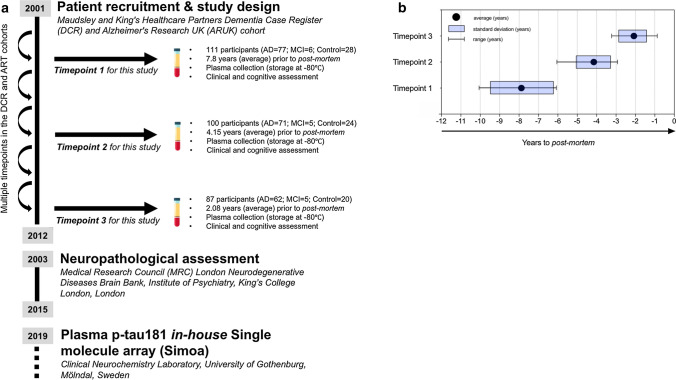
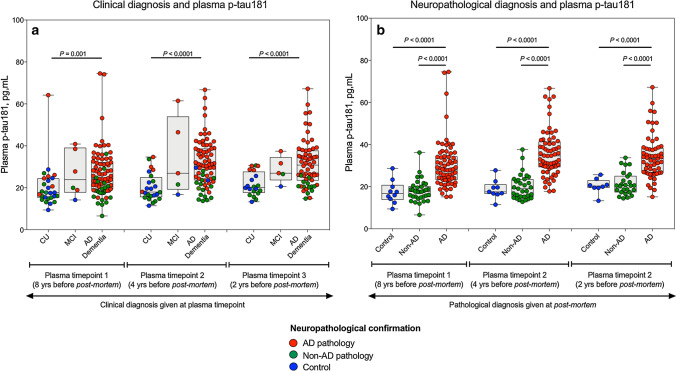
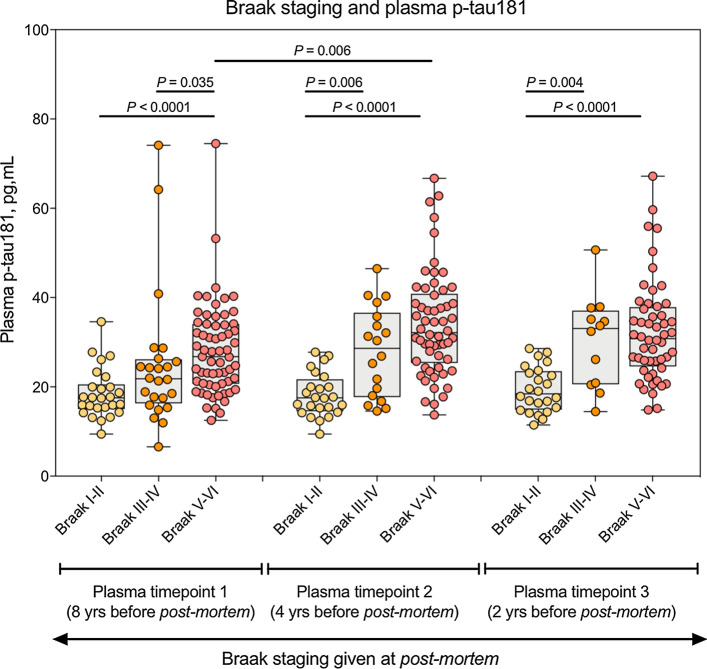
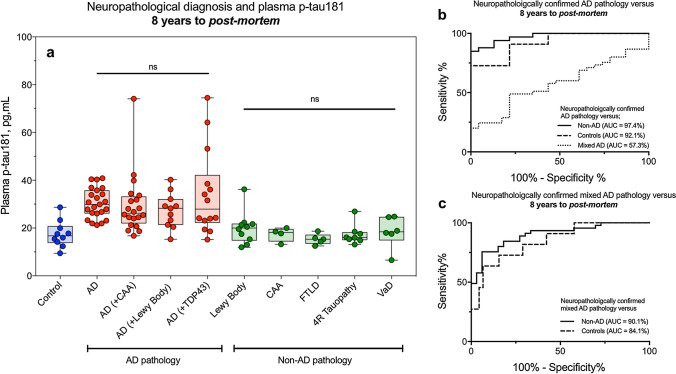
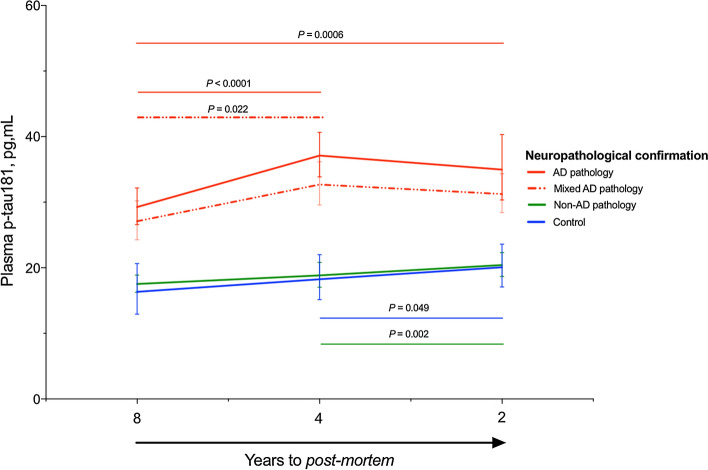
The neuropathological confirmation of amyloid-β (Aβ) plaques and tau neurofibrillary tangles (NFT) remains the gold standard for a definitive diagnosis of Alzheimer’s disease (AD). Nowadays, the in vivo diagnosis of AD is greatly aided by both cerebrospinal fluid (CSF) and positron emission tomography (PET) biomarkers. Although highly accurate, their broad implementation is restricted by high cost, limited accessibility and invasiveness. We recently developed a high-performance, ultrasensitive immunoassay for the quantification of tau phosphorylated at threonine-181 (p-tau181) in plasma, which identifies AD pathophysiology with high accuracy. However, it remains unclear whether plasma p-tau181, measured years before the death, can predict the eventual neuropathological confirmation of AD, and successfully discriminates AD from non-AD dementia pathologies. We studied a unique cohort of 115 individuals with longitudinal blood collections with clinical evaluation at 8, 4 and 2 years prior to neuropathological assessment at death. The results demonstrate that plasma p-tau181 associates better with AD neuropathology and Braak staging than a clinical diagnosis 8 years before post-mortem. Moreover, while all patients had a diagnosis of AD dementia during life, plasma p-tau181 proved to discriminate AD from non-AD pathologies with high accuracy (AUC = 97.4%, 95% CI = 94.1–100%) even 8 years before death. Additionally, the longitudinal trajectory of plasma p-tau181 was assessed in all patients. We found that the main increases in plasma p-tau181 occurred between 8 and 4 years prior to death in patients with AD neuropathology and later plateauing. In contrast, non-AD pathologies and controls exhibited minor, albeit significant, increases in p-tau181 up until death. Overall, our study demonstrates that plasma p-tau181 is highly predictive and specific of AD neuropathology years before post-mortem examination. These data add further support for the use of plasma p-tau181 to aid clinical management in primary care and recruitment for clinical trials.
Overview
The claims and statistics of this paper haven’t been checked yet.
Free: it reads the open-access text and checks the first 5 claims that cite a source we can check. Create a free account to check every claim.
Integrity signals
Registry
Cites
Statistics
Figures
Verification
Claims the paper makes
The claims and statistics of this paper haven’t been checked yet.
Free: it reads the open-access text and checks the first 5 claims that cite a source we can check. Create a free account to check every claim.
Claims other papers make about this one
Each is checked against this paper’s own text: does it say what the citing paper says it does?
The source backs part of the claim, not all of it — or backs it for a different population, condition or comparison.
In the citing paper
“Yet certain p-tau species, but not all, are also associated with neurofibrillary tangle pathology, the secondary AD pathological hallmark.15,16,17”
From Diagnostic Accuracy of a Plasma Phosphorylated Tau 217 Immunoassay for Alzheimer Disease Pathology (2024) · cites this paper as [17]
Experimental — accuracy not yet measuredThe source backs part of the claim, not all of it — or backs it for a different population, condition or comparison.
In the citing paper
“Plasma levels of p-tau are strongly associated with PET and CSF biomarkers of AD pathology19–25, neuropathological changes associated with AD20,23,26,27 and the subsequent development of AD dementia20,23,28.”
From Highly accurate blood test for Alzheimer's disease is similar or superior to clinical cerebrospinal fluid tests (2024) · cites this paper as [26]
Experimental — accuracy not yet measuredThe source backs part of the claim, not all of it — or backs it for a different population, condition or comparison.
In the citing paper
“Plasma measures of phosphorylated tau at Thr181 (p-tau181), Thr217 (p-tau217) and Thr231 (p-tau231) have high diagnostic accuracy in differentiating AD from other neurodegenerative disorders in clinical studies1–3, which are validated by postmortem neuropathological studies1,2,4.”
From Plasma p-tau231 and p-tau217 as state markers of amyloid-β pathology in preclinical Alzheimer’s disease (2022) · cites this paper as [4]
Experimental — accuracy not yet measured
Self-check
Percentages, sums and reported differences re-computed from the paper’s own numbers.
The self-check needs the paper’s full text.
Citations
Cites
Home visits: a strategy to improve newborn survival - Authors' reply
(2008) · Americanae (AECID Library) · doi:10.1016/s0140 · Cited by 22,524
McKhann, G. M., Knopman, D. S., Chertkow, H., Hyman, B. T., Jack, C. R., Kawas, C. H., Klunk, W. E., Koroshetz, W. J., Manly, J. J., Mayeux, R., et al. (2011) · Alzheimer's & Dementia · doi:10.1016/j.jalz.2011.03.005 · Cited by 18,657
NIA‐AA Research Framework: Toward a biological definition of Alzheimer's disease
Jack, C. R., Bennett, D. A., Blennow, K., Carrillo, M. C., Dunn, B., Haeberlein, S. B., Holtzman, D. M., Jagust, W., Jessen, F., Karlawish, J., et al. (2018) · Alzheimer's & Dementia · doi:10.1016/j.jalz.2018.02.018 · Cited by 10,537
Self-citationJack, C. R., Knopman, D. S., Jagust, W. J., Petersen, R. C., Weiner, M. W., Aisen, P. S., Shaw, L. M., Vemuri, P., Wiste, H. J., Weigand, S. D., et al. (2013) · The Lancet Neurology · doi:10.1016/s1474-4422(12)70291-0 · Cited by 4,396
Advancing research diagnostic criteria for Alzheimer's disease: the IWG-2 criteria
Dubois, B., Feldman, H. H., Jacova, C., Hampel, H., Molinuevo, J. L., Blennow, K., DeKosky, S. T., Gauthier, S., Selkoe, D., Bateman, R., et al. (2014) · The Lancet Neurology · doi:10.1016/s1474-4422(14)70090-0 · Cited by 3,321
Self-citationBraak, H., Alafuzoff, I., Arzberger, T., Kretzschmar, H., & Del Tredici, K. (2006) · Acta Neuropathologica · doi:10.1007/s00401-006-0127-z · Cited by 3,172
Blennow, K., de Leon, M. J., & Zetterberg, H. (2006) · The Lancet · doi:10.1016/s0140-6736(06)69113-7 · Cited by 3,134
Self-citationHigh performance plasma amyloid-β biomarkers for Alzheimer's disease
Nakamura, A., Kaneko, N., Villemagne, V. L., Kato, T., Doecke, J., Doré, V., Fowler, C., Li, Q.-X., Martins, R., Rowe, C., et al. (2018) · Nature · doi:10.1038/nature25456 · Cited by 1,681
World Alzheimer Report 2018: The state of the art of dementia research: New frontiers
Patterson, C. (2018) · Cited by 1,461
Karikari, T. K., Pascoal, T. A., Ashton, N. J., Janelidze, S., Benedet, A. L., Rodriguez, J. L., Chamoun, M., Savard, M., Kang, M. S., Therriault, J., et al. (2020) · The Lancet Neurology · doi:10.1016/s1474-4422(20)30071-5 · Cited by 1,316
Self-citationJanelidze, S., Mattsson, N., Palmqvist, S., Smith, R., Beach, T. G., Serrano, G. E., Chai, X., Proctor, N. K., Eichenlaub, U., Zetterberg, H., et al. (2020) · Nature Medicine · doi:10.1038/s41591-020-0755-1 · Cited by 1,247
Self-citationBeach, T. G., Monsell, S. E., Phillips, L. E., & Kukull, W. (2012) · Journal of Neuropathology & Experimental Neurology · doi:10.1097/nen.0b013e31824b211b · Cited by 1,103
High-precision plasma β-amyloid 42/40 predicts current and future brain amyloidosis
Schindler, S. E., Bollinger, J. G., Ovod, V., Mawuenyega, K. G., Li, Y., Gordon, B. A., Holtzman, D. M., Morris, J. C., Benzinger, T. L. S., Xiong, C., et al. (2019) · Neurology · doi:10.1212/wnl.0000000000008081 · Cited by 885
Advancing Research and Treatment for Frontotemporal Lobar Degeneration (ARTFL) investigators, Thijssen, E. H., La Joie, R., Wolf, A., Strom, A., Wang, P., Iaccarino, L., Bourakova, V., Cobigo, Y., Heuer, H., et al. (2020) · Nature Medicine · doi:10.1038/s41591-020-0762-2 · Cited by 761
Self-citationMattsson, N., Cullen, N. C., Andreasson, U., Zetterberg, H., & Blennow, K. (2019) · JAMA Neurology · doi:10.1001/jamaneurol.2019.0765 · Cited by 726
Self-citation(2007) · YUHSpace (Yonsei University Medical Library) · doi:10.1016/s1474 · Cited by 641
Tau PET imaging in neurodegenerative tauopathies—still a challenge
Leuzy, A., Chiotis, K., Lemoine, L., Gillberg, P.-G., Almkvist, O., Rodriguez-Vieitez, E., & Nordberg, A. (2019) · Molecular Psychiatry · doi:10.1038/s41380-018-0342-8 · Cited by 628
Tau Kinetics in Neurons and the Human Central Nervous System
Sato, C., Barthélemy, N. R., Mawuenyega, K. G., Patterson, B. W., Gordon, B. A., Jockel-Balsarotti, J., Sullivan, M., Crisp, M. J., Kasten, T., Kirmess, K. M., et al. (2018) · Neuron · doi:10.1016/j.neuron.2018.02.015 · Cited by 586
Current state of Alzheimer’s fluid biomarkers
Molinuevo, J. L., Ayton, S., Batrla, R., Bednar, M. M., Bittner, T., Cummings, J., Fagan, A. M., Hampel, H., Mielke, M. M., Mikulskis, A., et al. (2018) · Acta Neuropathologica · doi:10.1007/s00401-018-1932-x · Cited by 518
Self-citationBlood-based NfL: A biomarker for differential diagnosis of parkinsonian disorder
Hansson, O., Janelidze, S., Hall, S., Magdalinou, N., Lees, A. J., Andreasson, U., Norgren, N., Linder, J., Forsgren, L., Constantinescu, R., et al. (2017) · Neurology · doi:10.1212/wnl.0000000000003680 · Cited by 506
Self-citationPlasma tau in Alzheimer disease
Mattsson, N., Zetterberg, H., Janelidze, S., Insel, P. S., Andreasson, U., Stomrud, E., Palmqvist, S., Baker, D., Tan Hehir, C. A., Jeromin, A., et al. (2016) · Neurology · doi:10.1212/wnl.0000000000003246 · Cited by 502
Self-citationProteome-based plasma biomarkers for Alzheimer's disease
Hye, A., Lynham, S., Thambisetty, M., Causevic, M., Campbell, J., Byers, H. L., Hooper, C., Rijsdijk, F., Tabrizi, S. J., Banner, S., et al. (2006) · Brain · doi:10.1093/brain/awl279 · Cited by 464
Self-citationPalmqvist, S., Janelidze, S., Stomrud, E., Zetterberg, H., Karl, J., Zink, K., Bittner, T., Mattsson, N., Eichenlaub, U., Blennow, K., et al. (2019) · JAMA Neurology · doi:10.1001/jamaneurol.2019.1632 · Cited by 435
Self-citationAmyloid beta peptides in human plasma and tissues and their significance for Alzheimer's disease
Roher, A. E., Esh, C. L., Kokjohn, T. A., Castaño, E. M., Van Vickle, G. D., Kalback, W. M., Patton, R. L., Luehrs, D. C., Daugs, I. D., Kuo, Y., et al. (2009) · Alzheimer's & Dementia · doi:10.1016/j.jalz.2008.10.004 · Cited by 414
de Wolf, F., Ghanbari, M., Licher, S., McRae-McKee, K., Gras, L., Weverling, G. J., Wermeling, P., Sedaghat, S., Ikram, M. K., Waziry, R., et al. (2020) · Brain · doi:10.1093/brain/awaa054 · Cited by 324
Schöll, M., Maass, A., Mattsson, N., Ashton, N. J., Blennow, K., Zetterberg, H., & Jagust, W. (2019) · Molecular and Cellular Neuroscience · doi:10.1016/j.mcn.2018.12.001 · Cited by 229
Self-citationPase, M. P., Beiser, A. S., Himali, J. J., Satizabal, C. L., Aparicio, H. J., DeCarli, C., Chêne, G., Dufouil, C., & Seshadri, S. (2019) · JAMA Neurology · doi:10.1001/jamaneurol.2018.4666 · Cited by 204
Plasma proteins predict conversion to dementia from prodromal disease
Hye, A., Riddoch‐Contreras, J., Baird, A. L., Ashton, N. J., Bazenet, C., Leung, R., Westman, E., Simmons, A., Dobson, R., Sattlecker, M., et al. (2014) · Alzheimer's & Dementia · doi:10.1016/j.jalz.2014.05.1749 · Cited by 198
Self-citationHigh performance plasma amyloid-beta biomarkers for Alzheimer's disease
Nakamura, A., Kaneko, N., Villemagne, V. L., Kato, T., Doecke, J. D., Doré, V., Fowler, C. J., Li, Q., Martins, R. N., Rowe, C. C., et al. (2018) · Nature · Cited by 196
An update on blood-based biomarkers for non-Alzheimer neurodegenerative disorders
Ashton, N. J., Hye, A., Rajkumar, A. P., Leuzy, A., Snowden, S., Suárez-Calvet, M., Karikari, T. K., Schöll, M., La Joie, R., Rabinovici, G. D., et al. (2020) · Nature Reviews Neurology · doi:10.1038/s41582-020-0348-0 · Cited by 185
Self-citationAshton, N. J., Leuzy, A., Lim, Y. M., Troakes, C., Hortobágyi, T., Höglund, K., Aarsland, D., Lovestone, S., Schöll, M., Blennow, K., et al. (2019) · Acta Neuropathologica Communications · doi:10.1186/s40478-018-0649-3 · Cited by 172
Self-citationSutphen, C. L., McCue, L., Herries, E. M., Xiong, C., Ladenson, J. H., Holtzman, D. M., Fagan, A. M., & On behalf of, A. D. N. I. (2018) · Alzheimer's & Dementia · doi:10.1016/j.jalz.2018.01.012 · Cited by 162
Tau Kinetics in Neurons and the Human Central Nervous System
Sato, C., Barthélemy, N. R., Mawuenyega, K. G., Patterson, B. W., Gordon, B. A., Jockel-Balsarotti, J., Sullivan, M., Crisp, M. J., Kasten, T., Kirmess, K. M., et al. (2018) · Neuron · doi:10.1016/j.neuron.2018.04.035 · Cited by 154
Serrano-Pozo, A., Qian, J., Muzikansky, A., Monsell, S. E., Montine, T. J., Frosch, M. P., Betensky, R. A., & Hyman, B. T. (2016) · Journal of Neuropathology & Experimental Neurology · doi:10.1093/jnen/nlw026 · Cited by 105
Benedet, A. L., Ashton, N. J., Pascoal, T. A., Leuzy, A., Mathotaarachchi, S., Kang, M. S., Therriault, J., Savard, M., Chamoun, M., Schöll, M., et al. (2019) · Alzheimer's & Dementia: Diagnosis, Assessment & Disease Monitoring · doi:10.1016/j.dadm.2019.08.002 · Cited by 76
Self-citationUpdate on Biomarkers For Amyloid Pathology in Alzheimer’s Disease
Ashton, N. J., Schöll, M., Heurling, K., Gkanatsiou, E., Portelius, E., Höglund, K., Brinkmalm, G., Hye, A., Blennow, K., & Zetterberg, H. (2018) · Biomarkers in Medicine · doi:10.2217/bmm-2017-0433 · Cited by 75
Self-citation
Cited by
Biomarkers for neurodegenerative diseases
Hansson, O. (2021) · Nature Medicine · doi:10.1038/s41591-021-01382-x · Cited by 1,159
Blood-based biomarkers for Alzheimer's disease: towards clinical implementation
Teunissen, C. E., Verberk, I. M. W., Thijssen, E. H., Vermunt, L., Hansson, O., Zetterberg, H., van der Flier, W. M., Mielke, M. M., & del Campo, M. (2022) · The Lancet Neurology · doi:10.1016/s1474-4422(21)00361-6 · Cited by 1,045
Self-citationDiagnostic Accuracy of a Plasma Phosphorylated Tau 217 Immunoassay for Alzheimer Disease Pathology
Ashton, N. J., Brum, W. S., Di Molfetta, G., Benedet, A. L., Arslan, B., Jonaitis, E., Langhough, R. E., Cody, K., Wilson, R., Carlsson, C. M., et al. (2024) · JAMA Neurology · doi:10.1001/jamaneurol.2023.5319 · Cited by 884
Self-citationPlasma p-tau231: a new biomarker for incipient Alzheimer’s disease pathology.
Ashton, N. J., Pascoal, T. A., Karikari, T. K., Benedet, A. L., Lantero-Rodriguez, J., Brinkmalm, G., Snellman, A., Schöll, M., Troakes, C., Hye, A., et al. (2021) · Acta Neuropathologica · doi:10.1007/s00401-021-02275-6 · Cited by 719
Self-citationBenedet, A. L., Milà-Alomà, M., Vrillon, A., Ashton, N. J., Pascoal, T. A., Lussier, F., Karikari, T. K., Hourregue, C., Cognat, E., Dumurgier, J., et al. (2021) · JAMA Neurology · doi:10.1001/jamaneurol.2021.3671 · Cited by 638
Self-citation
Metadata
- Authors
- Lantero Rodriguez, J., Karikari, T. K., Suárez-Calvet, M., Troakes, C., King, A., Emersic, A., Aarsland, D., Hye, A., Zetterberg, H., Blennow, K., & Ashton, N. J.
- Affiliations
- University of Gothenburg (SE)
- King's College London (GB)
- Sahlgrenska University Hospital (SE)
- Corresponding author
- Ashton, Nicholas J.
- ORCID
- Venue
- Acta Neuropathologica
- Published
- 2020-07-27
- Volume
- 140
- Issue
- 3
- Pages
- 267-278
- ISSN
- 0001-6322 (ISSN-L)
- 1432-0533
- PMC
- PMC7423866
- OpenAlex
- W3044633524
- Cited by
- 350
- References
- 33
- Citations by year
- 2026: 22 · 2025: 58 · 2024: 55 · 2023: 63 · 2022: 79 · 2021: 63 · 2020: 9
- FWCI
- 39.04
- Type
- journal article
- Language
- en
- Open access
- hybrid
- doi.org
- Licence
- cc-by
- creativecommons.org/licenses/by/4.0 (tdm)
- creativecommons.org/licenses/by/4.0 (vor)
- Locations
- Acta Neuropathologica (publishedVersion, cc-by)
- PubMed Central (publishedVersion, cc-by)
- PubMed (publishedVersion)
- UCL Discovery (University College London) (submittedVersion)
- Research Portal (King's College London) (submittedVersion, cc-by)
- Repositori digital de la UPF (Universitat Pompeu Fabra) (submittedVersion, cc-by)
- Funders
- BrightFocus Foundation (AF-930627, A2020812F)
- South London and Maudsley NHS Foundation Trust
- Gun och Bertil Stohnes Stiftelse
- Demensförbundet
- Ministerio de Ciencia, Innovación y Universidades (IJC2018‐037478‐I)
- Alzheimer's Society
- National Institute for Health and Care Research
- King's College London
- European Commission (HORIZON2020, 752310)
- Royal Swedish Academy of Sciences (2017-00915)
- Hjärnfonden (FO2017‑0243, FO2017, ALFGBG-715986, #FO2020-0240)
- Vetenskapsrådet (2017-00915, (#ALFGBG-715986, PI19/00155, FO2017-0243)
- Göteborgs Universitet
- Alzheimerfonden (#AF-930627, -742881, AF-742881, -715986, -0243, FO2017-0243)
- Medical Research Council (MR/L016397/1)
- Instituto de Salud Carlos III (PI19/00155, IJC2018-037478-I)
- Wallenberg Centre for Molecular and Translational Medicine
- Topics
- Health Sciences › Medicine › Psychiatry and Mental health › Dementia and Cognitive Impairment Research
- Life Sciences › Neuroscience › Cellular and Molecular Neuroscience › Alzheimer's disease research and treatments
- Health Sciences › Medicine › Clinical Neurology › Cerebrospinal fluid and hydrocephalus
- Keywords
- Alzheimer's disease, tau phosphorylation, early diagnosis, neurofibrillary tangles, amyloid plaques, Braak staging, differential diagnosis of dementia, cognitive decline, longitudinal biomarker trajectories, blood-based biomarkers
- MeSH terms
- Alzheimer Disease, Humans, Biomarkers, Amyloid beta-Peptides, Neurofibrillary Tangles, tau Proteins, Disease Progression, Early Diagnosis
About these checks
Registry, retraction, Cites and statistics results are computed, not judged, with one exception: a printed reference that no index lists is read once by a model before it counts as a citation error. Claims are extracted by a model and kept only when their quote appears verbatim in the text; each cited source is then checked, with a model’s help, for whether it says what the claim relies on. Those verdicts can be wrong — read the claim’s quote and the cited source before relying on one.
Statistics and arithmetic are recomputed, not judged.
Confidence bands are shown only for fields calibrated on our annotated test set. None is calibrated yet, so no band is shown.
What counts as a claim ›How we measure confidence ›How we check this ›
Are you an author, or do you see a problem with this page? Request a review
Data sources
Bibliographic data: Semantic Scholar, OpenAlex, Crossref.
Contains information from the Semantic Scholar Academic Graph Datasets, made available under the ODC Attribution License (ODC-BY 1.0).
Semantic Scholar’s data is described in: Kinney, R., et al. (2023). The Semantic Scholar Open Data Platform. arXiv:2301.10140.
