

The DOI matches its Crossref record; 68 of the 69 references it cites were found in a registry or an index.
Treatment of acute ankle ligament injuries: a systematic review
Open accessAbstract
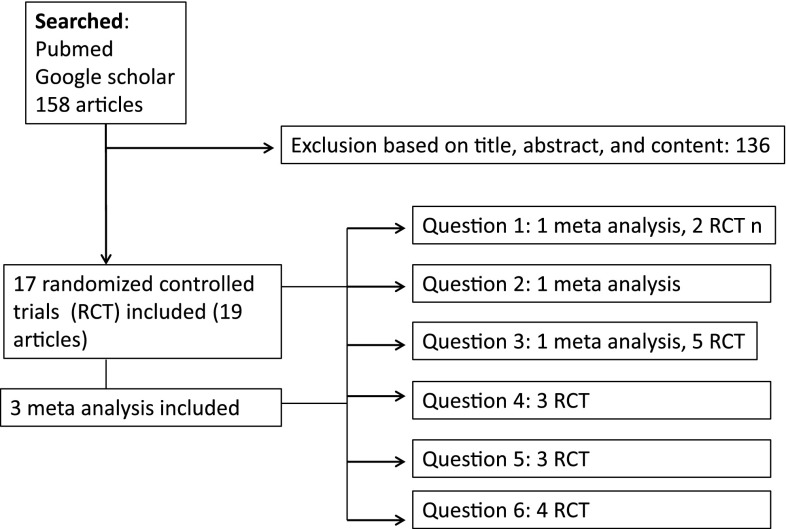
BACKGROUND: Lateral ankle sprains are common musculoskeletal injuries. OBJECTIVES: The objective of this study was to perform a systematic literature review of the last 10 years regarding evidence for the treatment and prevention of lateral ankle sprains. DATA SOURCE: Pubmed central, Google scholar. STUDY ELIGIBILITY CRITERIA: Meta-analysis, prospective randomized trials, English language articles. INTERVENTIONS: Surgical and non-surgical treatment, immobilization versus functional treatment, different external supports, balance training for rehabilitation, balance training for prevention, braces for prevention. METHODS: A systematic search for articles about the treatment of lateral ankle sprains that were published between January 2002 and December 2012. RESULTS: Three meta-analysis and 19 articles reporting 16 prospective randomized trials could be identified. The main advantage of surgical ankle ligament repair is that objective instability and recurrence rate is less common when compared with non-operative treatment. Balancing the advantages and disadvantages of surgical and non-surgical treatment, we conclude that the majority of grades I, II and III lateral ankle ligament ruptures can be managed without surgery. For non-surgical treatment, long-term immobilization should be avoided. For grade III injuries, however, a short period of immobilization (max. 10 days) in a below knee cast was shown to be advantageous. After this phase, the ankle is most effectively protected against inversion by a semi-rigid ankle brace. Even grades I and II injuries are most effectively treated with a semi-rigid ankle brace. There is evidence that treatment of acute ankle sprains should be supported by a neuromuscular training. Balance training is also effective for the prevention of ankle sprains in athletes with the previous sprains. There is good evidence from high level randomized trials in the literature that the use of a brace is effective for the prevention of ankle sprains. CONCLUSION: Balancing the advantages and disadvantages of surgical and non-surgical treatment, we conclude that the majority of grades I, II and III lateral ankle ligament ruptures can be managed without surgery. The indication for surgical repair should be always made on an individual basis. This systematic review supports a phase adapted non-surgical treatment of acute ankle sprains with a short-term immobilization for grade III injuries followed by a semi-rigid brace. More prospective randomized studies with a longer follow-up are needed to find out what type of non-surgical treatment has the lowest re-sprain rate.
Overview
The claims and statistics of this paper haven’t been checked yet.
Run the check — free, no account needed. It reads the open-access text and checks the sources it cites.
Integrity signals
Registry
Cites
Statistics
Figures
Verification
Claims the paper makes
The claims and statistics of this paper haven’t been checked yet.
Run the check — free, no account needed. It reads the open-access text and checks the sources it cites.
Claims other papers make about this one
Each is checked against this paper’s own text: does it say what the citing paper says it does?
In the citing paper
“However, access to timely interventions remains a challenge, due to limitations in the availability of physical therapists, physical mobility, transportation and/or costs [24–27].”
From Telerehabilitation of acute musculoskeletal multi-disorders: prospective, single-arm, interventional study (2022) · cites this paper as [25]
Self-check
Percentages, sums and reported differences re-computed from the paper’s own numbers.
The self-check needs the paper’s full text.
Citations
Cites
5 retracted
Interventions for preventing ankle ligament injuries
Handoll, H. H., Rowe, B. H., Quinn, K. M., & de Bie, R. A. (2001) · Cochrane Database of Systematic Reviews · doi:10.1002/14651858.cd000018 · Cited by 214
RetractedImmobilisation and functional treatment for acute lateral ankle ligament injuries in adults
Kerkhoffs, G. M. M. J., Rowe, B. H., Assendelft, W. J., Kelly, K. D., Struijs, P. A. A., & van Dijk, C. N. (2013) · Cochrane Database of Systematic Reviews · doi:10.1002/14651858.cd003762.pub2 · Cited by 167
RetractedImmobilisation and functional treatment for acute lateral ankle ligament injuries in adults
Kerkhoffs, G. M. M. J., Rowe, B. H., Assendelft, W. J., Kelly, K. D., Struijs, P. A. A., & van Dijk, C. N. (2002) · Cochrane Database of Systematic Reviews · doi:10.1002/14651858.cd003762 · Cited by 154
RetractedDifferent functional treatment strategies for acute lateral ankle ligament injuries in adults
Kerkhoffs, G. M. M. J., Struijs, P. A. A., Marti, R. K., Assendelft, W. J., Blankevoort, L., & van Dijk, C. N. (2002) · Cochrane Database of Systematic Reviews · doi:10.1002/14651858.cd002938 · Cited by 125
RetractedDifferent functional treatment strategies for acute lateral ankle ligament injuries in adults
Kerkhoffs, G. M. M. J., Struijs, P. A. A., Marti, R. K., Assendelft, W. J., Blankevoort, L., & van Dijk, C. N. (2013) · Cochrane Database of Systematic Reviews · doi:10.1002/14651858.cd002938.pub2 · Cited by 115
RetractedPreferred Reporting Items for Systematic Reviews and Meta-Analyses: the PRISMA statement
Moher, D., Liberati, A., Tetzlaff, J., Altman, D. G., & for the PRISMA Group (2009) · BMJ · doi:10.1136/bmj.b2535 · Cited by 83,823
Preferred reporting items for systematic reviews and meta-analyses: the PRISMA Statement.
(2009) · PubMed Central · Cited by 44,859
Pharmacological interventions for somatoform disorders in adults
Kleinstäuber, M., Witthöft, M., Steffanowski, A., van Marwijk, H., Hiller, W., & Lambert, M. J. (2014) · Cochrane Database of Systematic Reviews · doi:10.1002/14651858.cd010628.pub2 · Cited by 11,335
THE ETIOLOGY AND PREVENTION OF FUNCTIONAL INSTABILITY OF THE FOOT
Freeman, M. A. R., Dean, M. R. E., & Hanham, I. W. F. (1965) · The Journal of Bone and Joint Surgery. British volume · doi:10.1302/0301-620x.47b4.678 · Cited by 1,013
Gerber, J. P., Williams, G. N., Scoville, C. R., Arciero, R. A., & Taylor, D. C. (1998) · Foot & Ankle International · doi:10.1177/107110079801901002 · Cited by 895
Cited by
Gribble, P. A., Bleakley, C. M., Caulfield, B. M., Docherty, C. L., Fourchet, F., Fong, D. T.-P., Hertel, J., Hiller, C. E., Kaminski, T. W., McKeon, P. O., et al. (2016) · British Journal of Sports Medicine · doi:10.1136/bjsports-2016-096189 · Cited by 690
Diagnosis, treatment and prevention of ankle sprains: update of an evidence-based clinical guideline
Vuurberg, G., Hoorntje, A., Wink, L. M., van der Doelen, B. F. W., van den Bekerom, M. P., Dekker, R., van Dijk, C. N., Krips, R., Loogman, M. C. M., Ridderikhof, M. L., et al. (2018) · British Journal of Sports Medicine · doi:10.1136/bjsports-2017-098106 · Cited by 506
Doherty, C., Bleakley, C., Delahunt, E., & Holden, S. (2017) · British Journal of Sports Medicine · doi:10.1136/bjsports-2016-096178 · Cited by 408
Ankle Stability and Movement Coordination Impairments: Lateral Ankle Ligament Sprains Revision 2021
Martin, R. L., Davenport, T. E., Fraser, J. J., Sawdon-Bea, J., Carcia, C. R., Carroll, L. A., Kivlan, B. R., & Carreira, D. S. (2021) · Journal of Orthopaedic and Sports Physical Therapy · doi:10.2519/jospt.2021.0302 · Cited by 206
Acute ankle sprain in athletes: Clinical aspects and algorithmic approach
Halabchi, F., & Hassabi, M. (2020) · World Journal of Orthopedics · doi:10.5312/wjo.v11.i12.534 · Cited by 169
Delco, M. L., Kennedy, J. G., Bonassar, L. J., & Fortier, L. A. (2016) · Journal of Orthopaedic Research® · doi:10.1002/jor.23462 · Cited by 180
Arthroscopic Brostrom Technique
Acevedo, J. I., & Mangone, P. G. (2015) · Foot & Ankle International · doi:10.1177/1071100715576107 · Cited by 139
Deltoid ligament in acute ankle injury: MR imaging analysis
Jeong, M. S., Choi, Y. S., Kim, Y. J., Kim, J. S., Young, K. W., & Jung, Y. Y. (2014) · Skeletal Radiology · doi:10.1007/s00256-014-1842-5 · Cited by 119
Return to Play After a Lateral Ligament Ankle Sprain
d’Hooghe, P. P. R. N., Cruz, F., & Alkhelaifi, K. A. (2020) · Current Reviews in Musculoskeletal Medicine · doi:10.1007/s12178-020-09631-1 · Cited by 87
The Elephant in the Room: Too Much Medicine in Musculoskeletal Practice
Lewis, J. S., Cook, C. E., Hoffmann, T., & O’Sullivan, P. (2020) · Journal of Orthopaedic and Sports Physical Therapy · doi:10.2519/jospt.2020.0601 · Cited by 66
Arthroscopic Versus Open Broström-Gould Repair for Chronic Ankle Instability
Woo, B. J., Lai, M. C., & Koo, K. O. T. (2020) · Foot & Ankle International · doi:10.1177/1071100720914860 · Cited by 61
Operative Treatment of Lateral Ankle Instability
Yasui, Y., Murawski, C. D., Wollstein, A., Takao, M., & Kennedy, J. G. (2016) · JBJS Reviews · doi:10.2106/jbjs.rvw.15.00074 · Cited by 60
Punt, I. M., Ziltener, J., Monnin, D., & Allet, L. (2015) · Scandinavian Journal of Medicine and Science in Sports · doi:10.1111/sms.12509 · Cited by 59
Load transfer, damage, and failure in ligaments and tendons
Zitnay, J. L., & Weiss, J. A. (2018) · Journal of Orthopaedic Research® · doi:10.1002/jor.24134 · Cited by 63
LaPrade, R. F., Surowiec, R. K., Sochanska, A., Hentkowski, B. S., Martin, B. M., Engebretsen, L., & Wijdicks, C. A. (2013) · British Journal of Sports Medicine · doi:10.1136/bjsports-2013-093020 · Cited by 54
Treatment of lateral ankle sprain with platelet-rich plasma: A randomized clinical study
Blanco-Rivera, J., Elizondo-Rodríguez, J., Simental-Mendía, M. A., Vílchez‐Cavazos, F., Peña‐Martínez, V. M., & Acosta‐Olivo, C. (2019) · Foot and Ankle Surgery · doi:10.1016/j.fas.2019.09.004 · Cited by 51
Kakegawa, A., Mori, Y., Tsuchiya, A., Sumitomo, N., Fukushima, N., & Moriizumi, T. (2019) · The Journal of Foot & Ankle Surgery · doi:10.1053/j.jfas.2018.12.009 · Cited by 51
Giza, E., Whitlow, S. R., Williams, B. T., Acevedo, J. I., Mangone, P. G., Haytmanek, C. T., Curry, E. E., Turnbull, T. L., LaPrade, R. F., Wijdicks, C. A., et al. (2015) · Foot & Ankle International · doi:10.1177/1071100715576539 · Cited by 50
The Cost-Effectiveness of Measures to Prevent Recurrent Ankle Sprains
Janssen, K. W., Hendriks, M. R., van Mechelen, W., & Verhagen, E. A. L. M. (2014) · The American Journal of Sports Medicine · doi:10.1177/0363546514529642 · Cited by 49
Managing ankle ligament sprains and tears: current opinion
Martin, R. L., & McGovern, R. P. (2016) · Open Access Journal of Sports Medicine · doi:10.2147/oajsm.s72334 · Cited by 45
Complex regional pain syndrome – False hopes and miscommunications
Chang, C. C.-C., Mcdonnell, P. J., & Gershwin, M. E. (2019) · Autoimmunity Reviews · doi:10.1016/j.autrev.2018.10.003 · Cited by 48
Management of sports injuries of the foot and ankle
Hong, C. C., Pearce, C. J., Ballal, M. S., & Calder, J. D. F. (2016) · The Bone & Joint Journal · doi:10.1302/0301-620x.98b10.37896 · Cited by 42
Ko, K. R., Lee, W.-Y., Lee, H., Park, H. S., & Sung, K.-S. (2018) · Knee Surgery Sports Traumatology Arthroscopy · doi:10.1007/s00167-018-5091-3 · Cited by 42
Conservative Treatment for Acute Ankle Sprain: A Systematic Review
Ortega‐Ávila, A. B., Cervera‐Garvi, P., Marchena‐Rodríguez, A., Chicharro‐Luna, E., Nester, C., Starbuck, C., & Gijón-Noguerón, G. (2020) · Journal of Clinical Medicine · doi:10.3390/jcm9103128 · Cited by 40
Factors associated with pain intensity and physical limitations after lateral ankle sprains
Briët, J. P., Houwert, R. M., Hageman, M. G. J. S., Hietbrink, F., Ring, D., & Verleisdonk, E. J. (2016) · Injury · doi:10.1016/j.injury.2016.09.016 · Cited by 39
The Effectiveness of Physical Agents for Lower-Limb Soft Tissue Injuries: A Systematic Review
Yu, H., Randhawa, K. A., Côté, P., & Optima Collaboration (2016) · Journal of Orthopaedic and Sports Physical Therapy · doi:10.2519/jospt.2016.6521 · Cited by 41
Costa, F., Janela, D., Molinos, M., Lains, J., Francisco, G. E., Bento, V., & Dias Correia, F. (2022) · BMC Musculoskeletal Disorders · doi:10.1186/s12891-021-04891-5 · Cited by 35
Pitaru, A. A., Lacombe, J.-G., Cooke, M. E., Beckman, L., Steffen, T., Weber, M. H., Martineau, P. A., & Rosenzweig, D. H. (2020) · Micromachines · doi:10.3390/mi11090846 · Cited by 35
Tittley, J., Hébert, L. J., & Roy, J. (2020) · Journal of Foot and Ankle Research · doi:10.1186/s13047-020-00436-6 · Cited by 39
Kemler, E., van de Port, I. G. L., Schmikli, S. L., Huisstede, B. M. A., Hoes, A. W., & BACKX, F. J. G. (2015) · Journal of Foot and Ankle Research · doi:10.1186/s13047-015-0069-6 · Cited by 34
Green, T., Willson, G., Martin, D., & Fallon, K. E. (2019) · BMC Musculoskeletal Disorders · doi:10.1186/s12891-019-2750-6 · Cited by 33
The Burden of the “Simple Ankle Sprains”
Hong, C. C., & Calder, J. D. F. (2023) · Foot and Ankle Clinics · doi:10.1016/j.fcl.2022.12.002 · Cited by 33
van den Bekerom, M. P. J., van Kimmenade, R., Sierevelt, I. N., Eggink, K. M., Kerkhoffs, G. M. M. J., van Dijk, C. N., & Raven, E. E. J. (2015) · Knee Surgery Sports Traumatology Arthroscopy · doi:10.1007/s00167-015-3664-y · Cited by 32
Chaudhry, H., Simunovic, N., & Petrisor, B. A. (2014) · Clinical Orthopaedics and Related Research · doi:10.1007/s11999-014-4018-7 · Cited by 32
Mizrahi, D. J., Nazarian, L. N., & Parker, L. (2018) · Journal of Ultrasound in Medicine · doi:10.1002/jum.14542 · Cited by 32
Takenori, A., Morikita, I., Shogo, U., Hiroe, K., Junji, S., Yasutaka, T., Hiroya, K., & Miki, N. (2016) · Journal of science and medicine in sport · doi:10.1016/j.jsams.2016.03.006 · Cited by 32
Strudwick, K., McPhee, M. E., Bell, A., Martin‐Khan, M., & Russell, T. G. (2017) · Emergency Medicine Australasia · doi:10.1111/1742-6723.12904 · Cited by 31
Rebuilding Stability: Exploring the Best Rehabilitation Methods for Chronic Ankle Instability
Tedeschi, R., Ricci, V., Tarantino, D., Tarallo, L., Catani, F., & Donati, D. (2024) · Sports · doi:10.3390/sports12100282 · Cited by 28
Emergency Department Evaluation and Management of Foot and Ankle Pain
Wedmore, I. S., Young, S. E., & Franklin, J. (2015) · Emergency Medicine Clinics of North America · doi:10.1016/j.emc.2014.12.008 · Cited by 27
Radiographic Identification of the Deltoid Ligament Complex of the Medial Ankle
Clanton, T. O., Williams, B. T., James, E. W., Campbell, K. J., Rasmussen, M. T., Haytmanek, C. T., Wijdicks, C. A., & LaPrade, R. F. (2015) · The American Journal of Sports Medicine · doi:10.1177/0363546515605514 · Cited by 27
Yasui, Y., Murawski, C. D., Wollstein, A., & Kennedy, J. G. (2016) · Knee Surgery Sports Traumatology Arthroscopy · doi:10.1007/s00167-016-4207-x · Cited by 27
Yang, H. S., Su, M., Chen, Z., Qu, R., Yuan, Z., Yuan, J., He, S., Li, Z., Liu, C., Xiao, Z., et al. (2021) · Orthopaedic Journal of Sports Medicine · doi:10.1177/23259671211047269 · Cited by 27
Flore, Z., Hambly, K., Coninck, K. D., & Welsch, G. H. (2022) · Scandinavian Journal of Medicine and Science in Sports · doi:10.1111/sms.14217 · Cited by 33
Seok, H.-S., Lee, S. H., & Yun, S. J. (2019) · Acta Radiologica · doi:10.1177/0284185119873119 · Cited by 27
Portable Electromagnetic Knee Imaging System
Sultan, K. S., Mohammed, B. J., Manoufali, M., & Abbosh, A. M. (2021) · IEEE Transactions on Antennas and Propagation · doi:10.1109/tap.2021.3070015 · Cited by 26
Medial and Lateral Combined Ligament Arthroscopic Repair for Multidirectional Ankle Instability
Mansur, N. S. B., Lemos, A. V. K. C., Baumfeld, D. S., Baumfeld, T. S., Prado, M., Raduan, F. C., & Nery, C. A. D. S. (2021) · Foot & Ankle Orthopaedics · doi:10.1177/2473011420986150 · Cited by 25
Running shoes for preventing lower limb running injuries in adults
Relph, N., Greaves, H., Armstrong, R., Prior, T. D., Spencer, S., Griffiths, I. B., Dey, P., & Langley, B. (2022) · Cochrane Database of Systematic Reviews · doi:10.1002/14651858.cd013368.pub2 · Cited by 30
Gafner, S. C., Hoevel, V., Punt, I. M., Schmid, S., Armand, S., & Allet, L. (2018) · Journal of Electromyography and Kinesiology · doi:10.1016/j.jelekin.2018.09.004 · Cited by 25
Reiner, M. M., & Sharpe, J. J. (2017) · Foot & Ankle Specialist · doi:10.1177/1938640017729498 · Cited by 23
Radiographic Identification of the Primary Lateral Ankle Structures
Haytmanek, C. T., Williams, B. T., James, E. W., Campbell, K. J., Wijdicks, C. A., LaPrade, R. F., & Clanton, T. O. (2014) · The American Journal of Sports Medicine · doi:10.1177/0363546514553778 · Cited by 22
Acute Lateral Ankle Instability
Slater, K. (2018) · Foot and Ankle Clinics · doi:10.1016/j.fcl.2018.07.001 · Cited by 22
Management of sports injuries of the foot and ankle
Ballal, M. S., Pearce, C. J., & Calder, J. D. F. (2016) · The Bone & Joint Journal · doi:10.1302/0301-620x.98b7.36588 · Cited by 22
de Ruvo, R., Russo, G., Lena, F., Giovannico, G., Neville, C., Turolla, A., Torre, M., & Pellicciari, L. (2022) · Journal of Clinical Medicine · doi:10.3390/jcm11164925 · Cited by 21
Rhon, D. I., Greenlee, T. A., Cook, C. E., Westrick, R. B., Umlauf, J. A., & Fraser, J. J. (2021) · International Journal of Sports Physical Therapy · doi:10.26603/001c.27912 · Cited by 20
Biscarini, A., Contemori, S., & Grolla, G. (2018) · Journal of Sport Rehabilitation · doi:10.1123/jsr.2018-0089 · Cited by 23
Ziabari, E. Z., Haghpanahi, M., Razi, M., Lubberts, B., Ashkani‐Esfahani, S., & DiGiovanni, C. W. (2022) · Orthopaedic Surgery · doi:10.1111/os.13307 · Cited by 19
Zhang, J., Wang, C., Li, X.-Q., Fu, S., Gu, W., & Shi, Z. (2022) · Frontiers in Bioengineering and Biotechnology · doi:10.3389/fbioe.2022.1073063 · Cited by 19
Extremity trauma: field management of sports injuries
Wascher, D. C., & Bulthuis, L. (2014) · Current Reviews in Musculoskeletal Medicine · doi:10.1007/s12178-014-9242-y · Cited by 19
Hotfiel, T., Heiss, R. U., Janka, R., Forst, R., Raithel, M., Lutter, C., Gelse, K., Pachowsky, M. L., & Golditz, T. (2018) · The Physician and Sportsmedicine · doi:10.1080/00913847.2018.1484658 · Cited by 19
Anthropomorphic Durable Realistic Knee Phantom for Testing Electromagnetic Imaging Systems
Sultan, K. S., Mohammed, B. J., Mills, P. C., & Abbosh, A. M. (2020) · IEEE Journal of Electromagnetics RF and Microwaves in Medicine and Biology · doi:10.1109/jerm.2020.3023027 · Cited by 19
Digital Rehabilitation for Acute Ankle Sprains: Prospective Longitudinal Cohort Study
Correia, F. D., Molinos, M., Neves, C., Janela, D., Carvalho, D., Luis, S., Francisco, G. E., Lains, J., & Bento, V. (2021) · JMIR Rehabilitation and Assistive Technologies · doi:10.2196/31247 · Cited by 18
Woitzik, E., Jacobs, C. L., Wong, J. J., Côté, P., Shearer, H. M., Randhawa, K. A., Sutton, D. A., Southerst, D., Varatharajan, S., Brison, R. J., et al. (2015) · Manual Therapy · doi:10.1016/j.math.2015.03.012 · Cited by 19
From “Low” to “High” Athletic Ankle Sprains: A Comprehensive Review
d’Hooghe, P. P. R. N., Alkhelaifi, K. A., Abdelatif, N. M. N., & Kaux, J. (2018) · Operative Techniques in Orthopaedics · doi:10.1053/j.oto.2018.01.002 · Cited by 18
The Arterial Anatomy of the Lateral Ligament Complex of the Ankle: A Cadaveric Study
Gosselin, M. M., Haynes, J. A., McCormick, J. J., Johnson, J. E., & Klein, S. E. (2018) · The American Journal of Sports Medicine · doi:10.1177/0363546518808060 · Cited by 18
Park, J.-H., Kwon, H. W., Kim, D., Park, K.-R., Lee, M., Choi, Y.-J., & Cho, J. (2021) · BioMed Research International · doi:10.1155/2021/5575524 · Cited by 18
Punt, I. M., Armand, S., Ziltener, J., & Allet, L. (2017) · Gait & Posture · doi:10.1016/j.gaitpost.2017.06.284 · Cited by 18
Submaximal Force Steadiness and Accuracy in Patients With Chronic Ankle Instability
Lee, H., Son, S. J., Kim, H., Han, S., Seeley, M. K., & Hopkins, J. T. (2020) · Journal of Athletic Training · doi:10.4085/15-20 · Cited by 17
Řezaninová, J., Hrazdíra, L., Králová, D. M., Svoboda, Z., & Benaroya, A. (2017) · Foot and Ankle Surgery · doi:10.1016/j.fas.2016.12.001 · Cited by 17
Ankle Injuries in the Pediatric Athlete
Erickson, J. B., Samora, W., & Klingele, K. E. (2016) · Sports Medicine and Arthroscopy Review · doi:10.1097/jsa.0000000000000125 · Cited by 16
Hudson, R., Baker, R. T., May, J., Reordan, D., & Nasypany, A. M. (2017) · Journal of Manual & Manipulative Therapy · doi:10.1080/10669817.2017.1332557 · Cited by 16
Time-sensitive ambulatory orthopaedic soft-tissue surgery paradigms during the COVID-19 pandemic
Ding, B. T. K., Decruz, J., & Kunnasegaran, R. (2020) · International Orthopaedics · doi:10.1007/s00264-020-04606-w · Cited by 16
Association between Patient History and Physical Examination and Osteoarthritis after Ankle Sprain
van Ochten, J., de Vries, A., van Putte, N., Oei, E. H. G., Bindels, P., Bierma‐Zeinstra, S., & van Middelkoop, M. (2017) · International Journal of Sports Medicine · doi:10.1055/s-0043-109554 · Cited by 15
Bsoul, N., Liang, N., Cai, L., Mazmanyan, D., & Porter, D. E. (2024) · BMC Musculoskeletal Disorders · doi:10.1186/s12891-024-07655-z · Cited by 20
Ko, K. R., Lee, H., Lee, W.-Y., & Sung, K.-S. (2018) · Knee Surgery Sports Traumatology Arthroscopy · doi:10.1007/s00167-018-4960-0 · Cited by 15
Bimani, S. A. A., Gates, L., Warner, M. B., & Bowen, C. J. (2018) · The Physician and Sportsmedicine · doi:10.1080/00913847.2018.1533392 · Cited by 15
Shin, J. C., Kim, J., Nam, D., Park, G.-C., & Lee, J.-S. (2020) · Trials · doi:10.1186/s13063-020-4111-z · Cited by 14
Tee, E., Melbourne, J., Sattler, L. N., & Hing, W. A. (2021) · Journal of Sport Rehabilitation · doi:10.1123/jsr.2021-0244 · Cited by 13
Treatment and prevention of chronic ankle instability: An umbrella review of meta-analyses
Hu, D., Sun, H., Wang, S., Wang, H., Zheng, X., Tang, H., & Hou, H. (2024) · Foot and Ankle Surgery · doi:10.1016/j.fas.2024.07.010 · Cited by 18
Zwirner, J., Koutp, A., Vidakovic, H., Ondruschka, B., Kieser, D., & Hammer, N. (2020) · Journal of the mechanical behavior of biomedical materials/Journal of mechanical behavior of biomedical materials · doi:10.1016/j.jmbbm.2020.104244 · Cited by 13
Wang, X., Qiu, J., & Fong, D. T.-P. (2023) · Medicine in Novel Technology and Devices · doi:10.1016/j.medntd.2023.100210 · Cited by 13
Walaszek, R., Chwała, W., Walaszek, K., Burdacki, M., & Błaszczuk, J. (2017) · PubMed · doi:10.5277/abb-00675-2016-02 · Cited by 13
Kim, B. S., Woo, S., Kim, J. Y., & Park, C. (2017) · La radiologia medica · doi:10.1007/s11547-017-0786-y · Cited by 12
Waizy, H., Harrasser, N., & Fehske, K. (2018) · Der Unfallchirurg · doi:10.1007/s00113-018-0535-2 · Cited by 12
Ankle instability: presentation and management
Hossain, M., & Thomas, R. (2015) · Orthopaedics and Trauma · doi:10.1016/j.mporth.2014.12.001 · Cited by 12
Burger, M., Dreyer, D., Fisher, R. L., Foot, D., O’Connor, D. H., Galante, M., & Zalgaonkir, S. (2017) · Journal of Back and Musculoskeletal Rehabilitation · doi:10.3233/bmr-170804 · Cited by 12
Modern Open and Minimally Invasive Stabilization of Chronic Lateral Ankle Instability
Allen, T., & Kelly, M. (2021) · Foot and Ankle Clinics · doi:10.1016/j.fcl.2020.11.003 · Cited by 11
Defining the Components of the Deltoid Ligament (DL): A Cadaveric Study
Ismail, E. E., Saffar, R. A. M. A., Motawei, K., Hiware, S. D., Moizuddin, K., Shaikh, S. A. H., Bayer, S. B., Alharbi, Y., Aldahhan, R. A., & Daimi, S. R. H. (2022) · Cureus · doi:10.7759/cureus.23051 · Cited by 11
Dolan, P., Kenny, I. C., Glynn, L. G., Campbell, M. J., Warrington, G. D., Cahalan, R., Harrison, A. J., Lyons, M., & Comyns, T. M. (2022) · The Physician and Sportsmedicine · doi:10.1080/00913847.2022.2093618 · Cited by 13
Razzano, C., Izzo, R., Savastano, R., Colantuoni, C., & Carbone, S. (2019) · The Journal of Foot & Ankle Surgery · doi:10.1053/j.jfas.2018.09.009 · Cited by 11
Picot, B., Grimaud, O., Rauline, G., Haidar, I. M., Moussa, M., & Hardy, A. (2024) · Journal of Experimental Orthopaedics · doi:10.1002/jeo2.12073 · Cited by 10
Kocsis, K., Stubnya, B. G., Váncsa, S., Kói, T., Kovács, N., Hergár, L., Hetthéssy, J. R., Holnapy, G., Hegyi, P., & Pap, K. (2024) · Injury · doi:10.1016/j.injury.2024.111730 · Cited by 14
Laterale Instabilität des oberen Sprunggelenks
Harrasser, N., Eichelberg, K., Pohlig, F., Waizy, H., Toepfer, A. D. A., & von Eisenhart‐Rothe, R. (2016) · Der Orthopäde · doi:10.1007/s00132-016-3344-8 · Cited by 9
Fatoye, F., & Haigh, C. A. (2016) · Journal of Clinical Nursing · doi:10.1111/jocn.13255 · Cited by 10
Prianti, B. D. M., Novello, G. F., Prianti, T. D. S. M., Costa, D. R., Pessoa, D. R., & Nicolau, R. A. (2018) · Lasers in Medical Science · doi:10.1007/s10103-018-2460-6 · Cited by 9
Pawik, Ł., Pawik, M., Wysoczańska, E., Schabowska, A., Morasiewicz, P., & Lwow, F. (2022) · International Journal of Environmental Research and Public Health · doi:10.3390/ijerph19095291 · Cited by 8
Choi, Y., Cho, S.-H., Seo, J., Ahn, J. H., & Kim, Y. (2022) · Clinical Orthopaedics and Related Research · doi:10.1097/corr.0000000000002337 · Cited by 8
Fractionated Irradiation in Photobiomodulation Therapy of Ankle Sprain
Călin, M. A., Bădilă, A. E., Hristea, A., Manea, D., Savastru, R., & Nica, A. S. (2019) · American Journal of Physical Medicine & Rehabilitation · doi:10.1097/phm.0000000000001178 · Cited by 8
Running shoes for preventing lower limb running injuries in adults
Relph, N., Greaves, H., Armstrong, R., Gichuru, P., Prior, T. D., Griffiths, I. B., Spencer, S., Dey, P., & Langley, B. (2019) · Cochrane Database of Systematic Reviews · doi:10.1002/14651858.cd013368 · Cited by 8
The Effect of Ankle Brace Use on a 3‐Step Volleyball Spike Jump Height
You, D., Tomlinson, M., Borschneck, G., Borschneck, A., MacDonald, M., Deluzio, K. J., & Borschneck, D. P. (2020) · Arthroscopy Sports Medicine and Rehabilitation · doi:10.1016/j.asmr.2020.04.015 · Cited by 8
Epidemiology and Mechanisms of Ankle Pathology in Football
Anderson, R. L., Engebretsen, L., Kennedy, N. I., LaPrade, R. F., Wegner, A. M., & Giza, E. (2014) · Sports et traumatologie · doi:10.1007/978-2-8178-0523-8_3 · Cited by 8
Metadata
- Authors
- Petersen, W., Rembitzki, I. V., Koppenburg, A. G., Ellermann, A., Liebau, C., Brüggemann, G. P., & Best, R.
- Affiliations
- Martin-Luther-Krankenhaus (DE)
- Corresponding author
- Petersen, Wolf
- Best, Raymond
- Venue
- Archives of Orthopaedic and Trauma Surgery
- Published
- 2013-05-28
- Volume
- 133
- Issue
- 8
- Pages
- 1129-1141
- ISSN
- 0936-8051 (ISSN-L)
- 1434-3916
- PMC
- PMC3718986
- OpenAlex
- W2039059284
- Cited by
- 272
- References
- 69
- Citations by year
- 2026: 14 · 2025: 15 · 2024: 22 · 2023: 20 · 2022: 22 · 2021: 29 · 2020: 34 · 2019: 15 · 2018: 23 · 2017: 18 · 2016: 24 · 2015: 22 · 2014: 12 · 2013: 1
- FWCI
- 3.22
- Type
- journal article
- Language
- en
- Open access
- hybrid
- doi.org
- Locations
- Archives of Orthopaedic and Trauma Surgery (publishedVersion, cc-by)
- Europe PMC (PubMed Central) (publishedVersion, cc-by)
- PubMed Central (publishedVersion, cc-by)
- PubMed (publishedVersion)
- Topics
- Health Sciences › Medicine › Orthopedics and Sports Medicine › Foot and Ankle Surgery
- Health Sciences › Medicine › Orthopedics and Sports Medicine › Sports injuries and prevention
- Physical Sciences › Engineering › Biomedical Engineering › Lower Extremity Biomechanics and Pathologies
- Keywords
- lateral ankle sprain, ankle ligament injury, ankle sprain prevention, ankle brace, immobilization, conservative treatment, balance training, neuromuscular training, ankle instability, recurrence, athletes
- MeSH terms
- Acute Disease, Humans, Prospective Studies, Sprains and Strains, Randomized Controlled Trials as Topic, Ankle Injuries, Lateral Ligament, Ankle
About these checks
Registry, retraction, Cites and statistics results are computed, not judged, with one exception: a printed reference that no index lists is read once by a model before it counts as a citation error. Claims are extracted by a model and kept only when their quote appears verbatim in the text; each cited source is then checked, with a model’s help, for whether it says what the claim relies on. Those verdicts can be wrong — read the claim’s quote and the cited source before relying on one.
Statistics and arithmetic are recomputed, not judged.
Confidence bands are shown only for fields calibrated on our annotated test set. None is calibrated yet, so no band is shown.
What counts as a claim ›How we measure confidence ›How we check this ›
Are you an author, or do you see a problem with this page? Request a review
Data sources
Bibliographic data: Semantic Scholar, OpenAlex, Crossref.
Contains information from the Semantic Scholar Academic Graph Datasets, made available under the ODC Attribution License (ODC-BY 1.0).
Semantic Scholar’s data is described in: Kinney, R., et al. (2023). The Semantic Scholar Open Data Platform. arXiv:2301.10140.
