

On prognostic estimates of radiation risk in medicine and radiation protection
Open accessThe DOI matches its Crossref record; 29 of the 29 references it cites were found in a registry or an index.
Abstract
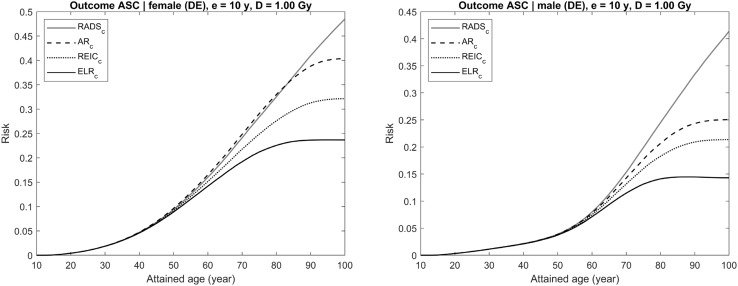
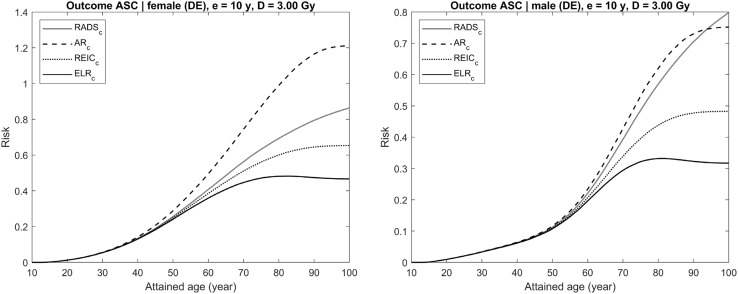
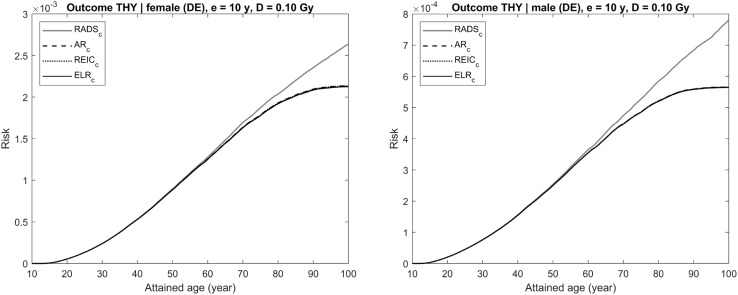
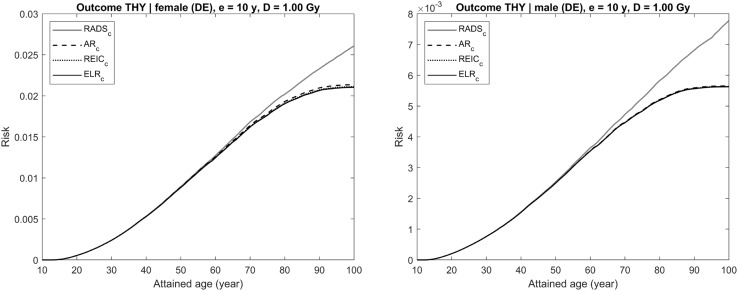
The problem of expressing cumulative detrimental effect of radiation exposure is revisited. All conventionally used and computationally complex lifetime or time-integrated risks are based on current population and health statistical data, with unknown future secular trends, that are projected far into the future. It is shown that application of conventionally used lifetime or time-integrated attributable risks (LAR, AR) should be limited to exposures under 1 Gy. More general quantities, such as excess lifetime risk (ELR) and, to a lesser extent, risk of exposure-induced death (REID), are free of dose constraints, but are even more computationally complex than LAR and AR and rely on the unknown total radiation effect on demographic and health statistical data. Appropriate assessment of time-integrated risk of a specific outcome following high-dose (more than 1 Gy) exposure requires consideration of competing risks for other radiation-attributed outcomes and the resulting ELR estimate has an essentially non-linear dose response. Limitations caused by basing conventionally applied time-integrated risks on current population and health statistical data are that they are: (a) not well suited for risk estimates for atypical groups of exposed persons not readily represented by the general population; and (b) not optimal for risk projections decades into the future due to large uncertainties in developments of the future secular trends in the population-specific disease rates. Alternative disease-specific quantities, baseline and attributable survival fractions, based on reduction of survival chances are considered here and are shown to be very useful in circumventing most aspects of these limitations. Another main quantity, named as radiation-attributed decrease of survival (RADS), is recommended here to represent cumulative radiation risk conditional on survival until a certain age. RADS, historically known in statistical literature as "cumulative risk", is only based on the radiation-attributed hazard and is insensitive to competing risks. Therefore, RADS is eminently suitable for risk projections in emergency situations and for estimating radiation risks for persons exposed after therapeutic or interventional medical applications of radiation or in other highly atypical groups of exposed persons, such as astronauts.
Overview
The claims and statistics of this paper haven’t been checked yet.
Free: it reads the open-access text and checks the first 5 claims that cite a source we can check. Create a free account to check every claim.
Integrity signals
Registry
Cites
Statistics
Figures
Verification
Claims the paper makes
The claims and statistics of this paper haven’t been checked yet.
Free: it reads the open-access text and checks the first 5 claims that cite a source we can check. Create a free account to check every claim.
Self-check
Percentages, sums and reported differences re-computed from the paper’s own numbers.
The self-check needs the paper’s full text.
Citations
Cites
The Statistical Analysis of Failure Time Data.
Aitkin, M., Kalbfleisch, J. D., & Prentice, R. L. (1981) · Biometrics · doi:10.2307/2530581 · Cited by 9,877
Cancer Incidence in Five Continents
(1970) · Springer eBooks · doi:10.1007/978-3-642-85851-2 · Cited by 8,501
Sources and effects of ionizing radiation
(2018) · United Nations Scientific Committee on the Effects of Atomic Radiation (UNSCEAR) Reports · doi:10.18356/f48d655d-en · Cited by 3,985
Estimated Risks of Radiation-Induced Fatal Cancer from Pediatric CT
Brenner, D. J., Elliston, C. D., Hall, E. J., & Berdon, W. E. (2001) · American Journal of Roentgenology · doi:10.2214/ajr.176.2.1760289 · Cited by 3,222
The Statistical Analysis of Failure Time Data
Kalbfleisch, J. D., & Prentice, R. L. (2002) · Wiley Series in Probability and Statistics · doi:10.1002/9781118032985 · Cited by 3,219 · cited 2×
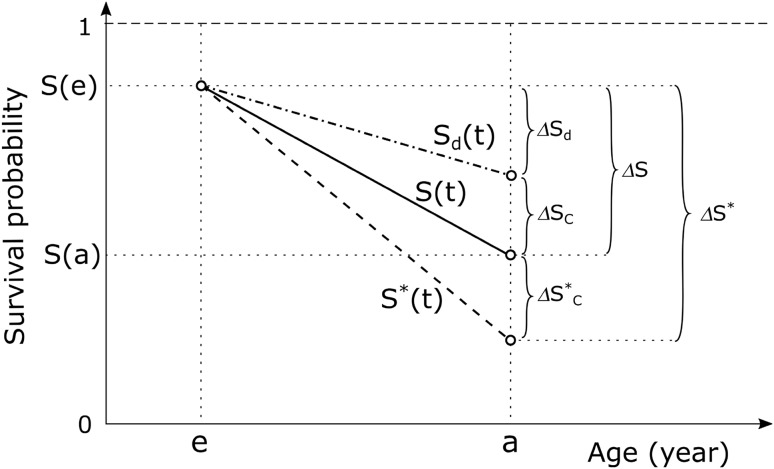
“Main terms of survival statistics and auxiliary equations In terms of survival statistics (see, e.g., Selvin 1996; Kalbfleisch and Prentice 2002; Kleinbaum and Klein 2012), hazard is a rate of relative change of the survival probability or instantaneous risk: where dS(t)∕S(t) is a relative change…”
BackgroundHealth Risks from Exposure to Low Levels of Ionizing Radiation:: BEIR VII Phase 2
Earth, D. O. (2006) · CERN Document Server (European Organization for Nuclear Research) · Cited by 2,190
Survival Analysis: A Self-Learning Text
Carpenter, M. (1997) · Technometrics · doi:10.1080/00401706.1997.10485091 · Cited by 1,811
Survival Analysis: A Self-Learning Text
Kleinbaum, D. G., & Klein, M. (2012) · Statistics for Biology and Health · doi:10.1007/978-1-4419-6646-9 · Cited by 1,015
Research works printed but not linked: 1
- EPA (2011) EPA radiogenic cancer risk models and projections for the US population. US Environmental Protection Agency, Washington, DC
Cited by
Fogtman, A., Baatout, S., Baselet, B., Berger, T., Hellweg, C. E., Jiggens, P., La Tessa, C., Narici, L., Nieminen, P., Sabatier, L., et al. (2023) · npj Microgravity · doi:10.1038/s41526-023-00262-7 · Cited by 70
Self-citationResearch plans in Europe for radiation health hazard assessment in exploratory space missions
Walsh, L., Schneider, U., Fogtman, A., Kausch, C., McKenna-Lawlor, S., Narici, L., Ngo-Anh, J., Reitz, G., Sabatier, L., Santin, G., et al. (2019) · Life Sciences in Space Research · doi:10.1016/j.lssr.2019.04.002 · Cited by 59
Self-citationClinical and epidemiological observations on individual radiation sensitivity and susceptibility
Seibold, P., Auvinen, A., Averbeck, D., Bourguignon, M., Hartikainen, J. M., Hoeschen, C., Laurent, O., Noël, G., Sabatier, L., Salomaa, S., et al. (2020) · International Journal of Radiation Biology · doi:10.1080/09553002.2019.1665209 · Cited by 56
“Other publications discussed various aspects of uncertainties in risk estimates (UNSCEAR 2012b; Fisher and Fahey 2017; Ulanowski et al. 2019) including competing risks and effective dose.”
BackgroundShavers, M., Semones, E., Tomi, L., Chen, J., Straube, U., Komiyama, T., Shurshakov, V., Li, C., & Rühm, W. (2024) · Zeitschrift für Medizinische Physik · doi:10.1016/j.zemedi.2023.06.005 · Cited by 41
“The metrics considered in ESA, Radiation Attributed Decrease of Survival (RADS) [31 – 33], represents the cumulative decrease in the unknown survival curve at a certain attained age due to the radiation exposure at an earlier age.”
BackgroundIs there any supportive evidence for low dose radiotherapy for COVID-19 pneumonia?
Salomaa, S. I., Bouffler, S. D., Atkinson, M. J., Cardis, E., & Hamada, N. (2020) · International Journal of Radiation Biology · doi:10.1080/09553002.2020.1786609 · Cited by 27
A bespoke health risk assessment methodology for the radiation protection of astronauts
Walsh, L., Hafner, L., Straube, U., Ulanowski, A., Fogtman, A., Durante, M., Weerts, G., & Schneider, U. (2021) · Radiation and Environmental Biophysics · doi:10.1007/s00411-021-00910-0 · Cited by 23
“RADS is a convenient description of cumulative radiation risk that is independent of survival rates and has many other advantages (Ulanowski et al. 2019).”
BackgroundSelf-citationUlanowski, A., Shemiakina, E. V., Güthlin, D., Becker, J., Preston, D. L., Apostoaei, A. I., Hoffman, F. O., Jacob, P., Kaiser, J. C., & Eidemüller, M. (2020) · Radiation and Environmental Biophysics · doi:10.1007/s00411-020-00866-7 · Cited by 22
Self-citationRääf, C., Marković, N., Tondel, M. O., Wålinder, R., & Isaksson, M. (2020) · PLoS ONE · doi:10.1371/journal.pone.0228549 · Cited by 18
“The complex features of the LAR concept when accounting for regional specific baseline all-cause mortality rates and its development over time are discussed in more detail in [46].”
BackgroundLifetime radiation risk of stochastic effects – prospective evaluation for space flight or medicine
Ulanowski, A., Kaiser, J. C., Schneider, U., & Walsh, L. (2020) · Annals of the ICRP · doi:10.1177/0146645320956517 · Cited by 22
“(3)] can be expressed for a single radiation-attributed outcome, as follows (see Ulanowski et al., 2019 for details): ERc aje,Dð Þ ¼ 1 SðeÞ Z a e c xð ÞSðxÞ e Hcðxje,DÞ 1þ hc xje,Dð Þ c xð Þ 1 dx ð5Þ where c and h are the baseline and excess incidence rates for the outcome of interest c, PY 1 ; and…”
Self-citationWalsh, L., Ulanowski, A., Kaiser, J. C., Woda, C., & Raskob, W. (2019) · Radiation and Environmental Biophysics · doi:10.1007/s00411-019-00809-x · Cited by 15
Self-citationMoghaddam, F. F., Bakhshandeh, M., Ghorbani, M., & Mofid, B. (2020) · Computers in Biology and Medicine · doi:10.1016/j.compbiomed.2020.104052 · Cited by 14
Cancer incidence risks above and below 1 Gy for radiation protection in space
Hafner, L., Walsh, L., & Schneider, U. (2021) · Life Sciences in Space Research · doi:10.1016/j.lssr.2020.09.001 · Cited by 10
Self-citationAGE DYNAMICS OF CANCER INCIDENCE INTENSITY INDICATES EXISTENCE OF SOME FRAILTY SUBGROUPS
Obesnyuk, V. F. (2023) · Health Risk Analysis · doi:10.21668/health.risk/2023.3.03 · Cited by 6
Sommer, M., Heinzl, F., Scholz-Kreisel, P., Wollschläger, D., Heumann, C., & Fenske, N. (2025) · Radiation Research · doi:10.1667/rade-24-00060.1 · Cited by 5
“Three additional lifetime risk measures were calculated: The risk of exposure-induced death REID [first introduced in ( 34 ) and employed in ( 13 , 35 )], the excess lifetime risk ELR ( 36 ) and the radiation attributable decrease of survival RADS ( 15 ).”
InfluentialDell’Oro, M., Short, M., Wilson, P., Peukert, D., Hua, C., Merchant, T. E., & Bezak, E. (2022) · Radiotherapy and Oncology · doi:10.1016/j.radonc.2022.04.027 · Cited by 5
Walsh, L., Hafner, L., Berger, T., Matthiä, D., Schneider, U., & Straube, U. (2023) · Zeitschrift für Medizinische Physik · doi:10.1016/j.zemedi.2023.10.003 · Cited by 6
“…quantity, Radiation Attributed Decrease of Survival (RADS), representing the cumulative decrease in the unknown survival curve (or cancer-free survival curve) at a certain attained age, due to the radiation exposure at an earlier age, forms the basis for this new approach, Ulanowski et al. [5,6].”
BackgroundSelf-citationA new European cancer risk assessment tool for application after nuclear accidents
Walsh, L., Ulanowski, A., Kaiser, J. C., Woda, C., & Raskob, W. (2020) · Radioprotection · doi:10.1051/radiopro/2020018 · Cited by 6
Self-citationObesnyuk, V. F. (2021) · Health Risk Analysis · doi:10.21668/health.risk/2021.2.02 · Cited by 4
Hafner, L., & Walsh, L. (2023) · Zeitschrift für Medizinische Physik · doi:10.1016/j.zemedi.2023.06.003 · Cited by 6
“…more attention has been paid to the uncertainties of different parameters in the radiation related cancer risk calculations (e.g. Ulanowski et al. [4], Hafner et al.[7], Walsh et al. [6], Stabilini et al. [8]) and sensitivity analysis have been performed to analyse their impacts (e.g. Zhang et…”
BackgroundSelf-citationTime-integrated radiation risk metrics and interpopulation variability of survival
Ulanowski, A., Ban, N., Ozasa, K., Rühm, W., Semones, E., Shavers, M., & Vaillant, L. (2024) · Zeitschrift für Medizinische Physik · doi:10.1016/j.zemedi.2023.08.002 · Cited by 4
“An alternative risk metric, termed the Radiation-Attributed Decrease of Survival (RADS [20]), was also calculated in the present study.”
MethodSelf-citationCalculation of an Indicator for Early Death Using Atomic Bomb Survivors’ Data
Sasaki, M., FUJIMICHI, Y., YOSHIDA, K., & Iwasaki, T. (2022) · Journal of Radiation Protection and Research · doi:10.14407/jrpr.2021.00108 · Cited by 3
“In addition, as there suggested already various indices— detriment, lifetime attributable risk (LAR), excess lifetime risk (ELR), and risk of exposure-induced death (REID) [2, 16, 17] —have already been suggested for lifetime risk prediction due to radiation exposure, it may be difficult for such a new risk indicator…”
BackgroundSommer, M., Fenske, N., Heumann, C., Scholz-Kreisel, P., & Heinzl, F. (2025) · Health Physics · doi:10.1097/hp.0000000000001994 · Cited by 2
Metrological Concepts for Ionizing Radiation in Medical Applications
Soliman, H. A. (2023) · Springer eBooks · doi:10.1007/978-981-99-2074-7_122 · Cited by 4
Hafner, L., & Walsh, L. (2021) · Journal of Radiological Protection · doi:10.1088/1361-6498/ac290a · Cited by 2
Self-citationCalibration Algorithms for Estimating the Number of Radiogenic Deaths in a Cohort
Vasilyev, E. V., Annenkova, E., Biryukov, A., Orlov, Y. V., Митрофанович, Д. С., & Романович, Т. А. (2021) · Medical Radiology and radiation safety · doi:10.12737/1024-6177-2020-65-6-47-56
Metrological Concepts for Ionizing Radiation in Medical Applications
Soliman, H. A. (2023) · Springer eBooks · doi:10.1007/978-981-19-1550-5_122-1 · Cited by 1
Takada, M., Hirouchi, J., Kujiraoka, I., Takahara, S., Schneider, T., & Kai, M. (2024) · Journal of Radiological Protection · doi:10.1088/1361-6498/ad2ebc
“To calculate the cumulative mortality risk from age 15–74, we used the following formula for lifetime risk, based on Ulanowski et al ’s [10] work: where λ ( t ) is the mortality rate from a certain cause of death at age t and S e ( t ) is the survival rate from age e to age t , as in the following…”
Hafner, L., & Walsh, L. (2026) · Annals of the ICRP · doi:10.1177/01466453251412512 · Cited by 1
Self-citation
Metadata
- Authors
- Ulanowski, A., Kaiser, J. C., Schneider, U., & Walsh, L.
- Affiliations
- International Atomic Energy Agency (AT)
- Helmholtz Munich (DE)
- University of Zurich (CH)
- Corresponding author
- Ulanowski, Alexander
- Venue
- Radiation and Environmental Biophysics
- Published
- 2019-04-20
- Volume
- 58
- Issue
- 3
- Pages
- 305-319
- ISSN
- 0301-634X (ISSN-L)
- 1432-2099
- PMC
- PMC6609593
- OpenAlex
- W2936888623
- Semantic Scholar
- 5bab80396f4534e71802b60613e70ae2af5597e8
- Cited by
- 31
- References
- 29
- Citations by year
- 2026: 1 · 2025: 3 · 2024: 1 · 2023: 9 · 2022: 2 · 2021: 5 · 2020: 7 · 2019: 3
- FWCI
- 2.81
- Type
- journal article
- Language
- en
- Open access
- hybrid
- doi.org
- Licence
- cc-by
- creativecommons.org/licenses/by/4.0 (tdm)
- Locations
- Radiation and Environmental Biophysics (publishedVersion, cc-by)
- Europe PMC (PubMed Central) (publishedVersion, cc-by)
- PubMed Central (publishedVersion, cc-by)
- PubMed (publishedVersion)
- Zurich Open Repository and Archive (University of Zurich) (acceptedVersion)
- Site cant be reached (submittedVersion, other-oa)
- PuSH - Publication Server of Helmholtz Zentrum München (submittedVersion)
- Zurich Open Repository and Archive (University of Zurich) (submittedVersion, other-oa)
- Zurich Open Repository and Archive (University of Zurich)
- Funders
- Bundesministerium für Bildung und Forschung (02NUK026)
- H2020 Euratom (662287)
- Topics
- Health Sciences › Medicine › Radiology, Nuclear Medicine and Imaging › Radiation Dose and Imaging
- Health Sciences › Medicine › Radiology, Nuclear Medicine and Imaging › Effects of Radiation Exposure
- Physical Sciences › Physics and Astronomy › Radiation › Advanced Radiotherapy Techniques
- Keywords
- radiation risk, excess lifetime risk, attributable risk, competing risks, survival fraction, radiation protection, medical radiation exposure, astronaut radiation exposure, emergency radiation exposure
- MeSH terms
- Radiation Exposure, Adult, Aged, Aged, 80 and over, Female, Humans, Male, Medicine, Middle Aged, Prognosis, Radiation Injuries, Radiation Protection, Radiobiology, Models, Statistical, Survival Analysis, Risk Assessment, Young Adult
About these checks
Registry, retraction, Cites and statistics results are computed, not judged, with one exception: a printed reference that no index lists is read once by a model before it counts as a citation error. Claims are extracted by a model and kept only when their quote appears verbatim in the text; each cited source is then checked, with a model’s help, for whether it says what the claim relies on. Those verdicts can be wrong — read the claim’s quote and the cited source before relying on one.
Statistics and arithmetic are recomputed, not judged.
Confidence bands are shown only for fields calibrated on our annotated test set. None is calibrated yet, so no band is shown.
What counts as a claim ›How we measure confidence ›How we check this ›
Are you an author, or do you see a problem with this page? Request a review
Data sources
Bibliographic data: Semantic Scholar, OpenAlex, Crossref.
Contains information from the Semantic Scholar Academic Graph Datasets, made available under the ODC Attribution License (ODC-BY 1.0).
Semantic Scholar’s data is described in: Kinney, R., et al. (2023). The Semantic Scholar Open Data Platform. arXiv:2301.10140.
