

The DOI matches its Crossref record; 261 of the 261 references it cites were found in a registry or an index.
Physical exercise improves quality of life, depressive symptoms, and cognition across chronic brain disorders: a transdiagnostic systematic review and meta-analysis of randomized controlled trials
Open accessAbstract
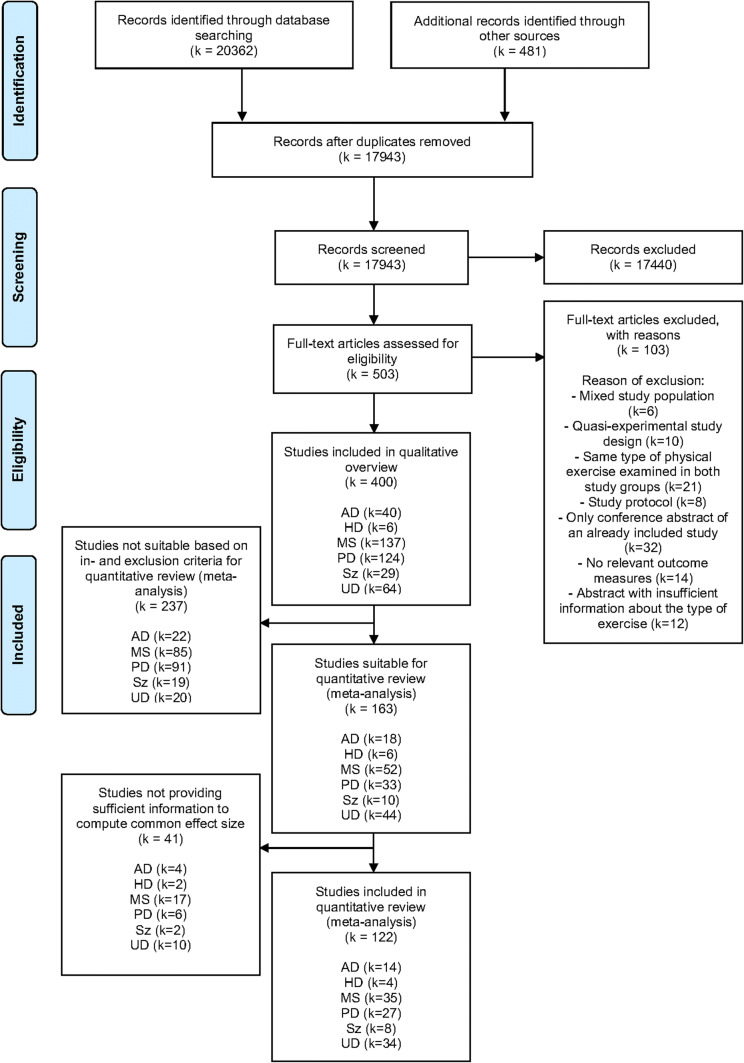
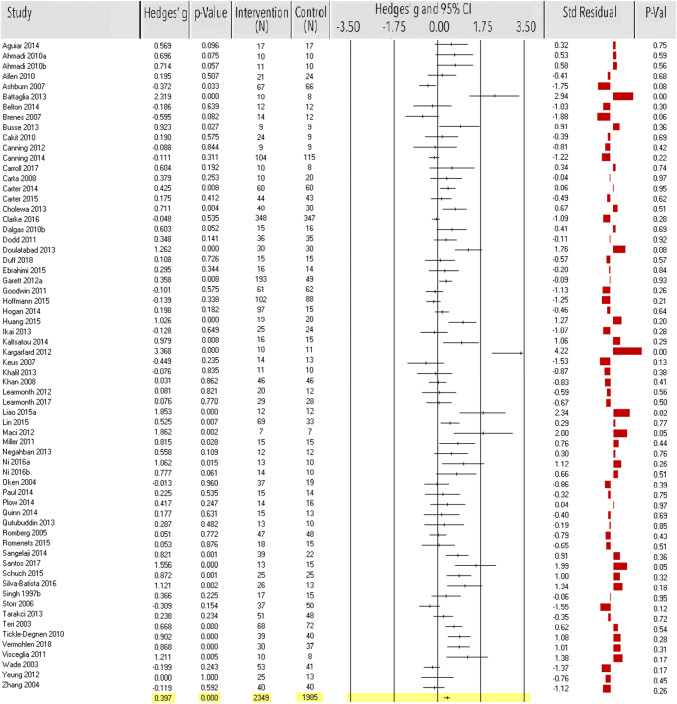
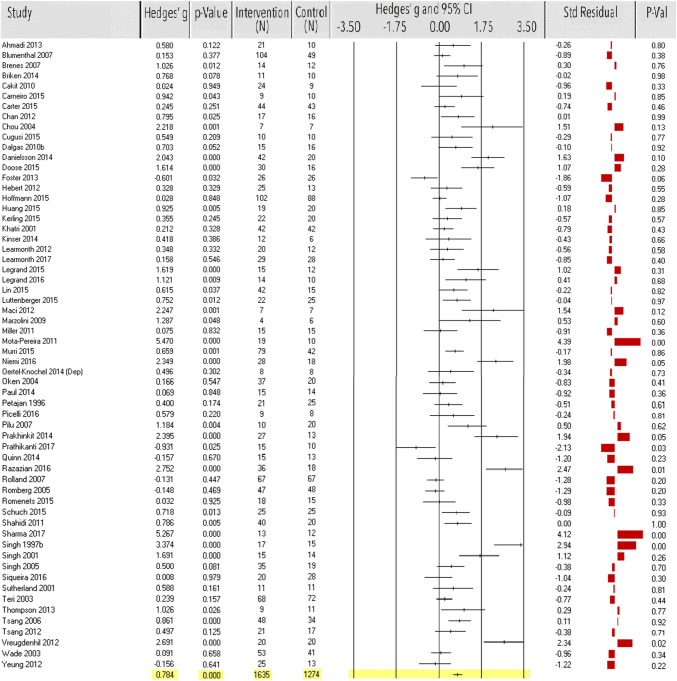
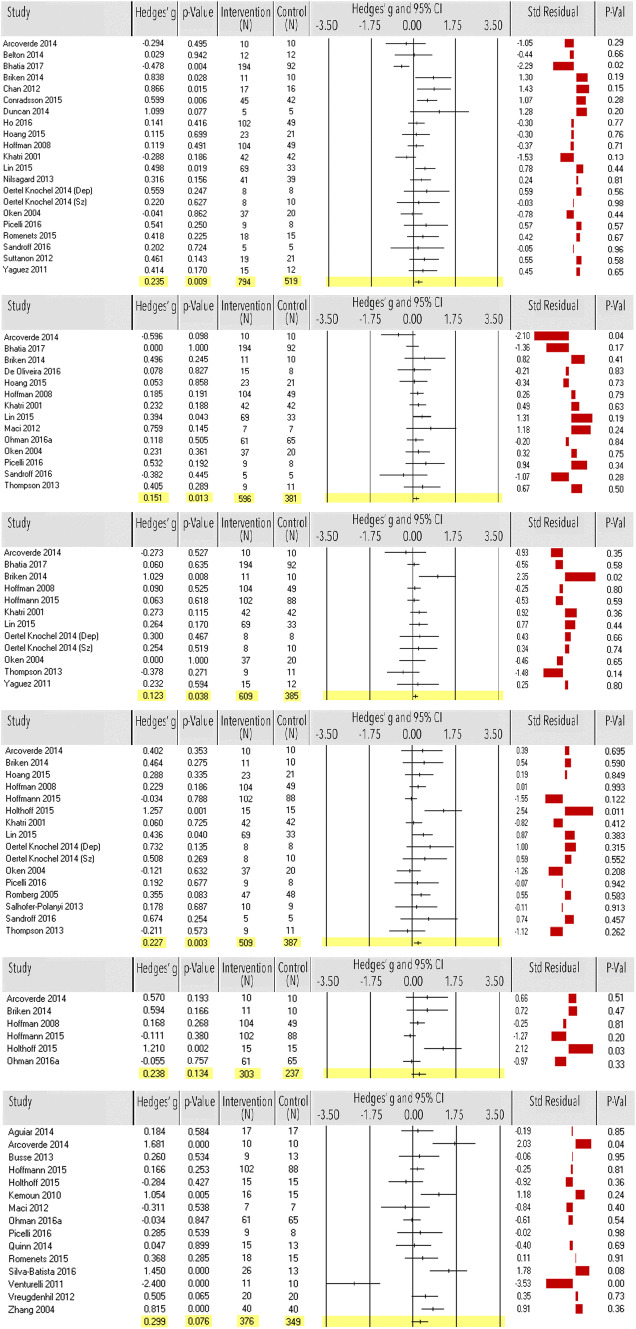
We performed a meta-analysis to synthesize evidence on the efficacy and safety of physical exercise as an add-on therapeutic intervention for quality of life (QoL), depressive symptoms and cognition across six chronic brain disorders: Alzheimer’s disease, Huntington’s disease, multiple sclerosis, Parkinson’s disease, schizophrenia and unipolar depression. 122 studies ( = k ) ( n = 7231) were included. Exercise was superior to treatment as usual in improving QoL ( k = 64, n = 4334, ES = 0.40, p < 0.0001), depressive symptoms ( k = 60, n = 2909, ES = 0.78, p < 0.0001), the cognitive domains attention and working memory ( k = 21, n = 1313, ES = 0.24, p < 0.009), executive functioning ( k = 14, n = 977, ES = 0.15, p = 0.013), memory ( k = 12, n = 994, ES = 0.12, p = 0.038) and psychomotor speed ( k = 16, n = 896, ES = 0.23, p = 0.003). Meta-regression showed a dose–response effect for exercise time (min/week) on depressive symptoms ( β = 0.007, p = 0.012). 69% of the studies that reported on safety, found no complications. Exercise is an efficacious and safe add-on therapeutic intervention showing a medium-sized effect on QoL and a large effect on mood in patients with chronic brain disorders, with a positive dose–response correlation. Exercise also improved several cognitive domains with small but significant effects.
Overview
The claims and statistics of this paper haven’t been checked yet.
Run the check — free, no account needed. It reads the open-access text and checks the sources it cites.
Integrity signals
Registry
Cites
Statistics
Figures
Verification
Claims the paper makes
The claims and statistics of this paper haven’t been checked yet.
Run the check — free, no account needed. It reads the open-access text and checks the sources it cites.
Claims other papers make about this one
Each is checked against this paper’s own text: does it say what the citing paper says it does?
In the citing paper
“Improvements in depression were paralleled by improvements in behavioral markers of cognitive control (ES = 0.24), with a high degree of heterogeneity (16).”
From The Role of Exercise in Management of Mental Health Disorders: An Integrative Review (2021) · cites this paper as [16]
Self-check
Percentages, sums and reported differences re-computed from the paper’s own numbers.
The self-check needs the paper’s full text.
Citations
Cites
Items 201–261 of 261
Park, A., Zid, D., Russell, J., Malone, A., Rendon, A., Wehr, A. M., & Li, X. (2013) · Parkinsonism & Related Disorders · doi:10.1016/j.parkreldis.2013.10.003 · Cited by 69
Netz, Y. (2017) · Frontiers in Pharmacology · doi:10.3389/fphar.2017.00257 · Cited by 69
Sandroff, B. M., Balto, J. M., Klaren, R. E., Sommer, S., DeLuca, J., & Motl, R. W. (2016) · Neurocase · doi:10.1080/13554794.2016.1237658 · Cited by 68
Triptish Bhatia, A., Mazumdar, S., Wood, J. A., He, F., Gur, R. E., Gur, R. C., Nimgaonkar, V. L., & Deshpande, S. N. (2016) · Acta Neuropsychiatrica · doi:10.1017/neu.2016.42 · Cited by 65
Neuropsychiatric Predictors of Cognitive Decline in Parkinson Disease: A Longitudinal Study
Pirogovsky‐Turk, E., Moore, R. C., Filoteo, J. V., Litvan, I., Song, D. D., Lessig, S. L., & Schiehser, D. M. (2016) · American Journal of Geriatric Psychiatry · doi:10.1016/j.jagp.2016.10.004 · Cited by 65
Exercise for Cognitive Symptoms in Depression: A Systematic Review of Interventional Studies
Sun, M., Lanctôt, K. L., Herrmann, N., & Gallagher, D. (2017) · The Canadian Journal of Psychiatry · doi:10.1177/0706743717738493 · Cited by 64
Siqueira, C. C., Valiengo, L. D. C. L., Carvalho, A. F., Silva, P. R. S., Missio, G., SOUSA, R. T. D., Natale, G. D., Gattaz, W. F., Moreno, R. A., & Machado‐Vieira, R. (2016) · PLoS ONE · doi:10.1371/journal.pone.0154195 · Cited by 62
Effectiveness of Physiotherapy Interventions on Spasticity in People With Multiple Sclerosis
Etoom, M., Khraiwesh, Y., Lena, F., Hawamdeh, M., Hawamdeh, Z. M., Centonze, D., & Foti, C. (2018) · American Journal of Physical Medicine & Rehabilitation · doi:10.1097/phm.0000000000000970 · Cited by 62
Tai Chi Treatment for Depression in Chinese Americans
Yeung, A., Lepoutre, V., Wayne, P. M., Yeh, G. Y., Slipp, L. E., D, M. F. M., Denninger, J. W., Benson, H., & Fricchione, G. L. (2012) · American Journal of Physical Medicine & Rehabilitation · doi:10.1097/phm.0b013e31825f1a67 · Cited by 61
Sangelaji, B., Nabavi, S. M., Estebsari, F., et al. (2014) · Iranian Red Crescent Medical Journal · doi:10.5812/ircmj.17173 · Cited by 60
Legrand, F. D. (2014) · Journal of Sport and Exercise Psychology · doi:10.1123/jsep.2013-0253 · Cited by 59
Beyond Assessment of Quality of Life in Schizophrenia
Voruganti, L. N. P., & Awad, A. G. (2016) · Springer eBooks · doi:10.1007/978-3-319-30061-0 · Cited by 59
Legrand, F. D., & Neff, E. M. (2016) · Journal of Affective Disorders · doi:10.1016/j.jad.2015.11.047 · Cited by 58
Ikai, S., Uchida, H., Suzuki, T., Tsunoda, K., Mimura, M., & 藤井, 康. (2013) · Journal of Psychiatric Research · doi:10.1016/j.jpsychires.2013.07.017 · Cited by 57
The Effect of Physical Activity in Parkinson’s Disease: A Mini-Review
Fayyaz, M., Jaffery, S. S., Anwar, F., Zil‐E‐Ali, A., & Anjum, I. (2018) · Cureus · doi:10.7759/cureus.2995 · Cited by 56
Demaneuf, T., Aitken, Z., Karahalios, A., Leong, T. I., Livera, A. M. D., Jelinek, G. A., Weiland, T. J., & Marck, C. H. (2018) · Archives of Physical Medicine and Rehabilitation · doi:10.1016/j.apmr.2018.08.178 · Cited by 56
A Chinese Chan-based mind–body intervention for patients with depression
Chan, A. S.-Y., Wong, Q. Y., Sze, S. L., Kwong, P., Han, Y. M. Y., & Cheung, M. (2012) · Journal of Affective Disorders · doi:10.1016/j.jad.2012.05.018 · Cited by 55
Deppe, M., Tabelow, K., Krämer, J., Tenberge, J., Schiffler, P., Bittner, S., Schwindt, W., Zipp, F., Wiendl, H., & Meuth, S. G. (2015) · Multiple Sclerosis Journal · doi:10.1177/1352458515579439 · Cited by 55
Doulatabad, S., Nooreyan, K., Doulatabad, A., & Noubandegani, Z. (2012) · African Journal of Traditional, Complementary and Alternative Medicines · doi:10.4314/ajtcam.v10i1.8 · Cited by 55
Καλτσάτου, Α., Kouidi, E. J., Fountoulakis, K. Ν., Sipka, C., Theochari, V., Kandylis, D., & Deligiannis, A. P. (2014) · Clinical Rehabilitation · doi:10.1177/0269215514564085 · Cited by 53
Keus, S. H. J., Bloem, B. R., van Hilten, J. J., Ashburn, A., & Munneke, M. (2006) · Parkinsonism & Related Disorders · doi:10.1016/j.parkreldis.2006.07.007 · Cited by 48
The Effect of Community Exercise Interventions for People with MS Who Use Bilateral Support for Gait
Hogan, N., Kehoe, M., Larkin, A., & Coote, S. B. (2014) · Multiple Sclerosis International · doi:10.1155/2014/109142 · Cited by 46
Rilo, O., Peña, J., Ojeda, N., Antigüedad, A. R., Bilbao, M. D. M. M., Gómez‐Gastiasoro, A., DeLuca, J., Chiaravalloti, N. D., & Ibarretxe‐Bilbao, N. (2016) · Disability and Rehabilitation · doi:10.1080/09638288.2016.1250168 · Cited by 46
Impact of Pilates Exercise in Multiple Sclerosis
DUFF, W. R. D., Andrushko, J. W., Renshaw, D. W., Chilibeck, P. D., Farthing, J. P., Danielson, J., & Evans, C. D. (2018) · International Journal of MS Care · doi:10.7224/1537-2073.2017-066 · Cited by 46
Veronese, N., Solmi, M., Basso, C., Smith, L., & Soysal, P. (2018) · International Journal of Geriatric Psychiatry · doi:10.1002/gps.4962 · Cited by 46
Loh, S. Y., Abdullah, A., Bakar, A. K. A., Maniam, T., & Jaafar, N. R. N. (2015) · Global Journal of Health Science · doi:10.5539/gjhs.v8n1p238 · Cited by 45
Rietberg, M. B., van Wegen, E. E. H., Eyssen, I. C. J. M., Kwakkel, G., & the MS study group (2014) · PLoS ONE · doi:10.1371/journal.pone.0107710 · Cited by 44
Kalron, A., & Zeilig, G. (2015) · Neurorehabilitation · doi:10.3233/nre-151260 · Cited by 43
Yeung, A., Feng, R., Kim, D. J. H., Wayne, P. M., Yeh, G. Y., Baer, L., Lee, O. E., Denninger, J. W., Benson, H., Fricchione, G. L., et al. (2017) · The Journal of Clinical Psychiatry · doi:10.4088/jcp.16m10772 · Cited by 43
Cholewa, J., Boczarska‐Jedynak, M., & Opala, G. (2013) · Neurologia i Neurochirurgia Polska · doi:10.5114/ninp.2013.35774 · Cited by 42
Pfaff, J. J., Alfonso, H. S., Newton, R. U., Sim, M., Flicker, L. A., & Almeida, O. P. (2013) · British Journal of Sports Medicine · doi:10.1136/bjsports-2013-092510 · Cited by 41
Task-Specific Training in Huntington Disease: A Randomized Controlled Feasibility Trial
Quinn, L., DeBono, K., Dawes, H., Rosser, A., Nemeth, A. H., Rickards, H. E., Tabrizi, S. J., Quarrell, O., Trender‐Gerhard, I., Kelson, M. J., et al. (2014) · Physical Therapy · doi:10.2522/ptj.20140123 · Cited by 41
Busse, M. E., Quinn, L., Drew, C. J. G., Kelson, M. J., Trubey, R., McEwan, K., Jones, C., Townson, J. K., Dawes, H., Edwards, R. T., et al. (2017) · Physical Therapy · doi:10.1093/ptj/pzx031 · Cited by 39
Kooshiar, H., Moshtagh, M., Sardar, M. A., Foroughipour, M., Shakeri, M. T., & Vahdatinia, B. (2015) · PubMed · Cited by 33
Ozgen, G., Karapolat, H., Akkoç, Y., et al. (2016) · PubMed · Cited by 33
Poliakoff, E., Galpin, A. J., McDonald, K. R., Kellett, M., Dick, J., Hayes, S. M., & Wearden, A. J. (2013) · Neurorehabilitation · doi:10.3233/nre-130829 · Cited by 32
Miller, L., Paul, L., Mattison, P., & McFadyen, A. K. (2011) · Clinical Rehabilitation · doi:10.1177/0269215511398376 · Cited by 32
BOUBCHIR, K. I. , Boutemeur‐Kheddis, B., Rabia, C., et al. (2017) · Molecules · doi:10.3390/molecules23010008 · Cited by 32
Aguiar, P., Monteiro, L., Feres, A. M. L. T., Gomes, I., & Melo, A. D. S. (2014) · Current Alzheimer Research · doi:10.2174/1567205011666140618102224 · Cited by 29
Self-selected intensity exercise in the treatment of major depression: A pragmatic RCT
Doose, M., Ziegenbein, M., Hoos, O., Reim, D., Stengert, W., Hoffer, N., Vogel, C., Ziert, Y., & Sieberer, M. G. (2015) · International Journal of Psychiatry in Clinical Practice · doi:10.3109/13651501.2015.1082599 · Cited by 28
Niemi, M., Kiel, S., Allebeck, P., & Hoan, L. T. (2016) · Tropical Medicine & International Health · doi:10.1111/tmi.12674 · Cited by 26
Effects of whole body vibration on hormonal & functional indices in patients with multiple sclerosis
Eftekhari, E., Ebrahimi, A., & Etemadifar, M. (2015) · The Indian Journal of Medical Research · doi:10.4103/0971-5916.169210 · Cited by 25
Coghe, G., Corona, F., Marongiu, E., Fenu, G., Frau, J., Lorefice, L., Crisafulli, A., Galli, M., Concu, A., Marrosu, M. G., et al. (2018) · Journal of Neurology · doi:10.1007/s00415-018-8836-5 · Cited by 23
Parkinson’s Disease and Forced Exercise: A Preliminary Study
Qutubuddin, A. A., Reis, T., Alramadhani, R., Cifu, D. X., Towne, A. R., & Carne, W. F. (2013) · Rehabilitation Research and Practice · doi:10.1155/2013/375267 · Cited by 22
Plow, M. A., Béthoux, F., Mai, K., & Marcus, B. H. (2014) · Health Education Research · doi:10.1093/her/cyu034 · Cited by 21
Physical Exercise Interventions for Mental Health
(2016) · Cambridge University Press eBooks · doi:10.1017/cbo9781316157565 · Cited by 21
European physiotherapy guideline for Parkinson's disease: Development & implementation
Keus, S. H. J., Munneke, M., Graziano, M., et al. (2014) · Movement Disorders · Cited by 21
Trade-Offs of Escherichia coli Adaptation to an Intracellular Lifestyle in Macrophages
Azevedo, M., Sousa, A., de Sousa, J. A. M., Thompson, J. A., Proença, J. T., & Gordo, I. (2016) · PLoS ONE · doi:10.1371/journal.pone.0146123 · Cited by 20
Benefits of inpatient multidisciplinary rehabilitation in multiple sclerosis
Salhofer‐Polanyi, S., Windt, J., Sumper, H., et al. (2013) · Neurorehabilitation · doi:10.3233/nre-130956 · Cited by 19
Stack, E. L., Roberts, H. C., & Ashburn, A. (2011) · Parkinson s Disease · doi:10.1155/2012/360231 · Cited by 19
Benefits of Exercise on the Executive Functions in People with Parkinson Disease
de Oliveira, R. T., Felippe, L. A., Gobbi, L. T. B., Barbieri, F. A., & Christofoletti, G. (2016) · American Journal of Physical Medicine & Rehabilitation · doi:10.1097/phm.0000000000000612 · Cited by 19
Zur Kritik der Valleix'schen Schmerzenspunkte in Neuralgieen
Romberg, M. (1868) · European Archives of Psychiatry and Clinical Neuroscience · doi:10.1007/bf01983069 · Cited by 16
Ahmadi, A. (2010) · International sportmed journal for FIMS · Cited by 9
Laupheimer, M. W., Härtel, S., Schmidt, S., et al. (2013) · Journal of the Neurological Sciences · doi:10.1016/j.jns.2013.07.411 · Cited by 7
Louie, J., Baquie, K., Offerman, J., Granger, C. L., Khan, F., & Bower, K. J. (2021) · Clinical Rehabilitation · doi:10.1177/02692155211064949 · Cited by 7
Quality of Life as an Outcome and a Mediator of Other Outcomes in Patients with Schizophrenia
Karow, A., Bullinger, M., & Lambert, M. (2016) · Springer eBooks · doi:10.1007/978-3-319-30061-0_9 · Cited by 3
Quality of Life, Cognition, and Social Cognition in Schizophrenia
Brissos, S., Pereira, G., & Balanzá‐Martínez, V. (2016) · Springer eBooks · doi:10.1007/978-3-319-30061-0_3 · Cited by 3
The effect of a balance exercise class on activity limitations in people with parkinson’s disease
Belton, A. (2014) · doi:10.25419/rcsi.10812773 · Cited by 1
Louie, J., Baquie, K., Offerman, J., et al. (2015) · Physiotherapy · doi:10.1016/j.physio.2015.03.1739 · Cited by 1
Lautenschlager, N. T., Cox, K. L., Flicker, L. A., et al. (2015) · Alzheimer s & Dementia · doi:10.1016/j.jalz.2015.07.375 · Cited by 1
Research works printed but not linked: 11
- McNair DM, Droppleman LF, Lorr M (1992) Edits manual for the profile of mood states: POMS. Edits, San Diego
- Zhang Y-H, Lu S-P, Xu Y-N, Fu X, Huang Q (2004) Effect of one-year rehabilitation training in patients with Alzheimer disease. Chin J Clin Rehabil 8(31):6859–6861
- Oertel-Knöchel V, Mehler P, Thiel C, Steinbrecher K, Malchow B, Tesky V et al (2014) Effects of aerobic exercise on cognitive performance and individual psychopathology in depressive and schizophrenia patients. Eur Arch Psychiatry Clin Neurosci 1:1–16
- Bernhardt L, Jolk C, Alcantara R, Platen P, Marziniak M, Weßling K (2012) The effects of resistance training and physical activities in groups in comparison for the treatment of chronic fatigue in patients with multiple sclerosis. Mult Scler 18(4):247
- Doulatabad N, Tradit AJ, Altern C (2013) Afr J Tradit Complement Altern Med 2013(10):49–52
- Jäckel N, Tallner A, Virsevci Ö, Denkinger N, Sebald K, Mäurer M et al (2015) Effects of internet-based exercise (e-training) on fatigue and other patient reported behavioural outcomes (PRO) in patients with relapsing-remitting multiple sclerosis (RRMS). Mult Scler 23(11):616
- Donnell M, Coote S (2011) Physiotherapy intervention in persons with MS who are nonambulatory. Physiother (United Kingdom) 97:eS917
- Rahnama N, Namazizadeh M, Etemadifar M, Bambaeichi E, Arbabzadeh S, Sadeghipour HR (2011) Effects of yoga on depression in women with multiple sclerosis. J Isfahan Med Sch 29:136
- Tallner A, Maeurer M, Pfeifer K (2012) An internet-based at home training protocol enhances muscle strength and lung function in multiple sclerosis patients (#133). Mult Scler 18(5):S23–S24
- NICE (2014) Multiple sclerosis in adults: management. NICE Clin Guidel CG186 2014:20–22
- California Department of Public Health (2008) Guideline for Alzheimer’s disease management guideline for Alzheimer’s disease management California Workgroup on Guidelines for Alzheimer’s disease management. Calif Workgr Guidel ALzheimer’s Dis Manag 1:1–122
Cited by
Sorted by citations
Begemann, M. J., Brand, B. A., Ćurčić-Blake, B., Aleman, A., & Sommer, I. E. (2020) · Psychological Medicine · doi:10.1017/s0033291720003670 · Cited by 368
Self-citationThe Role of Exercise in Management of Mental Health Disorders: An Integrative Review
Smith, P. J., & Merwin, R. M. (2021) · Annual Review of Medicine · doi:10.1146/annurev-med-060619-022943 · Cited by 360
Metadata
- Authors
- Dauwan, M., Begemann, M. J. H., Slot, M. I. E., Lee, E. H. M., Scheltens, P., & Sommer, I. E. C.
- Affiliations
- University Medical Center Groningen (NL)
- University Medical Center Utrecht (NL)
- Queen Mary Hospital (CN)
- Amsterdam Neuroscience (NL)
- Corresponding author
- Dauwan, Meenakshi
- ORCID
- Venue
- Journal of Neurology
- Published
- 2019-08-14
- Volume
- 268
- Issue
- 4
- Pages
- 1222-1246
- ISSN
- 0012-1037 (ISSN-L)
- 0340-5354
- 1432-1459
- PMC
- PMC7990819
- OpenAlex
- W2968168409
- Cited by
- 239
- References
- 261
- Citations by year
- 2026: 23 · 2025: 45 · 2024: 42 · 2023: 44 · 2022: 45 · 2021: 19 · 2020: 16 · 2019: 5
- FWCI
- 2.52
- Type
- journal article
- Language
- en
- Open access
- hybrid
- doi.org
- Locations
- Journal of Neurology (publishedVersion, cc-by)
- PubMed Central (publishedVersion, cc-by)
- PubMed (publishedVersion)
- Pure Amsterdam UMC (acceptedVersion, cc-by)
- NORA - Norwegian Open Research Archives (submittedVersion, cc-by)
- Amsterdam UMC (VU Amsterdam) - Institutional Repository (submittedVersion, other-oa)
- University of Groningen research database (University of Groningen / Centre for Information Technology) (submittedVersion, cc-by)
- Data Archiving and Networked Services (DANS) (submittedVersion, other-oa)
- Funders
- zonmw (40-00812-98-13009)
- Topics
- Health Sciences › Medicine › Public Health, Environmental and Occupational Health › Physical Activity and Health
- Health Sciences › Medicine › Psychiatry and Mental health › Dementia and Cognitive Impairment Research
- Life Sciences › Neuroscience › Neurology › Transcranial Magnetic Stimulation Studies
- Keywords
- physical activity, quality of life, depressive symptoms, cognition, Alzheimer's disease, Huntington's disease, multiple sclerosis, Parkinson's disease, schizophrenia, major depressive disorder, executive function, memory, attention, working memory, psychomotor speed, dose-response relationship, exercise safety, adjunctive therapy
- MeSH terms
- Cognition, Depression, Humans, Parkinson Disease, Quality of Life, Exercise, Randomized Controlled Trials as Topic
About these checks
Registry, retraction, Cites and statistics results are computed, not judged, with one exception: a printed reference that no index lists is read once by a model before it counts as a citation error. Claims are extracted by a model and kept only when their quote appears verbatim in the text; each cited source is then checked, with a model’s help, for whether it says what the claim relies on. Those verdicts can be wrong — read the claim’s quote and the cited source before relying on one.
Statistics and arithmetic are recomputed, not judged.
Confidence bands are shown only for fields calibrated on our annotated test set. None is calibrated yet, so no band is shown.
What counts as a claim ›How we measure confidence ›How we check this ›
Are you an author, or do you see a problem with this page? Request a review
