

Psychological treatments for return to work in individuals on sickness absence due to common mental disorders or musculoskeletal disorders: a systematic review and meta-analysis of randomized-controlled trials
Open accessThe DOI matches its Crossref record; 70 of the 70 references it cites were found in a registry or an index.
Abstract
PURPOSE: Common mental disorders (CMDs) and musculoskeletal disorders are highly prevalent in the population and cause significant distress and disability, and high costs to society. The main objective of this systematic review and meta-analysis was to examine the outcome and comparative effectiveness of psychological interventions in reducing sickness absence (SA) due to CMDs or musculoskeletal disorders, compared to a waitlist control group, usual care or another clinical intervention. METHODS: We reviewed 3515 abstracts of randomized controlled trials published from 1998 to 2017. Of these, 30 studies were included in the analysis. RESULTS: The psychological interventions were overall more effective than treatment as usual in reducing SA (small effect sizes), but not compared to other clinical interventions. Results were similar for studies on CMDs and musculoskeletal pain. A few significant moderating effects were found for treatment-specific variables. However, these were difficult to interpret as they pointed in different directions. CONCLUSION: There was a small but significant effect of psychological treatments in reducing SA. We identified areas of improvement such as methodological problems among the included studies and failure to specifically address RTW in the interventions that were evaluated. Clinical implications of the findings, and ways of improving methodological rigour of future studies are discussed.
Overview
The claims and statistics of this paper haven’t been checked yet.
Free: it reads the open-access text and checks the first 5 claims that cite a source we can check. Create a free account to check every claim.
Integrity signals
Registry
Cites
Statistics
Figures
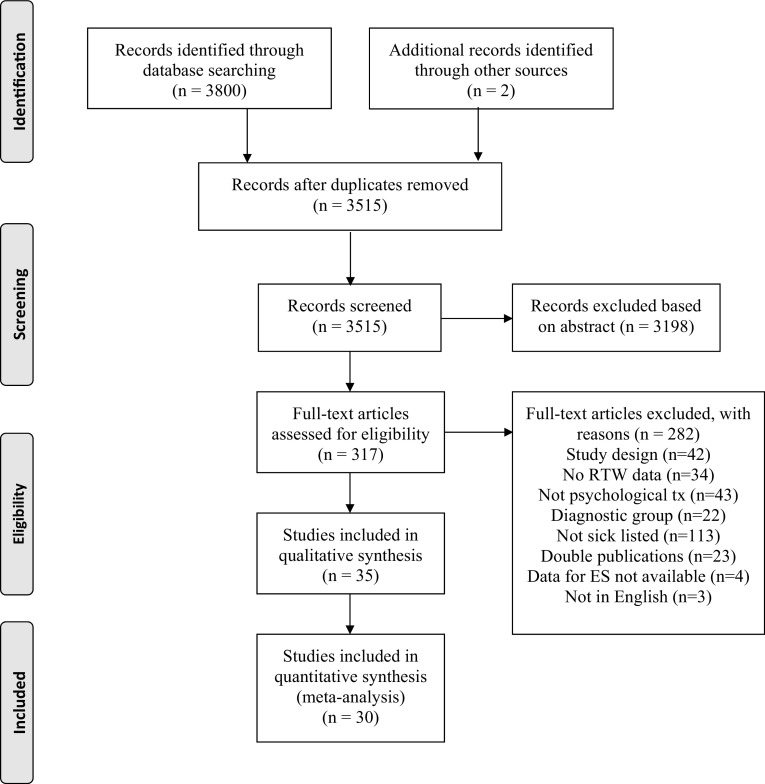
Verification
Claims the paper makes
The claims and statistics of this paper haven’t been checked yet.
Free: it reads the open-access text and checks the first 5 claims that cite a source we can check. Create a free account to check every claim.
Claims other papers make about this one
Each is checked against this paper’s own text: does it say what the citing paper says it does?
The source backs part of the claim, not all of it — or backs it for a different population, condition or comparison.
In the citing paper
“Interestingly, we found positive effects on work ability. However, the effect was small (d = 0.47), but comparable to effects found in a recent meta-analysis (Finnes et al., 2019) on the effects of psychological interventions on sickness absences due to common mental disorders (Hedges' g = 0.22).”
From Learning how to recover from stress: Results from an internet-based randomized controlled pilot trial (2023) · cites this paper as Finnes et al., 2019
Experimental — accuracy not yet measuredThe source backs part of the claim, not all of it — or backs it for a different population, condition or comparison.
In the citing paper
“low work ability and work participation have been associated with higher risks for long-term sick leave, poorer well-being, and high personal and societal costs (Finnes et al., 2019; Hassard et al., 2018).”
From Learning how to recover from stress: Results from an internet-based randomized controlled pilot trial (2023) · cites this paper as Finnes et al., 2019
Experimental — accuracy not yet measuredThe cited source says what the claim attributes to it.
In the citing paper
“However, there are mixed results regarding the effects of multidisciplinary treatment [7,8]”
In the citing paper
“For individuals with musculoskeletal or common mental health disorders, a recent meta-analysis concluded that psychological treatments reduce sick leave more than usual care, albeit with small effect sizes, and inconclusive results as to which form of psychological treatment is the most effective (7).”
Self-check
Percentages, sums and reported differences re-computed from the paper’s own numbers.
The self-check needs the paper’s full text.
Citations
Cites
Statistical Power Analysis for the Behavioral Sciences
Muller, K. (1989) · Technometrics · doi:10.1080/00401706.1989.10488618 · Cited by 99,167
Measuring inconsistency in meta-analyses
Higgins, J. P. T., Thompson, S. G., Deeks, J. J., & Altman, D. G. (2003) · BMJ · doi:10.1136/bmj.327.7414.557 · Cited by 63,139
Bias in meta-analysis detected by a simple, graphical test
Egger, M., Smith, G. D., Schneider, M., & Minder, C. (1997) · BMJ · doi:10.1136/bmj.315.7109.629 · Cited by 56,722
Liberati, A., Altman, D. G., Tetzlaff, J., Mulrow, C., Gøtzsche, P. C., Ioannidis, J. P. A., Clarke, M., Devereaux, P. J., Kleijnen, J., & Moher, D. (2009) · PLoS Medicine · doi:10.1371/journal.pmed.1000100 · Cited by 28,164
Liberati, A., Altman, D. G., Tetzlaff, J., Mulrow, C., Gotzsche, P. C., Ioannidis, J. P. A., Clarke, M., Devereaux, P. J., Kleijnen, J., & Moher, D. (2009) · BMJ · doi:10.1136/bmj.b2700 · Cited by 17,648
Duval, S., & Tweedie, R. (2000) · Biometrics · doi:10.1111/j.0006-341x.2000.00455.x · Cited by 14,099
(2000) · Cited by 9,198
Vos, T., Flaxman, A. D., Naghavi, M., Lozano, R., Michaud, C., Ezzati, M., Shibuya, K., Salomon, J. A., Abdalla, S., Aboyans, V., et al. (2012) · The Lancet · doi:10.1016/s0140-6736(12)61729-2 · Cited by 8,291 · cited 2×
“Musculoskeletal disorders are the second most common cause of disability worldwide, with low back and neck pain being the most frequent conditions (Vos et al. 2012).”
BackgroundThe biopsychosocial approach to chronic pain: Scientific advances and future directions.
Gatchel, R. J., Peng, Y. B., Peters, M. L., Fuchs, P. N., & Turk, D. C. (2007) · Psychological Bulletin · doi:10.1037/0033-2909.133.4.581 · Cited by 3,392
The empirical status of cognitive-behavioral therapy: A review of meta-analyses
Butler, A. C., Chapman, J. E., Forman, E. M., & Beck, A. T. (2006) · Clinical Psychology Review · doi:10.1016/j.cpr.2005.07.003 · Cited by 3,215
Cited by
New directions in burnout research
Demerouti, E., Bakker, A. B., Peeters, M. C. W., & Breevaart, K. (2021) · European Journal of Work and Organizational Psychology · doi:10.1080/1359432x.2021.1979962 · Cited by 202
Öst, L.-G., Enebrink, P., Finnes, A., Ghaderi, A., Havnen, A., Kvale, G., Salomonsson, S., & Wergeland, G. J. (2022) · Behaviour Research and Therapy · doi:10.1016/j.brat.2022.104170 · Cited by 75
Gismervik, S. Ø., Aasdahl, L., Vasseljen, O., Fors, E. A., Rise, M. B., Johnsen, R., Hara, K., Jacobsen, H. B., Pape, K., Fleten, N., et al. (2020) · Scandinavian Journal of Work, Environment & Health · doi:10.5271/sjweh.3882 · Cited by 37
“For individuals with musculoskeletal or common mental health disorders, a recent meta-analysis concluded that psychological treatments reduce sick leave more than usual care, albeit with small effect sizes, and inconclusive results as to which form of psychological treatment is the most effective (7).”
BackgroundTingulstad, A., Meneses-Echavez, J. F., Evensen, L. H., Bjerk, M., & Berg, R. C. (2022) · Systematic Reviews · doi:10.1186/s13643-022-02055-7 · Cited by 45
Xu, H., Cai, J., Sawhney, R., Jiang, S., Buys, N. J., & Sun, J. (2023) · Journal of Occupational Rehabilitation · doi:10.1007/s10926-023-10116-4 · Cited by 49
Metadata
- Authors
- Finnes, A., Enebrink, P., Ghaderi, A., Dahl, J., Nager, A., & Öst, L.-G.
- Affiliations
- Karolinska Institutet (SE)
- Uppsala University (SE)
- Stockholm University (SE)
- Corresponding author
- Finnes, Anna
- Venue
- International Archives of Occupational and Environmental Health
- Published
- 2018-11-24
- Volume
- 92
- Issue
- 3
- Pages
- 273-293
- ISSN
- 0340-0131 (ISSN-L)
- 1432-1246
- PMC
- PMC6420449
- OpenAlex
- W2901085500
- Cited by
- 99
- References
- 70
- Citations by year
- 2026: 8 · 2025: 15 · 2024: 22 · 2023: 13 · 2022: 12 · 2021: 16 · 2020: 11 · 2019: 2
- FWCI
- 1.32
- Type
- journal article
- Language
- en
- Open access
- hybrid
- doi.org
- Licence
- cc-by
- creativecommons.org/licenses/by/4.0 (tdm)
- Locations
- International Archives of Occupational and Environmental Health (publishedVersion, cc-by)
- Europe PMC (PubMed Central) (publishedVersion, other-oa)
- PubMed Central (publishedVersion, cc-by)
- PubMed (publishedVersion)
- KTH Publication Database DiVA (KTH Royal Institute of Technology) (submittedVersion, other-oa)
- Funders
- Karolinska Institutet
- Topics
- Health Sciences › Medicine › Public Health, Environmental and Occupational Health › Workplace Health and Well-being
- Health Sciences › Health Professions › Physical Therapy, Sports Therapy and Rehabilitation › Musculoskeletal pain and rehabilitation
- Health Sciences › Health Professions › Physical Therapy, Sports Therapy and Rehabilitation › Medical Practices and Rehabilitation
- Keywords
- return to work, sick leave, psychological intervention, common mental disorders, musculoskeletal disorders, musculoskeletal pain, comparative effectiveness, waitlist control, usual care, methodological quality
- MeSH terms
- Adolescent, Adult, Mental Disorders, Female, Humans, Male, Middle Aged, Musculoskeletal Diseases, Psychotherapy, Randomized Controlled Trials as Topic, Sick Leave, Return to Work
About these checks
Registry, retraction, Cites and statistics results are computed, not judged, with one exception: a printed reference that no index lists is read once by a model before it counts as a citation error. Claims are extracted by a model and kept only when their quote appears verbatim in the text; each cited source is then checked, with a model’s help, for whether it says what the claim relies on. Those verdicts can be wrong — read the claim’s quote and the cited source before relying on one.
Statistics and arithmetic are recomputed, not judged.
Confidence bands are shown only for fields calibrated on our annotated test set. None is calibrated yet, so no band is shown.
What counts as a claim ›How we measure confidence ›How we check this ›
Are you an author, or do you see a problem with this page? Request a review
How to cite
Cite CoChat for the checks on this page, and the paper for its own findings.
- This page
- CoChat. (2026). Citation check: Psychological treatments for return to work in individuals on sickness absence due to common mental disorders or musculoskeletal disorders: a systematic review and meta-analysis of randomized-controlled trials. https://app.cochat.ai/papers/10.1007/s00420-018-1380-x
- The paper
- Finnes, A., Enebrink, P., Ghaderi, A., Dahl, J., Nager, A., & Öst, L.-G. (2019). Psychological treatments for return to work in individuals on sickness absence due to common mental disorders or musculoskeletal disorders: a systematic review and meta-analysis of randomized-controlled trials. International Archives of Occupational and Environmental Health. https://doi.org/10.1007/s00420-018-1380-x
Data sources
Bibliographic data: Semantic Scholar, OpenAlex, Crossref.
Contains information from the Semantic Scholar Academic Graph Datasets, made available under the ODC Attribution License (ODC-BY 1.0).
Semantic Scholar’s data is described in: Kinney, R., et al. (2023). The Semantic Scholar Open Data Platform. arXiv:2301.10140.
