

Aerobic training enhances muscle deoxygenation in early post-myocardial infarction
Open accessThe DOI matches its Crossref record; 37 of the 38 references it cites were found in a registry or an index.
Abstract
PURPOSE: Exercise-induced skeletal muscle deoxygenation is startling by its absence in early post-myocardial infarction (MI) patients. Exercise training early post-MI is associated with reduced cardiovascular risk and increased aerobic capacity. We therefore investigated whether aerobic training could enhance the muscle deoxygenation in early post-MI patients. METHODS: 21 ± 8 days after the first MI patients (n = 16) were divided into 12-week aerobic training (TR, n = 10) or non-training (CON, n = 6) groups. Before and after intervention, patients performed ramp bicycle exercise until exhaustion. Muscle deoxygenation was measured at vastus lateralis by near-infrared spectroscopy during exercise. RESULTS: Aerobic training significantly increased peak oxygen uptake (VO2) (18.1 ± 3.0 vs. 22.9 ± 2.8 mL/kg/min), decreased the change in muscle oxygen saturation from rest to submaximal and peak exercise (∆SmO2; 2.4 ± 5.7 vs. -7.0 ± 3.4 %), and increased the relative change in deoxygenated hemoglobin/myoglobin concentration from rest to submaximal (-1.5 ± 2.3 vs. 3.0 ± 3.6 μmol/L) and peak exercise (1.1 ± 4.5 vs. 8.2 ± 3.5 μmol/L). Change in total hemoglobin/myoglobin concentration in muscle was not significantly affected by training. In CON, no significant alterations were found after 12 weeks in either muscle deoxygenation or peak VO2 (18.6 ± 3.8 vs. 18.9 ± 4.6 mL/kg/min). An increase in peak VO2 was significantly negatively correlated with change in ∆SmO2 (r = -0.65) and positively associated with change in ∆deoxy-Hb/Mb at peak exercise (r = 0.64) in TR. CONCLUSIONS: In early post-MI patients, aerobic training enhanced skeletal muscle deoxygenation, and the enhancement was related to increased aerobic capacity.
Overview
The claims and statistics of this paper haven’t been checked yet.
Free: it reads the open-access text and checks the first 5 claims that cite a source we can check. Create a free account to check every claim.
Integrity signals
Registry
Cites
Statistics
Figures
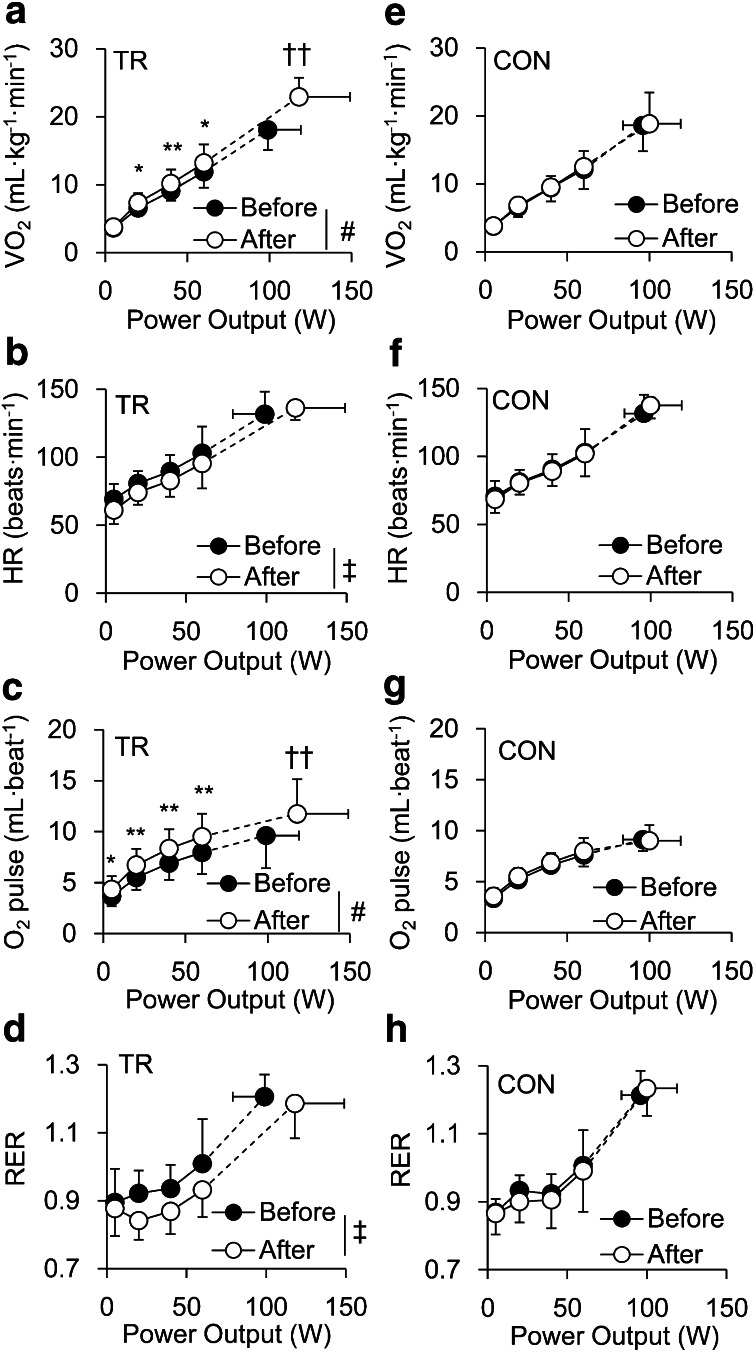
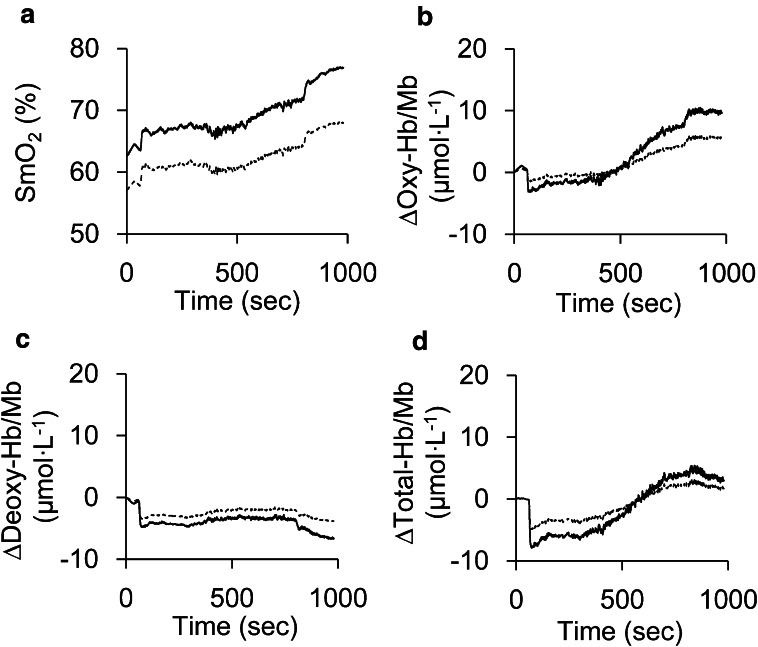
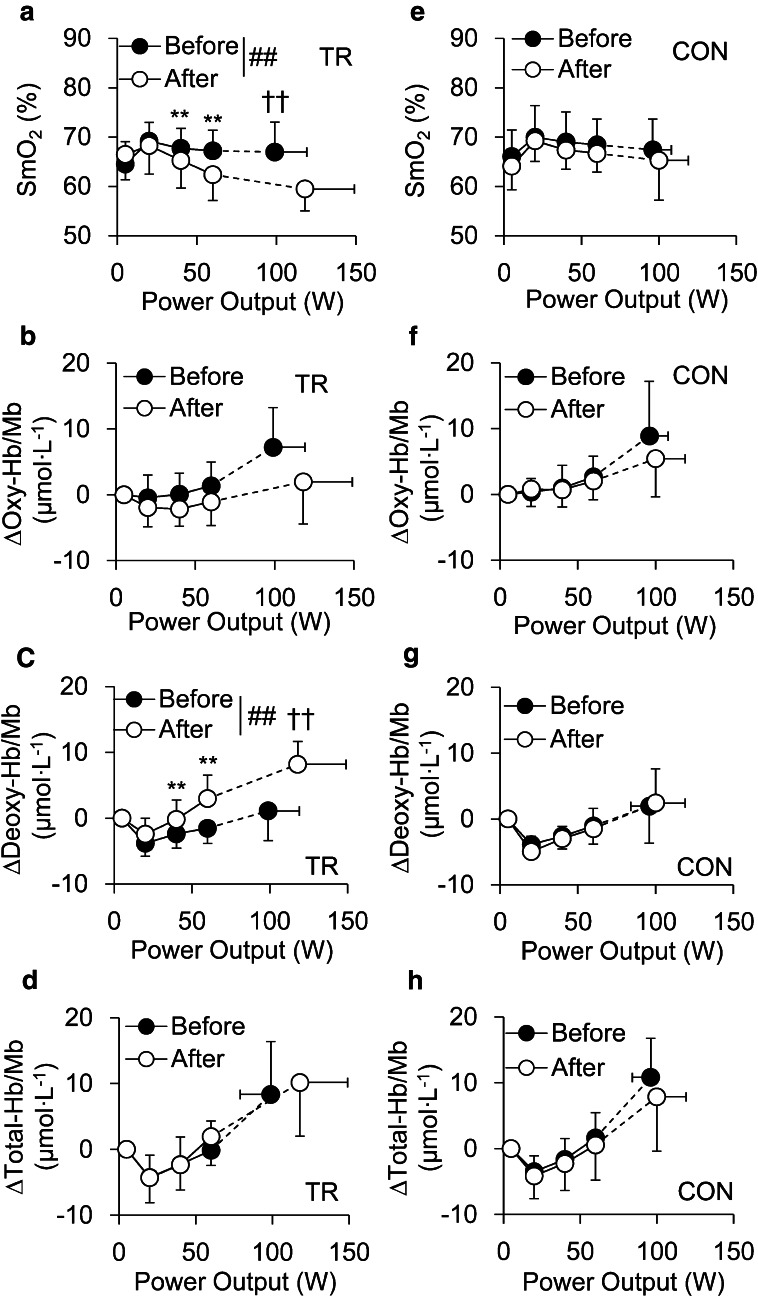
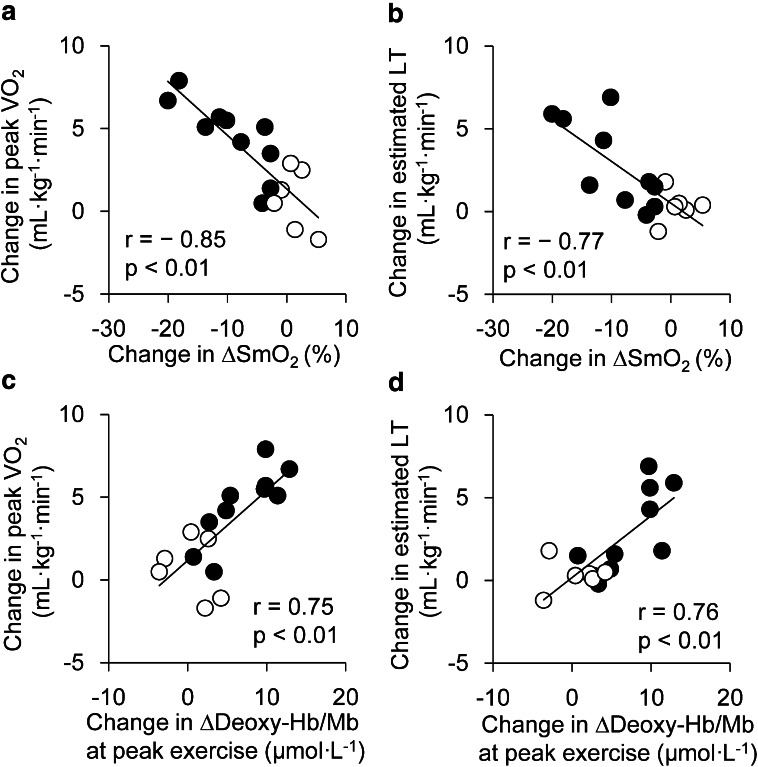
Verification
Claims the paper makes
The claims and statistics of this paper haven’t been checked yet.
Free: it reads the open-access text and checks the first 5 claims that cite a source we can check. Create a free account to check every claim.
Claims other papers make about this one
Each is checked against this paper’s own text: does it say what the citing paper says it does?
The cited source says what the claim attributes to it.
In the citing paper
“Some simple NIRS devices, such as the ASTEM NIRSRS , have incorporated adipose layer measurements to improve the accuracy of their algorithms. 49”
From Performance comparison of the MOXY and PortaMon near-infrared spectroscopy muscle oximeters at rest and during exercise (2018) · cites this paper as [49]
Self-check
Percentages, sums and reported differences re-computed from the paper’s own numbers.
The self-check needs the paper’s full text.
Citations
Cites
A new method for detecting anaerobic threshold by gas exchange
Beaver, W. L., Wasserman, K., & Whipp, B. J. (1986) · Journal of Applied Physiology · doi:10.1152/jappl.1986.60.6.2020 · Cited by 4,103 · cited 7×
“In contrast, there were no significant interactions or main effects in HR and RER at peak exercise.”
BackgroundMethodInfluentialAnaerobic threshold and respiratory gas exchange during exercise.
Wasserman, K., Whipp, B. J., Koyl, S. N., & Beaver, W. L. (1973) · Journal of Applied Physiology · doi:10.1152/jappl.1973.35.2.236 · Cited by 2,094 · cited 7×
“In contrast, there were no significant interactions or main effects in HR and RER at peak exercise.”
BackgroundMethodInfluentialWisløff, U., Støylen, A., Loennechen, J. P., Bruvold, M., Rognmo, Ø., Haram, P. M., Tjønna, A. E., Helgerud, J., Slørdahl, S. A., Lee, S. J., et al. (2007) · Circulation · doi:10.1161/circulationaha.106.675041 · Cited by 1,996 · cited 2×
“2012), and the risk may be the same compared with moderate intensity aerobic training in heart failure patients (Wisløff et al. 2007).”
BackgroundSullivan, M. J., Higginbotham, M. B., & Cobb, F. R. (1988) · Circulation · doi:10.1161/01.cir.78.3.506 · Cited by 697 · cited 4×
“…1997), but also increased peak muscle blood flow (Sullivan et al. 1988), increased arterial venous oxygen (O2) difference (Dubach et al. 1997), and increased mitochondrial density and oxidative enzyme activity in skeletal muscle (Belardinelli et al. 1995; Minotti et al. 1990; Sullivan et al. 1988).”
BackgroundInfluentialHambrecht, R., Niebauer, J., Fiehn, E., Kälberer, B., Offner, B., Hauer, K., Riede, U., Schlierf, G., Kübler, W., & Schuler, G. (1995) · Journal of the American College of Cardiology · doi:10.1016/0735-1097(94)00568-b · Cited by 580 · cited 1×
“In fact, previous results demonstrated that, after 6 months of exercise training, leg VO2 at a given absolute WR was increased in CHF patients (Hambrecht et al. 1995).”
ResultFitness versus physical activity patterns in predicting mortality in men
Myers, J., Kaykha, A., George, S., Abella, J., Zaheer, N., Lear, S., Yamazaki, T., & Froelicher, V. (2004) · The American Journal of Medicine · doi:10.1016/j.amjmed.2004.06.047 · Cited by 521 · cited 1×
“An increase in aerobic capacity reduces cardiovascular-associated morbidity and mortality, as well as an increase in physical activity (Myers et al. 2004).”
BackgroundRognmo, Ø., Moholdt, T., Bakken, H., Hole, T., Mølstad, P., Myhr, N. E., Grimsmo, J., & Wisløff, U. (2012) · Circulation · doi:10.1161/circulationaha.112.123117 · Cited by 511 · cited 2×
“Recent previous studies demonstrated that high-intensity interval training may be effective to improve aerobic capacity in coronary heart disease patients (Rognmo et al. 2012), and the risk may be the same compared with moderate intensity aerobic training in heart failure patients (Wisløff et al.”
BackgroundThe maximally attainable V̇o2during exercise in humans: the peak vs. maximum issue
Day, J. R., Rossiter, H. B., Coats, E. M., Skasick, A., & Whipp, B. J. (2003) · Journal of Applied Physiology · doi:10.1152/japplphysiol.00024.2003 · Cited by 447 · cited 1×
“The ∆VO2/∆WR slope during ramp exercise was calculated by the linear regression of VO2 with work rate, from 4 min after the beginning of the ramp loading up to the point that represented 80 % of the total duration of ramp exercise (Boone et al. 2008; Day et al. 2003).”
MethodHamaoka, T., McCully, K. K., Quaresima, V., Yamamoto, K., & Chance, B. (2007) · Journal of Biomedical Optics · doi:10.1117/1.2805437 · Cited by 329
Low intensity exercise training in patients with chronic heart failure
Belardinelli, R., Georgiou, D., Scocco, V., Barstow, T. J., & Purcaro, A. (1995) · Journal of the American College of Cardiology · doi:10.1016/0735-1097(95)00267-1 · Cited by 314 · cited 3×
“…1997), but also increased peak muscle blood flow (Sullivan et al. 1988), increased arterial venous oxygen (O2) difference (Dubach et al. 1997), and increased mitochondrial density and oxidative enzyme activity in skeletal muscle (Belardinelli et al. 1995; Minotti et al. 1990; Sullivan et al. 1988).”
Background
Research works printed but not linked: 1
- Niwayama M Sono S Murata H Yoshida H Shinohara S Errors in muscle oxygenation measurement using spatially-resolved NIRS and its correction J Jpn Coll Angiol 2007 47 1 17 20
Cited by
McManus, C. J., Collison, J., & Cooper, C. E. (2018) · Journal of Biomedical Optics · doi:10.1117/1.jbo.23.1.015007 · Cited by 205
“Some simple NIRS devices, such as the ASTEM NIRSRS, have incorporated adipose layer measurements to improve the accuracy of their algorithms.(49) In principle, both PortaMon and MOXY methods described in this paper could make similar adjustments.”
MethodBoone, J., Vandekerckhove, K., Coomans, I., Prieur, F., & Bourgois, J. G. (2016) · European Journal of Applied Physiology · doi:10.1007/s00421-016-3468-x · Cited by 68
“It should be noted, however, that the studies reporting an association between the amplitude of the totalHb and HHb response and aerobic fitness level are limited (Prieur and Mucci 2013; Takagi et al. 2016).”
BackgroundInfluentialTuesta, M., Yáñez-Sepúlveda, R., Verdugo-Marchese, H., Mateluna, C., & Alvear-Ordenes, I. (2022) · Biology · doi:10.3390/biology11071073 · Cited by 37
“NIR srs Hb11 CW, multi-distance StO2 (%), ∆HHb, ∆O2Hb, ∆tHb (μmol) 770, 830 [57]”
BackgroundMethodInfluentialYanaoka, T., Hamada, Y., Kashiwabara, K., Kurata, K., Yamamoto, R., Miyashita, M., & Hirose, N. (2018) · The Journal of Strength and Conditioning Research · doi:10.1519/jsc.0000000000002781 · Cited by 37
“The probe consisted of 1 light source and 2 photodiode detectors, and the optode distances were 20 and 30 mm (26).”
BackgroundMethodInfluentialThe Effect of Half-time Re-Warm up Duration on Intermittent Sprint Performance.
Yanaoka, T., Kashiwabara, K., Masuda, Y., Yamagami, J., Kurata, K., Takagi, S., Miyashita, M., & Hirose, N. (2018) · Europe PMC (PubMed Central) · Cited by 27
Self-citationAerobic Interval Training Impacts Muscle and Brain Oxygenation Responses to Incremental Exercise
Caen, K., Vermeire, K., Pogliaghi, S., Moerman, A., Niemeijer, V. M., Bourgois, J., & Boone, J. (2019) · Frontiers in Physiology · doi:10.3389/fphys.2019.01195 · Cited by 24
Smarż, K., Jaxa-Chamiec, T., Zaborska, B., Tysarowski, M., & Budaj, A. (2021) · Journal of Clinical Medicine · doi:10.3390/jcm10184083 · Cited by 21
“In another study of early post-AMI patients assigned to a CR group, aerobic training enhanced skeletal muscle deoxygenation assessed in near-infrared spectroscopy, and it was related to an increased EC [39].”
BackgroundRissanen, A., Tikkanen, H. O., Koponen, A. S., Aho, J. M., & Peltonen, J. E. (2017) · Applied Physiology, Nutrition, and Metabolism · doi:10.1139/apnm-2017-0222 · Cited by 14
“The principles of NIRS and its applications in exercise physiology have been described elsewhere (Ferrari et al. 2004); briefly, the intensity of incident and transmitted light was recorded continuously and, along with the specific optical pathlength and extinction coefficients, used for on-line estimation and display…”
ResultInfluentialGildea, N., McDermott, A., Rocha, J., O'Shea, D. B., Green, S., & Egaña, M. (2021) · American Journal of Physiology-Regulatory, Integrative and Comparative Physiology · doi:10.1152/ajpregu.00318.2020 · Cited by 13
Manresa‐Rocamora, A., Sarabia, J. M., Sánchez‐Meca, J., de Oliveira, J. J. F., Vera-García, F. J., & Moya‐Ramón, M. (2020) · Journal of Aging and Physical Activity · doi:10.1123/japa.2019-0363 · Cited by 12
Smarż, K., Jaxa-Chamiec, T., Zaborska, B., Tysarowski, M., & Budaj, A. (2021) · PLoS ONE · doi:10.1371/journal.pone.0255682 · Cited by 12
Skeletal muscle oxygen dynamics and peak aerobic capacity
Takagi, S. (2016) · The Journal of Physical Fitness and Sports Medicine · doi:10.7600/jpfsm.5.379 · Cited by 11
Self-citationWakasugi, T., Morishita, S., Kaida, K., Ikegame, K., Uchiyama, Y., & Domen, K. (2021) · Supportive Care in Cancer · doi:10.1007/s00520-021-06178-w · Cited by 12
Bourscheid, G., Just, K. R., Costa, R. R., Petry, T., Danzmann, L. C., Pereira, A. H., Pereira, A. A., Franzoni, L. T., & Garcia, E. L. (2021) · Jornal Vascular Brasileiro · doi:10.1590/1677-5449.210056 · Cited by 11
Fitze, D. P., Franchi, M. V., Popp, W., Ruoss, S., Catuogno, S., Camenisch, K., Lehmann, D., Schmied, C. M., Niederseer, D., Frey, W. O., et al. (2019) · JMIR Research Protocols · doi:10.2196/10970 · Cited by 8
“vastus lateralis during the ramp test [39].”
Gollie, J. M., Guccione, A. A., Keyser, R. E., Chin, L. M. K., Panza, G. S., & Herrick, J. E. (2020) · Journal of Spinal Cord Medicine · doi:10.1080/10790268.2020.1798137 · Cited by 7
Determinants of V̇+O2peak Changes After Aerobic Training in Coronary Heart Disease Patients
Girault, A., Leprêtre, P., Trachsel, L. D., Besnier, F., Boidin, M., Lalongé, J., Juneau, M., Bherer, L., Nigam, A., & Gayda, M. (2024) · International Journal of Sports Medicine · doi:10.1055/a-2253-1807 · Cited by 5
Shirai, Y., Ito, T., Ito, Y., Matsunaga, N., Noritake, K., Ochi, N., & Sugiura, H. (2023) · Healthcare · doi:10.3390/healthcare11020221 · Cited by 4
Vasquez-Bonilla, A. A., Camacho-Cardeñosa, A., Camacho-Cardeñosa, M., Martínez‐Guardado, I., Timón, R., & Olcina, G. J. (2016) · RICYDE Revista Internacional de Ciencias del Deporte · doi:10.5232/ricyde2017.04705 · Cited by 2
Muscle Oxygen Dynamics Measured by NIRS
Kime, R., Endo, T., Takagi, S., & Hamaoka, T. (2024) · Advances in experimental medicine and biology · doi:10.1007/978-3-031-67458-7_56 · Cited by 2
Self-citationWakasugi, T., Morishita, S., Kaida, K., Ikegame, K., Uchiyama, Y., & Domen, K. (2021) · Supportive Care in Cancer · doi:10.1007/s00520-021-06225-6 · Cited by 2
Orcioli‐Silva, D., Marostegan, A. B., Rasteiro, F. M., Gobatto, C. A., & Manchado-Gobatto, F. D. B. (2025) · Translational Journal of the American College of Sports Medicine · doi:10.1249/tjx.0000000000000322 · Cited by 1
Effects of 8 Weeks’ Training on Systemic and Muscle Oxygen Dynamics in University Rugby Players
Takagi, S., Kime, R., Niwayama, M., Hirayama, K., & Sakamoto, S. (2017) · Advances in experimental medicine and biology · doi:10.1007/978-3-319-55231-6_7 · Cited by 1
Self-citationTakagi, S., Kime, R., Murase, N., Niwayama, M., Osada, T., & Katsumura, T. (2018) · Advances in experimental medicine and biology · doi:10.1007/978-3-319-91287-5_15
Self-citation12-13 Yaş Futbolcularda Uygulanan Ramp Isınma Protokolünün Fiziksel Parametrelere Etkisi
Ercin, Ç. B. (2025) · Akademisyen Kitabevi eBooks · doi:10.37609/akya.3887.c1958
Whyte, E. (2021) · TSpace (University of Toronto)
Pereira, A. A. (2024) · LA Referencia (Red Federada de Repositorios Institucionales de Publicaciones Científicas)
He, M., Zhang, Y., Pan, Y., Chen, L., Huang, M., & Wei, W. (2026) · Research Square · doi:10.21203/rs.3.rs-10680264/v1
球技系競技における効果的なハーフタイム・リウォームアッププロトコルの検討
Yanaoka, T., & 柳岡, 拓. (2018) · Institutional Repositories DataBase (IRDB)
Ionescu, G., Piele, D., Geambesa, M., Rusu, M. R., Rusu, L., Marin, M., & Buciu, G. (2026) · Research Square · doi:10.21203/rs.3.rs-10779556/v1
Metadata
- Authors
- Takagi, S., Murase, N., Kime, R., Niwayama, M., Osada, T., & Katsumura, T.
- Affiliations
- Waseda University (JP)
- Tokyo Medical University (JP)
- Shizuoka University (JP)
- Corresponding author
- Takagi, Shun
- Venue
- European Journal of Applied Physiology
- Published
- 2016-01-12
- Volume
- 116
- Issue
- 4
- Pages
- 673-685
- ISSN
- 0020-9376 (ISSN-L)
- 1439-6319
- 1439-6327
- PMC
- PMC4819748
- OpenAlex
- W2236961342
- Semantic Scholar
- 558e1df93b12124224423e68ed1dda647d7084c7
- Cited by
- 25
- References
- 38
- Citations by year
- 2026: 2 · 2025: 1 · 2024: 2 · 2023: 1 · 2022: 1 · 2021: 5 · 2020: 2 · 2019: 2 · 2018: 4 · 2017: 2 · 2016: 3
- FWCI
- 7.54
- Type
- journal article
- Language
- en
- Open access
- hybrid
- doi.org
- Licence
- cc-by
- creativecommons.org/licenses/by/4.0 (tdm)
- creativecommons.org/licenses/by/4.0 (vor)
- Locations
- European Journal of Applied Physiology (publishedVersion, cc-by)
- Europe PMC (PubMed Central) (publishedVersion, cc-by)
- PubMed Central (publishedVersion, cc-by)
- PubMed (publishedVersion)
- Funders
- Japan Society for the Promotion of Science (26882044)
- Topics
- Health Sciences › Medicine › Physiology (medical) › Cardiovascular and exercise physiology
- Health Sciences › Medicine › Physiology (medical) › Exercise and Physiological Responses
- Health Sciences › Medicine › Orthopedics and Sports Medicine › Sports Performance and Training
- Keywords
- aerobic exercise, myocardial infarction, muscle oxygen saturation, peak oxygen uptake, cardiorespiratory fitness, deoxyhemoglobin, myoglobin, exercise training
- MeSH terms
- Adult, Aged, Exercise Therapy, Female, Humans, Male, Middle Aged, Myocardial Infarction, Oxygen Consumption, Exercise, Muscle, Skeletal
About these checks
Registry, retraction, Cites and statistics results are computed, not judged, with one exception: a printed reference that no index lists is read once by a model before it counts as a citation error. Claims are extracted by a model and kept only when their quote appears verbatim in the text; each cited source is then checked, with a model’s help, for whether it says what the claim relies on. Those verdicts can be wrong — read the claim’s quote and the cited source before relying on one.
Statistics and arithmetic are recomputed, not judged.
Confidence bands are shown only for fields calibrated on our annotated test set. None is calibrated yet, so no band is shown.
What counts as a claim ›How we measure confidence ›How we check this ›
Are you an author, or do you see a problem with this page? Request a review
Data sources
Bibliographic data: Semantic Scholar, OpenAlex, Crossref.
Contains information from the Semantic Scholar Academic Graph Datasets, made available under the ODC Attribution License (ODC-BY 1.0).
Semantic Scholar’s data is described in: Kinney, R., et al. (2023). The Semantic Scholar Open Data Platform. arXiv:2301.10140.
