

The DOI matches its Crossref record; 58 of the 59 references it cites were found in a registry or an index; none of the 43 sources its claims cite is checked for support yet.
Vitamin D status and its determinants in German elite athletes
Open accessAbstract
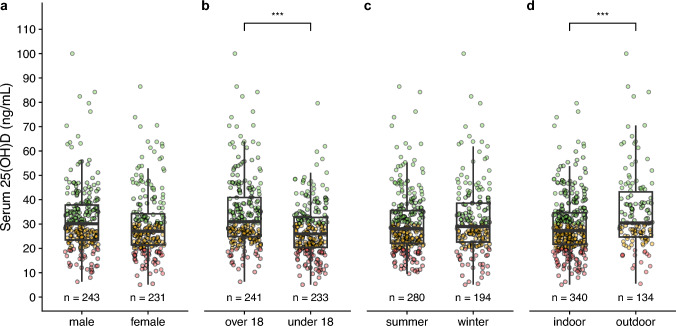
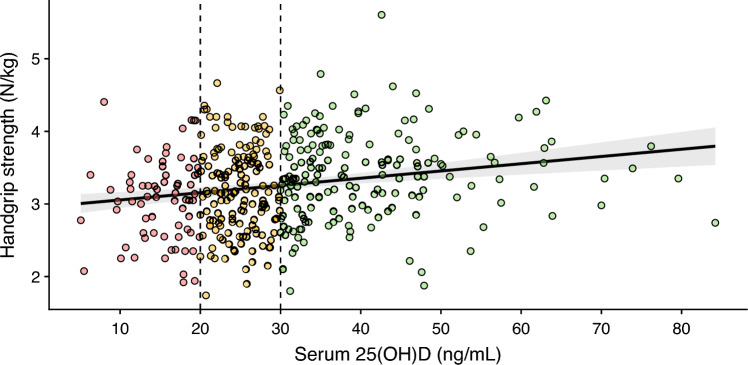
Purpose: This study investigated elite German athletes to (1) assess their serum 25(OH)D levels and the prevalence of insufficiency, (2) identify key factors influencing serum 25(OH)D levels, and (3) analyze the association between serum 25(OH)D levels and handgrip strength. Methods: In this cross-sectional study, a total of 474 athletes (231 female), aged 13–39 years (mean 19.3 years), from ten Olympic disciplines were included. Serum 25(OH)D levels were analyzed via liquid chromatography–mass spectrometry, and 17 single nucleotide polymorphisms (SNPs) related to vitamin D metabolism were determined using leukocyte DNA. Grip strength was measured unimanually using a hand-held dynamometer. Multiple linear regressions were used to analyze the influence of SNPs, age, sex, season (summer vs. winter), and discipline (indoor vs. outdoor) on 25(OH)D status. Linear regression analyzed the relationship between handgrip strength and serum 25(OH)D levels. Results: In total, 55.5% (n = 263) of athletes demonstrated insufficient serum 25(OH)D levels (< 30 ng/mL, < 75 nmol/L), with 16% (n = 76) showing levels below 20 ng/mL (50 nmol/L). After correction for multiple testing, significant influences on 25(OH)D levels were observed for the C allele of VDBP rs7041 (AC Genotype: $$\widehat{\upbeta }$$ β ^ = 7.46, p < .001; CC Genotype: $$\widehat{\upbeta }$$ β ^ = 6.23, p = .001). Age (all p < .01) and discipline (indoor vs. outdoor; all p < .05) also influenced serum 25(OH)D levels. Furthermore, serum 25(OH)D was positively associated with handgrip strength ( $$\widehat{\upbeta }$$ β ^ = 0.01, p < .001). Conclusion: A high prevalence of insufficient 25(OH)D levels (< 30 ng/mL, < 75 nmol/L) was observed. We identified certain genetic variants as well as age and discipline as predictors of serum 25(OH)D levels. This knowledge may guide individualized diagnostic, nutritional, and supplementation strategies.
Overview
CoChat Summary
TL;DR
In 474 German elite athletes, 55.5% had insufficient serum 25(OH)D (<30 ng/mL) and 16% were deficient (<20 ng/mL). VDBP rs7041 C allele, age, and outdoor discipline predicted higher 25(OH)D, and 25(OH)D was positively associated with handgrip strength.
Key findings
- Mean serum 25(OH)D was 30.98 ± 13.43 ng/mL; 55.5% (n = 263) had levels <30 ng/mL, including 16% (n = 76) <20 ng/mL and 39.5% (n = 187) at 20–30 ng/mL.
- After multiple-testing correction, VDBP rs7041 C allele was associated with higher 25(OH)D: AC genotype β^ = 7.46, p < .001; CC genotype β^ = 6.23, p = .001.
- Older athletes had higher 25(OH)D than juniors (34.39 ± 14.76 vs. 27.46 ± 10.84 ng/mL, p < 0.001), and outdoor-discipline athletes had higher levels than indoor athletes (35.15 ± 16.10 vs. 29.34 ± 11.85 ng/mL, p < 0.001).
- Serum 25(OH)D was positively associated with handgrip strength (β^ = 0.01, p < .001), with the model explaining 4% of variance (adjusted R² = 0.04).
Methods
- Cross-sectional analysis within the ongoing “in:prove” project; 474 elite German athletes (231 female), aged 13–39 years (mean 19.3), from ten Olympic disciplines.
- Serum 25(OH)D measured by liquid chromatography–mass spectrometry; 17 vitamin D pathway SNPs genotyped from leukocyte DNA; handgrip strength measured unimanually with a hand-held dynamometer; nutrition assessed in a subset using a three-day protocol.
- Welch t tests compared groups; multiple linear regression with tenfold cross-validation analyzed SNP, age, sex, season, and discipline effects; linear regression analyzed handgrip strength; Benjamini–Hochberg FDR controlled multiple comparisons.
Limitations
- Stated: vitamin D status relied on a single blood sample, providing only a snapshot and not accounting for temporal fluctuations, sun exposure, skin type/pigmentation, clothing, sunscreen, diet, and supplementation; cross-sectional design may not fully capture dynamic vitamin D levels.
- Stated: dietary intake and supplementation were recorded via a three-day nutrition protocol dependent on accurate athlete documentation, with some protocols incomplete, introducing reporting bias.
- Evident from text: handgrip analysis included only 404 of 474 athletes, and genetic information was missing for 8 athletes for all SNPs except VDBP rs7041 and 9 athletes for VDBP rs7041; the handgrip finding is an association, not causation.
Model-written summary. Check it against the paper before relying on it.
Integrity signals
Registry
Cites
Statistics
Figures
Verification
Claims the paper makes
0 Valid · 0 Not valid · 28 Not checked · 58 Own results and interpretations
In the paper
“Following previous analyses (Farrokhyar et al. 2015), we see higher levels of 25(OH)D in athletes competing in outdoor disciplines compared to indoor disciplines.”
- Also stated in: § Conclusions and future directions · plain
“The analysis revealed that age and discipline (indoor vs. outdoor) significantly influence vitamin D status, with older elite athletes and outdoor athletes having higher serum 25(OH)D levels.”
§ Vitamin D status and its determinants in German elite athletes > Discussion > Factors influencing serum 25(OH)D levels
What the sources say
- Not checked yetcites Farrokhyar et al. 2015 source
plainstates an association- Asserted: passes — The authors put it forward as true.
- Checkable: passes — It can be checked against evidence.
- Load-bearing: passes — The paper’s conclusions depend on it.
- Based: passes — The paper gives a reason why it holds.
- Also stated in: § Conclusions and future directions · plain
A result the paper reports from its own data — it cites no other source for it, so there is none to check. The quote shows it is in the paper.
In the paper
“Of the 474 included athletes (231 female), 39.5% (n = 187) had insufficient levels between 20 and 30 ng/mL (50–75 nmol/L), and 16% (n = 76) had serum 25(OH)D levels beneath 20 ng/mL (50 nmol/L).”
- Also stated in: § Results · plain
“In total, 55.5% (n = 263) of athletes demonstrated insufficient serum 25(OH)D levels (< 30 ng/mL, < 75 nmol/L), with 16% (n = 76) showing levels below 20 ng/mL (50 nmol/L).”
§ Vitamin D status and its determinants in German elite athletes > Results > Vitamin D status
plainn = 76- Asserted: passes — The authors put it forward as true.
- Checkable: passes — It can be checked against evidence.
- Load-bearing: unclear — It is unclear whether the paper’s conclusions depend on it.
- Based: passes — The paper gives a reason why it holds.
- Rests on an assumption not shown here.
- Also stated in: § Results · plain
A result the paper reports from its own data — it cites no other source for it, so there is none to check. The quote shows it is in the paper.
In the paper
“Further, the predictors age and ‘outdoor’ were positively associated with serum 25(OH)D (β^ = 0.63, SE = 0.18, p = 0.001 and β^ = 4.33, SE = 1.58, p = 0.007, respectively).”
§ Vitamin D status and its determinants in German elite athletes > Results > Analysis of vitamin D pathway related single nucleotide polymorphisms
plainstates an association- Asserted: passes — The authors put it forward as true.
- Checkable: passes — It can be checked against evidence.
- Load-bearing: unclear — It is unclear whether the paper’s conclusions depend on it.
- Based: passes — The paper gives a reason why it holds.
- Rests on an assumption not shown here.
A result the paper reports from its own data — it cites no other source for it, so there is none to check. The quote shows it is in the paper.
In the paper
“Of the 474 included athletes (231 female), 39.5% (n = 187) had insufficient levels between 20 and 30 ng/mL (50–75 nmol/L), and 16% (n = 76) had serum 25(OH)D levels beneath 20 ng/mL (50 nmol/L).”
§ Vitamin D status and its determinants in German elite athletes > Results > Vitamin D status
plainn = 187- Asserted: passes — The authors put it forward as true.
- Checkable: passes — It can be checked against evidence.
- Load-bearing: unclear — It is unclear whether the paper’s conclusions depend on it.
- Based: passes — The paper gives a reason why it holds.
- Rests on an assumption not shown here.
37 more claims
Create a free account to see all 86 claims and to verify the 40 references still open.
- Probably not a substantial claim. 33
- It may state two separate claims as one. 21
Statistics recomputed
Every reported test result, recomputed from its test statistic and degrees of freedom. A result shows as not adding up only once an independent check has confirmed it.
- Consistentt(440.59) = 5.84reported p < .001 · recomputed p < .001
“t(440.59) = 5.84, p < .001”
- Consistentt(471.7) = 1.73reported p = .085 · recomputed p = .084
“t(471.7) = 1.73, p = .085”
- Consistentt(136.84) = 2.89reported p = .004 · recomputed p = .004
“t(136.84) = 2.89, p = .004”
- ConsistentF(1, 402) = 17.82reported p < .001 · recomputed p < .001
“F(1, 402) = 17.82, p < .001”
Self-check
Percentages, sums and reported differences re-computed from the paper’s own numbers.
Self-check results appear here once an independent check has confirmed them.
Cited works that were retracted
Works this paper cites that were later retracted, from the retraction notices publishers deposit. Major when the notice came out before this paper was published.
A note, not an issue: for example, a cited work that was retracted only after this paper was published, which its authors could not have known.
Cited work 10.5167/uzh-227991 · retraction date not known · this paper published 2025-01-04
Citations
Cites
1 retracted
Performance improvement in sport through vitamin D - a narrative review
Weiss, K., Devrim-Lanpir, A., Jastrzębski, Z., Nikolaidis, P. Τ., Hill, L., & Knechtle, B. (2022) · PubMed · doi:10.5167/uzh-227991 · Cited by 8
RetractedWickham, H. (2016) · Use R! · doi:10.1007/978-3-319-24277-4 · Cited by 33,115
Holick, M. F. (2007) · New England Journal of Medicine · doi:10.1056/nejmra070553 · Cited by 13,720
Holick, M. F., Binkley, N. C., Bischoff-Ferrari, H. A., Gordon, C. M., Hanley, D. A., Heaney, R. P., Murad, M. H., & Weaver, C. M. (2011) · The Journal of Clinical Endocrinology & Metabolism · doi:10.1210/jc.2011-0385 · Cited by 10,538
Vitamin D metabolism, mechanism of action, and clinical applications
Bikle, D. D. (2014) · Chemistry & Biology · doi:10.1016/j.chembiol.2013.12.016 · Cited by 1,933
Common genetic determinants of vitamin D insufficiency: a genome-wide association study
Wang, T. J., Zhang, F., Richards, J. B., Kestenbaum, B., van Meurs, J. B., Berry, D., Kiel, D. P., Streeten, E. A., Ohlsson, C., Koller, D. L., et al. (2010) · The Lancet · doi:10.1016/s0140-6736(10)60588-0 · Cited by 1,540
Hayes, A. F., & Cai, L. (2007) · Behavior Research Methods · doi:10.3758/bf03192961 · Cited by 1,432
Hand grip strength: Outcome predictor and marker of nutritional status
Norman, K., Stobäus, N., Gonzalez, M. C., Schulzke, J.-D., & Pirlich, M. (2011) · Clinical Nutrition · doi:10.1016/j.clnu.2010.09.010 · Cited by 1,060
Vitamin D supplementation guidelines
Pludowski, P., Holick, M. F., Grant, W. B., Konstantynowicz, J., Mascarenhas, M. R., Haq, A., Povoroznyuk, V., Balatska, N., Barbosa, A. P., Karonova, T., et al. (2018) · The Journal of Steroid Biochemistry and Molecular Biology · doi:10.1016/j.jsbmb.2017.01.021 · Cited by 720
Vitamin D Receptor Expression in Human Muscle Tissue Decreases with Age
Bischoff-Ferrari, H., Borchers, M., Gudat, F., Dürmüller, U., Stähelin, H., & Dick, W. (2004) · Journal of Bone and Mineral Research · doi:10.1359/jbmr.2004.19.2.265 · Cited by 585
Research works printed but not linked: 2
- Institute of Medicine (2011) Dietary reference intakes for calcium and Vitamin D (Ross AC, Taylor CL, Yaktine AL, Del Valle HB (Eds). National Academies Press (US). http://www.ncbi.nlm.nih.gov/books/NBK56070/
- Zeileis A, Hothorn T (2002) Diagnostic checking in regression relationships. R News 2(3):7–10
Cited by
Gabdulkayum, A., Amangeldikyzy, S., Khassanova, S., Yerezhepov, A. Y., Akilzhanov, K. R., Kozhamkulov, U. A., Rakhimova, S., Kairov, U., Yerezhepov, D., & Akilzhanova, A. R. (2025) · European Journal of Applied Physiology · doi:10.1007/s00421-025-05976-y · Cited by 4
Gabdulkayum, A., Amangeldikyzy, S., Yerezhepov, A. Y., Khassanova, S., Akilzhanov, K. R., Kozhamkulov, U. A., Rakhimova, S., Kairov, U., Akilzhanova, A. R., & Yerezhepov, D. (2025) · Nutrients · doi:10.3390/nu17203195 · Cited by 3
Hacker, S., Reichert, L., Lenz, C., Henne, S. K., David, F. S., Heilmann‐Heimbach, S., Zentgraf, K., & Krüger, K. (2026) · Frontiers in Genetics · doi:10.3389/fgene.2026.1838157 · Cited by 1
Self-citationCurrent Perspectives on Vitamin D Deficiency in Athletes
Muntean, P. S., Onofrei, R. R., & Amaricai, E. C. (2026) · Advances in biochemistry in health and disease · doi:10.1007/978-3-032-14441-6_13
Jürimäe, J., Remmel, L., Purge, P., & Tillmann, V. (2026) · Applied Sciences · doi:10.3390/app16083643
Metadata
- Authors
- Hacker, S., Lenz, C., Reichert, L., Ringseis, R., Zentgraf, K., & Krüger, K.
- Affiliations
- Justus-Liebig-Universität Gießen (DE)
- Goethe University Frankfurt (DE)
- Corresponding author
- Hacker, Sebastian
- Venue
- European Journal of Applied Physiology
- Published
- 2025-01-04
- Volume
- 125
- Issue
- 6
- Pages
- 1549-1561
- ISSN
- 0020-9376 (ISSN-L)
- 1439-6319
- 1439-6327
- PMC
- PMC12174178
- OpenAlex
- W4406061180
- Semantic Scholar
- b5c764a8c546844909e08b1658112b7dac6e6bb2
- Cited by
- 9
- References
- 59
- Citations by year
- 2026: 7 · 2025: 2
- FWCI
- 4.58
- Type
- journal article
- Language
- en
- Update notices
- correction (2025-09-29)
- Open access
- hybrid
- doi.org
- Licence
- cc-by
- creativecommons.org/licenses/by/4.0 (tdm)
- creativecommons.org/licenses/by/4.0 (vor)
- Locations
- European Journal of Applied Physiology (publishedVersion, cc-by)
- PubMed (publishedVersion)
- PubMed Central (publishedVersion, cc-by)
- Publication Server of Goethe University Frankfurt am Main (Goethe University Frankfurt) (submittedVersion, cc-by)
- Funders
- Bundesinstitut für Sportwissenschaft (081901/21-25)
- Justus-Liebig-Universität Gießen
- Topics
- Health Sciences › Medicine › Endocrinology, Diabetes and Metabolism › Vitamin D Research Studies
- Life Sciences › Biochemistry, Genetics and Molecular Biology › Genetics › Genetics and Physical Performance
- Health Sciences › Medicine › Orthopedics and Sports Medicine › Sports Performance and Training
- Keywords
- vitamin D status, serum 25-hydroxyvitamin D, vitamin D insufficiency, elite athletes, grip strength, single nucleotide polymorphisms, vitamin D metabolism genes, age effects, seasonal variation, German athletes, Olympic athletes, muscle strength
- MeSH terms
- Adolescent, Adult, Cross-Sectional Studies, Female, Germany, Humans, Male, Vitamin D, Vitamin D Deficiency, Hand Strength, Polymorphism, Single Nucleotide, Young Adult, Athletes
About these checks
Registry, retraction, Cites and statistics results are computed, not judged, with one exception: a printed reference that no index lists is read once by a model before it counts as a citation error. Claims are extracted by a model and kept only when their quote appears verbatim in the text; each cited source is then checked, with a model’s help, for whether it says what the claim relies on. Those verdicts can be wrong — read the claim’s quote and the cited source before relying on one.
A language model drew the claims from the paper on 2026-11-14, under version 3 of the claim definition (model deepseek-v4.1-flash, prompt extract-v3).
A second model labelled each claim on 2026-11-14 (model jev-1.13-20260917, definition revision gold-guideline-v0.2).
Statistics and arithmetic are recomputed, not judged.
Confidence bands are shown only for fields calibrated on our annotated test set. None is calibrated yet, so no band is shown.
What counts as a claim ›How we measure confidence ›How we check this ›
Are you an author, or do you see a problem with this page? Request a review
How to cite
Cite CoChat for the checks on this page, and the paper for its own findings.
- This page
- CoChat. (2026). Citation check: Vitamin D status and its determinants in German elite athletes. https://app.cochat.ai/papers/10.1007/s00421-024-05699-6
- The paper
- Hacker, S., Lenz, C., Reichert, L., Ringseis, R., Zentgraf, K., & Krüger, K. (2025). Vitamin D status and its determinants in German elite athletes. European Journal of Applied Physiology. https://doi.org/10.1007/s00421-024-05699-6
Data sources
Bibliographic data: Semantic Scholar, OpenAlex, Crossref.
Contains information from the Semantic Scholar Academic Graph Datasets, made available under the ODC Attribution License (ODC-BY 1.0).
Semantic Scholar’s data is described in: Kinney, R., et al. (2023). The Semantic Scholar Open Data Platform. arXiv:2301.10140.
