

Transposing musical skill: sonification of movement as concurrent augmented feedback enhances learning in a bimanual task
Open accessThe DOI matches its Crossref record; 68 of the 68 references it cites were found in a registry or an index.
Abstract
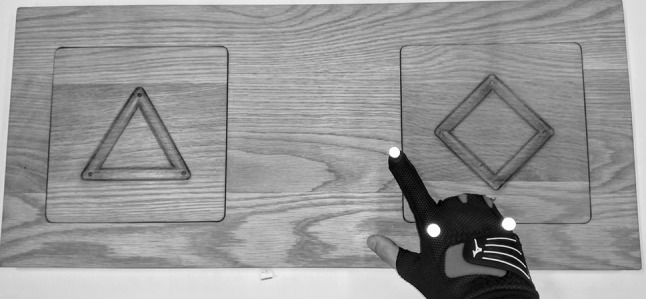
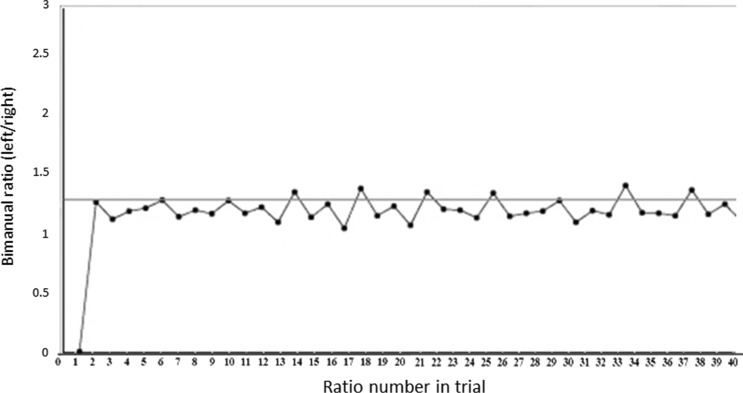
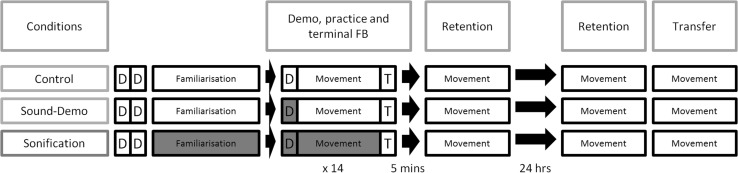
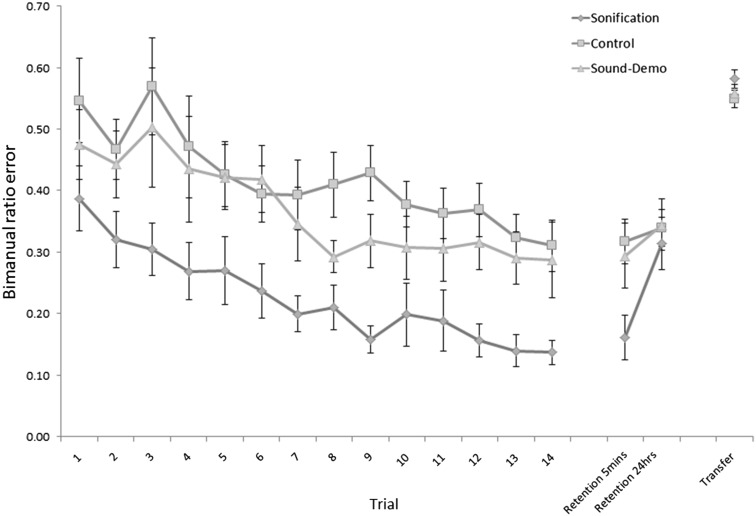
Concurrent feedback provided during acquisition can enhance performance of novel tasks. The 'guidance hypothesis' predicts that feedback provision leads to dependence and poor performance in its absence. However, appropriately structured feedback information provided through sound ('sonification') may not be subject to this effect. We test this directly using a rhythmic bimanual shape-tracing task in which participants learned to move at a 4:3 timing ratio. Sonification of movement and demonstration was compared to two other learning conditions: (1) Sonification of task demonstration alone and (2) completely silent practice (control). Sonification of movement emerged as the most effective form of practice, reaching significantly lower error scores than control. Sonification of solely the demonstration, which was expected to benefit participants by perceptually unifying task requirements, did not lead to better performance than control. Good performance was maintained by participants in the Sonification condition in an immediate retention test without feedback, indicating that the use of this feedback can overcome the guidance effect. On a 24-h retention test, performance had declined and was equal between groups. We argue that this and similar findings in the feedback literature are best explained by an ecological approach to motor skill learning which places available perceptual information at the highest level of importance.
Overview
The claims and statistics of this paper haven’t been checked yet.
Free: it reads the open-access text and checks the first 5 claims that cite a source we can check. Create a free account to check every claim.
Integrity signals
Registry
Cites
Statistics
Figures

Verification
Claims the paper makes
The claims and statistics of this paper haven’t been checked yet.
Free: it reads the open-access text and checks the first 5 claims that cite a source we can check. Create a free account to check every claim.
Self-check
Percentages, sums and reported differences re-computed from the paper’s own numbers.
The self-check needs the paper’s full text.
Citations
Cites
The assessment and analysis of handedness: The Edinburgh inventory
Oldfield, R. C. (1971) · Neuropsychologia · doi:10.1016/0028-3932(71)90067-4 · Cited by 35,900 · cited 1×
“Right-handedness was confirmed for all participants by administration of the Edinburgh Handedness Inventory (Oldfield, 1971).”
MethodJournal of Experimental Psychology: Human Perception and Performance.
Intons-Peterson, M. J. (1981) · Journal of Experimental Psychology: Human Perception and Performance · doi:10.1037/h0078016 · Cited by 3,183
Principles of Perceptual Learning and Development
Gibson, E. J. (1973) · Leonardo · doi:10.2307/1572721 · Cited by 2,487
Hearing Sounds, Understanding Actions: Action Representation in Mirror Neurons
Kohler, E., Keysers, C., Umiltà, M. A., Fogassi, L., Gallese, V., & Rizzolatti, G. (2002) · Science · doi:10.1126/science.1070311 · Cited by 1,801
A Closed-Loop Theory of Motor Learning
Adams, J. A. (1971) · Journal of Motor Behavior · doi:10.1080/00222895.1971.10734898 · Cited by 1,636 · cited 1×
“The explanation for this is that learners come to rely too heavily on the augmented information provided by concurrent feedback, and ignore task-intrinsic sources of sensory feedback, an effect known as the ‘guidance hypothesis’ (Adams, 1971).”
BackgroundKnowledge of results and motor learning: A review and critical reappraisal.
Salmoni, A. W., Schmidt, R. A., & Walter, C. B. (1984) · Psychological Bulletin · doi:10.1037/0033-2909.95.3.355 · Cited by 1,438
Augmented visual, auditory, haptic, and multimodal feedback in motor learning: A review
Sigrist, R., Rauter, G., Riener, R., & Wolf, P. (2013) · Psychonomic Bulletin & Review · doi:10.3758/s13423-012-0333-8 · Cited by 1,416
Embodied Music Cognition and Mediation Technology
Leman, M. (2007) · doi:10.7551/mitpress/7476.001.0001 · Cited by 1,047
What in the World Do We Hear?: An Ecological Approach to Auditory Event Perception
Gaver, W. W. (1993) · Ecological Psychology · doi:10.1207/s15326969eco0501_1 · Cited by 903 · cited 3×
“…the exemplary sound profile might enable early retention-level performance to re-emerge, as perception of the sonic outcome of musical motor performance entails holistic perception of the movement event which precipitated it (Gaver, 1993; Lahav, Katz, Chess, & Saltzman, 2013; Lahav et al., 2007).”
BackgroundUnderstanding Equivalence and Noninferiority Testing
Walker, E., & Nowacki, A. S. (2011) · Journal of General Internal Medicine · doi:10.1007/s11606-010-1513-8 · Cited by 751 · cited 2×
“This procedure is described in full by Walker and Nowacki (2011).”
BackgroundMethodInfluential
Research works printed but not linked: 1
- Michaels, C. F., & Carello, C. (1981). Direct Perception. Englewood Cliffs: Prentice-Hall.
Cited by
A Review on the Relationship Between Sound and Movement in Sports and Rehabilitation
Schaffert, N., Janzen, T. B., Mattes, K., & Thaut, M. H. (2019) · Frontiers in Psychology · doi:10.3389/fpsyg.2019.00244 · Cited by 206
“The use of meaningful auditory information is, therefore, determinant for the user’s experience (Effenberg et al., 2016; Dyer et al., 2017b) and needs to be considered in a clear framework for sonification mapping derived from a better understanding of the processes underlying motor learning/control from a basic resea…”
BackgroundAzaryahu, L., Courey, S. J., Elkoshi, R., & Adi‐Japha, E. (2019) · Developmental Science · doi:10.1111/desc.12882 · Cited by 70
Ghai, S., Schmitz, G. H., Hwang, T., & Effenberg, A. O. (2018) · Frontiers in Neuroscience · doi:10.3389/fnins.2018.00142 · Cited by 51
Ghai, S. (2018) · Frontiers in Neurology · doi:10.3389/fneur.2018.00488 · Cited by 54
“Ghai Recovering Arm Function Post Stroke reported to alleviate sensory perceptions like proprioception (98), by enhancing sensorimotor representation while facilitating activations in action observation system (90), and inducing neural plasticity (99).”
BackgroundMapping Sonification for Perception and Action in Motor Skill Learning
Dyer, J., Stapleton, P., & Rodger, M. W. M. (2017) · Frontiers in Neuroscience · doi:10.3389/fnins.2017.00463 · Cited by 40
“If learning is seen as education of attention (Jacobs and Michaels, 2007), the need to sonify task-intrinsic events to avoid the guidance effect is clear (for similar findings, see Dyer et al., 2017).”
ResultSelf-citationA Mapping Review of Real-Time Movement Sonification Systems for Movement Rehabilitation
Nown, T. H., Upadhyay, P., Kerr, A., Andonović, I., Tachtatzis, C., & Grealy, M. (2022) · IEEE Reviews in Biomedical Engineering · doi:10.1109/rbme.2022.3187840 · Cited by 46
“combination with the following auditory categories: loudness as demonstrated through [6], [115], [116] and [74]; timbral as demonstrated through [117]–[121]; pitch as demonstrated”
BackgroundEffenberg, A. O., & Schmitz, G. H. (2018) · Annals of the New York Academy of Sciences · doi:10.1111/nyas.13693 · Cited by 44
Advantages of melodic over rhythmic movement sonification in bimanual motor skill learning
Dyer, J. F., Stapleton, P., & Rodger, M. W. M. (2017) · Experimental Brain Research · doi:10.1007/s00221-017-5047-8 · Cited by 37
“1993), auditory displays have also been shown to be effective as concurrent augmented feedback (Dyer et al. 2016).”
BackgroundSelf-citationRoddy, S., & Bridges, B. (2020) · Journal on Multimodal User Interfaces · doi:10.1007/s12193-020-00318-y · Cited by 40
Training proprioception with sound: effects of real‐time auditory feedback on intermodal learning
Ghai, S., Schmitz, G. H., Hwang, T., & Effenberg, A. O. (2018) · Annals of the New York Academy of Sciences · doi:10.1111/nyas.13967 · Cited by 30
Frid, E., Moll, J., Bresin, R., & Sallnäs Pysander, E.-L. (2019) · Journal on Multimodal User Interfaces · doi:10.1007/s12193-018-0264-4 · Cited by 19
The Limitations of Being a Copycat: Learning Golf Putting Through Auditory and Visual Guidance
Bieńkiewicz, M. M. N., Bringoux, L., Buloup, F., Rodger, M. W. M., Craig, C., & Bourdin, C. (2019) · Frontiers in Psychology · doi:10.3389/fpsyg.2019.00092 · Cited by 15
Self-citationSonification of Golf Putting Gesture Reduces Swing Movement Variability in Novices
O’Brien, B., Juhas, B. D., Bieńkiewicz, M. M. N., Buloup, F., Bringoux, L., & Bourdin, C. (2020) · Research Quarterly for Exercise and Sport · doi:10.1080/02701367.2020.1726859 · Cited by 13
O’Brien, B., Juhas, B. D., Bieńkiewicz, M. M. N., Buloup, F., Bringoux, L., & Bourdin, C. (2020) · Experimental Brain Research · doi:10.1007/s00221-020-05757-3 · Cited by 12
“Concurrent sound enhanced their natural execution of the swing gesture, a point advocated by Dyer et al. (2017).”
BackgroundPardue, L., Buys, K., Overholt, D., McPherson, A., & Edinger, M. (2019) · VBN Forskningsportal (Aalborg Universitet) · doi:10.5281/zenodo.3672957 · Cited by 8
Roddy, S. (2019) · Journal of sonic studies · doi:10.22501/jss.515156 · Cited by 15
Human Movement Sonification for Motor Skill Learning
Dyer, J. (2017) · Research Portal (Queen's University Belfast) · doi:10.13140/rg.2.2.27723.08485 · Cited by 15
Self-citationAdaptation to unstable coordination patterns in individual and joint actions
Wolf, T., Sebanz, N., & Knoblich, G. (2020) · PLoS ONE · doi:10.1371/journal.pone.0232667 · Cited by 7
“Sonification, for example, can facilitate bimanual skill acquisition in the context of unstable coordination patterns [31].”
BackgroundConsiderations for Developing Sound in Golf Putting Experiments
O’Brien, B., Juhas, B. D., Bieńkiewicz, M. M. N., Pruvost, L., Buloup, F., Bringnoux, L., & Bourdin, C. (2018) · Lecture notes in computer science · doi:10.1007/978-3-030-01692-0_23 · Cited by 5
“They experience auditory feedback where their movement maps to sound, which, in turn, can help influence or guide their process of learning a particular task involving motion.[17] Numerous studies have traced this relationship, examining the activity of the motor cortex of professional pianists and non-musicians who l…”
BackgroundA Qualitative Investigation of Music Use among Amateur and Semi-Professional Golfers
Gabana, N. T., Hutchinson, J., Beauchemin, J. D., Powless, M. D., Cawthra, J. N., Halterman, A. W., & Steinfeldt, J. A. (2019) · Sports · doi:10.3390/sports7030060 · Cited by 6
“Sonification of movement, which involves digitally transforming human movement data into sound, emerged in the motor skill learning literature as an effective method of providing concurrent augmented feedback [18].”
BackgroundNataraj, R., Sanford, S., & Liu, M. (2023) · Biomechanics · doi:10.3390/biomechanics3030035 · Cited by 4
“Augmented feedback can be used to acquire complex motor skills in sports [11] or play instruments [12] for populations that are healthy, diseased, or athletic [13] In addition, augmented cues through virtual reality can cognitively engage and motivate persons to participate in more therapeutic…”
BackgroundOrchestrating Motion: Real-Time Sonification Tools and Methods to Support Movement Rehabilitation
Kantan, P. R. (2024) · VBN Forskningsportal (Aalborg Universitet) · doi:10.54337/aau696001045 · Cited by 8
Audio cues enhance mirroring of arm motion when visual cues are scarce
Lee, E., Esposito, E. P., & Cohen, I. (2019) · Journal of The Royal Society Interface · doi:10.1098/rsif.2018.0903 · Cited by 4
“When used as feedback, audio cues can enhance performance at motor tasks across a variety of contexts including learning a cyclic motion [10,13,14] and interpersonal coordination [2,15,16]—more generally perceptual coupling including other sensory modalities like vision and touch have been shown to…”
BackgroundMethodResultInfluentialMovement Sonification: Intermodal Transformation of Movement Data to Enhance Motor Learning
Effenberg, A. O., & Hwang, T. (2024) · Springer eBooks · doi:10.1007/978-3-662-68703-1_20 · Cited by 2
Hohagen, J., & Wöllner, C. (2019) · Jahrbuch der Deutschen Gesellschaft für Musikpsychologie/Jahrbuch Musikpsychologie · doi:10.5964/jbdgm.2018v28.36 · Cited by 3
Sonifying motor skills with Pizzicato, a game for motor behavior research
Starkov, M., Jochems, S., Rijsdijk, J., Snellenberg, R., Stoffels, L., Zaidi, A., & Bidarra, R. (2024) · IEEE Conference on Games (CoG) · doi:10.1109/cog60054.2024.10645594 · Cited by 4
“In a study on the effect of concurrent feedback during novel tasks, Dyer et al. [5] found that properly structured auditory feedback may not be subject to the guidance effect , which predicts that performance improves while accompanied by feedback, but is affected negatively when feedback is left…”
BackgroundA Motor Abundance Approach to Augmented Feedback for Skill Learning
Toth, M., & Rodger, M. W. M. (2025) · Ecological Psychology · doi:10.1080/10407413.2025.2582869 · Cited by 1
“However, this works when the sound conveys a clear temporal rhythm with discrete sound events to anchor movement end-points or reversals (e.g. Dyer et al., 2017b).”
Self-citationMusical Gesture through the Human Computer Interface: An Investigation using Information Theory
Blandino, M. (2021) · Louisiana State University · doi:10.31390/gradschool_dissertations.5535
Effenberg, A. O., & Hwang, T. (2024) · Springer eBooks · doi:10.1007/978-3-662-68128-2_20
Divergent effects of pitch feedback on online and offline motor sequence learning
Ploettner, P., Mühlberg, C., Psurek, F., Fricke, C., & Rumpf, J. (2025) · Frontiers in Behavioral Neuroscience · doi:10.3389/fnbeh.2025.1680277 · Cited by 1
“…eect may especially apply to visual feedback modalities whereas auditory feedback could improve online skill acquisition without impairing retention in the absence of feedback (Danna et al., 2015; Dyer et al., 2017b; van Vugt and Tillmann, 2015; Ronsse et al., 1991; Finney and Palmer, 2003).”
Giroux, M. (2021) · theses.fr (ABES) · doi:10.70675/2cba0225z2f0fz47cdz84a6z797af8b4d1d2 · Cited by 1
Véron‐Delor, L. (2021) · theses.fr (ABES) · doi:10.70675/598a3c6azf105z4d06z8a87z9c98de7ae8a0 · Cited by 3
Peyre, I. (2022) · theses.fr (ABES) · doi:10.70675/f0a335cfzb53ez4ef9z9eb9z7988e6f5f896 · Cited by 4
Sasaki, R., Niijima, A., Park, C., & Ogawa, T. (2026) · Frontiers in Psychology · doi:10.3389/fpsyg.2026.1813641
Metadata
- Authors
- Dyer, J., Stapleton, P., & Rodger, M.
- Affiliations
- Queen's University Belfast (GB)
- Corresponding author
- Dyer, John
- Venue
- Psychological Research
- Published
- 2016-05-27
- Volume
- 81
- Issue
- 4
- Pages
- 850-862
- ISSN
- 0033-3026 (ISSN-L)
- 0340-0727
- 1430-2772
- PMC
- PMC5486555
- OpenAlex
- W2403300874
- Cited by
- 34
- References
- 68
- Citations by year
- 2026: 1 · 2025: 2 · 2024: 4 · 2023: 1 · 2022: 2 · 2021: 3 · 2020: 4 · 2019: 8 · 2018: 6 · 2017: 3
- FWCI
- 3.60
- Type
- journal article
- Language
- en
- Open access
- hybrid
- doi.org
- Locations
- Psychological Research (publishedVersion, cc-by)
- Europe PMC (PubMed Central) (publishedVersion, cc-by)
- PubMed Central (publishedVersion, cc-by)
- PubMed (publishedVersion)
- Research Portal (Queen's University Belfast) (publishedVersion, cc-by)
- Topics
- Life Sciences › Neuroscience › Cognitive Neuroscience › Motor Control and Adaptation
- Social Sciences › Psychology › Developmental and Educational Psychology › Sport Psychology and Performance
- Life Sciences › Neuroscience › Cognitive Neuroscience › Tactile and Sensory Interactions
- Keywords
- sonification, concurrent feedback, bimanual coordination, rhythmic movement, motor skill learning, auditory feedback, retention, perceptual information
- MeSH terms
- Adult, Female, Humans, Functional Laterality, Learning, Male, Motor Skills, Movement, Music, Sound
About these checks
Registry, retraction, Cites and statistics results are computed, not judged, with one exception: a printed reference that no index lists is read once by a model before it counts as a citation error. Claims are extracted by a model and kept only when their quote appears verbatim in the text; each cited source is then checked, with a model’s help, for whether it says what the claim relies on. Those verdicts can be wrong — read the claim’s quote and the cited source before relying on one.
Statistics and arithmetic are recomputed, not judged.
Confidence bands are shown only for fields calibrated on our annotated test set. None is calibrated yet, so no band is shown.
What counts as a claim ›How we measure confidence ›How we check this ›
Are you an author, or do you see a problem with this page? Request a review
Data sources
Bibliographic data: Semantic Scholar, OpenAlex, Crossref.
Contains information from the Semantic Scholar Academic Graph Datasets, made available under the ODC Attribution License (ODC-BY 1.0).
Semantic Scholar’s data is described in: Kinney, R., et al. (2023). The Semantic Scholar Open Data Platform. arXiv:2301.10140.
