

Motivations of children and their parents to participate in drug research: a systematic review
Open accessThe DOI matches its Crossref record; 59 of the 60 references it cites were found in a registry or an index.
Abstract
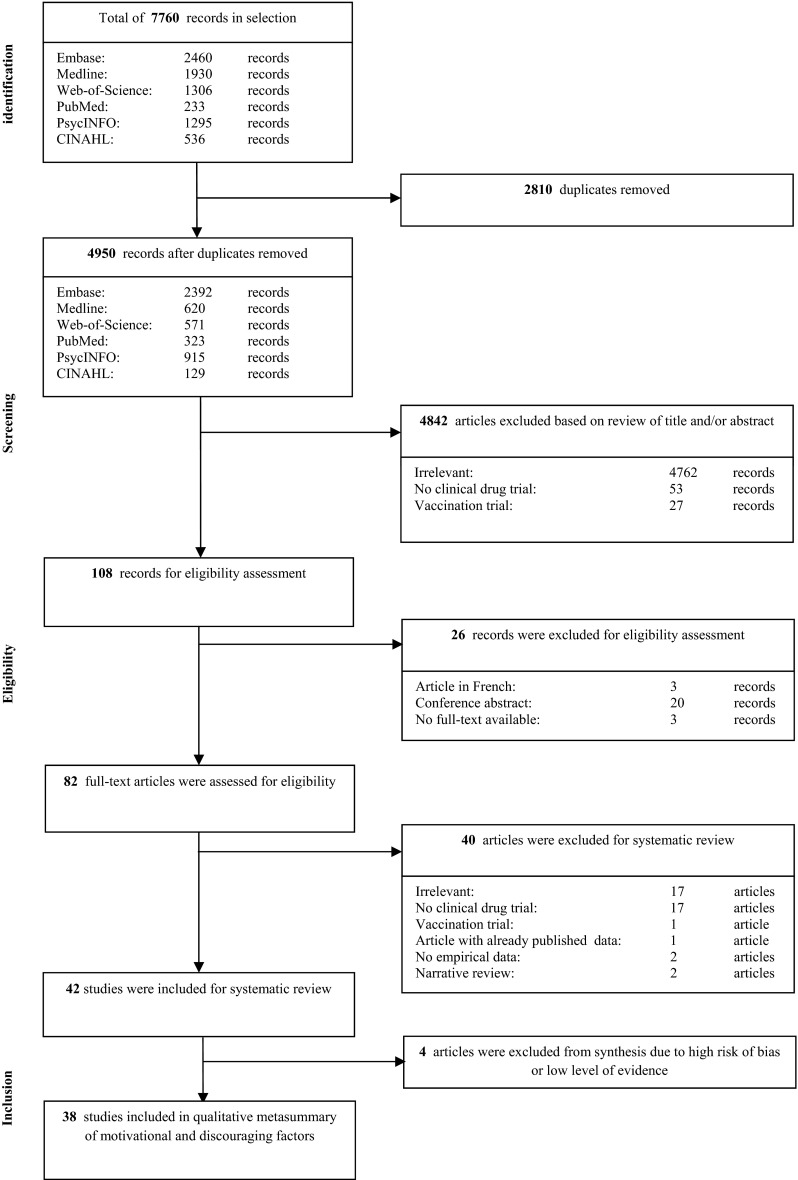
UNLABELLED: Information on motivations for research participation, may enable professionals to better tailor the process of recruitment and informed consent to the perspective of parents and children. Therefore, this systematic review assesses motivating and discouraging factors for children and their parents to decide to participate in clinical drug research. Studies were identified from searches in 6 databases. Two independent reviewers screened and selected relevant articles. Results were aggregated and presented by use of qualitative metasummary. 38 studies fulfilled the selection criteria and were of sufficient quality for inclusion in the qualitative metasummary. Most mentioned motivating factors for parents were: health benefit for child, altruism, trust in research, and relation to researcher. Most mentioned motivating factors for children were: personal health benefit, altruism and increasing comfort. Fear of risks, distrust in research, logistical aspects and disruption of daily life were mentioned most by parents as discouraging factors. Burden and disruption of daily life, feeling like a "guinea pig" and fear of risks were most mentioned as discouraging factors by children. CONCLUSION: Paying attention to these motivating and discouraging factors of children and their parents during the recruitment and informed consent process in drug research increases the moral and instrumental value of informed consent. WHAT IS KNOWN: • This systematic review pools the existing empirical literature on motivations of minors and their parents to consent or dissent to participation in clinical drug research. • The most mentioned motivating and discouraging factors for children and their parents to consent to participation in clinical drug research are identified aggregated and presented by use of qualitative metasummary. What is new: • This information can be used to adapt the research protocol, recruitment, and informed consent/assent process to the needs of children and their parents.
Overview
The claims and statistics of this paper haven’t been checked yet.
Free: it reads the open-access text and checks the first 5 claims that cite a source we can check. Create a free account to check every claim.
Integrity signals
Registry
Cites
Statistics
Figures
Verification
Claims the paper makes
The claims and statistics of this paper haven’t been checked yet.
Free: it reads the open-access text and checks the first 5 claims that cite a source we can check. Create a free account to check every claim.
Claims other papers make about this one
Each is checked against this paper’s own text: does it say what the citing paper says it does?
The source backs part of the claim, not all of it — or backs it for a different population, condition or comparison.
In the citing paper
“A general reluctance, particularly among parents and healthcare professionals, to involve children in trials, has exacerbated the challenges in recruiting children to research studies [8].”
From Parental attitudes to randomised controlled trials in primary dental care: A qualitative study (2026) · cites this paper as [8]
Experimental — accuracy not yet measured
Self-check
Percentages, sums and reported differences re-computed from the paper’s own numbers.
The self-check needs the paper’s full text.
Citations
Cites
Preferred Reporting Items for Systematic Reviews and Meta-Analyses: the PRISMA statement
Moher, D., Liberati, A., Tetzlaff, J., Altman, D. G., & for the PRISMA Group (2009) · BMJ · doi:10.1136/bmj.b2535 · Cited by 83,823
Preferred Reporting Items for Systematic Reviews and Meta-Analyses: The PRISMA Statement
Moher, D., Liberati, A., Tetzlaff, J., Altman, D. G., & The PRISMA Group (2009) · PLoS Medicine · doi:10.1371/journal.pmed.1000097 · Cited by 64,042 · cited 1×
“This systematic review is reported in accordance with the Preferred Reporting Items for Systematic Review and Metaanalyses (PRISMA) statement [32].”
MethodPreferred reporting items for systematic reviews and meta-analyses: the PRISMA Statement.
(2009) · PubMed Central · Cited by 44,859
Wang, G., Ma, R., Qiao, G., Wada, K., Aizawa, Y., & Satoh, T. (2015) · Integrative Medicine International · doi:10.1159/000368408 · Cited by 18,657
(2003) · Manual for Research Ethics Committees · doi:10.1017/cbo9780511550089.028 · Cited by 3,413
International Ethical Guidelines for Biomedical Research Involving Human Subjects
Cioms (1993) · Cited by 1,311
International ethical guidelines for biomedical research involving human subjects.
(2002) · PubMed · Cited by 783
Using qualitative metasummary to synthesize qualitative and quantitative descriptive findings
Sandelowski, M., Barroso, J., & Voils, C. I. (2007) · Research in Nursing & Health · doi:10.1002/nur.20176 · Cited by 528 · cited 1×
“[43] This approach of data-synthesis entails treating research reports as indexes of the studies conducted, and the research findings in these reports as indexes of the experiences of the persons who participated in those studies.”
MethodOff-Label Drug Use in Pediatric Patients
Kimland, E., & Odlind, V (2012) · Clinical Pharmacology & Therapeutics · doi:10.1038/clpt.2012.26 · Cited by 223 · cited 1×
“Current estimates of off-label or unlicensed use of drugs range between 10 % and 60 % in the pediatric population.[24] Precisely because clinical drug research with children is a precarious enterprise, special attention needs to be given to the informed consent process.”
Background
Research works printed but not linked: 1
- 15. Critical Appraisal Skills Programme (CASP) (2014) CASP Checklists. www.casp-uk.net. Oxford, CASP
Cited by
Sheridan, R., Martin-Kerry, J., Hudson, J., Parker, A., Bower, P., & Knapp, P. (2020) · Trials · doi:10.1186/s13063-020-4197-3 · Cited by 223
“…2015; Liljas, 2017; Limkakeng, 2013b; Woodall, 2010 Emotion (Automatic Motivation) Desire for choice Reported in 3 SRs: Grand 2012; Fisher 2011; Tromp 2016 Goals (Reflective Motivation) Patient preference trial design Factors reported as facilitators and barriers Belief about consequences…”
BackgroundInfluentialParental Views of Facilitators and Barriers to Research Participation: Systematic Review
Nathe, J. M., Oskoui, T., & Weiss, E. M. (2022) · PEDIATRICS · doi:10.1542/peds.2022-058067 · Cited by 82
Browne, J. L., Rees, C. O., van Delden, J. J. M., Agyepong, I. A., Grobbee, D. E., Edwin, A. K., Klipstein‐Grobusch, K., & van der Graaf, R. (2018) · Tropical Medicine & International Health · doi:10.1111/tmi.13195 · Cited by 47
Nkyekyer, J., Clifford, S. A., Mensah, F. K., Wang, Y., Chiu, L., & Wake, M. A. (2021) · Journal of Medical Internet Research · doi:10.2196/23499 · Cited by 35
Wexler, A., Choi, R. J., Ramayya, A. G., Sharma, N., McShane, B., Buch, L. Y., Donley, M. P., Gold, J. I., Baltuch, G. H., Goering, S., et al. (2021) · AJOB Empirical Bioethics · doi:10.1080/23294515.2021.1941415 · Cited by 31
Paquette, E., Shukla, A., Davidson, J., Rychlik, K. L., & Davis, M. M. (2019) · Ethics & Human Research · doi:10.1002/eahr.500014 · Cited by 29
Clayton, P., Connelly, J., Ellington, M., Rojas, V., Lorenzo, Y., Trak‐Fellermeier, M. A., & Palacios, C. S. (2021) · Obesity Reviews · doi:10.1111/obr.13335 · Cited by 31
Researching the Experiences of Children with Cancer: Considerations for Practice
Boles, J. C., & Daniels, S. R. (2019) · Children · doi:10.3390/children6080093 · Cited by 27
“Of these articles, children have reported several motivations for participating in healthcare research, including direct health benefits, altruism, and hope for an improved quality of life [43,47].”
BackgroundMethodNordheim, T., Anderzén‐Carlsson, A., & Nakstad, B. (2018) · Journal of Pediatric Nursing · doi:10.1016/j.pedn.2018.07.008 · Cited by 22
“This is in accordance with previous research (Tromp et al., 2016).”
ResultAl-Shami, K. M., Ahmed, W. S., & Alzoubi, K. H. (2022) · PLoS ONE · doi:10.1371/journal.pone.0270300 · Cited by 26
Fragile X syndrome clinical trials: exploring parental decision‐making
D'Amanda, C. S., Peay, H. L., Wheeler, A., Turbitt, E., & Biesecker, B. B. (2019) · Journal of Intellectual Disability Research · doi:10.1111/jir.12605 · Cited by 21
“for paediatric drug trial participation for physical and psychiatric ailments (Tromp et al. 2016; Wagner et al. 2006; Peay et al. 2014, 2016).”
BackgroundResultInfluentialŠtefanová, E., Baška, T., Holubčíková, J., Timková, S., Tatarková, M., Sovičová, M., & Hudečková, H. (2020) · International Journal of Environmental Research and Public Health · doi:10.3390/ijerph17207516 · Cited by 22
“Moreover, comparable response rates were achieved also in other similar studies [42].”
ResultParental Perceptions About Informed Consent/Assent in Pediatric Research in Jordan
Khabour, O. F., Alomari, M. A., & Al-Sheyab, N. (2017) · Journal of Empirical Research on Human Research Ethics · doi:10.1177/1556264617718937 · Cited by 20
Drury, N. E., Menzies, J. C., Taylor, C. J., Jones, T. J. J., & Lavis, A. (2021) · BMJ Open · doi:10.1136/bmjopen-2020-044896 · Cited by 19
Children’s views on taking medicines and participating in clinical trials
Nordenmalm, S., Kimland, E. E., Ligas, F., Lehmann, B., Claverol, J., Nafría, B., Tötterman, A. M., & Pelle, B. (2019) · Archives of Disease in Childhood · doi:10.1136/archdischild-2018-316511 · Cited by 19
Knapp, P., Bower, P., Lidster, A., O'Hare, H., Sol, L. F., Golder, S., Keyworth, C., Parker, A., & Sheridan, R. (2025) · Trials · doi:10.1186/s13063-025-08850-6 · Cited by 21
“%) focussed on child or adolescent participants [23, 27, 33, 38, 41, 42, 45, 53, 58, 75, 76, 86, 90], five (7.1”
InfluentialLau, J. S. Y., Smith, M. Z., Allan, B., Martinez, C., Power, J., Lewin, S. R., & McMahon, J. H. (2020) · AIDS Research and Therapy · doi:10.1186/s12981-020-00321-z · Cited by 16
Consent and recruitment: the reporting of paediatric trials published in 2012
Gates, A., Caldwell, P. H. Y., Curtis, S. J., Dans, L. F., Fernandes, R. M., Hartling, L., Kelly, L. E., Williams, K. J., Woolfall, K., & Dyson, M. P. (2018) · BMJ Paediatrics Open · doi:10.1136/bmjpo-2018-000369 · Cited by 14
Tromp, K., & van de Vathorst, S. (2019) · Journal of Empirical Research on Human Research Ethics · doi:10.1177/1556264619845599 · Cited by 15
Self-citationNaarding, K. J., Doorenweerd, N., Koeks, Z., Hendriksen, R. G. F., Chotkan, K. A., Krom, Y. D., de Groot, I. J. M., Straathof, C. S. M., Niks, E. H., & Kan, H. E. (2020) · Journal of Neuromuscular Diseases · doi:10.3233/jnd-200541 · Cited by 16
Sindhu, K. N., Srinivasan, M., Subramaniam, S., David, A. S., Mohan, V. R., John, J. K., & Kang, G. (2019) · BMC Medical Research Methodology · doi:10.1186/s12874-019-0881-y · Cited by 13
Consent Rates Reported in Published Pediatric Randomized Controlled Trials
Lonhart, J. A., Edwards, A. R., Agarwal, S., Lucas, B., & Schroeder, A. R. (2020) · The Journal of Pediatrics · doi:10.1016/j.jpeds.2020.06.058 · Cited by 15
Johnson, S. L., Jones, V., Ryan, L. M., DuBois, D. L., Fein, J. A., & Cheng, T. L. (2022) · Prevention Science · doi:10.1007/s11121-022-01406-z · Cited by 11
“However, they also may indicate a lack of a desire for those not matched for the intervention or for behavior change (Tromp et al., 2016), particularly given that the main reason BBBS agencies reported lack of match was difficulty contacting or engaging youth and/or families.”
BackgroundMuller, P. C. E. H., Yildiz, B., Allaart, C. F., Brinkman, D. M. C., van Rossum, M. A. J., van Suijlekom‐Smit, L. W. A., van den Berg, J. M., Cate, R. T., & de Vries, M. C. (2018) · BMC Medical Ethics · doi:10.1186/s12910-018-0336-8 · Cited by 12
Jungmann, S. M., Grebinyk, G., & Witthöft, M. (2023) · PLoS ONE · doi:10.1371/journal.pone.0287339 · Cited by 10
“With regard to the motivation and advantages of studies, an altruistic motive was first mentioned, which is in line with previous research [8, 34].”
BackgroundResultInfluentialRationale for participation in venous leg ulcer clinical research: Patient interview study
Weller, C. D., Richards, C., Turnour, L., & Victoria Team (2020) · International Wound Journal · doi:10.1111/iwj.13438 · Cited by 10
“This motivator is consistent theme across the literature on research participation.(44,45) Participants reported they also felt a rewarding sense of “doing good” and repaying health professionals who had helped them to heal.”
BackgroundMoultrie, R., Lewis, M. A., Paquin, R. S., Lucas, A. M., Jarecki, J., & Peay, H. L. (2017) · Journal of Genetic Counseling · doi:10.1007/s10897-017-0190-8 · Cited by 10
“health benefits, altruism, and psychosocial factors such as hopefulness and feelings of obligation (Tromp et al. 2016; Wulf et al. 2012).”
BackgroundWakefield, C. E., Doolan, E. L., Fardell, J. E., Signorelli, C., Quinn, V. F., Tucker, K., Patenaude, A. F., Marshall, G. M., Lock, R. B., Georgiou, G., et al. (2018) · EBioMedicine · doi:10.1016/j.ebiom.2018.10.060 · Cited by 10
“Potential health benefit is a key motivator for many patients and parents considering enrolling in research [22].”
BackgroundParents learning about their children’s TGNC identities
Tyler, T. R., Huddleston, B. S., Barnett, F. A., Kohring, C. L., & Spaeth, C. M. (2020) · Sexual and Gender Diversity in Social Services · doi:10.1080/10538720.2020.1763224 · Cited by 10
Qadri, S. M., Sohail, M. U., Akhtar, N., Pir, G. J., Yousif, G., Pananchikkal, S. V., Al-Noubi, M. N., Choi, S., Shuaib, A. M., Haik, Y., et al. (2024) · Frontiers in Molecular Biosciences · doi:10.3389/fmolb.2024.1387859 · Cited by 11
Schupmann, W. D., Li, X., & Wendler, D. S. (2021) · The Journal of Pediatrics · doi:10.1016/j.jpeds.2021.06.009 · Cited by 9
Safety of sildenafil in extremely premature infants: a phase I trial
Jackson, W., González, D., Smith, P. B., Ambalavanan, N., Atz, A. M., Sokol, G. M., Hornik, C. D., Stewart, D. L., Mundakel, G. T., Poindexter, B. B., et al. (2021) · Journal of Perinatology · doi:10.1038/s41372-021-01261-w · Cited by 9
“Parents who consent to enrollment in early phase trials for potential therapeutics are often motivated by a desire to help future infants [20].”
BackgroundWhat motivates people with type 2 diabetes mellitus to participate in clinical trials from home?
Kopanz, J., Lagerwaard, B., Beran, M., Veldwijk, J., Mader, J. K., Pöttler, T., Tews, D., Grobbee, D. E., & Zuidgeest, M. G. P. (2024) · Clinical and Translational Science · doi:10.1111/cts.70070 · Cited by 7
Micsinszki, S. K., Ballantyne, M., Cleverley, K., Green, P., Brennenstuhl, S., & Stremler, R. (2022) · Disability and Rehabilitation · doi:10.1080/09638288.2022.2103594 · Cited by 8
McGorm, K. J., Brown, J. D., Roberts, A., Greenbank, S., Brasacchio, D., Sawyer, A. C. P., Oakey, H., Colman, P. G., Craig, M. E., Davis, E. A., et al. (2023) · Children · doi:10.3390/children10040637 · Cited by 6
Hare, M. M., Walker, C. S., Sarver, D. E., Lim, C. S., Brown, D. C., & Annett, R. D. (2023) · Contemporary Clinical Trials · doi:10.1016/j.cct.2023.107321 · Cited by 6
Parent clinical trial priorities for fragile X syndrome: a best–worst scaling
Turbitt, E., D'Amanda, C. S., Hyman, S. R., Weber, J. D., Bridges, J. F. P., Peay, H. L., & Biesecker, B. B. (2021) · European Journal of Human Genetics · doi:10.1038/s41431-021-00922-w · Cited by 6
Testing Facial Recognition Software for Young Adults and Adolescents: An Integrative Review
Roundtree, A. K. (2021) · Lecture notes in computer science · doi:10.1007/978-3-030-77392-2_4 · Cited by 6
Shou, Y., Yeo, J. E., Pang, A. S., Paterson, D. L., & Mo, Y. (2024) · BMJ Open · doi:10.1136/bmjopen-2023-082096 · Cited by 5
Bilodeau, M., Dussel, V., & Wolfe, J. (2019) · Pediatric Blood & Cancer · doi:10.1002/pbc.27880 · Cited by 5
Facilitators and barriers in obtaining informed consent for neonatal research: a scoping review
Storm, K. K., Stolk, V., Onland, W., Obermann-Borst, S. A., Smits, A., Reiss, I. K. M., van Kaam, A. H., Simons, S. H. P., & Hutten, G. J. (2026) · European Journal of Pediatrics · doi:10.1007/s00431-026-06865-y · Cited by 4
“The identified facilitators were consistent with findings from previous reviews on pediatric research participation [28] and pediatric drug trials [29].”
Factors associated with successful mentor matching in an intervention study of youth violence
Lennon, T., Cheng, T. L., Johnson, S. L., Jones, V., Fein, J. A., & Ryan, L. M. (2021) · Journal of Community Psychology · doi:10.1002/jcop.22503 · Cited by 5
Fang, H., Xian, R., Li, J., Li, Y., Liu, E., Zhao, Y., & Hu, Y. (2024) · Journal of Medical Internet Research · doi:10.2196/60324 · Cited by 3
Parker, A. E., Scull, T. M., & Morrison, A. M. (2021) · Journal of Child Health Care · doi:10.1177/13674935211003774 · Cited by 3
“In a systemic review, fear of risks, lack of information, and misinformation about pediatric clinical trials were found to be prominent factors that reduced parents’ and children’s motivations to participate (Tromp et al., 2016).”
BackgroundConsent to research participation: understanding and motivation among German pupils
Reetz, J. E., Richter, G., Borzikowsky, C., Glinicke, C., Darabaneanu, S., & Buyx, A. (2021) · BMC Medical Ethics · doi:10.1186/s12910-021-00661-z · Cited by 6
Chapagain, R. H., Adhikari, S., Kunwar, K., Thapa, P., Maharjan, J., Giri, B. R., Shrestha, N. J., Shrestha, A. K., Shrestha, S. K., Tamang, S. M., et al. (2024) · Vaccine X · doi:10.1016/j.jvacx.2024.100585 · Cited by 2
Ren, Y., Tang, S. L. S., Ji, G., Li, R., Liu, J., Xia, R., & Fei, Y. (2026) · Archives of Public Health · doi:10.1186/s13690-026-01904-4 · Cited by 3
“Three Cochrane reviews have focused on adults [25–27], while other reviews have prioritized participation burden [28] or recruitment within pharmacological trials [29], largely overlooking children’s perspectives in non-pharmacological settings.”
Parents' and children's needs in the drug development process
Cavaller-Bellaubi, M., Weinman, A., Vermeulen, E., Athanassiou, D., Driessens, M. H. E., Kienesberger, A., & Borrell-Pagés, M. (2024) · Elsevier eBooks · doi:10.1016/b978-0-323-88459-4.00003-1 · Cited by 3
Group Investigation Learning in Developing 21st Century Skills of Elementary School Students
Novita, L. D., Sarkadi, S., & Maksum, A. (2021) · International Journal of Multicultural and Multireligious Understanding · doi:10.18415/ijmmu.v8i6.2751 · Cited by 2
Clinical Studies in Infants (Pediatric Pharmacology)
Allegaert, K. (2017) · Springer eBooks · doi:10.1007/978-3-319-56637-5_44-1 · Cited by 1
“For children, the most mentioned motivating factors for children were personal health benefit, altruism, and increasing comfort (Tromp et al. 2016).”
BackgroundDesigning trials for new cystic fibrosis modulators
Cunningham, S., & McColley, S. A. (2018) · The Lancet Respiratory Medicine · doi:10.1016/s2213-2600(18)30195-4 · Cited by 1
RECRUITMENT OF BABIES IN VACCINE TRIAL: A CHALLENGE
Hanumante, N., & ., S. P. R. (2019) · Indian Journal of Child Health · doi:10.32677/ijch.2019.v06.i08.007 · Cited by 1
Special challenges in paediatric recruitment
Allegaert, K., & Auby, P. (2019) · Elsevier eBooks · doi:10.1016/b978-0-08-100616-0.00008-3 · Cited by 1
Smith, V. A., Corry, M., Devane, D., Treweek, S. P., Hunter, A., Grylka‐Baeschlin, S., & Hannon, K. (2020) · HRB Open Research · doi:10.12688/hrbopenres.13125.2 · Cited by 1
“Seven systematic reviews of studies of reasons for participating in trials 6–12 were identified in an evidence mapping exercise conducted as part of the PRioRiTy study 1 13 and from the ORRCA project 14 .”
Bradley, C., Tapia, A. L., DiGuiseppi, C. G., Kepner, M. W., Kloetzer, J. M., Schieve, L. A., Wiggins, L. D., Windham, G. C., & Daniels, J. L. (2022) · Paediatric and Perinatal Epidemiology · doi:10.1111/ppe.12861 · Cited by 1
Mohini, P., Palaganas, M., Elia, Y. T., Motran, L., Sochett, E. B., Curtis, J., Scholey, J. W., McArthur, L., & Mahmud, F. H. (2022) · Journal of Patient Experience · doi:10.1177/23743735221138236 · Cited by 1
Toraman, S., Merianos, A. L., Stone, L., Schnadower, D., Bouvay, K. L., & Mahabee‐Gittens, E. M. (2023) · Toxics · doi:10.3390/toxics11080655 · Cited by 1
“A prior systematic review found that parents were more likely to participate if they felt like the research would potentially benefit their child, if they trusted the research being conducted, and if they had a relationship with the researcher [21].”
BackgroundParker, A. E., Scull, T. M., Green, J., & Stump, K. N. (2025) · Journal of Pediatric Health Care · doi:10.1016/j.pedhc.2024.10.013 · Cited by 1
NICU Voices: Understanding Parent Perspectives of Research in the Neonatal Intensive Care UnitPreprint
Coloma, M., Nguyen, B. T., Bartrug, W. C., Swander, L. M., Silva, K. L., Villegas, E., Numis, A. L., McQuillen, P. S., Peyvandi, S., Rogers, E. E., et al. (2025) · medRxiv · doi:10.1101/2025.03.12.25322895 · Cited by 1
Including Collateral Benefits? Beware of Therapeutic Misconception!
Tromp, K., & Bunnik, E. M. (2025) · The American Journal of Bioethics · doi:10.1080/15265161.2025.2488255 · Cited by 1
“A systematic review of the literature has shown, for instance, that “more contact with the medical team” may be a major motivation for parents to enroll their child in clinical research (Tromp, Zwaan, and van de Vathorst 2016).”
Self-citationParental attitudes to randomised controlled trials in primary dental care: A qualitative study
Coventry, H., Maguire, A., McColl, E., & Haighton, C. (2026) · PLoS ONE · doi:10.1371/journal.pone.0330055
“A general reluctance, particularly among parents and healthcare professionals, to involve children in trials, has exacerbated the challenges in recruiting children to research studies [8].”
Disposición para participar en investigación en población adicta: prevalencia y factores asociados
Morán‐Sánchez, I., Maldonado, A. L., & Pérez-Cárceles, M. D. (2018) · Adicciones · doi:10.20882/adicciones.960 · Cited by 1
“Therapeutic error appears as an important element in our sample, as occurred in other studies (Barrat et al., 2007; Tromp et al., 2016).”
BackgroundResultJuvenile Idiopathic Arthritis: Towards Improving Clinical Care
Hissink, M. P. (2019) · Leiden Repository (Leiden University)
Smith, V. A., Corry, M., Devane, D., Treweek, S. P., Hunter, A., Grylka‐Baeschlin, S., & Hannon, K. (2020) · doi:10.21203/rs.2.20748/v1
Clinical Studies in Infants (Pediatric Pharmacology)
Allegaert, K. (2020) · Springer eBooks · doi:10.1007/978-3-319-68864-0_44
Ciptaningtyas, V. R., Sumekar, T. A., Fauzia, L. P., de Mast, Q., de Jonge, M. I., & Margawati, A. (2025) · BMC Public Health · doi:10.1186/s12889-025-24039-7 · Cited by 2
“A systematic review of paediatric pharmacological research reveals that the health benefits for their child, altruism, trust in the research, and relationship with the researcher are the most commonly cited reasons parents support their child’s involvement in those studies [11].”
Kopanz, J., Rogers, A., Pérez–Breva, L., Hall, E., Devaiah, P., Mackenzie, I. S., Lagerwaard, B., Grobbee, D. E., & Zuidgeest, M. G. P. (2025) · British Journal of Clinical Pharmacology · doi:10.1002/bcp.70258
“23 – 26 Given the importance of trust and rapport in clinical trials, both identified as motivating factors for trial participation, 27 – 29 it would be reasonable to expect these benefits to extend to this setting.”
Mínguez-Garrido, A., Moriconi, V., Vergara-Muñoz, B., López, S. B., Andión, M., Herrero, B., Luengo, M., & Rubio‐San‐Simón, A. (2025) · Frontiers in Psychology · doi:10.3389/fpsyg.2025.1655835
Reetz, J. E., Richter, G., Borzikowsky, C., Glinicke, C., Darabaneanu, S., & Buyx, A. (2021) · Figshare · doi:10.6084/m9.figshare.14998835
Sheridan, R., Martin-Kerry, J., Hudson, J. L., Parker, A., Bower, P., & Knapp, P. (2020) · Figshare · doi:10.6084/m9.figshare.11978733
Reetz, J. E., Richter, G., Borzikowsky, C., Glinicke, C., Darabaneanu, S., & Buyx, A. (2021) · Figshare · doi:10.6084/m9.figshare.14998838
Reetz, J. E., Richter, G., Borzikowsky, C., Glinicke, C., Darabaneanu, S., & Buyx, A. (2021) · Figshare · doi:10.6084/m9.figshare.14998841
Alhejailan, R. (2024) · Trinity's Access to Research Output (TARA) (Trinity College Dublin)
Pediatric Dissent: An Underdeveloped and Challenging Concept
Berthelot-Dilk, M. (2024) · eScholarship@McGill (McGill) · doi:10.82308/52353
Hõbejõgi, E., & Toomeoks, A. (2025) · DSpace repository (University of Tartu)
Opinión de niños, niñas y adolescentes sobre su participación en estudios clínicos de vacunas
Junyent, S. J., Seco, J. H., Rodriguez, M. P. R., Blanco, F. G., Pinuer, F. R., & Gonzalez, V. A. (2026) · Revista Confluencia · doi:10.52611/confluencia.2026.1471
Hensley, A. (2026) · VTechWorks (Virginia Tech)
Wieslander, K. N., Frygner-Holm, S., Nilsson, S., Lövgren, M., Höglund, A., & Godskesen, T. (2026) · Trials · doi:10.1186/s13063-026-10011-2
“Since research is generally not designed to directly benefit the individual child, children should be supported in declining participation, in situations where it feels burdensome or intrusive [51–53].”
Dinnissen, M. (2026) · University of Groningen research database (University of Groningen / Centre for Information Technology) · doi:10.33612/diss.1572255838
Dinnissen, M., van den Hoofdakker, B. J., Dietrich, A., & Hoekstra, P. J. (2026) · Journal of Clinical Psychopharmacology · doi:10.1097/jcp.0000000000002280
Metadata
- Authors
- Tromp, K., Zwaan, C. M., & van de Vathorst, S.
- Affiliations
- Erasmus MC (NL)
- Erasmus MC - Sophia Children’s Hospital (NL)
- Corresponding author
- Tromp, Krista
- Venue
- European Journal of Pediatrics
- Published
- 2016-04-04
- Volume
- 175
- Issue
- 5
- Pages
- 599-612
- ISSN
- 0340-6199 (ISSN-L)
- 1432-1076
- PMC
- PMC4839044
- OpenAlex
- W2319584370
- Cited by
- 71
- References
- 60
- Citations by year
- 2026: 4 · 2025: 7 · 2024: 6 · 2023: 4 · 2022: 5 · 2021: 15 · 2020: 11 · 2019: 9 · 2018: 7 · 2017: 3
- FWCI
- 0.95
- Type
- journal article
- Language
- en
- Open access
- hybrid
- doi.org
- Locations
- European Journal of Pediatrics (publishedVersion, cc-by)
- PubMed Central (publishedVersion, cc-by)
- PubMed (publishedVersion)
- EUR Research Repository (Erasmus University Rotterdam) (publishedVersion, other-oa)
- EUR Research Repository (Erasmus University Rotterdam) (submittedVersion, other-oa)
- RePub (Erasmus University Rotterdam) (submittedVersion, other-oa)
- Funders
- Netherlands Organisation for Health Research and Development (NL) (113203203)
- Topics
- Health Sciences › Medicine › Public Health, Environmental and Occupational Health › Ethics in Clinical Research
- Health Sciences › Medicine › Pediatrics, Perinatology and Child Health › Ethics and Legal Issues in Pediatric Healthcare
- Social Sciences › Sociology and Political Science › Children's Rights and Participation
- Keywords
- research participation motivation, children, parents, clinical drug research, informed consent, research recruitment, minors, altruism, trust in research, fear of risk, pediatric clinical trials
- MeSH terms
- Pharmaceutical Research, Child, Decision Making, Humans, Informed Consent, Motivation, Surveys and Questionnaires, Parental Consent, Research Subjects
About these checks
Registry, retraction, Cites and statistics results are computed, not judged, with one exception: a printed reference that no index lists is read once by a model before it counts as a citation error. Claims are extracted by a model and kept only when their quote appears verbatim in the text; each cited source is then checked, with a model’s help, for whether it says what the claim relies on. Those verdicts can be wrong — read the claim’s quote and the cited source before relying on one.
Statistics and arithmetic are recomputed, not judged.
Confidence bands are shown only for fields calibrated on our annotated test set. None is calibrated yet, so no band is shown.
What counts as a claim ›How we measure confidence ›How we check this ›
Are you an author, or do you see a problem with this page? Request a review
Data sources
Bibliographic data: Semantic Scholar, OpenAlex, Crossref.
Contains information from the Semantic Scholar Academic Graph Datasets, made available under the ODC Attribution License (ODC-BY 1.0).
Semantic Scholar’s data is described in: Kinney, R., et al. (2023). The Semantic Scholar Open Data Platform. arXiv:2301.10140.
