

The DOI matches its Crossref record; 13 of the 13 references it cites were found in a registry or an index; none of the 17 sources its claims cite is checked for support yet.
Pediatric traumatic brain injury and later psychotic syndromes in Finland
Open accessAbstract
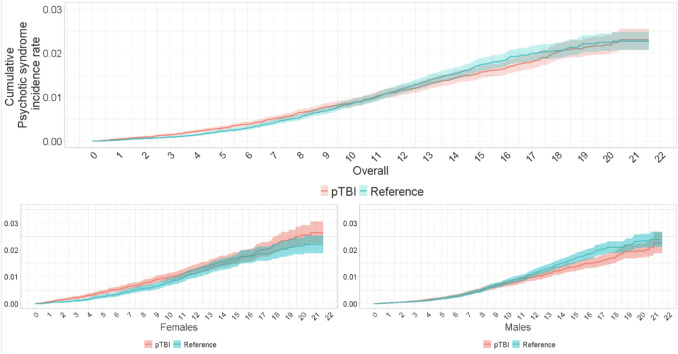
The association between pediatric traumatic brain injury (pTBI) and post-traumatic psychotic syndromes remains understudied subject. The objective of this study was to evaluate the association between pTBI and subsequent psychotic syndrome incidence in Finland. A nationwide retrospective cohort study in Finland from 1998 to 2018 included 71,969 pediatric (< 18 years) TBI patients and 64,856 references with distal extremity fractures. Our primary outcome was psychotic syndrome occurrence post-pTBI, analyzed via Kaplan–Meier (KM) survival and multivariable Cox regression with 95% confidence intervals (CI).. KM analyses demonstrated consistently elevated rates in pediatric TBI (pTBI), particularly notable 10 years post-trauma. Beyond the initial year, cumulative incidence was 0.04% in pTBI and 0.02% in the reference group. Cox regression revealed increased long-term psychotic syndrome risk in pTBI compared to the reference. Up to 10 years of follow-up, the hazard ratio (HR) was 1.34 (95% CI: 1.16–1.55). Notably, among females, pTBI exhibited higher cumulative rates than the reference group. Post the first year, cumulative incidence was 0.06% (pTBI) versus 0.03% (reference) for females. Following 3 years, the HR for pTBI females was 2.00 (95% CI: 1.24–3.23), decreasing to 1.08 (95% CI: 0.90–1.30) from 3 to 20 years. Conclusion : These findings suggest that the risk of psychotic syndromes remains slightly elevated up to 10 years following pTBI. What Is Known: • The association between pTBI and post-traumatic psychotic syndromes is relatively understudied. Existing literature mainly focuses on schizophrenia. What Is New: • This nationwide study found an association between pTBI and an increased risk of post-traumatic psychotic syndromes, particularly within the first 10 years after injury. Notably, female patients faced a higher risk.
Overview
CoChat Summary
TL;DR
In a Finnish nationwide retrospective cohort of 71,969 pediatric TBI patients and 64,856 distal extremity fracture references, pTBI was associated with a slightly elevated risk of later psychotic syndromes, especially within 10 years (HR 1.34, 95% CI 1.16–1.55). Female pTBI patients showed higher early risk (HR 2.00, 95% CI 1.24–3.23 following 3 years), though the association attenuated over longer follow-up.
Key findings
- During follow-up, 1,270 patients were diagnosed with psychotic syndrome post-injury; median time from trauma to psychotic syndrome was 7.94 years in the pTBI group and 9.39 years in references. Table 1 reports psychotic syndrome in 611 (0.85%) pTBI patients vs. 659 (1.02%) references.
- Kaplan–Meier cumulative incidence at 1 year was 0.04% in pTBI vs. 0.02% in references; at 20 years it was 2.19% vs. 2.25% (Table 2).
- Cox regression showed higher long-term psychotic syndrome risk in pTBI vs. references: up to 10 years, HR 1.34 (95% CI 1.16–1.55); 10–18 years, HR 1.13 (95% CI 0.95–1.36); post-18 years, HR 1.37 (95% CI 0.68–2.78).
- Among females, after 1 year cumulative incidence was 0.06% (pTBI) vs. 0.03% (reference); following 3 years, HR for pTBI females was 2.00 (95% CI 1.24–3.23), decreasing to 1.08 (95% CI 0.90–1.30) from 3 to 20 years. In males with pTBI, HR was 1.19 (95% CI 0.71–1.99) post-initial 3 years, reducing to 0.85 (95% CI 0.73–0.99) during 3–20 years.
Methods
- Nationwide retrospective cohort study in Finland from January 1998 to December 2018, using the Finnish Care Register for Health Care and the Finnish Social Insurance Institution.
- The primary cohort included 71,969 individuals under 18 diagnosed with pTBI (ICD-10 S06*); references were 64,856 individuals under 18 with ankle (ICD-10 S82*) or wrist fractures (ICD-10 S52*). All patients were hospitalized in secondary healthcare units. Psychotic syndrome was identified using reimbursement code 112 from the Finnish Social Insurance Institution, covering conditions such as schizophrenia, bipolar disorder with psychotic features, and psychotic depression, with date of onset recorded.
- Cumulative incidence was evaluated with Kaplan–Meier analysis and multivariable Cox regression with 95% CIs; covariates were age at hospitalization and sex, guided by a directed acyclic graph. Proportional hazards assumptions were checked with scaled Schoenfeld residuals, and time-dependent coefficients with a step function were used for violations (main analysis intervals: 0–9, 10–17, 18–20 years; subgroup analysis: 0–2 and 3–20 years). Analyses used R Windows version 4.0.5 with the survival package.
Limitations
- The paper states that the Finnish Care Register for Health Care lacks data on familial medical history, pre-traumatic psychiatric conditions, and substance misuse, which may leave residual confounding. It also notes potential diagnostic inaccuracies in pTBI coding, exclusion of isolated skull fracture diagnoses, use of only S06* codes to define TBI, no primary care data (possibly underestimating less severe injuries), lack of GCS ratings and other severity indicators, and that only age and sex could be used as covariates.
- The paper states that including only intracranial injuries excluded patients with isolated skull fracture diagnoses, which may have reduced the overall number of pTBI cases in the cohort.
- Evident from the text: the study is an observational registry analysis and cannot establish causality; the narrative reports a 3-year cumulative incidence of 0.14% (pTBI) vs. 0.09% (reference), while Table 2 reports 0.30% vs. 0.22%, indicating an internal inconsistency. The reference group is distal extremity fractures rather than uninjured controls, so residual confounding by injury or healthcare contact may remain.
Model-written summary. Check it against the paper before relying on it.
Integrity signals
Registry
Cites
Statistics
Figures
Verification
Claims the paper makes
0 Valid · 0 Not valid · 11 Not checked · 37 Own results and interpretations
A result the paper reports from its own data — it cites no other source for it, so there is none to check. The quote shows it is in the paper.
In the paper
“Post-18 years, risk was (HR: 1.37, CI: 0.68–2.78).”
§ Pediatric traumatic brain injury and later psychotic syndromes in Finland > Results
plainstates an association- Asserted: passes — The authors put it forward as true.
- Checkable: passes — It can be checked against evidence.
- Load-bearing: unclear — It is unclear whether the paper’s conclusions depend on it.
- Based: passes — The paper gives a reason why it holds.
A result the paper reports from its own data — it cites no other source for it, so there is none to check. The quote shows it is in the paper.
In the paper
“and 0.03% (pTBI) vs. 0.02% (reference) for males.”
§ Pediatric traumatic brain injury and later psychotic syndromes in Finland > Results
plain- Asserted: passes — The authors put it forward as true.
- Checkable: passes — It can be checked against evidence.
- Load-bearing: unclear — It is unclear whether the paper’s conclusions depend on it.
- Based: passes — The paper gives a reason why it holds.
A result the paper reports from its own data — it cites no other source for it, so there is none to check. The quote shows it is in the paper.
In the paper
“further reducing to 0.85 (CI: 0.73–0.99) during 3–20 years.”
§ Pediatric traumatic brain injury and later psychotic syndromes in Finland > Results
plainstates an association- Asserted: passes — The authors put it forward as true.
- Checkable: passes — It can be checked against evidence.
- Load-bearing: unclear — It is unclear whether the paper’s conclusions depend on it.
- Based: passes — The paper gives a reason why it holds.
A result the paper reports from its own data — it cites no other source for it, so there is none to check. The quote shows it is in the paper.
In the paper
“After 20 years, female cumulative incidence increased to 2.55% (pTBI) vs. 2.14% (reference) (Fig. 1, Table 2).”
§ Pediatric traumatic brain injury and later psychotic syndromes in Finland > Results
plain- Asserted: passes — The authors put it forward as true.
- Checkable: passes — It can be checked against evidence.
- Load-bearing: passes — The paper’s conclusions depend on it.
- Based: passes — The paper gives a reason why it holds.
A result the paper reports from its own data — it cites no other source for it, so there is none to check. The quote shows it is in the paper.
In the paper
“Up to 10 years of follow-up, the hazard ratio (HR) was 1.34 (95% CI: 1.16–1.55).”
§ Pediatric traumatic brain injury and later psychotic syndromes in Finland > Abstract
plainstates an association- Asserted: passes — The authors put it forward as true.
- Checkable: passes — It can be checked against evidence.
- Load-bearing: passes — The paper’s conclusions depend on it.
- Based: passes — The paper gives a reason why it holds.
28 more claims
Create a free account to see all 48 claims and to verify the 17 references still open.
- It may state two separate claims as one. 8
- Probably not a substantial claim. 9
Self-check
Percentages, sums and reported differences re-computed from the paper’s own numbers.
Each contradiction between two passages listed here was confirmed by an independent check.
Rated major: it would touch a result — a value a result rests on, reported and recomputed p-values on opposite sides of the significance level, two passages that conflict with no sign which is right, or a cited work retracted before this paper was published.
In the paper
§ Pediatric traumatic brain injury and later psychotic syndromes in Finland > Results
“increasing to 0.14% (pTBI) vs. 0.09% (reference) after three years.”
§ Pediatric traumatic brain injury and later psychotic syndromes in Finland > Results
“| Cumulative incidence | 0.30% | 0.22% | 0.21% | 0.11% | 0.09% | 0.07% |”
Rated minor: it would not touch a result — a value no result rests on, a p-value that stays on the same side of the significance level, or a conflict that is clerical, resolved elsewhere in the paper, or outside its own findings.
In the paper
“| n. risk | 46,788 | 48,029 | 23,617 | 20,618 | 32,598 | 34,136 |”
§ Pediatric traumatic brain injury and later psychotic syndromes in Finland > Results
Reported 48029 · recomputed 54754
Rated minor: it would not touch a result — a value no result rests on, a p-value that stays on the same side of the significance level, or a conflict that is clerical, resolved elsewhere in the paper, or outside its own findings.
In the paper
“| n. risk | 29,332 | 32,987 | 12,285 | 12,304 | 17,790 | 21,377 |”
§ Pediatric traumatic brain injury and later psychotic syndromes in Finland > Results
Reported 32987 · recomputed 33681
Rated minor: it would not touch a result — a value no result rests on, a p-value that stays on the same side of the significance level, or a conflict that is clerical, resolved elsewhere in the paper, or outside its own findings.
In the paper
“| n. risk | 3,855 | 4,469 | 1,706 | 1,744 | 2,404 | 3,074 |”
§ Pediatric traumatic brain injury and later psychotic syndromes in Finland > Results
Reported 3855 · recomputed 4110
Rated minor: it would not touch a result — a value no result rests on, a p-value that stays on the same side of the significance level, or a conflict that is clerical, resolved elsewhere in the paper, or outside its own findings.
In the paper
“| n. risk | 46,788 | 48,029 | 23,617 | 20,618 | 32,598 | 34,136 |”
§ Pediatric traumatic brain injury and later psychotic syndromes in Finland > Results
Reported 46788 · recomputed 56215
1 more finding
Create a free account to see every finding of this check.
Citations
Cites
Reducing bias through directed acyclic graphs
Shrier, I., & Platt, R. W. (2008) · BMC Medical Research Methodology · doi:10.1186/1471-2288-8-70 · Cited by 1,386
Quality of the Finnish Hospital Discharge Register: A systematic review
Sund, R. (2012) · Scandinavian Journal of Public Health · doi:10.1177/1403494812456637 · Cited by 1,185
Time-varying covariates and coefficients in Cox regression models
Zhang, Z., Reinikainen, J., Adeleke, K. A., Pieterse, M. E., & Groothuis-Oudshoorn, C. G. M. (2018) · Annals of Translational Medicine · doi:10.21037/atm.2018.02.12 · Cited by 811
Epidemiology of Global Pediatric Traumatic Brain Injury: Qualitative Review
Dewan, M. C., Mummareddy, N., Wellons, J. C., & Bonfield, C. M. (2016) · World Neurosurgery · doi:10.1016/j.wneu.2016.03.045 · Cited by 650
Kalra, S., Malik, R., Singh, G., Bhatia, S., Al-Harrasi, A., Mohan, S., Albratty, M., Albarrati, A., & Tambuwala, M. M. (2022) · Inflammopharmacology · doi:10.1007/s10787-022-01017-8 · Cited by 193
Mattila, V. M., Sillanpää, P., Iivonen, T., Parkkari, J., Kannus, P., & Pihlajamäki, H. (2008) · Injury · doi:10.1016/j.injury.2008.05.007 · Cited by 90
Self-citationGrados, M. A., Vasa, R. A., Riddle, M. A., Slomine, B. S., Salorio, C. F., Christensen, J. R., & Gerring, J. P. (2007) · Depression and Anxiety · doi:10.1002/da.20398 · Cited by 77
Lyme borreliosis in Finland: a register-based linkage study
Feuth, E., Virtanen, M. J., Helve, O., Hytönen, J., & Sane, J. (2020) · BMC Infectious Diseases · doi:10.1186/s12879-020-05555-w · Cited by 18
Increased risk for dementia in neurofibromatosis type 1
Kallionpää, R. A., Valtanen, M., Auranen, K. J., Uusitalo, E., Rinne, J. O., Peltonen, S. A., & Peltonen, J. T. K. (2021) · Genetics in Medicine · doi:10.1038/s41436-021-01261-3 · Cited by 18
Kuitunen, I., Ponkilainen, V. T., Iverson, G. L., Isokuortti, H., Luoto, T. M., & Mattila, V. M. (2023) · Injury · doi:10.1016/j.injury.2022.12.023 · Cited by 18
Self-citationYau, K.-C., Revill, G., Blackman, G., Shaikh, M., & Bell, V. (2024) · Psychological Medicine · doi:10.1017/s0033291723002878 · Cited by 13
Impact of traumatic brain injury on risk for schizophrenia and bipolar disorder
Cheng, K.-Y., Robinson, N., Ploner, A., Kuja-Halkola, R., Molero, Y., Lichtenstein, P., & Bergen, S. E. (2024) · Psychiatry Research · doi:10.1016/j.psychres.2024.115990 · Cited by 13
(2019) · PubMed
Cited by
An update on paediatric traumatic brain injury in the emergency department: a narrative review
Alsuwais, S., Kennedy, C., Bressan, S., Lyttle, M. D., & Body, R. M. (2025) · European Journal of Pediatrics · doi:10.1007/s00431-025-06345-9 · Cited by 11
Schizophrenia: advances in pathophysiology, management, and precision medicine
Sawa, A., Chiappelli, J., Hamrah, O., & Cascella, N. G. (2026) · BMJ · doi:10.1136/bmj-2026-635470 · Cited by 4
Overcoming the challenges of caring for paediatric psychosis patients: a literature review
Ortese, T. A. (2025) · Theseus (Ammattikorkeakoulujen)
Reddy, S., Patil, T. A., & Espiridion, E. D. (2026) · Cureus · doi:10.7759/cureus.114341
Metadata
- Authors
- Laaksonen, J., Ponkilainen, V., Möttönen, J., Mattila, V. M., & Kuitunen, I.
- Affiliations
- University of Tampere (FI)
- Tampere University Hospital (FI)
- Tampere University (FI)
- University of Eastern Finland (FI)
- Corresponding author
- Laaksonen, Juho
- Venue
- European Journal of Pediatrics
- Published
- 2025-05-31
- Volume
- 184
- Issue
- 6
- Pages
- 380-380
- ISSN
- 0340-6199 (ISSN-L)
- 1432-1076
- PMC
- PMC12126354
- OpenAlex
- W4410924637
- Cited by
- 4
- References
- 13
- Citations by year
- 2026: 2 · 2025: 2
- FWCI
- 1.99
- Type
- journal article
- Language
- en
- Open access
- hybrid
- doi.org
- Licence
- cc-by
- creativecommons.org/licenses/by/4.0 (tdm)
- creativecommons.org/licenses/by/4.0 (vor)
- Locations
- European Journal of Pediatrics (publishedVersion, cc-by)
- PubMed Central (publishedVersion, cc-by)
- PubMed (publishedVersion)
- Tampere University Institutional Repository (Tampere University) (submittedVersion, cc-by)
- Funders
- Maire Taposen Säätiö
- Päivikki ja Sakari Sohlbergin Säätiö
- Yrjö Jahnssonin Säätiö
- Tampere University
- Topics
- Health Sciences › Medicine › Clinical Neurology › Traumatic Brain Injury Research
- Health Sciences › Medicine › Clinical Neurology › Traumatic Brain Injury and Neurovascular Disturbances
- Health Sciences › Medicine › Psychiatry and Mental health › Schizophrenia research and treatment
- Keywords
- pediatric traumatic brain injury, sex differences in risk, schizophrenia, Finland
- MeSH terms
- Brain Injuries, Traumatic, Adolescent, Child, Child, Preschool, Female, Finland, Humans, Infant, Male, Psychotic Disorders, Retrospective Studies, Risk Factors, Incidence, Proportional Hazards Models, Kaplan-Meier Estimate
About these checks
Registry, retraction, Cites and statistics results are computed, not judged, with one exception: a printed reference that no index lists is read once by a model before it counts as a citation error. Claims are extracted by a model and kept only when their quote appears verbatim in the text; each cited source is then checked, with a model’s help, for whether it says what the claim relies on. Those verdicts can be wrong — read the claim’s quote and the cited source before relying on one.
A language model drew the claims from the paper on 2026-11-14, under version 3 of the claim definition (model deepseek-v4.1-flash, prompt extract-v3).
A second model labelled each claim on 2026-11-14 (model jev-1.13-20260917, definition revision gold-guideline-v0.2).
Statistics and arithmetic are recomputed, not judged.
Confidence bands are shown only for fields calibrated on our annotated test set. None is calibrated yet, so no band is shown.
What counts as a claim ›How we measure confidence ›How we check this ›
Are you an author, or do you see a problem with this page? Request a review
Data sources
Bibliographic data: Semantic Scholar, OpenAlex, Crossref.
Contains information from the Semantic Scholar Academic Graph Datasets, made available under the ODC Attribution License (ODC-BY 1.0).
Semantic Scholar’s data is described in: Kinney, R., et al. (2023). The Semantic Scholar Open Data Platform. arXiv:2301.10140.
