

The DOI matches its Crossref record; 30 of the 31 references it cites were found in a registry or an index.
Loss of chromosome Y (LOY) in blood cells is associated with increased risk for disease and mortality in aging men
Open accessAbstract
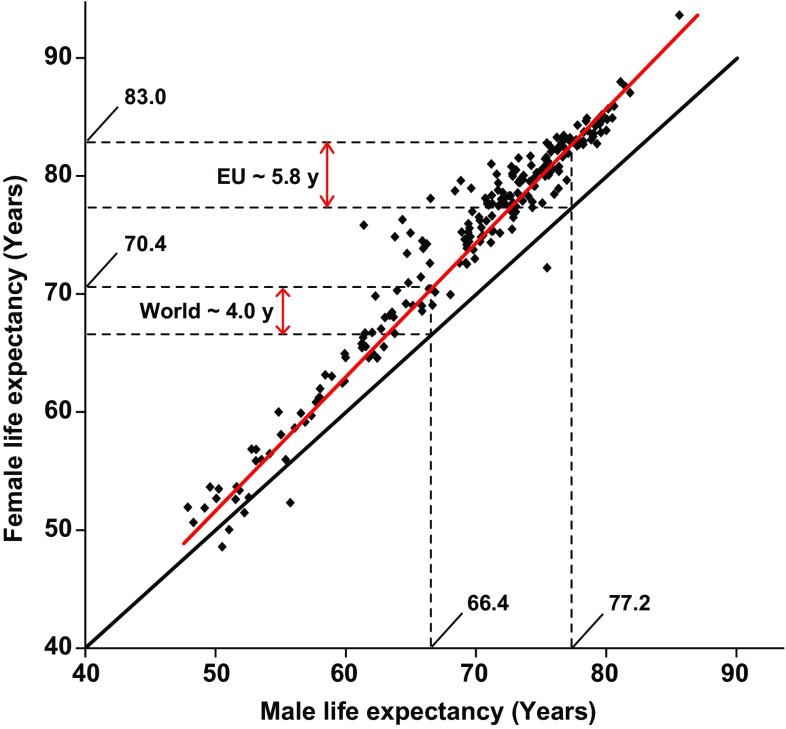
Recent discoveries have shown that harboring cells without the Y chromosome in the peripheral blood is associated with increased risk for all-cause mortality and disease such as different forms of cancer, Alzheimer's disease, as well as other conditions in aging men. In the entire world, the life expectancy of men is shorter compared to women, a sex difference that has been known for centuries, but the underlying mechanism(s) are not well understood. As a male-specific genetic risk factor, an increased risk for pathology and mortality associated with mosaic loss of chromosome Y (LOY) in blood cells could help to explain that men on average live shorter lives compared to women. This review primarily focuses on observed associations between LOY in blood and various diseases in aging men. Other topics covered are known risk factors for LOY, methods to detect LOY, and a discussion regarding mechanisms such as immunosurveillance, that could possibly explain how an acquired mutation in blood cells can be associated with disease processes in other organs.
Overview
The claims and statistics of this paper haven’t been checked yet.
Run the check — free, no account needed. It reads the open-access text and checks the sources it cites.
Integrity signals
Registry
Cites
Statistics
Figures
Verification
Claims the paper makes
The claims and statistics of this paper haven’t been checked yet.
Run the check — free, no account needed. It reads the open-access text and checks the sources it cites.
Claims other papers make about this one
Each is checked against this paper’s own text: does it say what the citing paper says it does?
The source backs part of the claim, not all of it — or backs it for a different population, condition or comparison.
In the citing paper
“Mosaic chromosomal alterations, including loss of the Y chromosome (LOY), are strongly associated with cardiovascular disease, stroke, and dementia risk [34,44,45].”
From Clonal Hematopoiesis of Indeterminate Potential as an Emerging Interdisciplinary Risk Factor in Alzheimer’s Disease: Current Evidence and Future Directions (2026) · cites this paper as [44]
Experimental — accuracy not yet measured
Self-check
Percentages, sums and reported differences re-computed from the paper’s own numbers.
The self-check needs the paper’s full text.
Citations
Cites
Cancer immunoediting: from immunosurveillance to tumor escape
Dunn, G. P., Bruce, A. T., Ikeda, H., Old, L. J., & Schreiber, R. D. (2002) · Nature Immunology · doi:10.1038/ni1102-991 · Cited by 5,393
International scoring system for evaluating prognosis in myelodysplastic syndromes
Greenberg, P., Cox, C., LeBeau, M. M., Fenaux, P., Morel, P., Sanz, G., Sanz, M., Vallespi, T., Hamblin, T., Oscier, D., et al. (1997) · Blood · doi:10.1182/blood.v89.6.2079 · Cited by 4,427
Simard, A. R., Soulet, D., Gowing, G., Julien, J.-P., & Rivest, S. (2006) · Neuron · doi:10.1016/j.neuron.2006.01.022 · Cited by 1,265
Kuroda-Kawaguchi, T., Skaletsky, H., Brown, L. G., Minx, P. J., Cordum, H. S., Waterston, R., Wilson, R. K., Silber, S. J., Oates, R. D., Rozen, S., et al. (2001) · Nature Genetics · doi:10.1038/ng757 · Cited by 726
Forsberg, L. A., Rasi, C., Malmqvist, N., Davies, H., Pasupulati, S., Pakalapati, G., Sandgren, J., de Ståhl, T. D., Zaghlool, A., Giedraitis, V., et al. (2014) · Nature Genetics · doi:10.1038/ng.2966 · Cited by 460
Self-citationImmune surveillance in the central nervous system
Ousman, S. S., & Kubes, P. (2012) · Nature Neuroscience · doi:10.1038/nn.3161 · Cited by 457
Change of Human Chromosome Count Distributions with Age: Evidence for a Sex Difference
Jacobs, P. A., BRUNTON, M., Brown, W. M. C., Doll, R., & Goldstein, H. (1963) · Nature · doi:10.1038/1971080a0 · Cited by 294
Mosaic Loss of Chromosome y in Blood Is Associated with Alzheimer Disease
Dumanski, J. P., Lambert, J.-C., Rasi, C., Giedraitis, V., Davies, H., Grenier-Boley, B., Lindgren, C. M., Campion, D., Dufouil, C., Pasquier, F., et al. (2016) · The American Journal of Human Genetics · doi:10.1016/j.ajhg.2016.05.014 · Cited by 266
Self-citationAge-associated aneuploidy: Loss of Y chromosome from human bone marrow cells with aging
Pierre, R. V., & Hoagland, H. C. (1972) · Cancer · doi:10.1002/1097-0142(197210)30:4 · Cited by 265
Mosaicism in health and disease — clones picking up speed
Forsberg, L. A., Gisselsson, D., & Dumanski, J. P. (2016) · Nature Reviews Genetics · doi:10.1038/nrg.2016.145 · Cited by 261
Self-citation
Cited by
Sorted by citations
Sex differences in biological aging with a focus on human studies
Hägg, S., & Jylhävä, J. (2021) · eLife · doi:10.7554/elife.63425 · Cited by 442
Human chromosome‐specific aneuploidy is influenced by DNA‐dependent centromeric features
Dumont, M., Gamba, R., Gestraud, P., Klaasen, S. J., Worrall, J. T., de Vries, S. G., Boudreau, V. G., Salinas‐Luypaert, C., Maddox, P. S., Lens, S. M. A., et al. (2019) · The EMBO Journal · doi:10.15252/embj.2019102924 · Cited by 134
Mosaic loss of human Y chromosome: what, how and why
Guo, X., Dai, X., Zhou, T., Wang, H., Ni, J., Xue, J., & Wang, X. (2020) · Human Genetics · doi:10.1007/s00439-020-02114-w · Cited by 124
Sex Chromosome Effects on Male–Female Differences in Mammals
Snell, D. M., & Turner, J. M. A. (2018) · Current Biology · doi:10.1016/j.cub.2018.09.018 · Cited by 114
Clonal hematopoiesis, somatic mosaicism, and age-associated disease
Evans, M. A., & Walsh, K. X. (2022) · Physiological Reviews · doi:10.1152/physrev.00004.2022 · Cited by 112
Metadata
- Authors
- Forsberg, L. A.
- Affiliations
- Uppsala University (SE)
- Corresponding author
- Forsberg, Lars A.
- ORCID
- Forsberg, Lars A.
- Venue
- Human Genetics
- Published
- 2017-04-19
- Volume
- 136
- Issue
- 5
- Pages
- 657-663
- ISSN
- 0018-7348 (ISSN-L)
- 0340-6717
- 1432-1203
- PMC
- PMC5418310
- OpenAlex
- W2605722421
- Cited by
- 134
- References
- 31
- Citations by year
- 2026: 17 · 2025: 13 · 2024: 15 · 2023: 14 · 2022: 10 · 2021: 24 · 2020: 16 · 2019: 12 · 2018: 10 · 2017: 3
- FWCI
- 7.44
- Type
- journal article
- Language
- en
- Open access
- hybrid
- doi.org
- Locations
- Human Genetics (publishedVersion, cc-by)
- Europe PMC (PubMed Central) (publishedVersion, cc-by)
- PubMed Central (publishedVersion, cc-by)
- PubMed (publishedVersion)
- Funders
- European Research Council (679744)
- Kjell och Märta Beijers Stiftelse (SE)
- Stiftelsen Olle Engkvist Byggmästare
- Topics
- Life Sciences › Biochemistry, Genetics and Molecular Biology › Genetics › Genetic and Clinical Aspects of Sex Determination and Chromosomal Abnormalities
- Life Sciences › Biochemistry, Genetics and Molecular Biology › Cell Biology › Telomeres, Telomerase, and Senescence
- Health Sciences › Medicine › Reproductive Medicine › Sperm and Testicular Function
- Keywords
- Y chromosome, mosaicism, older men, sex differences in longevity, all-cause mortality, cancer risk, Alzheimer's disease, immune surveillance
- MeSH terms
- Aging, Alzheimer Disease, Blood Cells, Female, Hematologic Diseases, Humans, Life Expectancy, Male, Neoplasms, Risk Factors, Chromosomes, Human, Y
About these checks
Registry, retraction, Cites and statistics results are computed, not judged, with one exception: a printed reference that no index lists is read once by a model before it counts as a citation error. Claims are extracted by a model and kept only when their quote appears verbatim in the text; each cited source is then checked, with a model’s help, for whether it says what the claim relies on. Those verdicts can be wrong — read the claim’s quote and the cited source before relying on one.
Statistics and arithmetic are recomputed, not judged.
Confidence bands are shown only for fields calibrated on our annotated test set. None is calibrated yet, so no band is shown.
What counts as a claim ›How we measure confidence ›How we check this ›
Are you an author, or do you see a problem with this page? Request a review
