

The DOI matches its Crossref record; 163 of the 163 references it cites were found in a registry or an index; none of the 192 sources its claims cite is checked for support yet.
Development of a volcanic risk management system at Mount St. Helens—1980 to present
Open accessAbstract
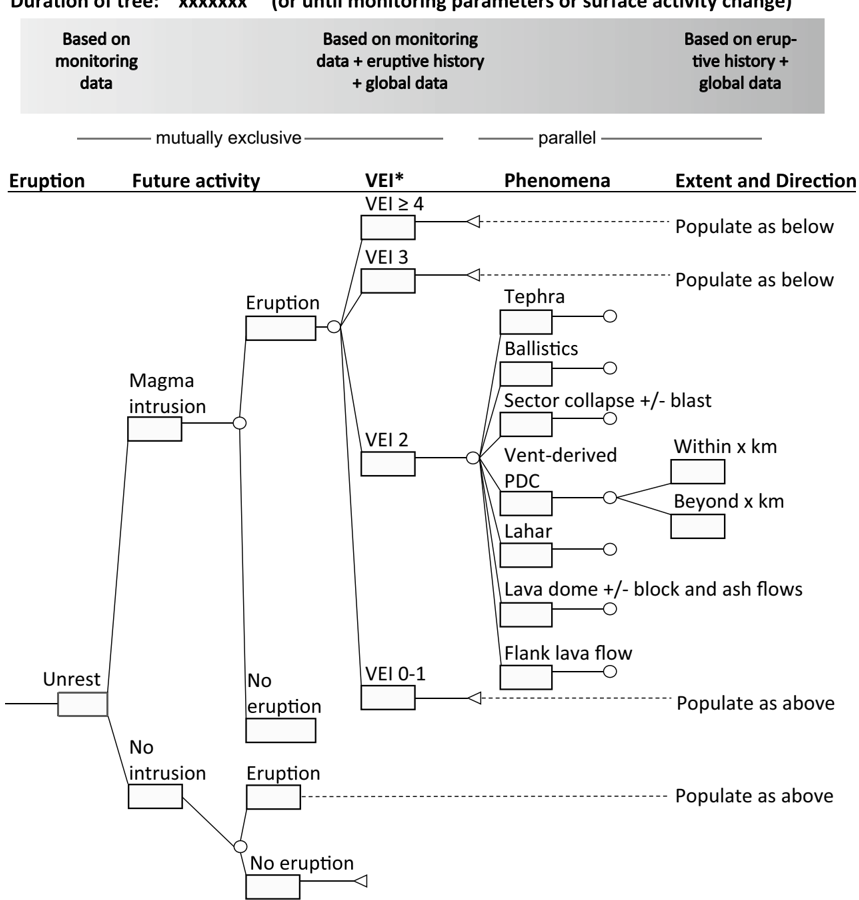
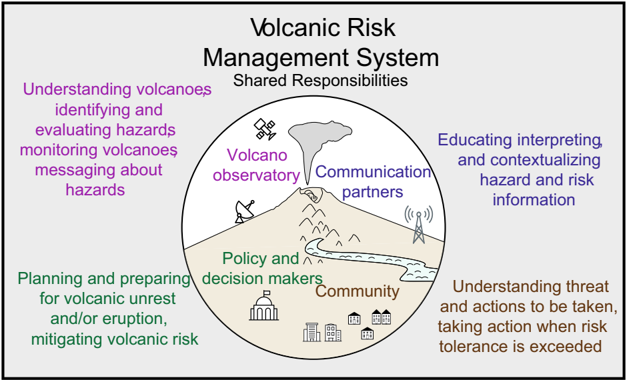
Here, we review volcanic risk management at Mount St. Helens from the perspective of the US Geological Survey’s (USGS) experience over the four decades since its 18 May 1980 climactic eruption. Prior to 1980, volcano monitoring, multidisciplinary eruption forecasting, and interagency coordination for eruption response were new to the Cascade Range. A Mount St. Helens volcano hazards assessment had recently been published and volcanic crisis response capabilities tested during 1975 thermal unrest at nearby Mount Baker. Volcanic unrest began in March 1980, accelerating the rate of advance of volcano monitoring, prompting coordinated eruption forecasting and hazards communication, and motivating emergency response planning. The destruction caused by the 18 May 1980 eruption led to an enormous emergency response effort and prompted extensive coordination and planning for continuing eruptive activity. Eruptions continued with pulsatory dome growth and explosive eruptions over the following 6 years and with transport of sediment downstream over many more. In response, USGS scientists and their partners expanded their staffing, deployed new instruments, developed new tools (including the first use of a volcanic event tree) for eruption forecasting, and created new pathways for agency internal and external communication. Involvement in the Mount St. Helens response motivated the establishment of response measures at other Cascade Range volcanoes. Since assembly during the early and mid-1990s, volcano hazard working groups continue to unite scientists, emergency and land managers, tribal nations, and community leaders in common cause for the promotion of risk reduction. By the onset of renewed volcanic activity in 2004, these new systems enabled a more efficient response that was greatly facilitated by the participation of organizations within volcano hazard working groups. Although the magnitude of the 2004 eruptive sequence was much smaller than that of 1980, a new challenge emerged focused on hazard communication demands. Since 2008, our understanding of Mount St. Helens volcanic system has improved, helping us refine hazard assessments and eruption forecasts. Some professions have worked independently to apply the Mount St. Helens story to their products and services. Planning meetings and working group activities fortify partnerships among information disseminators, policy and decision-makers, scientists, and communities. We call the sum of these pieces the Volcanic Risk Management System (VRMS). In its most robust form, the VRMS encompasses effective production and coordinated exchange of volcano hazards and risk information among all interested parties.
Overview
CoChat Summary
Written by AI from the paper’s full text.
TL;DR
This review traces how volcanic risk management at Mount St. Helens evolved from the 1980 climactic eruption through 2023, arguing that a non-formalized but integrated Volcanic Risk Management System (VRMS) emerged through repeated crises, partnerships, and communication advances. It emphasizes that scientific monitoring and forecasting improved, but long-term engagement, uncertainty communication, and forecasting of collapse, blast, and explosive magnitude remain difficult.
Key findings
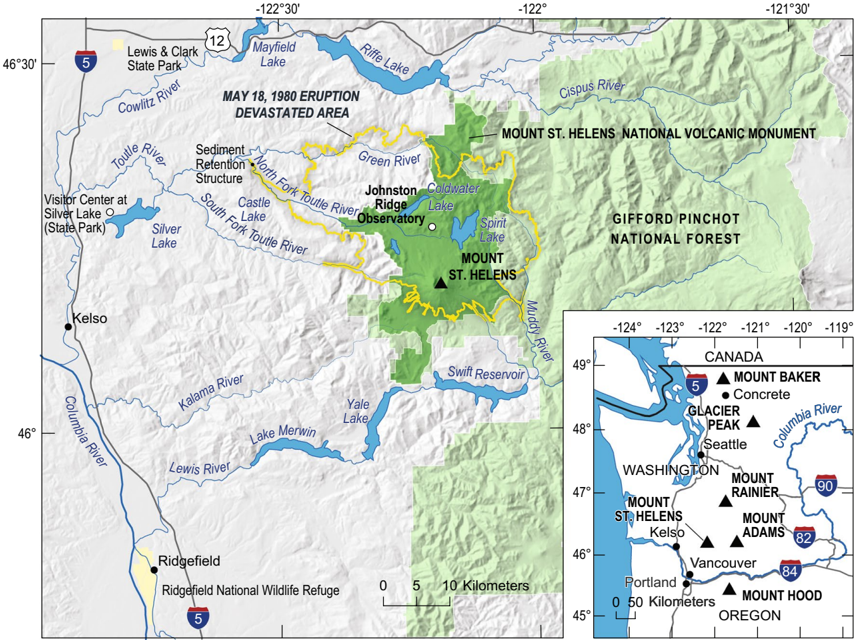
- The 18 May 1980 eruption killed 57 people and caused an estimated $1.1 billion in damages (not inflation-adjusted); the debris avalanche traveled up to 29 km, the lateral blast reached 28 km, the vertical column reached 30 km, and a delayed lahar reached the Columbia River about 120 km away.
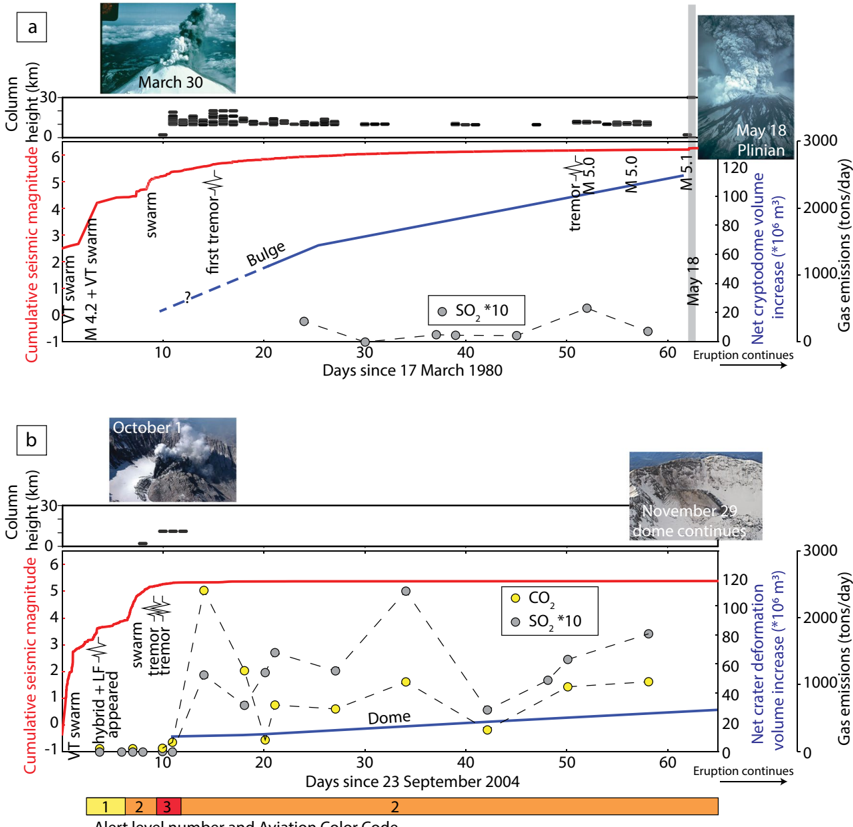
- Forecasting improved after 1980: increasing seismicity, gas emission, and deformation repeatedly preceded dome extrusion and explosions, allowing successful forecasts before all but two dome-building eruptions, though eruption size and style remained hard to forecast.
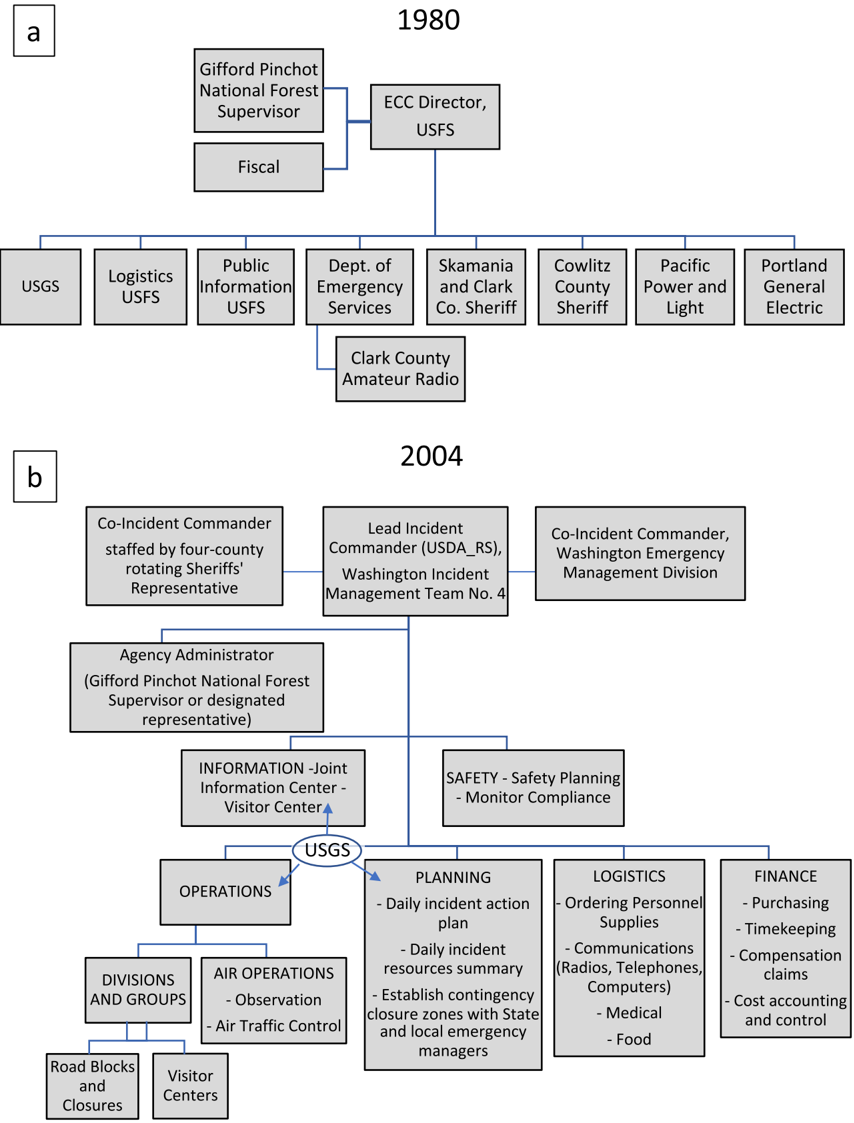
- By 2004, existing monitoring, coordination plans, and volcano hazard working groups enabled a more efficient response; about 2,500 people were evacuated from Johnston Ridge Observatory, and the Joint Information Center handled approximately 800 media inquiries during 3–13 October 2004.
- The paper identifies the VRMS as encompassing scientists, land and emergency managers, tribal nations, schools, parks, news media, and community leaders; since 1995, Cascades Volcano Observatory scientists attended more than 70 comprehensive volcano hazard working group meetings.
Methods
- Narrative review and synthesis of USGS experience at Mount St. Helens over four decades, organized into seven time periods: 1970s, March–May 1980, 18 May 1980, late May 1980–1986, 1986–2004, 2004–2008, and 2008–2023.
- Draws on published scientific literature, agency reports, monitoring records, event trees, hazard assessments, emergency coordination plans, and oral communications with responders, scientists, and communicators.
- Main analysis is qualitative historical synthesis, using Table 1 and figures to trace changes in monitoring, forecasting, hazards communication, education, and emergency management.
Limitations
- The paper’s “Challenges” section states remaining limitations: maintaining monitoring networks, forecasting sector collapse and lateral blasts, forecasting explosive magnitude, forecasting small/phreatic explosions, sustaining long-term multi-agency participation, institutionalizing two-way science communication, communicating uncertainty, linking preparedness to volcano state, and long-term risk mitigation in a multi-risk environment.
- Evident from the text: this is a retrospective, USGS-centered review rather than a formal outcome evaluation; it relies heavily on cited literature, agency documents, and oral histories, and it notes that robust evaluation of volcanic hazard outreach effectiveness “remains to be completed.”
Model-written summary. Check it against the paper before relying on it.
Integrity signals
Registry
Cites
Statistics
Figures
Verification
Claims the paper makes
73 Own interpretation · 61 Sources not found · 36 No full text of the sources · 28 Check pending · 26 Own result · 16 Not checked yet · 13 No basis given
In the paper
“As was the case at Mount Baker, scientists from a variety of geological and geophysical disciplines became involved in the crisis response within days (Foxworthy and Hill 1982, and a variety of multi-parametric monitoring instruments and observation techniques were utilized (Table 1).”
§ Development of a volcanic risk management system at Mount St. Helens-1980 to present > Initiation of volcanic crisis response
What the sources say
- Not matchedcites Table 1
Couldn’t be matched to a paper in Crossref, so it can’t be checked.
plain- Asserted: passes — The authors put it forward as true.
- Checkable: passes — It can be checked against evidence.
- Load-bearing: unclear — It is unclear whether the paper’s conclusions depend on it.
- Based: passes — The paper gives a reason why it holds.
- Not matched
None of the sources cited for this claim have been checked yet.
In the paper
“For emergency responders, the 1980-1986 activity was so complex and long-lasting that it impacted an extraordinary number of related professions and agencies in the coordination of mitigation activities.”
§ Development of a volcanic risk management system at Mount St. Helens-1980 to present > Emerging components of a Volcanic Risk Management System
plainstates a cause- Asserted: passes — The authors put it forward as true.
- Checkable: passes — It can be checked against evidence.
- Load-bearing: unclear — It is unclear whether the paper’s conclusions depend on it.
- Based: passes — The paper gives a reason why it holds.
None of the sources cited for this claim have been checked yet.
In the paper
“Community risk-mitigation strategies in the region also included integration of volcano-hazard information into existing social structures such as schools, parks, and emergency management organizations.”
§ Development of a volcanic risk management system at Mount St. Helens-1980 to present > Emerging components of a Volcanic Risk Management System
plain- Asserted: passes — The authors put it forward as true.
- Checkable: passes — It can be checked against evidence.
- Load-bearing: unclear — It is unclear whether the paper’s conclusions depend on it.
- Based: passes — The paper gives a reason why it holds.
In the paper
“Importantly, however, debris avalanche, and blast hazards were not represented in any of the three scenarios presented in hazard maps used for discussion (despite the maps' intended purpose to represent the largest, intermediate, and the most likely eruptions; Miller et al. 1981).”
§ Development of a volcanic risk management system at Mount St. Helens-1980 to present > Onset of multi-agency response
What the sources say
- Not matchedcites Miller et al. 1981
Couldn’t be matched to a paper in Crossref, so it can’t be checked.
plain- Asserted: passes — The authors put it forward as true.
- Checkable: passes — It can be checked against evidence.
- Load-bearing: unclear — It is unclear whether the paper’s conclusions depend on it.
- Based: passes — The paper gives a reason why it holds.
- Not matched
In the paper
“Within days, the USGS assigned response coordination roles within the USGS for activities such as field investigations, hazards warning, news media contacts, and technical resources (Online Resource 3).”
§ Development of a volcanic risk management system at Mount St. Helens-1980 to present > Initiation of volcanic crisis response
What the sources say
- Not matchedcites Online Resource 3
Couldn’t be matched to a paper in Crossref, so it can’t be checked.
plain- Asserted: passes — The authors put it forward as true.
- Checkable: passes — It can be checked against evidence.
- Load-bearing: unclear — It is unclear whether the paper’s conclusions depend on it.
- Based: passes — The paper gives a reason why it holds.
- Not matched
- It may state two separate claims as one. 87
- Probably not a substantial claim. 77
- The quote only partly states this claim. 1
Create a free account to see these claims.
Create a free account to see these assumptions.
105 more claims
Create a free account to see all 253 claims and to verify the 34 references still open.
Self-check
Percentages, sums and reported differences re-computed from the paper’s own numbers.
Each contradiction between two passages listed here was confirmed by an independent check.
Rated minor: it would not touch a result — a value no result rests on, a p-value that stays on the same side of the significance level, or a conflict that is clerical, resolved elsewhere in the paper, or outside its own findings.
In the paper
§ Development of a volcanic risk management system at Mount St. Helens-1980 to present > Actionable hazard messaging
“Newhall (1982) proposed only quantification of long-term hazard and risk focusing on probabilistic forecasts based on historical and stratigraphic information”
§ Development of a volcanic risk management system at Mount St. Helens-1980 to present > References
“Newhall CG (1982) A method for estimating intermediate and long- term risks from volcanic activity, with an example from Mount St. Helens, Washington.”
Rated minor: it would not touch a result — a value no result rests on, a p-value that stays on the same side of the significance level, or a conflict that is clerical, resolved elsewhere in the paper, or outside its own findings.
In the paper
§ Development of a volcanic risk management system at Mount St. Helens-1980 to present > Volcano hazards and forecasting
“1st MSH hazard assessment published; 1st medium-term forecast at MSH ("eruption by the end of the century").”
§ Development of a volcanic risk management system at Mount St. Helens-1980 to present > Hazards communication and education
“The durations implied by short, medium, and long-term designations span minutes to days, weeks to months, and years to hundreds of years, respectively.”
Citations
Cites
(2013) · Cited by 6,708
Risk Perception and Communication Unplugged: Twenty Years of Process1
Fischhoff, B. (1995) · Risk Analysis · doi:10.1111/j.1539-6924.1995.tb00308.x · Cited by 886
Introduction: `Mode 2' Revisited: The New Production of Knowledge
Nowotny, H., Scott, P., & Gibbons, M. (2003) · Minerva · doi:10.1023/a:1025505528250 · Cited by 871
The 1980 eruptions of Mount St. Helens, Washington
Lipman, P. W., & Mullineaux, D. R. (1981) · USGS professional paper · doi:10.3133/pp1250 · Cited by 686
Siebert, L. (1984) · Journal of Volcanology and Geothermal Research · doi:10.1016/0377-0273(84)90002-7 · Cited by 612
Ascent-driven crystallisation of dacite magmas at Mount St Helens, 1980–1986
Blundy, J., & Cashman, K. V. (2001) · Contributions to Mineralogy and Petrology · doi:10.1007/s004100000219 · Cited by 514
Environmental interpretation. A practical guide for people with big ideas and small budgets
(1993) · Environment International · doi:10.1016/0160-4120(93)90348-l · Cited by 464
National Research Council (1989) · National Academies Press eBooks · doi:10.17226/1189 · Cited by 393
Rutherford, M. J., Sigurdsson, H., Carey, S., & Davis, A. (1985) · Journal of Geophysical Research Atmospheres · doi:10.1029/jb090ib04p02929 · Cited by 390
Volcanic hazards from Bezymianny- and Bandai-type eruptions
Siebert, L., Glicken, H., & Ui, T. (1987) · Bulletin of Volcanology · doi:10.1007/bf01046635 · Cited by 334
Research works printed but not linked: 50
- Allen J (1980) Final report on the operations of the Mount St. Helens Research and Educational Coordinating Committee
- Burket SD, Furlow EP, Golding PR, Grant LC, Lipovsky WA, Lopp TG (1980) The economic effects of the eruptions of Mt. St. Helens: report to the Committee on Ways and Means of the U.S. House of Representatives on investigation no. 332-110 under section 332 of the Tariff act of 1930. U.S. International Trade Commission, Washington, DC
- Christiansen RL, Peterson DW, Lipman PW, Mullineaux DR (1981) Chronology of the 1980 eruptive activity. In: Lipman PW, Mullineaux DR (eds) The 1980 eruptions of Mount St. Helens, Washington. US Geol Surv Prof Pap 1250:17–30
- Crandell DR (1987) Deposits of Pre-1980 pyroclastic flows and lahars from Mount St. Helens Volcano. US Geol Surv Prof Pap 1444, Washington
- Crandell DR (1989) Gigantic debris avalanche of Pleistocene age from ancestral Mount Shasta volcano, California, and debris-avalanche hazard zonation. US Geol Surv Bulletin 1861:32
- Crandell DR, Mullineaux DR (1978) Potential hazards from future eruptions of Mt. St. Helens volcano. US Geol Surv Bull 1383-C, Washington, p 26
- Decker RW (1981) The 1980 activity-a case study in forecasting volcanic eruptions In: Lipman PW, Mullineaux DR (eds) The 1980 eruptions of Mount St. Helens, Washington. US Geol Surv Prof Pap 1250:815–820
- Drabek TE, Tamminga HL, Kilijanek TS, Adams CR (1981) Managing multiorganizational emergency responses-emergents search and rescue networks in natural disaster and remote area settings: monograph #31. Institute of Behavioral Science, The University of Colorado, p 292
- Endo ET, Malone SD, Noson LL, Weaver CS (1981) Locations, magnitudes, and statistics of the March 20–May 18 earthquake sequence. In: Lipman PW, Mullineaux DR (eds) The 1980 eruptions of Mount St. Helens, Washington. US Geol Surv Prof Pap 1250:93–107
- Ewert J, Guffanti M, Murray T (2005) An assessment of volcanic threat and monitoring capabilities in the United States—framework for a National Volcanic Early Warning System, NVEWS. US Geol Surv Open-File Rep 1164:1–62
- Ewert JW, Murray TL, Lockhart AB, Miller CD (1993) Preventing volcanic catastrophe; the US International Volcano Disaster Assistance Program. Earthquakes Volcanoes (USGS) 24(6):270–291
- FEMA (2006) Civil Defense and Homeland Security: a short history of national preparedness efforts. Homeland Security National Preparedness Task Force, p 36
- Fiske RS (1984) Volcanologists, journalists, and the concerned local public: a tale of two crises in the Eastern Caribbean. Interception, Evolution, and Hazard. National Academy Press, Washington, DC, Explosive Volcanism, pp 170–176
- Flinders AF, Shen Y (2017) Seismic evidence for a possible deep crustal hot zone beneath Southwest Washington. Nature Comm Sci Rep 7:7400
- Gerlach TM, McGee KA, Doukas MP (2008) Emission Rates of CO2, SO2, and H2S, scrubbing, and preeruption excess volatiles at Mount St. Helens, 2004–2005. In: Sherrod DR, Scott WE, Stauffer PH (eds) A volcano rekindled; the renewed eruption of Mount St. Helens, 2004-2006. US Geol Surv Prof Pap 1750: 543–571.
- Hopson CA, Melson WG (1990) Compositional trends and eruptive cycles at Mount St. Helens. Geosci Canada 17:131–141
- Kilijanek TS (1981) There she blows: the search and rescue response to the Mount St. Helens Volcano. SAR Research Project Report 11. Department of Sociology, University of Denver, Denver, Colorado
- Lisowski M, Dzurisin D, Denlinger RP, Iwatsubo EY (2008) Analysis of GPS-measured deformation associated with the 2004–2006 dome-building eruption of Mount St. Helens, Washington. In: Sherrod DR, Scott WE, Stauffer PH (eds) A volcano rekindled: the renewed eruption of Mount St. Helens, 2004–2006, vol 1850. US Geol Surv Prof Pap, pp 301–333
- Ludwin RS, Qamar AI, Malone SD, Jonientz-Trisler C, Crosson RS, Benson R, Moran SC (1994) Earthquake Hypocenters in Washington and Northern Oregon, 1987-1989, and operation of the Washington Regional Seismograph Network, vol 89. Washington Division of Geology and Earth Resources, Information Circular, p 40
- Majors H, McCollum RC (eds) (1981) Mount St. Helens–the 1831 and 1835 eruptions, and Mount St. Helens–The 1844-1857 Eruptions: Northwest Discov 2(8):534–550
- Malone SD, Endo ET, Weaver CS, Ramey JW (1981) Seismic monitoring for eruption prediction In: Lipman PW, Mullineaux DR (eds) The 1980 eruptions of Mount St. Helens, Washington. US Geol Surv Prof Pap 1250:803–814. https://doi.org/10.3133/pp1250 · DOI
- McChesney PJ, Couchman MR, Moran SC, Lockhart AB, Swinford KJ, LaHusen RG (2008) Seismic-monitoring changes and the remote deployment of seismic stations (seismic spider) at Mount St. Helens, 2004–2005. In: Sherrod DR, Scott WE, Stauffer PH (eds) A volcano rekindled: the renewed eruption of Mount St. Helens, 2004–2006. US Geol Surv Prof Pap 1750:129–140
- McClure RH, Reynolds ND (2015) Making the list: Mount St. Helens as a traditional cultural property: a case study in tribal/government cooperation. J Northwest Anthropol 49:117–142
- Meyer W, Sabol M, Schuster R (1986) Landslide dammed lakes at Mount St. Helens, Washington. In: Schuster, R.L. (ed.) Landslide Dams – Processes, Risks and Mitigation. American Society of Civil Engineers Geotechnical Special Publication 3:21–41
- Miller CD, Mullineaux DR, Crandell DR (1981) Hazards assessments at Mount St. Helens. In: Lipman PW, Mullineaux DR (eds) The 1980 eruptions of Mount St. Helens, Washington, vol 1250. US Geol Surv Prof Pap, pp 803–814. https://doi.org/10.3133/pp1250 · DOI
- Moore JG, Sisson TW (1981) Deposits and effects of the May 18 pyroclastic surge. In: Lipman PW, Mullineaux DR (eds) The 1980 eruptions of Mount St. Helens, Washington. US Geol Surv Prof Pap 1250:421–438. https://doi.org/10.3133/pp1250 · DOI
- Moran SC, Malone SD, Qamar AI, Thelen WA, Wright AK, Caplan-Auerbach J (2008b) Seismicity associated with renewed dome building at Mount St. Helens, 2004–2005. In: Sherrod DR, Scott WE, Stauffer PH (eds) A volcano rekindled: the renewed eruption of Mount St. Helens, 2004–2006. US Geol Surv Prof Pap 1750: 27–60
- Moran SC, McChesney PJ, Lockhart AB (2008c) Seismicity and infrasound associated with explosions at Mount St. Helens, 2004–2005. In: Sherrod DR, Scott WE, Stauffer PH (eds) A volcano rekindled: the renewed eruption of Mount St. Helens, 2004–2006. US Geol Surv Prof Pap 1750: 111–127
- Mullineaux DR, Hyde JH, Rubin M (1975) Widespread late glacial and postglacial tephra deposits from Mount St. Helens volcano, Washington. Jour Res US Geol Surv 3:329–335
- Ocel C, Carroll TM (1995) Where the river begins-an educator’s guide to the Nisqually River of Mount Rainier National Park. Nisqually River Education Project. National Park Service, Yelm, Washington, p 163
- Paine AM, Meyer DF, Schumm SA (1987) Incised channel and terrace formation near Mount St. Helens, Washington. In: Beschta RL, Blinn T, Grant GE, Ice GG, Swanson FJ (eds) Erosion and sedimentation in the Pacific Rim, vol 165. International Association of Hydrological Sciences Publication, pp 389–390
- Perry RW, Lindell MK (1990) Living with Mount St. Helens—human adjustment to volcano hazards. Washington State University Press, Pullman, p 205
- Peterson DW (1982) Operations of the U.S. Geological Survey at Mount St. Helens. In: Martin RC, Davis JF (eds) Status of Volcanic Prediction and Emergency Response Capabilities in Volcanic Hazard Zones of California In: Martin RC, Davis JF (eds) Cal Dept of Conservation and Division of Mines and Geology, Special Pub, vol 63, pp 193–204
- Pinsker LM (2004) Paths of destruction: the hidden threat of Mount Rainier. Geotimes 49:18–23. http://www.geotimes.org/apr04/feature_MountRainier.html. Accessed 16 May 2023
- Pope C (1980) Mount St. Helens classroom activities: elementary. Educational Service District 112:254
- Pringle PT, Cameron KA, Pierson TC (1999) Eruption-triggered lahar on May 14, 1984. US Geol Surv Prof Pap 1586:81–103
- Rowley PD (1981) Pyroclastic-flow deposits. In: Lipman PW, Mullineaux DR (eds) The 1980 eruptions of Mount St. Helens. US Geol Surv Prof Pap 1250: 489–512. https://doi.org/10.3133/pp1250 · DOI
- Rutherford MJ, Devine JD (2008) Magmatic conditions and processes in the storage zone of the 2004–2006 Mount St. Helens dacite. In: Sherrod DR, Scott WE, Stauffer PH (eds) A volcano rekindled; the renewed eruption of Mount St. Helens, 2004–2006. US Geol Surv Prof Pap 1750: 703–725
- Sherrod DR, Scott WE, Stauffer PH (2008) A volcano rekindled: the renewed eruption of Mount St. Helens, 2004-2006. US Geol Surv Prof Paper 1750
- Sorensen JH (1982) Emergency planning for rare events: some behavioral science lessons for volcano hazards management. In: Martin RC, Davis JF (eds) Status of volcanic hazard prediction and emergency response capabilities in volcanic hazard zones of California, Special publication 63, Proceedings of a workshop on volcanic hazards in California, December 3-4 1981. California Department of Conservation of Mines and Geology, pp 153–167
- Terbush and Driedger (2019) Rapid response reference page for 911 responders In: Pierce County Department of Emergency Management. Mount Rainier Response Plan, Tacoma, WA, pp 127–128
- U.S. Army Corps of Engineers (1986) Mount St Helens, Washington - Toutle, Cowlitz and Columbia Rivers, vol 3. Portland District, Sedimentation Design Memorandum
- Ulberg CW, Abers GA, Bachmann O, Bedrosian P, Blatter DL, Bowles-Martinez E, Clynne MA, Creager KC, Crosbie K, Denlinger RP, Glascow ME, Han J, Hansen SM, Hill GJ, Kiser E, Levander A, Mann M, Meng X, Moran S et al (2017) Imaging magma under Mount St. In: Helens with geophysical and petrologic methods, vol 39. GeoPRISMS Newsletter
- Voight B, Glicken H, Janda RJ, Douglass PM (1981) Catastrophic rockslide avalanche on May 18. In: Lipman and Mullineaux (eds) The 1980 eruptions of Mount St. Helens Washington. US Geol Surv Prof Pap 1250:347–377
- Waitt RB, Malone SC (in press) Pre-cataclysmic phreatic eruptions at Mount St. Helens, 1980. US Geol Surv Prof Pap 1251A
- Weaver CS, Grant WC, Shemata JE (1987) Local crustal extension at Mount St.Helens. Washington: J Geophys Res 92:10,170–10,178
- Westby EG (2016) GeoGirls: Five days of discovery at Mount St. Helens (video). US Geological Survey and Mount St. Helens Institute 6:34 minutes. Accessed 27 September 2021
- Willingham WF (2005) The Army Corps of Engineers’ short-term response to the eruption of Mount St. Helens. Or Hist Q 106:174–203
- Wolfe EW, Pierson TC (1995) Volcanic-hazard zonation for Mount St. Helens, Washington, 1995. US Geol Surv Open-File Rep 95–497:1–14
- Zarcadoolas C, Vaughon W (2018) Broadening the accessibility of Hawaiian volcano observatory daily updates, report to USGS Contract # G15PC00059. How To Health Literacy, LLC New York, NY, p 44
Cited by
Following the tug of the audience from complex to simplified hazards maps at Cascade Range volcanoes
Driedger, C. L., Ramsey, D. W., Scott, W. E., Faust, L. M., Bard, J. A., & Wold, P. (2024) · Journal of Applied Volcanology · doi:10.1186/s13617-024-00142-z · Cited by 3
Self-citationVOLCANBOX: A software platform for volcanic hazard assessment
Martínez-Sepúlveda, M., Martí, J., & López‐Saavedra, M. (2024) · International Journal of Disaster Risk Reduction · doi:10.1016/j.ijdrr.2024.104817 · Cited by 2
Теоретическое обоснование необходимости зонирования и мониторинга земель вулканоопасных территорий
Верхотуров, А. А. (2025) · Vestnik SSUGT (Siberian State University of Geosystems and Technologies) · doi:10.33764/2411-1759-2025-30-2-156-165 · Cited by 2
Methodological principles of zoning and land monitoring in areas of active volcanism
Верхотуров, А. А. (2025) · Geodesy and Cartography · doi:10.22389/0016-7126-2025-1025-11-42-51 · Cited by 1
Harris, A. J. L., Mutaqin, B. W., & Kelfoun, K. (2024) · Bulletin of Volcanology · doi:10.1007/s00445-024-01762-4
Rodríguez, F., Cabrera-Paladines, C., Calderón-Tupiza, J., et al. (2025) · doi:10.5194/egusphere-2025-298-rc2
Wood, N., & Peters, J. H. (2026) · International Journal of Disaster Risk Reduction · doi:10.1016/j.ijdrr.2026.106132
An Inclusive Early Warning System and Community Preparedness in the Mount Merapi Eruption-Prone Area
Nugroho, A., Rahmuniyati, M. E., Sahayati, S., Rusyani, Y. Y., Farida, A., & Sari, A. A. N. (2026) · Jurnal Kesmas Jambi · doi:10.22437/jkmj.v10i1.53099
A UNIQUE GEOSITE OF A LAVA SUBFOSSIL FOREST IN THE GALÁPAGOS
Toulkeridis, T., Páez-Barrera, G. T., Muñoz, J. L., & ALVARADO, G. E. (2026) · GeoJournal of Tourism and Geosites · doi:10.30892/gtg.68417-1898
Metadata
- Authors
- Wright, H. M. N., Driedger, C. L., Pallister, J. S., Newhall, C. G., Clynne, M. A., & Ewert, J. W.
- Affiliations
- United States Geological Survey (US)
- Corresponding author
- Wright, Heather M. N.
- Venue
- Bulletin of Volcanology
- Published
- 2023-09-08
- Volume
- 85
- Issue
- 10
- ISSN
- 0258-8900 (ISSN-L)
- 1432-0819
- OpenAlex
- W4386544133
- Semantic Scholar
- 48742ddaf3f42684401f7e9ebaf6207beeb1b0d6
- Cited by
- 10
- References
- 163
- Citations by year
- 2026: 3 · 2025: 4 · 2024: 3
- FWCI
- 2.94
- Type
- journal article
- Language
- en
- Open access
- hybrid
- doi.org
- Locations
- Bulletin of Volcanology (publishedVersion, cc-by)
- Funders
- U.S. Geological Survey
- Topics
- Social Sciences › Sociology and Political Science › Disaster Management and Resilience
- Social Sciences › Communication › Public Relations and Crisis Communication
- Social Sciences › Safety Research › Safety and Risk Management
- Keywords
- Mount St. Helens, volcanic risk management, volcanic hazard assessment, eruption forecasting, volcano monitoring, emergency planning, hazard communication, inter-agency coordination, Cascade Range volcanoes, risk mitigation
About these checks
Registry, retraction, Cites and statistics results are computed, not judged, with one exception: a printed reference that no index lists is read once by a model before it counts as a citation error. Claims are extracted by a model and kept only when their quote appears verbatim in the text; each cited source is then checked, with a model’s help, for whether it says what the claim relies on. Those verdicts can be wrong — read the claim’s quote and the cited source before relying on one.
A language model drew the claims from the paper on 2026-11-12, under version 3 of the claim definition (model deepseek-v4.1-flash, prompt extract-v3).
A second model labelled each claim on 2026-11-12 (model jev-1.13-20260917, definition revision gold-guideline-v0.2).
Statistics and arithmetic are recomputed, not judged.
Confidence bands are shown only for fields calibrated on our annotated test set. None is calibrated yet, so no band is shown.
What counts as a claim ›How we measure confidence ›How we check this ›
Are you an author, or do you see a problem with this page? Request a review
