

What do bereaved relatives of cancer patients dying in hospital want to tell us? Analysis of free-text comments from the International Care of the Dying Evaluation (i-CODE) survey: a mixed methods approach
Open accessThe DOI matches its Crossref record; 38 of the 38 references it cites were found in a registry or an index.
Abstract
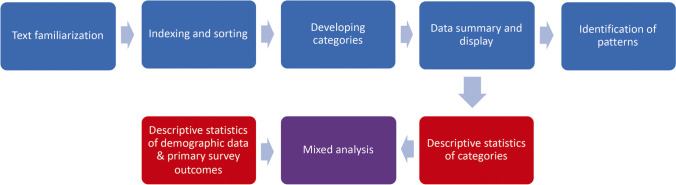
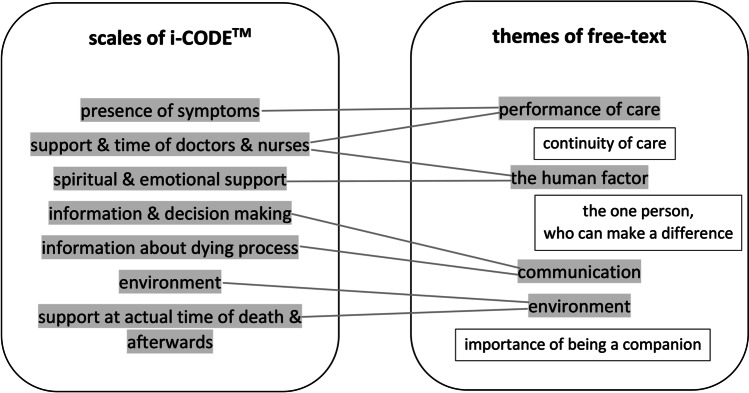
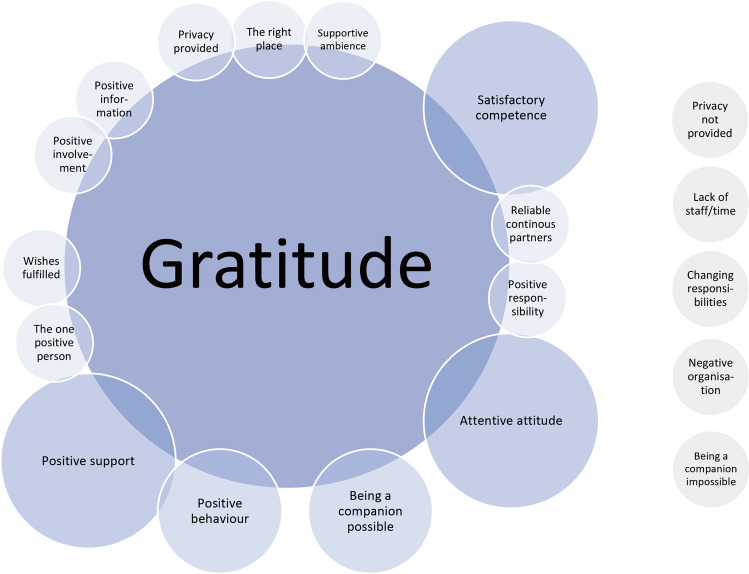
PURPOSE: We conducted an international survey of bereaved relatives of cancer patients dying in hospitals in seven countries, with the aim to assess and improve the quality of care. The survey used the i-CODE (International Care of the Dying Evaluation) questionnaire. Here, we report findings from the free-text comments submitted with the questionnaires. We explored for topic areas which would potentially be important for improving the quality of care. Further, we examined who reported free-texts and in what way, to reduce bias without ignoring the function the free-texts may have for those contributing. METHODS: We used a combined qualitative-quantitative approach: logistic regression analysis to study the effect of respondents' socio-demographic characteristics on the probability of free-texts contributions and thematic analysis to understand the free-text meaning. The primary survey outcomes, (1) how frequently the dying person was treated with dignity and respect and (2) support for the relative, were related to free-text content. RESULTS: In total, 914 questionnaires were submitted; 457/914 (50%) contained free-text comments. We found no socio-demographic differences between the respondents providing free-texts and those who did not. We discovered different types of free-texts ("feedback," "narrative," "self-revelation") containing themes of which "continuity of care," "the one person who can make a difference," and "the importance of being a companion to the dying" represent care dimensions supplementing the questionnaire items. A free-text type of grateful feedback was associated with well perceived support for the relative. CONCLUSION: Bereaved relatives used the free-texts to report details related to i-CODE items and to dimensions otherwise not represented. They highlighted the importance of the perceived support from human interaction between staff and the dying patient and themselves; and that more than professional competence alone, personal, meaningful interactions have profound importance.
Overview
The claims and statistics of this paper haven’t been checked yet.
Free: it reads the open-access text and checks the first 5 claims that cite a source we can check. Create a free account to check every claim.
Integrity signals
Registry
Cites
Statistics
Figures
Verification
Claims the paper makes
The claims and statistics of this paper haven’t been checked yet.
Free: it reads the open-access text and checks the first 5 claims that cite a source we can check. Create a free account to check every claim.
Claims other papers make about this one
Each is checked against this paper’s own text: does it say what the citing paper says it does?
The source backs part of the claim, not all of it — or backs it for a different population, condition or comparison.
In the citing paper
“the organic combination of proximal and intimate relationship defenses have somewhat similar effects to that of palliative care for patients with advanced cancer (Snaman et al., 2020; Gerlach et al., 2022).”
From Differences in proximal and intimacy-related defense mechanisms among patients with cancer in different psychological stages of dying (2024) · cites this paper as Gerlach et al., 2022
Experimental — accuracy not yet measured
Self-check
Percentages, sums and reported differences re-computed from the paper’s own numbers.
The self-check needs the paper’s full text.
Citations
Cites
Gale, N. K., Heath, G., Cameron, E., Rashid, S., & Redwood, S. (2013) · BMC Medical Research Methodology · doi:10.1186/1471-2288-13-117 · Cited by 10,865
The grateful disposition: A conceptual and empirical topography.
McCullough, M. E., Emmons, R. A., & Tsang, J.-A. (2002) · Journal of Personality and Social Psychology · doi:10.1037//0022-3514.82.1.112 · Cited by 3,664 · cited 1×
“Gratitude may support resilience, providing a way of coping with stressful life events [31] such as those experienced by bereaved relatives.”
BackgroundThe Causes and Consequences of a Need for Self-Esteem: A Terror Management Theory
Greenberg, J., Pyszczynski, T., & Solomon, S. (1986) · Public Self and Private Self · doi:10.1007/978-1-4613-9564-5_10 · Cited by 3,032
McCullough, M. E., Kilpatrick, S. D., Emmons, R. A., & Larson, D. B. (2001) · Psychological Bulletin · doi:10.1037/0033-2909.127.2.249 · Cited by 1,698 · cited 1×
“Moreover, the “moral reinforce function” of gratitude [32] is a replicable phenomenon [15, 29], encouraging healthcare professionals to continue with their positive behavior in the future.”
BackgroundHuman emotion and memory: Interactions of the amygdala and hippocampal complex
Phelps, E. A. (2004) · Current Opinion in Neurobiology · doi:10.1016/j.conb.2004.03.015 · Cited by 1,577
Best Practices for Mixed Methods Research in Health Sciences: (566732013-001)
Creswell, J. W., Klassen, A. C., Clark, V. L. P., & Smith, K. C. (2011) · PsycEXTRA Dataset · doi:10.1037/e566732013-001 · Cited by 1,574
Coefficient Kappa: Some Uses, Misuses, and Alternatives
Brennan, R. L., & Prediger, D. J. (1981) · Educational and Psychological Measurement · doi:10.1177/001316448104100307 · Cited by 1,570
The Sense of an Ending: Studies in the Theory of Fiction
Kermode, F. (1967) · Medical Entomology and Zoology · Cited by 1,430
Confidence, Not Consistency, Characterizes Flashbulb Memories
Talarico, J. M., & Rubin, D. C. (2003) · Psychological Science · doi:10.1111/1467-9280.02453 · Cited by 638
The impact of emotion on perception, attention, memory, and decision-making
Brosch, T., Scherer, K., Grandjean, D., & Sander, D. (2013) · Swiss Medical Weekly · doi:10.4414/smw.2013.13786 · Cited by 370
Research works printed but not linked: 3
- Ormston R, Spencer, L.; Barnard M.; Snape, D. (2014) 1. Foundations of qualitative research. In: Ritchie JL, J.; McNaughton Nicholls, C.; Ormston, R. (ed) Qualitative research Practice. SAGE, Thousand Oaks, California, 1–25.
- Spencer LR J, O'Connor W, Morrell G, Ormston R (2014) 11. Analysis in practice. In: Ritchie JL, J.; McNaughton Nicholls, C.; Ormston, R. (ed) Qualitative research practice. SAGE, Thousand Oaks, California, 297–345.
- Spencer LRJ, Ormston R, O'Connor W, Barnard M (2014) 10. analysis: principles and processes. In: Ritchie JL, J.; McNaughton Nicholls, C.; Ormston, R. (ed) Qualitative research practice. SAGE, Thousand Oaks, California, pp. 269–293.
Cited by
Death rattle: current experiences and non-pharmacological management—a narrative review
Moons, L., Roo, M. L. D., Deschodt, M., & Oldenburger, E. (2023) · Annals of Palliative Medicine · doi:10.21037/apm-23-507 · Cited by 7
Where Science Meets Stories: A Systematic Review on Narrative Medicine
Massari, M. G., Trani, M. D., Palmieri, A., Reho, M., & Gennaro, A. (2025) · Qualitative Health Research · doi:10.1177/10497323251387023 · Cited by 9
Luo, J., West, N., Pang, S., Robillard, J. M., Page, P. M., Chadha, N. K., Gan, H., Correll, L. R., Ridgway, R., Broemling, N., et al. (2024) · JMIR Perioperative Medicine · doi:10.2196/65198 · Cited by 6
Zhou, J., Li, M., Dong, J., Shi, H., & Shi, M. (2024) · Frontiers in Psychology · doi:10.3389/fpsyg.2024.1329043 · Cited by 2
Wei, W., Wang, P., Qing, P., Li, Z., & He, Q. (2024) · Frontiers in Oncology · doi:10.3389/fonc.2024.1322196 · Cited by 2
Metadata
- Authors
- Gerlach, C., Baus, M., Gianicolo, E., Bayer, O., Haugen, D. F., Weber, M., Mayland, C. R., ERANet-LAC CODE Core scientific group, Sigurdardottir, K., Hansen, M. I. T., Hufthammer, K. O., Leppert, W., Wolszczak, K., Yanneo, E. G., Tripodoro, V., Goldraij, G., Gerlach, C., Zambon, L., Passarini, J. N., Saad, I. B., Ellershaw, J., & Ting, G.
- Affiliations
- Johannes Gutenberg University Mainz (DE)
- Haukeland University Hospital (NO)
- University of Liverpool (GB)
- University Hospital Heidelberg (DE)
- ORCID
- Venue
- Supportive Care in Cancer
- Published
- 2022-12-23
- Volume
- 31
- Issue
- 1
- Pages
- 81-81
- ISSN
- 0941-4355 (ISSN-L)
- 1433-7339
- PMC
- PMC9788999
- OpenAlex
- W4312161597
- Cited by
- 6
- References
- 38
- Citations by year
- 2025: 2 · 2024: 3 · 2023: 1
- FWCI
- 1.32
- Type
- journal article
- Language
- en
- Open access
- hybrid
- doi.org
- Licence
- cc-by
- creativecommons.org/licenses/by/4.0 (tdm)
- creativecommons.org/licenses/by/4.0 (vor)
- Locations
- Supportive Care in Cancer (publishedVersion, cc-by)
- PubMed Central (publishedVersion, cc-by)
- PubMed (publishedVersion)
- Gutenberg Open Science (publishedVersion, cc-by)
- White Rose Research Online (University of Leeds, The University of Sheffield, University of York) (acceptedVersion, other-oa)
- NORA - Norwegian Open Research Archives (submittedVersion, cc-by)
- Gutenberg Open Science (cc-by)
- Funders
- Mainzer Wissenschaftsstiftung (10-03-2019)
- ERANet-LAC CODE (ELAC2015/T07–0545)
- Federal Ministry of Education and Research, Germany (funding reference 01DN17018)
- Research Council of Norway (271051)
- Yorkshire Cancer Center, United Kingdom
- Universitätsmedizin der Johannes Gutenberg-Universität Mainz
- Topics
- Health Sciences › Medicine › Public Health, Environmental and Occupational Health › Palliative Care and End-of-Life Issues
- Health Sciences › Medicine › Public Health, Environmental and Occupational Health › Palliative and Oncologic Care
- Social Sciences › Psychology › Clinical Psychology › Grief, Bereavement, and Mental Health
- Keywords
- bereaved families, quality of end-of-life care, dignity and respect, support for relatives, continuity of care, staff-patient interaction, free-text comments
- MeSH terms
- Bereavement, Family, Hospitals, Humans, Neoplasms, Palliative Care, Surveys and Questionnaires, Terminal Care, Text Messaging
About these checks
Registry, retraction, Cites and statistics results are computed, not judged, with one exception: a printed reference that no index lists is read once by a model before it counts as a citation error. Claims are extracted by a model and kept only when their quote appears verbatim in the text; each cited source is then checked, with a model’s help, for whether it says what the claim relies on. Those verdicts can be wrong — read the claim’s quote and the cited source before relying on one.
Statistics and arithmetic are recomputed, not judged.
Confidence bands are shown only for fields calibrated on our annotated test set. None is calibrated yet, so no band is shown.
What counts as a claim ›How we measure confidence ›How we check this ›
Are you an author, or do you see a problem with this page? Request a review
How to cite
Cite CoChat for the checks on this page, and the paper for its own findings.
- This page
- CoChat. (2026). Citation check: What do bereaved relatives of cancer patients dying in hospital want to tell us? Analysis of free-text comments from the International Care of the Dying Evaluation (i-CODE) survey: a mixed methods approach. https://app.cochat.ai/papers/10.1007/s00520-022-07490-9
- The paper
- Gerlach, C., Baus, M., Gianicolo, E., Bayer, O., Haugen, D. F., Weber, M., Mayland, C. R., ERANet-LAC CODE Core scientific group, Sigurdardottir, K., Hansen, M. I. T., Hufthammer, K. O., Leppert, W., Wolszczak, K., Yanneo, E. G., Tripodoro, V., Goldraij, G., Gerlach, C., Zambon, L., Passarini, J. N., . . . Ting, G. (2023). What do bereaved relatives of cancer patients dying in hospital want to tell us? Analysis of free-text comments from the International Care of the Dying Evaluation (i-CODE) survey: a mixed methods approach. Supportive Care in Cancer. https://doi.org/10.1007/s00520-022-07490-9
Data sources
Bibliographic data: Semantic Scholar, OpenAlex, Crossref.
Contains information from the Semantic Scholar Academic Graph Datasets, made available under the ODC Attribution License (ODC-BY 1.0).
Semantic Scholar’s data is described in: Kinney, R., et al. (2023). The Semantic Scholar Open Data Platform. arXiv:2301.10140.
