

Calculation of corrected body height in idiopathic scoliosis: comparison of four methods
Open accessThe DOI matches its Crossref record; 26 of the 26 references it cites were found in a registry or an index.
Abstract
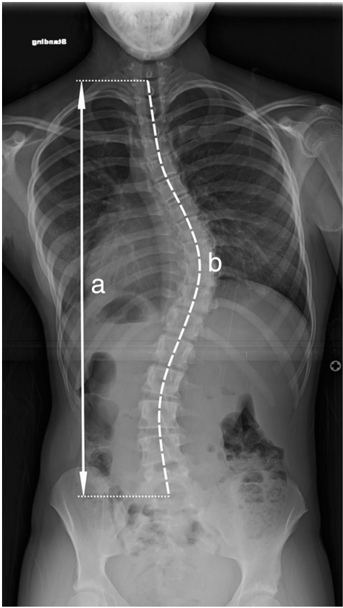
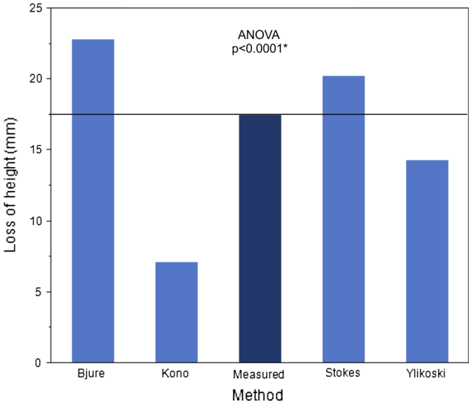
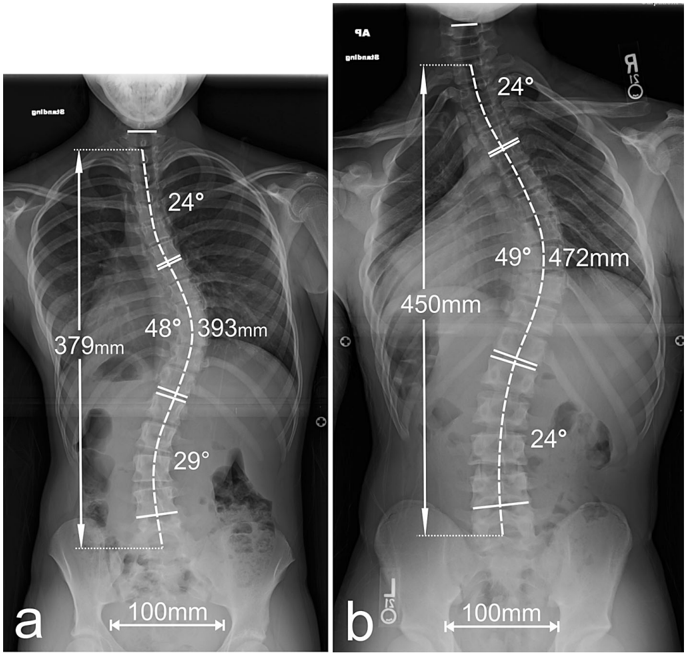
PURPOSE: The aim of the study was to analyze four radiographic methods of calculating the loss of body height associated with scoliosis. METHODS: Thirty patients with right thoracic idiopathic scoliosis were examined with standing postero-anterior radiographs. Cobb angles of the upper thoracic, main thoracic and lumbar curves were measured. The loss of body height due to scoliosis was measured directly on the radiographs and then calculated using the methods of Bjure, Kono, Stokes and Ylikoski, respectively. The reproducibility of calculations was tested. Detailed analysis of two patients with similar Cobb angle but different trunk height was performed. RESULTS: The mean Cobb angle of the main thoracic curve was 46° (21°-74°). The mean loss of body height was 23 mm (11-43 mm) calculated by method of Bjure, 7 mm (-24 to 46 mm) by Kono, 20 mm (5-47 mm) by Stokes, 14 mm (3-36 mm) by Ylikoski, versus 18 mm (3-50 mm) measured directly on radiographs. The overall difference between the loss of body heights was significant (p < 0.0001), with significant differences in pairs for: Bjure versus Kono (p < 0.0001), Stokes versus Kono (p = 0.0002), Kono versus measured (p = 0.0061) and Bjure versus Ylikoski (p = 0.0386). Strong linear correlation between the methods was found (r ≥ 0.92; p < 0.0001). High reproducibility of height loss calculations was noticed. The two patients with similar Cobb angle and different trunk height revealed similar height loss calculated, while different loss measured on radiographs. CONCLUSIONS: There existed no overall agreement between the four methods of calculation of the loss of body height associated with scoliosis. Calculations based on the Cobb angle produced inaccuracy and could be supplemented with data considering trunk size.
Overview
The claims and statistics of this paper haven’t been checked yet.
Free: it reads the open-access text and checks the first 5 claims that cite a source we can check. Create a free account to check every claim.
Integrity signals
Registry
Cites
Statistics
Figures
Verification
Claims the paper makes
The claims and statistics of this paper haven’t been checked yet.
Free: it reads the open-access text and checks the first 5 claims that cite a source we can check. Create a free account to check every claim.
Self-check
Percentages, sums and reported differences re-computed from the paper’s own numbers.
The self-check needs the paper’s full text.
Citations
Cites
Miller, M. R., Hankinson, J., Brusasco, V., Burgos, F., Casaburi, R., Coates, A., Crapo, R., Enright, P., van der Grinten, C. P. M., Gustafsson, P., et al. (2005) · European Respiratory Journal · doi:10.1183/09031936.05.00034805 · Cited by 15,627
National High Blood Pressure Education Program Working Group on High Blood Pressure in Children and Adolescents (2004) · PEDIATRICS · doi:10.1542/peds.114.2.s2.555 · Cited by 6,938
Statistics corner: A guide to appropriate use of correlation coefficient in medical research.
(2012) · Europe PMC (PubMed Central) · Cited by 4,239
Tanner, J. M., & Whitehouse, R. H. (1976) · Archives of Disease in Childhood · doi:10.1136/adc.51.3.170 · Cited by 3,137 · cited 1×
“When treating the patient with scoliosis the difference in total body height of 16 mm between 2 follow-ups may be clinically important for calculating peak growth velocity and timing of surgical intervention [24, 25].”
BackgroundIntroduction to health measurement scales
Keszei, A. P., Novak, M., & Streiner, D. L. (2010) · Journal of Psychosomatic Research · doi:10.1016/j.jpsychores.2010.01.006 · Cited by 490 · cited 1×
“7 reflected acceptable reproducibility for a research tool [16].”
Circadian Variation in Stature and the Effects of Spinal Loading
TYRRELL, A. R., REILLY, T., & TROUP, J. D. G. (1985) · Spine · doi:10.1097/00007632-198503000-00011 · Cited by 257 · cited 1×
“However, the diurnal and circadian variations in human body height may vary from 5 up to 19 mm, making the 16 mm difference (the highest revealed in our analysis) irrelevant [18–23].”
BackgroundCheung, C. S. K., Lee, W. T. K., Tse, Y. K., Tang, S. P., Lee, K., Guo, X., Qin, L., & Cheng, J. C. Y. (2003) · Spine · doi:10.1097/01.brs.0000084265.15201.d5 · Cited by 147 · cited 2×
“In spite of this hypothesized limitation the methods are being used to calculate BMI or VC of patients with scoliosis [2, 5, 13, 14].”
MethodQiu, Y., Sun, X., Qiu, X., Li, W., Zhu, Z., Zhu, F., Wang, B., Yu, Y., & Qian, B. (2007) · Spine · doi:10.1097/brs.0b013e31815a59e5 · Cited by 97 · cited 1×
“Corrected body height is needed to establish various clinical parameters such as normal values of blood pressure in children, lungs vital capacity (VC), growth charts, and body mass index (BMI) [1–6].”
BackgroundPrediction of the Crankshaft Phenomenon by Peak Height Velocity
Sanders, J. O., Little, D. G., & Richards, B. S. (1997) · Spine · doi:10.1097/00007632-199706150-00013 · Cited by 95
Correction of Body Height in Predicting Spirometric Values in Scoliotic Patients
BJURE, J., Grimby, G., & NACHEMSON, A. K. (1968) · Scandinavian Journal of Clinical and Laboratory Investigation · doi:10.3109/00365516809084283 · Cited by 90 · cited 5×
“1) [7–11].”
BackgroundMethodInfluential
Cited by
Tarrant, R. C., Queally, J. M., Moore, D. P., & Kiely, P. J. (2018) · European Journal of Clinical Nutrition · doi:10.1038/s41430-018-0095-0 · Cited by 51
Cheung, P. W. H., Canavese, F., Chan, C. Y. W., Wong, J. S. H., Shigematsu, H., Luk, K. D. K., & Cheung, J. P. Y. (2022) · Journal of Bone and Joint Surgery · doi:10.2106/jbjs.21.00747 · Cited by 26
Chen, H., Schlösser, T. P. C., Brink, R. C., Colo, D., van Stralen, M., Shi, L., Chu, C. W., Heng, P., Castelein, R. M., & Cheng, J. C. Y. (2017) · Scientific Reports · doi:10.1038/srep46448 · Cited by 23
Nutrition and physical activity level of adolescents with idiopathic scoliosis: a narrative review
Normand, É., Franco, A., & Marcil, V. (2019) · The Spine Journal · doi:10.1016/j.spinee.2019.11.012 · Cited by 24
Gardner, A. C., Price, A., Berryman, F., & Pynsent, P. B. (2016) · Scoliosis and Spinal Disorders · doi:10.1186/s13013-016-0068-9 · Cited by 13
“Four of these formulae for calculating loss of height were compared against a measured loss of spine height on an individual basis by Tyrakowski et al. [28].”
Method
Metadata
- Authors
- Tyrakowski, M., Kotwicki, T., Czubak, J., & Siemionow, K.
- Affiliations
- Poznan University of Medical Sciences (PL)
- University of Illinois Chicago (US)
- Corresponding author
- Tyrakowski, Marcin
- Venue
- European Spine Journal
- Published
- 2014-04-01
- Volume
- 23
- Issue
- 6
- Pages
- 1244-1250
- ISSN
- 0940-6719 (ISSN-L)
- 1432-0932
- OpenAlex
- W2089703220
- Cited by
- 24
- References
- 25
- Citations by year
- 2026: 1 · 2025: 2 · 2022: 3 · 2021: 2 · 2020: 1 · 2019: 2 · 2018: 3 · 2017: 2 · 2016: 5 · 2015: 1 · 2014: 2
- FWCI
- 3.30
- Type
- journal article
- Language
- en
- Open access
- hybrid
- doi.org
- Locations
- European Spine Journal (publishedVersion, cc-by)
- PubMed (publishedVersion)
- Topics
- Health Sciences › Medicine › Surgery › Scoliosis diagnosis and treatment
- Health Sciences › Medicine › Surgery › Pectus Deformity Diagnosis and Treatment
- Physical Sciences › Engineering › Biomedical Engineering › Medical Imaging and Analysis
- Keywords
- idiopathic scoliosis, thoracic scoliosis, trunk height, Cobb angle, Stokes method, measurement agreement
- MeSH terms
- Adolescent, Anthropometry, Body Height, Child, Humans, Lumbar Vertebrae, Male, Radiography, Scoliosis, Thoracic Vertebrae, Reproducibility of Results, Models, Statistical
About these checks
Registry, retraction, Cites and statistics results are computed, not judged, with one exception: a printed reference that no index lists is read once by a model before it counts as a citation error. Claims are extracted by a model and kept only when their quote appears verbatim in the text; each cited source is then checked, with a model’s help, for whether it says what the claim relies on. Those verdicts can be wrong — read the claim’s quote and the cited source before relying on one.
Statistics and arithmetic are recomputed, not judged.
Confidence bands are shown only for fields calibrated on our annotated test set. None is calibrated yet, so no band is shown.
What counts as a claim ›How we measure confidence ›How we check this ›
Are you an author, or do you see a problem with this page? Request a review
How to cite
Cite CoChat for the checks on this page, and the paper for its own findings.
- This page
- CoChat. (2026). Citation check: Calculation of corrected body height in idiopathic scoliosis: comparison of four methods. https://app.cochat.ai/papers/10.1007/s00586-014-3275-1
- The paper
- Tyrakowski, M., Kotwicki, T., Czubak, J., & Siemionow, K. (2014). Calculation of corrected body height in idiopathic scoliosis: comparison of four methods. European Spine Journal. https://doi.org/10.1007/s00586-014-3275-1
Data sources
Bibliographic data: Semantic Scholar, OpenAlex, Crossref.
Contains information from the Semantic Scholar Academic Graph Datasets, made available under the ODC Attribution License (ODC-BY 1.0).
Semantic Scholar’s data is described in: Kinney, R., et al. (2023). The Semantic Scholar Open Data Platform. arXiv:2301.10140.
