

Effects of alcohol mixed with energy drink and alcohol alone on subjective intoxication
Open accessThe DOI matches its Crossref record; 18 of the 18 references it cites were found in a registry or an index.
Abstract
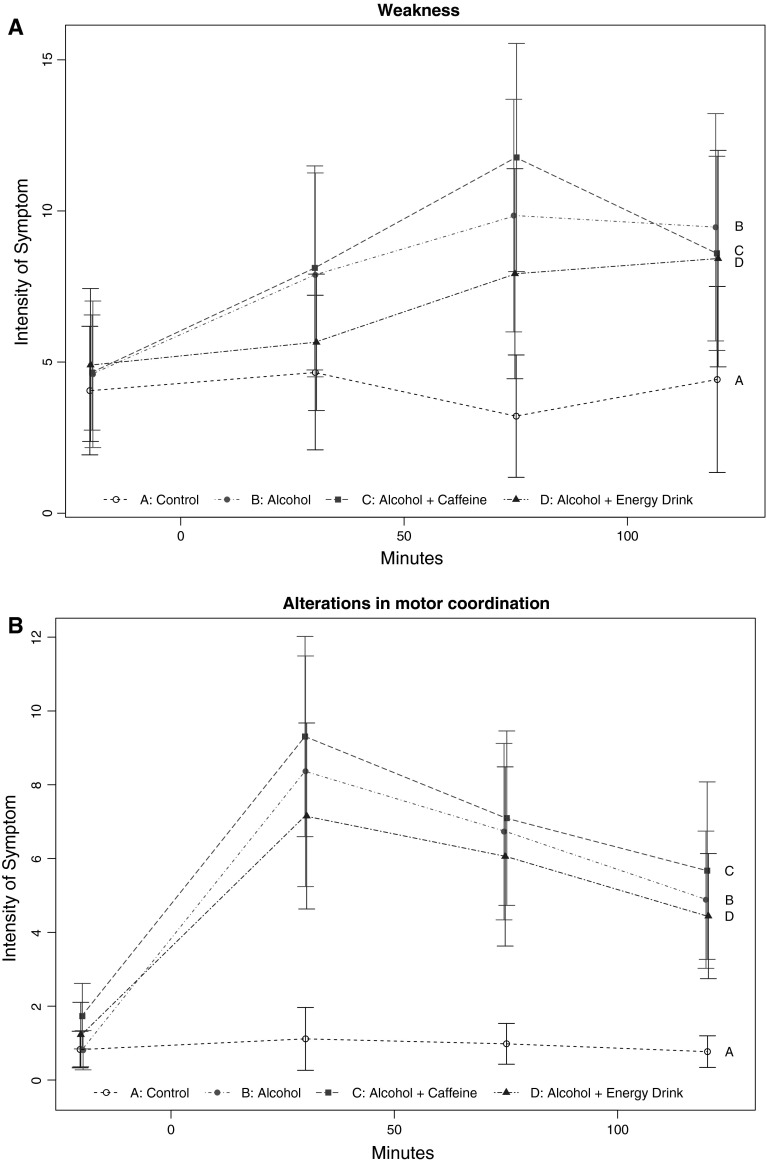
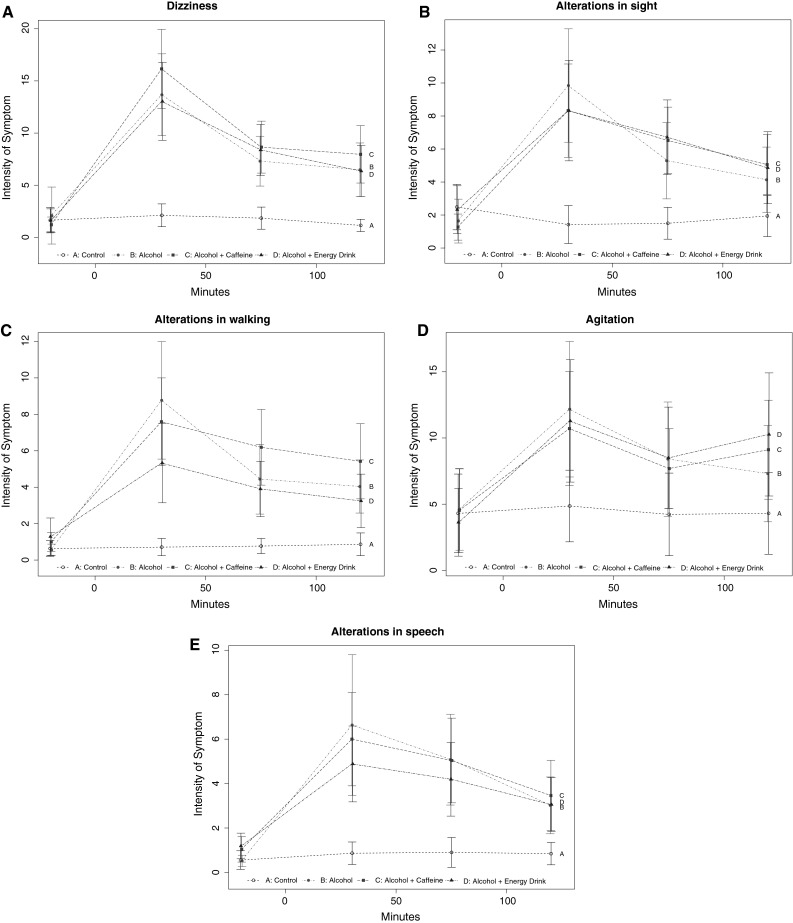
Recent studies suggest that the combination of caffeine-containing drinks together with alcohol might reduce the subjective feelings of alcohol intoxication-the so-called "masking effect". In this study, we aimed to review the effects of alcohol in combination with caffeine or energy drink with special focus on the "masking effect". Fifty-two healthy male volunteers were analysed concerning breath alcohol concentration and subjective sensations of intoxication using a 18 item Visual Analogue Scale in a randomised, double-blinded, controlled, four treatments cross-over trial after consumption of (A) placebo, (B) alcohol (vodka 37.5% at a dose of 46.5 g ethanol), (C) alcohol in combination with caffeine at a dose of 80 mg (equivalent to one 250 ml can of energy drink) and (D) alcohol in combination with energy drink at a dose of 250 ml (one can). Primary variables were headache, weakness, salivation and motor coordination. Out of four primary variables, weakness and motor coordination showed a statistically significant difference between alcohol and non-alcohol group, out of 14 secondary variables, five more variables (dizziness, alterations in sight, alterations in walking, agitation and alterations in speech) also showed significant differences due mainly to contrasts with the non-alcohol group. In none of these end points, could a statistically significant effect be found for the additional ingestion of energy drink or caffeine on the subjective feelings of alcohol intoxication. This within-subjects study does not confirm the presence of a "masking effect" when combining caffeine or energy drink with alcohol.
Overview
The claims and statistics of this paper haven’t been checked yet.
Free: it reads the open-access text and checks the first 5 claims that cite a source we can check. Create a free account to check every claim.
Integrity signals
Registry
Cites
Statistics
Figures
Verification
Claims the paper makes
The claims and statistics of this paper haven’t been checked yet.
Free: it reads the open-access text and checks the first 5 claims that cite a source we can check. Create a free account to check every claim.
Self-check
Percentages, sums and reported differences re-computed from the paper’s own numbers.
The self-check needs the paper’s full text.
Citations
Cites
A short questionnaire for the measurement of habitual physical activity in epidemiological studies
Baecke, J., Burema, J., & Frijters, J. (1982) · The American Journal of Clinical Nutrition · doi:10.1093/ajcn/36.5.936 · Cited by 3,945
Hjermstad, M. J., Fayers, P. M., Haugen, D. F., Caraceni, A., Hanks, G. W., Loge, J. H., Fainsinger, R., Aass, N., & Kaasa, S. (2011) · Journal of Pain and Symptom Management · doi:10.1016/j.jpainsymman.2010.08.016 · Cited by 2,697 · cited 3×
“In a recent review of the literature (Hjermstad et al. 2011), VAS scales were compared 50 0 100 Dizziness”
MethodInfluentialCollins, R. L., Parks, G. A., & Marlatt, G. A. (1985) · Journal of Consulting and Clinical Psychology · doi:10.1037//0022-006x.53.2.189 · Cited by 1,980 · cited 2×
“Further inclusion criteria were: Moderate alcohol consumption (less than 190.4 g/week) according to the Daily Drink questionnaire (Collins et al. 1985), sporadic users of energy drinks (less than ten cans of 250 ml in the last 6 months), and confirmation from the participant’s general practitioner…”
MethodInfluentialAitken, R. C. B. (1969) · Proceedings of the Royal Society of Medicine · doi:10.1177/003591576906201005 · Cited by 1,539 · cited 3×
“Starting with the measurement of feelings and moods (Bond and Lader 1972; Aitken 1969; Folstein and Luria 1973), VAS were also used for rating physiological signs of emotions and Table 2 p values of the coefficients of the secondary variables in the mixed model Symptom Treatment Baseline value…”
MethodCaffeinated energy drinks a growing problem
Reissig, C. J., Strain, E. C., & Griffiths, R. R. (2009) · Drug and Alcohol Dependence · doi:10.1016/j.drugalcdep.2008.08.001 · Cited by 1,026 · cited 1×
“One of the most popular energy drinks is Red Bull , which has been available in Austria since 1987 and in the United States since 1997 (Reissig et al. 2009).”
BackgroundReliability, validity, and clinical application of the visual analogue mood scale
Folstein, M. F., & Luria, R. (1973) · Psychological Medicine · doi:10.1017/s0033291700054283 · Cited by 514 · cited 2×
“Starting with the measurement of feelings and moods (Bond and Lader 1972; Aitken 1969; Folstein and Luria 1973), VAS were also used for rating physiological signs of emotions and Table 2 p values of the coefficients of the secondary variables in the mixed model Symptom Treatment Baseline value…”
MethodEffects of Energy Drink Ingestion on Alcohol Intoxication
Ferreira, S. E., De Mello, M. T., Pompéia, S., & De Souza‐Formigoni, M. L. O. (2006) · Alcoholism: Clinical and Experimental Research · doi:10.1111/j.1530-0277.2006.00070.x · Cited by 289 · cited 12×
“Some studies report a significant antagonising effect of caffeine on alcohol such as influencing weakness and impairment of motor coordination (Ferreira et al. 2006), or they suggest that the combination of caffeine and alcohol may lead to longer drinking and to an increase in stimulation compared to alcohol-only cons…”
BackgroundMethodResultInfluentialMartinez, T. Y., Pereira, C. A. C., dos Santos, M. L., Ciconelli, R. M., Guimarães, S. M., & Martínez, J. A. B. (2000) · CHEST Journal · doi:10.1378/chest.117.6.1627 · Cited by 157 · cited 2×
“Participants were similar regarding social and demographic data, patterns of use of alcoholic beverages and energy drinks as well as quality of life (Martinez et al. 2000) and having a similar level of physical activity (Baecke et al. 1982).”
BackgroundMarczinski, C. A., Fillmore, M. T., Bardgett, M. E., & Howard, M. A. (2011) · Alcoholism: Clinical and Experimental Research · doi:10.1111/j.1530-0277.2011.01464.x · Cited by 149 · cited 1×
“Several studies have already investigated whether caffeine counteracts the neuro-cognitive effects of alcohol consumption, with inconsistent results (Ferreira et al. 2006; Alford et al. 2012; Azcona et al. 1995; Marczinski et al. 2011).”
ResultBond, A. J., & LADER, M. H. (1972) · Psychopharmacology · doi:10.1007/bf00423189 · Cited by 126
Cited by
The Safety of Ingested Caffeine: A Comprehensive Review
Temple, J. L., Bernard, C., Lipshultz, S. E., Czachor, J. D., Westphal, J. A., & Mestre, M. A. (2017) · Frontiers in Psychiatry · doi:10.3389/fpsyt.2017.00080 · Cited by 557
Polysubstance use: diagnostic challenges, patterns of use and health
Connor, J. P., Gullo, M. J., White, A., & Kelly, A. B. (2014) · Current Opinion in Psychiatry · doi:10.1097/yco.0000000000000069 · Cited by 461
Yuan, X.-S., Wang, L., Dong, H., Qu, W., Yang, S.-R., Chérasse, Y., Lazarus, M., Schiffmann, S. N., d’Exaerde, A. D. K., Li, R., et al. (2017) · eLife · doi:10.7554/elife.29055 · Cited by 120
“Both A1Rs and A2ARs have been reported to regulate sleep (Basheer et al., 2004; Thakkar et al., 2003; Urade et al., 2003).”
BackgroundA comprehensive review of the effects of mixing caffeinated energy drinks with alcohol
McKetin, R., Coen, A., & Kaye, S. (2015) · Drug and Alcohol Dependence · doi:10.1016/j.drugalcdep.2015.01.047 · Cited by 98
“…GmbH (Alford et al., 2012; de Haan et al., 2012; Penning et al., 2011; Rohsenow et al., 2014; Ulbrich et al., 2013) and/or who had received funding from Red Bull GmbH for other research (Alford et al., 2012; Amlung et al., 2013; Penning et al., 2011; Rohsenow et al., 2014; Ulbrich et al., 2013).”
BackgroundMethodResultInfluentialAlcohol mixed with energy drink (AMED): A critical review and meta‐analysis
Verster, J. C., Benson, S., Johnson, S. J., Alford, C., Godefroy, S. B., & Scholey, A. B. (2018) · Human Psychopharmacology Clinical and Experimental · doi:10.1002/hup.2650 · Cited by 71
“Of note, Ferreira's findings were not confirmed in a recent replication study with twice the number of subjects (Ulbrich et al., 2013).”
Background
Metadata
- Authors
- Ulbrich, A., Hemberger, S. H., Loidl, A., Dufek, S., Pablik, E., Fodor, S., Herle, M., & Aufricht, C.
- Affiliations
- Medical University of Vienna (AT)
- University of Vienna (AT)
- Corresponding author
- Aufricht, Christoph
- Venue
- Amino Acids
- Published
- 2013-11-01
- Volume
- 45
- Issue
- 6
- Pages
- 1385-1393
- ISSN
- 0939-4451 (ISSN-L)
- 1438-2199
- PMC
- PMC3837191
- OpenAlex
- W2114249469
- Cited by
- 23
- References
- 18
- Citations by year
- 2026: 1 · 2021: 2 · 2019: 3 · 2018: 1 · 2017: 6 · 2016: 1 · 2015: 5 · 2014: 4
- FWCI
- 2.45
- Type
- journal article
- Language
- en
- Open access
- hybrid
- doi.org
- Locations
- Amino Acids (publishedVersion, cc-by)
- Europe PMC (PubMed Central) (publishedVersion, cc-by)
- PubMed Central (publishedVersion, cc-by)
- PubMed (publishedVersion)
- UCL Discovery (University College London) (submittedVersion)
- Topics
- Health Sciences › Medicine › Pharmacology (medical) › Coffee research and impacts
- Health Sciences › Medicine › Epidemiology › Substance Abuse Treatment and Outcomes
- Health Sciences › Medicine › Pathology and Forensic Medicine › Alcohol Consumption and Health Effects
- Keywords
- alcohol, energy drinks, caffeine, masking, subjective intoxication, breath alcohol concentration, motor coordination, dizziness
- MeSH terms
- Adult, Alcoholic Intoxication, Alcohols, Caffeine, Humans, Male, Young Adult, Energy Drinks, Healthy Volunteers
About these checks
Registry, retraction, Cites and statistics results are computed, not judged, with one exception: a printed reference that no index lists is read once by a model before it counts as a citation error. Claims are extracted by a model and kept only when their quote appears verbatim in the text; each cited source is then checked, with a model’s help, for whether it says what the claim relies on. Those verdicts can be wrong — read the claim’s quote and the cited source before relying on one.
Statistics and arithmetic are recomputed, not judged.
Confidence bands are shown only for fields calibrated on our annotated test set. None is calibrated yet, so no band is shown.
What counts as a claim ›How we measure confidence ›How we check this ›
Are you an author, or do you see a problem with this page? Request a review
Data sources
Bibliographic data: Semantic Scholar, OpenAlex, Crossref.
Contains information from the Semantic Scholar Academic Graph Datasets, made available under the ODC Attribution License (ODC-BY 1.0).
Semantic Scholar’s data is described in: Kinney, R., et al. (2023). The Semantic Scholar Open Data Platform. arXiv:2301.10140.
